Gluten-Free Beer Market (2026 - 2035)

ID: MRFR/FnB/5678-CR 105 Pages Pradeep Nandi Last Updated: November 20, 2026
Gluten-Free Beer Market Size, Share, Industry Trend & Analysis Research Report Information By Ingredient Type (Corn, Sorghum, Millet, Others), By Product Type (Ale, Lager, Others), By Packaging Type (Bottles, Cans, Others), By Distribution Channel (On-Trade, Off-Trade (Specialty/Liquor Stores, Supermarkets/Hypermarkets, Online Retail Stores, Others)), By Region (North America, Europe, Asia-Pacific, South America, Middle East & Africa) – Forecast Till 2035
Gluten-Free Beer Market
Market Size
Forecast Period2026-2035
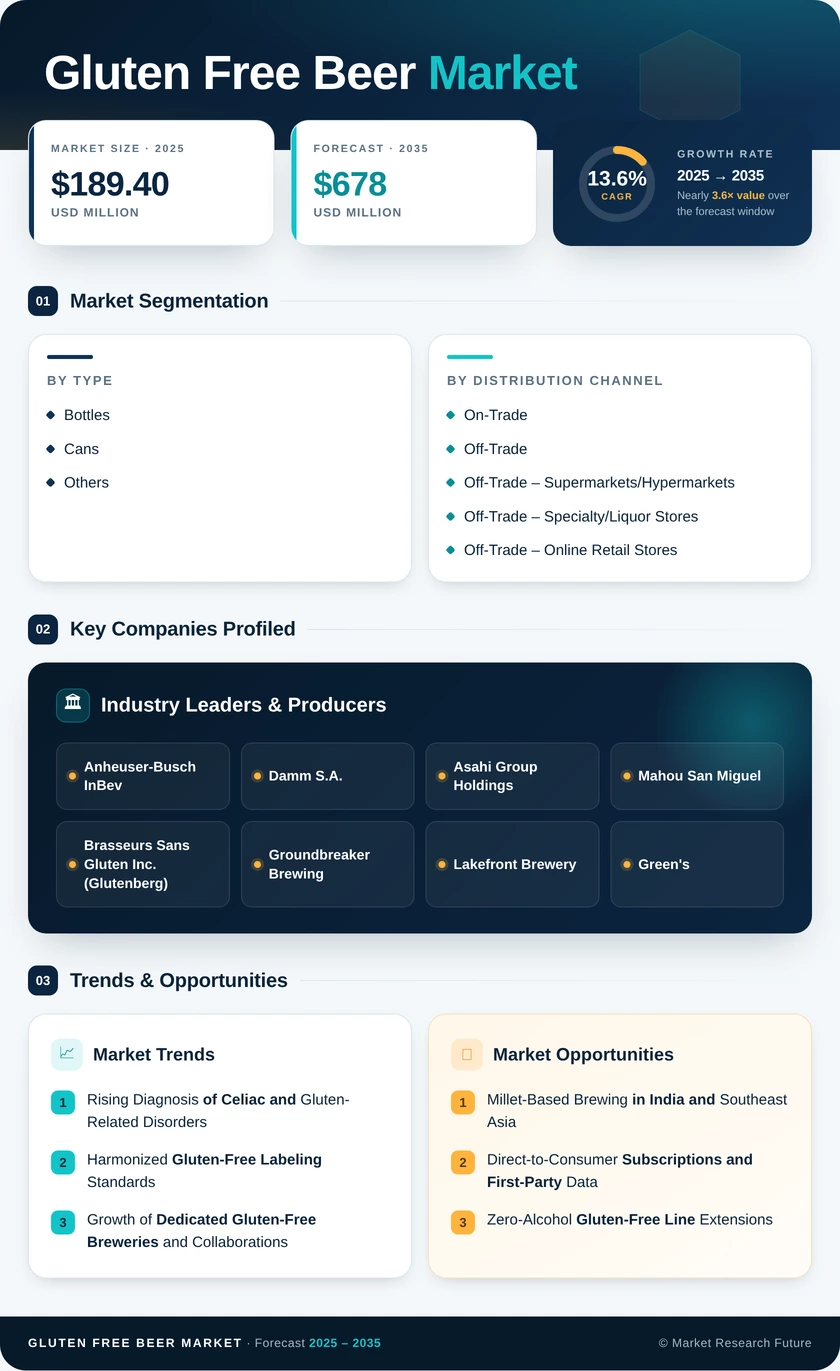
CAGR (2026-2035)13.60%
2025 Market SizeUSD 189.4 Million
2035 Market SizeUSD 678.0 Million
Key Players
Anheuser-Busch InBev
Damm S.A.
Asahi Group Holdings
Mahou San Miguel
Brasseurs Sans Gluten Inc.
Groundbreaker Brewing
Opportunities
  • Millet-Based Brewing in India and Southeast Asia
  • Direct-to-Consumer Subscriptions and First-Party Data
  • Zero-Alcohol Gluten-Free Line Extensions
  1. 1 Market Summary | |
  2. 2 Key Report Takeaways | |
    1. 2.1 By Ingredient Type | |
    2. 2.2 By Product Type | |
    3. 2.3 By Packaging Type | |
    4. 2.4 By Distribution Channel | |
    5. 2.5 By Region | |
  3. 3 Market Size and Forecast (2021–2035) | |
    1. 3.1 Historical Market Size (2021–2025) | |
    2. 3.2 Forecast Market Size (2026–2035) | |
    3. 3.3 Year-over-Year Growth Analysis | |
  4. 4 Driver Impact Analysis | |
    1. 4.1 Rising Diagnosis of Celiac and Gluten-Related Disorders | |
    2. 4.2 Harmonized Gluten-Free Labeling Standards | |
    3. 4.3 Growth of Dedicated Gluten-Free Breweries and Collaborations | |
    4. 4.4 Off-Trade and E-Commerce Distribution Expansion | |
    5. 4.5 Lifestyle-Driven Gluten Avoidance | |
    6. 4.6 Ingredient and Enzyme Technology Gains | |
    7. 4.7 Premiumization in Asia-Pacific | |
  5. 5 Restraints Impact Analysis | |
    1. 5.1 Production Cost Premium Over Barley Brewing | |
    2. 5.2 Sorghum Trade Concentration | |
    3. 5.3 Flavor and Foam Perception Gap | |
    4. 5.4 Confusion Between Gluten-Free and Gluten-Reduced Claims | |
    5. 5.5 Cross-Contact Compliance Burden for Small Producers | |
  6. 6 Opportunities | |
    1. 6.1 Millet-Based Brewing in India and Southeast Asia | |
    2. 6.2 Direct-to-Consumer Subscriptions and First-Party Data | |
    3. 6.3 Zero-Alcohol Gluten-Free Line Extensions | |
    4. 6.4 Certified Contract Brewing and Co-Packing | |
    5. 6.5 Aluminum Cans as a Sustainability and Quality Play | |
  7. 7 Regional Market Share and Country-Level Analysis | |
    1. 7.1 North America | | |
      1. 7.1.1 United States | | |
      2. 7.1.2 Canada | | |
      3. 7.1.3 Mexico | |
    2. 7.2 Europe | | |
      1. 7.2.1 United Kingdom | | |
      2. 7.2.2 Germany | | |
      3. 7.2.3 Italy | | |
      4. 7.2.4 Spain | | |
      5. 7.2.5 France | | |
      6. 7.2.6 Rest of Europe | |
    3. 7.3 Asia-Pacific | | |
      1. 7.3.1 Australia | | |
      2. 7.3.2 China | | |
      3. 7.3.3 Japan | | |
      4. 7.3.4 India | | |
      5. 7.3.5 Rest of Asia-Pacific | |
    4. 7.4 South America | | |
      1. 7.4.1 Brazil | | |
      2. 7.4.2 Argentina | | |
      3. 7.4.3 Rest of South America | |
    5. 7.5 Middle East & Africa | | |
      1. 7.5.1 South Africa | | |
      2. 7.5.2 United Arab Emirates | | |
      3. 7.5.3 Rest of Middle East & Africa | |
  8. 8 Future Outlook (2026–2035) | |
    1. 8.1 Climate-Resilient Grains Move to the Center | |
    2. 8.2 Digital Retail and Personalized Discovery | |
    3. 8.3 Sustainability Reporting and Packaging Choices | |
    4. 8.4 Moderation and Health Policy | |
  9. 9 Segmentation Analysis | |
    1. 9.1 By Ingredient Type | | |
      1. 9.1.1 Corn | | |
      2. 9.1.2 Sorghum | | |
      3. 9.1.3 Millet | | |
      4. 9.1.4 Others | |
    2. 9.2 By Product Type | | |
      1. 9.2.1 Ale | | |
      2. 9.2.2 Lager | | |
      3. 9.2.3 Others | |
    3. 9.3 By Packaging Type | | |
      1. 9.3.1 Bottles | | |
      2. 9.3.2 Cans | | |
      3. 9.3.3 Others | |
    4. 9.4 By Distribution Channel | | |
      1. 9.4.1 On-Trade | | |
      2. 9.4.2 Off-Trade | |
  10. 10 Competitive Landscape | |
    1. 10.1 Market Concentration Analysis | |
    2. 10.2 Competitive Benchmarking Matrix | |
    3. 10.3 Company Profiles | | |
      1. 10.3.1 Anheuser-Busch InBev | | |
      2. 10.3.2 Damm S.A. | | |
      3. 10.3.3 Asahi Group Holdings | | |
      4. 10.3.4 Mahou San Miguel | | |
      5. 10.3.5 Brasseurs Sans Gluten Inc. (Glutenberg) | | |
      6. 10.3.6 Ghostfish Brewing Company | | |
      7. 10.3.7 Holidaily Brewing Company | | |
      8. 10.3.8 Groundbreaker Brewing | | |
      9. 10.3.9 Lakefront Brewery | | |
      10. 10.3.10 Green's | | |
      11. 10.3.11 Bard's Tale Beer Company | | |
      12. 10.3.12 Brouwerij Huyghe (Mongozo) | |
  11. 11 Recent News & Developments | |
  12. 12 Report Scope and Methodology | |
  13. 13 Detailed Sources and Citations | |
  14. 14 Frequently Asked Questions (FAQs) | | LIST OF TABLES | |
  15. TABLE 1 Global Market Size & Forecast, by Revenue (USD Million), 2021–2035 | |
  16. TABLE 2 Year-over-Year Growth Analysis, 2021–2035 | |
  17. TABLE 3 Driver Impact Analysis | |
  18. TABLE 4 Restraints Impact Analysis | |
  19. TABLE 5 Regional Summary, 2025 | |
  20. TABLE 6 North America Market, by Country, 2021–2035 (USD Million) | |
  21. TABLE 7 Europe Market, by Country, 2021–2035 (USD Million) | |
  22. TABLE 8 Asia-Pacific Market, by Country, 2021–2035 (USD Million) | |
  23. TABLE 9 South America Market, by Country, 2021–2035 (USD Million) | |
  24. TABLE 10 Middle East & Africa Market, by Country, 2021–2035 (USD Million) | |
  25. TABLE 11 Market Size, by Ingredient Type, 2021–2035 (USD Million) | |
  26. TABLE 12 Market Size, by Product Type, 2021–2035 (USD Million) | |
  27. TABLE 13 Market Size, by Packaging Type, 2021–2035 (USD Million) | |
  28. TABLE 14 Market Size, by Distribution Channel, 2021–2035 (USD Million) | |
  29. TABLE 15 Competitive Benchmarking Matrix, 2025 | |
  30. TABLE 16 Recent News & Developments, 2023–2025 | |
  31. TABLE 17 Report Scope and Methodology | |
  32. TABLE 18 Detailed Sources and Citations | | LIST OF FIGURES | |
  33. FIGURE 1 Market Dynamics Overview (Drivers, Restraints, Opportunities) | |
  34. FIGURE 2 Industry Value Chain Analysis | |
  35. FIGURE 3 Porter's Five Forces Analysis | |
  36. FIGURE 4 Global Market Size Trend, 2021–2035 (USD Million) | |
  37. FIGURE 5 Market Share, by Ingredient Type, 2025 | |
  38. FIGURE 6 Market Share, by Product Type, 2025 | |
  39. FIGURE 7 Market Share, by Packaging Type, 2025 | |
  40. FIGURE 8 Market Share, by Distribution Channel, 2025 | |
  41. FIGURE 9 Regional Market Share, 2025 | |
  42. FIGURE 10 Regional CAGR Comparison, 2026–2035 | |
  43. FIGURE 11 Competitive Landscape – Estimated Revenue Share Ranges, 2025

Segmentation Quick Reference

DimensionSub-SegmentsDominant SegmentFastest Growing Segment
By Ingredient TypeCorn, Sorghum, Millet, OthersSorghum (31.4% share)Corn (14.6% CAGR)
By Product TypeAle, Lager, OthersLager (62.9% share)Ale (14.9% CAGR)
By Packaging TypeBottles, Cans, OthersBottles (48.1% share)Cans (15.1% CAGR)
By Distribution ChannelOn-Trade, Off-Trade (Specialty/Liquor Stores, Supermarkets/Hypermarkets, Online Retail Stores, Others)On-Trade (52.8% share)Off-Trade (16.2% CAGR)
By RegionNorth America, Europe, Asia-Pacific, South America, Middle East & AfricaNorth America (38.6% share)Asia-Pacific (16.4% CAGR)


Market Segmentation Overview

By Ingredient Type

Sub-SegmentKey Trend
CornCost-efficient base supported by large U.S. harvests
SorghumEstablished brewing grain exposed to concentrated trade demand
MilletHeritage and nutrition-led positioning in Africa and India
OthersPremium buckwheat, quinoa and rice malt recipes


Sorghum leads because brewers trust its fermentation performance and neutral taste, but its exposure to Chinese import demand creates price risk. Corn grows fastest since stable U.S. supply and low per-bushel cost let brewers scale without that procurement volatility. Millet and rice malts serve brands seeking flavor distinction and enzyme-free saccharification.

By Product Type

Sub-SegmentKey Trend
AleHop-forward recipes from dedicated breweries
LagerFamiliar crisp profile for mainstream drinkers
OthersStouts, porters and seasonal specialties


Lager leads because newly diagnosed drinkers want a direct replacement for the beer they gave up. Ale grows fastest as dedicated brewers apply IPA and pale ale techniques that attract enthusiasts, regardless of dietary need. Dark styles in the Others group remain technically demanding without roasted barley.

By Packaging Type

Sub-SegmentKey Trend
BottlesPremium presentation and restaurant service
CansSuperior light and oxygen protection, recyclability
OthersKegs for dedicated draft lines


Bottles hold the lead through restaurant service and premium shelf positioning. Cans grow fastest because gluten-free beers stale quickly, and aluminum's barrier against light and oxygen extends freshness while lowering freight weight. Kegs depend on bars installing dedicated lines to avoid cross-contact.

By Distribution Channel

Sub-SegmentKey Trend
On-TradeMenus adding certified gluten-free options
Off-TradeFree-from bays, specialty curation and online shipping


On-Trade leads as restaurants respond to guest dietary requests with certified bottled and draft options. Off-Trade grows fastest, with Supermarkets/Hypermarkets driving volume through free-from bays and Online Retail Stores reaching dispersed celiac buyers. Specialty/Liquor Stores add range depth that mainstream retail cannot match.


 

Download PDF ×

We do not share your information with anyone. However, we may send you emails based on your report interest from time to time. You may contact us at any time to opt-out.