Request Free Sample ×

Kindly complete the form below to receive a free sample of this Report

* Please use a valid business email

Leading companies partner with us for data-driven Insights

clients tt-cursor
Hero Background
English
Chinese
French
Japanese
Korean
German
Spanish

Pyrogen Testing Market Size

ID: MRFR/LS/5322-HCR
200 Pages
Rahul Gotadki
March 2026

Pyrogen Testing Market Research Report: Size, Share, Trend Analysis By Test Type (LAL Test, Rabbit Pyrogen Test, Monocyte Activation Test, Synthetic Pyrogen Test), By Product Type (Reagents, Kits, Instruments), By End Use (Pharmaceuticals, Biologics, Medical Devices, Research Laboratories), By Methodology (Gel Clot Method, Chromogenic Method, Turbidimetric Method) and By Regional (North America, Europe, South America, Asia Pacific, Middle East and Africa) - Growth Outlook & Industry Forecast 2025 To 2035

Share:
Download PDF ×

We do not share your information with anyone. However, we may send you emails based on your report interest from time to time. You may contact us at any time to opt-out.

Pyrogen Testing Market Infographic
Purchase Options

Pyrogen Testing Size

Pyrogen Testing Market Growth Projections and Opportunities

The Pyrogen Testing marketplace is drastically encouraged by the increase in the pharmaceutical and biotechnology industries. As these sectors become bigger globally, the demand for rigorous testing of pharmaceutical products to ensure certain freedom from pyrogens becomes essential, driving market growth. The globalization of pharmaceutical production ends in accelerated cross-border exchange and collaboration. Pyrogen testing becomes essential in ensuring the protection and best of pharmaceutical products, fostering growth in the marketplace. Ongoing advancements in Pyrogen Testing strategies contribute to marketplace evolution. Innovative and efficient checking out technologies, which include the Limulus Amebocyte Lysate (LAL) test, decorate sensitivity, lessen testing time, and improve accuracy, impacting market dynamics. Endotoxin testing, a subset of Pyrogen Testing, is witnessing accelerated emphasis because of its relevance in excellent pharmaceutical control. The market is pushed via the growing recognition of the effect of endotoxins on affected persons' health and the want for reliable trying-out solutions. The prevalence of pyrogen infection in pharmaceutical merchandise and medical devices maintains an upward push. This drives the demand for effective Pyrogen Testing answers as groups strive to fulfill high-quality standards and avoid regulatory issues. The Pyrogen Testing market is stimulated by focus and schooling initiatives regarding the dangers associated with pyrogen infection. Efforts to train experts within the pharmaceutical and biotechnology industries contribute to improved adoption and marketplace growth. Collaborations and partnerships between Pyrogen Testing solution providers and pharmaceutical companies influence marketplace trends. These collaborations frequently result in the development of superior trying-out solutions tailored to enterprise needs, impacting adoption quotes. The price-effectiveness of Pyrogen Testing answers is a critical factor influencing marketplace dynamics. Affordable and green testing methods appeal to a broader variety of users, including smaller pharmaceutical businesses and research laboratories. Efforts to validate and standardize Pyrogen Testing strategies increase contributions to the marketplace. The established order of standardized protocols enhances the reliability and comparison of check outcomes, promoting the adoption of Pyrogen Testing across the industry. Emerging markets with growing pharmaceutical and biotechnology sectors gift untapped possibilities for the Pyrogen Testing marketplace.
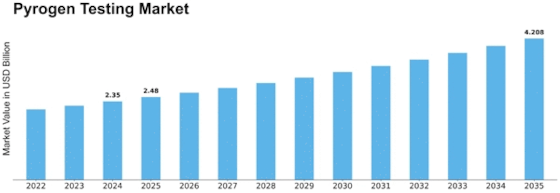
Pyrogen Testing Market Size Graph
Author
Author Profile
Rahul Gotadki
Research Manager

He holds an experience of about 9+ years in Market Research and Business Consulting, working under the spectrum of Life Sciences and Healthcare domains. Rahul conceptualizes and implements a scalable business strategy and provides strategic leadership to the clients. His expertise lies in market estimation, competitive intelligence, pipeline analysis, customer assessment, etc.

Leave a Comment

FAQs

What is the projected market valuation of the Pyrogen Testing Market by 2035?

<p>The Pyrogen Testing Market is projected to reach approximately 4.208 USD Billion by 2035.</p>

What was the market valuation of the Pyrogen Testing Market in 2024?

<p>In 2024, the overall market valuation of the Pyrogen Testing Market was 2.35 USD Billion.</p>

What is the expected CAGR for the Pyrogen Testing Market during the forecast period 2025 - 2035?

<p>The expected CAGR for the Pyrogen Testing Market during the forecast period 2025 - 2035 is 5.44%.</p>

Which companies are considered key players in the Pyrogen Testing Market?

<p>Key players in the Pyrogen Testing Market include Charles River Laboratories, Lonza Group, and Thermo Fisher Scientific, among others.</p>

What are the main test types in the Pyrogen Testing Market and their valuations?

<p>The main test types include LAL Test, Rabbit Pyrogen Test, Monocyte Activation Test, and Synthetic Pyrogen Test, with valuations ranging from 0.4 to 1.65 USD Billion.</p>

How do the product types in the Pyrogen Testing Market compare in terms of valuation?

<p>Product types such as Reagents, Kits, and Instruments have valuations ranging from 0.75 to 1.5 USD Billion.</p>

What end-use segments are present in the Pyrogen Testing Market?

<p>End-use segments include Pharmaceuticals, Biologics, Medical Devices, and Research Laboratories, with valuations from 0.3 to 1.68 USD Billion.</p>

What methodologies are utilized in the Pyrogen Testing Market?

<p>Methodologies include Gel Clot Method, Chromogenic Method, and Turbidimetric Method, with valuations between 0.75 and 1.45 USD Billion.</p>

How does the market for the Rabbit Pyrogen Test compare to other test types?

<p>The Rabbit Pyrogen Test had a valuation of 0.55 USD Billion in 2024, projected to reach 0.95 USD Billion by 2035.</p>

What trends are influencing the growth of the Pyrogen Testing Market?

<p>Trends such as increasing demand for biopharmaceuticals and stringent regulatory requirements are likely influencing the growth of the Pyrogen Testing Market.</p>

Market Summary

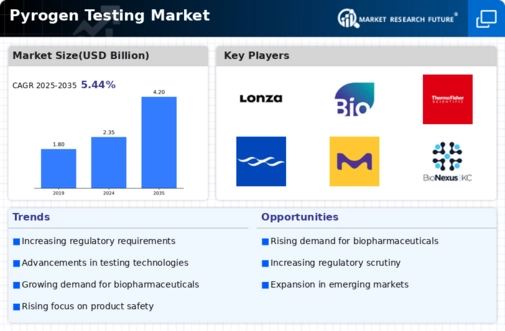
As per Market Research Future analysis, the Pyrogen Testing Market Size was estimated at 2.35 USD Billion in 2024. The Pyrogen Testing industry is projected to grow from 2.478 USD Billion in 2025 to 4.208 USD Billion by 2035, exhibiting a compound annual growth rate (CAGR) of 5.44% during the forecast period 2025 - 2035

Key Market Trends & Highlights

The Pyrogen Testing Market is experiencing robust growth driven by regulatory compliance and technological advancements.

  • North America remains the largest market for pyrogen testing, primarily due to stringent regulatory requirements. The Asia-Pacific region is emerging as the fastest-growing market, fueled by increasing investments in biopharmaceuticals. The LAL Test continues to dominate the market, while the Rabbit Pyrogen Test is witnessing rapid growth due to its evolving applications. Key market drivers include the rising incidence of infections and the growing emphasis on product safety and quality assurance.

Market Size & Forecast

2024 Market Size 2.35 (USD Billion)
2035 Market Size 4.208 (USD Billion)
CAGR (2025 - 2035) 5.44%
Largest Regional Market Share in 2024 North America

Major Players

Charles River Laboratories (US), Lonza Group (CH), Thermo Fisher Scientific (US), Merck KGaA (DE), WuXi AppTec (CN), Eli Lilly and Company (US), GenScript Biotech Corporation (CN), Bio-Rad Laboratories (US), Fujifilm Wako Pure Chemical Corporation (JP)

Market Trends

The Pyrogen Testing Market is currently experiencing a notable evolution, driven by the increasing demand for safety and efficacy in pharmaceuticals and medical devices. Regulatory bodies are emphasizing stringent testing protocols to ensure that products are free from pyrogens, which can cause severe reactions in patients. This heightened focus on quality assurance is prompting manufacturers to adopt advanced testing methodologies, thereby enhancing the overall reliability of their offerings. Furthermore, the rise in biopharmaceuticals and personalized medicine is likely to propel the need for robust pyrogen testing solutions, as these products often require meticulous validation processes to meet regulatory standards. In addition, technological advancements are reshaping the landscape of the Pyrogen Testing Market. Innovations such as the development of rapid testing methods and automated systems are streamlining the testing process, reducing time and labor costs. These advancements not only improve efficiency but also enhance accuracy, which is crucial in maintaining compliance with regulatory requirements. As the market continues to evolve, stakeholders are expected to invest in research and development to explore novel testing techniques, ensuring that they remain competitive in an increasingly complex environment. Overall, the Pyrogen Testing Market appears poised for growth, driven by regulatory pressures and technological innovations.

Regulatory Compliance and Quality Assurance

The emphasis on regulatory compliance is intensifying within the Pyrogen Testing Market. As authorities enforce stricter guidelines, companies are compelled to enhance their quality assurance processes. This trend indicates a shift towards more rigorous testing protocols, ensuring that products meet safety standards before reaching consumers.

Technological Advancements in Testing Methods

Innovations in testing methodologies are transforming the Pyrogen Testing Market. The introduction of rapid testing techniques and automation is streamlining processes, potentially reducing the time required for results. This trend suggests that companies are increasingly adopting technology to improve efficiency and accuracy in pyrogen detection.

Growth in Biopharmaceuticals and Personalized Medicine

The rise of biopharmaceuticals and personalized medicine is significantly impacting the Pyrogen Testing Market. As these products require meticulous validation, the demand for effective pyrogen testing solutions is likely to increase. This trend highlights the need for specialized testing to ensure the safety and efficacy of advanced therapeutic options.

Pyrogen Testing Market Market Drivers

Increasing Awareness of Product Safety

There is a growing awareness among consumers and healthcare professionals regarding the importance of product safety, which is significantly impacting the Pyrogen Testing Market. As patients become more informed about the potential risks associated with medical products, manufacturers are compelled to prioritize safety measures, including thorough pyrogen testing. This heightened awareness is leading to increased scrutiny of product labels and testing certifications, thereby driving demand for reliable pyrogen testing solutions. In 2025, the market is expected to witness a surge in investments aimed at enhancing testing capabilities, as companies strive to meet consumer expectations. Consequently, the Pyrogen Testing Market is likely to benefit from this trend, as safety becomes a central focus in product development.

Regulatory Compliance and Quality Assurance

The Pyrogen Testing Market is experiencing a surge in demand due to stringent regulatory requirements imposed by health authorities. Regulatory bodies, such as the FDA and EMA, mandate rigorous testing for pyrogens in pharmaceutical and medical device manufacturing. This compliance ensures that products are safe for human use, thereby driving the need for effective pyrogen testing methods. The market is projected to grow as companies invest in advanced testing technologies to meet these regulations. In 2023, the market for pyrogen testing reached an estimated value of USD 1.2 billion, reflecting a compound annual growth rate of approximately 8% over the past five years. As regulations evolve, the Pyrogen Testing Market is likely to expand further, necessitating continuous innovation in testing methodologies.

Technological Advancements in Testing Methods

Technological advancements are playing a pivotal role in shaping the Pyrogen Testing Market. Innovations such as the development of recombinant Factor C assays and automated testing systems are enhancing the accuracy and efficiency of pyrogen detection. These advancements not only reduce testing time but also improve the reliability of results, which is crucial for manufacturers aiming to comply with regulatory standards. The introduction of rapid testing methods is expected to capture a significant share of the market, as they allow for quicker product release cycles. In 2024, the market for advanced pyrogen testing technologies is anticipated to reach USD 1.5 billion, driven by the increasing adoption of these innovative solutions. Consequently, the Pyrogen Testing Market is likely to witness a paradigm shift towards more sophisticated testing methodologies.

Rising Incidence of Infections and Contaminations

The rising incidence of infections and contaminations in healthcare settings is a critical driver for the Pyrogen Testing Market. As healthcare-associated infections continue to pose significant risks to patient safety, the need for effective pyrogen testing becomes increasingly vital. Contaminated medical devices and pharmaceuticals can lead to severe adverse reactions, underscoring the necessity for rigorous testing protocols. The market is projected to grow as healthcare facilities and manufacturers recognize the importance of implementing comprehensive pyrogen testing to mitigate these risks. In 2025, the Pyrogen Testing Market is expected to expand, driven by the increasing focus on infection control and prevention strategies. This trend highlights the essential role of pyrogen testing in ensuring the safety and efficacy of medical products.

Growth in Biopharmaceuticals and Personalized Medicine

The rise of biopharmaceuticals and personalized medicine is significantly influencing the Pyrogen Testing Market. As the biopharmaceutical sector expands, the need for rigorous pyrogen testing becomes paramount to ensure patient safety. Biopharmaceutical products, including monoclonal antibodies and vaccines, require stringent testing protocols to detect pyrogens effectively. The market for biopharmaceuticals is projected to grow at a rate of 10% annually, further propelling the demand for pyrogen testing solutions. Additionally, personalized medicine, which tailors treatments to individual patients, necessitates precise testing to avoid adverse reactions. This trend is expected to drive the Pyrogen Testing Market towards more specialized and targeted testing approaches, thereby enhancing overall product safety and efficacy.

Market Segment Insights

By Test Type: LAL Test (Largest) vs. Rabbit Pyrogen Test (Fastest-Growing)

In the Pyrogen Testing Market, the LAL Test holds the largest market share, favored for its efficiency and regulatory acceptance in detecting pyrogens in pharmaceuticals and medical devices. The Rabbit Pyrogen Test, although historically significant, is gradually being overshadowed by synthetic methods, yet remains relevant due to its long-standing application in safety testing. Other tests like the Monocyte Activation Test and Synthetic Pyrogen Test are gaining traction, reflecting the market's shift towards alternatives that reduce animal testing. The growth of the LAL Test can be attributed to increasing demand for endotoxin testing across industries, while the Rabbit Pyrogen Test is witnessing an uptrend due to regulatory shifts favoring traditional methods. The Monocyte Activation Test is emerging as a robust option due to its human relevance, while innovative synthetic approaches are being developed, indicating a dynamic evolution in the market as stakeholders consider ethical and efficiency factors in pyrogen testing methodologies.

LAL Test (Dominant) vs. Monocyte Activation Test (Emerging)

The LAL Test is widely recognized as the dominant method in pyrogen testing, primarily due to its rapid and reliable detection of endotoxins, which is critical for ensuring product safety in the pharmaceutical sector. This method aligns with regulatory standards, making it the preferred choice among manufacturers. In contrast, the Monocyte Activation Test is emerging as a potent alternative that closely mimics human physiological responses. This novel approach is gaining traction particularly among companies striving to minimize <a href="https://www.marketresearchfuture.com/reports/animal-antibiotics-and-antimicrobials-market-6680">animal </a>testing, catering to a growing segment of ethically-conscious consumers and regulatory bodies promoting humane practices. Both tests reflect the market's transformation, with the LAL Test maintaining its stronghold while the Monocyte Activation Test positions itself as a possible contender for future growth.

By Product Type: Kits (Largest) vs. Reagents (Fastest-Growing)

In the Pyrogen Testing Market, the distribution of market share among product types such as reagents, kits, and instruments reveals that kits are currently the largest segment. This dominance can be attributed to the growing adoption of ready-to-use solutions, which ensure reliability and ease of use in testing environments. Reagents, while smaller in share, are rapidly gaining traction, suggesting a shift in preference towards these essential components due to their versatility in various testing scenarios.

Kits (Dominant) vs. Reagents (Emerging)

Kits have established themselves as the dominant force in the Pyrogen Testing Market, primarily due to their comprehensive nature, which allows labs to conduct tests more efficiently. These kits typically include all necessary components and protocols, thus facilitating standardization across various testing facilities. On the other hand, reagents are emerging as a crucial segment, experiencing substantial growth driven by innovations that enhance their effectiveness and reliability. As laboratories increasingly seek to balance cost and performance, the versatility and essential role of reagents in testing processes positions them as an attractive option for future applications.

By End Use: Pharmaceuticals (Largest) vs. Biologics (Fastest-Growing)

In the Pyrogen Testing Market, the end-use distribution highlights that the Pharmaceuticals sector holds the largest market share, reflecting a well-established need for pyrogen testing in drug production. The rigorous regulatory requirements for safety and efficacy in pharmaceuticals create a sustained demand for reliable pyrogen detection methods. In contrast, Biologics is emerging as a fast-growing segment, driven by the rising prevalence of chronic diseases and an increase in biologics development and production, which necessitates stringent pyrogen testing procedures. The growth trends within this segment are significantly influenced by advances in biotechnology and increasing investments in research and development. As biopharmaceutical companies expand their product pipelines and innovations in therapeutics rise, the need for effective pyrogen testing in the biologics segment is set to increase. Medical Devices and Research Laboratories also contribute to the market, but their growth rates are comparatively slower as they catch up with the burgeoning pharmaceuticals and biologics sectors.

Pharmaceuticals (Dominant) vs. Biologics (Emerging)

The Pharmaceuticals sector stands as the dominant force in the Pyrogen Testing Market, characterized by established protocols and adherence to stringent regulatory standards that ensure patient safety in drug manufacturing. Companies in this sector leverage sophisticated pyrogen testing techniques to comply with rigorous safety guidelines. Conversely, the Biologics domain is identified as an emerging segment, driven by innovations in therapies and treatments focused on complex diseases. The segment's growth is fueled by an increasing number of biologics undergoing development, which translates into a higher demand for comprehensive pyrogen testing to ensure the safety of these advanced products. While pharmaceuticals maintain a leading position, the rise of biologics signifies a dynamic shift in the market.

By Methodology: Gel Clot Method (Largest) vs. Chromogenic Method (Fastest-Growing)

In the Pyrogen Testing Market, the methodology segment illustrates distinct market share distributions among the Gel Clot Method, Chromogenic Method, and Turbidimetric Method. The Gel Clot Method commands the largest share, favored for its reliability and established results. Meanwhile, the Chromogenic Method, known for its rapid results and accuracy, is gaining traction among users seeking efficiency in pyrogen detection. The Turbidimetric Method, while effective, holds a smaller share relative to its counterparts, primarily utilized in specific applications requiring precise quantification. As demand for faster and more efficient testing methods grows, the Chromogenic Method emerges as the fastest-growing segment in this market. Healthcare facilities are increasingly leaning towards this method due to its high sensitivity and quicker response time compared to traditional techniques. Regulatory bodies and industry standards also favor methodologies that enhance safety and reduce risks, thereby driving the adoption of the Gel Clot and Chromogenic Methods in various applications, while the Turbidimetric Method continues to serve niche markets.

Methodology: Gel Clot (Dominant) vs. Chromogenic (Emerging)

The Gel Clot Method is recognized as the dominant player within the Pyrogen Testing Market, largely due to its long-standing reputation for producing reliable and consistent results in detecting pyrogens. This method works by utilizing gel-forming reagents that produce visible clots in the presence of pyrogenic substances, making it an effective choice for many laboratories. Conversely, the Chromogenic Method is categorized as an emerging option, rapidly gaining popularity for its speed and accuracy. This method employs chromogenic substrates that change color in response to the presence of pyrogens, allowing for quicker results and improved laboratory throughput. As laboratories aim for both reliability and efficiency, these methodologies illustrate the diverse approaches available to meet the growing regulatory demands and safety concerns in pyrogen testing.

Get more detailed insights about Pyrogen Testing Market Research Report - Forecast till 2035

Regional Insights

The Pyrogen Testing Market, valued at 2.35 USD Billion in 2024, is evolving across various regions, reflecting significant growth trends. North America dominated this market with a valuation of 0.9 USD Billion in 2024, projected to rise to 1.6 USD Billion by 2035, primarily driven by stringent regulatory standards and a robust presence of pharmaceutical companies focusing on quality control and safety. Following closely, Europe holds a valuation of 0.75 USD Billion in 2024, expected to grow to 1.3 USD Billion, propelled by increasing investments in Research and Development and a rising emphasis on biopharmaceutical innovation.

The Asia-Pacific (APAC) region, valued at 0.5 USD Billion in 2024 and projected at 0.95 USD Billion by 2035, is anticipated to witness rapid growth owing to the expansion of manufacturing capabilities and heightened healthcare infrastructure. 

In contrast, South America and the Middle East and Africa (MEA) segments reflect lower market valuations at 0.1 USD Billion and projected growth to 0.25 USD Billion and 0.2 USD Billion respectively by 2035, indicating emerging opportunities and challenges in these regions due to varying levels of regulatory frameworks and market maturity.The overall Pyrogen Testing Market segmentation showcases varied growth drivers and potential for expansion influenced by regional needs and economic conditions.

Key Players and Competitive Insights

The Pyrogen Testing Market has been experiencing significant growth driven by the increasing demand for safety testing in the pharmaceutical and biopharmaceutical industries. This rise can be attributed to the growing focus on biopharmaceutical products, stringent regulatory requirements, and the need for effective quality assurance measures. The market is characterized by a diverse mix of key players who offer various innovative solutions and technologies for pyrogen testing, including Limulus Amebocyte Lysate (LAL) tests, recombinant Factor C (rFC) assays, and cell-based assays. 
Companies in this field are investing heavily in research and development to enhance the efficiency and accuracy of their pyrogen detection methods, while also expanding their geographical presence to capture a larger market share. The landscape is marked by strategic partnerships and collaborations aimed at leveraging technological advancements and improving product offerings to meet the changing needs of the industry.Lonza is a prominent player in the Pyrogen Testing Market, recognized for its robust portfolio of solutions catering specifically to the testing needs of pharmaceutical and biopharmaceutical products. 
Lonza offers a wide range of pyrogen testing services, leveraging its expertise in both LAL and rFC methodologies. Its deep industry knowledge combined with a commitment to high-quality standards has allowed Lonza to establish a strong market presence, particularly in North America and Europe. The company emphasizes its strengths in innovation, regulatory compliance, and customer support, which have enabled it to build strong relationships with key stakeholders.
Lonza's continuous investment in developing advanced testing technologies enhances its competitive edge, allowing it to effectively respond to the evolving demands of the market while sustaining its reputation for delivering reliable and efficient testing solutions.
The Biotechnology Innovation Organization plays a crucial role in shaping the Pyrogen Testing Market through its advocacy and support for biopharmaceutical innovations. This organization focuses on promoting and facilitating the advancement of biotechnological research and development, offering resources and guidance to its members engaged in pyrogen testing. Key products and services under its umbrella include educational programs, regulatory updates, and collaborative initiatives aimed at enhancing industry standards. The organization is known for strengthening partnerships between biotechnology companies and regulatory bodies, ensuring that the latest advancements in pyrogen testing are implemented effectively. 
Strengths of the Biotechnology Innovation Organization include its extensive network of industry professionals and thought leaders, which positions it as a significant contributor to the dialogue surrounding innovative testing practices. Additionally, the organization's efforts in mergers and acquisitions allow it to consolidate resources and expertise, further enhancing its impact and presence in the global market, ultimately working toward a safer and more compliant biopharmaceutical landscape.

Key Companies in the Pyrogen Testing Market include

Industry Developments

The Pyrogen Testing Market has experienced significant developments recently, driven by the increasing demand for biopharmaceuticals and the focus on patient safety. Companies such as Lonza and Thermo Fisher Scientific are actively enhancing their product offerings to meet regulatory requirements, particularly in the context of stringent guidelines surrounding pyrogen testing. In August 2023, Merck KGaA announced their new advancements in testing methodologies, reinforcing their commitment to safety in drug manufacturing processes. 

Furthermore, in September 2023, WuXi AppTec expanded its capabilities with the acquisition of a biotechnology firm specializing in pyrogen detection technologies.The market valuation for companies involved in pyrogen testing has seen growth due to increased investments in Research and Development, ensuring higher efficiency in testing methods. Reports indicate that the increasing regulatory landscape is also driving enhancements in testing technologies among firms such as Charles River Laboratories and GenScript. 

Over the last few years, from 2021 through 2023, key market players like Bionexus and Pacific Biolabs have launched innovative testing solutions, positioning themselves competitively in an evolving market. These factors contribute to a dynamic Pyrogen Testing Market influenced by regulatory advancements and technological innovation.

Future Outlook

Pyrogen Testing Market Future Outlook

The Pyrogen Testing Market is projected to grow at a 5.44% CAGR from 2025 to 2035, driven by increasing regulatory requirements and advancements in testing technologies.

New opportunities lie in:

  • Development of rapid testing kits for point-of-care applications.
  • Expansion into emerging markets with tailored testing solutions.
  • Integration of AI-driven analytics for enhanced testing accuracy.

By 2035, the Pyrogen Testing Market is expected to achieve substantial growth, reflecting evolving industry needs.

Market Segmentation

Pyrogen Testing Market End Use Outlook

  • Pharmaceuticals
  • Biologics
  • Medical Devices
  • Research Laboratories

Pyrogen Testing Market Test Type Outlook

  • LAL Test
  • Rabbit Pyrogen Test
  • Monocyte Activation Test
  • Synthetic Pyrogen Test

Pyrogen Testing Market Methodology Outlook

  • Gel Clot Method
  • Chromogenic Method
  • Turbidimetric Method

Pyrogen Testing Market Product Type Outlook

  • Reagents
  • Kits
  • Instruments

Report Scope

MARKET SIZE 2024 2.35(USD Billion)
MARKET SIZE 2025 2.478(USD Billion)
MARKET SIZE 2035 4.208(USD Billion)
COMPOUND ANNUAL GROWTH RATE (CAGR) 5.44% (2025 - 2035)
REPORT COVERAGE Revenue Forecast, Competitive Landscape, Growth Factors, and Trends
BASE YEAR 2024
Market Forecast Period 2025 - 2035
Historical Data 2019 - 2024
Market Forecast Units USD Billion
Key Companies Profiled Charles River Laboratories (US), Lonza Group (CH), Thermo Fisher Scientific (US), Merck KGaA (DE), WuXi AppTec (CN), Eli Lilly and Company (US), GenScript Biotech Corporation (CN), Bio-Rad Laboratories (US), Fujifilm Wako Pure Chemical Corporation (JP)
Segments Covered Test Type, Product Type, End Use, Methodology, Regional
Key Market Opportunities Advancements in rapid testing technologies enhance efficiency in the Pyrogen Testing Market.
Key Market Dynamics Rising regulatory scrutiny and technological advancements drive innovation in pyrogen testing methodologies and market dynamics.
Countries Covered North America, Europe, APAC, South America, MEA

FAQs

What is the projected market valuation of the Pyrogen Testing Market by 2035?

<p>The Pyrogen Testing Market is projected to reach approximately 4.208 USD Billion by 2035.</p>

What was the market valuation of the Pyrogen Testing Market in 2024?

<p>In 2024, the overall market valuation of the Pyrogen Testing Market was 2.35 USD Billion.</p>

What is the expected CAGR for the Pyrogen Testing Market during the forecast period 2025 - 2035?

<p>The expected CAGR for the Pyrogen Testing Market during the forecast period 2025 - 2035 is 5.44%.</p>

Which companies are considered key players in the Pyrogen Testing Market?

<p>Key players in the Pyrogen Testing Market include Charles River Laboratories, Lonza Group, and Thermo Fisher Scientific, among others.</p>

What are the main test types in the Pyrogen Testing Market and their valuations?

<p>The main test types include LAL Test, Rabbit Pyrogen Test, Monocyte Activation Test, and Synthetic Pyrogen Test, with valuations ranging from 0.4 to 1.65 USD Billion.</p>

How do the product types in the Pyrogen Testing Market compare in terms of valuation?

<p>Product types such as Reagents, Kits, and Instruments have valuations ranging from 0.75 to 1.5 USD Billion.</p>

What end-use segments are present in the Pyrogen Testing Market?

<p>End-use segments include Pharmaceuticals, Biologics, Medical Devices, and Research Laboratories, with valuations from 0.3 to 1.68 USD Billion.</p>

What methodologies are utilized in the Pyrogen Testing Market?

<p>Methodologies include Gel Clot Method, Chromogenic Method, and Turbidimetric Method, with valuations between 0.75 and 1.45 USD Billion.</p>

How does the market for the Rabbit Pyrogen Test compare to other test types?

<p>The Rabbit Pyrogen Test had a valuation of 0.55 USD Billion in 2024, projected to reach 0.95 USD Billion by 2035.</p>

What trends are influencing the growth of the Pyrogen Testing Market?

<p>Trends such as increasing demand for biopharmaceuticals and stringent regulatory requirements are likely influencing the growth of the Pyrogen Testing Market.</p>

  1. SECTION I: EXECUTIVE SUMMARY AND KEY HIGHLIGHTS
    1. | 1.1 EXECUTIVE SUMMARY
    2. | | 1.1.1 Market Overview
    3. | | 1.1.2 Key Findings
    4. | | 1.1.3 Market Segmentation
    5. | | 1.1.4 Competitive Landscape
    6. | | 1.1.5 Challenges and Opportunities
    7. | | 1.1.6 Future Outlook
  2. SECTION II: SCOPING, METHODOLOGY AND MARKET STRUCTURE
    1. | 2.1 MARKET INTRODUCTION
    2. | | 2.1.1 Definition
    3. | | 2.1.2 Scope of the study
    4. | | | 2.1.2.1 Research Objective
    5. | | | 2.1.2.2 Assumption
    6. | | | 2.1.2.3 Limitations
    7. | 2.2 RESEARCH METHODOLOGY
    8. | | 2.2.1 Overview
    9. | | 2.2.2 Data Mining
    10. | | 2.2.3 Secondary Research
    11. | | 2.2.4 Primary Research
    12. | | | 2.2.4.1 Primary Interviews and Information Gathering Process
    13. | | | 2.2.4.2 Breakdown of Primary Respondents
    14. | | 2.2.5 Forecasting Model
    15. | | 2.2.6 Market Size Estimation
    16. | | | 2.2.6.1 Bottom-Up Approach
    17. | | | 2.2.6.2 Top-Down Approach
    18. | | 2.2.7 Data Triangulation
    19. | | 2.2.8 Validation
  3. SECTION III: QUALITATIVE ANALYSIS
    1. | 3.1 MARKET DYNAMICS
    2. | | 3.1.1 Overview
    3. | | 3.1.2 Drivers
    4. | | 3.1.3 Restraints
    5. | | 3.1.4 Opportunities
    6. | 3.2 MARKET FACTOR ANALYSIS
    7. | | 3.2.1 Value chain Analysis
    8. | | 3.2.2 Porter's Five Forces Analysis
    9. | | | 3.2.2.1 Bargaining Power of Suppliers
    10. | | | 3.2.2.2 Bargaining Power of Buyers
    11. | | | 3.2.2.3 Threat of New Entrants
    12. | | | 3.2.2.4 Threat of Substitutes
    13. | | | 3.2.2.5 Intensity of Rivalry
    14. | | 3.2.3 COVID-19 Impact Analysis
    15. | | | 3.2.3.1 Market Impact Analysis
    16. | | | 3.2.3.2 Regional Impact
    17. | | | 3.2.3.3 Opportunity and Threat Analysis
  4. SECTION IV: QUANTITATIVE ANALYSIS
    1. | 4.1 Healthcare, BY Test Type (USD Billion)
    2. | | 4.1.1 LAL Test
    3. | | 4.1.2 Rabbit Pyrogen Test
    4. | | 4.1.3 Monocyte Activation Test
    5. | | 4.1.4 Synthetic Pyrogen Test
    6. | 4.2 Healthcare, BY Product Type (USD Billion)
    7. | | 4.2.1 Reagents
    8. | | 4.2.2 Kits
    9. | | 4.2.3 Instruments
    10. | 4.3 Healthcare, BY End Use (USD Billion)
    11. | | 4.3.1 Pharmaceuticals
    12. | | 4.3.2 Biologics
    13. | | 4.3.3 Medical Devices
    14. | | 4.3.4 Research Laboratories
    15. | 4.4 Healthcare, BY Methodology (USD Billion)
    16. | | 4.4.1 Gel Clot Method
    17. | | 4.4.2 Chromogenic Method
    18. | | 4.4.3 Turbidimetric Method
    19. | 4.5 Healthcare, BY Region (USD Billion)
    20. | | 4.5.1 North America
    21. | | | 4.5.1.1 US
    22. | | | 4.5.1.2 Canada
    23. | | 4.5.2 Europe
    24. | | | 4.5.2.1 Germany
    25. | | | 4.5.2.2 UK
    26. | | | 4.5.2.3 France
    27. | | | 4.5.2.4 Russia
    28. | | | 4.5.2.5 Italy
    29. | | | 4.5.2.6 Spain
    30. | | | 4.5.2.7 Rest of Europe
    31. | | 4.5.3 APAC
    32. | | | 4.5.3.1 China
    33. | | | 4.5.3.2 India
    34. | | | 4.5.3.3 Japan
    35. | | | 4.5.3.4 South Korea
    36. | | | 4.5.3.5 Malaysia
    37. | | | 4.5.3.6 Thailand
    38. | | | 4.5.3.7 Indonesia
    39. | | | 4.5.3.8 Rest of APAC
    40. | | 4.5.4 South America
    41. | | | 4.5.4.1 Brazil
    42. | | | 4.5.4.2 Mexico
    43. | | | 4.5.4.3 Argentina
    44. | | | 4.5.4.4 Rest of South America
    45. | | 4.5.5 MEA
    46. | | | 4.5.5.1 GCC Countries
    47. | | | 4.5.5.2 South Africa
    48. | | | 4.5.5.3 Rest of MEA
  5. SECTION V: COMPETITIVE ANALYSIS
    1. | 5.1 Competitive Landscape
    2. | | 5.1.1 Overview
    3. | | 5.1.2 Competitive Analysis
    4. | | 5.1.3 Market share Analysis
    5. | | 5.1.4 Major Growth Strategy in the Healthcare
    6. | | 5.1.5 Competitive Benchmarking
    7. | | 5.1.6 Leading Players in Terms of Number of Developments in the Healthcare
    8. | | 5.1.7 Key developments and growth strategies
    9. | | | 5.1.7.1 New Product Launch/Service Deployment
    10. | | | 5.1.7.2 Merger & Acquisitions
    11. | | | 5.1.7.3 Joint Ventures
    12. | | 5.1.8 Major Players Financial Matrix
    13. | | | 5.1.8.1 Sales and Operating Income
    14. | | | 5.1.8.2 Major Players R&D Expenditure. 2023
    15. | 5.2 Company Profiles
    16. | | 5.2.1 Charles River Laboratories (US)
    17. | | | 5.2.1.1 Financial Overview
    18. | | | 5.2.1.2 Products Offered
    19. | | | 5.2.1.3 Key Developments
    20. | | | 5.2.1.4 SWOT Analysis
    21. | | | 5.2.1.5 Key Strategies
    22. | | 5.2.2 Lonza Group (CH)
    23. | | | 5.2.2.1 Financial Overview
    24. | | | 5.2.2.2 Products Offered
    25. | | | 5.2.2.3 Key Developments
    26. | | | 5.2.2.4 SWOT Analysis
    27. | | | 5.2.2.5 Key Strategies
    28. | | 5.2.3 Thermo Fisher Scientific (US)
    29. | | | 5.2.3.1 Financial Overview
    30. | | | 5.2.3.2 Products Offered
    31. | | | 5.2.3.3 Key Developments
    32. | | | 5.2.3.4 SWOT Analysis
    33. | | | 5.2.3.5 Key Strategies
    34. | | 5.2.4 Merck KGaA (DE)
    35. | | | 5.2.4.1 Financial Overview
    36. | | | 5.2.4.2 Products Offered
    37. | | | 5.2.4.3 Key Developments
    38. | | | 5.2.4.4 SWOT Analysis
    39. | | | 5.2.4.5 Key Strategies
    40. | | 5.2.5 WuXi AppTec (CN)
    41. | | | 5.2.5.1 Financial Overview
    42. | | | 5.2.5.2 Products Offered
    43. | | | 5.2.5.3 Key Developments
    44. | | | 5.2.5.4 SWOT Analysis
    45. | | | 5.2.5.5 Key Strategies
    46. | | 5.2.6 Eli Lilly and Company (US)
    47. | | | 5.2.6.1 Financial Overview
    48. | | | 5.2.6.2 Products Offered
    49. | | | 5.2.6.3 Key Developments
    50. | | | 5.2.6.4 SWOT Analysis
    51. | | | 5.2.6.5 Key Strategies
    52. | | 5.2.7 GenScript Biotech Corporation (CN)
    53. | | | 5.2.7.1 Financial Overview
    54. | | | 5.2.7.2 Products Offered
    55. | | | 5.2.7.3 Key Developments
    56. | | | 5.2.7.4 SWOT Analysis
    57. | | | 5.2.7.5 Key Strategies
    58. | | 5.2.8 Bio-Rad Laboratories (US)
    59. | | | 5.2.8.1 Financial Overview
    60. | | | 5.2.8.2 Products Offered
    61. | | | 5.2.8.3 Key Developments
    62. | | | 5.2.8.4 SWOT Analysis
    63. | | | 5.2.8.5 Key Strategies
    64. | | 5.2.9 Fujifilm Wako Pure Chemical Corporation (JP)
    65. | | | 5.2.9.1 Financial Overview
    66. | | | 5.2.9.2 Products Offered
    67. | | | 5.2.9.3 Key Developments
    68. | | | 5.2.9.4 SWOT Analysis
    69. | | | 5.2.9.5 Key Strategies
    70. | 5.3 Appendix
    71. | | 5.3.1 References
    72. | | 5.3.2 Related Reports
  6. LIST OF FIGURES
    1. | 6.1 MARKET SYNOPSIS
    2. | 6.2 NORTH AMERICA MARKET ANALYSIS
    3. | 6.3 US MARKET ANALYSIS BY TEST TYPE
    4. | 6.4 US MARKET ANALYSIS BY PRODUCT TYPE
    5. | 6.5 US MARKET ANALYSIS BY END USE
    6. | 6.6 US MARKET ANALYSIS BY METHODOLOGY
    7. | 6.7 CANADA MARKET ANALYSIS BY TEST TYPE
    8. | 6.8 CANADA MARKET ANALYSIS BY PRODUCT TYPE
    9. | 6.9 CANADA MARKET ANALYSIS BY END USE
    10. | 6.10 CANADA MARKET ANALYSIS BY METHODOLOGY
    11. | 6.11 EUROPE MARKET ANALYSIS
    12. | 6.12 GERMANY MARKET ANALYSIS BY TEST TYPE
    13. | 6.13 GERMANY MARKET ANALYSIS BY PRODUCT TYPE
    14. | 6.14 GERMANY MARKET ANALYSIS BY END USE
    15. | 6.15 GERMANY MARKET ANALYSIS BY METHODOLOGY
    16. | 6.16 UK MARKET ANALYSIS BY TEST TYPE
    17. | 6.17 UK MARKET ANALYSIS BY PRODUCT TYPE
    18. | 6.18 UK MARKET ANALYSIS BY END USE
    19. | 6.19 UK MARKET ANALYSIS BY METHODOLOGY
    20. | 6.20 FRANCE MARKET ANALYSIS BY TEST TYPE
    21. | 6.21 FRANCE MARKET ANALYSIS BY PRODUCT TYPE
    22. | 6.22 FRANCE MARKET ANALYSIS BY END USE
    23. | 6.23 FRANCE MARKET ANALYSIS BY METHODOLOGY
    24. | 6.24 RUSSIA MARKET ANALYSIS BY TEST TYPE
    25. | 6.25 RUSSIA MARKET ANALYSIS BY PRODUCT TYPE
    26. | 6.26 RUSSIA MARKET ANALYSIS BY END USE
    27. | 6.27 RUSSIA MARKET ANALYSIS BY METHODOLOGY
    28. | 6.28 ITALY MARKET ANALYSIS BY TEST TYPE
    29. | 6.29 ITALY MARKET ANALYSIS BY PRODUCT TYPE
    30. | 6.30 ITALY MARKET ANALYSIS BY END USE
    31. | 6.31 ITALY MARKET ANALYSIS BY METHODOLOGY
    32. | 6.32 SPAIN MARKET ANALYSIS BY TEST TYPE
    33. | 6.33 SPAIN MARKET ANALYSIS BY PRODUCT TYPE
    34. | 6.34 SPAIN MARKET ANALYSIS BY END USE
    35. | 6.35 SPAIN MARKET ANALYSIS BY METHODOLOGY
    36. | 6.36 REST OF EUROPE MARKET ANALYSIS BY TEST TYPE
    37. | 6.37 REST OF EUROPE MARKET ANALYSIS BY PRODUCT TYPE
    38. | 6.38 REST OF EUROPE MARKET ANALYSIS BY END USE
    39. | 6.39 REST OF EUROPE MARKET ANALYSIS BY METHODOLOGY
    40. | 6.40 APAC MARKET ANALYSIS
    41. | 6.41 CHINA MARKET ANALYSIS BY TEST TYPE
    42. | 6.42 CHINA MARKET ANALYSIS BY PRODUCT TYPE
    43. | 6.43 CHINA MARKET ANALYSIS BY END USE
    44. | 6.44 CHINA MARKET ANALYSIS BY METHODOLOGY
    45. | 6.45 INDIA MARKET ANALYSIS BY TEST TYPE
    46. | 6.46 INDIA MARKET ANALYSIS BY PRODUCT TYPE
    47. | 6.47 INDIA MARKET ANALYSIS BY END USE
    48. | 6.48 INDIA MARKET ANALYSIS BY METHODOLOGY
    49. | 6.49 JAPAN MARKET ANALYSIS BY TEST TYPE
    50. | 6.50 JAPAN MARKET ANALYSIS BY PRODUCT TYPE
    51. | 6.51 JAPAN MARKET ANALYSIS BY END USE
    52. | 6.52 JAPAN MARKET ANALYSIS BY METHODOLOGY
    53. | 6.53 SOUTH KOREA MARKET ANALYSIS BY TEST TYPE
    54. | 6.54 SOUTH KOREA MARKET ANALYSIS BY PRODUCT TYPE
    55. | 6.55 SOUTH KOREA MARKET ANALYSIS BY END USE
    56. | 6.56 SOUTH KOREA MARKET ANALYSIS BY METHODOLOGY
    57. | 6.57 MALAYSIA MARKET ANALYSIS BY TEST TYPE
    58. | 6.58 MALAYSIA MARKET ANALYSIS BY PRODUCT TYPE
    59. | 6.59 MALAYSIA MARKET ANALYSIS BY END USE
    60. | 6.60 MALAYSIA MARKET ANALYSIS BY METHODOLOGY
    61. | 6.61 THAILAND MARKET ANALYSIS BY TEST TYPE
    62. | 6.62 THAILAND MARKET ANALYSIS BY PRODUCT TYPE
    63. | 6.63 THAILAND MARKET ANALYSIS BY END USE
    64. | 6.64 THAILAND MARKET ANALYSIS BY METHODOLOGY
    65. | 6.65 INDONESIA MARKET ANALYSIS BY TEST TYPE
    66. | 6.66 INDONESIA MARKET ANALYSIS BY PRODUCT TYPE
    67. | 6.67 INDONESIA MARKET ANALYSIS BY END USE
    68. | 6.68 INDONESIA MARKET ANALYSIS BY METHODOLOGY
    69. | 6.69 REST OF APAC MARKET ANALYSIS BY TEST TYPE
    70. | 6.70 REST OF APAC MARKET ANALYSIS BY PRODUCT TYPE
    71. | 6.71 REST OF APAC MARKET ANALYSIS BY END USE
    72. | 6.72 REST OF APAC MARKET ANALYSIS BY METHODOLOGY
    73. | 6.73 SOUTH AMERICA MARKET ANALYSIS
    74. | 6.74 BRAZIL MARKET ANALYSIS BY TEST TYPE
    75. | 6.75 BRAZIL MARKET ANALYSIS BY PRODUCT TYPE
    76. | 6.76 BRAZIL MARKET ANALYSIS BY END USE
    77. | 6.77 BRAZIL MARKET ANALYSIS BY METHODOLOGY
    78. | 6.78 MEXICO MARKET ANALYSIS BY TEST TYPE
    79. | 6.79 MEXICO MARKET ANALYSIS BY PRODUCT TYPE
    80. | 6.80 MEXICO MARKET ANALYSIS BY END USE
    81. | 6.81 MEXICO MARKET ANALYSIS BY METHODOLOGY
    82. | 6.82 ARGENTINA MARKET ANALYSIS BY TEST TYPE
    83. | 6.83 ARGENTINA MARKET ANALYSIS BY PRODUCT TYPE
    84. | 6.84 ARGENTINA MARKET ANALYSIS BY END USE
    85. | 6.85 ARGENTINA MARKET ANALYSIS BY METHODOLOGY
    86. | 6.86 REST OF SOUTH AMERICA MARKET ANALYSIS BY TEST TYPE
    87. | 6.87 REST OF SOUTH AMERICA MARKET ANALYSIS BY PRODUCT TYPE
    88. | 6.88 REST OF SOUTH AMERICA MARKET ANALYSIS BY END USE
    89. | 6.89 REST OF SOUTH AMERICA MARKET ANALYSIS BY METHODOLOGY
    90. | 6.90 MEA MARKET ANALYSIS
    91. | 6.91 GCC COUNTRIES MARKET ANALYSIS BY TEST TYPE
    92. | 6.92 GCC COUNTRIES MARKET ANALYSIS BY PRODUCT TYPE
    93. | 6.93 GCC COUNTRIES MARKET ANALYSIS BY END USE
    94. | 6.94 GCC COUNTRIES MARKET ANALYSIS BY METHODOLOGY
    95. | 6.95 SOUTH AFRICA MARKET ANALYSIS BY TEST TYPE
    96. | 6.96 SOUTH AFRICA MARKET ANALYSIS BY PRODUCT TYPE
    97. | 6.97 SOUTH AFRICA MARKET ANALYSIS BY END USE
    98. | 6.98 SOUTH AFRICA MARKET ANALYSIS BY METHODOLOGY
    99. | 6.99 REST OF MEA MARKET ANALYSIS BY TEST TYPE
    100. | 6.100 REST OF MEA MARKET ANALYSIS BY PRODUCT TYPE
    101. | 6.101 REST OF MEA MARKET ANALYSIS BY END USE
    102. | 6.102 REST OF MEA MARKET ANALYSIS BY METHODOLOGY
    103. | 6.103 KEY BUYING CRITERIA OF HEALTHCARE
    104. | 6.104 RESEARCH PROCESS OF MRFR
    105. | 6.105 DRO ANALYSIS OF HEALTHCARE
    106. | 6.106 DRIVERS IMPACT ANALYSIS: HEALTHCARE
    107. | 6.107 RESTRAINTS IMPACT ANALYSIS: HEALTHCARE
    108. | 6.108 SUPPLY / VALUE CHAIN: HEALTHCARE
    109. | 6.109 HEALTHCARE, BY TEST TYPE, 2024 (% SHARE)
    110. | 6.110 HEALTHCARE, BY TEST TYPE, 2024 TO 2035 (USD Billion)
    111. | 6.111 HEALTHCARE, BY PRODUCT TYPE, 2024 (% SHARE)
    112. | 6.112 HEALTHCARE, BY PRODUCT TYPE, 2024 TO 2035 (USD Billion)
    113. | 6.113 HEALTHCARE, BY END USE, 2024 (% SHARE)
    114. | 6.114 HEALTHCARE, BY END USE, 2024 TO 2035 (USD Billion)
    115. | 6.115 HEALTHCARE, BY METHODOLOGY, 2024 (% SHARE)
    116. | 6.116 HEALTHCARE, BY METHODOLOGY, 2024 TO 2035 (USD Billion)
    117. | 6.117 BENCHMARKING OF MAJOR COMPETITORS
  7. LIST OF TABLES
    1. | 7.1 LIST OF ASSUMPTIONS
    2. | | 7.1.1
    3. | 7.2 North America MARKET SIZE ESTIMATES; FORECAST
    4. | | 7.2.1 BY TEST TYPE, 2025-2035 (USD Billion)
    5. | | 7.2.2 BY PRODUCT TYPE, 2025-2035 (USD Billion)
    6. | | 7.2.3 BY END USE, 2025-2035 (USD Billion)
    7. | | 7.2.4 BY METHODOLOGY, 2025-2035 (USD Billion)
    8. | 7.3 US MARKET SIZE ESTIMATES; FORECAST
    9. | | 7.3.1 BY TEST TYPE, 2025-2035 (USD Billion)
    10. | | 7.3.2 BY PRODUCT TYPE, 2025-2035 (USD Billion)
    11. | | 7.3.3 BY END USE, 2025-2035 (USD Billion)
    12. | | 7.3.4 BY METHODOLOGY, 2025-2035 (USD Billion)
    13. | 7.4 Canada MARKET SIZE ESTIMATES; FORECAST
    14. | | 7.4.1 BY TEST TYPE, 2025-2035 (USD Billion)
    15. | | 7.4.2 BY PRODUCT TYPE, 2025-2035 (USD Billion)
    16. | | 7.4.3 BY END USE, 2025-2035 (USD Billion)
    17. | | 7.4.4 BY METHODOLOGY, 2025-2035 (USD Billion)
    18. | 7.5 Europe MARKET SIZE ESTIMATES; FORECAST
    19. | | 7.5.1 BY TEST TYPE, 2025-2035 (USD Billion)
    20. | | 7.5.2 BY PRODUCT TYPE, 2025-2035 (USD Billion)
    21. | | 7.5.3 BY END USE, 2025-2035 (USD Billion)
    22. | | 7.5.4 BY METHODOLOGY, 2025-2035 (USD Billion)
    23. | 7.6 Germany MARKET SIZE ESTIMATES; FORECAST
    24. | | 7.6.1 BY TEST TYPE, 2025-2035 (USD Billion)
    25. | | 7.6.2 BY PRODUCT TYPE, 2025-2035 (USD Billion)
    26. | | 7.6.3 BY END USE, 2025-2035 (USD Billion)
    27. | | 7.6.4 BY METHODOLOGY, 2025-2035 (USD Billion)
    28. | 7.7 UK MARKET SIZE ESTIMATES; FORECAST
    29. | | 7.7.1 BY TEST TYPE, 2025-2035 (USD Billion)
    30. | | 7.7.2 BY PRODUCT TYPE, 2025-2035 (USD Billion)
    31. | | 7.7.3 BY END USE, 2025-2035 (USD Billion)
    32. | | 7.7.4 BY METHODOLOGY, 2025-2035 (USD Billion)
    33. | 7.8 France MARKET SIZE ESTIMATES; FORECAST
    34. | | 7.8.1 BY TEST TYPE, 2025-2035 (USD Billion)
    35. | | 7.8.2 BY PRODUCT TYPE, 2025-2035 (USD Billion)
    36. | | 7.8.3 BY END USE, 2025-2035 (USD Billion)
    37. | | 7.8.4 BY METHODOLOGY, 2025-2035 (USD Billion)
    38. | 7.9 Russia MARKET SIZE ESTIMATES; FORECAST
    39. | | 7.9.1 BY TEST TYPE, 2025-2035 (USD Billion)
    40. | | 7.9.2 BY PRODUCT TYPE, 2025-2035 (USD Billion)
    41. | | 7.9.3 BY END USE, 2025-2035 (USD Billion)
    42. | | 7.9.4 BY METHODOLOGY, 2025-2035 (USD Billion)
    43. | 7.10 Italy MARKET SIZE ESTIMATES; FORECAST
    44. | | 7.10.1 BY TEST TYPE, 2025-2035 (USD Billion)
    45. | | 7.10.2 BY PRODUCT TYPE, 2025-2035 (USD Billion)
    46. | | 7.10.3 BY END USE, 2025-2035 (USD Billion)
    47. | | 7.10.4 BY METHODOLOGY, 2025-2035 (USD Billion)
    48. | 7.11 Spain MARKET SIZE ESTIMATES; FORECAST
    49. | | 7.11.1 BY TEST TYPE, 2025-2035 (USD Billion)
    50. | | 7.11.2 BY PRODUCT TYPE, 2025-2035 (USD Billion)
    51. | | 7.11.3 BY END USE, 2025-2035 (USD Billion)
    52. | | 7.11.4 BY METHODOLOGY, 2025-2035 (USD Billion)
    53. | 7.12 Rest of Europe MARKET SIZE ESTIMATES; FORECAST
    54. | | 7.12.1 BY TEST TYPE, 2025-2035 (USD Billion)
    55. | | 7.12.2 BY PRODUCT TYPE, 2025-2035 (USD Billion)
    56. | | 7.12.3 BY END USE, 2025-2035 (USD Billion)
    57. | | 7.12.4 BY METHODOLOGY, 2025-2035 (USD Billion)
    58. | 7.13 APAC MARKET SIZE ESTIMATES; FORECAST
    59. | | 7.13.1 BY TEST TYPE, 2025-2035 (USD Billion)
    60. | | 7.13.2 BY PRODUCT TYPE, 2025-2035 (USD Billion)
    61. | | 7.13.3 BY END USE, 2025-2035 (USD Billion)
    62. | | 7.13.4 BY METHODOLOGY, 2025-2035 (USD Billion)
    63. | 7.14 China MARKET SIZE ESTIMATES; FORECAST
    64. | | 7.14.1 BY TEST TYPE, 2025-2035 (USD Billion)
    65. | | 7.14.2 BY PRODUCT TYPE, 2025-2035 (USD Billion)
    66. | | 7.14.3 BY END USE, 2025-2035 (USD Billion)
    67. | | 7.14.4 BY METHODOLOGY, 2025-2035 (USD Billion)
    68. | 7.15 India MARKET SIZE ESTIMATES; FORECAST
    69. | | 7.15.1 BY TEST TYPE, 2025-2035 (USD Billion)
    70. | | 7.15.2 BY PRODUCT TYPE, 2025-2035 (USD Billion)
    71. | | 7.15.3 BY END USE, 2025-2035 (USD Billion)
    72. | | 7.15.4 BY METHODOLOGY, 2025-2035 (USD Billion)
    73. | 7.16 Japan MARKET SIZE ESTIMATES; FORECAST
    74. | | 7.16.1 BY TEST TYPE, 2025-2035 (USD Billion)
    75. | | 7.16.2 BY PRODUCT TYPE, 2025-2035 (USD Billion)
    76. | | 7.16.3 BY END USE, 2025-2035 (USD Billion)
    77. | | 7.16.4 BY METHODOLOGY, 2025-2035 (USD Billion)
    78. | 7.17 South Korea MARKET SIZE ESTIMATES; FORECAST
    79. | | 7.17.1 BY TEST TYPE, 2025-2035 (USD Billion)
    80. | | 7.17.2 BY PRODUCT TYPE, 2025-2035 (USD Billion)
    81. | | 7.17.3 BY END USE, 2025-2035 (USD Billion)
    82. | | 7.17.4 BY METHODOLOGY, 2025-2035 (USD Billion)
    83. | 7.18 Malaysia MARKET SIZE ESTIMATES; FORECAST
    84. | | 7.18.1 BY TEST TYPE, 2025-2035 (USD Billion)
    85. | | 7.18.2 BY PRODUCT TYPE, 2025-2035 (USD Billion)
    86. | | 7.18.3 BY END USE, 2025-2035 (USD Billion)
    87. | | 7.18.4 BY METHODOLOGY, 2025-2035 (USD Billion)
    88. | 7.19 Thailand MARKET SIZE ESTIMATES; FORECAST
    89. | | 7.19.1 BY TEST TYPE, 2025-2035 (USD Billion)
    90. | | 7.19.2 BY PRODUCT TYPE, 2025-2035 (USD Billion)
    91. | | 7.19.3 BY END USE, 2025-2035 (USD Billion)
    92. | | 7.19.4 BY METHODOLOGY, 2025-2035 (USD Billion)
    93. | 7.20 Indonesia MARKET SIZE ESTIMATES; FORECAST
    94. | | 7.20.1 BY TEST TYPE, 2025-2035 (USD Billion)
    95. | | 7.20.2 BY PRODUCT TYPE, 2025-2035 (USD Billion)
    96. | | 7.20.3 BY END USE, 2025-2035 (USD Billion)
    97. | | 7.20.4 BY METHODOLOGY, 2025-2035 (USD Billion)
    98. | 7.21 Rest of APAC MARKET SIZE ESTIMATES; FORECAST
    99. | | 7.21.1 BY TEST TYPE, 2025-2035 (USD Billion)
    100. | | 7.21.2 BY PRODUCT TYPE, 2025-2035 (USD Billion)
    101. | | 7.21.3 BY END USE, 2025-2035 (USD Billion)
    102. | | 7.21.4 BY METHODOLOGY, 2025-2035 (USD Billion)
    103. | 7.22 South America MARKET SIZE ESTIMATES; FORECAST
    104. | | 7.22.1 BY TEST TYPE, 2025-2035 (USD Billion)
    105. | | 7.22.2 BY PRODUCT TYPE, 2025-2035 (USD Billion)
    106. | | 7.22.3 BY END USE, 2025-2035 (USD Billion)
    107. | | 7.22.4 BY METHODOLOGY, 2025-2035 (USD Billion)
    108. | 7.23 Brazil MARKET SIZE ESTIMATES; FORECAST
    109. | | 7.23.1 BY TEST TYPE, 2025-2035 (USD Billion)
    110. | | 7.23.2 BY PRODUCT TYPE, 2025-2035 (USD Billion)
    111. | | 7.23.3 BY END USE, 2025-2035 (USD Billion)
    112. | | 7.23.4 BY METHODOLOGY, 2025-2035 (USD Billion)
    113. | 7.24 Mexico MARKET SIZE ESTIMATES; FORECAST
    114. | | 7.24.1 BY TEST TYPE, 2025-2035 (USD Billion)
    115. | | 7.24.2 BY PRODUCT TYPE, 2025-2035 (USD Billion)
    116. | | 7.24.3 BY END USE, 2025-2035 (USD Billion)
    117. | | 7.24.4 BY METHODOLOGY, 2025-2035 (USD Billion)
    118. | 7.25 Argentina MARKET SIZE ESTIMATES; FORECAST
    119. | | 7.25.1 BY TEST TYPE, 2025-2035 (USD Billion)
    120. | | 7.25.2 BY PRODUCT TYPE, 2025-2035 (USD Billion)
    121. | | 7.25.3 BY END USE, 2025-2035 (USD Billion)
    122. | | 7.25.4 BY METHODOLOGY, 2025-2035 (USD Billion)
    123. | 7.26 Rest of South America MARKET SIZE ESTIMATES; FORECAST
    124. | | 7.26.1 BY TEST TYPE, 2025-2035 (USD Billion)
    125. | | 7.26.2 BY PRODUCT TYPE, 2025-2035 (USD Billion)
    126. | | 7.26.3 BY END USE, 2025-2035 (USD Billion)
    127. | | 7.26.4 BY METHODOLOGY, 2025-2035 (USD Billion)
    128. | 7.27 MEA MARKET SIZE ESTIMATES; FORECAST
    129. | | 7.27.1 BY TEST TYPE, 2025-2035 (USD Billion)
    130. | | 7.27.2 BY PRODUCT TYPE, 2025-2035 (USD Billion)
    131. | | 7.27.3 BY END USE, 2025-2035 (USD Billion)
    132. | | 7.27.4 BY METHODOLOGY, 2025-2035 (USD Billion)
    133. | 7.28 GCC Countries MARKET SIZE ESTIMATES; FORECAST
    134. | | 7.28.1 BY TEST TYPE, 2025-2035 (USD Billion)
    135. | | 7.28.2 BY PRODUCT TYPE, 2025-2035 (USD Billion)
    136. | | 7.28.3 BY END USE, 2025-2035 (USD Billion)
    137. | | 7.28.4 BY METHODOLOGY, 2025-2035 (USD Billion)
    138. | 7.29 South Africa MARKET SIZE ESTIMATES; FORECAST
    139. | | 7.29.1 BY TEST TYPE, 2025-2035 (USD Billion)
    140. | | 7.29.2 BY PRODUCT TYPE, 2025-2035 (USD Billion)
    141. | | 7.29.3 BY END USE, 2025-2035 (USD Billion)
    142. | | 7.29.4 BY METHODOLOGY, 2025-2035 (USD Billion)
    143. | 7.30 Rest of MEA MARKET SIZE ESTIMATES; FORECAST
    144. | | 7.30.1 BY TEST TYPE, 2025-2035 (USD Billion)
    145. | | 7.30.2 BY PRODUCT TYPE, 2025-2035 (USD Billion)
    146. | | 7.30.3 BY END USE, 2025-2035 (USD Billion)
    147. | | 7.30.4 BY METHODOLOGY, 2025-2035 (USD Billion)
    148. | 7.31 PRODUCT LAUNCH/PRODUCT DEVELOPMENT/APPROVAL
    149. | | 7.31.1
    150. | 7.32 ACQUISITION/PARTNERSHIP
    151. | | 7.32.1

Healthcare Market Segmentation

Healthcare By Test Type (USD Billion, 2025-2035)

  • LAL Test
  • Rabbit Pyrogen Test
  • Monocyte Activation Test
  • Synthetic Pyrogen Test

Healthcare By Product Type (USD Billion, 2025-2035)

  • Reagents
  • Kits
  • Instruments

Healthcare By End Use (USD Billion, 2025-2035)

  • Pharmaceuticals
  • Biologics
  • Medical Devices
  • Research Laboratories

Healthcare By Methodology (USD Billion, 2025-2035)

  • Gel Clot Method
  • Chromogenic Method
  • Turbidimetric Method
Infographic

Free Sample Request

Kindly complete the form below to receive a free sample of this Report

Get Free Sample

Customer Strories

Compare Licence

×
Features License Type
Single User Multiuser License Enterprise User
Price $4,950 $5,950 $7,250
Maximum User Access Limit 1 User Upto 10 Users Unrestricted Access Throughout the Organization
Free Customization
Direct Access to Analyst
Deliverable Format
Platform Access
Discount on Next Purchase 10% 15% 15%
Printable Versions