×
Request Free Sample ×

Kindly complete the form below to receive a free sample of this Report

* Please use a valid business email

Leading companies partner with us for data-driven Insights

clients tt-cursor
Hero Background
English
Chinese
French
Japanese
Korean
German
Spanish

Military Power Solutions Market Trends

ID: MRFR/AD/8832-CR
168 Pages
Sejal Akre
November 2022

Military Power Solutions Market Size, Share, Industry Trend & Analysis Research Report Information by Type (Portable, Non-Portable), By Source (Batteries, Generators, Fuel Cells, Solar Power, Energy Harvesters), By Platform (Air, Marine, Ground), By Wattage (Low-Power, Medium Power, High Power), and Region (North America, Europe, Asia-Pacific, Middle East & Africa, and Latin America)—Forecast till 2035

Share:
Download PDF ×

We do not share your information with anyone. However, we may send you emails based on your report interest from time to time. You may contact us at any time to opt-out.

Military Power Solutions Market Infographic
×
Military Power Solutions Market Infographic Full View
Purchase Options

Market Trends

Key Emerging Trends in the Military Power Solutions Market

The military power solutions market is witnessing notable trends and developments driven by advancements in technology, evolving military requirements, and increasing demand for reliable and efficient power sources in defense applications. One prominent trend in this market is the growing adoption of advanced power solutions to meet the increasing power demands of modern military platforms and systems. With the proliferation of electronic equipment, sensors, communication systems, and other mission-critical devices in military operations, there is a growing need for power solutions that can deliver high-performance, resilience, and longevity in harsh and demanding environments. As a result, defense organizations are investing in advanced power generation, storage, and distribution systems to ensure the availability of uninterrupted power supply for critical military operations.

Moreover, technological advancements in power generation technologies, energy storage systems, and power management solutions are driving innovation and expanding the capabilities of military power solutions. The development of lightweight, compact, and fuel-efficient power generators, such as diesel generators, fuel cells, and hybrid power systems, enables military forces to deploy power sources in remote or austere environments with limited logistical support. Additionally, advancements in battery technology, including lithium-ion batteries, solid-state batteries, and ultracapacitors, offer higher energy density, faster charging rates, and longer cycle life, making them well-suited for portable power applications in the field.

Furthermore, the increasing adoption of renewable energy sources, such as solar photovoltaic (PV) panels, wind turbines, and fuel cells, is driving the integration of renewable energy systems into military power solutions. Renewable energy technologies offer a sustainable and environmentally friendly alternative to traditional fossil fuel-based power generation, reducing the reliance on fossil fuels and lowering greenhouse gas emissions associated with military operations. Moreover, the deployment of microgrids and smart grid technologies enables military bases and installations to optimize energy consumption, manage peak demand, and enhance energy resilience by integrating renewable energy sources with conventional power systems.

Additionally, the military power solutions market is influenced by evolving mission requirements, including expeditionary operations, disaster relief efforts, and humanitarian missions, which demand flexible and scalable power solutions to support diverse operational scenarios. Portable power systems, mobile generators, and deployable energy storage units enable military forces to establish temporary power infrastructure in remote or disaster-affected areas, providing essential electricity for command and control, communication, medical facilities, and other critical functions. Moreover, advancements in power management software and remote monitoring capabilities enable military personnel to monitor, control, and optimize power consumption and distribution across multiple platforms and locations in real-time.

Moreover, the integration of advanced electronics, sensors, and communication systems into military platforms, such as aircraft, ground vehicles, naval vessels, and unmanned systems, is driving demand for power solutions that can meet the stringent requirements of these mission-critical applications. Power electronics, voltage regulators, and electromagnetic interference (EMI) filters play a crucial role in ensuring the reliability, efficiency, and performance of onboard power systems in military platforms operating in harsh electromagnetic and environmental conditions. Additionally, the miniaturization and ruggedization of power components and subsystems enable them to withstand shock, vibration, temperature extremes, and electromagnetic interference encountered in military operations.

However, despite the opportunities and advancements in the military power solutions market, several challenges remain, including budget constraints, interoperability issues, and technology obsolescence. Defense budget uncertainties and competing funding priorities may impact investment in power generation and distribution infrastructure, leading to delays or cancellations of modernization programs. Additionally, ensuring interoperability and compatibility among diverse power systems and equipment from different manufacturers poses integration challenges for defense contractors and military operators. Moreover, addressing technology obsolescence and maintaining lifecycle support for power systems and components require ongoing investment in research and development, sustainment, and technology refresh initiatives to keep pace with evolving mission requirements and emerging threats.

Author
Sejal Akre
Senior Research Analyst

She has over 5 years of rich experience, in market research and consulting providing valuable market insights to client. Hands on expertise in management consulting, and extensive knowledge in domain including ICT, Automotive & Transportation and Aerospace & Defense. She is skilled in Go-to market strategy, industry analysis, market sizing, in depth company profiling, competitive intelligence & benchmarking and value chain amongst others.

Leave a Comment

FAQs

Which type of segment is driving the market?

The nonportable segment is expected to drive the market during the forecasted period.

What is the growth scope of the market?

The global Military Power Solutions market has been growing rapidly over the past few decades and is expected to reach USD 6,258.5 Million by 2030, at a CAGR of 6.7% during the forecast period.

Which segment is expected to register the highest CAGR?

The ground segment is expected to register the highest CAR during the forecast period owing to the increasing demand for military power solutions for military base camps and military vehicles.

Which segment is anticipated to be the fastest-growing segment of the global Military Power Solutions Market?

The fuel cells segment is anticipated to be the fastest-growing segment of the global market for military power solutions.

In Which region is guiding the achievement of the market?

The North American region is expected to be the largest market for Military Power Solutions market during the forecast period.

What can limit the expansion of the global market?

Stringtent military regulations and the high initial cost of development may slow the growth of the Military Power Solutions market during the forecast period.

Market Summary

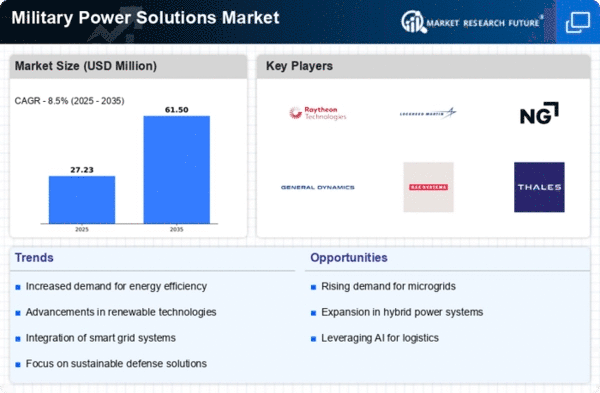
As per MRFR analysis, the Military Power Solutions Market was estimated at 25.1 USD Million in 2024. The Military Power Solutions industry is projected to grow from 27.2 in 2025 to 61.5 by 2035, exhibiting a compound annual growth rate (CAGR) of 8.5 during the forecast period 2025 - 2035.

Key Market Trends & Highlights

The Military Power Solutions Market is poised for substantial growth driven by technological advancements and sustainability initiatives.

  • North America remains the largest market for military power solutions, reflecting robust defense spending and technological investments.
  • The Asia-Pacific region is emerging as the fastest-growing market, driven by increasing military modernization efforts and geopolitical tensions.
  • Military vehicles continue to dominate the market, while the aerospace segment is experiencing rapid growth due to advancements in electric power technologies.
  • Key market drivers include increased defense budgets and a rising demand for energy resilience, emphasizing the importance of sustainable and reliable power solutions.

Market Size & Forecast

2024 Market Size 25.1 (USD Million)
2035 Market Size 61.5 (USD Million)
CAGR (2025 - 2035) 8.5%
Largest Regional Market Share in 2024 North America

Major Players

Raytheon Technologies (US), Lockheed Martin (US), Northrop Grumman (US), General Dynamics (US), BAE Systems (GB), Thales Group (FR), Leonardo S.p.A. (IT), Elbit Systems (IL), Saab AB (SE), Kongsberg Gruppen (NO)

Market Trends

The Military Power Solutions Market is currently experiencing a transformative phase, driven by advancements in technology and the increasing demand for efficient energy solutions in defense applications. As military operations become more complex, the need for reliable and sustainable power sources has intensified. This market encompasses a wide range of products, including portable power systems, energy storage solutions, and renewable energy technologies. The integration of these solutions is crucial for enhancing operational capabilities and ensuring mission success in diverse environments. Moreover, the focus on reducing the carbon footprint of military operations is gaining traction. Governments and defense organizations are increasingly prioritizing environmentally friendly power solutions, which may lead to a shift in procurement strategies. The Military Power Solutions Market appears poised for growth as stakeholders seek innovative approaches to meet the evolving energy demands of modern warfare. This trend suggests a potential for collaboration between military and civilian sectors, fostering the development of cutting-edge technologies that could redefine energy use in defense contexts.

Sustainable Energy Initiatives

The emphasis on sustainability within the Military Power Solutions Market is becoming more pronounced. Defense organizations are exploring renewable energy sources to reduce reliance on traditional fuels. This shift not only addresses environmental concerns but also enhances energy security during operations.

Advancements in Energy Storage Technologies

Innovations in energy storage are reshaping the Military Power Solutions Market. Enhanced battery technologies and energy management systems are enabling military forces to store and utilize energy more efficiently. This development is critical for ensuring power availability in remote and austere environments.

Integration of Smart Technologies

The incorporation of smart technologies into military power solutions is gaining momentum. Smart grids and IoT-enabled devices are being utilized to optimize energy distribution and consumption. This trend indicates a move towards more intelligent and responsive energy systems that can adapt to dynamic operational needs.

Military Power Solutions Market Market Drivers

Geopolitical Tensions

Geopolitical tensions are a significant driver of the Global Military Power Solutions Industry. The ongoing conflicts and territorial disputes in various regions have led to an urgent need for nations to bolster their military capabilities. This heightened focus on defense is expected to propel the market towards an estimated value of 8.66 USD Billion by 2035. Countries are increasingly investing in power solutions that ensure operational continuity and reliability in hostile environments. As military operations become more complex, the demand for robust power systems that can withstand diverse challenges is likely to intensify, further fueling market growth.

Focus on Energy Resilience

The emphasis on energy resilience within military operations is a key factor influencing the Global Military Power Solutions Industry. Armed forces are recognizing the importance of maintaining uninterrupted power supply during missions, which has led to increased investments in reliable power solutions. This focus is particularly critical in remote or austere environments where traditional power sources may be compromised. As a result, the market is witnessing a shift towards portable and adaptable power systems that can be deployed in various scenarios. This trend is expected to contribute to the overall growth of the market, aligning with the projected CAGR of 6.65% from 2025 to 2035.

Increasing Defense Budgets

The Global Military Power Solutions Industry is experiencing a notable surge due to the increasing defense budgets across various nations. Countries are allocating more resources to enhance their military capabilities, which is reflected in the projected market value of 4.26 USD Billion in 2024. This trend is particularly evident in regions such as Asia-Pacific and Europe, where geopolitical tensions have prompted governments to invest heavily in advanced military technologies. As nations prioritize modernization and readiness, the demand for innovative power solutions, including energy-efficient systems and reliable power sources, is expected to rise significantly.

Technological Advancements

Technological advancements play a crucial role in shaping the Global Military Power Solutions Industry. Innovations in energy generation, storage, and distribution are driving the development of more efficient military power systems. For instance, the integration of renewable energy sources, such as solar and wind, into military operations is becoming increasingly prevalent. This shift not only enhances operational efficiency but also aligns with global sustainability goals. As military forces seek to reduce their carbon footprint while maintaining operational readiness, the market is likely to see a compound annual growth rate of 6.65% from 2025 to 2035, indicating a robust future for advanced power solutions.

Emerging Markets and Global Collaboration

Emerging markets are becoming increasingly influential in the Global Military Power Solutions Industry. Countries in regions such as Asia and the Middle East are expanding their military capabilities and seeking advanced power solutions to support their defense initiatives. Collaborative efforts between nations, including joint exercises and technology sharing, are fostering innovation and enhancing the development of military power systems. This collaborative approach is likely to drive market growth as nations work together to address common security challenges. The combined effect of these emerging markets and global partnerships may lead to a more dynamic and competitive landscape in the military power solutions sector.

Market Segment Insights

By Application: Military Vehicles (Largest) vs. AeroSpace (Fastest-Growing)

In the Military Power Solutions Market, the application segment is predominantly led by Military Vehicles, capturing a substantial portion of the market due to advancements in vehicle electrification and power efficiency. Following closely, the Aerospace segment is emerging with a noteworthy share as the demand for advanced military aircraft and drones rises, complementing the evolving defense strategies across nations. Each segment plays a crucial role, with Military Vehicles serving as the backbone of ground operations and Aerospace gaining prominence with its technological advancements.

Military Vehicles (Dominant) vs. Aerospace (Emerging)

Military Vehicles represent the dominant segment within the Military Power Solutions Market, characterized by robust demand for enhanced performance and operational capabilities in combat scenarios. Governments worldwide are investing heavily in modernization programs that focus on integrating advanced power solutions into military fleets, driving the growth of this segment. Conversely, the Aerospace segment, while considered emerging, is rapidly gaining traction as geopolitical tensions necessitate the development of sophisticated aerial platforms. This segment benefits from innovations in energy storage and management, positioning it for exponential growth as military forces seek to enhance their air capabilities.

By Power Source: Internal Combustion Engine (Largest) vs. Electric Power (Fastest-Growing)

The Military Power Solutions Market showcases a diverse distribution of power sources, with the Internal Combustion Engine being the dominant player. This segment accounts for a significant portion of the overall market, benefiting from its established technology and reliability in military applications. Electric Power is emerging as a formidable competitor, attracting attention due to advancements in battery technology and energy efficiency. Its growing share reflects a shift toward more sustainable solutions in military operations, driving interest and investment in this area. The growth trends within the power source segment are greatly influenced by the increasing demand for hybrid systems and renewable energy. The military sector is increasingly focusing on reducing its carbon footprint and enhancing operational flexibility, with Electric Power leading the charge as the fastest-growing segment due to technological innovations and military procurement strategies. Hybrid Systems are also gaining traction, as military organizations seek to optimize performance while balancing fuel costs and environmental considerations.

Internal Combustion Engine (Dominant) vs. Hybrid Systems (Emerging)

The Internal Combustion Engine (ICE) has long held its ground as the dominant power source within the military power solutions market. Renowned for its robust performance and reliability under diverse operational conditions, the ICE remains the backbone of traditional military vehicles and equipment. It offers a well-established supply chain and maintenance infrastructure that supports its widespread use. In contrast, Hybrid Systems represent an emerging trend, blending traditional combustion engines with electric power to optimize fuel efficiency and reduce emissions. These advanced systems are gaining traction due to the military's focus on sustainability and operational efficiency, allowing for simultaneous operation of electric and combustion power. This flexibility enhances the versatility of military equipment and enables mission adaptation without compromising performance.

By End User: Defense Forces (Largest) vs. Government Agencies (Fastest-Growing)

The end user segment of the Military Power Solutions Market is predominantly driven by Defense Forces, which hold the largest market share due to their extensive need for reliable and advanced power solutions. Government Agencies are also significant players, yet their share is increasing rapidly, reflecting their growing involvement in defense initiatives and military modernization programs. Other notable contributors include Private Contractors and Research Institutions, which support the defense sector but are outpaced by the primary end users.

Defense Forces (Dominant) vs. Government Agencies (Emerging)

Defense Forces serve as the dominant end user in the Military Power Solutions Market, owing to their requirement for robust and efficient power solutions that enhance operational readiness and effectiveness. Their significant investments in new technologies drive demand for advanced power systems. On the other hand, Government Agencies represent an emerging segment, reflecting increased defense spending and modernization efforts spurred by geopolitical tensions. They are increasingly focusing on implementing cutting-edge military solutions, propelling growth in this category and creating opportunities for innovation in power solutions.

Get more detailed insights about Military Power Solutions Market Research Report—Global Forecast till 2035

Regional Insights

North America : Dominant Military Power Hub

North America continues to dominate the Military Power Solutions Market, holding a significant market share of 12.55 in 2024. The region's growth is driven by increased defense budgets, technological advancements, and a focus on modernization of military capabilities. Regulatory support from government initiatives further catalyzes demand for innovative power solutions, ensuring that military forces remain equipped with cutting-edge technology. The competitive landscape in North America is robust, featuring key players such as Raytheon Technologies, Lockheed Martin, and Northrop Grumman. These companies are at the forefront of developing advanced military power solutions, leveraging their expertise to meet the evolving needs of defense forces. The presence of a strong industrial base and government contracts ensures sustained growth in this region, solidifying its position as a leader in military power solutions.

Europe : Emerging Defense Technology Leader

Europe's Military Power Solutions Market is projected to reach 7.53 by 2025, driven by increasing geopolitical tensions and a commitment to enhancing defense capabilities. The region is witnessing a surge in demand for advanced military technologies, supported by government initiatives aimed at boosting defense spending. Regulatory frameworks are evolving to facilitate innovation and collaboration among defense contractors, further propelling market growth. Leading countries such as the UK, France, and Germany are pivotal in this landscape, with companies like BAE Systems and Thales Group leading the charge. The competitive environment is characterized by strategic partnerships and collaborations aimed at developing next-generation military power solutions. As European nations prioritize defense readiness, the market is expected to expand significantly, fostering innovation and technological advancements.

Asia-Pacific : Rapidly Growing Defense Sector

The Asia-Pacific region is emerging as a significant player in the Military Power Solutions Market, with a projected size of 4.92 by 2025. The growth is fueled by rising defense budgets, regional security concerns, and a focus on modernization of military forces. Countries in this region are increasingly investing in advanced technologies to enhance their military capabilities, supported by favorable government policies and initiatives. Key players in the Asia-Pacific market include companies like Elbit Systems and Kongsberg Gruppen, which are actively involved in developing innovative military power solutions. The competitive landscape is marked by collaborations and partnerships aimed at leveraging technological advancements. As nations prioritize defense readiness, the market is expected to witness substantial growth, driven by the demand for cutting-edge military technologies.

Middle East and Africa : Emerging Defense Market

The Middle East and Africa region represents a nascent but growing Military Power Solutions Market, with a size of 0.1 by 2025. The growth is primarily driven by increasing defense expenditures and the need for enhanced military capabilities in response to regional conflicts. Governments are focusing on modernizing their armed forces, which is creating demand for advanced military power solutions and technologies. Countries such as the UAE and South Africa are leading the charge in this market, with a focus on acquiring innovative military technologies. The competitive landscape is characterized by partnerships with global defense contractors to enhance local capabilities. As the region continues to develop its defense sector, the demand for military power solutions is expected to rise, fostering growth and innovation in the market.

Key Players and Competitive Insights

The Military Power Solutions Market is characterized by a dynamic competitive landscape, driven by technological advancements and increasing defense budgets across various nations. Key players such as Raytheon Technologies (US), Lockheed Martin (US), and Northrop Grumman (US) are at the forefront, focusing on innovation and strategic partnerships to enhance their operational capabilities. These companies are not only investing in research and development but are also pursuing mergers and acquisitions to consolidate their market positions. The collective strategies of these firms contribute to a competitive environment that is increasingly shaped by technological prowess and collaborative efforts.In terms of business tactics, companies are localizing manufacturing to reduce costs and enhance supply chain efficiency. The market appears moderately fragmented, with several key players exerting substantial influence. This structure allows for a variety of competitive strategies, as firms seek to differentiate themselves through unique offerings and operational efficiencies. The interplay between established companies and emerging players is likely to intensify, further shaping the market dynamics.

In November Raytheon Technologies (US) announced a partnership with a leading AI firm to develop advanced power management systems for military applications. This strategic move is expected to enhance the efficiency and reliability of power solutions, aligning with the growing trend of integrating artificial intelligence into defense technologies. The collaboration signifies Raytheon's commitment to innovation and positions it favorably in a market that increasingly values technological advancements.

In October Lockheed Martin (US) unveiled a new line of modular power systems designed for rapid deployment in various military scenarios. This initiative reflects the company's focus on adaptability and responsiveness to evolving defense needs. By offering customizable solutions, Lockheed Martin aims to capture a larger share of the market, catering to diverse operational requirements while enhancing its competitive edge.

In September Northrop Grumman (US) completed the acquisition of a renewable energy technology firm, signaling a strategic pivot towards sustainable power solutions. This acquisition is likely to bolster Northrop Grumman's portfolio, enabling the company to offer environmentally friendly options in military power solutions. The move aligns with global trends towards sustainability and positions Northrop Grumman as a forward-thinking player in the market.

As of December the Military Power Solutions Market is witnessing trends such as digitalization, sustainability, and the integration of AI technologies. Strategic alliances are becoming increasingly important, as companies recognize the need for collaboration to stay competitive. The shift from price-based competition to a focus on innovation and technology is evident, with firms prioritizing supply chain reliability and advanced solutions. Looking ahead, competitive differentiation is likely to evolve, emphasizing the importance of technological advancements and strategic partnerships in shaping the future landscape.

Key Companies in the Military Power Solutions Market include

Industry Developments

In April 2024, Tekever, a company specializing in uncrewed aerial systems (UAS), introduced its new modular ARX platform in Lisbon, Portugal. The ARX, Tekever's inaugural UAS with swarm capabilities, offers users the flexibility to select from a range of sensors, including EO/IR, LIDAR, SAR, and SIGINT/COMINT/ELINT. The ARX is equipped with advanced onboard artificial intelligence/machine learning (AI/ML) capabilities, SATCOM and mesh connection, and the capability to function in GNSS-denied conditions both at sea and on land. Tekever also provides the "ARX Digital Twin" alongside the ARX launch. This model serves as a digital representation of the system and may be used for simulation, integration, testing, monitoring, and maintenance. The ARX is scheduled to be released in 2025. In February 2024, Vecow Co., Ltd., a group of international specialists in embedded technology, introduced their new Fanless High-Endurance System designed for workstation use. The Vecow HEC-1000 is specifically engineered to be deployed in demanding environments, offering robust computing power based on the 13th Generation Intel® Core™ i9/i7/i5/i3 processor. It is equipped with dependable input/output interfaces, making it ideal for outdoor applications such as Advanced Driver Assistance Systems (ADAS), Autonomous Mobile Robots (AMR), Robotic Control, and rugged Edge Artificial Intelligence (AI) deployments. 

Collins Aerospace (a division of Raytheon) has created a new power module to serve open architecture programs including radar, signal processors, mission computers, and aircraft communication. For platforms working in severe environments with limited space, weight, and power (SWAP), the Collins 3Phase 3U power module provides up to 800 watts of power without the need for extra filtering hardware. On February 2022

Seanergy 2.0, a new lithium-ion (Li-ion) battery system for fully electric and hybrid ships, has been introduced by Saft, a TotalEnergies subsidiary. The marine battery can assist ship owners in lowering their fuel costs, CO2 and NOx emissions, and air pollution without compromising performance or being overly expensive. On June 2022

Enersys announced the successful integration of its ABSL Lithium-ion (Li-ion) batteries into the launch of the James Webb Space Telescope by the National Aeronautics and Space Administration (NASA). The Web space telescope, which replaces the venerable Hubble space telescope, was developed through international cooperation between NASA, the European Space Agency (ESA), the Canadian Space Agency (CSA), and Northrop Grumman, the leading company in the field. On December 2021

Cummins announced the acquisition of Meritor, Inc. had been completed. Through the integration of Meritor's people, products, and skills in axle and brake technology, Cummins will be positioned as a leading provider of integrated powertrain solutions in both internal combustion and electric power applications. On August 2022

Future Outlook

Military Power Solutions Market Future Outlook

The Military Power Solutions Market is projected to grow at an 8.5% CAGR from 2025 to 2035, driven by technological advancements, increasing defense budgets, and the demand for energy-efficient solutions.

New opportunities lie in:

  • Development of modular power systems for rapid deployment
  • Integration of renewable energy sources in military operations
  • Expansion of energy storage solutions for tactical applications

By 2035, the market is expected to be robust, driven by innovation and strategic investments.

Market Segmentation

Military Power Solutions Market End User Outlook

  • Defense Forces
  • Government Agencies
  • Private Contractors
  • Research Institutions
  • International Organizations

Military Power Solutions Market Application Outlook

  • Military Vehicles
  • Aerospace
  • Naval
  • Ground Support Equipment
  • Portable Power Systems

Military Power Solutions Market Power Source Outlook

  • Internal Combustion Engine
  • Electric Power
  • Hybrid Systems
  • Renewable Energy
  • Fuel Cells

Report Scope

MARKET SIZE 202425.1(USD Million)
MARKET SIZE 202527.2(USD Million)
MARKET SIZE 203561.5(USD Million)
COMPOUND ANNUAL GROWTH RATE (CAGR)8.5% (2025 - 2035)
REPORT COVERAGERevenue Forecast, Competitive Landscape, Growth Factors, and Trends
BASE YEAR2024
Market Forecast Period2025 - 2035
Historical Data2019 - 2024
Market Forecast UnitsUSD Million
Key Companies ProfiledRaytheon Technologies (US), Lockheed Martin (US), Northrop Grumman (US), General Dynamics (US), BAE Systems (GB), Thales Group (FR), Leonardo S.p.A. (IT), Elbit Systems (IL), Saab AB (SE), Kongsberg Gruppen (NO)
Segments CoveredApplication, Power Source, End User
Key Market OpportunitiesIntegration of renewable energy sources in Military Power Solutions Market enhances operational efficiency and sustainability.
Key Market DynamicsTechnological advancements drive innovation in military power solutions, enhancing operational efficiency and sustainability.
Countries CoveredNorth America, Europe, APAC, South America, MEA

FAQs

Which type of segment is driving the market?

The nonportable segment is expected to drive the market during the forecasted period.

What is the growth scope of the market?

The global Military Power Solutions market has been growing rapidly over the past few decades and is expected to reach USD 6,258.5 Million by 2030, at a CAGR of 6.7% during the forecast period.

Which segment is expected to register the highest CAGR?

The ground segment is expected to register the highest CAR during the forecast period owing to the increasing demand for military power solutions for military base camps and military vehicles.

Which segment is anticipated to be the fastest-growing segment of the global Military Power Solutions Market?

The fuel cells segment is anticipated to be the fastest-growing segment of the global market for military power solutions.

In Which region is guiding the achievement of the market?

The North American region is expected to be the largest market for Military Power Solutions market during the forecast period.

What can limit the expansion of the global market?

Stringtent military regulations and the high initial cost of development may slow the growth of the Military Power Solutions market during the forecast period.

  1. SECTION I: EXECUTIVE SUMMARY AND KEY HIGHLIGHTS
    1. | 1.1 EXECUTIVE SUMMARY
    2. | 1.1.1 Market Overview
    3. | 1.1.2 Key Findings
    4. | 1.1.3 Market Segmentation
    5. | 1.1.4 Competitive Landscape
    6. | 1.1.5 Challenges and Opportunities
    7. | 1.1.6 Future Outlook
  2. SECTION II: SCOPING, METHODOLOGY AND MARKET STRUCTURE
    1. | 2.1 MARKET INTRODUCTION
    2. | 2.1.1 Definition
    3. | 2.1.2 Scope of the study
    4. |-- 2.1.2.1 Research Objective
    5. |-- 2.1.2.2 Assumption
    6. |-- 2.1.2.3 Limitations
    7. | 2.2 RESEARCH METHODOLOGY
    8. | 2.2.1 Overview
    9. | 2.2.2 Data Mining
    10. | 2.2.3 Secondary Research
    11. | 2.2.4 Primary Research
    12. |-- 2.2.4.1 Primary Interviews and Information Gathering Process
    13. |-- 2.2.4.2 Breakdown of Primary Respondents
    14. | 2.2.5 Forecasting Model
    15. | 2.2.6 Market Size Estimation
    16. |-- 2.2.6.1 Bottom-Up Approach
    17. |-- 2.2.6.2 Top-Down Approach
    18. | 2.2.7 Data Triangulation
    19. | 2.2.8 Validation
  3. SECTION III: QUALITATIVE ANALYSIS
    1. | 3.1 MARKET DYNAMICS
    2. | 3.1.1 Overview
    3. | 3.1.2 Drivers
    4. | 3.1.3 Restraints
    5. | 3.1.4 Opportunities
    6. | 3.2 MARKET FACTOR ANALYSIS
    7. | 3.2.1 Value chain Analysis
    8. | 3.2.2 Porter's Five Forces Analysis
    9. |-- 3.2.2.1 Bargaining Power of Suppliers
    10. |-- 3.2.2.2 Bargaining Power of Buyers
    11. |-- 3.2.2.3 Threat of New Entrants
    12. |-- 3.2.2.4 Threat of Substitutes
    13. |-- 3.2.2.5 Intensity of Rivalry
    14. | 3.2.3 COVID-19 Impact Analysis
    15. |-- 3.2.3.1 Market Impact Analysis
    16. |-- 3.2.3.2 Regional Impact
    17. |-- 3.2.3.3 Opportunity and Threat Analysis
  4. SECTION IV: QUANTITATIVE ANALYSIS
    1. | 4.1 Aerospace & Defense, BY Application (USD Million)
    2. | 4.1.1 Military Vehicles
    3. | 4.1.2 Aerospace
    4. | 4.1.3 Naval
    5. | 4.1.4 Ground Support Equipment
    6. | 4.1.5 Portable Power Systems
    7. | 4.2 Aerospace & Defense, BY Power Source (USD Million)
    8. | 4.2.1 Internal Combustion Engine
    9. | 4.2.2 Electric Power
    10. | 4.2.3 Hybrid Systems
    11. | 4.2.4 Renewable Energy
    12. | 4.2.5 Fuel Cells
    13. | 4.3 Aerospace & Defense, BY End User (USD Million)
    14. | 4.3.1 Defense Forces
    15. | 4.3.2 Government Agencies
    16. | 4.3.3 Private Contractors
    17. | 4.3.4 Research Institutions
    18. | 4.3.5 International Organizations
    19. | 4.4 Aerospace & Defense, BY Region (USD Million)
    20. | 4.4.1 North America
    21. |-- 4.4.1.1 US
    22. |-- 4.4.1.2 Canada
    23. | 4.4.2 Europe
    24. |-- 4.4.2.1 Germany
    25. |-- 4.4.2.2 UK
    26. |-- 4.4.2.3 France
    27. |-- 4.4.2.4 Russia
    28. |-- 4.4.2.5 Italy
    29. |-- 4.4.2.6 Spain
    30. |-- 4.4.2.7 Rest of Europe
    31. | 4.4.3 APAC
    32. |-- 4.4.3.1 China
    33. |-- 4.4.3.2 India
    34. |-- 4.4.3.3 Japan
    35. |-- 4.4.3.4 South Korea
    36. |-- 4.4.3.5 Malaysia
    37. |-- 4.4.3.6 Thailand
    38. |-- 4.4.3.7 Indonesia
    39. |-- 4.4.3.8 Rest of APAC
    40. | 4.4.4 South America
    41. |-- 4.4.4.1 Brazil
    42. |-- 4.4.4.2 Mexico
    43. |-- 4.4.4.3 Argentina
    44. |-- 4.4.4.4 Rest of South America
    45. | 4.4.5 MEA
    46. |-- 4.4.5.1 GCC Countries
    47. |-- 4.4.5.2 South Africa
    48. |-- 4.4.5.3 Rest of MEA
  5. SECTION V: COMPETITIVE ANALYSIS
    1. | 5.1 Competitive Landscape
    2. | 5.1.1 Overview
    3. | 5.1.2 Competitive Analysis
    4. | 5.1.3 Market share Analysis
    5. | 5.1.4 Major Growth Strategy in the Aerospace & Defense
    6. | 5.1.5 Competitive Benchmarking
    7. | 5.1.6 Leading Players in Terms of Number of Developments in the Aerospace & Defense
    8. | 5.1.7 Key developments and growth strategies
    9. |-- 5.1.7.1 New Product Launch/Service Deployment
    10. |-- 5.1.7.2 Merger & Acquisitions
    11. |-- 5.1.7.3 Joint Ventures
    12. | 5.1.8 Major Players Financial Matrix
    13. |-- 5.1.8.1 Sales and Operating Income
    14. |-- 5.1.8.2 Major Players R&D Expenditure. 2023
    15. | 5.2 Company Profiles
    16. | 5.2.1 Raytheon Technologies (US)
    17. |-- 5.2.1.1 Financial Overview
    18. |-- 5.2.1.2 Products Offered
    19. |-- 5.2.1.3 Key Developments
    20. |-- 5.2.1.4 SWOT Analysis
    21. |-- 5.2.1.5 Key Strategies
    22. | 5.2.2 Lockheed Martin (US)
    23. |-- 5.2.2.1 Financial Overview
    24. |-- 5.2.2.2 Products Offered
    25. |-- 5.2.2.3 Key Developments
    26. |-- 5.2.2.4 SWOT Analysis
    27. |-- 5.2.2.5 Key Strategies
    28. | 5.2.3 Northrop Grumman (US)
    29. |-- 5.2.3.1 Financial Overview
    30. |-- 5.2.3.2 Products Offered
    31. |-- 5.2.3.3 Key Developments
    32. |-- 5.2.3.4 SWOT Analysis
    33. |-- 5.2.3.5 Key Strategies
    34. | 5.2.4 General Dynamics (US)
    35. |-- 5.2.4.1 Financial Overview
    36. |-- 5.2.4.2 Products Offered
    37. |-- 5.2.4.3 Key Developments
    38. |-- 5.2.4.4 SWOT Analysis
    39. |-- 5.2.4.5 Key Strategies
    40. | 5.2.5 BAE Systems (GB)
    41. |-- 5.2.5.1 Financial Overview
    42. |-- 5.2.5.2 Products Offered
    43. |-- 5.2.5.3 Key Developments
    44. |-- 5.2.5.4 SWOT Analysis
    45. |-- 5.2.5.5 Key Strategies
    46. | 5.2.6 Thales Group (FR)
    47. |-- 5.2.6.1 Financial Overview
    48. |-- 5.2.6.2 Products Offered
    49. |-- 5.2.6.3 Key Developments
    50. |-- 5.2.6.4 SWOT Analysis
    51. |-- 5.2.6.5 Key Strategies
    52. | 5.2.7 Leonardo S.p.A. (IT)
    53. |-- 5.2.7.1 Financial Overview
    54. |-- 5.2.7.2 Products Offered
    55. |-- 5.2.7.3 Key Developments
    56. |-- 5.2.7.4 SWOT Analysis
    57. |-- 5.2.7.5 Key Strategies
    58. | 5.2.8 Elbit Systems (IL)
    59. |-- 5.2.8.1 Financial Overview
    60. |-- 5.2.8.2 Products Offered
    61. |-- 5.2.8.3 Key Developments
    62. |-- 5.2.8.4 SWOT Analysis
    63. |-- 5.2.8.5 Key Strategies
    64. | 5.2.9 Saab AB (SE)
    65. |-- 5.2.9.1 Financial Overview
    66. |-- 5.2.9.2 Products Offered
    67. |-- 5.2.9.3 Key Developments
    68. |-- 5.2.9.4 SWOT Analysis
    69. |-- 5.2.9.5 Key Strategies
    70. | 5.2.10 Kongsberg Gruppen (NO)
    71. |-- 5.2.10.1 Financial Overview
    72. |-- 5.2.10.2 Products Offered
    73. |-- 5.2.10.3 Key Developments
    74. |-- 5.2.10.4 SWOT Analysis
    75. |-- 5.2.10.5 Key Strategies
    76. | 5.3 Appendix
    77. | 5.3.1 References
    78. | 5.3.2 Related Reports

Aerospace & Defense Market Segmentation

Aerospace & Defense By Application (USD Million, 2025-2035)

  • Military Vehicles
  • Aerospace
  • Naval
  • Ground Support Equipment
  • Portable Power Systems

Aerospace & Defense By Power Source (USD Million, 2025-2035)

  • Internal Combustion Engine
  • Electric Power
  • Hybrid Systems
  • Renewable Energy
  • Fuel Cells

Aerospace & Defense By End User (USD Million, 2025-2035)

  • Defense Forces
  • Government Agencies
  • Private Contractors
  • Research Institutions
  • International Organizations
Infographic

Free Sample Request

Kindly complete the form below to receive a free sample of this Report

Get Free Sample

Customer Strories

Compare Licence

×
Features License Type
Single User Multiuser License Enterprise User
Price $4,950 $5,950 $7,250
Maximum User Access Limit 1 User Upto 10 Users Unrestricted Access Throughout the Organization
Free Customization
Direct Access to Analyst
Deliverable Format
Platform Access
Discount on Next Purchase 10% 15% 15%
Printable Versions