×
Request Free Sample ×

Kindly complete the form below to receive a free sample of this Report

* Please use a valid business email

Leading companies partner with us for data-driven Insights

clients tt-cursor
Hero Background
English
Chinese
French
Japanese
Korean
German
Spanish

Interactive Display Market Analysis

ID: MRFR/SEM/6570-HCR
200 Pages
Shubham Munde
February 2026

Interactive Display Market Size, Share and Research Report: By Technology (LCD, LED, Projection, OLED, Interactive Touchscreen), By Application (Education, Retail, Corporate, Healthcare, Entertainment), By End Use (Permanent Installations, Portable Installations, Rental Services), By Display Type (Interactive Whiteboards, Digital Signage, Video Walls, Tablets), and By Regional (North America, Europe, South America, Asia Pacific, Middle East and Africa) - Industry Forecast Till 2035

Share:
Download PDF ×

We do not share your information with anyone. However, we may send you emails based on your report interest from time to time. You may contact us at any time to opt-out.

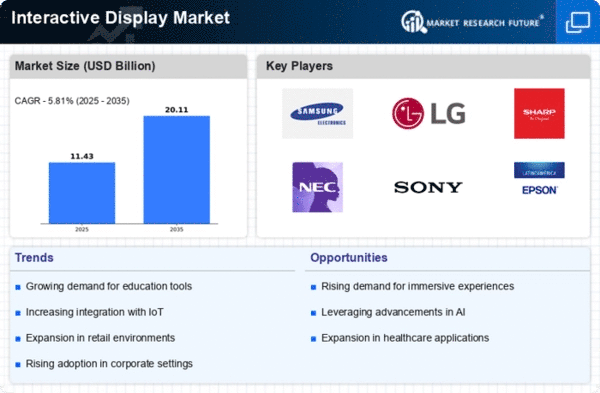
Interactive Display Market Infographic
Purchase Options

Market Analysis

In-depth Analysis of Interactive Display Market Industry Landscape

The interactive display industry is expanding and changing quickly thanks to new technologies and a growing need for immersive and collaborative solutions in many fields. It's clear that the market gains from the growing use of digital displays in business, healthcare, education, and stores. Interactive displays have become very popular in the education field because they make learning more fun and interesting. Interactive displays help people work together in meetings and talks, so businesses are getting more of them. By letting people communicate with material in real time, these displays make conversation more interesting and lively. They also spark new ideas and innovations. Businesses are changing how they talk to each other and show information because of the move toward engaging tools. The healthcare industry has also accepted and started to use interactive displays for teaching doctors, making diagnoses, and teaching patients. Interactively visualizing difficult medical information helps both doctors and people understand it better. The main reason healthcare facilities use interactive displays is that they get patients more involved and improve their health.

The store business is changing because of engaging displays that make shopping more fun. With these displays, stores can make personalized and engaging marketing efforts that get people interested in their products and give them useful information about them. Interactive ones are very useful because they change the way people act and bring in more sales.

The rate of growth of the world market depends on how quickly technology improves. Among other things, technologies like virtual reality (VR) and augmented reality (AR) have made dynamic displays even more useful. This has made it possible to make experiences that are more complicated and engaging, which has led to more demand in many areas. In order to stay ahead of the competition, big names in the interactive display market are always coming up with new ideas. They put a lot of effort into research and development to meet the needs of many different businesses, add new features, and make things run better. People who use technology and people who sell it are working together to make unique solutions. This is leading to new ideas and market growth. Growing technologies are coming together with digital displays, which means the market is ready to grow even more. When the IoT and AI work together, they should open up new options that will make dynamic displays even more important to our daily lives. Businesses and institutions are becoming more aware of how useful interactive displays are for improving communication, teamwork, and participation. This will cause the market to change even more, opening up new possibilities and encouraging more innovation in the interactive display area.

Author
Shubham Munde
Team Lead - Research

Shubham brings over 7 years of expertise in Market Intelligence and Strategic Consulting, with a strong focus on the Automotive, Aerospace, and Defense sectors. Backed by a solid foundation in semiconductors, electronics, and software, he has successfully delivered high-impact syndicated and custom research on a global scale. His core strengths include market sizing, forecasting, competitive intelligence, consumer insights, and supply chain mapping. Widely recognized for developing scalable growth strategies, Shubham empowers clients to navigate complex markets and achieve a lasting competitive edge. Trusted by start-ups and Fortune 500 companies alike, he consistently converts challenges into strategic opportunities that drive sustainable growth.

Leave a Comment

FAQs

What is the projected market valuation of the Interactive Display Market by 2035?

<p>The Interactive Display Market is projected to reach a valuation of 20.11 USD Billion by 2035.</p>

What was the market valuation of the Interactive Display Market in 2024?

<p>In 2024, the overall market valuation was 10.8 USD Billion.</p>

What is the expected CAGR for the Interactive Display Market from 2025 to 2035?

<p>The expected CAGR for the Interactive Display Market during the forecast period 2025 - 2035 is 5.81%.</p>

Which application segment is expected to grow the most in the Interactive Display Market?

<p>The Corporate application segment is anticipated to grow from 3.0 USD Billion in 2024 to 5.5 USD Billion by 2035.</p>

How does the Healthcare segment perform in the Interactive Display Market?

<p>The Healthcare segment was valued at 1.5 USD Billion in 2024 and is projected to reach 3.0 USD Billion by 2035.</p>

What are the key technologies driving the Interactive Display Market?

<p>Key technologies include LCD, LED, OLED, Projection, and Interactive Whiteboards, with LCD expected to grow from 3.5 USD Billion to 6.5 USD Billion by 2035.</p>

Which companies are leading the Interactive Display Market?

<p>Key players in the market include Samsung Electronics, LG Electronics, Sharp Corporation, and Sony Corporation.</p>

What is the projected growth for the Retail segment in the Interactive Display Market?

<p>The Retail segment is expected to grow from 2.0 USD Billion in 2024 to 3.5 USD Billion by 2035.</p>

How does the Industrial end-use segment perform in the Interactive Display Market?

<p>The Industrial end-use segment was valued at 2.16 USD Billion in 2024 and is projected to reach 4.12 USD Billion by 2035.</p>

What is the expected growth trajectory for the Transportation end-use segment?

<p>The Transportation end-use segment is anticipated to grow from 1.1 USD Billion in 2024 to 2.63 USD Billion by 2035.</p>

Market Summary

As per MRFR analysis, the Interactive Display Market Size was estimated at 10.8 USD Billion in 2024. The Interactive Display industry is projected to grow from 11.43 USD Billion in 2025 to 20.11 USD Billion by 2035, exhibiting a compound annual growth rate (CAGR) of 5.81% during the forecast period 2025 - 2035.

Key Market Trends & Highlights

The Interactive Display Market is experiencing robust growth driven by technological advancements and evolving user needs.

  • North America remains the largest market for interactive displays, driven by significant investments in education and corporate sectors. The Asia-Pacific region is emerging as the fastest-growing market, fueled by increasing adoption of interactive technologies in various industries. The education segment continues to dominate the market, while the corporate segment is witnessing the fastest growth due to enhanced collaboration tools. Key market drivers include the rising demand for interactive learning environments and the expansion of retail and advertising applications.

Market Size & Forecast

2024 Market Size 10.8 (USD Billion)
2035 Market Size 20.11 (USD Billion)
CAGR (2025 - 2035) 5.81%
Largest Regional Market Share in 2024 North America

Major Players

Samsung Electronics (KR), LG Electronics (KR), Sharp Corporation (JP), NEC Corporation (JP), Sony Corporation (JP), Epson (JP), ViewSonic (US), BenQ (TW), Cisco Systems (US), Microsoft Corporation (US). These companies are among leading digital display manufacturers and providers of interactive display system solutions globally.

Market Trends

The Interactive Display Market is currently experiencing a dynamic evolution, driven by advancements in technology and changing consumer preferences. As organizations increasingly seek innovative ways to engage audiences, interactive digital screen technologies are becoming integral to various sectors, including education, retail, and corporate environments. These displays facilitate immersive experiences, allowing users to interact with content in real-time, which enhances learning and engagement through interactive touchscreen display platforms. Furthermore, the integration of artificial intelligence and machine learning into these systems appears to be reshaping how information is presented and consumed, potentially leading to more personalized user experiences. In retail environments, the growing deployment of interactive retail displays and interactive product display solutions is transforming customer engagement strategies. In addition to technological advancements, the growing emphasis on remote collaboration and digital communication is influencing the interactive display market. Businesses are increasingly adopting interactive displays for business to enhance virtual meetings and presentations, thereby improving productivity and collaboration among teams. The versatility of interactive touch screen displays, which can serve multiple functions from advertising to training tools, suggests a broadening scope of applications.

Technological Integration

The incorporation of advanced technologies such as artificial intelligence and augmented reality is transforming the interactive display market. These innovations enable more engaging and interactive experiences, allowing users to interact with content in novel ways through interactive lcd display and interactive wall display formats.

Remote Collaboration

The rise of remote work and digital communication is driving demand for touch screen interactive display solutions that facilitate virtual meetings and presentations. This trend highlights the importance of collaboration display market solutions in enhancing productivity across enterprises.

Diverse Applications

Interactive displays are finding applications across various sectors, including education, retail, and corporate environments. Educational institutions are increasingly adopting touchscreen interactive displays education use UK models, while retailers deploy interactive retail display systems to enhance customer engagement.

Interactive Display Market Market Drivers

Market Growth Projections

The Global Interactive Display Market Industry is poised for substantial growth, with projections indicating a market value of 17.5 USD Billion in 2024 and an anticipated increase to 35 USD Billion by 2035. This growth trajectory suggests a compound annual growth rate of 6.49% from 2025 to 2035, reflecting the increasing adoption of interactive display technologies across various sectors. Factors contributing to this growth include advancements in display technologies, rising demand for interactive solutions in education and retail, and the expanding applications in corporate and healthcare environments. These projections highlight the potential for innovation and investment within the Global Interactive Display Market Industry.

Growth in Retail Sector Engagement

The Global Interactive Display Market Industry is significantly influenced by the retail sector's growing emphasis on customer engagement. Retailers are increasingly utilizing interactive displays to create immersive shopping experiences that captivate consumers. For example, interactive kiosks and digital signage provide personalized product information and promotions, enhancing customer interaction and satisfaction. This trend is underscored by the anticipated market growth to 35 USD Billion by 2035, suggesting a strong correlation between interactive display adoption and retail performance. As retailers seek to differentiate themselves in a competitive landscape, the demand for innovative interactive display solutions is expected to rise, further propelling the Global Interactive Display Market Industry.

Emerging Applications in Healthcare

The Global Interactive Display Market Industry is experiencing growth due to emerging applications in the healthcare sector. Interactive displays are increasingly utilized for patient engagement, medical training, and telemedicine solutions. For instance, hospitals are adopting interactive kiosks to provide patients with information and streamline check-in processes. Additionally, interactive displays are used in medical training programs to simulate real-life scenarios, enhancing learning outcomes for healthcare professionals. This trend indicates a diversification of the market, as healthcare organizations recognize the benefits of interactive display technologies. The integration of these solutions is likely to contribute to the overall expansion of the Global Interactive Display Market Industry.

Increased Adoption in Corporate Environments

The Global Interactive Display Market Industry is witnessing increased adoption of interactive displays in corporate environments, where they serve as essential tools for collaboration and communication. Businesses utilize interactive displays for presentations, meetings, and training sessions, enhancing productivity and engagement among employees. For example, companies are integrating interactive whiteboards and video conferencing solutions to facilitate remote collaboration. This trend aligns with the overall market growth, as organizations recognize the value of interactive displays in improving operational efficiency. As the corporate sector continues to embrace these technologies, the Global Interactive Display Market Industry is expected to expand, reflecting the evolving needs of modern workplaces.

Rising Demand for Interactive Learning Solutions

The Global Interactive Display Market Industry experiences a notable surge in demand for interactive learning solutions, particularly in educational institutions. As schools and universities increasingly adopt technology-driven teaching methods, interactive displays facilitate engaging and immersive learning experiences. For instance, the integration of interactive whiteboards and touchscreens in classrooms enhances student participation and collaboration. This trend is reflected in the projected market value of 17.5 USD Billion in 2024, indicating a robust growth trajectory. The emphasis on interactive learning tools is likely to drive further investments in the Global Interactive Display Market Industry, fostering innovation and development in educational technologies.

Technological Advancements in Display Technologies

Technological advancements play a pivotal role in shaping the Global Interactive Display Market Industry. Innovations such as high-resolution displays, touch-sensitive interfaces, and augmented reality capabilities enhance the functionality and appeal of interactive displays. For instance, the introduction of OLED technology has improved image quality and energy efficiency, making interactive displays more attractive to consumers and businesses alike. As these technologies evolve, they are likely to drive market growth, with a projected compound annual growth rate of 6.49% from 2025 to 2035. This continuous evolution in display technologies is expected to create new opportunities within the Global Interactive Display Market Industry, fostering a competitive environment.

Market Segment Insights

By Application: Education (Largest) vs. Healthcare (Fastest-Growing)

<p>In the Interactive Display Market, the application segment is primarily dominated by Education, which holds the largest market share. This dominance can be attributed to the increasing integration of interactive technologies in classrooms and educational institutions, enhancing engagement and learning outcomes. Corporate application follows closely, supported by the demand for collaborative and interactive tools in modern workplaces. Other segments, particularly Healthcare and Retail, hold significant shares but are growing at a slower pace compared to Education and Corporate. Growth trends in the Interactive Display Market show a remarkable surge in the Healthcare segment, which is currently the fastest-growing application area. The rising need for digital solutions in telemedicine, patient education, and healthcare presentations drives this growth. Additionally, Retail is also witnessing an uptick as businesses adopt interactive displays to enhance customer experience and drive sales. Emerging technologies and increased investment in digital solutions are crucial factors propelling growth across these segments.</p>

<p>Education (Dominant) vs. Healthcare (Emerging)</p>

<p>The Education segment in the Interactive Display Market is characterized by its widespread adoption in institutions ranging from primary schools to universities. These displays facilitate interactive learning, supporting various teaching methods and catering to diverse learning styles. Their integration into classrooms has transformed the educational experience, making it more engaging for students. On the other hand, the Healthcare segment is emerging rapidly as a key player, driven by advancements in digital health solutions. Interactive displays are increasingly used for patient engagement, enhancing communication during consultations, and improving presentations at medical conferences. This segment's growth is supported by a rising awareness of the benefits of interactive technologies in improving patient outcomes and expediting the dissemination of information.</p>

By Technology: LCD (Largest) vs. LED (Fastest-Growing)

The interactive display market showcases a diverse range of technologies, with LCD leading due to widespread adoption and cost efficiency. Interactive LCD display solutions remain popular in education and corporate environments.. Following closely is the LED technology, which, although relatively newer in this segment, is gaining traction due to its superior brightness, energy efficiency, and decreasing costs. <br>As consumers demand more immersive experiences, the trend is shifting towards more advanced technologies, such as OLED and interactive whiteboards, which are capitalizing on the growth of digital collaboration tools. The rising interest in interactive learning and engagement strategies is further driving the adoption of these technologies, especially among educational institutions and corporate settings eager to enhance interactivity in their presentations and training sessions.

Technology: LCD (Dominant) vs. LED (Emerging)

LCD remains dominant due to affordability and versatility, while OLED is emerging for premium applications requiring high visual fidelity. These trends are contributing to the growth of the <a href="https://www.marketresearchfuture.com/reports/interactive-flat-panel-display-market-33797" target="_blank" title="interactive flat panel display">interactive flat panel display</a> market globally. It offers vibrant colors and resolutions suitable for various applications. In contrast, OLED technology, while emerging, brings a revolutionary change with its ability to deliver superior image quality, deeper blacks, and wider viewing angles without the blurring typical of traditional displays. Although still capturing a smaller market share, OLED is rapidly becoming popular in high-end applications where visual fidelity is paramount, suggesting that as manufacturing costs decline, OLED could carve out a more significant niche in the interactive display space.

By End Use: Commercial (Largest) vs. Residential (Fastest-Growing)

In the Interactive Display Market, The Commercial segment dominates the interactive display market, driven by applications such as interactive wall display, digital signage, and collaborative tools. Various applications such as interactive kiosks, digital signage, and collaborative tools contribute to the commercial sector's dominance. The Residential segment, while smaller, is emerging rapidly due to advancements in <a href="https://www.marketresearchfuture.com/reports/smart-home-market-974" target="_blank" title="smart home">smart home</a> technologies and increasing consumer demand for interactive entertainment solutions.

Commercial (Dominant) vs. Residential (Emerging)

The commercial segment of the Interactive Display Market stands out as the dominant player, fueled by its application in settings such as conference rooms, hotels, and retail spaces. Businesses utilize interactive displays to elevate customer experience and streamline operations. In contrast, the residential segment is emerging rapidly, propelled by increasing consumer interests in smart home technologies and entertainment systems. Consumers are increasingly adopting interactive displays for home theaters and gaming, indicating a promising growth trajectory for this segment.

Get more detailed insights about Interactive Display Market Research Report - Forecast till 2035

Regional Insights

North America : Market Leader in Innovation

North America continues to lead the interactive display market, holding a significant share of 5.4 in 2024. North America continues to lead the interactive display market, driven by advanced adoption of interactive display system technologies across education and corporate sectors. Regulatory support for digital transformation initiatives further fuels this growth, as businesses and educational institutions invest in interactive technologies to improve learning and collaboration.

The competitive landscape is robust, with key players like Samsung Electronics, LG Electronics, and Microsoft Corporation dominating the market. The U.S. stands out as a leader, leveraging its technological advancements and strong infrastructure. Companies are focusing on innovation and user experience, ensuring that North America remains at the forefront of the interactive display market.

Europe : Emerging Market with Potential

Europe's interactive display market is poised for growth, with a market size of 3.2 in 2024. Europe is emerging as a high-growth region, supported by digital education initiatives and increasing focus on durability of interactive displays UK, especially in institutional deployments. Regulatory frameworks promoting digital education and smart city initiatives are key catalysts for this growth, encouraging the adoption of interactive technologies across various sectors.

Leading countries such as Germany, the UK, and France are at the forefront of this market, with a competitive landscape featuring major players like LG Electronics and Sharp Corporation. The presence of innovative startups and established firms fosters a dynamic environment, ensuring that Europe remains a significant player in The Interactive Display. "The European market is witnessing a surge in demand for interactive solutions, driven by educational reforms and digital transformation initiatives," European Commission report.

Asia-Pacific : Rapid Growth and Adoption

The Asia-Pacific region, with a market size of 1.8 in 2024, is experiencing rapid growth in the interactive display market. Asia-Pacific is witnessing rapid expansion due to government-led digitalization programs and strong participation from digital display manufacturers. Governments are implementing policies to enhance digital literacy, which is driving demand for interactive displays in classrooms and workplaces.

Countries like China, Japan, and India are leading the charge, with significant contributions from local manufacturers and global players like Epson and ViewSonic. The competitive landscape is evolving, with a mix of established brands and emerging companies focusing on innovation and affordability. This dynamic environment positions Asia-Pacific as a key player in The Interactive Display.

Middle East and Africa : Emerging Market Opportunities

The Middle East and Africa region, with a market size of 0.5 in 2024, presents untapped potential for the interactive display market. MEA presents untapped potential as governments invest in education, retail digitization, and smart infrastructure supported by interactive digital display solutions. Governments are recognizing the importance of technology in enhancing learning and business operations, leading to supportive policies and initiatives.

Countries like South Africa and the UAE are emerging as key players, with a growing presence of international brands and local manufacturers. The competitive landscape is gradually evolving, with companies focusing on providing cost-effective solutions tailored to regional needs. This positions the Middle East and Africa as a promising market for interactive displays in the coming years.

Key Players and Competitive Insights

The interactive display market is characterized by rapid innovation and competition. Major players are investing in advanced interactive monitors, AI-enabled platforms, and scalable interactive display system architectures to strengthen market positioning. Key players such as Samsung Electronics (KR), LG Electronics (KR), and Sharp Corporation (JP) are at the forefront, each adopting distinct strategies to enhance their market positioning. Samsung Electronics (KR) emphasizes innovation through its development of advanced display technologies, while LG Electronics (KR) focuses on expanding its product portfolio to include more sustainable options. Sharp Corporation (JP) appears to be leveraging strategic partnerships to enhance its market reach, collectively shaping a competitive environment that is increasingly focused on technological differentiation and customer-centric solutions.
In terms of business tactics, companies are localizing manufacturing to reduce costs and optimize supply chains, which is particularly relevant in the context of global economic fluctuations. The market structure is moderately fragmented, with several key players exerting considerable influence. This fragmentation allows for a variety of competitive strategies, as companies seek to carve out niche markets while also competing on broader fronts.
In November 2025, LG Electronics (KR) announced a partnership with a leading educational technology firm to develop interactive displays tailored for classrooms. This strategic move is significant as it not only expands LG's footprint in the education sector but also aligns with the growing trend of digital learning environments. By focusing on this niche, LG is likely to enhance its brand recognition and customer loyalty in a rapidly evolving market.
In October 2025, Samsung Electronics (KR) unveiled its latest line of interactive displays featuring AI-driven capabilities designed for corporate environments. This launch is pivotal, as it positions Samsung as a leader in integrating artificial intelligence into display technology, potentially transforming how businesses engage with their clients and employees. The emphasis on AI suggests a shift towards more intelligent, responsive systems that could redefine user experiences.
In September 2025, Sharp Corporation (JP) expanded its manufacturing capabilities in Southeast Asia, aiming to meet the rising demand for interactive displays in emerging markets. This expansion is crucial, as it not only enhances Sharp's production efficiency but also allows the company to respond more swiftly to regional market needs, thereby strengthening its competitive edge.
As of December 2025, the Interactive Display Market is witnessing trends such as digitalization, sustainability, and AI integration, which are reshaping competitive dynamics. Strategic alliances are becoming increasingly important, as companies collaborate to leverage complementary strengths. The competitive differentiation is likely to evolve from traditional price-based competition towards a focus on innovation, advanced technology, and reliable supply chains. This shift indicates a future where companies that prioritize technological advancements and sustainable practices may gain a significant advantage in the marketplace.

Key Companies in the Interactive Display Market include

Industry Developments

Industry developments continue to reinforce the interactive display market, with innovations in AI-powered displays, large-format interactive touch screen displays, and enhanced collaboration platforms.

Sharp's PN‑LM Series AQUOS BOARD® collaboration displays, designed for innovative cooperation and digital signage, were introduced in May 2025. The new LD‑AF all-in-one Direct View LED series, which offers smooth integration and reliable system control, was released in April. Sharp unveiled the PN-LA AQUOS BOARD® range of safe Windows 11 Pro internal PCs earlier in January 2024.

At ISE 2025 in January 2025, Sharp NEC Display Solutions made their debut with entirely Sharp-branded MultiSync® large-format screens, focusing on ease of installation, safe interoperability, and efficiency in commercial settings.

At InfoComm 2024 in June 2024, Samsung Electronics also demonstrated its SmartThings Pro platform, Color E-Paper signage, and AI-powered upgrades to its interactive whiteboard portfolio. Samsung unveiled the 65- to 86-inch WAF Interactive Display Market (powered by Android 14 with AI Class Assistant) and next-generation signs, including 115-inch 4K Smart signs and 5K UHD versions, at ISE 2025.

The market for interactive displays was estimated by worldwide studies to be worth USD 45–48 billion in December 2024. It is expected to increase to USD 71–91 billion by 2030–2032 at a compound annual growth rate (CAGR) of ~8–9 percent, driven by digital engagement in retail, business, healthcare, and education.

With portrait mode and improved touch and video conferencing features, Microsoft's third-generation Surface Hub 3 (50" and 85" interactive boards) was introduced in 2023 to meet business collaboration demands.


Future Outlook

Interactive Display Market Future Outlook

The Interactive Display Market is projected to grow at a 5.81% CAGR from 2025 to 2035, driven by technological advancements, increasing demand for interactive learning, and enhanced user engagement.

New opportunities lie in:

  • <p>Integration of AI-driven analytics for personalized user experiences. Expansion into smart retail environments with interactive kiosks. Development of immersive virtual reality displays for training applications.</p>

By 2035, the market is expected to achieve substantial growth, solidifying its role in various sectors.

Market Segmentation

Interactive Display Market End Use Outlook

  • Commercial
  • Residential
  • Industrial
  • Government
  • Transportation

Interactive Display Market Technology Outlook

  • LCD
  • LED
  • OLED
  • Projection
  • Interactive Whiteboard

Interactive Display Market Application Outlook

  • Education
  • Corporate
  • Healthcare
  • Retail
  • Entertainment

Report Scope

MARKET SIZE 2024 10.8(USD Billion)
MARKET SIZE 2025 11.43(USD Billion)
MARKET SIZE 2035 20.11(USD Billion)
COMPOUND ANNUAL GROWTH RATE (CAGR) 5.81% (2025 - 2035)
REPORT COVERAGE Revenue Forecast, Competitive Landscape, Growth Factors, and Trends
BASE YEAR 2024
Market Forecast Period 2025 - 2035
Historical Data 2019 - 2024
Market Forecast Units USD Billion
Key Companies Profiled Samsung Electronics (KR), LG Electronics (KR), Sharp Corporation (JP), NEC Corporation (JP), Sony Corporation (JP), Epson (JP), ViewSonic (US), BenQ (TW), Acer Inc. (TW)
Segments Covered Application, Technology, End Use
Key Market Opportunities Integration of artificial intelligence enhances user engagement in the Interactive Display Market.
Key Market Dynamics Rising demand for interactive displays drives innovation and competition among technology providers and educational institutions.
Countries Covered North America, Europe, APAC, South America, MEA

FAQs

What is the projected market valuation of the Interactive Display Market by 2035?

<p>The Interactive Display Market is projected to reach a valuation of 20.11 USD Billion by 2035.</p>

What was the market valuation of the Interactive Display Market in 2024?

<p>In 2024, the overall market valuation was 10.8 USD Billion.</p>

What is the expected CAGR for the Interactive Display Market from 2025 to 2035?

<p>The expected CAGR for the Interactive Display Market during the forecast period 2025 - 2035 is 5.81%.</p>

Which application segment is expected to grow the most in the Interactive Display Market?

<p>The Corporate application segment is anticipated to grow from 3.0 USD Billion in 2024 to 5.5 USD Billion by 2035.</p>

How does the Healthcare segment perform in the Interactive Display Market?

<p>The Healthcare segment was valued at 1.5 USD Billion in 2024 and is projected to reach 3.0 USD Billion by 2035.</p>

What are the key technologies driving the Interactive Display Market?

<p>Key technologies include LCD, LED, OLED, Projection, and Interactive Whiteboards, with LCD expected to grow from 3.5 USD Billion to 6.5 USD Billion by 2035.</p>

Which companies are leading the Interactive Display Market?

<p>Key players in the market include Samsung Electronics, LG Electronics, Sharp Corporation, and Sony Corporation.</p>

What is the projected growth for the Retail segment in the Interactive Display Market?

<p>The Retail segment is expected to grow from 2.0 USD Billion in 2024 to 3.5 USD Billion by 2035.</p>

How does the Industrial end-use segment perform in the Interactive Display Market?

<p>The Industrial end-use segment was valued at 2.16 USD Billion in 2024 and is projected to reach 4.12 USD Billion by 2035.</p>

What is the expected growth trajectory for the Transportation end-use segment?

<p>The Transportation end-use segment is anticipated to grow from 1.1 USD Billion in 2024 to 2.63 USD Billion by 2035.</p>

  1. SECTION I: EXECUTIVE SUMMARY AND KEY HIGHLIGHTS
    1. | 1.1 EXECUTIVE SUMMARY
    2. | | 1.1.1 Market Overview
    3. | | 1.1.2 Key Findings
    4. | | 1.1.3 Market Segmentation
    5. | | 1.1.4 Competitive Landscape
    6. | | 1.1.5 Challenges and Opportunities
    7. | | 1.1.6 Future Outlook
  2. SECTION II: SCOPING, METHODOLOGY AND MARKET STRUCTURE
    1. | 2.1 MARKET INTRODUCTION
    2. | | 2.1.1 Definition
    3. | | 2.1.2 Scope of the study
    4. | | | 2.1.2.1 Research Objective
    5. | | | 2.1.2.2 Assumption
    6. | | | 2.1.2.3 Limitations
    7. | 2.2 RESEARCH METHODOLOGY
    8. | | 2.2.1 Overview
    9. | | 2.2.2 Data Mining
    10. | | 2.2.3 Secondary Research
    11. | | 2.2.4 Primary Research
    12. | | | 2.2.4.1 Primary Interviews and Information Gathering Process
    13. | | | 2.2.4.2 Breakdown of Primary Respondents
    14. | | 2.2.5 Forecasting Model
    15. | | 2.2.6 Market Size Estimation
    16. | | | 2.2.6.1 Bottom-Up Approach
    17. | | | 2.2.6.2 Top-Down Approach
    18. | | 2.2.7 Data Triangulation
    19. | | 2.2.8 Validation
  3. SECTION III: QUALITATIVE ANALYSIS
    1. | 3.1 MARKET DYNAMICS
    2. | | 3.1.1 Overview
    3. | | 3.1.2 Drivers
    4. | | 3.1.3 Restraints
    5. | | 3.1.4 Opportunities
    6. | 3.2 MARKET FACTOR ANALYSIS
    7. | | 3.2.1 Value chain Analysis
    8. | | 3.2.2 Porter's Five Forces Analysis
    9. | | | 3.2.2.1 Bargaining Power of Suppliers
    10. | | | 3.2.2.2 Bargaining Power of Buyers
    11. | | | 3.2.2.3 Threat of New Entrants
    12. | | | 3.2.2.4 Threat of Substitutes
    13. | | | 3.2.2.5 Intensity of Rivalry
    14. | | 3.2.3 COVID-19 Impact Analysis
    15. | | | 3.2.3.1 Market Impact Analysis
    16. | | | 3.2.3.2 Regional Impact
    17. | | | 3.2.3.3 Opportunity and Threat Analysis
  4. SECTION IV: QUANTITATIVE ANALYSIS
    1. | 4.1 Semiconductor & Electronics, BY Application (USD Billion)
    2. | | 4.1.1 Education
    3. | | 4.1.2 Corporate
    4. | | 4.1.3 Healthcare
    5. | | 4.1.4 Retail
    6. | | 4.1.5 Entertainment
    7. | 4.2 Semiconductor & Electronics, BY Technology (USD Billion)
    8. | | 4.2.1 LCD
    9. | | 4.2.2 LED
    10. | | 4.2.3 OLED
    11. | | 4.2.4 Projection
    12. | | 4.2.5 Interactive Whiteboard
    13. | 4.3 Semiconductor & Electronics, BY End Use (USD Billion)
    14. | | 4.3.1 Commercial
    15. | | 4.3.2 Residential
    16. | | 4.3.3 Industrial
    17. | | 4.3.4 Government
    18. | | 4.3.5 Transportation
    19. | 4.4 Semiconductor & Electronics, BY Region (USD Billion)
    20. | | 4.4.1 North America
    21. | | | 4.4.1.1 US
    22. | | | 4.4.1.2 Canada
    23. | | 4.4.2 Europe
    24. | | | 4.4.2.1 Germany
    25. | | | 4.4.2.2 UK
    26. | | | 4.4.2.3 France
    27. | | | 4.4.2.4 Russia
    28. | | | 4.4.2.5 Italy
    29. | | | 4.4.2.6 Spain
    30. | | | 4.4.2.7 Rest of Europe
    31. | | 4.4.3 APAC
    32. | | | 4.4.3.1 China
    33. | | | 4.4.3.2 India
    34. | | | 4.4.3.3 Japan
    35. | | | 4.4.3.4 South Korea
    36. | | | 4.4.3.5 Malaysia
    37. | | | 4.4.3.6 Thailand
    38. | | | 4.4.3.7 Indonesia
    39. | | | 4.4.3.8 Rest of APAC
    40. | | 4.4.4 South America
    41. | | | 4.4.4.1 Brazil
    42. | | | 4.4.4.2 Mexico
    43. | | | 4.4.4.3 Argentina
    44. | | | 4.4.4.4 Rest of South America
    45. | | 4.4.5 MEA
    46. | | | 4.4.5.1 GCC Countries
    47. | | | 4.4.5.2 South Africa
    48. | | | 4.4.5.3 Rest of MEA
  5. SECTION V: COMPETITIVE ANALYSIS
    1. | 5.1 Competitive Landscape
    2. | | 5.1.1 Overview
    3. | | 5.1.2 Competitive Analysis
    4. | | 5.1.3 Market share Analysis
    5. | | 5.1.4 Major Growth Strategy in the Semiconductor & Electronics
    6. | | 5.1.5 Competitive Benchmarking
    7. | | 5.1.6 Leading Players in Terms of Number of Developments in the Semiconductor & Electronics
    8. | | 5.1.7 Key developments and growth strategies
    9. | | | 5.1.7.1 New Product Launch/Service Deployment
    10. | | | 5.1.7.2 Merger & Acquisitions
    11. | | | 5.1.7.3 Joint Ventures
    12. | | 5.1.8 Major Players Financial Matrix
    13. | | | 5.1.8.1 Sales and Operating Income
    14. | | | 5.1.8.2 Major Players R&D Expenditure. 2023
    15. | 5.2 Company Profiles
    16. | | 5.2.1 Samsung Electronics (KR)
    17. | | | 5.2.1.1 Financial Overview
    18. | | | 5.2.1.2 Products Offered
    19. | | | 5.2.1.3 Key Developments
    20. | | | 5.2.1.4 SWOT Analysis
    21. | | | 5.2.1.5 Key Strategies
    22. | | 5.2.2 LG Electronics (KR)
    23. | | | 5.2.2.1 Financial Overview
    24. | | | 5.2.2.2 Products Offered
    25. | | | 5.2.2.3 Key Developments
    26. | | | 5.2.2.4 SWOT Analysis
    27. | | | 5.2.2.5 Key Strategies
    28. | | 5.2.3 Sharp Corporation (JP)
    29. | | | 5.2.3.1 Financial Overview
    30. | | | 5.2.3.2 Products Offered
    31. | | | 5.2.3.3 Key Developments
    32. | | | 5.2.3.4 SWOT Analysis
    33. | | | 5.2.3.5 Key Strategies
    34. | | 5.2.4 NEC Corporation (JP)
    35. | | | 5.2.4.1 Financial Overview
    36. | | | 5.2.4.2 Products Offered
    37. | | | 5.2.4.3 Key Developments
    38. | | | 5.2.4.4 SWOT Analysis
    39. | | | 5.2.4.5 Key Strategies
    40. | | 5.2.5 Sony Corporation (JP)
    41. | | | 5.2.5.1 Financial Overview
    42. | | | 5.2.5.2 Products Offered
    43. | | | 5.2.5.3 Key Developments
    44. | | | 5.2.5.4 SWOT Analysis
    45. | | | 5.2.5.5 Key Strategies
    46. | | 5.2.6 Epson (JP)
    47. | | | 5.2.6.1 Financial Overview
    48. | | | 5.2.6.2 Products Offered
    49. | | | 5.2.6.3 Key Developments
    50. | | | 5.2.6.4 SWOT Analysis
    51. | | | 5.2.6.5 Key Strategies
    52. | | 5.2.7 ViewSonic (US)
    53. | | | 5.2.7.1 Financial Overview
    54. | | | 5.2.7.2 Products Offered
    55. | | | 5.2.7.3 Key Developments
    56. | | | 5.2.7.4 SWOT Analysis
    57. | | | 5.2.7.5 Key Strategies
    58. | | 5.2.8 BenQ (TW)
    59. | | | 5.2.8.1 Financial Overview
    60. | | | 5.2.8.2 Products Offered
    61. | | | 5.2.8.3 Key Developments
    62. | | | 5.2.8.4 SWOT Analysis
    63. | | | 5.2.8.5 Key Strategies
    64. | | 5.2.9 Cisco Systems (US)
    65. | | | 5.2.9.1 Financial Overview
    66. | | | 5.2.9.2 Products Offered
    67. | | | 5.2.9.3 Key Developments
    68. | | | 5.2.9.4 SWOT Analysis
    69. | | | 5.2.9.5 Key Strategies
    70. | | 5.2.10 Microsoft Corporation (US)
    71. | | | 5.2.10.1 Financial Overview
    72. | | | 5.2.10.2 Products Offered
    73. | | | 5.2.10.3 Key Developments
    74. | | | 5.2.10.4 SWOT Analysis
    75. | | | 5.2.10.5 Key Strategies
    76. | 5.3 Appendix
    77. | | 5.3.1 References
    78. | | 5.3.2 Related Reports
  6. LIST OF FIGURES
    1. | 6.1 MARKET SYNOPSIS
    2. | 6.2 NORTH AMERICA MARKET ANALYSIS
    3. | 6.3 US MARKET ANALYSIS BY APPLICATION
    4. | 6.4 US MARKET ANALYSIS BY TECHNOLOGY
    5. | 6.5 US MARKET ANALYSIS BY END USE
    6. | 6.6 CANADA MARKET ANALYSIS BY APPLICATION
    7. | 6.7 CANADA MARKET ANALYSIS BY TECHNOLOGY
    8. | 6.8 CANADA MARKET ANALYSIS BY END USE
    9. | 6.9 EUROPE MARKET ANALYSIS
    10. | 6.10 GERMANY MARKET ANALYSIS BY APPLICATION
    11. | 6.11 GERMANY MARKET ANALYSIS BY TECHNOLOGY
    12. | 6.12 GERMANY MARKET ANALYSIS BY END USE
    13. | 6.13 UK MARKET ANALYSIS BY APPLICATION
    14. | 6.14 UK MARKET ANALYSIS BY TECHNOLOGY
    15. | 6.15 UK MARKET ANALYSIS BY END USE
    16. | 6.16 FRANCE MARKET ANALYSIS BY APPLICATION
    17. | 6.17 FRANCE MARKET ANALYSIS BY TECHNOLOGY
    18. | 6.18 FRANCE MARKET ANALYSIS BY END USE
    19. | 6.19 RUSSIA MARKET ANALYSIS BY APPLICATION
    20. | 6.20 RUSSIA MARKET ANALYSIS BY TECHNOLOGY
    21. | 6.21 RUSSIA MARKET ANALYSIS BY END USE
    22. | 6.22 ITALY MARKET ANALYSIS BY APPLICATION
    23. | 6.23 ITALY MARKET ANALYSIS BY TECHNOLOGY
    24. | 6.24 ITALY MARKET ANALYSIS BY END USE
    25. | 6.25 SPAIN MARKET ANALYSIS BY APPLICATION
    26. | 6.26 SPAIN MARKET ANALYSIS BY TECHNOLOGY
    27. | 6.27 SPAIN MARKET ANALYSIS BY END USE
    28. | 6.28 REST OF EUROPE MARKET ANALYSIS BY APPLICATION
    29. | 6.29 REST OF EUROPE MARKET ANALYSIS BY TECHNOLOGY
    30. | 6.30 REST OF EUROPE MARKET ANALYSIS BY END USE
    31. | 6.31 APAC MARKET ANALYSIS
    32. | 6.32 CHINA MARKET ANALYSIS BY APPLICATION
    33. | 6.33 CHINA MARKET ANALYSIS BY TECHNOLOGY
    34. | 6.34 CHINA MARKET ANALYSIS BY END USE
    35. | 6.35 INDIA MARKET ANALYSIS BY APPLICATION
    36. | 6.36 INDIA MARKET ANALYSIS BY TECHNOLOGY
    37. | 6.37 INDIA MARKET ANALYSIS BY END USE
    38. | 6.38 JAPAN MARKET ANALYSIS BY APPLICATION
    39. | 6.39 JAPAN MARKET ANALYSIS BY TECHNOLOGY
    40. | 6.40 JAPAN MARKET ANALYSIS BY END USE
    41. | 6.41 SOUTH KOREA MARKET ANALYSIS BY APPLICATION
    42. | 6.42 SOUTH KOREA MARKET ANALYSIS BY TECHNOLOGY
    43. | 6.43 SOUTH KOREA MARKET ANALYSIS BY END USE
    44. | 6.44 MALAYSIA MARKET ANALYSIS BY APPLICATION
    45. | 6.45 MALAYSIA MARKET ANALYSIS BY TECHNOLOGY
    46. | 6.46 MALAYSIA MARKET ANALYSIS BY END USE
    47. | 6.47 THAILAND MARKET ANALYSIS BY APPLICATION
    48. | 6.48 THAILAND MARKET ANALYSIS BY TECHNOLOGY
    49. | 6.49 THAILAND MARKET ANALYSIS BY END USE
    50. | 6.50 INDONESIA MARKET ANALYSIS BY APPLICATION
    51. | 6.51 INDONESIA MARKET ANALYSIS BY TECHNOLOGY
    52. | 6.52 INDONESIA MARKET ANALYSIS BY END USE
    53. | 6.53 REST OF APAC MARKET ANALYSIS BY APPLICATION
    54. | 6.54 REST OF APAC MARKET ANALYSIS BY TECHNOLOGY
    55. | 6.55 REST OF APAC MARKET ANALYSIS BY END USE
    56. | 6.56 SOUTH AMERICA MARKET ANALYSIS
    57. | 6.57 BRAZIL MARKET ANALYSIS BY APPLICATION
    58. | 6.58 BRAZIL MARKET ANALYSIS BY TECHNOLOGY
    59. | 6.59 BRAZIL MARKET ANALYSIS BY END USE
    60. | 6.60 MEXICO MARKET ANALYSIS BY APPLICATION
    61. | 6.61 MEXICO MARKET ANALYSIS BY TECHNOLOGY
    62. | 6.62 MEXICO MARKET ANALYSIS BY END USE
    63. | 6.63 ARGENTINA MARKET ANALYSIS BY APPLICATION
    64. | 6.64 ARGENTINA MARKET ANALYSIS BY TECHNOLOGY
    65. | 6.65 ARGENTINA MARKET ANALYSIS BY END USE
    66. | 6.66 REST OF SOUTH AMERICA MARKET ANALYSIS BY APPLICATION
    67. | 6.67 REST OF SOUTH AMERICA MARKET ANALYSIS BY TECHNOLOGY
    68. | 6.68 REST OF SOUTH AMERICA MARKET ANALYSIS BY END USE
    69. | 6.69 MEA MARKET ANALYSIS
    70. | 6.70 GCC COUNTRIES MARKET ANALYSIS BY APPLICATION
    71. | 6.71 GCC COUNTRIES MARKET ANALYSIS BY TECHNOLOGY
    72. | 6.72 GCC COUNTRIES MARKET ANALYSIS BY END USE
    73. | 6.73 SOUTH AFRICA MARKET ANALYSIS BY APPLICATION
    74. | 6.74 SOUTH AFRICA MARKET ANALYSIS BY TECHNOLOGY
    75. | 6.75 SOUTH AFRICA MARKET ANALYSIS BY END USE
    76. | 6.76 REST OF MEA MARKET ANALYSIS BY APPLICATION
    77. | 6.77 REST OF MEA MARKET ANALYSIS BY TECHNOLOGY
    78. | 6.78 REST OF MEA MARKET ANALYSIS BY END USE
    79. | 6.79 KEY BUYING CRITERIA OF SEMICONDUCTOR & ELECTRONICS
    80. | 6.80 RESEARCH PROCESS OF MRFR
    81. | 6.81 DRO ANALYSIS OF SEMICONDUCTOR & ELECTRONICS
    82. | 6.82 DRIVERS IMPACT ANALYSIS: SEMICONDUCTOR & ELECTRONICS
    83. | 6.83 RESTRAINTS IMPACT ANALYSIS: SEMICONDUCTOR & ELECTRONICS
    84. | 6.84 SUPPLY / VALUE CHAIN: SEMICONDUCTOR & ELECTRONICS
    85. | 6.85 SEMICONDUCTOR & ELECTRONICS, BY APPLICATION, 2024 (% SHARE)
    86. | 6.86 SEMICONDUCTOR & ELECTRONICS, BY APPLICATION, 2024 TO 2035 (USD Billion)
    87. | 6.87 SEMICONDUCTOR & ELECTRONICS, BY TECHNOLOGY, 2024 (% SHARE)
    88. | 6.88 SEMICONDUCTOR & ELECTRONICS, BY TECHNOLOGY, 2024 TO 2035 (USD Billion)
    89. | 6.89 SEMICONDUCTOR & ELECTRONICS, BY END USE, 2024 (% SHARE)
    90. | 6.90 SEMICONDUCTOR & ELECTRONICS, BY END USE, 2024 TO 2035 (USD Billion)
    91. | 6.91 BENCHMARKING OF MAJOR COMPETITORS
  7. LIST OF TABLES
    1. | 7.1 LIST OF ASSUMPTIONS
    2. | | 7.1.1
    3. | 7.2 North America MARKET SIZE ESTIMATES; FORECAST
    4. | | 7.2.1 BY APPLICATION, 2025-2035 (USD Billion)
    5. | | 7.2.2 BY TECHNOLOGY, 2025-2035 (USD Billion)
    6. | | 7.2.3 BY END USE, 2025-2035 (USD Billion)
    7. | 7.3 US MARKET SIZE ESTIMATES; FORECAST
    8. | | 7.3.1 BY APPLICATION, 2025-2035 (USD Billion)
    9. | | 7.3.2 BY TECHNOLOGY, 2025-2035 (USD Billion)
    10. | | 7.3.3 BY END USE, 2025-2035 (USD Billion)
    11. | 7.4 Canada MARKET SIZE ESTIMATES; FORECAST
    12. | | 7.4.1 BY APPLICATION, 2025-2035 (USD Billion)
    13. | | 7.4.2 BY TECHNOLOGY, 2025-2035 (USD Billion)
    14. | | 7.4.3 BY END USE, 2025-2035 (USD Billion)
    15. | 7.5 Europe MARKET SIZE ESTIMATES; FORECAST
    16. | | 7.5.1 BY APPLICATION, 2025-2035 (USD Billion)
    17. | | 7.5.2 BY TECHNOLOGY, 2025-2035 (USD Billion)
    18. | | 7.5.3 BY END USE, 2025-2035 (USD Billion)
    19. | 7.6 Germany MARKET SIZE ESTIMATES; FORECAST
    20. | | 7.6.1 BY APPLICATION, 2025-2035 (USD Billion)
    21. | | 7.6.2 BY TECHNOLOGY, 2025-2035 (USD Billion)
    22. | | 7.6.3 BY END USE, 2025-2035 (USD Billion)
    23. | 7.7 UK MARKET SIZE ESTIMATES; FORECAST
    24. | | 7.7.1 BY APPLICATION, 2025-2035 (USD Billion)
    25. | | 7.7.2 BY TECHNOLOGY, 2025-2035 (USD Billion)
    26. | | 7.7.3 BY END USE, 2025-2035 (USD Billion)
    27. | 7.8 France MARKET SIZE ESTIMATES; FORECAST
    28. | | 7.8.1 BY APPLICATION, 2025-2035 (USD Billion)
    29. | | 7.8.2 BY TECHNOLOGY, 2025-2035 (USD Billion)
    30. | | 7.8.3 BY END USE, 2025-2035 (USD Billion)
    31. | 7.9 Russia MARKET SIZE ESTIMATES; FORECAST
    32. | | 7.9.1 BY APPLICATION, 2025-2035 (USD Billion)
    33. | | 7.9.2 BY TECHNOLOGY, 2025-2035 (USD Billion)
    34. | | 7.9.3 BY END USE, 2025-2035 (USD Billion)
    35. | 7.10 Italy MARKET SIZE ESTIMATES; FORECAST
    36. | | 7.10.1 BY APPLICATION, 2025-2035 (USD Billion)
    37. | | 7.10.2 BY TECHNOLOGY, 2025-2035 (USD Billion)
    38. | | 7.10.3 BY END USE, 2025-2035 (USD Billion)
    39. | 7.11 Spain MARKET SIZE ESTIMATES; FORECAST
    40. | | 7.11.1 BY APPLICATION, 2025-2035 (USD Billion)
    41. | | 7.11.2 BY TECHNOLOGY, 2025-2035 (USD Billion)
    42. | | 7.11.3 BY END USE, 2025-2035 (USD Billion)
    43. | 7.12 Rest of Europe MARKET SIZE ESTIMATES; FORECAST
    44. | | 7.12.1 BY APPLICATION, 2025-2035 (USD Billion)
    45. | | 7.12.2 BY TECHNOLOGY, 2025-2035 (USD Billion)
    46. | | 7.12.3 BY END USE, 2025-2035 (USD Billion)
    47. | 7.13 APAC MARKET SIZE ESTIMATES; FORECAST
    48. | | 7.13.1 BY APPLICATION, 2025-2035 (USD Billion)
    49. | | 7.13.2 BY TECHNOLOGY, 2025-2035 (USD Billion)
    50. | | 7.13.3 BY END USE, 2025-2035 (USD Billion)
    51. | 7.14 China MARKET SIZE ESTIMATES; FORECAST
    52. | | 7.14.1 BY APPLICATION, 2025-2035 (USD Billion)
    53. | | 7.14.2 BY TECHNOLOGY, 2025-2035 (USD Billion)
    54. | | 7.14.3 BY END USE, 2025-2035 (USD Billion)
    55. | 7.15 India MARKET SIZE ESTIMATES; FORECAST
    56. | | 7.15.1 BY APPLICATION, 2025-2035 (USD Billion)
    57. | | 7.15.2 BY TECHNOLOGY, 2025-2035 (USD Billion)
    58. | | 7.15.3 BY END USE, 2025-2035 (USD Billion)
    59. | 7.16 Japan MARKET SIZE ESTIMATES; FORECAST
    60. | | 7.16.1 BY APPLICATION, 2025-2035 (USD Billion)
    61. | | 7.16.2 BY TECHNOLOGY, 2025-2035 (USD Billion)
    62. | | 7.16.3 BY END USE, 2025-2035 (USD Billion)
    63. | 7.17 South Korea MARKET SIZE ESTIMATES; FORECAST
    64. | | 7.17.1 BY APPLICATION, 2025-2035 (USD Billion)
    65. | | 7.17.2 BY TECHNOLOGY, 2025-2035 (USD Billion)
    66. | | 7.17.3 BY END USE, 2025-2035 (USD Billion)
    67. | 7.18 Malaysia MARKET SIZE ESTIMATES; FORECAST
    68. | | 7.18.1 BY APPLICATION, 2025-2035 (USD Billion)
    69. | | 7.18.2 BY TECHNOLOGY, 2025-2035 (USD Billion)
    70. | | 7.18.3 BY END USE, 2025-2035 (USD Billion)
    71. | 7.19 Thailand MARKET SIZE ESTIMATES; FORECAST
    72. | | 7.19.1 BY APPLICATION, 2025-2035 (USD Billion)
    73. | | 7.19.2 BY TECHNOLOGY, 2025-2035 (USD Billion)
    74. | | 7.19.3 BY END USE, 2025-2035 (USD Billion)
    75. | 7.20 Indonesia MARKET SIZE ESTIMATES; FORECAST
    76. | | 7.20.1 BY APPLICATION, 2025-2035 (USD Billion)
    77. | | 7.20.2 BY TECHNOLOGY, 2025-2035 (USD Billion)
    78. | | 7.20.3 BY END USE, 2025-2035 (USD Billion)
    79. | 7.21 Rest of APAC MARKET SIZE ESTIMATES; FORECAST
    80. | | 7.21.1 BY APPLICATION, 2025-2035 (USD Billion)
    81. | | 7.21.2 BY TECHNOLOGY, 2025-2035 (USD Billion)
    82. | | 7.21.3 BY END USE, 2025-2035 (USD Billion)
    83. | 7.22 South America MARKET SIZE ESTIMATES; FORECAST
    84. | | 7.22.1 BY APPLICATION, 2025-2035 (USD Billion)
    85. | | 7.22.2 BY TECHNOLOGY, 2025-2035 (USD Billion)
    86. | | 7.22.3 BY END USE, 2025-2035 (USD Billion)
    87. | 7.23 Brazil MARKET SIZE ESTIMATES; FORECAST
    88. | | 7.23.1 BY APPLICATION, 2025-2035 (USD Billion)
    89. | | 7.23.2 BY TECHNOLOGY, 2025-2035 (USD Billion)
    90. | | 7.23.3 BY END USE, 2025-2035 (USD Billion)
    91. | 7.24 Mexico MARKET SIZE ESTIMATES; FORECAST
    92. | | 7.24.1 BY APPLICATION, 2025-2035 (USD Billion)
    93. | | 7.24.2 BY TECHNOLOGY, 2025-2035 (USD Billion)
    94. | | 7.24.3 BY END USE, 2025-2035 (USD Billion)
    95. | 7.25 Argentina MARKET SIZE ESTIMATES; FORECAST
    96. | | 7.25.1 BY APPLICATION, 2025-2035 (USD Billion)
    97. | | 7.25.2 BY TECHNOLOGY, 2025-2035 (USD Billion)
    98. | | 7.25.3 BY END USE, 2025-2035 (USD Billion)
    99. | 7.26 Rest of South America MARKET SIZE ESTIMATES; FORECAST
    100. | | 7.26.1 BY APPLICATION, 2025-2035 (USD Billion)
    101. | | 7.26.2 BY TECHNOLOGY, 2025-2035 (USD Billion)
    102. | | 7.26.3 BY END USE, 2025-2035 (USD Billion)
    103. | 7.27 MEA MARKET SIZE ESTIMATES; FORECAST
    104. | | 7.27.1 BY APPLICATION, 2025-2035 (USD Billion)
    105. | | 7.27.2 BY TECHNOLOGY, 2025-2035 (USD Billion)
    106. | | 7.27.3 BY END USE, 2025-2035 (USD Billion)
    107. | 7.28 GCC Countries MARKET SIZE ESTIMATES; FORECAST
    108. | | 7.28.1 BY APPLICATION, 2025-2035 (USD Billion)
    109. | | 7.28.2 BY TECHNOLOGY, 2025-2035 (USD Billion)
    110. | | 7.28.3 BY END USE, 2025-2035 (USD Billion)
    111. | 7.29 South Africa MARKET SIZE ESTIMATES; FORECAST
    112. | | 7.29.1 BY APPLICATION, 2025-2035 (USD Billion)
    113. | | 7.29.2 BY TECHNOLOGY, 2025-2035 (USD Billion)
    114. | | 7.29.3 BY END USE, 2025-2035 (USD Billion)
    115. | 7.30 Rest of MEA MARKET SIZE ESTIMATES; FORECAST
    116. | | 7.30.1 BY APPLICATION, 2025-2035 (USD Billion)
    117. | | 7.30.2 BY TECHNOLOGY, 2025-2035 (USD Billion)
    118. | | 7.30.3 BY END USE, 2025-2035 (USD Billion)
    119. | 7.31 PRODUCT LAUNCH/PRODUCT DEVELOPMENT/APPROVAL
    120. | | 7.31.1
    121. | 7.32 ACQUISITION/PARTNERSHIP
    122. | | 7.32.1

Semiconductor & Electronics Market Segmentation

Semiconductor & Electronics By Application (USD Billion, 2025-2035)

  • Education
  • Corporate
  • Healthcare
  • Retail
  • Entertainment

Semiconductor & Electronics By Technology (USD Billion, 2025-2035)

  • LCD
  • LED
  • OLED
  • Projection
  • Interactive Whiteboard

Semiconductor & Electronics By End Use (USD Billion, 2025-2035)

  • Commercial
  • Residential
  • Industrial
  • Government
  • Transportation
Infographic

Free Sample Request

Kindly complete the form below to receive a free sample of this Report

Get Free Sample

Customer Strories

Compare Licence

×
Features License Type
Single User Multiuser License Enterprise User
Price $4,950 $5,950 $7,250
Maximum User Access Limit 1 User Upto 10 Users Unrestricted Access Throughout the Organization
Free Customization
Direct Access to Analyst
Deliverable Format
Platform Access
Discount on Next Purchase 10% 15% 15%
Printable Versions