×
Request Free Sample ×

Kindly complete the form below to receive a free sample of this Report

* Please use a valid business email

Leading companies partner with us for data-driven Insights

clients tt-cursor
Hero Background

Biomaterial Market

ID: MRFR/HC/1489-HCR
200 Pages
Rahul Gotadki
October 2025

Biomaterials Market Research Report By Application (Medical Devices, Tissue Engineering, Drug Delivery, Orthopedics, Wound Care), By Type (Natural Biomaterials, Synthetic Biomaterials, Modified Biomaterials), By Source (Plant-based, Animal-based, Microbial-based), By End-use (Healthcare, Pharmaceuticals, Cosmetics), and By Regional (North America, Europe, South America, Asia Pacific, Middle East and Africa) - Forecast to 2035

Share:
Download PDF ×

We do not share your information with anyone. However, we may send you emails based on your report interest from time to time. You may contact us at any time to opt-out.

Biomaterial Market Infographic
Purchase Options

Biomaterial Market Summary

As per MRFR analysis, the Biomaterial Market Size was estimated at 157.18 USD Billion in 2024. The Biomaterial industry is projected to grow from 169.47 USD Billion in 2025 to 359.83 USD Billion by 2035, exhibiting a compound annual growth rate (CAGR) of 7.82 during the forecast period 2025 - 2035.

Key Market Trends & Highlights

The Biomaterial Market is poised for substantial growth driven by sustainability and technological advancements.

  • Sustainable innovations are reshaping the Biomaterial Market, particularly in North America, which remains the largest market.
  • Advancements in medical applications, especially in tissue engineering, continue to dominate the sector's landscape.
  • The Asia-Pacific region is emerging as the fastest-growing market, with a notable expansion into diverse industries.
  • Rising demand for biodegradable materials and increasing investment in healthcare are key drivers propelling market growth.

Market Size & Forecast

2024 Market Size 157.18 (USD Billion)
2035 Market Size 359.83 (USD Billion)
CAGR (2025 - 2035) 7.82%

Major Players

BASF SE (DE), DuPont de Nemours Inc (US), Evonik Industries AG (DE), Mitsubishi Chemical Corporation (JP), Covestro AG (DE), 3M Company (US), NatureWorks LLC (US), Genomatica Inc (US), Futerro (BE)

Biomaterial Market Trends

The Biomaterial Market is currently experiencing a dynamic evolution, driven by advancements in technology and increasing demand for sustainable solutions across various industries. The integration of biomaterials into medical applications, such as tissue engineering and drug delivery systems, appears to be gaining momentum. This trend is likely influenced by the growing awareness of the environmental impact of traditional materials, prompting researchers and manufacturers to explore biodegradable and biocompatible alternatives. Furthermore, the rise of personalized medicine and regenerative therapies suggests a shift towards more tailored biomaterial solutions, enhancing patient outcomes and overall healthcare efficiency. In addition to medical applications, the Biomaterial Market is expanding into sectors such as packaging, automotive, and construction. The emphasis on reducing carbon footprints and promoting circular economies indicates a potential for biomaterials to replace conventional materials in these industries. As regulatory frameworks evolve to support sustainable practices, the market may witness increased investment in research and development. Overall, the Biomaterial Market seems poised for substantial growth, driven by innovation and a collective push towards sustainability across multiple sectors.

Sustainable Innovations

The Biomaterial Market is witnessing a surge in sustainable innovations, as companies strive to develop eco-friendly alternatives to traditional materials. This trend is characterized by the increasing use of biodegradable and renewable resources, which align with global efforts to reduce environmental impact. As consumers become more environmentally conscious, the demand for sustainable biomaterials is likely to rise, prompting manufacturers to invest in research and development.

Advancements in Medical Applications

Recent advancements in medical applications of biomaterials indicate a growing focus on tissue engineering and regenerative medicine. The integration of biomaterials into healthcare solutions appears to enhance the effectiveness of treatments, particularly in areas such as drug delivery and wound healing. This trend suggests a potential for improved patient outcomes and a shift towards more personalized medical solutions.

Expansion into Diverse Industries

The Biomaterial Market is expanding beyond healthcare into diverse industries, including packaging, automotive, and construction. This diversification reflects a broader recognition of the benefits of biomaterials, such as reduced carbon emissions and enhanced sustainability. As regulatory pressures increase and consumer preferences shift, the adoption of biomaterials in these sectors may accelerate, fostering innovation and growth.

Biomaterial Market Drivers

Market Growth Projections

The Global Biomaterials Market Industry is on a trajectory of substantial growth, with projections indicating a market size of 69.4 USD Billion in 2024 and an anticipated increase to 130.5 USD Billion by 2035. This growth is underpinned by a compound annual growth rate of 5.9% from 2025 to 2035, reflecting the increasing integration of biomaterials in various sectors, particularly healthcare. The expansion is driven by factors such as rising healthcare expenditures, technological advancements, and a growing emphasis on sustainable materials. As the market evolves, it is expected to attract further investments and innovations, solidifying its position in the global economy.

Regulatory Support for Biomaterials

Regulatory frameworks are increasingly supportive of the Global Biomaterials Market Industry, facilitating the approval and commercialization of new biomaterials. Agencies are streamlining the approval processes for biocompatible materials, which encourages innovation and expedites market entry. This regulatory environment is particularly beneficial for startups and small enterprises focused on developing novel biomaterials. As regulations evolve to accommodate advancements in technology, the market is likely to experience accelerated growth. The supportive regulatory landscape, combined with rising consumer demand, positions the market for a robust expansion, potentially reaching 69.4 USD Billion in 2024.

Rising Demand for Biocompatible Materials

The Global Biomaterials Market Industry experiences a notable surge in demand for biocompatible materials, driven by their essential role in medical applications. As healthcare providers increasingly prioritize patient safety and comfort, materials such as hydrogels and biodegradable polymers are gaining traction. In 2024, the market is projected to reach 69.4 USD Billion, reflecting a growing preference for materials that minimize adverse reactions. This trend is particularly evident in surgical implants and drug delivery systems, where biocompatibility is paramount. The shift towards these materials indicates a broader movement towards sustainable healthcare solutions, aligning with global health initiatives.

Technological Advancements in Biomaterials

Technological innovations play a crucial role in shaping the Global Biomaterials Market Industry. Advances in material science, such as 3D printing and nanotechnology, enable the development of customized biomaterials tailored to specific medical needs. For instance, 3D-printed scaffolds are revolutionizing tissue engineering by allowing for precise control over porosity and mechanical properties. This adaptability not only enhances the efficacy of implants but also reduces the risk of complications. As these technologies continue to evolve, they are expected to contribute significantly to the market's growth, with projections indicating a rise to 130.5 USD Billion by 2035.

Growing Applications in Regenerative Medicine

The Global Biomaterials Market Industry is witnessing an expansion in applications within regenerative medicine, which focuses on repairing or replacing damaged tissues and organs. Biomaterials such as collagen and chitosan are increasingly utilized in wound healing and tissue regeneration, reflecting a shift towards more effective treatment modalities. The integration of biomaterials in regenerative therapies is expected to enhance patient outcomes and reduce recovery times. As the field progresses, the demand for innovative biomaterials is likely to rise, contributing to a projected compound annual growth rate of 5.9% from 2025 to 2035, underscoring the market's potential.

Increasing Investment in Research and Development

Investment in research and development is a pivotal driver of the Global Biomaterials Market Industry. Governments and private entities are allocating substantial resources to explore new biomaterials and their applications. This influx of funding fosters innovation and accelerates the development of advanced materials that meet the evolving needs of healthcare. For example, initiatives aimed at developing bioactive materials for orthopedic applications are gaining momentum, reflecting a commitment to enhancing patient care. As R&D efforts intensify, the market is poised for significant growth, with projections indicating a market size of 130.5 USD Billion by 2035.

Market Segment Insights

By Application: Tissue Engineering (Largest) vs. Drug Delivery (Fastest-Growing)

In the Biomaterial Market, the 'By Application' segment comprises various integral components such as Tissue Engineering, Drug Delivery, Wound Healing, Orthopedics, and Cardiovascular applications. Among these, Tissue Engineering currently holds the largest share, reflecting significant demand for advanced materials that support cell growth and tissue regeneration. Conversely, Drug Delivery has emerged as the fastest-growing application, driven by increasing focus on precision medicine and targeted therapies that require sophisticated biomaterials for effective drug release. The growth trends within the Biomaterial Market are bolstered by rising healthcare needs, innovations in material science, and an aging population that necessitates advanced medical solutions. Moreover, the expansion of Drug Delivery systems is fueled by technological advancements that enhance drug efficacy and reduce side effects. As a result, key players in this market are ramping up R&D efforts, investing in biomaterials that promise increased biocompatibility and performance across various applications.

Tissue Engineering: Dominant vs. Orthopedics: Emerging

Tissue Engineering stands as the dominant application within the Biomaterial Market, characterized by its pivotal role in developing scaffolds that facilitate the regeneration of tissues and organs. It leverages biocompatible materials to support cellular activities, fostering advancements in regenerative medicine. In contrast, Orthopedics represents an emerging application area that is gaining traction due to increasing rates of musculoskeletal injuries and the growing need for sophisticated surgical solutions. This segment focuses on the development of biomaterials that aid in bone repair and regeneration. As the demand for orthopedic implants rises, fueled by an aging population and active lifestyles, the market for orthopedic biomaterials is expected to expand, presenting numerous opportunities for innovation and growth.

By Material Type: Natural Biomaterials (Largest) vs. Synthetic Biomaterials (Fastest-Growing)

The Biomaterial Market is significantly influenced by the various material types, with Natural Biomaterials leading in terms of market share. This segment reflects a strong consumer preference for eco-friendly and sustainable materials, making it the largest contributor to market dynamics. In contrast, Synthetic Biomaterials are rapidly gaining traction, especially in advanced healthcare applications, which positions them as a significant player in the ongoing market evolution. Their tailored properties are increasingly recognized, fostering a robust expansion in this area. The growth trends in the Biomaterial Market are being driven by advancements in technology and increasing applications of biocompatible materials in medical devices and tissue engineering. The rise in chronic diseases and the need for innovative healthcare solutions further fuel the demand for Synthetic Biomaterials. Additionally, ongoing research and development in Composite Biomaterials, Hydrogels, and Bioactive Glass contribute to enhanced performance and functionality, ensuring a diverse and competitive market landscape for future developments.

Natural Biomaterials (Dominant) vs. Bioactive Glass (Emerging)

Natural Biomaterials have established themselves as the dominant force in the Biomaterial Market, characterized by their biocompatibility and sustainable nature. These materials, derived from natural sources, offer significant benefits in medical applications, particularly in regenerative medicine and tissue repair. They promote better integration with biological systems, making them highly sought after in various healthcare settings. On the other hand, Bioactive Glass represents an emerging sector within this market, gaining popularity for its unique properties that stimulate bone regeneration and repair. Although it currently holds a smaller market share, its innovative applications, especially in orthopedic and dental surgery, are paving the way for increased adoption and market growth. As research progresses, the potential for Bioactive Glass to contribute significantly to the overall biomaterials landscape is promising.

By End Use: Medical Devices (Largest) vs. Pharmaceuticals (Fastest-Growing)

In the Biomaterial Market, the end-use segment is prominently led by Medical Devices, showcasing the highest market share due to extensive applications in surgical implants, diagnostics, and wound care. Following closely is the Pharmaceuticals segment, benefiting from the integration of biomaterials in drug delivery systems and regenerative medicine applications. Other noteworthy applications include Biotechnology, Research Laboratories, and Cosmetics, each contributing to the diversification of this market.

Medical Devices (Dominant) vs. Pharmaceuticals (Emerging)

The dominance of Medical Devices in the Biomaterial Market can be attributed to its well-established applications in healthcare, where biomaterials are crucial for implants and prosthetics. This segment is characterized by innovations that enhance biocompatibility and functionality, leading to improved patient outcomes. Conversely, the Pharmaceuticals segment is emerging rapidly, driven by advancements in drug formulation and delivery technologies using biomaterials. This segment is fueled by rising investments in research and development, along with a growing focus on personalized medicine, creating opportunities for synergies between biotechnology and pharmaceutical sectors.

Get more detailed insights about Biomaterial Market

Regional Insights

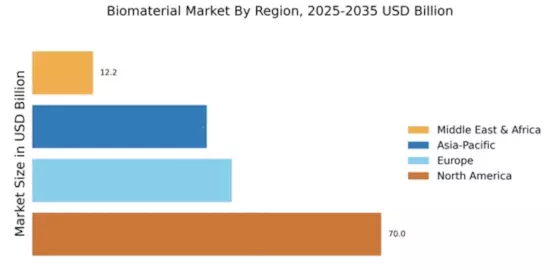
The Biomaterials Market experienced significant growth across various regions. North America held the majority, valued at 25.0 USD Billion in 2024 and projected to reach 48.0 USD Billion in 2035, driven by advancing healthcare technologies and high demand for effective medical implants.

Europe followed closely with a value of 20.0 USD Billion in 2024 and expected growth to 38.0 USD Billion by 2035, reflecting a strong focus on sustainable material development and innovation in the biomaterials sector. Asia Pacific, valued at 15.0 USD Billion in 2024 and 28.0 USD Billion in 2035, showed increasing investment in research and development, contributing to its rising market significance. South America, although smaller at 5.0 USD Billion in 2024, is projected to reach 10.0 USD Billion by 2035, indicating potential growth opportunities driven by healthcare improvements.

Meanwhile, the Middle East and Africa, valued at 4.43 USD Billion in 2024 with an anticipated rise to 6.5 USD Billion in 2035, is gradually expanding, focusing on enhancing healthcare infrastructure and raising awareness about biomaterial applications. These regional dynamics underscored the growing importance of the Biomaterials Market, as each area addresses unique challenges and opportunities in healthcare advancements.

Key Players and Competitive Insights

The Biomaterial Market is currently characterized by a dynamic competitive landscape, driven by increasing demand for sustainable materials and innovative applications across various industries. Key players such as BASF SE (DE), DuPont de Nemours Inc (US), and Evonik Industries AG (DE) are strategically positioned to leverage their extensive research and development capabilities. These companies focus on innovation and sustainability, which are pivotal in shaping their operational strategies. For instance, BASF SE (DE) emphasizes the development of bio-based materials, while DuPont de Nemours Inc (US) is enhancing its portfolio through strategic partnerships aimed at expanding its biopolymer offerings. Collectively, these strategies foster a competitive environment that prioritizes technological advancement and environmental responsibility.

In terms of business tactics, companies are increasingly localizing manufacturing to reduce supply chain vulnerabilities and enhance responsiveness to market demands. The competitive structure of the Biomaterial Market appears moderately fragmented, with several players vying for market share. However, the influence of major companies is substantial, as they set industry standards and drive innovation through their extensive resources and capabilities.

In November 2025, Evonik Industries AG (DE) announced a strategic partnership with a leading automotive manufacturer to develop bio-based composites for lightweight vehicle applications. This collaboration is significant as it not only enhances Evonik's position in the automotive sector but also aligns with the growing trend towards sustainability in transportation. The partnership is expected to yield innovative materials that reduce vehicle weight and improve fuel efficiency, thereby addressing both environmental concerns and regulatory pressures.

In October 2025, DuPont de Nemours Inc (US) launched a new line of bioplastics designed for food packaging applications, which are fully compostable. This move is particularly noteworthy as it responds to the increasing consumer demand for sustainable packaging solutions. By expanding its bioplastics portfolio, DuPont positions itself as a leader in the sustainable materials space, potentially capturing a larger share of the growing market for eco-friendly packaging.

In September 2025, BASF SE (DE) unveiled a new production facility dedicated to the manufacturing of bio-based polymers in North America. This facility is expected to enhance BASF's production capacity and reduce lead times for customers in the region. The establishment of this facility underscores BASF's commitment to meeting the rising demand for sustainable materials and reflects a broader trend of regional production capabilities that enhance supply chain efficiency.

As of December 2025, the Biomaterial Market is witnessing trends that emphasize digitalization, sustainability, and the integration of AI technologies. Strategic alliances among key players are increasingly shaping the competitive landscape, fostering innovation and collaboration. The shift from price-based competition to a focus on technological differentiation and supply chain reliability is evident. Companies that prioritize innovation and sustainability are likely to emerge as leaders in this evolving market, as they adapt to changing consumer preferences and regulatory frameworks.

Key Companies in the Biomaterial Market market include

Industry Developments

After a post-2022 slump, investors showed increased interest in the global biomaterials sector in June 2025, as financing hit $392 million in the first quarter. Businesses like Tidal Vision received $140 million for its chitosan products, Bloom Biorenewables raised $15 million to promote plant-derived alternatives, and Pulpex concluded a $80 million round for environmentally friendly packaging solutions.

Researchers from Northwestern University demonstrated encouraging preclinical findings in April 2025 when they introduced a unique electroactive scaffold that can improve bladder tissue regeneration. Plasma-treated polymeric biomaterials first appeared in early 2025, using low-temperature plasma treatments to enhance scaffold and vascular implant surface wettability and cell adhesion.

A significant milestone for Asia-Pacific innovation was reached in July 2024 when the FDA granted Japanese company Mochida Pharmaceutical 510(k) approval for ReFeel, a sodium-alginate-based nerve regeneration sheet. Early in 2025, desktop 4D printed, shape-changing soft biomaterials for tissue engineering also became popular because they provide a dynamic response to temperature or mechanical stimuli. Sustainability was still a major issue in the sector, with companies looking into marine and plant-based resources and regulatory bodies trying to expedite the clearance process for sophisticated regenerative and intelligent biomaterials.

Future Outlook

Biomaterial Market Future Outlook

The Biomaterial Market is projected to grow at a 7.82% CAGR from 2024 to 2035, driven by advancements in medical applications, sustainable materials, and increasing demand for biocompatible products.

New opportunities lie in:

  • Development of biodegradable implants for orthopedic applications.
  • Expansion into regenerative medicine with stem cell-compatible biomaterials.
  • Innovative packaging solutions using bio-based materials for consumer goods.

By 2035, the Biomaterial Market is expected to achieve substantial growth, reflecting evolving industry demands and technological advancements.

Market Segmentation

Biomaterial Market End Use Outlook

  • Medical Devices
  • Pharmaceuticals
  • Biotechnology
  • Research Laboratories
  • Cosmetics

Biomaterial Market Application Outlook

  • Tissue Engineering
  • Drug Delivery
  • Wound Healing
  • Orthopedics
  • Cardiovascular

Biomaterial Market Material Type Outlook

  • Natural Biomaterials
  • Synthetic Biomaterials
  • Composite Biomaterials
  • Bioactive Glass
  • Hydrogels

Report Scope

MARKET SIZE 2024157.18(USD Billion)
MARKET SIZE 2025169.47(USD Billion)
MARKET SIZE 2035359.83(USD Billion)
COMPOUND ANNUAL GROWTH RATE (CAGR)7.82% (2024 - 2035)
REPORT COVERAGERevenue Forecast, Competitive Landscape, Growth Factors, and Trends
BASE YEAR2024
Market Forecast Period2025 - 2035
Historical Data2019 - 2024
Market Forecast UnitsUSD Billion
Key Companies ProfiledBASF SE (DE), DuPont de Nemours Inc (US), Evonik Industries AG (DE), Mitsubishi Chemical Corporation (JP), Covestro AG (DE), 3M Company (US), NatureWorks LLC (US), Genomatica Inc (US), Futerro (BE)
Segments CoveredApplication, Material Type, End Use
Key Market OpportunitiesAdvancements in biodegradable materials drive growth in the Biomaterial Market.
Key Market DynamicsRising demand for sustainable materials drives innovation and competition in the biomaterial market.
Countries CoveredNorth America, Europe, APAC, South America, MEA

Market Highlights

Author
Rahul Gotadki
Assistant Manager

He holds an experience of about 7+ years in Market Research and Business Consulting, working under the spectrum of Life Sciences and Healthcare domains. Rahul conceptualizes and implements a scalable business strategy and provides strategic leadership to the clients. His expertise lies in market estimation, competitive intelligence, pipeline analysis, customer assessment, etc. In addition to the above, his other responsibility includes strategic tracking of high growth markets & advising clients on the potential areas of focus they could direct their business initiatives

Leave a Comment

FAQs

What is the projected growth of the Biomaterials market?

The Biomaterials market is the expected increase in total market value of 359.83 USD billion over a defined forecast period 2025–2035. It is driven by factors such as demand trends, technological advances, regulatory changes, and geographic expansion.

What is the size of the Biomaterials market?

Biomaterials market size was valued at approximately 157.18 billion USD in 2024. This figure will reach 359.83 billion USD covering all regions (America, Europe, Asia, MEA and ROW), focusing its segments / services / distribution channels till 2035.

What is the CAGR of the Biomaterials market?

Biomaterials market is expected to grow at a CAGR of 7.82% between 2025 and 2035.

How much will the Biomaterials market be worth by 2035?

Biomaterials market is expected to be worth of 359.83 billion USD, reflecting growth driven by usage, technology and global demands by the end of 2035.

How will the Biomaterials market perform over the next 10 years?

Over the next 10 years the Biomaterials market is expected to shift from usd billion 157.18 to 359.83 billion USD, led by adoption of advanced tech, demographic trends, regulatory approvals, with potential headwinds from 2025 to 2035.

What region held the largest market share in the Biomaterials Market in 2024?

North America held the largest market share in 2024, valued at 25.0 billion USD.

Which region is expected to experience significant growth in the Biomaterials Market by 2035?

By 2035, Europe is expected to experience significant growth, reaching a market value of 38.0 billion USD.

What was the market size for Medical Devices within the Biomaterials Market in 2024?

The market size for Medical Devices within the Biomaterials Market was valued at 15.0 billion USD in 2024.

Who are the key players in the Biomaterials Market?

Key players in the Biomaterials Market include Covestro, Moderna, DuPont, and BASF among others.

What are some key applications driving growth in the Biomaterials Market?

Key applications driving growth include Medical Devices, Tissue Engineering, and Drug Delivery.

Download Free Sample

Kindly complete the form below to receive a free sample of this Report

Compare Licence

×
Features License Type
Single User Multiuser License Enterprise User
Price $4,950 $5,950 $7,250
Maximum User Access Limit 1 User Upto 10 Users Unrestricted Access Throughout the Organization
Free Customization
Direct Access to Analyst
Deliverable Format
Platform Access
Discount on Next Purchase 10% 15% 15%
Printable Versions