Request Free Sample ×

Kindly complete the form below to receive a free sample of this Report

* Please use a valid business email

Leading companies partner with us for data-driven Insights

clients tt-cursor
Hero Background
English
Chinese
French
Japanese
Korean
German
Spanish

Biomaterial Market Size

ID: MRFR/HC/1489-HCR
200 Pages
Satyendra Maurya
March 2026

Biomaterials Market Research Report: Size, Share, Trend Analysis By Applications (Medical Devices, Tissue Engineering, Drug Delivery, Orthopedics, Wound Care), By Types (Natural Biomaterials, Synthetic Biomaterials, Modified Biomaterials), By Source (Plant-based, Animal-based, Microbial-based), By End-use (Healthcare, Pharmaceuticals, Cosmetics), and By Regional (North America, Europe, South America, Asia Pacific, Middle East and Africa) - Growth Outlook & Industry Forecast 2025 To 2035

Share:
Download PDF ×

We do not share your information with anyone. However, we may send you emails based on your report interest from time to time. You may contact us at any time to opt-out.

Biomaterial Market Infographic
Purchase Options

Biomaterial Size

Biomaterial Market Growth Projections and Opportunities

The biomaterials market is driven by numerous factors that cumulatively lead to its development and change. A major factor is the growing number of chronic diseases, especially in an aging world. Biomaterials that include metals and ceramics, polymers as well as composites have an important influence on the production of medical implants, tissue technology or drug-delivering systems. With the increasing need for sophisticated healthcare alternatives, biomaterials become critical to meeting the diverse needs of patients, regenerating tissues, and improving efficacy in medical procedures. Technological developments play a critical role in determining the biomaterials market. Ongoing innovation in biomaterials triggers the emergence of new types with enhanced biological compatibility, mechanical characteristics, and functionality. These innovations not only broaden the scope of applications for biomaterials but also contributes to advancements in personalized and regenerative medicine, which will stimulate growth within this market. The regulatory environment of biomaterials plays a significant role in determining market behavior. Strict regulatory requirements provide a guarantee for the safety, efficacy, and biocompatibility of biomaterials in medical practice. This compliance is necessary for market approval, commercialization purposes as well building trust among the health providers’ patients and regulatory bodies. The adoption of biomaterials depends on the economic factors and health infrastructure in different regions. Differences in health care availability, reimbursement policies and economic factors affect the demand of biomaterials with respect to medical procedures. In order to offer their biomaterial solutions that can meet the challenges posed by a variety of healthcare systems, market players need to cover these different terrains. In the market of biomaterials, there is a constant focus on research and development activities. Companies seek to launch biomaterials with better properties, including bioresorbable, bioactivity and immunological effects. Such highly competitive environment fosters the cycle of innovation where market players should be focused on staying ahead in terms of technological development and contributing to further advancement capabilities that biomaterials have for use within healthcare. Several global health events have had some impact on the biomaterials market. The pandemic highlighted the growing relevance of biomaterials in medical devices, diagnostics as well as vaccine delivery systems. The ability of biomaterials to adapt to different applications was an essential contribution in the fight against urgent needs of healthcare during pandemic. Market innovativeness is due to collaborations between biomaterial manufacturers, research institutions and healthcare organizations. Such collaborations are driven by collective knowledge to combat some challenges in constructing biomaterials through tissue integration, surface modifications and design of bio mimetic materials.

Biomaterial Market Size Graph
Author
Author Profile
Satyendra Maurya
Research Analyst

An accomplished research analyst with high proficiency in market forecasting, data visualization, competitive benchmarking, and others. He holds a pronounced track record in research and consulting projects for sectors such as life sciences, medical devices, and healthcare IT. His capabilities in qualitative and quantitative analysis have resulted in positive client outcomes. Working on niche market trends, opportunities, sales, and forecasted value is part of his skill set.

Leave a Comment

FAQs

What is the current valuation of the Biomaterial Market as of 2024?

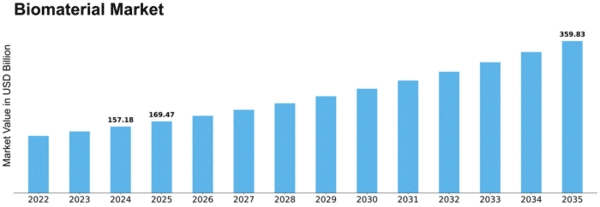
<p>The Biomaterial Market was valued at 157.18 USD Billion in 2024.</p>

What is the projected market valuation for the Biomaterial Market in 2035?

<p>The Biomaterial Market is projected to reach 359.83 USD Billion by 2035.</p>

What is the expected CAGR for the Biomaterial Market during the forecast period 2025 - 2035?

<p>The expected CAGR for the Biomaterial Market during the forecast period 2025 - 2035 is 7.82%.</p>

Which application segment is expected to have the highest valuation in 2035?

<p>The Orthopedics application segment is projected to reach 90.0 USD Billion by 2035.</p>

How do natural and synthetic biomaterials compare in terms of market valuation?

<p>In 2024, synthetic biomaterials were valued at 50.0 USD Billion, while natural biomaterials were valued at 30.0 USD Billion.</p>

What is the projected valuation for the Drug Delivery segment by 2035?

<p>The Drug Delivery segment is expected to reach 70.0 USD Billion by 2035.</p>

Which key players are leading the Biomaterial Market?

<p>Key players in the Biomaterial Market include BASF SE, DuPont de Nemours Inc, and Evonik Industries AG.</p>

What is the expected market size for the Cardiovascular segment in 2035?

<p>The Cardiovascular segment is projected to reach 89.83 USD Billion by 2035.</p>

What is the valuation of the Pharmaceuticals end-use segment in 2024?

<p>The Pharmaceuticals end-use segment was valued at 40.0 USD Billion in 2024.</p>

What is the projected market size for Hydrogels by 2035?

<p>Hydrogels are expected to reach a valuation of 59.83 USD Billion by 2035.</p>

Market Summary

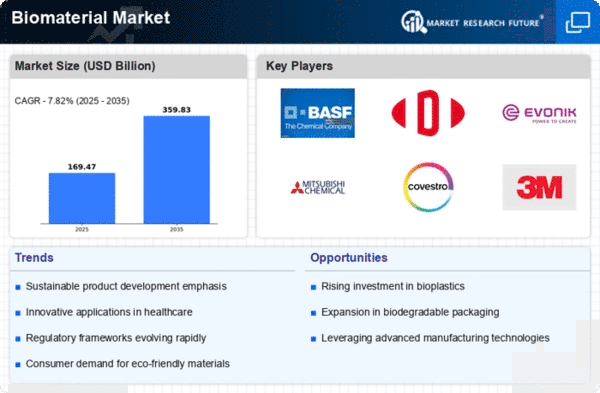
As per MRFR analysis, the Biomaterial Market Size was estimated at 157.18 USD Billion in 2024. The Biomaterial industry is projected to grow from 169.47 USD Billion in 2025 to 359.83 USD Billion by 2035, exhibiting a compound annual growth rate (CAGR) of 7.82% during the forecast period 2025 - 2035.

Key Market Trends & Highlights

The Biomaterial Market is experiencing robust growth driven by sustainability and innovation.

  • North America remains the largest market for biomaterials, reflecting a strong demand for advanced medical solutions.
  • Asia-Pacific is identified as the fastest-growing region, propelled by increasing investments in healthcare and technology.
  • Tissue engineering stands as the largest segment, while drug delivery is emerging as the fastest-growing segment within the biomaterials landscape.
  • Key market drivers include sustainable material development and regulatory support, which are fostering innovation and consumer demand for eco-friendly products.

Market Size & Forecast

2024 Market Size 157.18 (USD Billion)
2035 Market Size 359.83 (USD Billion)
CAGR (2025 - 2035) 7.82%
Largest Regional Market Share in 2024 North America

Major Players

BASF SE (DE), DuPont de Nemours Inc (US), Evonik Industries AG (DE), Mitsubishi Chemical Corporation (JP), Covestro AG (DE), 3M Company (US), NatureWorks LLC (US), Genomatica Inc (US), Corbion NV (NL)

Market Trends

The Biomaterial Market is currently experiencing a dynamic evolution, driven by advancements in technology and increasing demand for sustainable materials. This sector encompasses a wide range of applications, including medical devices, tissue engineering, and drug delivery systems. The growing awareness of environmental issues has prompted a shift towards biodegradable and eco-friendly materials, which are gaining traction among manufacturers and consumers alike. As industries seek to reduce their carbon footprint, the integration of biomaterials into various products appears to be a promising solution. Furthermore, ongoing research and development efforts are likely to enhance the performance and functionality of these materials, potentially leading to innovative applications in diverse fields. In addition to environmental considerations, the Biomaterial Market is influenced by the rising prevalence of chronic diseases and the aging population. These factors contribute to an increased need for advanced medical solutions, thereby propelling the demand for biomaterials in healthcare. The collaboration between academia and industry is fostering a robust pipeline of new products, which may further stimulate market growth. As the landscape continues to evolve, stakeholders must remain vigilant to emerging trends and technologies that could reshape the future of the Biomaterial Market.

Sustainable Material Development

The emphasis on sustainability is reshaping the Biomaterial Market, as manufacturers increasingly prioritize eco-friendly alternatives. This trend reflects a broader societal shift towards environmental responsibility, with biomaterials being developed to minimize waste and reduce reliance on non-renewable resources.

Innovative Medical Applications

The demand for advanced medical solutions is driving innovation within the Biomaterial Market. New applications in tissue engineering and regenerative medicine are emerging, as researchers explore the potential of biomaterials to enhance healing processes and improve patient outcomes.

Collaboration Between Sectors

The Biomaterial Market is witnessing a surge in collaboration between academic institutions and industry players. This partnership fosters knowledge exchange and accelerates the development of novel biomaterials, which may lead to breakthroughs in various applications, particularly in healthcare.

Biomaterial Market Market Drivers

Market Growth Projections

The Global Biomaterials Market Industry is on a trajectory of substantial growth, with projections indicating a market size of 69.4 USD Billion in 2024 and an anticipated increase to 130.5 USD Billion by 2035. This growth is underpinned by a compound annual growth rate of 5.9% from 2025 to 2035, reflecting the increasing integration of biomaterials in various sectors, particularly healthcare. The expansion is driven by factors such as rising healthcare expenditures, technological advancements, and a growing emphasis on sustainable materials. As the market evolves, it is expected to attract further investments and innovations, solidifying its position in the global economy.

Regulatory Support for Biomaterials

Regulatory frameworks are increasingly supportive of the Global Biomaterials Market Industry, facilitating the approval and commercialization of new biomaterials. Agencies are streamlining the approval processes for biocompatible materials, which encourages innovation and expedites market entry. This regulatory environment is particularly beneficial for startups and small enterprises focused on developing novel biomaterials. As regulations evolve to accommodate advancements in technology, the market is likely to experience accelerated growth. The supportive regulatory landscape, combined with rising consumer demand, positions the market for a robust expansion, potentially reaching 69.4 USD Billion in 2024.

Rising Demand for Biocompatible Materials

The Global Biomaterials Market Industry experiences a notable surge in demand for biocompatible materials, driven by their essential role in medical applications. As healthcare providers increasingly prioritize patient safety and comfort, materials such as hydrogels and biodegradable polymers are gaining traction. In 2024, the market is projected to reach 69.4 USD Billion, reflecting a growing preference for materials that minimize adverse reactions. This trend is particularly evident in surgical implants and drug delivery systems, where biocompatibility is paramount. The shift towards these materials indicates a broader movement towards sustainable healthcare solutions, aligning with global health initiatives.

Technological Advancements in Biomaterials

Technological innovations play a crucial role in shaping the Global Biomaterials Market Industry. Advances in material science, such as 3D printing and nanotechnology, enable the development of customized biomaterials tailored to specific medical needs. For instance, 3D-printed scaffolds are revolutionizing tissue engineering by allowing for precise control over porosity and mechanical properties. This adaptability not only enhances the efficacy of implants but also reduces the risk of complications. As these technologies continue to evolve, they are expected to contribute significantly to the market's growth, with projections indicating a rise to 130.5 USD Billion by 2035.

Growing Applications in Regenerative Medicine

The Global Biomaterials Market Industry is witnessing an expansion in applications within regenerative medicine, which focuses on repairing or replacing damaged tissues and organs. Biomaterials such as collagen and chitosan are increasingly utilized in wound healing and tissue regeneration, reflecting a shift towards more effective treatment modalities. The integration of biomaterials in regenerative therapies is expected to enhance patient outcomes and reduce recovery times. As the field progresses, the demand for innovative biomaterials is likely to rise, contributing to a projected compound annual growth rate of 5.9% from 2025 to 2035, underscoring the market's potential.

Increasing Investment in Research and Development

Investment in research and development is a pivotal driver of the Global Biomaterials Market Industry. Governments and private entities are allocating substantial resources to explore new biomaterials and their applications. This influx of funding fosters innovation and accelerates the development of advanced materials that meet the evolving needs of healthcare. For example, initiatives aimed at developing bioactive materials for orthopedic applications are gaining momentum, reflecting a commitment to enhancing patient care. As R&D efforts intensify, the market is poised for significant growth, with projections indicating a market size of 130.5 USD Billion by 2035.

Market Segment Insights

By Application: Tissue Engineering (Largest) vs. Drug Delivery (Fastest-Growing)

The Biomaterial Market is characterized by a diverse range of applications, among which Tissue Engineering holds the largest share. This segment has established itself as a critical area of growth due to its extensive utilization in regenerative medicine and stem cell research. Following closely is Drug Delivery, which has emerged as a rapidly expanding segment. With its innovative approaches to enhancing the bioavailability and therapeutic efficacy of drugs, it is gaining traction, driven by increasing demand for more effective treatment options.

Tissue Engineering (Dominant) vs. Drug Delivery (Emerging)

Tissue Engineering remains the dominant force within the Biomaterial Market, leveraging advancements in scaffold technology and cellular therapies to support the regeneration of damaged tissues. This segment is characterized by its extensive research collaborations and significant investments aimed at creating biocompatible materials that can facilitate the growth of new tissues. On the other hand, Drug Delivery represents an emerging and dynamic aspect of biomaterials, focusing on the development of smart materials that can target specific sites within the body. The rise of personalized medicine and novel drug formulations are further propelling this segment, driving innovations in nanotechnology and biodegradable polymers that enhance drug release profiles.

By Material Type: Natural Biomaterials (Largest) vs. Synthetic Biomaterials (Fastest-Growing)

<p>The Biomaterial Market is significantly influenced by the various material types, with Natural Biomaterials leading in terms of market share. This segment reflects a strong consumer preference for eco-friendly and sustainable materials, making it the largest contributor to market dynamics. In contrast, Synthetic Biomaterials are rapidly gaining traction, especially in advanced healthcare applications, which positions them as a significant player in the ongoing market evolution. Their tailored properties are increasingly recognized, fostering a robust expansion in this area. The growth trends in the Biomaterial Market are being driven by advancements in technology and increasing applications of biocompatible materials in medical devices and tissue engineering. The rise in chronic diseases and the need for innovative healthcare solutions further fuel the demand for Synthetic Biomaterials. Additionally, ongoing research and development in Composite Biomaterials, Hydrogels, and Bioactive Glass contribute to enhanced performance and functionality, ensuring a diverse and competitive market landscape for future developments.</p>

<p>Natural Biomaterials (Dominant) vs. Bioactive Glass (Emerging)</p>

<p>Natural Biomaterials have established themselves as the dominant force in the Biomaterial Market, characterized by their biocompatibility and sustainable nature. These materials, derived from natural sources, offer significant benefits in medical applications, particularly in regenerative medicine and tissue repair. They promote better integration with biological systems, making them highly sought after in various healthcare settings. On the other hand, Bioactive Glass represents an emerging sector within this market, gaining popularity for its unique properties that stimulate bone regeneration and repair. Although it currently holds a smaller market share, its innovative applications, especially in orthopedic and dental surgery, are paving the way for increased adoption and market growth. As research progresses, the potential for Bioactive Glass to contribute significantly to the overall biomaterials landscape is promising.</p>

By End Use: Medical Devices (Largest) vs. Pharmaceuticals (Fastest-Growing)

The biomaterials market is significantly segmented by end-use, with <a href="https://www.marketresearchfuture.com/reports/medical-devices-market-2869" target="_blank" title="medical devices">medical devices</a> commanding the largest share. This segment includes various applications, from implants to surgical instruments, driving a substantial portion of overall market demand. Pharmaceuticals follows closely, representing a key area of growth in the biomaterials sector as innovations in <a href="https://www.marketresearchfuture.com/reports/drug-delivery-system-market-43638" target="_blank" title="drug delivery system">drug delivery systems</a> gain traction. Biotechnology, research laboratories, and cosmetics collectively contribute but are relatively smaller in comparison to the emerging medical device and pharmaceutical sectors. Growth trends in the biomaterials market are largely propelled by advancements in medical technology and the increasing demand for biocompatible materials. The medical devices segment continues to thrive due to an aging global population and a rising prevalence of chronic diseases. Pharmaceuticals, on the other hand, have been picking up pace as new materials enhance drug efficiency, leading to a surge in research and investment in innovative therapeutic solutions.

Pharmaceuticals (Dominant) vs. Biotechnology (Emerging)

The pharmaceuticals segment stands as the dominant force within the biomaterials market, thanks to its integral role in drug formulation and delivery. This segment primarily utilizes biomaterials for developing advanced formulations that improve bioavailability and therapeutic efficacy. As global health challenges increase, the push towards more effective and patient-friendly solutions enhances this segment's significance. In contrast, biotechnology represents an emerging frontier characterized by rapid innovation and application of biomaterials in genetic engineering and molecular therapies. This sector, while still developing, holds substantial potential as it pioneers new therapies and solutions utilizing biomolecular and cellular techniques, thus complementing the more established pharmaceuticals segment.

Get more detailed insights about Biomaterials Market Research Report-Forecast to 2035

Regional Insights

North America : Market Leader in Biomaterials

North America is poised to maintain its leadership in the biomaterial market, holding a significant share of 70.0% as of 2024. The region's growth is driven by increasing demand for sustainable materials across various industries, including healthcare and packaging. Regulatory support for eco-friendly products and innovations in bioplastics are key catalysts for this growth. The focus on reducing carbon footprints and enhancing product recyclability further fuels market expansion. The competitive landscape in North America is robust, featuring major players such as BASF SE, DuPont de Nemours Inc, and 3M Company. The U.S. stands out as a leading country, supported by substantial investments in R&D and a strong manufacturing base. The presence of innovative companies like NatureWorks LLC and Genomatica Inc enhances the region's market dynamics, ensuring a continuous flow of advanced biomaterial solutions.

Europe : Sustainable Growth and Innovation

Europe is emerging as a significant player in the biomaterial market, with a market size of €40.0 billion. The region's growth is propelled by stringent environmental regulations and a strong consumer preference for sustainable products. Initiatives from the European Union aimed at promoting circular economy practices are pivotal in driving demand for biomaterials. The focus on reducing plastic waste and enhancing biodegradability is reshaping the market landscape. Leading countries such as Germany, France, and the Netherlands are at the forefront of this transformation, supported by key players like BASF SE and Covestro AG. The competitive environment is characterized by innovation and collaboration among companies and research institutions. The European market is witnessing a surge in biopolymer applications, driven by advancements in technology and a commitment to sustainability.

Asia-Pacific : Emerging Market Potential

Asia-Pacific is rapidly becoming a vital region in the biomaterial market, with a market size of $35.0 billion. The growth is primarily driven by increasing industrialization, urbanization, and a rising awareness of environmental issues. Countries like China and Japan are leading the charge, supported by government initiatives promoting sustainable materials. The demand for biodegradable plastics and eco-friendly alternatives is on the rise, further enhancing market prospects. The competitive landscape in Asia-Pacific is diverse, with key players such as Mitsubishi Chemical Corporation and Genomatica Inc making significant strides. The region is characterized by a mix of established companies and emerging startups, fostering innovation and collaboration. As the market matures, investments in R&D and technology will be crucial for maintaining competitive advantages and meeting evolving consumer demands.

Middle East and Africa : Untapped Market Opportunities

The Middle East and Africa region is gradually emerging in the biomaterial market, with a market size of $12.18 billion. The growth is driven by increasing awareness of sustainability and the need for eco-friendly materials in various sectors, including construction and packaging. Government initiatives aimed at promoting green technologies are also contributing to market expansion. The region's diverse climate and resources present unique opportunities for biomaterial applications. Leading countries such as South Africa and the UAE are beginning to invest in biomaterial technologies, supported by local and international players. The competitive landscape is evolving, with a focus on developing innovative solutions tailored to regional needs. As the market grows, collaboration between governments and private sectors will be essential to harness the full potential of biomaterials in this region.

Key Players and Competitive Insights

The Biomaterial Market is currently characterized by a dynamic competitive landscape, driven by increasing demand for sustainable materials and innovations in biopolymer technologies. Key players such as BASF SE (DE), DuPont de Nemours Inc (US), and Evonik Industries AG (DE) are strategically positioned to leverage their extensive research and development capabilities. These companies focus on innovation and sustainability, which are critical in shaping their operational strategies. For instance, BASF SE (DE) emphasizes the development of biodegradable materials, while DuPont de Nemours Inc (US) is enhancing its biopolymer portfolio to meet the growing demand for eco-friendly solutions. Collectively, these strategies foster a competitive environment that prioritizes sustainability and technological advancement.In terms of business tactics, companies are increasingly localizing manufacturing to reduce supply chain vulnerabilities and enhance responsiveness to market demands. The competitive structure of the Biomaterial Market appears moderately fragmented, with several players vying for market share. However, the influence of major companies like Covestro AG (DE) and 3M Company (US) is substantial, as they continue to innovate and expand their product offerings, thereby shaping market dynamics.

In November Covestro AG (DE) announced a strategic partnership with a leading agricultural firm to develop bio-based polycarbonate materials. This collaboration is significant as it not only enhances Covestro's product line but also aligns with the growing trend towards sustainable agricultural practices. The partnership is expected to yield innovative solutions that could redefine material applications in various industries.

In October 3M Company (US) launched a new line of bioplastics derived from renewable resources, aimed at reducing carbon footprints across multiple sectors. This initiative underscores 3M's commitment to sustainability and positions the company as a leader in the transition towards greener materials. The introduction of these bioplastics is likely to attract environmentally conscious consumers and businesses, further solidifying 3M's market presence.

In September DuPont de Nemours Inc (US) expanded its biopolymer production facility in the United States, a move that reflects its commitment to meeting the increasing demand for sustainable materials. This expansion is crucial as it not only boosts production capacity but also enhances DuPont's ability to innovate and respond to market needs swiftly. The facility is expected to play a pivotal role in the company's strategy to lead in the biopolymer sector.

As of December current competitive trends in the Biomaterial Market are heavily influenced by digitalization, sustainability, and the integration of artificial intelligence in production processes. Strategic alliances are becoming increasingly important, as companies recognize the value of collaboration in driving innovation and efficiency. Looking ahead, competitive differentiation is likely to evolve from traditional price-based competition to a focus on innovation, technological advancements, and supply chain reliability. This shift indicates a broader industry trend towards creating value through sustainable practices and cutting-edge technologies.

Key Companies in the Biomaterial Market include

Industry Developments

After a post-2022 slump, investors showed increased interest in the global biomaterials sector in June 2025, as financing hit $392 million in the first quarter. Businesses like Tidal Vision received $140 million for its chitosan products, Bloom Biorenewables raised $15 million to promote plant-derived alternatives, and Pulpex concluded a $80 million round for environmentally friendly packaging solutions.

Researchers from Northwestern University demonstrated encouraging preclinical findings in April 2025 when they introduced a unique electroactive scaffold that can improve bladder tissue regeneration. Plasma-treated polymeric biomaterials first appeared in early 2025, using low-temperature plasma treatments to enhance scaffold and vascular implant surface wettability and cell adhesion.

A significant milestone for Asia-Pacific innovation was reached in July 2024 when the FDA granted Japanese company Mochida Pharmaceutical 510(k) approval for ReFeel, a sodium-alginate-based nerve regeneration sheet. Early in 2025, desktop 4D printed, shape-changing soft biomaterials for tissue engineering also became popular because they provide a dynamic response to temperature or mechanical stimuli. Sustainability was still a major issue in the sector, with companies looking into marine and plant-based resources and regulatory bodies trying to expedite the clearance process for sophisticated regenerative and intelligent biomaterials.

Future Outlook

Biomaterial Market Future Outlook

The Biomaterial Market is projected to grow at a 7.82% CAGR from 2025 to 2035, driven by advancements in medical applications, sustainable practices, and increasing demand for biocompatible materials.

New opportunities lie in:

  • Development of biodegradable implants for orthopedic applications.
  • Expansion into regenerative medicine with stem cell-compatible biomaterials.
  • Innovative packaging solutions utilizing bio-based materials for consumer goods.

By 2035, the Biomaterial Market is expected to achieve substantial growth, reflecting evolving industry demands and technological advancements.

Market Segmentation

Biomaterial Market End Use Outlook

  • Medical Devices
  • Pharmaceuticals
  • Biotechnology
  • Research Laboratories
  • Cosmetics

Biomaterial Market Application Outlook

  • Tissue Engineering
  • Drug Delivery
  • Wound Healing
  • Orthopedics
  • Cardiovascular

Biomaterial Market Material Type Outlook

  • Natural Biomaterials
  • Synthetic Biomaterials
  • Composite Biomaterials
  • Bioactive Glass
  • Hydrogels

Report Scope

MARKET SIZE 2024 157.18(USD Billion)
MARKET SIZE 2025 169.47(USD Billion)
MARKET SIZE 2035 359.83(USD Billion)
COMPOUND ANNUAL GROWTH RATE (CAGR) 7.82% (2025 - 2035)
REPORT COVERAGE Revenue Forecast, Competitive Landscape, Growth Factors, and Trends
BASE YEAR 2024
Market Forecast Period 2025 - 2035
Historical Data 2019 - 2024
Market Forecast Units USD Billion
Key Companies Profiled BASF SE (DE), DuPont de Nemours Inc (US), Evonik Industries AG (DE), Mitsubishi Chemical Corporation (JP), Covestro AG (DE), 3M Company (US), NatureWorks LLC (US), Genomatica Inc (US), Corbion NV (NL)
Segments Covered Application, Material Type, End Use
Key Market Opportunities Advancements in biodegradable materials drive innovation in the Biomaterial Market, addressing sustainability concerns.
Key Market Dynamics Rising demand for sustainable materials drives innovation and competition in the biomaterial market.
Countries Covered North America, Europe, APAC, South America, MEA

FAQs

What is the current valuation of the Biomaterial Market as of 2024?

<p>The Biomaterial Market was valued at 157.18 USD Billion in 2024.</p>

What is the projected market valuation for the Biomaterial Market in 2035?

<p>The Biomaterial Market is projected to reach 359.83 USD Billion by 2035.</p>

What is the expected CAGR for the Biomaterial Market during the forecast period 2025 - 2035?

<p>The expected CAGR for the Biomaterial Market during the forecast period 2025 - 2035 is 7.82%.</p>

Which application segment is expected to have the highest valuation in 2035?

<p>The Orthopedics application segment is projected to reach 90.0 USD Billion by 2035.</p>

How do natural and synthetic biomaterials compare in terms of market valuation?

<p>In 2024, synthetic biomaterials were valued at 50.0 USD Billion, while natural biomaterials were valued at 30.0 USD Billion.</p>

What is the projected valuation for the Drug Delivery segment by 2035?

<p>The Drug Delivery segment is expected to reach 70.0 USD Billion by 2035.</p>

Which key players are leading the Biomaterial Market?

<p>Key players in the Biomaterial Market include BASF SE, DuPont de Nemours Inc, and Evonik Industries AG.</p>

What is the expected market size for the Cardiovascular segment in 2035?

<p>The Cardiovascular segment is projected to reach 89.83 USD Billion by 2035.</p>

What is the valuation of the Pharmaceuticals end-use segment in 2024?

<p>The Pharmaceuticals end-use segment was valued at 40.0 USD Billion in 2024.</p>

What is the projected market size for Hydrogels by 2035?

<p>Hydrogels are expected to reach a valuation of 59.83 USD Billion by 2035.</p>

  1. SECTION I: EXECUTIVE SUMMARY AND KEY HIGHLIGHTS
    1. | 1.1 EXECUTIVE SUMMARY
    2. | | 1.1.1 Market Overview
    3. | | 1.1.2 Key Findings
    4. | | 1.1.3 Market Segmentation
    5. | | 1.1.4 Competitive Landscape
    6. | | 1.1.5 Challenges and Opportunities
    7. | | 1.1.6 Future Outlook
  2. SECTION II: SCOPING, METHODOLOGY AND MARKET STRUCTURE
    1. | 2.1 MARKET INTRODUCTION
    2. | | 2.1.1 Definition
    3. | | 2.1.2 Scope of the study
    4. | | | 2.1.2.1 Research Objective
    5. | | | 2.1.2.2 Assumption
    6. | | | 2.1.2.3 Limitations
    7. | 2.2 RESEARCH METHODOLOGY
    8. | | 2.2.1 Overview
    9. | | 2.2.2 Data Mining
    10. | | 2.2.3 Secondary Research
    11. | | 2.2.4 Primary Research
    12. | | | 2.2.4.1 Primary Interviews and Information Gathering Process
    13. | | | 2.2.4.2 Breakdown of Primary Respondents
    14. | | 2.2.5 Forecasting Model
    15. | | 2.2.6 Market Size Estimation
    16. | | | 2.2.6.1 Bottom-Up Approach
    17. | | | 2.2.6.2 Top-Down Approach
    18. | | 2.2.7 Data Triangulation
    19. | | 2.2.8 Validation
  3. SECTION III: QUALITATIVE ANALYSIS
    1. | 3.1 MARKET DYNAMICS
    2. | | 3.1.1 Overview
    3. | | 3.1.2 Drivers
    4. | | 3.1.3 Restraints
    5. | | 3.1.4 Opportunities
    6. | 3.2 MARKET FACTOR ANALYSIS
    7. | | 3.2.1 Value chain Analysis
    8. | | 3.2.2 Porter's Five Forces Analysis
    9. | | | 3.2.2.1 Bargaining Power of Suppliers
    10. | | | 3.2.2.2 Bargaining Power of Buyers
    11. | | | 3.2.2.3 Threat of New Entrants
    12. | | | 3.2.2.4 Threat of Substitutes
    13. | | | 3.2.2.5 Intensity of Rivalry
    14. | | 3.2.3 COVID-19 Impact Analysis
    15. | | | 3.2.3.1 Market Impact Analysis
    16. | | | 3.2.3.2 Regional Impact
    17. | | | 3.2.3.3 Opportunity and Threat Analysis
  4. SECTION IV: QUANTITATIVE ANALYSIS
    1. | 4.1 Healthcare, BY Application (USD Billion)
    2. | | 4.1.1 Tissue Engineering
    3. | | 4.1.2 Drug Delivery
    4. | | 4.1.3 Wound Healing
    5. | | 4.1.4 Orthopedics
    6. | | 4.1.5 Cardiovascular
    7. | 4.2 Healthcare, BY Material Type (USD Billion)
    8. | | 4.2.1 Natural Biomaterials
    9. | | 4.2.2 Synthetic Biomaterials
    10. | | 4.2.3 Composite Biomaterials
    11. | | 4.2.4 Bioactive Glass
    12. | | 4.2.5 Hydrogels
    13. | 4.3 Healthcare, BY End Use (USD Billion)
    14. | | 4.3.1 Medical Devices
    15. | | 4.3.2 Pharmaceuticals
    16. | | 4.3.3 Biotechnology
    17. | | 4.3.4 Research Laboratories
    18. | | 4.3.5 Cosmetics
    19. | 4.4 Healthcare, BY Region (USD Billion)
    20. | | 4.4.1 North America
    21. | | | 4.4.1.1 US
    22. | | | 4.4.1.2 Canada
    23. | | 4.4.2 Europe
    24. | | | 4.4.2.1 Germany
    25. | | | 4.4.2.2 UK
    26. | | | 4.4.2.3 France
    27. | | | 4.4.2.4 Russia
    28. | | | 4.4.2.5 Italy
    29. | | | 4.4.2.6 Spain
    30. | | | 4.4.2.7 Rest of Europe
    31. | | 4.4.3 APAC
    32. | | | 4.4.3.1 China
    33. | | | 4.4.3.2 India
    34. | | | 4.4.3.3 Japan
    35. | | | 4.4.3.4 South Korea
    36. | | | 4.4.3.5 Malaysia
    37. | | | 4.4.3.6 Thailand
    38. | | | 4.4.3.7 Indonesia
    39. | | | 4.4.3.8 Rest of APAC
    40. | | 4.4.4 South America
    41. | | | 4.4.4.1 Brazil
    42. | | | 4.4.4.2 Mexico
    43. | | | 4.4.4.3 Argentina
    44. | | | 4.4.4.4 Rest of South America
    45. | | 4.4.5 MEA
    46. | | | 4.4.5.1 GCC Countries
    47. | | | 4.4.5.2 South Africa
    48. | | | 4.4.5.3 Rest of MEA
  5. SECTION V: COMPETITIVE ANALYSIS
    1. | 5.1 Competitive Landscape
    2. | | 5.1.1 Overview
    3. | | 5.1.2 Competitive Analysis
    4. | | 5.1.3 Market share Analysis
    5. | | 5.1.4 Major Growth Strategy in the Healthcare
    6. | | 5.1.5 Competitive Benchmarking
    7. | | 5.1.6 Leading Players in Terms of Number of Developments in the Healthcare
    8. | | 5.1.7 Key developments and growth strategies
    9. | | | 5.1.7.1 New Product Launch/Service Deployment
    10. | | | 5.1.7.2 Merger & Acquisitions
    11. | | | 5.1.7.3 Joint Ventures
    12. | | 5.1.8 Major Players Financial Matrix
    13. | | | 5.1.8.1 Sales and Operating Income
    14. | | | 5.1.8.2 Major Players R&D Expenditure. 2023
    15. | 5.2 Company Profiles
    16. | | 5.2.1 BASF SE (DE)
    17. | | | 5.2.1.1 Financial Overview
    18. | | | 5.2.1.2 Products Offered
    19. | | | 5.2.1.3 Key Developments
    20. | | | 5.2.1.4 SWOT Analysis
    21. | | | 5.2.1.5 Key Strategies
    22. | | 5.2.2 DuPont de Nemours Inc (US)
    23. | | | 5.2.2.1 Financial Overview
    24. | | | 5.2.2.2 Products Offered
    25. | | | 5.2.2.3 Key Developments
    26. | | | 5.2.2.4 SWOT Analysis
    27. | | | 5.2.2.5 Key Strategies
    28. | | 5.2.3 Evonik Industries AG (DE)
    29. | | | 5.2.3.1 Financial Overview
    30. | | | 5.2.3.2 Products Offered
    31. | | | 5.2.3.3 Key Developments
    32. | | | 5.2.3.4 SWOT Analysis
    33. | | | 5.2.3.5 Key Strategies
    34. | | 5.2.4 Mitsubishi Chemical Corporation (JP)
    35. | | | 5.2.4.1 Financial Overview
    36. | | | 5.2.4.2 Products Offered
    37. | | | 5.2.4.3 Key Developments
    38. | | | 5.2.4.4 SWOT Analysis
    39. | | | 5.2.4.5 Key Strategies
    40. | | 5.2.5 Covestro AG (DE)
    41. | | | 5.2.5.1 Financial Overview
    42. | | | 5.2.5.2 Products Offered
    43. | | | 5.2.5.3 Key Developments
    44. | | | 5.2.5.4 SWOT Analysis
    45. | | | 5.2.5.5 Key Strategies
    46. | | 5.2.6 3M Company (US)
    47. | | | 5.2.6.1 Financial Overview
    48. | | | 5.2.6.2 Products Offered
    49. | | | 5.2.6.3 Key Developments
    50. | | | 5.2.6.4 SWOT Analysis
    51. | | | 5.2.6.5 Key Strategies
    52. | | 5.2.7 NatureWorks LLC (US)
    53. | | | 5.2.7.1 Financial Overview
    54. | | | 5.2.7.2 Products Offered
    55. | | | 5.2.7.3 Key Developments
    56. | | | 5.2.7.4 SWOT Analysis
    57. | | | 5.2.7.5 Key Strategies
    58. | | 5.2.8 Genomatica Inc (US)
    59. | | | 5.2.8.1 Financial Overview
    60. | | | 5.2.8.2 Products Offered
    61. | | | 5.2.8.3 Key Developments
    62. | | | 5.2.8.4 SWOT Analysis
    63. | | | 5.2.8.5 Key Strategies
    64. | | 5.2.9 Futerro (BE)
    65. | | | 5.2.9.1 Financial Overview
    66. | | | 5.2.9.2 Products Offered
    67. | | | 5.2.9.3 Key Developments
    68. | | | 5.2.9.4 SWOT Analysis
    69. | | | 5.2.9.5 Key Strategies
    70. | 5.3 Appendix
    71. | | 5.3.1 References
    72. | | 5.3.2 Related Reports
  6. LIST OF FIGURES
    1. | 6.1 MARKET SYNOPSIS
    2. | 6.2 NORTH AMERICA MARKET ANALYSIS
    3. | 6.3 US MARKET ANALYSIS BY APPLICATION
    4. | 6.4 US MARKET ANALYSIS BY MATERIAL TYPE
    5. | 6.5 US MARKET ANALYSIS BY END USE
    6. | 6.6 CANADA MARKET ANALYSIS BY APPLICATION
    7. | 6.7 CANADA MARKET ANALYSIS BY MATERIAL TYPE
    8. | 6.8 CANADA MARKET ANALYSIS BY END USE
    9. | 6.9 EUROPE MARKET ANALYSIS
    10. | 6.10 GERMANY MARKET ANALYSIS BY APPLICATION
    11. | 6.11 GERMANY MARKET ANALYSIS BY MATERIAL TYPE
    12. | 6.12 GERMANY MARKET ANALYSIS BY END USE
    13. | 6.13 UK MARKET ANALYSIS BY APPLICATION
    14. | 6.14 UK MARKET ANALYSIS BY MATERIAL TYPE
    15. | 6.15 UK MARKET ANALYSIS BY END USE
    16. | 6.16 FRANCE MARKET ANALYSIS BY APPLICATION
    17. | 6.17 FRANCE MARKET ANALYSIS BY MATERIAL TYPE
    18. | 6.18 FRANCE MARKET ANALYSIS BY END USE
    19. | 6.19 RUSSIA MARKET ANALYSIS BY APPLICATION
    20. | 6.20 RUSSIA MARKET ANALYSIS BY MATERIAL TYPE
    21. | 6.21 RUSSIA MARKET ANALYSIS BY END USE
    22. | 6.22 ITALY MARKET ANALYSIS BY APPLICATION
    23. | 6.23 ITALY MARKET ANALYSIS BY MATERIAL TYPE
    24. | 6.24 ITALY MARKET ANALYSIS BY END USE
    25. | 6.25 SPAIN MARKET ANALYSIS BY APPLICATION
    26. | 6.26 SPAIN MARKET ANALYSIS BY MATERIAL TYPE
    27. | 6.27 SPAIN MARKET ANALYSIS BY END USE
    28. | 6.28 REST OF EUROPE MARKET ANALYSIS BY APPLICATION
    29. | 6.29 REST OF EUROPE MARKET ANALYSIS BY MATERIAL TYPE
    30. | 6.30 REST OF EUROPE MARKET ANALYSIS BY END USE
    31. | 6.31 APAC MARKET ANALYSIS
    32. | 6.32 CHINA MARKET ANALYSIS BY APPLICATION
    33. | 6.33 CHINA MARKET ANALYSIS BY MATERIAL TYPE
    34. | 6.34 CHINA MARKET ANALYSIS BY END USE
    35. | 6.35 INDIA MARKET ANALYSIS BY APPLICATION
    36. | 6.36 INDIA MARKET ANALYSIS BY MATERIAL TYPE
    37. | 6.37 INDIA MARKET ANALYSIS BY END USE
    38. | 6.38 JAPAN MARKET ANALYSIS BY APPLICATION
    39. | 6.39 JAPAN MARKET ANALYSIS BY MATERIAL TYPE
    40. | 6.40 JAPAN MARKET ANALYSIS BY END USE
    41. | 6.41 SOUTH KOREA MARKET ANALYSIS BY APPLICATION
    42. | 6.42 SOUTH KOREA MARKET ANALYSIS BY MATERIAL TYPE
    43. | 6.43 SOUTH KOREA MARKET ANALYSIS BY END USE
    44. | 6.44 MALAYSIA MARKET ANALYSIS BY APPLICATION
    45. | 6.45 MALAYSIA MARKET ANALYSIS BY MATERIAL TYPE
    46. | 6.46 MALAYSIA MARKET ANALYSIS BY END USE
    47. | 6.47 THAILAND MARKET ANALYSIS BY APPLICATION
    48. | 6.48 THAILAND MARKET ANALYSIS BY MATERIAL TYPE
    49. | 6.49 THAILAND MARKET ANALYSIS BY END USE
    50. | 6.50 INDONESIA MARKET ANALYSIS BY APPLICATION
    51. | 6.51 INDONESIA MARKET ANALYSIS BY MATERIAL TYPE
    52. | 6.52 INDONESIA MARKET ANALYSIS BY END USE
    53. | 6.53 REST OF APAC MARKET ANALYSIS BY APPLICATION
    54. | 6.54 REST OF APAC MARKET ANALYSIS BY MATERIAL TYPE
    55. | 6.55 REST OF APAC MARKET ANALYSIS BY END USE
    56. | 6.56 SOUTH AMERICA MARKET ANALYSIS
    57. | 6.57 BRAZIL MARKET ANALYSIS BY APPLICATION
    58. | 6.58 BRAZIL MARKET ANALYSIS BY MATERIAL TYPE
    59. | 6.59 BRAZIL MARKET ANALYSIS BY END USE
    60. | 6.60 MEXICO MARKET ANALYSIS BY APPLICATION
    61. | 6.61 MEXICO MARKET ANALYSIS BY MATERIAL TYPE
    62. | 6.62 MEXICO MARKET ANALYSIS BY END USE
    63. | 6.63 ARGENTINA MARKET ANALYSIS BY APPLICATION
    64. | 6.64 ARGENTINA MARKET ANALYSIS BY MATERIAL TYPE
    65. | 6.65 ARGENTINA MARKET ANALYSIS BY END USE
    66. | 6.66 REST OF SOUTH AMERICA MARKET ANALYSIS BY APPLICATION
    67. | 6.67 REST OF SOUTH AMERICA MARKET ANALYSIS BY MATERIAL TYPE
    68. | 6.68 REST OF SOUTH AMERICA MARKET ANALYSIS BY END USE
    69. | 6.69 MEA MARKET ANALYSIS
    70. | 6.70 GCC COUNTRIES MARKET ANALYSIS BY APPLICATION
    71. | 6.71 GCC COUNTRIES MARKET ANALYSIS BY MATERIAL TYPE
    72. | 6.72 GCC COUNTRIES MARKET ANALYSIS BY END USE
    73. | 6.73 SOUTH AFRICA MARKET ANALYSIS BY APPLICATION
    74. | 6.74 SOUTH AFRICA MARKET ANALYSIS BY MATERIAL TYPE
    75. | 6.75 SOUTH AFRICA MARKET ANALYSIS BY END USE
    76. | 6.76 REST OF MEA MARKET ANALYSIS BY APPLICATION
    77. | 6.77 REST OF MEA MARKET ANALYSIS BY MATERIAL TYPE
    78. | 6.78 REST OF MEA MARKET ANALYSIS BY END USE
    79. | 6.79 KEY BUYING CRITERIA OF HEALTHCARE
    80. | 6.80 RESEARCH PROCESS OF MRFR
    81. | 6.81 DRO ANALYSIS OF HEALTHCARE
    82. | 6.82 DRIVERS IMPACT ANALYSIS: HEALTHCARE
    83. | 6.83 RESTRAINTS IMPACT ANALYSIS: HEALTHCARE
    84. | 6.84 SUPPLY / VALUE CHAIN: HEALTHCARE
    85. | 6.85 HEALTHCARE, BY APPLICATION, 2024 (% SHARE)
    86. | 6.86 HEALTHCARE, BY APPLICATION, 2024 TO 2035 (USD Billion)
    87. | 6.87 HEALTHCARE, BY MATERIAL TYPE, 2024 (% SHARE)
    88. | 6.88 HEALTHCARE, BY MATERIAL TYPE, 2024 TO 2035 (USD Billion)
    89. | 6.89 HEALTHCARE, BY END USE, 2024 (% SHARE)
    90. | 6.90 HEALTHCARE, BY END USE, 2024 TO 2035 (USD Billion)
    91. | 6.91 BENCHMARKING OF MAJOR COMPETITORS
  7. LIST OF TABLES
    1. | 7.1 LIST OF ASSUMPTIONS
    2. | | 7.1.1
    3. | 7.2 North America MARKET SIZE ESTIMATES; FORECAST
    4. | | 7.2.1 BY APPLICATION, 2025-2035 (USD Billion)
    5. | | 7.2.2 BY MATERIAL TYPE, 2025-2035 (USD Billion)
    6. | | 7.2.3 BY END USE, 2025-2035 (USD Billion)
    7. | 7.3 US MARKET SIZE ESTIMATES; FORECAST
    8. | | 7.3.1 BY APPLICATION, 2025-2035 (USD Billion)
    9. | | 7.3.2 BY MATERIAL TYPE, 2025-2035 (USD Billion)
    10. | | 7.3.3 BY END USE, 2025-2035 (USD Billion)
    11. | 7.4 Canada MARKET SIZE ESTIMATES; FORECAST
    12. | | 7.4.1 BY APPLICATION, 2025-2035 (USD Billion)
    13. | | 7.4.2 BY MATERIAL TYPE, 2025-2035 (USD Billion)
    14. | | 7.4.3 BY END USE, 2025-2035 (USD Billion)
    15. | 7.5 Europe MARKET SIZE ESTIMATES; FORECAST
    16. | | 7.5.1 BY APPLICATION, 2025-2035 (USD Billion)
    17. | | 7.5.2 BY MATERIAL TYPE, 2025-2035 (USD Billion)
    18. | | 7.5.3 BY END USE, 2025-2035 (USD Billion)
    19. | 7.6 Germany MARKET SIZE ESTIMATES; FORECAST
    20. | | 7.6.1 BY APPLICATION, 2025-2035 (USD Billion)
    21. | | 7.6.2 BY MATERIAL TYPE, 2025-2035 (USD Billion)
    22. | | 7.6.3 BY END USE, 2025-2035 (USD Billion)
    23. | 7.7 UK MARKET SIZE ESTIMATES; FORECAST
    24. | | 7.7.1 BY APPLICATION, 2025-2035 (USD Billion)
    25. | | 7.7.2 BY MATERIAL TYPE, 2025-2035 (USD Billion)
    26. | | 7.7.3 BY END USE, 2025-2035 (USD Billion)
    27. | 7.8 France MARKET SIZE ESTIMATES; FORECAST
    28. | | 7.8.1 BY APPLICATION, 2025-2035 (USD Billion)
    29. | | 7.8.2 BY MATERIAL TYPE, 2025-2035 (USD Billion)
    30. | | 7.8.3 BY END USE, 2025-2035 (USD Billion)
    31. | 7.9 Russia MARKET SIZE ESTIMATES; FORECAST
    32. | | 7.9.1 BY APPLICATION, 2025-2035 (USD Billion)
    33. | | 7.9.2 BY MATERIAL TYPE, 2025-2035 (USD Billion)
    34. | | 7.9.3 BY END USE, 2025-2035 (USD Billion)
    35. | 7.10 Italy MARKET SIZE ESTIMATES; FORECAST
    36. | | 7.10.1 BY APPLICATION, 2025-2035 (USD Billion)
    37. | | 7.10.2 BY MATERIAL TYPE, 2025-2035 (USD Billion)
    38. | | 7.10.3 BY END USE, 2025-2035 (USD Billion)
    39. | 7.11 Spain MARKET SIZE ESTIMATES; FORECAST
    40. | | 7.11.1 BY APPLICATION, 2025-2035 (USD Billion)
    41. | | 7.11.2 BY MATERIAL TYPE, 2025-2035 (USD Billion)
    42. | | 7.11.3 BY END USE, 2025-2035 (USD Billion)
    43. | 7.12 Rest of Europe MARKET SIZE ESTIMATES; FORECAST
    44. | | 7.12.1 BY APPLICATION, 2025-2035 (USD Billion)
    45. | | 7.12.2 BY MATERIAL TYPE, 2025-2035 (USD Billion)
    46. | | 7.12.3 BY END USE, 2025-2035 (USD Billion)
    47. | 7.13 APAC MARKET SIZE ESTIMATES; FORECAST
    48. | | 7.13.1 BY APPLICATION, 2025-2035 (USD Billion)
    49. | | 7.13.2 BY MATERIAL TYPE, 2025-2035 (USD Billion)
    50. | | 7.13.3 BY END USE, 2025-2035 (USD Billion)
    51. | 7.14 China MARKET SIZE ESTIMATES; FORECAST
    52. | | 7.14.1 BY APPLICATION, 2025-2035 (USD Billion)
    53. | | 7.14.2 BY MATERIAL TYPE, 2025-2035 (USD Billion)
    54. | | 7.14.3 BY END USE, 2025-2035 (USD Billion)
    55. | 7.15 India MARKET SIZE ESTIMATES; FORECAST
    56. | | 7.15.1 BY APPLICATION, 2025-2035 (USD Billion)
    57. | | 7.15.2 BY MATERIAL TYPE, 2025-2035 (USD Billion)
    58. | | 7.15.3 BY END USE, 2025-2035 (USD Billion)
    59. | 7.16 Japan MARKET SIZE ESTIMATES; FORECAST
    60. | | 7.16.1 BY APPLICATION, 2025-2035 (USD Billion)
    61. | | 7.16.2 BY MATERIAL TYPE, 2025-2035 (USD Billion)
    62. | | 7.16.3 BY END USE, 2025-2035 (USD Billion)
    63. | 7.17 South Korea MARKET SIZE ESTIMATES; FORECAST
    64. | | 7.17.1 BY APPLICATION, 2025-2035 (USD Billion)
    65. | | 7.17.2 BY MATERIAL TYPE, 2025-2035 (USD Billion)
    66. | | 7.17.3 BY END USE, 2025-2035 (USD Billion)
    67. | 7.18 Malaysia MARKET SIZE ESTIMATES; FORECAST
    68. | | 7.18.1 BY APPLICATION, 2025-2035 (USD Billion)
    69. | | 7.18.2 BY MATERIAL TYPE, 2025-2035 (USD Billion)
    70. | | 7.18.3 BY END USE, 2025-2035 (USD Billion)
    71. | 7.19 Thailand MARKET SIZE ESTIMATES; FORECAST
    72. | | 7.19.1 BY APPLICATION, 2025-2035 (USD Billion)
    73. | | 7.19.2 BY MATERIAL TYPE, 2025-2035 (USD Billion)
    74. | | 7.19.3 BY END USE, 2025-2035 (USD Billion)
    75. | 7.20 Indonesia MARKET SIZE ESTIMATES; FORECAST
    76. | | 7.20.1 BY APPLICATION, 2025-2035 (USD Billion)
    77. | | 7.20.2 BY MATERIAL TYPE, 2025-2035 (USD Billion)
    78. | | 7.20.3 BY END USE, 2025-2035 (USD Billion)
    79. | 7.21 Rest of APAC MARKET SIZE ESTIMATES; FORECAST
    80. | | 7.21.1 BY APPLICATION, 2025-2035 (USD Billion)
    81. | | 7.21.2 BY MATERIAL TYPE, 2025-2035 (USD Billion)
    82. | | 7.21.3 BY END USE, 2025-2035 (USD Billion)
    83. | 7.22 South America MARKET SIZE ESTIMATES; FORECAST
    84. | | 7.22.1 BY APPLICATION, 2025-2035 (USD Billion)
    85. | | 7.22.2 BY MATERIAL TYPE, 2025-2035 (USD Billion)
    86. | | 7.22.3 BY END USE, 2025-2035 (USD Billion)
    87. | 7.23 Brazil MARKET SIZE ESTIMATES; FORECAST
    88. | | 7.23.1 BY APPLICATION, 2025-2035 (USD Billion)
    89. | | 7.23.2 BY MATERIAL TYPE, 2025-2035 (USD Billion)
    90. | | 7.23.3 BY END USE, 2025-2035 (USD Billion)
    91. | 7.24 Mexico MARKET SIZE ESTIMATES; FORECAST
    92. | | 7.24.1 BY APPLICATION, 2025-2035 (USD Billion)
    93. | | 7.24.2 BY MATERIAL TYPE, 2025-2035 (USD Billion)
    94. | | 7.24.3 BY END USE, 2025-2035 (USD Billion)
    95. | 7.25 Argentina MARKET SIZE ESTIMATES; FORECAST
    96. | | 7.25.1 BY APPLICATION, 2025-2035 (USD Billion)
    97. | | 7.25.2 BY MATERIAL TYPE, 2025-2035 (USD Billion)
    98. | | 7.25.3 BY END USE, 2025-2035 (USD Billion)
    99. | 7.26 Rest of South America MARKET SIZE ESTIMATES; FORECAST
    100. | | 7.26.1 BY APPLICATION, 2025-2035 (USD Billion)
    101. | | 7.26.2 BY MATERIAL TYPE, 2025-2035 (USD Billion)
    102. | | 7.26.3 BY END USE, 2025-2035 (USD Billion)
    103. | 7.27 MEA MARKET SIZE ESTIMATES; FORECAST
    104. | | 7.27.1 BY APPLICATION, 2025-2035 (USD Billion)
    105. | | 7.27.2 BY MATERIAL TYPE, 2025-2035 (USD Billion)
    106. | | 7.27.3 BY END USE, 2025-2035 (USD Billion)
    107. | 7.28 GCC Countries MARKET SIZE ESTIMATES; FORECAST
    108. | | 7.28.1 BY APPLICATION, 2025-2035 (USD Billion)
    109. | | 7.28.2 BY MATERIAL TYPE, 2025-2035 (USD Billion)
    110. | | 7.28.3 BY END USE, 2025-2035 (USD Billion)
    111. | 7.29 South Africa MARKET SIZE ESTIMATES; FORECAST
    112. | | 7.29.1 BY APPLICATION, 2025-2035 (USD Billion)
    113. | | 7.29.2 BY MATERIAL TYPE, 2025-2035 (USD Billion)
    114. | | 7.29.3 BY END USE, 2025-2035 (USD Billion)
    115. | 7.30 Rest of MEA MARKET SIZE ESTIMATES; FORECAST
    116. | | 7.30.1 BY APPLICATION, 2025-2035 (USD Billion)
    117. | | 7.30.2 BY MATERIAL TYPE, 2025-2035 (USD Billion)
    118. | | 7.30.3 BY END USE, 2025-2035 (USD Billion)
    119. | 7.31 PRODUCT LAUNCH/PRODUCT DEVELOPMENT/APPROVAL
    120. | | 7.31.1
    121. | 7.32 ACQUISITION/PARTNERSHIP
    122. | | 7.32.1

Healthcare Market Segmentation

Healthcare By Application (USD Billion, 2025-2035)

  • Tissue Engineering
  • Drug Delivery
  • Wound Healing
  • Orthopedics
  • Cardiovascular

Healthcare By Material Type (USD Billion, 2025-2035)

  • Natural Biomaterials
  • Synthetic Biomaterials
  • Composite Biomaterials
  • Bioactive Glass
  • Hydrogels

Healthcare By End Use (USD Billion, 2025-2035)

  • Medical Devices
  • Pharmaceuticals
  • Biotechnology
  • Research Laboratories
  • Cosmetics
Infographic

Free Sample Request

Kindly complete the form below to receive a free sample of this Report

Get Free Sample

Customer Strories

Compare Licence

×
Features License Type
Single User Multiuser License Enterprise User
Price $4,950 $5,950 $7,250
Maximum User Access Limit 1 User Upto 10 Users Unrestricted Access Throughout the Organization
Free Customization
Direct Access to Analyst
Deliverable Format
Platform Access
Discount on Next Purchase 10% 15% 15%
Printable Versions