
×
Request Free Sample ×

Kindly complete the form below to receive a free sample of this Report

* Please use a valid business email

Leading companies partner with us for data-driven Insights

clients tt-cursor
Hero Background
English
Chinese
French
Japanese
Korean
German
Spanish

Gaming Market Trends

ID: MRFR/ICT/9284-HCR
100 Pages
Shubham Munde
October 2025

Gaming Market Size, Share & Trends Analysis Research Report: By Platform (PC, Console, Mobile, Cloud Gaming, Handheld), By Game Type (Action, Adventure, Role-Playing, Simulation, Sports), By Monetization Model (Premium, Freemium, Subscription, In-App Purchases, Advertising), By Player Type (Casual Gamers, Hardcore Gamers, Professional Gamers, Streamers) andBy Regional (North America, Europe, South America, Asia Pacific, Middle East and Africa)- Forecast to 2035.

Share:
Download PDF ×

We do not share your information with anyone. However, we may send you emails based on your report interest from time to time. You may contact us at any time to opt-out.

Gaming Market Infographic
×
Gaming Market Infographic Full View
Purchase Options

Market Trends

Key Emerging Trends in the Gaming Market

The gaming market has experienced significant shifts in recent years, driven by technological advancements, changing consumer preferences, and evolving industry dynamics. One notable trend is the increasing popularity of mobile gaming. With the widespread availability of smartphones and tablets, more people are engaging in gaming on-the-go, leading to a surge in mobile game downloads and revenue. This trend is expected to continue as mobile devices become more powerful and developers tap into the potential of this platform.

Another prominent trend is the rise of esports. Competitive gaming has grown into a global phenomenon, with professional players, teams, and tournaments attracting massive audiences both online and offline. Esports events fill stadiums and arenas, while millions tune in to watch competitions livestreamed on platforms like Twitch and YouTube. This trend has not only transformed gaming into a spectator sport but has also created new opportunities for players, coaches, sponsors, and advertisers.

Furthermore, the gaming industry has witnessed a shift towards subscription-based models and digital distribution. Subscription services like Xbox Game Pass, PlayStation Now, and Apple Arcade offer consumers access to a library of games for a monthly fee, providing greater affordability and convenience compared to traditional retail purchases. Additionally, digital storefronts such as Steam, Epic Games Store, and the Nintendo eShop have become the primary channels for purchasing and downloading games, reflecting a broader trend towards digitalization and online connectivity.

The emergence of cloud gaming is another significant trend reshaping the gaming landscape. Services like Google Stadia, NVIDIA GeForce Now, and Xbox Cloud Gaming allow players to stream games directly to their devices, eliminating the need for high-end hardware and expanding access to gaming experiences. As internet infrastructure improves and streaming technology advances, cloud gaming has the potential to revolutionize how games are played and distributed.

Moreover, the gaming market has seen increased crossover between traditional entertainment industries, such as film, television, and music. Major franchises are being adapted into games, and vice versa, as companies recognize the value of intellectual property across different mediums. This convergence has led to collaborations between game developers, Hollywood studios, and celebrity influencers, blurring the lines between gaming and mainstream media.

In addition, the gaming market continues to diversify in terms of genres and target demographics. While traditional genres like action, adventure, and sports remain popular, niche categories such as indie games, narrative-driven experiences, and virtual reality (VR) titles are gaining traction among specific audiences. Furthermore, the expanding global reach of gaming has led to greater localization efforts, with developers creating content tailored to different cultural preferences and languages.

Furthermore, the gaming industry is increasingly embracing sustainability and social responsibility. With growing concerns about the environmental impact of gaming hardware production and energy consumption, companies are investing in eco-friendly initiatives and promoting energy-efficient technologies. Additionally, gaming communities are becoming more inclusive and diverse, with efforts to address issues of representation, accessibility, and online safety.

Author
Shubham Munde
Research Analyst Level II

With a technical background in information technology & semiconductors, Shubham has 4.5+ years of experience in market research and analytics with the tasks of data mining, analysis, and project execution. He is the POC for our clients, for their consulting projects running under the ICT/Semiconductor domain. Shubham holds a Bachelor’s in Information and Technology and a Master of Business Administration (MBA). Shubham has executed over 150 research projects for our clients under the brand name Market Research Future in the last 2 years. His core skill is building the research respondent relation for gathering the primary information from industry and market estimation for niche markets. He is having expertise in conducting secondary & primary research, market estimations, market projections, competitive analysis, analysing current market trends and market dynamics, deep-dive analysis on market scenarios, consumer behaviour, technological impact analysis, consulting, analytics, etc. He has worked on fortune 500 companies' syndicate and consulting projects along with several government projects. He has worked on the projects of top tech brands such as IBM, Google, Microsoft, AWS, Meta, Oracle, Cisco Systems, Samsung, Accenture, VMware, Schneider Electric, Dell, HP, Ericsson, and so many others. He has worked on Metaverse, Web 3.0, Zero-Trust security, cyber-security, blockchain, quantum computing, robotics, 5G technology, High-Performance computing, data centers, AI, automation, IT equipment, sensors, semiconductors, consumer electronics and so many tech domain projects.

Leave a Comment

FAQs

What is the projected market size of the Global Gaming Market in 2024?

The Global Gaming Market is expected to be valued at 197.38 billion USD in 2024.

What will the market size of the Global Gaming Market be by 2035?

By 2035, the Global Gaming Market is projected to reach a value of 350.0 billion USD.

What is the expected CAGR for the Global Gaming Market between 2025 and 2035?

The expected compound annual growth rate (CAGR) for the Global Gaming Market from 2025 to 2035 is 5.35%.

Which region holds the largest market share in the Global Gaming Market for 2024?

North America holds the largest market share in the Global Gaming Market with a value of 75.0 billion USD in 2024.

What is the projected market size for the PC segment in the Global Gaming Market by 2035?

The PC segment of the Global Gaming Market is projected to be valued at 80.0 billion USD by 2035.

What is the expected market size of the Mobile segment in the Global Gaming Market for 2024?

The Mobile segment is expected to be valued at 70.0 billion USD in the Global Gaming Market in 2024.

Who are the major players in the Global Gaming Market?

Major players in the Global Gaming Market include companies like Tencent, Sony, Microsoft, and Activision Blizzard.

What is the projected market size for the Console segment in the Global Gaming Market by 2035?

The Console segment is projected to reach a size of 100.0 billion USD in the Global Gaming Market by 2035.

What is the anticipated growth rate for the APAC region in the Global Gaming Market from 2024 to 2035?

The APAC region is projected to grow from a value of 45.0 billion USD in 2024 to 75.0 billion USD by 2035.

What challenges might the Global Gaming Market face in the future?

The Global Gaming Market may face challenges including regulatory issues and evolving consumer preferences as it grows in the coming years.

Market Summary

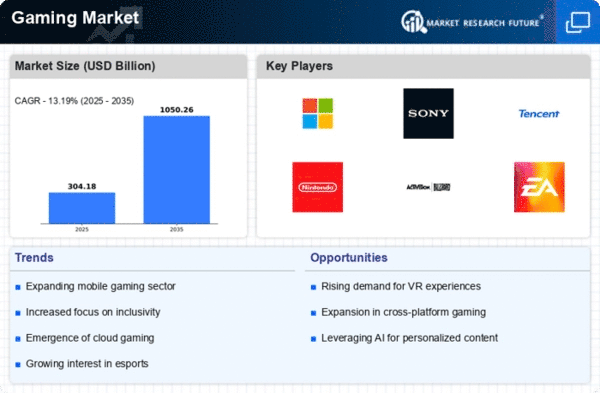
As per Market Research Future analysis, the Gaming Market was estimated at 268.73 USD Billion in 2024. The Gaming industry is projected to grow from 304.19 USD Billion in 2025 to 1050.26 USD Billion by 2035, exhibiting a compound annual growth rate (CAGR) of 13.19% during the forecast period 2025 - 2035

Key Market Trends & Highlights

The gaming market is experiencing robust growth driven by technological advancements and evolving consumer preferences.

  • Mobile gaming continues to expand rapidly, particularly in the Asia-Pacific region, which is the fastest-growing market. Cloud gaming adoption is gaining traction, especially in North America, where the largest market resides. Social gaming integration is becoming increasingly prevalent, appealing to diverse demographics across various platforms. Technological advancements and increased investment in esports are key drivers propelling the growth of action and mobile gaming segments.

Market Size & Forecast

2024 Market Size 268.73 (USD Billion)
2035 Market Size 1050.26 (USD Billion)
CAGR (2025 - 2035) 13.19%
Largest Regional Market Share in 2024 North America

Major Players

Microsoft (US), Sony (JP), Tencent (CN), Nintendo (JP), Activision Blizzard (US), Electronic Arts (US), Take-Two Interactive (US), Ubisoft (FR), Bandai Namco (JP)

Market Trends

The Gaming Market is currently experiencing a dynamic evolution, characterized by rapid technological advancements and shifting consumer preferences. The proliferation of mobile devices has democratized access to gaming, allowing a broader demographic to engage with various genres. This accessibility appears to be driving an increase in casual gaming, where individuals seek entertainment in shorter, more flexible formats. Furthermore, the integration of social features within gaming platforms fosters community engagement, enhancing the overall user experience. As a result, developers are increasingly focusing on creating immersive environments that cater to diverse audiences, which may lead to innovative gameplay mechanics and storytelling techniques. In addition, the rise of cloud gaming services is reshaping how consumers interact with games. This model allows players to stream content without the need for high-end hardware, potentially expanding the market reach. The emphasis on subscription-based models also suggests a shift in revenue generation strategies, as companies explore new avenues for monetization. Overall, the Gaming Market appears poised for continued growth, driven by technological innovation and evolving consumer demands, which may redefine the landscape in the coming years.

Mobile Gaming Expansion

The Gaming Market is witnessing a notable expansion in mobile gaming, as smartphones become the primary platform for many players. This trend indicates a shift towards more casual gaming experiences, appealing to a wider audience.

Cloud Gaming Adoption

Cloud gaming is gaining traction, allowing users to access games without the need for expensive hardware. This development suggests a potential transformation in how games are distributed and consumed.

Social Gaming Integration

The integration of social features within gaming platforms is enhancing community interaction. This trend indicates a growing emphasis on multiplayer experiences, fostering connections among players.

Gaming Market Market Drivers

E-sports Growth

The Global Gaming Industry is witnessing a remarkable surge in e-sports, which has transformed gaming into a competitive and spectator-driven phenomenon. E-sports events attract millions of viewers globally, with significant sponsorship and advertising revenues. The increasing popularity of e-sports is fostering a new generation of gamers and fans, further expanding the market. Major tournaments, such as the League of Legends World Championship, draw substantial audiences and generate considerable revenue. This trend indicates a promising future for the industry, as e-sports is likely to play a crucial role in maintaining the market's value of 187.4 USD Billion by 2024.

Diverse Gaming Genres

The Global Gaming Industry benefits from a wide array of gaming genres that cater to various consumer preferences. From action and adventure to simulation and role-playing games, the diversity in offerings attracts a broad audience. This variety not only enhances user engagement but also encourages cross-genre exploration among players. The continuous development of new genres and innovative gameplay mechanics keeps the market dynamic and appealing. As consumer interests evolve, the industry adapts, ensuring sustained growth and relevance, which is crucial for achieving the projected market value of 187.4 USD Billion in 2024.

Market Value Projection

The Global Gaming Industry is projected to maintain a steady market value of 187.4 USD Billion from 2024 through 2035, with a compound annual growth rate of 0.0% for the period between 2025 and 2035. This stability suggests a mature market where growth may plateau, reflecting a balance between supply and demand. Factors such as market saturation and changing consumer preferences could influence this stagnation. However, the industry remains resilient, adapting to new trends and technologies, ensuring its relevance in the global entertainment landscape.

Technological Advancements

The Global Gaming Industry is experiencing rapid technological advancements that enhance user experience and engagement. Innovations such as virtual reality, augmented reality, and cloud gaming are reshaping how games are developed and played. For instance, the integration of VR technology allows players to immerse themselves in realistic environments, thereby increasing user retention and satisfaction. As these technologies become more accessible, they are likely to attract a broader audience, contributing to the market's growth. The Global Gaming Market Industry is projected to reach 187.4 USD Billion in 2024, indicating a robust demand for technologically advanced gaming solutions.

Mobile Gaming Proliferation

The rise of mobile gaming is a pivotal driver in the Global Gaming Industry. With the increasing penetration of smartphones and tablets, gaming has become more accessible to a diverse demographic. Mobile games account for a substantial portion of the market, appealing to casual gamers and hardcore enthusiasts alike. The convenience of gaming on-the-go has led to a surge in downloads and in-app purchases, significantly boosting revenue streams. As mobile gaming continues to evolve, it is expected to maintain its dominance, contributing to the projected market value of 187.4 USD Billion in 2024.

Increased Investment in Game Development

Investment in game development is a critical driver for the Global Gaming Market Industry. As companies recognize the lucrative potential of gaming, they are allocating substantial resources to develop high-quality games. This influx of capital enables studios to hire top talent, invest in advanced technologies, and create immersive experiences. The competitive landscape encourages innovation, leading to the production of blockbuster titles that capture consumer interest. As the industry continues to attract investment, it is likely to sustain its growth trajectory, maintaining a market value of 187.4 USD Billion in 2024 and beyond.

Market Segment Insights

By Game Type: Action (Largest) vs. Role Playing (Fastest-Growing)

The gaming market's segmentation by game type showcases a diverse distribution, with Action games taking the lead as the largest segment. This category resonates with a wide audience due to its fast-paced gameplay, engaging narrative, and competitive elements. Role Playing games, while smaller in share, are emerging quickly, capturing players with their immersive storytelling and character development. The growth in these segments reflects broader trends in consumer preferences towards dynamic experiences and social interaction online.

Action (Dominant) vs. Role Playing (Emerging)

Action games dominate the gaming landscape by appealing to players with adrenaline-pumping gameplay and visually stunning graphics. Renowned for their engaging mechanics, these games often feature high levels of interactivity, enhancing player satisfaction. Role Playing games, on the other hand, are witnessing rapid growth, driven by their emphasis on character immersion and complex narrative arcs. They invite players to embark on epic quests, often in expansive open worlds, which fosters community engagement. The increasing popularity of online multiplayer features further accelerates this growth, making Role Playing games a significant aspect of future market expansion.

By Platform: PC (Largest) vs. Mobile (Fastest-Growing)

The Gaming Market is diverse, featuring primary segments such as PC, Console, Mobile, Cloud Gaming, and Virtual Reality. Among these, PC remains the largest segment, appealing to serious gamers with tailored rigs and high-performance titles. Mobile gaming, however, has carved out a significant space, attracting casual gamers and offering a wide range of accessible games. As a result, the market share distribution reflects a clear preference towards both PC and mobile platforms, with a rising interest in cloud and VR gaming as technology evolves. Examining growth trends, mobile gaming shows unprecedented expansion driven by the proliferation of smartphones and high-speed internet. Social gaming and multiplayer experiences have increased engagement, while cloud gaming is poised to grow as platforms integrate advanced technologies. PC gaming, despite being established, continues to innovate with enhanced graphics and hardware, retaining a loyal user base that values immersive experiences. Together, these platforms showcase the dynamic landscape of the gaming market.

PC (Dominant) vs. Mobile (Emerging)

PC gaming stands as the dominant force in the market, characterized by its robust ecosystem of high-performance hardware, expansive game libraries, and a dedicated community. It offers unmatched graphical fidelity and customization options, catering to enthusiasts and professional gamers alike. In contrast, mobile gaming has emerged as a formidable contender, appealing to a broader audience with its convenience and accessibility. The rise of casual gaming applications and social connectivity has propelled mobile platforms into mainstream popularity. While PC gaming thrives on depth and complexity, mobile gaming focuses on quick, engaging experiences, creating a diverse environment in the gaming sector that caters to various player preferences.

By Monetization Model: Free to Play (Largest) vs. In-Game Purchases (Fastest-Growing)

The gaming market is significantly shaped by various monetization models, with the Free to Play model leading in market share. This model allows players to access games without initial payment, generating revenue through in-game purchases and advertisements. Its widespread acceptance has led to a diverse audience, attracting both casual and hardcore gamers, which is critical for its dominance in the market. In contrast, In-Game Purchases represent the fastest-growing segment within the gaming industry. As players increasingly seek personalized gaming experiences, in-game purchases offer a lucrative path for developers. This growth is driven by advancements in mobile gaming and the increasing popularity of online multiplayer games, encouraging players to enhance their gameplay through additional purchases.

Free to Play: Dominant vs. In-Game Purchases: Emerging

The Free to Play model is the dominant monetization strategy in the gaming market, allowing gamers to engage without upfront costs while offering optional in-game purchases that can enhance their experience. This model thrives on microtransactions, where small purchases provide significant revenue for developers. In contrast, In-Game Purchases represent an emerging approach that is rapidly gaining traction, particularly in mobile and online gaming. Players are now more willing to invest in enhancements such as skins, characters, and inventory boosts. This growth is encouraged by an evolving player psychology that favors customization and status symbols within gaming environments, driving developers to innovate and offer more enticing purchases.

By User Demographics: Age (Largest) vs. Gender (Fastest-Growing)

In the Gaming Market, age distribution remains a critical factor, with the largest segment dominated by individuals aged 18-34, making up a significant portion of gamers. This demographic showcases a strong inclination toward immersive and competitive gaming experiences, shaping game development and marketing strategies. Meanwhile, the gender distribution is also shifting, as more female gamers are entering the market, contributing to an increasingly diverse player base. This growth underscores the need for inclusive gaming content that appeals to varied audiences.

Age: 18-34 (Dominant) vs. Gender: Female Gamers (Emerging)

The 18-34 age group holds a dominant position in the gaming market, characterized by a high engagement level with various gaming genres, including action, adventure, and role-playing games. This demographic is tech-savvy and often seeks out multiplayer and online gaming options. On the other hand, female gamers represent an emerging segment, rapidly increasing in number and influence. This change is driven by the development of games that resonate with female players, as well as the growing presence of women in gaming communities. Game developers and marketers are recognizing the need to cater to this demographic, resulting in a more inclusive gaming landscape.

By Game Genre: Single Player (Largest) vs. Multiplayer (Fastest-Growing)

The gaming market is characterized by various game genres, with Single Player games commanding the largest share. Players often gravitate towards immersive, narrative-driven experiences that cater to individual preferences, leading to a steady demand for Single Player titles. In contrast, Multiplayer games are witnessing rapid growth, appealing to players seeking social interaction and competition. This genre is increasingly popular as gaming communities continue to expand, supported by advanced online platforms and technology that enhance the multiplayer experience.

Multiplayer: Dominant vs. Cooperative: Emerging

Multiplayer games have established themselves as a dominant force, attracting vast audiences who thrive on competitive and cooperative experiences. This genre emphasizes real-time interactions, strategic gameplay, and team dynamics, making it appealing for players looking for engagement with peers. On the other hand, Cooperative games, while still emerging, are gaining traction among gamers who prefer collaboration rather than competition. With an increasing emphasis on teamwork and shared objectives, this sub-genre offers a unique gaming experience that contrasts with the highly competitive Multiplayer scene, indicating a diversification in player preferences.

Get more detailed insights about Gaming Market Research Report - Forecast till 2035

Regional Insights

The Global Gaming Market is poised for considerable growth, with North America accounting for a significant portion of the overall market. In 2024, North America is valued at 75.0 USD Billion, expected to rise to 130.0 USD Billion by 2035, making it a major player in the Global Market revenue landscape. Europe follows closely, with a valuation of 55.0 USD Billion in 2024, projected to reach 95.0 USD Billion in 2035, demonstrating its importance in the Global Gaming industry.

The APAC region, valued at 45.0 USD Billion in 2024, is anticipated to expand to 75.0 USD Billion by 2035, which reflects the growing demand for mobile gaming and esports in emerging markets.

South America, while smaller, shows notable growth from 15.0 USD Billion in 2024 to 25.0 USD Billion in 2035, indicating rising adoption rates and increasing investment in gaming infrastructure. The MEA region captures a niche audience with a current valuation of 7.38 USD Billion in 2024, expected to double to 25.0 USD Billion by 2035; its unique cultural landscape fuels its market potential. Such regional segmentation reveals distinct market dynamics, trends, and opportunities that drive the overall Global Market statistics and growth trends, highlighting the diverse landscape that characterizes the industry across different geographical areas.

Fig 3: Gaming Market Regional Insights

Key Players and Competitive Insights

The Gaming Market is currently characterized by intense competition and rapid innovation, driven by technological advancements and evolving consumer preferences. Major players such as Microsoft (US), Sony (JP), and Tencent (CN) are at the forefront, each adopting distinct strategies to enhance their market positioning. Microsoft (US) focuses on cloud gaming and subscription services, leveraging its Azure platform to deliver seamless gaming experiences. Sony (JP), on the other hand, emphasizes exclusive game titles and immersive virtual reality experiences, aiming to capture a dedicated gaming audience. Tencent (CN) continues to expand its influence through strategic investments in various gaming companies, thereby diversifying its portfolio and enhancing its global reach. Collectively, these strategies contribute to a competitive landscape that is both dynamic and multifaceted.
In terms of business tactics, companies are increasingly localizing manufacturing and optimizing supply chains to respond to regional demands and mitigate risks. The market structure appears moderately fragmented, with a mix of established giants and emerging players. This fragmentation allows for a diverse range of offerings, yet the collective influence of key players like Microsoft (US) and Tencent (CN) shapes market trends and consumer expectations.
In November 2025, Microsoft (US) announced a significant partnership with a leading cloud service provider to enhance its gaming infrastructure. This strategic move is likely to bolster its cloud gaming capabilities, allowing for improved performance and accessibility for gamers worldwide. By investing in cloud technology, Microsoft (US) positions itself to capitalize on the growing trend of remote gaming, which is becoming increasingly popular among consumers seeking flexibility and convenience.
In October 2025, Sony (JP) unveiled a new line of virtual reality headsets designed to integrate seamlessly with its PlayStation platform. This launch is indicative of Sony's commitment to innovation and its strategy to create immersive gaming experiences. By enhancing its VR offerings, Sony (JP) aims to attract a broader audience and differentiate itself from competitors, potentially leading to increased market share in the burgeoning VR segment.
In December 2025, Tencent (CN) completed its acquisition of a prominent mobile gaming studio, further solidifying its position as a leader in the mobile gaming sector. This acquisition is strategically important as it allows Tencent (CN) to expand its portfolio and leverage the studio's expertise in developing popular mobile titles. Such moves not only enhance Tencent's competitive edge but also reflect a broader trend of consolidation within the industry, as companies seek to strengthen their market presence through strategic acquisitions.
As of December 2025, the Gaming Market is witnessing trends such as digitalization, sustainability, and the integration of artificial intelligence (AI) into gaming experiences. Strategic alliances are increasingly shaping the competitive landscape, enabling companies to pool resources and expertise. Looking ahead, competitive differentiation is likely to evolve, with a shift from price-based competition to a focus on innovation, technology, and supply chain reliability. Companies that can effectively leverage these trends will likely emerge as leaders in the market. Analyzing the gaming console market share reveals that major players like Sony, Microsoft, and Nintendo dominate global sales. The distribution of market share reflects consumer preferences for high-performance consoles and exclusive game titles.

Key Companies in the Gaming Market include

Industry Developments

Recent developments in the Global Gaming Market show significant activity, particularly among major companies such as Activision Blizzard and Microsoft. In October 2023, Microsoft completed its acquisition of Activision Blizzard, a deal valued at approximately $69 billion that is expected to reshape the industry landscape. Square Enix and Bandai Namco continue to innovate, with their focus on expanding into the mobile gaming sector, leveraging the increasing demand for mobile gaming applications. Meanwhile, Nvidia reported substantial growth driven by demand for GPU technology in gaming, indicating a robust market valuation and increasing investment in gaming hardware. The mobile gaming market continues to expand rapidly as smartphones become more powerful and accessible. Innovations in mobile technology and increasing user engagement are driving significant growth, making mobile platforms a key segment in the gaming industry.

Additionally, Epic Games continues to enhance its position in the market with the development of Unreal Engine 5, impacting game design and production. Electronic Arts and Riot Games have also been expanding their esports engagements, establishing competitive frameworks to attract new users globally. In the last couple of years, the Market has seen remarkable shifts, including the rise of cloud gaming services, with Apple and Sony pushing significant products into this domain. Overall, with various mergers and innovative product launches, the market is currently experiencing profound growth and transformation across all segments.

Future Outlook

Gaming Market Future Outlook

The Gaming Market is projected to grow at a 13.19% CAGR from 2025 to 2035, driven by technological advancements, increased mobile gaming, and expanding esports participation.

New opportunities lie in:

  • Development of cloud gaming platforms for seamless user experiences.
  • Investment in virtual reality gaming to enhance immersive gameplay.
  • Creation of subscription-based models for consistent revenue streams.

By 2035, the Gaming Market is expected to be a dominant force, reflecting robust growth and innovation.

Market Segmentation

Gaming Market Platform Outlook

  • PC
  • Console
  • Mobile
  • Cloud Gaming
  • Virtual Reality

Gaming Market Game Type Outlook

  • Action
  • Adventure
  • Role Playing
  • Simulation
  • Strategy

Gaming Market Game Genre Outlook

  • Single Player
  • Multiplayer
  • Cooperative
  • Competitive
  • Casual

Gaming Market User Demographics Outlook

  • Age
  • Gender
  • Income Level
  • Gaming Experience
  • Geographic Location

Gaming Market Monetization Model Outlook

  • Free to Play
  • Premium
  • Subscription
  • In-Game Purchases
  • Ad-Supported

Report Scope

MARKET SIZE 2024 268.73(USD Billion)
MARKET SIZE 2025 304.19(USD Billion)
MARKET SIZE 2035 1050.26(USD Billion)
COMPOUND ANNUAL GROWTH RATE (CAGR) 13.19% (2025 - 2035)
REPORT COVERAGE Revenue Forecast, Competitive Landscape, Growth Factors, and Trends
BASE YEAR 2024
Market Forecast Period 2025 - 2035
Historical Data 2019 - 2024
Market Forecast Units USD Billion
Key Companies Profiled Microsoft (US), Sony (JP), Tencent (CN), Nintendo (JP), Activision Blizzard (US), Electronic Arts (US), Take-Two Interactive (US), Ubisoft (FR), Bandai Namco (JP)
Segments Covered Game Type, Platform, Monetization Model, User Demographics, Game Genre
Key Market Opportunities Integration of virtual reality and augmented reality technologies in the Gaming Market.
Key Market Dynamics Rising consumer demand for immersive experiences drives innovation and competition in the gaming industry.
Countries Covered North America, Europe, APAC, South America, MEA

FAQs

What is the projected market size of the Global Gaming Market in 2024?

The Global Gaming Market is expected to be valued at 197.38 billion USD in 2024.

What will the market size of the Global Gaming Market be by 2035?

By 2035, the Global Gaming Market is projected to reach a value of 350.0 billion USD.

What is the expected CAGR for the Global Gaming Market between 2025 and 2035?

The expected compound annual growth rate (CAGR) for the Global Gaming Market from 2025 to 2035 is 5.35%.

Which region holds the largest market share in the Global Gaming Market for 2024?

North America holds the largest market share in the Global Gaming Market with a value of 75.0 billion USD in 2024.

What is the projected market size for the PC segment in the Global Gaming Market by 2035?

The PC segment of the Global Gaming Market is projected to be valued at 80.0 billion USD by 2035.

What is the expected market size of the Mobile segment in the Global Gaming Market for 2024?

The Mobile segment is expected to be valued at 70.0 billion USD in the Global Gaming Market in 2024.

Who are the major players in the Global Gaming Market?

Major players in the Global Gaming Market include companies like Tencent, Sony, Microsoft, and Activision Blizzard.

What is the projected market size for the Console segment in the Global Gaming Market by 2035?

The Console segment is projected to reach a size of 100.0 billion USD in the Global Gaming Market by 2035.

What is the anticipated growth rate for the APAC region in the Global Gaming Market from 2024 to 2035?

The APAC region is projected to grow from a value of 45.0 billion USD in 2024 to 75.0 billion USD by 2035.

What challenges might the Global Gaming Market face in the future?

The Global Gaming Market may face challenges including regulatory issues and evolving consumer preferences as it grows in the coming years.

  1. SECTION I: EXECUTIVE SUMMARY AND KEY HIGHLIGHTS
    1. | 1.1 EXECUTIVE SUMMARY
    2. | 1.1.1 Market Overview
    3. | 1.1.2 Key Findings
    4. | 1.1.3 Market Segmentation
    5. | 1.1.4 Competitive Landscape
    6. | 1.1.5 Challenges and Opportunities
    7. | 1.1.6 Future Outlook
  2. SECTION II: SCOPING, METHODOLOGY AND MARKET STRUCTURE
    1. | 2.1 MARKET INTRODUCTION
    2. | 2.1.1 Definition
    3. | 2.1.2 Scope of the study
    4. |-- 2.1.2.1 Research Objective
    5. |-- 2.1.2.2 Assumption
    6. |-- 2.1.2.3 Limitations
    7. | 2.2 RESEARCH METHODOLOGY
    8. | 2.2.1 Overview
    9. | 2.2.2 Data Mining
    10. | 2.2.3 Secondary Research
    11. | 2.2.4 Primary Research
    12. |-- 2.2.4.1 Primary Interviews and Information Gathering Process
    13. |-- 2.2.4.2 Breakdown of Primary Respondents
    14. | 2.2.5 Forecasting Model
    15. | 2.2.6 Market Size Estimation
    16. |-- 2.2.6.1 Bottom-Up Approach
    17. |-- 2.2.6.2 Top-Down Approach
    18. | 2.2.7 Data Triangulation
    19. | 2.2.8 Validation
  3. SECTION III: QUALITATIVE ANALYSIS
    1. | 3.1 MARKET DYNAMICS
    2. | 3.1.1 Overview
    3. | 3.1.2 Drivers
    4. | 3.1.3 Restraints
    5. | 3.1.4 Opportunities
    6. | 3.2 MARKET FACTOR ANALYSIS
    7. | 3.2.1 Value chain Analysis
    8. | 3.2.2 Porter's Five Forces Analysis
    9. |-- 3.2.2.1 Bargaining Power of Suppliers
    10. |-- 3.2.2.2 Bargaining Power of Buyers
    11. |-- 3.2.2.3 Threat of New Entrants
    12. |-- 3.2.2.4 Threat of Substitutes
    13. |-- 3.2.2.5 Intensity of Rivalry
    14. | 3.2.3 COVID-19 Impact Analysis
    15. |-- 3.2.3.1 Market Impact Analysis
    16. |-- 3.2.3.2 Regional Impact
    17. |-- 3.2.3.3 Opportunity and Threat Analysis
  4. SECTION IV: QUANTITATIVE ANALYSIS
    1. | 4.1 Information and Communications Technology, BY Game Type (USD Billion)
    2. | 4.1.1 Action
    3. | 4.1.2 Adventure
    4. | 4.1.3 Role Playing
    5. | 4.1.4 Simulation
    6. | 4.1.5 Strategy
    7. | 4.2 Information and Communications Technology, BY Platform (USD Billion)
    8. | 4.2.1 PC
    9. | 4.2.2 Console
    10. | 4.2.3 Mobile
    11. | 4.2.4 Cloud Gaming
    12. | 4.2.5 Virtual Reality
    13. | 4.3 Information and Communications Technology, BY Monetization Model (USD Billion)
    14. | 4.3.1 Free to Play
    15. | 4.3.2 Premium
    16. | 4.3.3 Subscription
    17. | 4.3.4 In-Game Purchases
    18. | 4.3.5 Ad-Supported
    19. | 4.4 Information and Communications Technology, BY User Demographics (USD Billion)
    20. | 4.4.1 Age
    21. | 4.4.2 Gender
    22. | 4.4.3 Income Level
    23. | 4.4.4 Gaming Experience
    24. | 4.4.5 Geographic Location
    25. | 4.5 Information and Communications Technology, BY Game Genre (USD Billion)
    26. | 4.5.1 Single Player
    27. | 4.5.2 Multiplayer
    28. | 4.5.3 Cooperative
    29. | 4.5.4 Competitive
    30. | 4.5.5 Casual
    31. | 4.6 Information and Communications Technology, BY Region (USD Billion)
    32. | 4.6.1 North America
    33. |-- 4.6.1.1 US
    34. |-- 4.6.1.2 Canada
    35. | 4.6.2 Europe
    36. |-- 4.6.2.1 Germany
    37. |-- 4.6.2.2 UK
    38. |-- 4.6.2.3 France
    39. |-- 4.6.2.4 Russia
    40. |-- 4.6.2.5 Italy
    41. |-- 4.6.2.6 Spain
    42. |-- 4.6.2.7 Rest of Europe
    43. | 4.6.3 APAC
    44. |-- 4.6.3.1 China
    45. |-- 4.6.3.2 India
    46. |-- 4.6.3.3 Japan
    47. |-- 4.6.3.4 South Korea
    48. |-- 4.6.3.5 Malaysia
    49. |-- 4.6.3.6 Thailand
    50. |-- 4.6.3.7 Indonesia
    51. |-- 4.6.3.8 Rest of APAC
    52. | 4.6.4 South America
    53. |-- 4.6.4.1 Brazil
    54. |-- 4.6.4.2 Mexico
    55. |-- 4.6.4.3 Argentina
    56. |-- 4.6.4.4 Rest of South America
    57. | 4.6.5 MEA
    58. |-- 4.6.5.1 GCC Countries
    59. |-- 4.6.5.2 South Africa
    60. |-- 4.6.5.3 Rest of MEA
  5. SECTION V: COMPETITIVE ANALYSIS
    1. | 5.1 Competitive Landscape
    2. | 5.1.1 Overview
    3. | 5.1.2 Competitive Analysis
    4. | 5.1.3 Market share Analysis
    5. | 5.1.4 Major Growth Strategy in the Information and Communications Technology
    6. | 5.1.5 Competitive Benchmarking
    7. | 5.1.6 Leading Players in Terms of Number of Developments in the Information and Communications Technology
    8. | 5.1.7 Key developments and growth strategies
    9. |-- 5.1.7.1 New Product Launch/Service Deployment
    10. |-- 5.1.7.2 Merger & Acquisitions
    11. |-- 5.1.7.3 Joint Ventures
    12. | 5.1.8 Major Players Financial Matrix
    13. |-- 5.1.8.1 Sales and Operating Income
    14. |-- 5.1.8.2 Major Players R&D Expenditure. 2023
    15. | 5.2 Company Profiles
    16. | 5.2.1 Microsoft (US)
    17. |-- 5.2.1.1 Financial Overview
    18. |-- 5.2.1.2 Products Offered
    19. |-- 5.2.1.3 Key Developments
    20. |-- 5.2.1.4 SWOT Analysis
    21. |-- 5.2.1.5 Key Strategies
    22. | 5.2.2 Sony (JP)
    23. |-- 5.2.2.1 Financial Overview
    24. |-- 5.2.2.2 Products Offered
    25. |-- 5.2.2.3 Key Developments
    26. |-- 5.2.2.4 SWOT Analysis
    27. |-- 5.2.2.5 Key Strategies
    28. | 5.2.3 Tencent (CN)
    29. |-- 5.2.3.1 Financial Overview
    30. |-- 5.2.3.2 Products Offered
    31. |-- 5.2.3.3 Key Developments
    32. |-- 5.2.3.4 SWOT Analysis
    33. |-- 5.2.3.5 Key Strategies
    34. | 5.2.4 Nintendo (JP)
    35. |-- 5.2.4.1 Financial Overview
    36. |-- 5.2.4.2 Products Offered
    37. |-- 5.2.4.3 Key Developments
    38. |-- 5.2.4.4 SWOT Analysis
    39. |-- 5.2.4.5 Key Strategies
    40. | 5.2.5 Activision Blizzard (US)
    41. |-- 5.2.5.1 Financial Overview
    42. |-- 5.2.5.2 Products Offered
    43. |-- 5.2.5.3 Key Developments
    44. |-- 5.2.5.4 SWOT Analysis
    45. |-- 5.2.5.5 Key Strategies
    46. | 5.2.6 Electronic Arts (US)
    47. |-- 5.2.6.1 Financial Overview
    48. |-- 5.2.6.2 Products Offered
    49. |-- 5.2.6.3 Key Developments
    50. |-- 5.2.6.4 SWOT Analysis
    51. |-- 5.2.6.5 Key Strategies
    52. | 5.2.7 Take-Two Interactive (US)
    53. |-- 5.2.7.1 Financial Overview
    54. |-- 5.2.7.2 Products Offered
    55. |-- 5.2.7.3 Key Developments
    56. |-- 5.2.7.4 SWOT Analysis
    57. |-- 5.2.7.5 Key Strategies
    58. | 5.2.8 Ubisoft (FR)
    59. |-- 5.2.8.1 Financial Overview
    60. |-- 5.2.8.2 Products Offered
    61. |-- 5.2.8.3 Key Developments
    62. |-- 5.2.8.4 SWOT Analysis
    63. |-- 5.2.8.5 Key Strategies
    64. | 5.2.9 Bandai Namco (JP)
    65. |-- 5.2.9.1 Financial Overview
    66. |-- 5.2.9.2 Products Offered
    67. |-- 5.2.9.3 Key Developments
    68. |-- 5.2.9.4 SWOT Analysis
    69. |-- 5.2.9.5 Key Strategies
    70. | 5.3 Appendix
    71. | 5.3.1 References
    72. | 5.3.2 Related Reports

Information and Communications Technology Market Segmentation

Information and Communications Technology By Game Type (USD Billion, 2025-2035)

  • Action
  • Adventure
  • Role Playing
  • Simulation
  • Strategy

Information and Communications Technology By Platform (USD Billion, 2025-2035)

  • PC
  • Console
  • Mobile
  • Cloud Gaming
  • Virtual Reality

Information and Communications Technology By Monetization Model (USD Billion, 2025-2035)

  • Free to Play
  • Premium
  • Subscription
  • In-Game Purchases
  • Ad-Supported

Information and Communications Technology By User Demographics (USD Billion, 2025-2035)

  • Age
  • Gender
  • Income Level
  • Gaming Experience
  • Geographic Location

Information and Communications Technology By Game Genre (USD Billion, 2025-2035)

  • Single Player
  • Multiplayer
  • Cooperative
  • Competitive
  • Casual
Infographic

Free Sample Request

Kindly complete the form below to receive a free sample of this Report

Get Free Sample

Customer Strories

Compare Licence

×
Features License Type
Single User Multiuser License Enterprise User
Price $4,950 $5,950 $7,250
Maximum User Access Limit 1 User Upto 10 Users Unrestricted Access Throughout the Organization
Free Customization
Direct Access to Analyst
Deliverable Format
Platform Access
Discount on Next Purchase 10% 15% 15%
Printable Versions