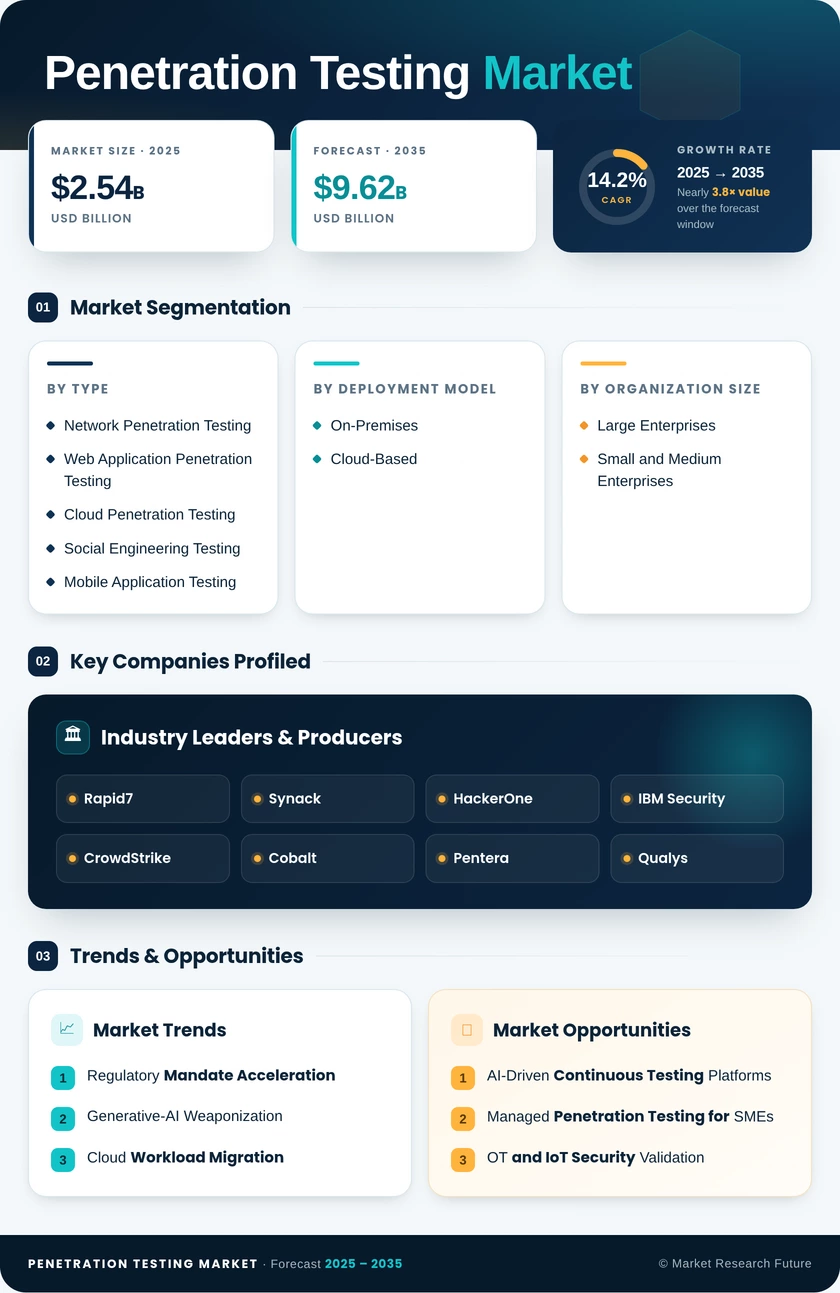
Penetration Testing Market (2025 - 2035)

Penetration Testing Market Size, Share and Research Report: By Type of Testing (Network Penetration Testing, Web Application Penetration Testing, Mobile Application Penetration Testing, Social Engineering Testing), By Deployment Model (On-Premises, Cloud-Based, Hybrid), By Service Type (Security Consulting, Managed Services, Testing as a Service), By End Use Industry (Banking and Financial Services, Healthcare, Retail, IT and Telecommunications, Government), and By Regional (North America, Europe, South America, Asia Pacific, Middle East and Africa) - Industry Forecast Till 2035

Forecast Period
2025-2035
CAGR
14.2%
2025 Market Size
USD 2.54 billion
2035 Market Size
USD 9.62 billion
Semiconductor & Electronics ● Updated August 2026 Report ID: MRFR/SEM/4391-HCR | Pages: 200 | Author: Ankit Gupta
  1. 1 Market Overview |
    1. 1.1 Study Assumptions & Market Definition |
    2. 1.2 Scope of the Study |
    3. 1.3 Research Methodology
  2. 2 Market Summary & Key Takeaways
  3. 3 Market Dynamics |
    1. 3.1 Market Drivers Analysis | |
      1. 3.1.1 Regulatory Mandate Acceleration (PCI DSS
      2. 3.1.2 Generative-AI Weaponization of Exploits | |
      3. 3.1.3 Cloud Workload Migration and Multi-Cloud Complexity | |
      4. 3.1.4 Zero-Trust Architecture Validation Requirements | |
      5. 3.1.5 IoT and OT Attack Surface Expansion | |
      6. 3.1.6 Cyber Insurance Underwriting Tightening | |
      7. 3.1.7 DevSecOps Pipeline Integration |
    2. 4.0, DORA, NIS2) | |
    3. 3.2 Market Restraints Analysis | |
      1. 3.2.1 Shortage of Certified Penetration Testing Professionals | |
      2. 3.2.2 High Cost of Comprehensive Testing Engagements | |
      3. 3.2.3 False Positive Fatigue and Remediation Backlogs | |
      4. 3.2.4 Data Sovereignty and Scope-of-Testing Restrictions | |
      5. 3.2.5 Organizational Resistance to Simulated Attacks |
    4. 3.3 Market Opportunity Analysis | |
      1. 3.3.1 AI-Driven Continuous Testing Platforms | |
      2. 3.3.2 Managed Penetration Testing for SMEs | |
      3. 3.3.3 OT and IoT Security Validation | |
      4. 3.3.4 Compliance-as-a-Service Bundling | |
      5. 3.3.5 Emerging Market Regulatory Catalysts |
    5. 3.4 Industry Value Chain Analysis |
    6. 3.5 Porter's Five Forces Analysis
  4. 4 Global Penetration Testing Market Size & Forecast (2021–2035) |
    1. 4.1 Historical Market Size (2021–2025) |
    2. 4.2 Current & Forecast Market Size (2026–2035) |
    3. 4.3 Market Size by Revenue (USD billion) |
    4. 4.4 Year-over-Year Growth Analysis
  5. 5 Segmentation Analysis |
    1. 5.1 By Testing Type | |
      1. 5.1.1 Network Penetration Testing | |
      2. 5.1.2 Web Application Penetration Testing | |
      3. 5.1.3 Cloud Penetration Testing | |
      4. 5.1.4 Social Engineering Testing | |
      5. 5.1.5 Mobile Application Testing |
    2. 5.2 By Deployment Model | |
      1. 5.2.1 On-Premises | |
      2. 5.2.2 Cloud-Based |
    3. 5.3 By Organization Size | |
      1. 5.3.1 Large Enterprises | |
      2. 5.3.2 Small and Medium Enterprises |
    4. 5.4 By Service Delivery Mode | |
      1. 5.4.1 Third-Party Managed Services | |
      2. 5.4.2 In-House Testing Teams |
    5. 5.5 By End-User Industry | |
      1. 5.5.1 BFSI | |
      2. 5.5.2 IT and Telecom | |
      3. 5.5.3 Healthcare and Life Sciences | |
      4. 5.5.4 Government and Defense | |
      5. 5.5.5 Manufacturing | |
      6. 5.5.6 Retail and E-Commerce
  6. 6 Regional Analysis |
    1. 6.1 North America | |
      1. 6.1.1 United States | |
      2. 6.1.2 Canada | |
      3. 6.1.3 Mexico |
    2. 6.2 Europe | |
      1. 6.2.1 Germany | |
      2. 6.2.2 United Kingdom | |
      3. 6.2.3 France | |
      4. 6.2.4 Italy | |
      5. 6.2.5 Spain | |
      6. 6.2.6 Nordic Countries | |
      7. 6.2.7 Russia | |
      8. 6.2.8 Rest of Europe |
    3. 6.3 Asia-Pacific | |
      1. 6.3.1 China | |
      2. 6.3.2 India | |
      3. 6.3.3 Japan | |
      4. 6.3.4 South Korea | |
      5. 6.3.5 ASEAN | |
      6. 6.3.6 Rest of Asia-Pacific |
    4. 6.4 South America | |
      1. 6.4.1 Brazil | |
      2. 6.4.2 Argentina | |
      3. 6.4.3 Rest of South America |
    5. 6.5 Middle East & Africa | |
      1. 6.5.1 Saudi Arabia | |
      2. 6.5.2 UAE | |
      3. 6.5.3 South Africa | |
      4. 6.5.4 Egypt | |
      5. 6.5.5 Rest of MEA
  7. 7 Competitive Landscape |
    1. 7.1 Market Share Analysis (2025) |
    2. 7.2 Competitive Benchmarking Matrix |
    3. 7.3 Company Profiles | |
      1. 7.3.1 Rapid7 | |
      2. 7.3.2 Synack | |
      3. 7.3.3 HackerOne | |
      4. 7.3.4 IBM Security | |
      5. 7.3.5 CrowdStrike | |
      6. 7.3.6 Cobalt | |
      7. 7.3.7 Pentera | |
      8. 7.3.8 Qualys | |
      9. 7.3.9 BreachLock | |
      10. 7.3.10 Bugcrowd
  8. 8 Future Outlook & Strategic Recommendations (2026–2035) |
    1. 8.1 Autonomous Attack Simulation at Scale |
    2. 8.2 Platform Consolidation and Ecosystem Economics |
    3. 8.3 Quantum-Readiness Validation |
    4. 8.4 ESG and Cyber Resilience Reporting
  9. 9 Recent Developments & News
  10. 10 Frequently Asked Questions (FAQs)
  11. 11 Report Scope & Methodology |
    1. 11.1 Study Period & Base Year |
    2. 11.2 Data Sources & Citations |
    3. 11.3 Abbreviations
  12. 12 LIST OF TABLES |
  13. TABLE 1 Global Penetration Testing Market Size & Forecast, by Revenue (USD billion), 2021–2035 |
  14. TABLE 2 Global Penetration Testing Market – Year-over-Year Growth Analysis, 2021–2035 |
  15. TABLE 3 Global Penetration Testing Market – Driver Impact Analysis |
  16. TABLE 4 Global Penetration Testing Market – Restraint Impact Analysis |
  17. TABLE 5 Global Penetration Testing Market Size, by Testing Type, 2021–2035 (USD billion) |
  18. TABLE 6 Global Penetration Testing Market Size, by Deployment Model, 2021–2035 (USD billion) |
  19. TABLE 7 Global Penetration Testing Market Size, by Organization Size, 2021–2035 (USD billion) |
  20. TABLE 8 Global Penetration Testing Market Size, by Service Delivery Mode, 2021–2035 (USD billion) |
  21. TABLE 9 Global Penetration Testing Market Size, by End-User Industry, 2021–2035 (USD billion) |
  22. TABLE 10 Global Penetration Testing Market Size, by Region, 2021–2035 (USD billion) |
  23. TABLE 11 North America Penetration Testing Market Size, by Country, 2021–2035 (USD billion) |
  24. TABLE 12 Europe Penetration Testing Market Size, by Country, 2021–2035 (USD billion) |
  25. TABLE 13 Asia-Pacific Penetration Testing Market Size, by Country, 2021–2035 (USD billion) |
  26. TABLE 14 South America Penetration Testing Market Size, by Country, 2021–2035 (USD billion) |
  27. TABLE 15 Middle East & Africa Penetration Testing Market Size, by Country, 2021–2035 (USD billion) |
  28. TABLE 16 Competitive Benchmarking Matrix – Global Penetration Testing Market, 2025 |
  29. TABLE 17 Company Profiles – Key Players, Global Penetration Testing Market |
  30. TABLE 18 Recent Developments & Strategic Announcements, 2024–2025 |
  31. TABLE 19 Report Scope & Methodology Summary |
  32. TABLE 20 Detailed Sources and Citations
  33. 13 LIST OF FIGURES |
  34. FIGURE 1 Penetration Testing Market Dynamics — Drivers, Restraints, and Opportunities |
  35. FIGURE 2 Industry Value Chain Analysis — Penetration Testing Market |
  36. FIGURE 3 Porter's Five Forces Analysis — Penetration Testing Market |
  37. FIGURE 4 Global Penetration Testing Market Size Trend and Forecast (USD billion), 2021–2035 |
  38. FIGURE 5 Penetration Testing Market Share by Testing Type (%), 2025 |
  39. FIGURE 6 Penetration Testing Market Share by Deployment Model (%), 2025 |
  40. FIGURE 7 Penetration Testing Market Share by Organization Size (%), 2025 |
  41. FIGURE 8 Penetration Testing Market Share by Service Delivery Mode (%), 2025 |
  42. FIGURE 9 Penetration Testing Market Share by End-User Industry (%), 2025 |
  43. FIGURE 10 Penetration Testing Market Share by Region (%), 2025 |
  44. FIGURE 11 North America Penetration Testing Market Share by Country (%), 2025 |
  45. FIGURE 12 Europe Penetration Testing Market Share by Country (%), 2025 |
  46. FIGURE 13 Asia-Pacific Penetration Testing Market Share by Country (%), 2025 |
  47. FIGURE 14 South America Penetration Testing Market Share by Country (%), 2025 |
  48. FIGURE 15 Middle East & Africa Penetration Testing Market Share by Country (%), 2025 |
  49. FIGURE 16 Competitive Landscape — Market Share Analysis, Penetration Testing Market, 2025 |
  50. FIGURE 17 Competitive Positioning Matrix — Key Players, Penetration Testing Market
Share::
Request Free Sample

Segmentation Quick Reference

DimensionSub-SegmentsDominant SegmentFastest Growing Segment
Testing TypeNetwork, Web Application, Cloud, Social Engineering, Mobile ApplicationNetwork Penetration TestingCloud Penetration Testing
Deployment ModelOn-Premises, Cloud-BasedOn-PremisesCloud-Based
Organization SizeLarge Enterprises, Small and Medium EnterprisesLarge EnterprisesSmall and Medium Enterprises
Service Delivery ModeThird-Party Managed Services, In-House Testing TeamsThird-Party Managed ServicesIn-House Testing Teams
End-User IndustryBFSI, IT and Telecom, Healthcare and Life Sciences, Government and Defense, Manufacturing, Retail and E-CommerceBFSIHealthcare and Life Sciences
GeographyNorth America, Europe, Asia-Pacific, South America, Middle East & AfricaNorth AmericaAsia-Pacific


Market Segmentation Overview

By Testing Type

Sub-SegmentKey Trend
Network Penetration TestingContinued demand driven by Active Directory exploitation and lateral movement simulation
Web Application Penetration TestingAPI security testing is expanding with microservices and serverless adoption
Cloud Penetration TestingIAM misconfiguration and container escape testing are growing with multi-cloud migration
Social Engineering TestingGenerative-AI-powered phishing simulation increases engagement realism.
Mobile Application TestingFintech and health app proliferation are driving mobile-specific security assessments.


Network and web application testing represent the established core of penetration testing engagements, while cloud and mobile categories are capturing incremental budget as enterprise architectures evolve. Social engineering testing is gaining boardroom attention following high-profile deepfake-enabled fraud incidents.

By Deployment Model

Sub-SegmentKey Trend
On-PremisesPreferred by regulated industries with strict data residency and air-gapped environments
Cloud-BasedSaaS delivery enables rapid scaling and reduces deployment overhead for distributed teams.


On-premises deployment retains the majority share due to data sovereignty requirements, but cloud-based platforms are narrowing the gap by offering elastic scan capacity and browser-based reporting.

By Organization Size

Sub-SegmentKey Trend
Large EnterprisesComplex multi-site environments requiring customized red-team engagements
Small and Medium EnterprisesSubscription-based managed testing lowers entry barriers for SME adoption.


Large enterprises drive absolute spend, while SMEs represent the growth frontier as cyber insurance mandates expand testing requirements beyond the enterprise tier.

By Service Delivery Mode

Sub-SegmentKey Trend
Third-Party Managed ServicesAudit independence and specialized expertise sustaining outsourced model dominance
In-House Testing TeamsContinuous testing cadence and institutional knowledge are driving internal capability buildout.


Third-party services dominate for compliance-driven testing where auditor independence is required, while in-house teams are growing among technology companies with mature DevSecOps practices.

By End-User Industry

Sub-SegmentKey Trend
BFSIPCI DSS 4.0 and DORA mandate generating recurring multi-year contract demand
IT and Telecom5G rollout and SaaS platform validation, expanding the scope of required assessments
Healthcare and Life SciencesConnected medical devices and HIPAA enforcement are creating the fastest-growing vertical demand.
Government and DefenseZero-trust and CMMC 2.0 mandate institutionalizing testing across federal supply chains
ManufacturingOT/IT convergence requires specialized industrial control system testing methodologies
Retail and E-CommercePCI DSS compliance for payment systems and e-commerce platform security assessments


BFSI remains the largest vertical by revenue share, but healthcare is the fastest-growing end-user industry as ransomware targeting of health systems escalates and regulatory enforcement intensifies.


 

Share::
Request Free Sample
Download PDF ×

We do not share your information with anyone. However, we may send you emails based on your report interest from time to time. You may contact us at any time to opt-out.