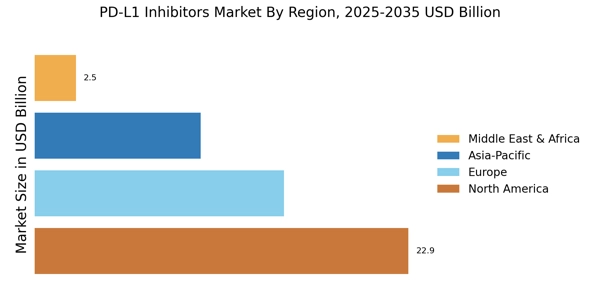
North America : Leading Market Innovators
North America accounted for the largest share of the global PD-L1 inhibitors size, reaching USD 22.9 billion in 2024. North America is the largest market for PD-L1 inhibitors, accounting for approximately 45% of the global market share. The region's growth is driven by advanced healthcare infrastructure, high R&D investments, and increasing prevalence of cancer.
Regulatory support from agencies like the FDA has accelerated the approval of new therapies, enhancing market dynamics. The demand for innovative treatments is further fueled by rising healthcare expenditures and a growing aging population. The United States is the primary contributor to this market, with key players such as Merck & Co., Bristol-Myers Squibb, and Pfizer leading the charge. The competitive landscape is characterized by continuous innovation and strategic collaborations among pharmaceutical companies. The presence of robust clinical trial frameworks and a focus on personalized medicine are also pivotal in shaping the market, ensuring that North America remains at the forefront of PD-L1 inhibitor development.
Europe : Regulatory Advancements Drive Growth
Europe PD-L1 Inhibitors Market size was valued at USD 15.297 billion in 2024, making it the second-largest regional market with 30% share. The region's growth is propelled by increasing cancer incidence, supportive regulatory frameworks, and a strong emphasis on research and development. The European Medicines Agency (EMA) has been instrumental in expediting the approval process for innovative therapies, thereby enhancing market accessibility. Additionally, the rising demand for targeted therapies is driving investments in this sector.
Leading countries in this market include Germany, France, and the UK, where major pharmaceutical companies like AstraZeneca and Roche are actively involved. The competitive landscape is marked by collaborations between biotech firms and research institutions, fostering innovation. The presence of well-established healthcare systems and a focus on patient-centric approaches further contribute to the region's growth, making Europe a key player in the PD-L1 inhibitors market.
Asia-Pacific : Rapidly Growing Market Potential
Asia-Pacific is witnessing rapid growth in the PD-L1 inhibitors market, accounting for approximately 20% of the global share. The region's expansion is driven by increasing cancer prevalence, rising healthcare investments, and a growing focus on personalized medicine. Countries like China and Japan are leading this growth, supported by favorable regulatory environments and government initiatives aimed at improving cancer care. The demand for advanced therapies is also being fueled by a rising middle class and increased awareness of cancer treatments.
China is emerging as a significant player, with local companies and international firms collaborating to enhance treatment options. The competitive landscape is characterized by a mix of established pharmaceutical giants and innovative startups. Key players such as Novartis and Eli Lilly are actively investing in research and development, ensuring that Asia-Pacific remains a vital region for PD-L1 inhibitors, with a strong emphasis on addressing unmet medical needs.
Middle East and Africa : Untapped Market Opportunities
The Middle East and Africa (MEA) region is gradually emerging in the PD-L1 inhibitors market, currently holding about 5% of the global share. The growth in this region is driven by increasing cancer rates, improving healthcare infrastructure, and rising awareness about advanced treatment options. Governments are beginning to prioritize cancer care, leading to regulatory reforms that facilitate the introduction of innovative therapies. The demand for PD-L1 inhibitors is expected to rise as healthcare systems evolve and access to treatments improves.
Countries like South Africa and the UAE are at the forefront of this market, with a growing number of clinical trials and partnerships between local and international pharmaceutical companies. The competitive landscape is still developing, with opportunities for new entrants and collaborations. Key players are beginning to explore this region, recognizing its potential for growth in oncology treatments, particularly in addressing the rising cancer burden.