
×
Hero Background
English
Chinese
French
Japanese
Korean
German
Spanish

Network Slicing Market Size

ID: MRFR/ICT/9143-HCR
141 Pages
Ankit Gupta
October 2025

Network Slicing Market Research Report Information by Component (Solution and Services), End User (Telecom Operators and Enterprises), Application (Manufacturers, Healthcare, Automotive, Media & Entertainment, and Others), and Region (North America, Europe, Asia-Pacific, Middle East & Africa, and South America) - Forecast till 2035

Share:
Download PDF ×

We do not share your information with anyone. However, we may send you emails based on your report interest from time to time. You may contact us at any time to opt-out.

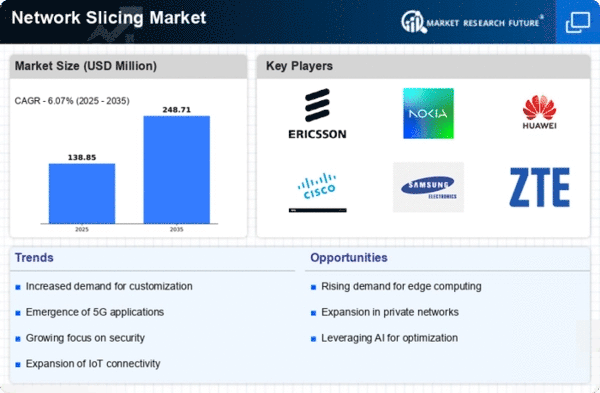
Network Slicing Market Infographic
Purchase Options

Network Slicing Size

Network Slicing Market Growth Projections and Opportunities

The Network Slicing business is impacted by different market factors that assume a significant part in molding its elements and development direction. One critical variable is the quick development of 5G innovation. The coming of 5G has introduced another time of availability, offering remarkable speed and low dormancy. Network Slicing, as a critical element of 5G, permits administrators to make numerous virtual organizations on a solitary actual framework. This adaptability empowers the customization of administrations for different applications, like shrewd urban communities, modern robotization, and increased reality. The interest for network cutting is accordingly pushed by the rising reception of 5G across enterprises.

Another market factor driving the development of Network Slicing is the flood in Web of Things (IoT) gadgets. The multiplication of associated gadgets across different areas, from medical services to assembling, requires an organization framework equipped for taking care of different necessities. Network cutting gives an answer by permitting administrators to designate explicit cuts for various sorts of IoT applications. This guarantees upgraded execution, security, and asset use, tending to the interesting requirements of each utilization case. As IoT keeps on extending, the interest for network cutting is supposed to proportionately rise.

Moreover, the market for Network Slicing is affected by the raising interest for upgraded portable broadband administrations. The demand for advanced network capabilities is being driven by the consumer demand for high-speed internet, seamless connectivity, and immersive multimedia experiences. Network cutting empowers administrators to designate committed cuts for upgraded portable broadband, guaranteeing that clients get the ideal degree of administration quality. This is especially pivotal in thickly populated metropolitan regions where network blockage is a typical test. As urbanization and cell phone use keep on developing, the market for network cutting is ready for extension.

Interoperability and normalization likewise assume a vital part in molding the organization cutting business sector. Keeping equipment and networks from various vendors compatible and seamlessly integrated becomes increasingly important as technology advances. Normalization endeavors by industry associations and cooperation among partners are fundamental to lay out a bound together system for network cutting sending. The foundation of normal guidelines works with interoperability, lessens organization intricacy, and advances a sound cutthroat scene. Market players are intently checking and effectively partaking in these normalization drives to profit by the learning experiences introduced by a blended biological system.

Additionally, the market dynamics of Network Slicing are influenced by regulatory initiatives and policies. States and administrative bodies assume an essential part in molding the media communications scene. Strategies that advance 5G organization and backing the execution of cutting edge innovations like Network Slicing can altogether influence market development. Administrative structures that encourage development, contest, and interest in broadcast communications framework establish a helpful climate for the extension of Network Slicing administrations.
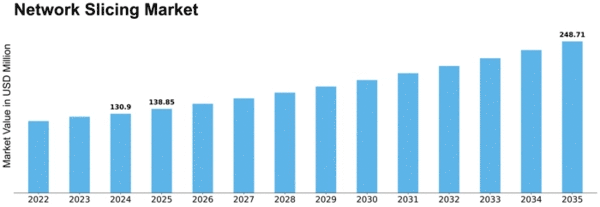
Network Slicing Market Size Graph
Author
Ankit Gupta
Senior Research Analyst

Ankit Gupta is an analyst in market research industry in ICT and SEMI industry. With post-graduation in "Telecom and Marketing Management" and graduation in "Electronics and Telecommunication" vertical he is well versed with recent development in ICT industry as a whole. Having worked on more than 150+ reports including consultation for fortune 500 companies such as Microsoft and Rio Tinto in identifying solutions with respect to business problems his opinions are inclined towards mixture of technical and managerial aspects.

Leave a Comment

FAQs

At what CAGR is the global network slicing market predicted to grow during the forecast period?

The global network slicing market is predicted to grow at a 6.03% CAGR by 2030.

What will be the valuation of the global network slicing market during the forecast period?

The global network slicing market will touch USD 0.98 Billion by 2030

Which region will lead the global network slicing market?

North America will lead the global network slicing market.

What are the key factors driving the global network slicing market

Advances in 5G technology and integration of SDN & NFV are the key factors driving the global network slicing market growth.

Who are the key contenders profiled in the global network slicing market?

Key contenders profiled in the global network slicing market include Huawei Technologies, ZTE Corporation, Ericsson, Affirmed Networks, CISCO Systems, Nokia (Finland), Samsung, NTT Docomo, BT Group PLC, NEC Corporation, Aria Networks, Parallel Wireless, Mavenir, AMDOCS, and Argela Technologies.

Market Summary

As per Market Research Future Analysis, the network slicing market is poised for significant growth, expanding from USD 105.74 million in 2019 to USD 0.98 billion by 2030, reflecting a CAGR of 6.03%. This growth is driven by the evolution of 5G technology, which facilitates multiple logical networks over a shared infrastructure, enhancing service quality and operational efficiency. The COVID-19 pandemic has further accelerated demand for high-speed connectivity, prompting service providers to invest in network slicing solutions to support applications like remote work and e-health services. Key challenges include security concerns and resource optimization in shared networks.

Key Market Trends & Highlights

Key trends influencing the network slicing market include advancements in technology and increasing demand across sectors.

  • Network slicing market size projected to reach USD 0.98 billion by 2030.
  • 5G technology is a major driver, enabling tailored connectivity for business customers.
  • Asia-Pacific expected to register the fastest growth rate due to infrastructure developments.
  • North America likely to dominate the market with a strong presence of key industry players.

Market Size & Forecast

2019 Market Size USD 105.74 million
2030 Market Size USD 0.98 billion
CAGR 6.03%
Dominant Regional Market North America
Fastest Growth Region Asia-Pacific.

Major Players

Key players include Huawei Technologies, ZTE Corporation, Ericsson, Affirmed Networks, CISCO Systems, Nokia, Samsung, NTT Docomo, BT Group PLC, NEC Corporation, Aria Networks, Parallel Wireless, Mavenir, AMDOCS, and Argela Technologies.

Market Trends

Network Slicing Market Market Drivers

Market Growth Projections

The Global Network Slicing Market Industry is poised for substantial growth, with projections indicating a market size of 12.5 USD Billion in 2024 and an anticipated increase to 45 USD Billion by 2035. This growth trajectory reflects a compound annual growth rate (CAGR) of 12.35% from 2025 to 2035. Such figures underscore the increasing adoption of network slicing technologies across various sectors, driven by the demand for tailored network solutions. The market's expansion is likely to be fueled by advancements in 5G technology, IoT applications, and regulatory support, positioning network slicing as a cornerstone of future telecommunications infrastructure.

Emergence of IoT Applications

The proliferation of Internet of Things (IoT) applications is a significant driver of the Global Network Slicing Market Industry. As more devices connect to the internet, the demand for dedicated network resources becomes paramount. Network slicing enables operators to allocate bandwidth and optimize performance for various IoT applications, such as smart cities and industrial automation. This tailored approach not only enhances user experience but also ensures reliability and security. With the market expected to grow at a CAGR of 12.35% from 2025 to 2035, the integration of IoT with network slicing is likely to reshape the telecommunications landscape, fostering innovation and efficiency.

Increasing Demand for 5G Services

The Global Network Slicing Market Industry is experiencing a surge in demand for 5G services, driven by the need for enhanced connectivity and lower latency. As industries increasingly adopt 5G technology, network slicing emerges as a critical solution, allowing operators to create multiple virtual networks on a single physical infrastructure. This capability supports diverse applications, from IoT to autonomous vehicles, thereby expanding market opportunities. In 2024, the market is projected to reach 12.5 USD Billion, reflecting the growing reliance on 5G networks. The ability to tailor network resources to specific use cases positions network slicing as a pivotal component in the evolution of telecommunications.

Support for Diverse Industry Verticals

The Global Network Slicing Market Industry is increasingly recognized for its ability to support diverse industry verticals, including healthcare, automotive, and entertainment. Each sector has unique requirements, necessitating customized network solutions. For instance, in healthcare, network slicing can facilitate real-time remote monitoring and telemedicine services, while in the automotive sector, it can enhance vehicle-to-everything (V2X) communication. This versatility not only drives adoption but also encourages investment in network slicing technologies. As the market evolves, the potential for tailored solutions across various industries may contribute to its projected growth to 45 USD Billion by 2035, indicating a robust future for network slicing.

Regulatory Support and Standardization Efforts

Regulatory support and standardization efforts play a vital role in the Global Network Slicing Market Industry. Governments and industry bodies are increasingly recognizing the importance of network slicing for enabling next-generation networks. Initiatives aimed at creating standards for network slicing facilitate interoperability and encourage investment in this technology. As regulatory frameworks evolve, they provide a conducive environment for operators to implement network slicing solutions. This support is likely to accelerate market growth, as stakeholders seek to align with emerging standards. The collaborative efforts between regulators and industry players may significantly influence the trajectory of the network slicing market in the coming years.

Enhanced Network Efficiency and Resource Management

The Global Network Slicing Market Industry benefits from enhanced network efficiency and resource management capabilities. By allowing operators to dynamically allocate resources based on demand, network slicing optimizes the use of existing infrastructure. This efficiency is particularly crucial as data traffic continues to escalate. Operators can create slices that prioritize critical applications while ensuring that less urgent traffic does not compromise performance. This approach not only improves user satisfaction but also reduces operational costs. As the market matures, the emphasis on efficient resource management is likely to drive further adoption of network slicing solutions, reinforcing its role in modern telecommunications.

Market Segment Insights

Regional Insights

Key Companies in the Network Slicing Market market include

Industry Developments

On Apr. 06, 2023, WiMi Hologram Cloud Inc., a leading global provider of Hologram Augmented Reality, announced the development of a new network slicing management system at the RAN (radio access network) side centered on artificial intelligence. WiMi develops an AI-enabled RAN-side network slicing management system for smart decision-making. The system uses network function virtualization (NFV) technology to instantiate multiple virtual networks on the same physical network infrastructure.

On Mar. 29, 2023, Nokia announced its plan to deploy transport network slicing for DoCoMo's 5G network. Docomo has deployed Nokia's 7750 SR-14s core routers to enhance its nationwide IP core and enable transport network slicing as it initiates new 5G mobile services. To deliver the network slicing for its innovative mobile services, DoCoMo will leverage the segment routing capabilities of Nokia's Service Router Operating System (SR OS) for traffic-engineered network slices for the granular SLAs required by DoCoMo's customers.

On Feb. 07, 2023, Ericsson, Far EasTone Telecommunications, and Taiwanese TV and multimedia company TVBS announced a collaboration to run 5G network slicing for marathon broadcasts in Taiwan. To ensure a significant viewing experience of the competition, companies used 5G network slicing to transmit live streaming data of the 21st New Taipei City Wan Jin Shi Marathon. Far EasTone uses network-slicing technology in the crime-fighting realm for a 5G smart patrol police car.  

On Jan.20, 2023, Samsung Electronics and KDDI announced that they have combined their technical expertise to demonstrate network slicing with RIC on a live 5G SA network. The successful demonstration of SLA (Service Level Agreements) ensures network slicing in a field trial conducted in Tokyo, Japan. The companies proved their capabilities to generate multiple network slices using a RAN Intelligent Controller (RIC) on a live commercial 5G Standalone (SA) network. 

Future Outlook

Network Slicing Market Future Outlook

The Network Slicing Market is poised for growth at 12.35% CAGR from 2024 to 2035, driven by increasing demand for 5G applications and IoT integration.

New opportunities lie in:

  • Develop tailored network slicing solutions for vertical industries like healthcare and automotive.
  • Invest in AI-driven analytics to optimize network performance and resource allocation.
  • Forge strategic partnerships with cloud service providers to enhance service delivery and scalability.

By 2035, the Network Slicing Market is expected to achieve substantial growth, reflecting its critical role in future telecommunications.

Market Segmentation

Market Segmentation

Report Scope

Report Attribute/Metric Details
  Market Size   USD 0.98 Billion
  CAGR   6.03%
  Base Year   2021
  Forecast Period   2022-2030
  Historical Data   2020
  Forecast Units   Value (USD Million)
  Report Coverage   Revenue Forecast, Competitive Landscape, Growth Factors, and Trends
  Segments Covered   By Component, Application
  Geographies Covered   North America, Europe, Aisa Pacific
  Key Vendors   Huawei Technologies (China), ZTE Corporation (China), Ericsson (Sweden), Affirmed Networks (US), CISCO Systems (US), Nokia (Finland), Samsung (South Korea), NTT Docomo (Japan), BT Group PLC (UK), NEC Corporation (Japan), Aria Networks (UK), Parallel Wireless (US), Mavenir (US), AMDOCS (US), and Argela Technologies (Turkey).
  Key Market Opportunities   The major factors driving the growth of the network slicing market includethe advancements in the 5G technology, increasing demand for high-speed network coverage across various market
  Key Market Drivers   The ability to improve operational efficiencies and time to market for delivering 5G networks across different verticals and reduce expenses & capital expenditure among network operators provide opportunities in the network slicing market.

FAQs

At what CAGR is the global network slicing market predicted to grow during the forecast period?

The global network slicing market is predicted to grow at a 6.03% CAGR by 2030.

What will be the valuation of the global network slicing market during the forecast period?

The global network slicing market will touch USD 0.98 Billion by 2030

Which region will lead the global network slicing market?

North America will lead the global network slicing market.

What are the key factors driving the global network slicing market

Advances in 5G technology and integration of SDN & NFV are the key factors driving the global network slicing market growth.

Who are the key contenders profiled in the global network slicing market?

Key contenders profiled in the global network slicing market include Huawei Technologies, ZTE Corporation, Ericsson, Affirmed Networks, CISCO Systems, Nokia (Finland), Samsung, NTT Docomo, BT Group PLC, NEC Corporation, Aria Networks, Parallel Wireless, Mavenir, AMDOCS, and Argela Technologies.

  1. EXECUTIVE SUMMARY
    1. Market Attractiveness
      1. Global Network Slicing Market, by End User
      2. Global Network Slicing
    2. Analysis
    3. Global Network SlicingMarket, by Component
  2. Market, by Application
    1. Global Network SlicingMarket, by Region
  3. MARKET INTRODUCTION
    1. Definition
    2. Scope of the Study
    3. Market Structure
  4. RESEARCH METHODOLOGY
    1. Research Process
    2. Primary Research
    3. Secondary Research
    4. Market Size Estimation
    5. Forecast Model
    6. List of Assumptions
  5. MARKET DYNAMICS
    1. Introduction
    2. Drivers
    3. Evolution of 5G technology
    4. Increasing demand for high-speed network coverages across various market segments
    5. of software-defined networking (SDN) and network function virtualization (NFV)
    6. operation efficienc& time to market for delivery of 5G networks
    7. in reducing expenses & capital expenditure
    8. 5G business
    9. Challenge
    10. Optimizing network resource usage
    11. Impact of COVID-19
    12. Impact on Telecommunication Industry
    13. Increase in 5G enabled e-health solutions in the healthcare industry
    14. y-o-y from 2020–2026
  6. Increasing integration
    1. Restraint
      1. Security breaches
    2. Opportunities
      1. Ability to improve
      2. Helps network operators
      3. 5G RAN slicing to positively impact growth in
      4. Impact on overall market
  7. MARKET FACTOR ANALYSIS
    1. Value Chain Analysis/Supply Chain Analysis
    2. Porter’s Five Forces Model
      1. Threat of New Entrants
      2. Bargaining Power
    3. of Suppliers
    4. Threat of Substitutes
    5. Bargaining Power of Buyers
    6. Intensity of Rivalry
  8. GLOBAL NETWORK SLICING MARKET, BY COMPONENT
    1. Introduction
    2. Solution
    3. Services
      1. Professional Services
      2. Managaed Services
  9. GLOBAL NETWORK SLICING MARKET, BY END USER
    1. Introduction
      1. Telecom Operators
      2. Enterprises
  10. GLOBAL NETWORK SLICING
  11. MARKET, BY APPLICATION
    1. Introduction
    2. Manufacturers
    3. Healthcare
    4. Government
    5. Automotive
    6. Media & Entertainment
    7. Others
  12. GLOBAL
    1. NETWORK SLICINGMARKET, BY REGION
    2. Introduction
    3. North America
  13. Market Size & Estimates, by Component, 2018–2026
    1. Estimates, by Application, 2018–2026
  14. Market Size & Estimates, by End User, 2018–2026
  15. Market Size &
  16. US
  17. Market Size & Estimates, by Component, 2018–2026
  18. Market Size & Estimates, by End User,
  19. Market Size & Estimates, by Application, 2018–2026
  20. Canada
  21. Market Size & Estimates, by Component,
  22. Market Size & Estimates, by End User, 2018–2026
    1. Mexico
  23. Market Size & Estimates, by Application,
  24. Market Size & Estimates, by Component, 2018–2026
  25. Market Size & Estimates, by End User,
  26. Market Size & Estimates, by Application, 2018–2026
    1. Europe
  27. Market Size & Estimates, by Country, 2018–2026
    1. Estimates, by End User, 2018–2026
  28. Market Size & Estimates, by Component, 2018–2026
  29. Market Size &
  30. Market Size & Estimates, by Application, 2018–2026
  31. Germany
  32. Market Size & Estimates, by Component,
  33. Market Size & Estimates, by End User, 2018–2026
    1. France
  34. Market Size & Estimates, by Application,
  35. Market Size & Estimates, by Component, 2018–2026
  36. Market Size & Estimates, by End User,
  37. Market Size & Estimates, by Application, 2018–2026
  38. UK
  39. Market Size & Estimates, by Component, 2018–2026
  40. Market Size & Estimates, by End User,
  41. Market Size & Estimates, by Application, 2018–2026
  42. Rest of Europe
  43. Market Size & Estimates, by Component,
  44. Market Size & Estimates, by End User, 2018–2026
    1. Asia-Pacific
  45. Market Size & Estimates, by Application,
  46. Market Size & Estimates, by Country, 2018–2026
    1. Estimates, by End User, 2018–2026
  47. Market Size & Estimates, by Component, 2018–2026
  48. Market Size &
  49. Market Size & Estimates, by Application, 2018–2026
  50. China
  51. Market Size & Estimates, by Component,
  52. Market Size & Estimates, by End User, 2018–2026
    1. Japan
  53. Market Size & Estimates, by Application,
  54. Market Size & Estimates, by Component, 2018–2026
  55. Market Size & Estimates, by End User,
  56. Market Size & Estimates, by Application, 2018–2026
  57. India
  58. Market Size & Estimates, by Component,
  59. Market Size & Estimates, by End User, 2018–2026
    1. Rest of Asia-Pacific
  60. Market Size & Estimates, by Application,
  61. Market Size & Estimates, by Component, 2018–2026
  62. Market Size & Estimates, by End User,
  63. Market Size & Estimates, by Application, 2018–2026
    1. Middle East & Africa
    2. Estimates, by Component, 2018–2026
  64. Market Size & Estimates, by Country, 2018–2026
  65. Market Size &
  66. Market Size & Estimates, by End User, 2018–2026
    1. South America
  67. Market Size & Estimates, by Application,
  68. Market Size & Estimates, by Country, 2018–2026
  69. Market Size & Estimates, by Component,
  70. Market Size & Estimates, by End User, 2018–2026
  71. Market Size & Estimates, by Application,
  72. COMPETITIVE LANDSCAPE
    1. Introduction
    2. KeyPlayersMarket Share Analysis, 2019 (%)
    3. Competitive Benchmarking
    4. Competitor Dashboard
    5. Major Growth Strategy in the market
    6. Key Developments
    7. & Growth Strategies
    8. Product Developments
    9. Mergers & Acquisitions
    10. Contracts & Agreements
    11. COMPANY PROFILES
    12. ZTE Corporation
    13. Company Overview
    14. Financial Overview
    15. Products Offered
    16. Key Developments
    17. SWOT Analysis
    18. Key Strategies
    19. Ericsson
    20. Company Overview
    21. Financial Overview
    22. Products Offered
    23. Key Developments
    24. SWOT Analysis
    25. Key Strategies
    26. Affirmed Networks
    27. Company Overview
    28. Financial Overview
    29. Products Offered
    30. Key Developments
    31. SWOT Analysis
    32. Key Strategies
    33. CISCO
    34. Company Overview
    35. Financial Overview
    36. Products Offered
    37. Key Developments
    38. SWOT Analysis
    39. Key Strategies
    40. Nokia
    41. Company Overview
    42. Financial Overview
    43. Products Offered
    44. Key Developments
    45. SWOT Analysis
    46. Key Strategies
    47. Samsung
    48. Company Overview
    49. Financial Overview
    50. Products Offered
    51. Key Developments
    52. SWOT Analysis
    53. Key Strategies
    54. NTT Docomo
    55. Company Overview
    56. Financial Overview
    57. Products Offered
    58. Key Developments
    59. SWOT Analysis
    60. Key Strategies
    61. BT Group PLC
    62. Company Overview
    63. Financial Overview
    64. Products Offered
    65. Key Developments
    66. SWOT Analysis
    67. Key Strategies
    68. NEC Corporation
    69. Company Overview
    70. Financial Overview
    71. Products Offered
    72. Key Developments
    73. SWOT Analysis
    74. Key Strategies
    75. Aria Networks
    76. Company Overview
    77. Financial Overview
    78. Products Offered
    79. Key Developments
    80. SWOT Analysis
    81. Key Strategies
    82. Parallel Wireless
    83. Company Overview
    84. Financial Overview
    85. Products Offered
    86. Key Developments
    87. SWOT Analysis
    88. Key Strategies
    89. Mavenir
    90. Company Overview
    91. Financial Overview
    92. Products Offered
    93. Key Developments
    94. SWOT Analysis
    95. Key Strategies
    96. AMDOCS
    97. Company Overview
    98. Financial Overview
    99. Products Offered
    100. Key Developments
    101. SWOT Analysis
    102. Key Strategies
    103. Argela Technologies
    104. Company Overview
    105. Financial Overview
    106. Products Offered
    107. Key Developments
    108. SWOT Analysis
    109. Key Strategies
    110. Huawei Technologies
    111. Company Overview
    112. Financial Overview
    113. Products Offered
    114. Key Developments
    115. SWOT Analysis
    116. Key Strategies
    117. APPENDIX
    118. Discussion Blueprint
  73. LIST OF TABLES
  74. LIST OF ASSUMPTIONS
  75. GLOBAL NETWORK
  76. SLICING MARKET, BY COMPONENT, 2018–2026 (USD MILLION)
  77. GLOBAL NETWORK SLICING MARKET, BY END USERS,
    1. TABLE
  78. GLOBAL NETWORK SLICING MARKET, BY APPLICATION, 2018–2026 (USD MILLION)
  79. GLOBAL NETWORK
  80. SLICING MARKET, BY REGION, 2018–2026 (USD MILLION)
  81. NORTH AMERICA: NETWORK SLICING MARKET, BY COUNTRY,
    1. TABLE
  82. NORTH AMERICA : NETWORK SLICING MARKET, BY COMPONENT, 2018–2026 (USD MILLION)
  83. NORTH AMERICA:
  84. NETWORK SLICING MARKET, BY END USERS, 2018–2026 (USD MILLION)
  85. NORTH AMERICA: NETWORK
  86. SLICING MARKET, BY APPLICATION, 2018–2026 (USD MILLION)
  87. US:NETWORK SLICING MARKET,
    1. BY COMPONENT, 2018–2026 (USD MILLION)
  88. US: NETWORK SLICING MARKET, BY END USERS,
    1. TABLE
  89. US: NETWORK SLICING MARKET, BY APPLICATION, 2018–2026 (USD MILLION)
  90. CANADA: NETWORK
  91. SLICING MARKET, BY COMPONENT, 2018–2026 (USD MILLION)
  92. CANADA: NETWORK SLICING MARKET, BY END USERS,
    1. TABLE
  93. CANADA: NETWORK SLICING MARKET, BY APPLICATION, 2018–2026 (USD MILLION)
  94. MEXICO: NETWORK
  95. SLICING MARKET, BY COMPONENT, 2018–2026 (USD MILLION)
  96. MEXICO: NETWORK SLICING MARKET, BY END USERS,
    1. TABLE
  97. MEXICO: NETWORK SLICING MARKET, BY APPLICATION, 2018–2026 (USD MILLION)
  98. EUROPE: NETWORK
  99. SLICING MARKET, BY COMPONENT, 2018–2026 (USD MILLION)
  100. EUROPE: NETWORK SLICING MARKET, BY END USERS,
    1. TABLE
  101. EUROPE: NETWORK SLICING MARKET, BY APPLICATION, 2018–2026 (USD MILLION)
  102. UK: NETWORK SLICING
  103. MARKET, BY COMPONENT, 2018–2026 (USD MILLION)
  104. UK: NETWORK SLICING MARKET, BY END USERS,
    1. TABLE
  105. UK: NETWORK SLICING MARKET, BY APPLICATION, 2018–2026 (USD MILLION)
  106. GERMANY: NETWORK
  107. SLICING MARKET, BY COMPONENT, 2018–2026 (USD MILLION)
  108. GERMANY: NETWORK SLICING MARKET, BY END USERS,
    1. TABLE
  109. GERMANY: NETWORK SLICING MARKET, BY APPLICATION, 2018–2026 (USD MILLION)
  110. FRANCE: NETWORK
  111. SLICING MARKET, BY COMPONENT, 2018–2026 (USD MILLION)
  112. TABLE29 FRANCE: NETWORK SLICING MARKET, BY END USERS,
    1. TABLE
  113. FRANCE: NETWORK SLICING MARKET, BY APPLICATION, 2018–2026 (USD MILLION)
  114. REST OF EUROPE:
  115. NETWORK SLICING MARKET, BY COMPONENT, 2018–2026 (USD MILLION)
  116. REST OF EUROPE: NETWORK
  117. SLICING MARKET, BY END USERS, 2018–2026 (USD MILLION)
  118. REST OF EUROPE: NETWORK SLICING MARKET, BY
    1. APPLICATION, 2018–2026 (USD MILLION)
  119. ASIA-PACIFIC: NETWORK SLICING MARKET, BY COMPONENT,
    1. TABLE
  120. ASIA-PACIFIC: NETWORK SLICING MARKET, BY END USERS, 2018–2026 (USD MILLION)
  121. ASIA-PACIFIC:
  122. NETWORK SLICING MARKET, BY APPLICATION, 2018–2026 (USD MILLION)
  123. CHINA: NETWORK
  124. SLICING MARKET, BY COMPONENT, 2018–2026 (USD MILLION)
  125. CHINA: NETWORK SLICING MARKET, BY END USERS,
    1. TABLE
  126. CHINA: NETWORK SLICING MARKET, BY APPLICATION, 2018–2026 (USD MILLION)
  127. INDIA: NETWORK
  128. SLICING MARKET, BY COMPONENT, 2018–2026 (USD MILLION)
  129. INDIA: NETWORK SLICING MARKET, BY END USERS,
    1. TABLE
  130. INDIA: NETWORK SLICING MARKET, BY APPLICATION, 2018–2026 (USD MILLION)
  131. JAPAN: NETWORK
  132. SLICING MARKET, BY COMPONENT, 2018–2026 (USD MILLION)
  133. JAPAN: NETWORK SLICING MARKET, BY END USERS,
    1. TABLE
  134. JAPAN: NETWORK SLICING MARKET, BY APPLICATION, 2018–2026 (USD MILLION)
  135. REST OF ASIA-PACIFIC:
  136. NETWORK SLICING MARKET, BY COMPONENT, 2018–2026 (USD MILLION)
  137. REST OF ASIA-PACIFIC:
  138. NETWORK SLICING MARKET, BY END USERS, 2018–2026 (USD MILLION)
  139. REST OF ASIA-PACIFIC:
  140. NETWORK SLICING MARKET, BY APPLICATION, 2018–2026 (USD MILLION)
  141. MIDDLE EAST &
  142. AFRICA: NETWORK SLICING MARKET, BY COMPONENT, 2018–2026 (USD MILLION)
  143. MIDDLE EAST &
  144. AFRICA: NETWORK SLICING MARKET, BY END USERS, 2018–2026 (USD MILLION)
  145. MIDDLE EAST &
  146. AFRICA: NETWORK SLICING MARKET, BY APPLICATION, 2018–2026 (USD MILLION)
  147. SOUTH AMERICA:
  148. NETWORK SLICING MARKET, BY COMPONENT, 2018–2026 (USD MILLION)
  149. SOUTH AMERICA: NETWORK
  150. SLICING MARKET, BY END USERS, 2018–2026 (USD MILLION)
  151. SOUTH AMERICA: NETWORK SLICING MARKET, BY
    1. APPLICATION, 2018–2026 (USD MILLION)
  152. LIST OF FIGURES
  153. MARKET SYNOPSIS
  154. RESEARCH PROCESS
    1. OF MRFR
    2. FIGURE
  155. TOP-DOWN AND BOTTOM-UP APPROACH
    1. FIGURE
  156. GLOBAL NETWORK SLICING MARKET, BY COMPONENT, 2018–2026 (USD MILLION)
  157. GLOBAL NETWORK
    1. SLICINGMarket, BY END USERS, 2018–2026 (USD MILLION)
  158. GLOBAL NETWORK SLICING Market, BY APPLICATION,
    1. FIGURE
  159. GLOBAL NETWORK SLICING MARKET, BY REGION, 2018–2026 (USD MILLION)
  160. NORTH AMERICA:
  161. NETWORK SLICING MARKET, BY COUNTRY, 2018–2026 (USD MILLION)
  162. NORTH AMERICA: NETWORK
  163. SLICING MARKET, BY COMPONENT, 2018–2026 (USD MILLION)
  164. NORTH AMERICA: NETWORK SLICING Market, BY
    1. END USERS, 2018–2026 (USD MILLION)
    2. FIGURE
  165. NORTH AMERICA: NETWORK SLICING Market, BY APPLICATION, 2018–2026 (USD MILLION)
  166. EUROPE: NETWORK
  167. SLICING MARKET, BY COUNTRY, 2018–2026 (USD MILLION)
  168. EUROPE: NETWORK SLICING MARKET, BY COMPONENT,
    1. FIGURE
  169. EUROPE: NETWORK SLICING Market, BY END USERS, 2018–2026 (USD MILLION)
  170. EUROPE: NETWORK
  171. SLICING Market, BY APPLICATION, 2018–2026 (USD MILLION)
  172. ASIA-PACIFIC: NETWORK
  173. SLICING MARKET, BY COUNTRY, 2018–2026 (USD MILLION)
  174. ASIA-PACIFIC: NETWORK SLICING MARKET, BY
    1. COMPONENT, 2018–2026 (USD MILLION)
    2. FIGURE
  175. ASIA-PACIFIC: NETWORK SLICING Market, BY END USERS, 2018–2026 (USD MILLION)
  176. ASIA-PACIFIC:
  177. NETWORK SLICING Market, BY APPLICATION, 2018–2026 (USD MILLION)
  178. MIDDLE EAST &
  179. AFRICA: NETWORK SLICING MARKET, BY COMPONENT, 2018–2026 (USD MILLION)
  180. MIDDLE EAST &
  181. AFRICA: NETWORK SLICING MARKET, BY COMPONENT, 2018–2026 (USD MILLION)
  182. MIDDLE EAST &
  183. AFRICA: NETWORK SLICING Market, BY END USERS, 2018–2026 (USD MILLION)
  184. MIDDLE EAST &
  185. AFRICA: NETWORK SLICING Market, BY APPLICATION, 2018–2026 (USD MILLION)
  186. SOUTH AMERICA:
  187. NETWORK SLICING MARKET, BY COMPONENT, 2018–2026 (USD MILLION)
  188. SOUTH AMERICA: NETWORK
  189. SLICING MARKET, BY COMPONENT, 2018–2026 (USD MILLION)
  190. SOUTH AMERICA: NETWORK SLICING Market, BY
    1. END USERS, 2018–2026 (USD MILLION)
    2. FIGURE
  191. SOUTH AMERICA: NETWORK SLICING Market, BY APPLICATION, 2018–2026 (USD MILLION)

Network Slicing Market Segmentation

Market Segmentation Overview

  • Detailed segmentation data will be available in the full report
  • Comprehensive analysis by multiple parameters
  • Regional and country-level breakdowns
  • Market size forecasts by segment
Infographic

Free Sample Request

Kindly complete the form below to receive a free sample of this Report

Get Free Sample

Customer Strories

Compare Licence

×
Features License Type
Single User Multiuser License Enterprise User
Price $4,950 $5,950 $7,250
Maximum User Access Limit 1 User Upto 10 Users Unrestricted Access Throughout the Organization
Free Customization
Direct Access to Analyst
Deliverable Format
Platform Access
Discount on Next Purchase 10% 15% 15%
Printable Versions