×
Request Free Sample ×

Kindly complete the form below to receive a free sample of this Report

* Please use a valid business email

Leading companies partner with us for data-driven Insights

clients tt-cursor
Hero Background
English
Chinese
French
Japanese
Korean
German
Spanish

Network Slicing Market Trends

ID: MRFR/ICT/9143-HCR
141 Pages
Ankit Gupta
October 2025

Network Slicing Market Research Report Information by Component (Solution and Services), End User (Telecom Operators and Enterprises), Application (Manufacturers, Healthcare, Automotive, Media & Entertainment, and Others), and Region (North America, Europe, Asia-Pacific, Middle East & Africa, and South America) - Forecast till 2035

Share:
Download PDF ×

We do not share your information with anyone. However, we may send you emails based on your report interest from time to time. You may contact us at any time to opt-out.

Network Slicing Market Infographic
×
Network Slicing Market Infographic Full View
Purchase Options

Market Trends

Key Emerging Trends in the Network Slicing Market

The Network Slicing business sector has seen critical development lately, impelled by the steadily expanding interest for rapid and solid correspondence administrations. The idea of Network Slicing, which enables the creation of multiple virtual networks on a shared physical infrastructure, has gained prominence as technology continues to advance. This imaginative methodology empowers network administrators to take care of different prerequisites and use cases, going from huge Web of Things (IoT) organizations to super low dormancy applications like independent vehicles and expanded reality.

One of the key market patterns driving the reception of Organization Cutting is the rising arrangement of 5G organizations. With 5G innovation turning out to be more broad, the requirement for productive organization the executives and customization has become significant. Network Cutting tends to this interest by permitting administrators to allot assets powerfully founded on the particular necessities of various administrations and applications. This adaptability is especially imperative in enhancing the utilization of organization assets and guaranteeing a consistent client experience across different use cases.

Besides, the expansion of IoT gadgets across ventures has energized the interest for Organization Cutting arrangements. These arrangements empower the production of committed network cuts for various IoT applications, guaranteeing solid availability and proficient information move. Businesses like medical care, assembling, and savvy urban areas benefit from the capacity to alter network boundaries to meet the interesting prerequisites of their applications, prompting worked on functional productivity and improved generally execution.

One more eminent pattern in the Organization Cutting business sector is the attention on giving start to finish cutting arrangements. Merchants and specialist organizations are progressively offering complete arrangements that cover the whole organization cutting lifecycle, from creation and coordination to observing and advancement. This approach works on the execution of organization cutting for administrators, decreasing intricacy and speeding up chance to-showcase for new administrations.

Besides, the reconciliation of computerized reasoning (artificial intelligence) and AI (ML) advancements into Organization Cutting arrangements is getting forward momentum. These cutting edge innovations empower wise robotization of organization the executives undertakings, like asset portion and streamlining. By utilizing simulated intelligence and ML calculations, administrators can upgrade the proficiency of their organizations, anticipate possible issues, and proactively address them, at last working on the general nature of administration.

The Network Slicing business sector is additionally seeing expanded cooperation among industry players. Associations and unions between network hardware suppliers, programming designers, and telecom administrators are turning out to be more normal. These coordinated efforts mean to make normalized approaches and interoperable arrangements, encouraging a more consistent execution of Organization Cutting across various organizations and biological systems.

Author
Ankit Gupta
Senior Research Analyst

Ankit Gupta is an analyst in market research industry in ICT and SEMI industry. With post-graduation in "Telecom and Marketing Management" and graduation in "Electronics and Telecommunication" vertical he is well versed with recent development in ICT industry as a whole. Having worked on more than 150+ reports including consultation for fortune 500 companies such as Microsoft and Rio Tinto in identifying solutions with respect to business problems his opinions are inclined towards mixture of technical and managerial aspects.

Leave a Comment

FAQs

At what CAGR is the global network slicing market predicted to grow during the forecast period?

The global network slicing market is predicted to grow at a 6.03% CAGR by 2030.

What will be the valuation of the global network slicing market during the forecast period?

The global network slicing market will touch USD 0.98 Billion by 2030

Which region will lead the global network slicing market?

North America will lead the global network slicing market.

What are the key factors driving the global network slicing market

Advances in 5G technology and integration of SDN & NFV are the key factors driving the global network slicing market growth.

Who are the key contenders profiled in the global network slicing market?

Key contenders profiled in the global network slicing market include Huawei Technologies, ZTE Corporation, Ericsson, Affirmed Networks, CISCO Systems, Nokia (Finland), Samsung, NTT Docomo, BT Group PLC, NEC Corporation, Aria Networks, Parallel Wireless, Mavenir, AMDOCS, and Argela Technologies.

Market Summary

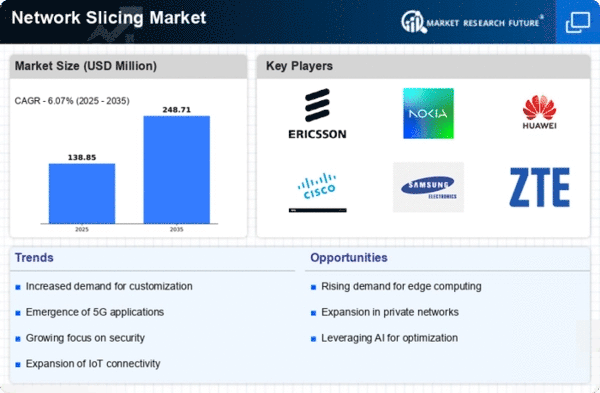
As per MRFR analysis, the Network Slicing Market Size was estimated at 130.9 USD Million in 2024. The Network Slicing industry is projected to grow from 137.96 in 2025 to 248.71 by 2035, exhibiting a compound annual growth rate (CAGR) of 6.07 during the forecast period 2025 - 2035.

Key Market Trends & Highlights

The Network Slicing Market is poised for substantial growth driven by technological advancements and increasing demand across various sectors.

  • North America remains the largest market for network slicing, driven by robust telecommunications infrastructure.
  • Asia-Pacific is emerging as the fastest-growing region, fueled by rapid digital transformation and urbanization.
  • The telecommunications segment continues to dominate, while the Internet of Things segment is witnessing the most rapid expansion.
  • Key market drivers include the rising demand for 5G services and the growing need for customized services across industries.

Market Size & Forecast

2024 Market Size 130.9 (USD Million)
2035 Market Size 248.71 (USD Million)
CAGR (2025 - 2035) 6.07%
Largest Regional Market Share in 2024 North America

Major Players

Ericsson (SE), Nokia (FI), Huawei (CN), Cisco Systems (US), Samsung Electronics (KR), ZTE Corporation (CN), Intel Corporation (US), AT&T Inc. (US), Verizon Communications (US)

Market Trends

The Network Slicing Market is currently experiencing a transformative phase, driven by the increasing demand for tailored network solutions across various industries. This innovative approach allows operators to create multiple virtual networks on a single physical infrastructure, optimizing resource allocation and enhancing service delivery. As organizations seek to improve operational efficiency and customer satisfaction, the adoption of network slicing is becoming more prevalent. This trend is particularly evident in sectors such as telecommunications, automotive, and healthcare, where specific requirements necessitate customized network configurations. Furthermore, advancements in technologies such as 5G are propelling the growth of this market, as they enable more sophisticated slicing capabilities and support diverse applications. In addition to technological advancements, regulatory frameworks and industry standards are evolving to support the deployment of network slicing. Stakeholders are increasingly recognizing the potential of this approach to facilitate innovation and drive economic growth. As a result, collaborations among telecom operators, technology providers, and regulatory bodies are likely to intensify, fostering an ecosystem conducive to the expansion of the Network Slicing Market. The future appears promising, with ongoing investments in research and development aimed at enhancing slicing techniques and ensuring seamless integration with existing infrastructures. Overall, the Network Slicing Market is poised for substantial growth, reflecting the dynamic nature of the telecommunications landscape and the need for adaptable network solutions.

Increased Adoption in Various Industries

The Network Slicing Market is witnessing a surge in adoption across multiple sectors, including healthcare, automotive, and entertainment. Organizations are increasingly recognizing the benefits of customized network solutions that cater to specific operational needs, leading to enhanced efficiency and improved user experiences.

Technological Advancements Driving Growth

Ongoing advancements in telecommunications technology, particularly with the rollout of 5G networks, are significantly influencing the Network Slicing Market. These innovations enable more sophisticated slicing capabilities, allowing for the creation of tailored network environments that support diverse applications and services.

Collaborative Ecosystem Development

The evolution of the Network Slicing Market is marked by increased collaboration among telecom operators, technology providers, and regulatory bodies. This collaborative approach aims to establish industry standards and frameworks that facilitate the seamless deployment of network slicing, ultimately driving market growth.

Network Slicing Market Market Drivers

Market Growth Projections

The Global Network Slicing Market Industry is poised for substantial growth, with projections indicating a market size of 12.5 USD Billion in 2024 and an anticipated increase to 45 USD Billion by 2035. This growth trajectory reflects a compound annual growth rate (CAGR) of 12.35% from 2025 to 2035. Such figures underscore the increasing adoption of network slicing technologies across various sectors, driven by the demand for tailored network solutions. The market's expansion is likely to be fueled by advancements in 5G technology, IoT applications, and regulatory support, positioning network slicing as a cornerstone of future telecommunications infrastructure.

Emergence of IoT Applications

The proliferation of Internet of Things (IoT) applications is a significant driver of the Global Network Slicing Market Industry. As more devices connect to the internet, the demand for dedicated network resources becomes paramount. Network slicing enables operators to allocate bandwidth and optimize performance for various IoT applications, such as smart cities and industrial automation. This tailored approach not only enhances user experience but also ensures reliability and security. With the market expected to grow at a CAGR of 12.35% from 2025 to 2035, the integration of IoT with network slicing is likely to reshape the telecommunications landscape, fostering innovation and efficiency.

Increasing Demand for 5G Services

The Global Network Slicing Market Industry is experiencing a surge in demand for 5G services, driven by the need for enhanced connectivity and lower latency. As industries increasingly adopt 5G technology, network slicing emerges as a critical solution, allowing operators to create multiple virtual networks on a single physical infrastructure. This capability supports diverse applications, from IoT to autonomous vehicles, thereby expanding market opportunities. In 2024, the market is projected to reach 12.5 USD Billion, reflecting the growing reliance on 5G networks. The ability to tailor network resources to specific use cases positions network slicing as a pivotal component in the evolution of telecommunications.

Support for Diverse Industry Verticals

The Global Network Slicing Market Industry is increasingly recognized for its ability to support diverse industry verticals, including healthcare, automotive, and entertainment. Each sector has unique requirements, necessitating customized network solutions. For instance, in healthcare, network slicing can facilitate real-time remote monitoring and telemedicine services, while in the automotive sector, it can enhance vehicle-to-everything (V2X) communication. This versatility not only drives adoption but also encourages investment in network slicing technologies. As the market evolves, the potential for tailored solutions across various industries may contribute to its projected growth to 45 USD Billion by 2035, indicating a robust future for network slicing.

Regulatory Support and Standardization Efforts

Regulatory support and standardization efforts play a vital role in the Global Network Slicing Market Industry. Governments and industry bodies are increasingly recognizing the importance of network slicing for enabling next-generation networks. Initiatives aimed at creating standards for network slicing facilitate interoperability and encourage investment in this technology. As regulatory frameworks evolve, they provide a conducive environment for operators to implement network slicing solutions. This support is likely to accelerate market growth, as stakeholders seek to align with emerging standards. The collaborative efforts between regulators and industry players may significantly influence the trajectory of the network slicing market in the coming years.

Enhanced Network Efficiency and Resource Management

The Global Network Slicing Market Industry benefits from enhanced network efficiency and resource management capabilities. By allowing operators to dynamically allocate resources based on demand, network slicing optimizes the use of existing infrastructure. This efficiency is particularly crucial as data traffic continues to escalate. Operators can create slices that prioritize critical applications while ensuring that less urgent traffic does not compromise performance. This approach not only improves user satisfaction but also reduces operational costs. As the market matures, the emphasis on efficient resource management is likely to drive further adoption of network slicing solutions, reinforcing its role in modern telecommunications.

Market Segment Insights

By Application: Telecommunications (Largest) vs. Internet of Things (Fastest-Growing)

In the Network Slicing Market, the telecommunications sector holds the largest share, driven by its crucial role in delivering tailored network services to various customer needs. This sector remains dominant as network operators leverage slicing technology to optimize their infrastructure and enhance user experiences. On the other hand, the Internet of Things (IoT) segment is rapidly gaining momentum, accounting for a significant share of new deployments as industries adopt IoT solutions that require dedicated and reliable network resources.

Telecommunications: Dominant vs. Internet of Things: Emerging

Telecommunications is the dominant player in the Network Slicing Market, reflecting robust demand for customized network solutions to support diverse services, ranging from mobile broadband to critical communications. Its ability to prioritize network slices for specific applications ensures superior performance and reliability. Meanwhile, the Internet of Things is emerging as a powerful segment, fueled by increasing connectivity needs across various sectors, such as smart cities and industrial automation. This segment’s rapid growth is driven by the need for low-latency, high-capacity networks that support the unprecedented number of devices connecting to the internet, establishing a compelling case for sustained investment in network slicing.

By End Use: Healthcare (Largest) vs. Smart Cities (Fastest-Growing)

In the Network Slicing Market, the end-use sector reveals a diverse distribution of market share across various industries. Healthcare holds the largest share, leveraging the need for reliable, low-latency communications to support critical medical applications and telehealth services. Following healthcare, the automotive sector also plays a significant role, driven by the integration of connected vehicles and advanced driver-assistance systems. Meanwhile, sectors like entertainment and smart cities are gaining traction as they adapt to new technologies and user demands, reshaping the competitive landscape of this market. As the need for tailored connectivity solutions rises, these sectors are witnessing dynamic growth trends. Healthcare’s pivotal reliance on network slicing highlights its sustained presence, while smart cities emerge as the fastest-growing segment due to heightened investments in infrastructure and IoT applications. The automotive industry is driven by the shift towards smarter vehicles, whereas entertainment increasingly caters to on-demand services, fueling demand for bespoke network capabilities that enhance user experiences.

Healthcare (Dominant) vs. Smart Cities (Emerging)

Healthcare stands as the dominant end-use segment in the Network Slicing Market, characterized by its critical importance in enabling seamless communication for real-time health monitoring and telemedicine. The reliance on high-quality, low-latency networks is imperative for applications such as remote surgeries and patient data transfer. With healthcare facilities increasingly adopting IoT devices and digital healthcare solutions, the market position remains robust. In contrast, smart cities represent an emerging segment that is rapidly gaining momentum. This segment focuses on enhancing urban living through interconnected infrastructure and IoT technologies, paving the way for innovations like smart grids and automated traffic systems. As governments prioritize digital transformation, smart cities are poised for significant growth in the network slicing landscape.

By Network Type: Public Network (Largest) vs. Private Network (Fastest-Growing)

In the Network Slicing Market, the distribution of market share reveals a significant preference for Public Networks, which currently hold the largest segment. This preference is fueled by the broad accessibility and scalability that public networks offer, appealing to a diverse range of consumers and businesses. Conversely, Private Networks, while a smaller segment, are gaining traction rapidly due to their tailored services and enhanced security features, attracting enterprises and critical applications that require more control.

Network Type: Public Network (Dominant) vs. Private Network (Emerging)

Public Networks dominate the Network Slicing Market, offering extensive coverage and flexibility, making them ideal for a wide array of applications, including consumer internet access and commercial services. Their scalable nature allows service providers to adapt quickly to changing demands. On the other hand, Private Networks are emerging rapidly, catering specifically to organizations requiring dedicated resources and higher security levels. This segment is particularly attractive to industries like manufacturing, healthcare, and finance, where data integrity and customized network functionality are paramount. As businesses increasingly seek reliable and private connectivity solutions, the demand for private network slicing solutions is expected to grow significantly, positioning them as essential for future network architectures.

By Deployment Model: Cloud-Based (Largest) vs. On-Premises (Fastest-Growing)

In the Network Slicing Market, Cloud-Based deployment models hold the largest market share, driven by their scalability and flexibility. This segment is increasingly preferred by enterprises looking to optimize their network resources while reducing operational costs. Meanwhile, On-Premises models are gaining momentum, representing the fastest-growing segment, as organizations seek greater control over their networking environments amidst rising security concerns. The growth trends for these deployment models are influenced by several factors. The increasing demand for 5G connectivity and network slicing capabilities is pushing businesses to adopt more advanced solutions. The hybrid model is also emerging as a viable option, allowing firms to balance performance and security. Overall, the market is witnessing a shift towards cloud-based solutions while on-premises deployments rapidly gain traction due to specific organizational needs.

Cloud-Based (Dominant) vs. On-Premises (Emerging)

Cloud-Based deployment models dominate the Network Slicing Market, offering unparalleled scalability and adaptability, which are essential for handling the complex demands of modern networking. These models allow users to swiftly provision and manage network slices, enhancing operational efficiency. Conversely, On-Premises solutions are positioned as an emerging alternative, gaining traction among organizations that prioritize security and data sovereignty. They provide enhanced control over network configurations but often come with higher implementation and maintenance costs. While Cloud-Based deployments take center stage, the rapid growth of On-Premises implementations highlights a demand for tailored solutions that align with specific business requirements, indicating a dynamic shift in deployment preferences within the sector.

By Technology: 5G Technology (Largest) vs. Edge Computing (Fastest-Growing)

The Network Slicing Market has seen significant contributions from various technological segments, with 5G Technology leading in market share. This segment is primarily responsible for enabling network slicing, providing dedicated resources for different applications. Following closely are Network Function Virtualization and Software-Defined Networking, which enhance the flexibility and efficiency of network management. While 5G Technology dominates, Edge Computing is gaining traction due to its ability to reduce latency and improve response times in applications, making it an essential player in this space.

Technology: 5G Technology (Dominant) vs. Edge Computing (Emerging)

5G Technology remains the dominant force in the Network Slicing Market, positioning itself as the backbone of future telecommunications. It offers superior bandwidth and latency capabilities, which are crucial for implementing effective network slices tailored to various demands. In contrast, Edge Computing is viewed as an emerging segment, playing a vital role in processing data closer to the source. This enhances efficiency, reduces latency, and supports real-time applications, thereby driving its rapid growth. As businesses increasingly recognize the importance of reducing operational delays, Edge Computing's momentum will likely continue on its upward trajectory.

Get more detailed insights about Network Slicing Market Research Report - Global Forecast till 2035

Regional Insights

North America : Leading Market Innovators

North America is poised to maintain its leadership in the Network Slicing Market, holding a significant market share of 65.0% as of December 2025. The region's growth is driven by rapid advancements in 5G technology, increasing demand for customized network solutions, and supportive regulatory frameworks. Major investments from telecom giants and tech companies are further propelling market expansion, making it a hub for innovation and development in network slicing. The competitive landscape in North America is characterized by the presence of key players such as Ericsson, Cisco Systems, and Verizon Communications. These companies are at the forefront of deploying network slicing solutions, catering to various sectors including healthcare, automotive, and entertainment. The U.S. government’s initiatives to enhance digital infrastructure also play a crucial role in fostering a conducive environment for market growth, ensuring that North America remains a leader in this domain.

Europe : Emerging Regulatory Frameworks

Europe is witnessing a robust growth trajectory in the Network Slicing Market, with a market share of 35.0% as of December 2025. The region's growth is fueled by the increasing adoption of 5G technology and the demand for tailored network solutions across various industries. Regulatory bodies are actively promoting innovation and investment in digital infrastructure, which is essential for the successful implementation of network slicing technologies. Leading countries in Europe, such as Germany, France, and the UK, are home to major players like Nokia and Ericsson. The competitive landscape is vibrant, with numerous startups and established firms vying for market share. The European Commission's commitment to enhancing connectivity and digital services is evident in its policies, which aim to create a favorable environment for network slicing advancements. "The European Union is committed to fostering a digital single market that enhances connectivity and innovation across member states."

Asia-Pacific : Rapidly Growing Market Potential

Asia-Pacific is emerging as a significant player in the Network Slicing Market, with a market share of 25.0% as of December 2025. The region's growth is driven by the rapid rollout of 5G networks and increasing demand for customized network solutions across various sectors, including manufacturing and smart cities. Government initiatives aimed at enhancing digital infrastructure are also contributing to the market's expansion, creating a favorable environment for innovation. Countries like China, Japan, and South Korea are leading the charge in adopting network slicing technologies. Major companies such as Huawei and Samsung Electronics are heavily investing in research and development to enhance their offerings. The competitive landscape is marked by collaborations between telecom operators and technology providers, ensuring that Asia-Pacific remains a dynamic and rapidly evolving market for network slicing solutions.

Middle East and Africa : Emerging Market Opportunities

The Middle East and Africa region is gradually developing its Network Slicing Market, currently holding a market share of 5.9% as of December 2025. The growth is primarily driven by increasing investments in digital infrastructure and the rollout of 5G networks. Governments in the region are recognizing the importance of advanced telecommunications technologies, leading to initiatives that support the adoption of network slicing solutions across various sectors. Countries like the UAE and South Africa are at the forefront of this development, with key players such as ZTE Corporation and local telecom operators actively participating in the market. The competitive landscape is evolving, with a focus on partnerships and collaborations to enhance service delivery. As the region continues to invest in technology, the potential for network slicing solutions is expected to grow significantly, paving the way for future advancements.

Key Players and Competitive Insights

The Network Slicing Market is currently characterized by a dynamic competitive landscape, driven by the increasing demand for tailored network solutions across various sectors. Key players such as Ericsson (SE), Nokia (FI), and Huawei (CN) are at the forefront, each adopting distinct strategies to enhance their market positioning. Ericsson (SE) emphasizes innovation through its advanced 5G network slicing capabilities, aiming to provide customized services for industries like automotive and healthcare. Meanwhile, Nokia (FI) focuses on strategic partnerships, collaborating with telecom operators to deploy network slicing solutions that enhance operational efficiency and customer experience. Huawei (CN), on the other hand, leverages its extensive R&D investments to develop cutting-edge technologies that support diverse applications, thereby solidifying its competitive edge in the market.The business tactics employed by these companies reflect a concerted effort to optimize supply chains and localize manufacturing processes. The Network Slicing Market appears moderately fragmented, with a mix of established players and emerging startups vying for market share. The collective influence of these key players shapes the competitive structure, as they engage in strategic collaborations and technological advancements to meet the evolving demands of their clients.

In November Cisco Systems (US) announced a partnership with a leading telecommunications provider to enhance its network slicing capabilities. This collaboration aims to integrate AI-driven analytics into network management, thereby improving service delivery and operational efficiency. The strategic importance of this move lies in Cisco's commitment to leveraging AI technologies, which could potentially redefine how network resources are allocated and managed, positioning the company as a leader in the digital transformation of network services.

In October Samsung Electronics (KR) unveiled its latest network slicing solutions tailored for smart cities. This initiative focuses on providing seamless connectivity for IoT devices, thereby enhancing urban infrastructure and public services. The strategic significance of this development is profound, as it aligns with global trends towards smart city initiatives, potentially opening new revenue streams for Samsung while addressing critical urban challenges.

In September AT&T Inc. (US) launched a new suite of network slicing services aimed at enterprise customers. This offering is designed to provide businesses with dedicated network resources, ensuring optimal performance for mission-critical applications. The strategic relevance of this launch is underscored by AT&T's focus on enterprise solutions, which may enhance customer loyalty and drive growth in a competitive market.

As of December the competitive trends in the Network Slicing Market are increasingly defined by digitalization, sustainability, and the integration of AI technologies. Strategic alliances among key players are shaping the landscape, fostering innovation and enhancing service offerings. Looking ahead, competitive differentiation is likely to evolve, shifting from price-based competition to a focus on technological innovation and supply chain reliability. This transition may redefine market dynamics, as companies strive to deliver superior value through advanced solutions.

Key Companies in the Network Slicing Market include

Industry Developments

On Apr. 06, 2023, WiMi Hologram Cloud Inc., a leading global provider of Hologram Augmented Reality, announced the development of a new network slicing management system at the RAN (radio access network) side centered on artificial intelligence. WiMi develops an AI-enabled RAN-side network slicing management system for smart decision-making. The system uses network function virtualization (NFV) technology to instantiate multiple virtual networks on the same physical network infrastructure.

On Mar. 29, 2023, Nokia announced its plan to deploy transport network slicing for DoCoMo's 5G network. Docomo has deployed Nokia's 7750 SR-14s core routers to enhance its nationwide IP core and enable transport network slicing as it initiates new 5G mobile services. To deliver the network slicing for its innovative mobile services, DoCoMo will leverage the segment routing capabilities of Nokia's Service Router Operating System (SR OS) for traffic-engineered network slices for the granular SLAs required by DoCoMo's customers.

On Feb. 07, 2023, Ericsson, Far EasTone Telecommunications, and Taiwanese TV and multimedia company TVBS announced a collaboration to run 5G network slicing for marathon broadcasts in Taiwan. To ensure a significant viewing experience of the competition, companies used 5G network slicing to transmit live streaming data of the 21st New Taipei City Wan Jin Shi Marathon. Far EasTone uses network-slicing technology in the crime-fighting realm for a 5G smart patrol police car.  

On Jan.20, 2023, Samsung Electronics and KDDI announced that they have combined their technical expertise to demonstrate network slicing with RIC on a live 5G SA network. The successful demonstration of SLA (Service Level Agreements) ensures network slicing in a field trial conducted in Tokyo, Japan. The companies proved their capabilities to generate multiple network slices using a RAN Intelligent Controller (RIC) on a live commercial 5G Standalone (SA) network. 

Future Outlook

Network Slicing Market Future Outlook

The Network Slicing Market is projected to grow at a 6.07% CAGR from 2025 to 2035, driven by increasing demand for tailored network solutions and advancements in 5G technology.

New opportunities lie in:

  • Development of customized network slicing solutions for IoT applications.
  • Partnerships with cloud service providers for enhanced network management.
  • Integration of AI-driven analytics for real-time network optimization.

By 2035, the Network Slicing Market is expected to be robust, driven by innovation and strategic partnerships.

Market Segmentation

Network Slicing Market End Use Outlook

  • Healthcare
  • Automotive
  • Manufacturing
  • Entertainment
  • Smart Cities

Network Slicing Market Technology Outlook

  • 5G Technology
  • Network Function Virtualization
  • Software-Defined Networking
  • Edge Computing

Network Slicing Market Application Outlook

  • Telecommunications
  • Internet of Things
  • Cloud Computing
  • Virtual Reality
  • Augmented Reality

Network Slicing Market Network Type Outlook

  • Public Network
  • Private Network
  • Hybrid Network
  • Core Network

Network Slicing Market Deployment Model Outlook

  • On-Premises
  • Cloud-Based
  • Hybrid Deployment

Report Scope

MARKET SIZE 2024130.9(USD Million)
MARKET SIZE 2025137.96(USD Million)
MARKET SIZE 2035248.71(USD Million)
COMPOUND ANNUAL GROWTH RATE (CAGR)6.07% (2025 - 2035)
REPORT COVERAGERevenue Forecast, Competitive Landscape, Growth Factors, and Trends
BASE YEAR2024
Market Forecast Period2025 - 2035
Historical Data2019 - 2024
Market Forecast UnitsUSD Million
Key Companies ProfiledEricsson (SE), Nokia (FI), Huawei (CN), Cisco Systems (US), Samsung Electronics (KR), ZTE Corporation (CN), Intel Corporation (US), AT&T Inc. (US), Verizon Communications (US)
Segments CoveredApplication, End Use, Network Type, Deployment Model, Technology
Key Market OpportunitiesIntegration of artificial intelligence in Network Slicing Market enhances resource allocation and service customization.
Key Market DynamicsRising demand for tailored connectivity solutions drives innovation and competition in the Network Slicing Market.
Countries CoveredNorth America, Europe, APAC, South America, MEA

FAQs

At what CAGR is the global network slicing market predicted to grow during the forecast period?

The global network slicing market is predicted to grow at a 6.03% CAGR by 2030.

What will be the valuation of the global network slicing market during the forecast period?

The global network slicing market will touch USD 0.98 Billion by 2030

Which region will lead the global network slicing market?

North America will lead the global network slicing market.

What are the key factors driving the global network slicing market

Advances in 5G technology and integration of SDN & NFV are the key factors driving the global network slicing market growth.

Who are the key contenders profiled in the global network slicing market?

Key contenders profiled in the global network slicing market include Huawei Technologies, ZTE Corporation, Ericsson, Affirmed Networks, CISCO Systems, Nokia (Finland), Samsung, NTT Docomo, BT Group PLC, NEC Corporation, Aria Networks, Parallel Wireless, Mavenir, AMDOCS, and Argela Technologies.

  1. SECTION I: EXECUTIVE SUMMARY AND KEY HIGHLIGHTS
    1. | 1.1 EXECUTIVE SUMMARY
    2. | 1.1.1 Market Overview
    3. | 1.1.2 Key Findings
    4. | 1.1.3 Market Segmentation
    5. | 1.1.4 Competitive Landscape
    6. | 1.1.5 Challenges and Opportunities
    7. | 1.1.6 Future Outlook
  2. SECTION II: SCOPING, METHODOLOGY AND MARKET STRUCTURE
    1. | 2.1 MARKET INTRODUCTION
    2. | 2.1.1 Definition
    3. | 2.1.2 Scope of the study
    4. |-- 2.1.2.1 Research Objective
    5. |-- 2.1.2.2 Assumption
    6. |-- 2.1.2.3 Limitations
    7. | 2.2 RESEARCH METHODOLOGY
    8. | 2.2.1 Overview
    9. | 2.2.2 Data Mining
    10. | 2.2.3 Secondary Research
    11. | 2.2.4 Primary Research
    12. |-- 2.2.4.1 Primary Interviews and Information Gathering Process
    13. |-- 2.2.4.2 Breakdown of Primary Respondents
    14. | 2.2.5 Forecasting Model
    15. | 2.2.6 Market Size Estimation
    16. |-- 2.2.6.1 Bottom-Up Approach
    17. |-- 2.2.6.2 Top-Down Approach
    18. | 2.2.7 Data Triangulation
    19. | 2.2.8 Validation
  3. SECTION III: QUALITATIVE ANALYSIS
    1. | 3.1 MARKET DYNAMICS
    2. | 3.1.1 Overview
    3. | 3.1.2 Drivers
    4. | 3.1.3 Restraints
    5. | 3.1.4 Opportunities
    6. | 3.2 MARKET FACTOR ANALYSIS
    7. | 3.2.1 Value chain Analysis
    8. | 3.2.2 Porter's Five Forces Analysis
    9. |-- 3.2.2.1 Bargaining Power of Suppliers
    10. |-- 3.2.2.2 Bargaining Power of Buyers
    11. |-- 3.2.2.3 Threat of New Entrants
    12. |-- 3.2.2.4 Threat of Substitutes
    13. |-- 3.2.2.5 Intensity of Rivalry
    14. | 3.2.3 COVID-19 Impact Analysis
    15. |-- 3.2.3.1 Market Impact Analysis
    16. |-- 3.2.3.2 Regional Impact
    17. |-- 3.2.3.3 Opportunity and Threat Analysis
  4. SECTION IV: QUANTITATIVE ANALYSIS
    1. | 4.1 Information and Communications Technology, BY Application (USD Million)
    2. | 4.1.1 Telecommunications
    3. | 4.1.2 Internet of Things
    4. | 4.1.3 Cloud Computing
    5. | 4.1.4 Virtual Reality
    6. | 4.1.5 Augmented Reality
    7. | 4.2 Information and Communications Technology, BY End Use (USD Million)
    8. | 4.2.1 Healthcare
    9. | 4.2.2 Automotive
    10. | 4.2.3 Manufacturing
    11. | 4.2.4 Entertainment
    12. | 4.2.5 Smart Cities
    13. | 4.3 Information and Communications Technology, BY Network Type (USD Million)
    14. | 4.3.1 Public Network
    15. | 4.3.2 Private Network
    16. | 4.3.3 Hybrid Network
    17. | 4.3.4 Core Network
    18. | 4.4 Information and Communications Technology, BY Deployment Model (USD Million)
    19. | 4.4.1 On-Premises
    20. | 4.4.2 Cloud-Based
    21. | 4.4.3 Hybrid Deployment
    22. | 4.5 Information and Communications Technology, BY Technology (USD Million)
    23. | 4.5.1 5G Technology
    24. | 4.5.2 Network Function Virtualization
    25. | 4.5.3 Software-Defined Networking
    26. | 4.5.4 Edge Computing
    27. | 4.6 Information and Communications Technology, BY Region (USD Million)
    28. | 4.6.1 North America
    29. |-- 4.6.1.1 US
    30. |-- 4.6.1.2 Canada
    31. | 4.6.2 Europe
    32. |-- 4.6.2.1 Germany
    33. |-- 4.6.2.2 UK
    34. |-- 4.6.2.3 France
    35. |-- 4.6.2.4 Russia
    36. |-- 4.6.2.5 Italy
    37. |-- 4.6.2.6 Spain
    38. |-- 4.6.2.7 Rest of Europe
    39. | 4.6.3 APAC
    40. |-- 4.6.3.1 China
    41. |-- 4.6.3.2 India
    42. |-- 4.6.3.3 Japan
    43. |-- 4.6.3.4 South Korea
    44. |-- 4.6.3.5 Malaysia
    45. |-- 4.6.3.6 Thailand
    46. |-- 4.6.3.7 Indonesia
    47. |-- 4.6.3.8 Rest of APAC
    48. | 4.6.4 South America
    49. |-- 4.6.4.1 Brazil
    50. |-- 4.6.4.2 Mexico
    51. |-- 4.6.4.3 Argentina
    52. |-- 4.6.4.4 Rest of South America
    53. | 4.6.5 MEA
    54. |-- 4.6.5.1 GCC Countries
    55. |-- 4.6.5.2 South Africa
    56. |-- 4.6.5.3 Rest of MEA
  5. SECTION V: COMPETITIVE ANALYSIS
    1. | 5.1 Competitive Landscape
    2. | 5.1.1 Overview
    3. | 5.1.2 Competitive Analysis
    4. | 5.1.3 Market share Analysis
    5. | 5.1.4 Major Growth Strategy in the Information and Communications Technology
    6. | 5.1.5 Competitive Benchmarking
    7. | 5.1.6 Leading Players in Terms of Number of Developments in the Information and Communications Technology
    8. | 5.1.7 Key developments and growth strategies
    9. |-- 5.1.7.1 New Product Launch/Service Deployment
    10. |-- 5.1.7.2 Merger & Acquisitions
    11. |-- 5.1.7.3 Joint Ventures
    12. | 5.1.8 Major Players Financial Matrix
    13. |-- 5.1.8.1 Sales and Operating Income
    14. |-- 5.1.8.2 Major Players R&D Expenditure. 2023
    15. | 5.2 Company Profiles
    16. | 5.2.1 Ericsson (SE)
    17. |-- 5.2.1.1 Financial Overview
    18. |-- 5.2.1.2 Products Offered
    19. |-- 5.2.1.3 Key Developments
    20. |-- 5.2.1.4 SWOT Analysis
    21. |-- 5.2.1.5 Key Strategies
    22. | 5.2.2 Nokia (FI)
    23. |-- 5.2.2.1 Financial Overview
    24. |-- 5.2.2.2 Products Offered
    25. |-- 5.2.2.3 Key Developments
    26. |-- 5.2.2.4 SWOT Analysis
    27. |-- 5.2.2.5 Key Strategies
    28. | 5.2.3 Huawei (CN)
    29. |-- 5.2.3.1 Financial Overview
    30. |-- 5.2.3.2 Products Offered
    31. |-- 5.2.3.3 Key Developments
    32. |-- 5.2.3.4 SWOT Analysis
    33. |-- 5.2.3.5 Key Strategies
    34. | 5.2.4 Cisco Systems (US)
    35. |-- 5.2.4.1 Financial Overview
    36. |-- 5.2.4.2 Products Offered
    37. |-- 5.2.4.3 Key Developments
    38. |-- 5.2.4.4 SWOT Analysis
    39. |-- 5.2.4.5 Key Strategies
    40. | 5.2.5 Samsung Electronics (KR)
    41. |-- 5.2.5.1 Financial Overview
    42. |-- 5.2.5.2 Products Offered
    43. |-- 5.2.5.3 Key Developments
    44. |-- 5.2.5.4 SWOT Analysis
    45. |-- 5.2.5.5 Key Strategies
    46. | 5.2.6 ZTE Corporation (CN)
    47. |-- 5.2.6.1 Financial Overview
    48. |-- 5.2.6.2 Products Offered
    49. |-- 5.2.6.3 Key Developments
    50. |-- 5.2.6.4 SWOT Analysis
    51. |-- 5.2.6.5 Key Strategies
    52. | 5.2.7 Intel Corporation (US)
    53. |-- 5.2.7.1 Financial Overview
    54. |-- 5.2.7.2 Products Offered
    55. |-- 5.2.7.3 Key Developments
    56. |-- 5.2.7.4 SWOT Analysis
    57. |-- 5.2.7.5 Key Strategies
    58. | 5.2.8 AT&T Inc. (US)
    59. |-- 5.2.8.1 Financial Overview
    60. |-- 5.2.8.2 Products Offered
    61. |-- 5.2.8.3 Key Developments
    62. |-- 5.2.8.4 SWOT Analysis
    63. |-- 5.2.8.5 Key Strategies
    64. | 5.2.9 Verizon Communications (US)
    65. |-- 5.2.9.1 Financial Overview
    66. |-- 5.2.9.2 Products Offered
    67. |-- 5.2.9.3 Key Developments
    68. |-- 5.2.9.4 SWOT Analysis
    69. |-- 5.2.9.5 Key Strategies
    70. | 5.3 Appendix
    71. | 5.3.1 References
    72. | 5.3.2 Related Reports

Information and Communications Technology Market Segmentation

Information and Communications Technology By Application (USD Million, 2025-2035)

  • Telecommunications
  • Internet of Things
  • Cloud Computing
  • Virtual Reality
  • Augmented Reality

Information and Communications Technology By End Use (USD Million, 2025-2035)

  • Healthcare
  • Automotive
  • Manufacturing
  • Entertainment
  • Smart Cities

Information and Communications Technology By Network Type (USD Million, 2025-2035)

  • Public Network
  • Private Network
  • Hybrid Network
  • Core Network

Information and Communications Technology By Deployment Model (USD Million, 2025-2035)

  • On-Premises
  • Cloud-Based
  • Hybrid Deployment

Information and Communications Technology By Technology (USD Million, 2025-2035)

  • 5G Technology
  • Network Function Virtualization
  • Software-Defined Networking
  • Edge Computing
Infographic

Free Sample Request

Kindly complete the form below to receive a free sample of this Report

Get Free Sample

Customer Strories

Compare Licence

×
Features License Type
Single User Multiuser License Enterprise User
Price $4,950 $5,950 $7,250
Maximum User Access Limit 1 User Upto 10 Users Unrestricted Access Throughout the Organization
Free Customization
Direct Access to Analyst
Deliverable Format
Platform Access
Discount on Next Purchase 10% 15% 15%
Printable Versions