×
Hero Background
English
Chinese
French
Japanese
Korean
German
Spanish

Military Battery Market Trends

ID: MRFR/AD/8053-HCR
174 Pages
Sejal Akre
October 2025

Military Battery Market Research Report Information by Type (Lithium Batteries, Lead Acid Battery, Nickel Battery, Thermal Battery ), Energy Consumption (Less Than 12 V, 12-24 V and More Than 24 V), Platform (Land, Maritime, Airborne and Space), Application (Propulsion Systems, Backup Power, Auxiliary Power Units (APU), Communication Navigation Systems, Ignition Systems, Fire Control Systems, Electro Optics Thermal Imaging Systems ) and Region - Forecast till 2032

Share:
Download PDF ×

We do not share your information with anyone. However, we may send you emails based on your report interest from time to time. You may contact us at any time to opt-out.

Military Battery Market Infographic
Purchase Options

Market Trends

Key Emerging Trends in the Military Battery Market

Rising Government Backing for Quantum Computing

Quantum computing has caught the attention of governments worldwide, leading to increased investments in research and development. Currently, the United States and China stand at the forefront of this global initiative. In a bold move in 2018, China unveiled plans to inject a staggering USD 10 billion into establishing a cutting-edge quantum laboratory in Heifei, with the ambitious goal of surpassing the United States in quantum capabilities. As part of its quantum endeavors, China also successfully launched a satellite utilizing quantum communication protocols, ensuring secure communications between scientists in Austria and China.

Shifting focus to the United Kingdom, there is a significant commitment to quantum technology. The UK government has outlined a plan to allocate USD 400 million over a five-year period for the development of the Quantum Hub Network. This initiative aims to position the UK as a key player in the quantum computing landscape. Following this trend, the European Union has charted a similar course, earmarking USD 1.3 billion over a span of ten years for the EU Flagship Quantum Program, emphasizing the collective effort to advance quantum capabilities across the European region.

The Netherlands, too, has joined the global momentum by announcing a strategic investment of USD 150 million over the next ten years in QuTech. This institute is dedicated to the foundational aspects of quantum computing, contributing to the broader goal of building practical quantum computers.

On the other side of the Atlantic, the United States government is actively fostering quantum advancements with an annual investment of USD 200 million. This financial commitment is spread across various organizations, including the National Security Agency and the armed forces, reflecting a multifaceted approach to quantum technology development.

As governments around the world intensify their support and funding for quantum computing research, the stage is set for substantial advancements in this cutting-edge technology. The collective efforts of these nations are poised to propel the growth of the quantum computing market, ushering in a new era of computational capabilities with far-reaching implications.

Author
Sejal Akre
Senior Research Analyst

She has over 5 years of rich experience, in market research and consulting providing valuable market insights to client. Hands on expertise in management consulting, and extensive knowledge in domain including ICT, Automotive & Transportation and Aerospace & Defense. She is skilled in Go-to market strategy, industry analysis, market sizing, in depth company profiling, competitive intelligence & benchmarking and value chain amongst others.

Leave a Comment

FAQs

What will be the valuation of the market?

USD 3.81 Billion will be the valuation of the Military Battery Market

What is the CAGR calculated for the Military Battery Market?

Global Military Battery Market’s CAGR is calculated to be 5.8% by 2032

Who Are Top Key Players in Military Battery Market’?

BST Systems, Inc. (US),Bren-Tronics (US),Concorde Battery Corporation (US),Arotech Corporation (US),Cell-Con, Inc. (US),Saft Group SA (France),Eaglepicher (US),Kokam (South Korea),Enersys (US),Denchi Power Ltd (UK).

What is the USP of the Global Military Battery Market?

The market USP of the Global Military Battery Market is the escalating use of unmanned systems by military agencies need advanced batteries.

What are the segments of the Global Military Battery Industry?

Global Military Battery Market’s segments are type and platform.

Market Summary

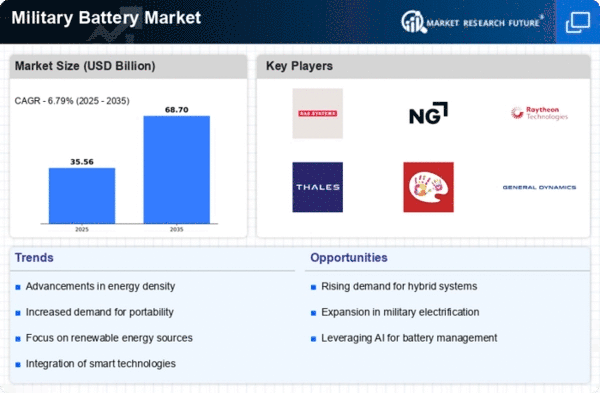
As per MRFR analysis, the Military Battery Market Size was estimated at 33.3 USD Billion in 2024. The Military Battery industry is projected to grow from 35.6 USD Billion in 2025 to 68.7 USD Billion by 2035, exhibiting a compound annual growth rate (CAGR) of 6.79 during the forecast period 2025 - 2035.

Key Market Trends & Highlights

The Military Battery Market is poised for substantial growth driven by technological advancements and increasing defense budgets.

  • North America remains the largest market for military batteries, driven by robust defense spending and technological innovation.
  • The Asia-Pacific region is emerging as the fastest-growing market, fueled by rising military expenditures and geopolitical tensions.
  • Communication equipment continues to dominate the market, while unmanned aerial vehicles are rapidly gaining traction as a key growth segment.
  • Technological advancements and increased defense budgets are significant drivers propelling the military battery market forward.

Market Size & Forecast

2024 Market Size 33.3 (USD Billion)
2035 Market Size 68.7 (USD Billion)
CAGR (2025 - 2035) 6.79%
Largest Regional Market Share in 2024 North America

Major Players

<p>Saft (FR), Northrop Grumman (US), Raytheon Technologies (US), Thales Group (FR), General Dynamics (US), BAE Systems (GB), Kongsberg Gruppen (NO), Leonardo (IT), AeroVironment (US)</p>

Market Trends

The Military Battery Market is currently experiencing a transformative phase, driven by advancements in technology and increasing demand for portable power solutions. The integration of lightweight materials and enhanced energy density is reshaping the landscape, allowing for more efficient and longer-lasting batteries. This evolution is particularly relevant for military applications, where reliability and performance are paramount. As armed forces around the globe seek to modernize their equipment, the emphasis on energy-efficient solutions is becoming increasingly pronounced. Furthermore, the shift towards renewable energy sources is influencing the development of hybrid systems, which may offer a sustainable alternative to traditional power sources. In addition to technological advancements, geopolitical factors are also playing a crucial role in shaping the Military Battery Market. Nations are investing heavily in defense capabilities, which includes the enhancement of energy storage systems. This trend suggests a growing recognition of the strategic importance of energy independence in military operations. As a result, manufacturers are likely to focus on developing batteries that not only meet the rigorous demands of military use but also align with broader sustainability goals. The interplay of these factors indicates a dynamic market environment, where innovation and strategic investment are key drivers of growth.

Technological Advancements

The Military Battery Market is witnessing rapid technological innovations, particularly in battery chemistry and design. New materials are being explored to enhance energy density and reduce weight, which is crucial for military applications. These advancements are likely to improve the overall performance and lifespan of batteries used in various military equipment.

Geopolitical Influences

Geopolitical dynamics are significantly impacting the Military Battery Market. Nations are increasingly prioritizing defense spending, which includes investments in advanced energy storage solutions. This trend indicates a strategic shift towards ensuring energy security and operational efficiency in military operations.

Sustainability Initiatives

There is a growing emphasis on sustainability within the Military Battery Market. Manufacturers are exploring eco-friendly materials and production processes to align with global sustainability goals. This shift not only addresses environmental concerns but also enhances the appeal of military technologies in a world increasingly focused on green solutions.

Military Battery Market Market Drivers

Increasing Defense Budgets

The Global Military Battery Industry is experiencing growth driven by increasing defense budgets across various nations. Countries are allocating substantial resources to enhance their military capabilities, which includes investing in advanced battery technologies for equipment such as drones, communication devices, and vehicles. For instance, in 2024, the market is projected to reach 25.75 USD Billion, reflecting a commitment to modernizing military assets. This trend is particularly evident in nations like the United States and China, where defense spending continues to rise, thereby creating a robust demand for high-performance batteries that can support extended operational capabilities.

Market Segment Insights

By Application: Communication Equipment (Largest) vs. Unmanned Aerial Vehicles (Fastest-Growing)

<p>The Military Battery Market is segmented primarily into Communication Equipment, Unmanned Aerial Vehicles (UAVs), Ground Vehicles, Weapon Systems, and Surveillance Systems. Among these, Communication Equipment holds the largest share due to its critical role in ensuring reliable communication across military operations. As military entities increasingly prioritize real-time communication, the demand for advanced battery systems to power these devices continues to surge, showcasing a decisive market direction towards enhancing connectivity in defense operations. In contrast, Unmanned Aerial Vehicles represent the fastest-growing segment within the Military Battery Market. The accelerating integration of UAVs in combat and reconnaissance missions has catalyzed the demand for specialized battery solutions that support longer operational times and enhanced performance. As technological advancements in UAVs continue, driven by innovations in battery chemistry and energy density, this segment is poised for significant growth, attracting investments and fostering research and development efforts.</p>

<p>Communication Equipment (Dominant) vs. Unmanned Aerial Vehicles (Emerging)</p>

<p>Communication Equipment serves as the dominant force in the Military Battery Market, characterized by its established use in various military applications, including radios and secure communication channels. The ongoing need for uninterrupted communication in combat scenarios continually drives this segment's relevance. Meanwhile, Unmanned Aerial Vehicles are emerging rapidly, representing a shift in military strategy towards drone warfare and surveillance. Equipped with advanced battery technologies, these UAVs demand high energy density and efficiency for prolonged flight durations. While Communication Equipment relies on proven technologies, UAVs are harnessing novel energy solutions, making them a focal point of innovation and investment within the market, thereby indicating a significant transition within military operational capabilities.</p>

By End Use: Defense (Largest) vs. Military Training (Fastest-Growing)

<p>In the Military Battery Market, the end-use distribution reflects a strong emphasis on Defense applications, which dominate the market with the highest share. This segment's significance is underscored by the increasing demand for advanced battery technologies required for various military equipment. Additionally, Logistics and Homeland Security also contribute considerably to the market, reflecting their crucial roles in supporting military operations and national security initiatives. As military strategies evolve, a notable trend is the rapid growth of the Military Training segment, driven by the integration of modern training technologies and simulations that require reliable power sources. Research and Development (R&D) efforts are also on the rise, fostering innovation in battery technology, which caters specifically to military needs. These trends indicate a dynamic market poised for growth, influenced by both tactical requirements and technological advancements.</p>

<p>Defense (Dominant) vs. Military Training (Emerging)</p>

<p>The Defense segment of the Military Battery Market is characterized by its longstanding dominance, fueled by the substantial investment in various defense equipment that necessitates reliable and high-performance battery solutions. This segment supports a wide range of military applications, including ground, air, and naval operations. In contrast, Military Training is an emerging area driven by the increasing adoption of virtual and augmented reality technologies for training purposes, requiring advanced battery systems that ensure extended operational periods without interruption. These two segments represent pivotal forces in the industry, with Defense continuing to lead, while Military Training gains traction as militaries adapt to new training paradigms.</p>

By Battery Type: Lithium-Ion (Largest) vs. Solid-State (Fastest-Growing)

<p>The Military Battery Market is predominantly influenced by various battery types. Currently, Lithium-Ion batteries hold the largest market share due to their superior energy density, lightweight nature, and longevity. This segment is preferred for applications requiring high power and efficiency. Other battery types, such as Lead-Acid and Nickel-Cadmium, follow, but they are gradually losing ground. This shift highlights a growing preference for advanced technologies that better meet military requirements, especially under challenging conditions.</p>

<p>Lithium-Ion (Dominant) vs. Solid-State (Emerging)</p>

<p>Lithium-Ion batteries are crucial in the Military Battery Market, known for their lightweight design and high energy density, making them ideal for various military applications, including portable electronics and vehicles. Their dominance is reinforced by ongoing technological advancements focused on enhancing performance and safety. In contrast, Solid-State batteries represent an emerging technology, characterized by higher energy densities and improved safety features, reducing risks of fires associated with traditional batteries. As research continues, Solid-State batteries are gaining attention for their potential to revolutionize energy storage in military operations, promising longer battery life and faster charging times.</p>

By Technology: Rechargeable (Largest) vs. Smart Battery Technology (Fastest-Growing)

<p>In the Military Battery Market, the technology segment is characterized by diverse products such as Rechargeable and Non-Rechargeable batteries, along with the emerging Smart Battery Technology, Energy Harvesting, and Wireless Charging solutions. Rechargeable batteries dominate the market share, favored for their sustainability and cost-effectiveness in various military applications, while Non-Rechargeable batteries are also significant due to their reliability in critical missions. Meanwhile, innovative technologies like Smart Battery and Energy Harvesting are beginning to capture a notable portion of the market, driven by modernization efforts in military operations.</p>

<p>Technology: Rechargeable (Dominant) vs. Smart Battery Technology (Emerging)</p>

<p>Rechargeable batteries serve as the cornerstone of the Military Battery Market, particularly valued for their longevity and lower life-cycle costs. They are widely utilized in various military applications, including communication devices and tactical equipment, due to their efficient charge retention and reusability. Conversely, Smart Battery Technology is emerging rapidly, incorporating advanced monitoring and management systems to optimize performance and enhance operational efficiency. These innovations include features like self-diagnosis and improved power management, making them increasingly attractive for modern military needs focusing on sustainability and performance in challenging environments.</p>

By Form Factor: Portable (Largest) vs. Stationary (Fastest-Growing)

<p>The Military Battery Market exhibits a diverse array of form factors which are indicative of various operational requirements. Among these, the Portable form factor commands a significant share, largely due to the increasing need for mobility in military operations. This is critical in combat scenarios where adaptable and lightweight power solutions are essential. In contrast, the Stationary segment is witnessing rapid growth, driven by advancements in technology and a growing need for reliable energy sources for command and control centers.</p>

<p>Portable (Dominant) vs. Modular (Emerging)</p>

<p>The Portable battery segment remains the dominant form factor in the military arena due to its lightweight configuration, which enables ease of transport and deployment in various terrains. Its versatility allows military personnel to maintain operational effectiveness in dynamic environments. On the other hand, the Modular battery segment is emerging as a significant player; its customizable architecture addresses specific mission needs and enhances overall tactical flexibility. This adaptability not only facilitates rapid scaling but also contributes to logistic efficiency, making Modular batteries an attractive option for modern military applications.</p>

Get more detailed insights about Military Battery Market Research Report - Forecast till 2035

Regional Insights

North America : Market Leader in Military Batteries

North America continues to lead the military battery market, holding a significant share of 16.65% in 2024. The region's growth is driven by increasing defense budgets, technological advancements, and a focus on energy efficiency in military operations. Regulatory support for innovation and sustainability further enhances market dynamics, fostering a robust environment for military battery development. The United States is the primary player in this market, with key companies like Northrop Grumman, Raytheon Technologies, and General Dynamics leading the charge. The competitive landscape is characterized by continuous innovation and strategic partnerships, ensuring that North America remains at the forefront of military battery technology. The presence of established manufacturers and a strong supply chain further solidify the region's dominance.

Europe : Emerging Market with Growth Potential

Europe's military battery market is poised for growth, currently valued at 9.99%. The region is witnessing increased investments in defense technologies and a shift towards more sustainable energy solutions. Regulatory frameworks aimed at enhancing military capabilities and environmental standards are key drivers of this growth, creating a favorable landscape for military battery innovations. Leading countries such as Germany, France, and the UK are at the forefront of this market, with companies like Thales Group and BAE Systems playing pivotal roles. The competitive environment is marked by collaborations between defense contractors and technology firms, enhancing the development of advanced battery solutions. As Europe focuses on strengthening its defense posture, the military battery market is expected to expand significantly.

Asia-Pacific : Rapidly Growing Defense Sector

The Asia-Pacific military battery market, valued at 5.0%, is experiencing rapid growth driven by increasing defense expenditures and modernization efforts across various countries. Nations like China, India, and Japan are investing heavily in advanced military technologies, including energy-efficient battery systems. Regulatory initiatives aimed at enhancing military readiness and sustainability are also contributing to market expansion. China and India are leading the charge in this region, with significant investments in military capabilities. The competitive landscape features both domestic and international players, including Kongsberg Gruppen and AeroVironment. As the region continues to prioritize defense spending, the demand for innovative military battery solutions is expected to rise, positioning Asia-Pacific as a key player in the global market.

Middle East and Africa : Emerging Market with Strategic Importance

The Middle East and Africa (MEA) military battery market, currently valued at 1.66%, is emerging as a strategic area for growth. The region's increasing focus on defense and security, driven by geopolitical tensions, is propelling demand for advanced military battery solutions. Regulatory frameworks are evolving to support modernization efforts, enhancing the market's attractiveness for investment and innovation. Countries like the UAE and South Africa are leading the way in military advancements, with a growing presence of international defense contractors. The competitive landscape is characterized by partnerships between local firms and global players, fostering the development of tailored military battery solutions. As the MEA region continues to invest in defense capabilities, the military battery market is expected to gain momentum.

Key Players and Competitive Insights

The Military Battery Market is characterized by a dynamic competitive landscape, driven by technological advancements and increasing demand for portable power solutions in defense applications. Key players such as Saft (FR), Northrop Grumman (US), and Raytheon Technologies (US) are strategically positioned to leverage innovation and partnerships to enhance their market presence. Saft (FR) focuses on developing advanced lithium-ion battery technologies, which are crucial for modern military applications, while Northrop Grumman (US) emphasizes integrating battery solutions into its broader defense systems. Raytheon Technologies (US) is also investing in next-generation battery technologies to support its defense electronics, indicating a collective shift towards high-performance energy solutions that shape the competitive environment.

In terms of business tactics, companies are increasingly localizing manufacturing and optimizing supply chains to enhance responsiveness to military needs. The market appears moderately fragmented, with several players vying for dominance. However, the collective influence of major companies like BAE Systems (GB) and Thales Group (FR) is notable, as they engage in strategic collaborations and mergers to consolidate their positions and expand their technological capabilities.

In November 2025, BAE Systems (GB) announced a partnership with a leading battery technology firm to develop next-generation energy storage systems for military vehicles. This collaboration is significant as it aims to enhance the operational efficiency and endurance of military assets, reflecting a broader trend towards integrating advanced energy solutions into defense operations. The partnership underscores BAE's commitment to innovation and its strategic focus on enhancing the capabilities of its defense offerings.

In October 2025, Thales Group (FR) unveiled a new line of compact, high-capacity batteries designed for unmanned aerial vehicles (UAVs). This launch is pivotal, as it aligns with the increasing reliance on UAVs in military operations, suggesting that Thales is positioning itself to capture a growing segment of the market. The introduction of these batteries could potentially enhance the operational range and effectiveness of UAVs, thereby reinforcing Thales's competitive edge in the sector.

In September 2025, Northrop Grumman (US) secured a contract to supply advanced battery systems for a new class of naval vessels. This contract is indicative of the company's strategic focus on expanding its footprint in maritime defense applications. By providing cutting-edge battery solutions, Northrop Grumman is likely to enhance the operational capabilities of naval forces, further solidifying its position as a leader in the military battery market.

As of December 2025, current trends in the Military Battery Market are increasingly defined by digitalization, sustainability, and the integration of artificial intelligence (AI) into battery management systems. Strategic alliances among key players are shaping the landscape, fostering innovation and enhancing supply chain reliability. The competitive differentiation appears to be shifting from price-based competition to a focus on technological advancements and sustainable practices. Companies that can effectively leverage these trends are likely to emerge as leaders in the evolving market.

Key Companies in the Military Battery Market market include

Industry Developments

Market Growth and Trends:

February 2024:

 A report by GlobeNewswire highlights the projected growthof the Military Aircraft Battery Market with a CAGR (Compound Annual Growth Rate) until 2030. The report emphasizes the evolving needs of modern warfare, increasing reliance on sophisticated electronics, and demand for high-performance batteries driving this growth.

Technological Advancements:

October 2023:

 A report on LinkedIn highlights various companies like Saft and EaglePicher Technologies engaged in research and development efforts to improve battery energy density and operational life. This focus on technological advancements remains a key area of interest for the market.

Competitive Landscape Analysis

As per the Military Battery Market Forecast report, the major key players of the global market are:

  • BST Systems, Inc. (US)
  • Bren-Tronics (US)
  • Concorde Battery Corporation (US)
  • Arotech Corporation (US)
  • Cell-Con, Inc. (US)
  • Saft Group SA (France)
  • Eaglepicher (US)
  • Kokam (South Korea)
  • Enersys (US)
  • Denchi Power Ltd (UK).

Apart from these, there are other prominent players such as Mathews Associates Inc. (US), Lincad (UK), Teledyne Battery Products (US), Navitas Systems (US), and Ultralife Corporation (US). These market players are implementing new innovations and strategies to enhance the performance of the Military Battery Market during the assessment period. 

Recent Developments

  • In May 2018, a subsidiary of Arotech Corporation named Epsilor-Electric Fuel Ltd. had signed a contract with Harris Corporation. This agreement was proposed to supply rechargeable batteries for its PRC-117 manpack radios and Falcon PRC-152 handheld radios for a customer of Southeast Asia.


Future Outlook

Military Battery Market Future Outlook

<p>The Military Battery Market is projected to grow at a 6.79% CAGR from 2024 to 2035, driven by advancements in energy density, demand for portable power, and military modernization initiatives.</p>

New opportunities lie in:

  • <p>Development of advanced lithium-sulfur batteries for enhanced energy capacity.</p>
  • <p>Integration of smart battery management systems for operational efficiency.</p>
  • <p>Expansion into renewable energy storage solutions for military applications.</p>

<p>By 2035, the Military Battery Market is expected to achieve substantial growth, reflecting evolving defense needs.</p>

Market Segmentation

Military Battery Market End Use Outlook

  • Defense
  • Homeland Security
  • Military Training
  • Logistics
  • Research and Development

Military Battery Market Technology Outlook

  • Rechargeable
  • Non-Rechargeable
  • Smart Battery Technology
  • Energy Harvesting
  • Wireless Charging

Military Battery Market Application Outlook

  • Communication Equipment
  • Unmanned Aerial Vehicles
  • Ground Vehicles
  • Weapon Systems
  • Surveillance Systems

Military Battery Market Form Factor Outlook

  • Portable
  • Stationary
  • Modular
  • Integrated
  • Custom

Military Battery Market Battery Type Outlook

  • Lithium-Ion
  • Lead-Acid
  • Nickel-Cadmium
  • Nickel-Metal Hydride
  • Solid-State

Report Scope

MARKET SIZE 202433.3(USD Billion)
MARKET SIZE 202535.6(USD Billion)
MARKET SIZE 203568.7(USD Billion)
COMPOUND ANNUAL GROWTH RATE (CAGR)6.79% (2024 - 2035)
REPORT COVERAGERevenue Forecast, Competitive Landscape, Growth Factors, and Trends
BASE YEAR2024
Market Forecast Period2025 - 2035
Historical Data2019 - 2024
Market Forecast UnitsUSD Billion
Key Companies ProfiledSaft (FR), Northrop Grumman (US), Raytheon Technologies (US), Thales Group (FR), General Dynamics (US), BAE Systems (GB), Kongsberg Gruppen (NO), Leonardo (IT), AeroVironment (US)
Segments CoveredApplication, End Use, Battery Type, Technology, Form Factor
Key Market OpportunitiesAdvancements in solid-state battery technology enhance performance and safety in the Military Battery Market.
Key Market DynamicsTechnological advancements drive competition in the Military Battery Market, enhancing performance and sustainability of energy solutions.
Countries CoveredNorth America, Europe, APAC, South America, MEA

FAQs

What will be the valuation of the market?

USD 3.81 Billion will be the valuation of the Military Battery Market

What is the CAGR calculated for the Military Battery Market?

Global Military Battery Market’s CAGR is calculated to be 5.8% by 2032

Who Are Top Key Players in Military Battery Market’?

BST Systems, Inc. (US),Bren-Tronics (US),Concorde Battery Corporation (US),Arotech Corporation (US),Cell-Con, Inc. (US),Saft Group SA (France),Eaglepicher (US),Kokam (South Korea),Enersys (US),Denchi Power Ltd (UK).

What is the USP of the Global Military Battery Market?

The market USP of the Global Military Battery Market is the escalating use of unmanned systems by military agencies need advanced batteries.

What are the segments of the Global Military Battery Industry?

Global Military Battery Market’s segments are type and platform.

  1. Executive Summary
    1. Market Attractiveness Analysis
      1. Global Military Battery Market, by Type
      2. Global Military Battery Market, by Energy Consumption
      3. Global Military Battery Market, by Platform
      4. Global Military Battery Market, by Application
      5. Global Military Battery Market, by Region
  2. Market Introduction
    1. Market Definition
    2. Scope of the Study
    3. Market Structure
    4. Key Buying Criteria
    5. Market Factor Indicator Analysis
  3. Research Methodology
    1. Research Process
    2. Primary Research
    3. Secondary Research
    4. Market Size Estimation
    5. Forecast Model
    6. List of Assumptions
  4. Market Insights
  5. Market Dynamics
    1. Introduction
    2. Drivers
      1. Increasing Defense Expenditure
      2. Increased Demand for UAVs Equipped with Long Endurance Capability
      3. Increased Use of Lightweight and High-Power Density Military Batteries
      4. Drivers Impact Analysis
    3. Challenges
      1. Regulations and Safety Issues Related to the Use of Lead Acid Military Batteries
      2. Challenge Impact Analysis
    4. Opportunities
      1. Increased Demand for Solid-State Batteries
      2. Need for Better Battery Management Systems
    5. Market/Technological Trends
    6. Patent Trends
    7. Regulatory Landscape/Standards
  6. Market Factor Analysis
    1. Value Chain/Supply Chain Analysis
      1. R&D
      2. Manufacturing
      3. Distribution & Sales
      4. Post-Sales Monitoring
    2. Porter’s Five Forces Analysis
      1. Threat of New Entrants
      2. Bargaining Power of Buyers
      3. Threat of Substitutes
      4. Segment Rivalry
      5. Bargaining Power of Supplies
  7. Global Military Battery Market, by Type
    1. Introduction
    2. Lithium Batteries
    3. Lead Acid Battery
    4. Nickel Battery
    5. Thermal Battery
    6. Others
  8. Global Military Battery Market, by Energy Consumption
    1. Introduction
    2. Less Than 12v
    3. 12-24 V
    4. More Than 24 V
  9. Global Military Battery Market, by Platform
    1. Introduction
    2. Land
      1. Vehicles
      2. Soldiers
      3. Base Stations
      4. UGV
    3. Maritime
      1. Ships
      2. Submarines
      3. Unmanned Maritime Vehicles (UMV)
    4. Airborne
      1. Military Aircraft
      2. UAV
    5. Space
  10. Global Military Battery Market, by Application
    1. Introduction
    2. Propulsion Systems
    3. Backup Power
    4. Auxiliary Power Units (APU)
    5. Communication & Navigation Systems
    6. Ignition Systems
    7. Fire Control Systems
    8. Electro Optics & Thermal Imaging Systems
    9. Others
  11. Global Military Battery Market, by Region
    1. Introduction
    2. North America
      1. US
      2. Canada
    3. Europe
      1. UK
      2. Germany
      3. France
      4. Italy
      5. Rest of Europe
    4. Asia-Pacific
      1. China
      2. Japan
      3. India
      4. Australia
      5. Rest of Asia-Pacific
    5. Middle East & Africa
      1. Saudi Arabia
      2. UAE
      3. Rest of Middle East & Africa
    6. Latin America
      1. Brazil
      2. Rest of Latin America
  12. Competitive Landscape
    1. Competitive Overview
    2. Competitor Dashboard
    3. Major Growth Key Strategies in the Global Military Battery Market
    4. Competitive Benchmarking
    5. Market Share Analysis
    6. Leading Player in terms of the Number of Developments in the Global Military Battery Market
    7. Key Developments & Growth Strategies
      1. New Product Launch/Service Energy Consumption
      2. Merger & Acquisition
      3. Joint Ventures
  13. Company Profiles
    1. Key Market Players
      1. Arotech Corporation
      2. Bren-Tronics
      3. BST Systems, Inc.
      4. Cell-Con
      5. Concorde
      6. Denchi Power
      7. Eaglepicher
      8. Enersys
      9. Kokam
      10. Saft
    2. (Company overview, financial updates, products & service offered, key developments, SWOT analysis, and key strategies to be provided for all the listed companies)
    3. Other Prominent Players
      1. Lincad
      2. Mathews Associates
      3. Navitas Systems
      4. Teledyne Battery Products (Teledyne Technologies)
      5. Ultralife
  14. Appendix
    1. References
    2. Related Reports
    3. List of Abbreviation 
    4. List of Tables
  15. LIST OF ASSUMPTIONS
  16. MAJOR PATENTS GRANTED FOR MILITARY BATTERY (2014–2020)
  17. TYPE: GLOBAL MILITARY BATTERY MARKET, 2022-2030 (USD MILLION)
  18. ENERGY CONSUMPTION: GLOBAL MILITARY BATTERY MARKET, 2022-2030 (USD MILLION)
  19. PLATFORM: GLOBAL MILITARY BATTERY MARKET, 2022-2030 (USD MILLION)
  20. APPLICATION: GLOBAL MILITARY BATTERY MARKET, 2022-2030 (USD MILLION)
  21. GLOBAL MILITARY BATTERY MARKET, BY REGION, 2022-2030 (USD MILLION)
  22. NORTH AMERICA: MILITARY BATTERY MARKET, BY COUNTRY, 2022-2030 (USD MILLION)
  23. NORTH AMERICA: MILITARY BATTERY MARKET, BY TYPE, 2022-2030 (USD MILLION)
  24. NORTH AMERICA: MILITARY BATTERY MARKET, BY ENERGY CONSUMPTION, 2022-2030 (USD MILLION)
  25. NORTH AMERICA: MILITARY BATTERY MARKET, BY PLATFORM, 2022-2030 (USD MILLION)
  26. NORTH AMERICA: MILITARY BATTERY MARKET, BY APPLICATION, 2022-2030 (USD MILLION)
  27. US: MILITARY BATTERY MARKET, BY TYPE, 2022-2030 (USD MILLION)
  28. US: MILITARY BATTERY MARKET, BY ENERGY CONSUMPTION, 2022-2030 (USD MILLION)
  29. US: MILITARY BATTERY MARKET, BY PLATFORM, 2022-2030 (USD MILLION)
  30. US: MILITARY BATTERY MARKET, BY APPLICATION, 2022-2030 (USD MILLION)
  31. CANADA: MILITARY BATTERY MARKET, BY TYPE, 2022-2030 (USD MILLION)
  32. CANADA: MILITARY BATTERY MARKET, BY ENERGY CONSUMPTION, 2022-2030 (USD MILLION)
  33. CANADA: MILITARY BATTERY MARKET, BY PLATFORM, 2022-2030 (USD MILLION)
  34. CANADA: MILITARY BATTERY MARKET, BY APPLICATION, 2022-2030 (USD MILLION)
  35. EUROPE: MILITARY BATTERY MARKET, BY COUNTRY, 2022-2030 (USD MILLION)
  36. EUROPE: MILITARY BATTERY MARKET, BY TYPE, 2022-2030 (USD MILLION)
  37. EUROPE: MILITARY BATTERY MARKET, BY ENERGY CONSUMPTION, 2022-2030 (USD MILLION)
  38. EUROPE: MILITARY BATTERY MARKET, BY PLATFORM, 2022-2030 (USD MILLION)
  39. EUROPE: MILITARY BATTERY MARKET, BY APPLICATION, 2022-2030 (USD MILLION)
  40. UK: MILITARY BATTERY MARKET, BY TYPE, 2022-2030 (USD MILLION)
  41. UK: MILITARY BATTERY MARKET, BY ENERGY CONSUMPTION, 2022-2030 (USD MILLION)
  42. UK: MILITARY BATTERY MARKET, BY PLATFORM, 2022-2030 (USD MILLION)
  43. UK: MILITARY BATTERY MARKET, BY APPLICATION, 2022-2030 (USD MILLION)
  44. GERMANY: MILITARY BATTERY MARKET, BY TYPE, 2022-2030 (USD MILLION)
  45. GERMANY: MILITARY BATTERY MARKET, BY ENERGY CONSUMPTION, 2022-2030 (USD MILLION)
  46. GERMANY: MILITARY BATTERY MARKET, BY PLATFORM, 2022-2030 (USD MILLION)
  47. GERMANY: MILITARY BATTERY MARKET, BY APPLICATION, 2022-2030 (USD MILLION)
  48. FRANCE: MILITARY BATTERY MARKET, BY TYPE, 2022-2030 (USD MILLION)
  49. FRANCE: MILITARY BATTERY MARKET, BY ENERGY CONSUMPTION, 2022-2030 (USD MILLION)
  50. FRANCE: MILITARY BATTERY MARKET, BY PLATFORM, 2022-2030 (USD MILLION)
  51. FRANCE: MILITARY BATTERY MARKET, BY APPLICATION, 2022-2030 (USD MILLION)
  52. ITALY: MILITARY BATTERY MARKET, BY TYPE, 2022-2030 (USD MILLION)
  53. ITALY: MILITARY BATTERY MARKET, BY ENERGY CONSUMPTION, 2022-2030 (USD MILLION)
  54. ITALY: MILITARY BATTERY MARKET, BY PLATFORM, 2022-2030 (USD MILLION)
  55. ITALY: MILITARY BATTERY MARKET, BY APPLICATION, 2022-2030 (USD MILLION)
  56. REST OF EUROPE: MILITARY BATTERY MARKET, BY TYPE, 2022-2030 (USD MILLION)
  57. REST OF EUROPE: MILITARY BATTERY MARKET, BY ENERGY CONSUMPTION, 2022-2030 (USD MILLION)
  58. REST OF EUROPE: MILITARY BATTERY MARKET, BY PLATFORM, 2022-2030 (USD MILLION)
  59. REST OF EUROPE: MILITARY BATTERY MARKET, BY APPLICATION, 2022-2030 (USD MILLION)
  60. ASIA-PACIFIC: MILITARY BATTERY MARKET, BY COUNTRY, 2022-2030 (USD MILLION)
  61. ASIA-PACIFIC: MILITARY BATTERY MARKET, BY TYPE, 2022-2030 (USD MILLION)
  62. ASIA-PACIFIC: MILITARY BATTERY MARKET, BY ENERGY CONSUMPTION, 2022-2030 (USD MILLION)
  63. ASIA-PACIFIC: MILITARY BATTERY MARKET, BY PLATFORM, 2022-2030 (USD MILLION)
  64. ASIA-PACIFIC: MILITARY BATTERY MARKET, BY APPLICATION, 2022-2030 (USD MILLION)
  65. CHINA: MILITARY BATTERY MARKET, BY TYPE, 2022-2030 (USD MILLION)
  66. CHINA: MILITARY BATTERY MARKET, BY ENERGY CONSUMPTION, 2022-2030 (USD MILLION)
  67. CHINA: MILITARY BATTERY MARKET, BY PLATFORM, 2022-2030 (USD MILLION)
  68. CHINA: MILITARY BATTERY MARKET, BY APPLICATION, 2022-2030 (USD MILLION)
  69. INDIA: MILITARY BATTERY MARKET, BY TYPE, 2022-2030 (USD MILLION)
  70. INDIA: MILITARY BATTERY MARKET, BY ENERGY CONSUMPTION, 2022-2030 (USD MILLION)
  71. INDIA: MILITARY BATTERY MARKET, BY PLATFORM, 2022-2030 (USD MILLION)
  72. INDIA: MILITARY BATTERY MARKET, BY APPLICATION, 2022-2030 (USD MILLION)
  73. JAPAN: MILITARY BATTERY MARKET, BY TYPE, 2022-2030 (USD MILLION)
  74. JAPAN: MILITARY BATTERY MARKET, BY ENERGY CONSUMPTION, 2022-2030 (USD MILLION)
  75. JAPAN: MILITARY BATTERY MARKET, BY PLATFORM, 2022-2030 (USD MILLION)
  76. JAPAN: MILITARY BATTERY MARKET, BY APPLICATION, 2022-2030 (USD MILLION)
  77. AUSTRALIA: MILITARY BATTERY MARKET, BY TYPE, 2022-2030 (USD MILLION)
  78. AUSTRALIA: MILITARY BATTERY MARKET, BY ENERGY CONSUMPTION, 2022-2030 (USD MILLION)
  79. AUSTRALIA: MILITARY BATTERY MARKET, BY PLATFORM, 2022-2030 (USD MILLION)
  80. AUSTRALIA: MILITARY BATTERY MARKET, BY APPLICATION, 2022-2030 (USD MILLION)
  81. REST OF ASIA-PACIFIC: MILITARY BATTERY MARKET, BY TYPE, 2022-2030 (USD MILLION)
  82. REST OF ASIA-PACIFIC: MILITARY BATTERY MARKET, BY ENERGY CONSUMPTION, 2022-2030 (USD MILLION)
  83. REST OF ASIA-PACIFIC: MILITARY BATTERY MARKET, BY PLATFORM, 2022-2030 (USD MILLION)
  84. REST OF ASIA-PACIFIC: MILITARY BATTERY MARKET, BY APPLICATION, 2022-2030 (USD MILLION)
  85. MIDDLE EAST & AFRICA: MILITARY BATTERY MARKET, BY COUNTRY, 2022-2030 (USD MILLION)
  86. MIDDLE EAST & AFRICA: MILITARY BATTERY MARKET, BY TYPE, 2022-2030 (USD MILLION)
  87. MIDDLE EAST & AFRICA: MILITARY BATTERY MARKET, BY ENERGY CONSUMPTION, 2022-2030 (USD MILLION)
  88. MIDDLE EAST & AFRICA: MILITARY BATTERY MARKET, BY PLATFORM, 2022-2030 (USD MILLION)
  89. MIDDLE EAST & AFRICA: MILITARY BATTERY MARKET, BY APPLICATION, 2022-2030 (USD MILLION)
  90. SAUDI ARABIA: MILITARY BATTERY MARKET, BY TYPE, 2022-2030 (USD MILLION)
  91. SAUDI ARABIA: MILITARY BATTERY MARKET, BY ENERGY CONSUMPTION, 2022-2030 (USD MILLION)
  92. SAUDI ARABIA: MILITARY BATTERY MARKET, BY PLATFORM, 2022-2030 (USD MILLION)
  93. SAUDI ARABIA: MILITARY BATTERY MARKET, BY APPLICATION, 2022-2030 (USD MILLION)
  94. UAE: MILITARY BATTERY MARKET, BY TYPE, 2022-2030 (USD MILLION)
  95. UAE: MILITARY BATTERY MARKET, BY ENERGY CONSUMPTION, 2022-2030 (USD MILLION)
  96. UAE: MILITARY BATTERY MARKET, BY PLATFORM, 2022-2030 (USD MILLION)
  97. UAE: MILITARY BATTERY MARKET, BY APPLICATION, 2022-2030 (USD MILLION)
  98. REST OF THE MIDDLE EAST & AFRICA: MILITARY BATTERY MARKET, BY INSTALLATION BASE, 2022-2030 (USD MILLION)
  99. REST OF THE MIDDLE EAST & AFRICA: MILITARY BATTERY MARKET, BY ENERGY CONSUMPTION, 2022-2030 (USD MILLION)
  100. REST OF THE MIDDLE EAST & AFRICA: MILITARY BATTERY MARKET, BY PLATFORM, 2022-2030 (USD MILLION)
  101. REST OF THE MIDDLE EAST & AFRICA: MILITARY BATTERY MARKET, BY APPLICATION, 2022-2030 (USD MILLION)
  102. LATIN AMERICA: MILITARY BATTERY MARKET, BY COUNTRY, 2022-2030 (USD MILLION)
  103. LATIN AMERICA: MILITARY BATTERY MARKET, BY TYPE, 2022-2030 (USD MILLION)
  104. LATIN AMERICA: MILITARY BATTERY MARKET, BY ENERGY CONSUMPTION, 2022-2030 (USD MILLION)
  105. LATIN AMERICA: MILITARY BATTERY MARKET, BY PLATFORM, 2022-2030 (USD MILLION)
  106. LATIN AMERICA: MILITARY BATTERY MARKET, BY APPLICATION, 2022-2030 (USD MILLION)
  107. BRAZIL: MILITARY BATTERY MARKET, BY TYPE, 2022-2030 (USD MILLION)
  108. BRAZIL: MILITARY BATTERY MARKET, BY ENERGY CONSUMPTION, 2022-2030 (USD MILLION)
  109. BRAZIL: MILITARY BATTERY MARKET, BY PLATFORM, 2022-2030 (USD MILLION)
  110. BRAZIL: MILITARY BATTERY MARKET, BY APPLICATION, 2022-2030 (USD MILLION)
  111. REST OF LATIN AMERICA: MILITARY BATTERY MARKET, BY TYPE, 2022-2030 (USD MILLION)
  112. REST OF LATIN AMERICA: MILITARY BATTERY MARKET, BY ENERGY CONSUMPTION, 2022-2030 (USD MILLION)
  113. REST OF LATIN AMERICA: MILITARY BATTERY MARKET, BY FREQUENCY- BAND, 2022-2030 (USD MILLION)
  114. REST OF LATIN AMERICA: MILITARY BATTERY MARKET, BY APPLICATION, 2022-2030 (USD MILLION)
  115. THE MOST ACTIVE PLAYERS IN THE GLOBAL MILITARY BATTERY MARKET
  116. CONTRACTS AND AGREEMENTS
  117. MERGERS AND ACQUISITIONS
  118. PRODUCT DEVELOPMENTS
  119. EXPANSIONS AND INVESTMENTS
  120. JOINT VENTURES AND PARTNERSHIPS
    1. List of Figures
  121. MARKET SYNOPSIS
  122. GLOBAL MILITARY BATTERY MARKET: MARKET ATTRACTIVENESS ANALYSIS
  123. GLOBAL MILITARY BATTERY MARKET ANALYSIS, BY TYPE
  124. GLOBAL MILITARY BATTERY MARKET ANALYSIS, BY APPLICATION
  125. GLOBAL MILITARY BATTERY MARKET ANALYSIS, BY PLATFORM
  126. GLOBAL MILITARY BATTERY MARKET ANALYSIS, BY APPLICATION
  127. GLOBAL MILITARY BATTERY MARKET ANALYSIS, BY REGION
  128. GLOBAL MILITARY BATTERY MARKET: MARKET STRUCTURE
  129. KEY BUYING CRITERIA FOR MILITARY BATTERY TYPES
  130. RESEARCH PROCESS OF MRFR
  131. NORTH AMERICA: MARKET SIZE & MARKET SHARE, BY COUNTRY, 2020 VS 2030
  132. EUROPE: MARKET SIZE & MARKET SHARE, BY COUNTRY, 2020 VS 2030
  133. ASIA-PACIFIC: MARKET SIZE & MARKET SHARE, BY COUNTRY, 2020 VS 2030
  134. MIDDLE EAST & AFRICA: MARKET SIZE & MARKET SHARE, BY COUNTRY, 2020 VS 2030
  135. LATIN AMERICA: MARKET SIZE & MARKET SHARE, BY REGION, 2020 VS 2030
  136. MARKET DYNAMICS OVERVIEW
  137. DRIVERS IMPACT ANALYSIS: GLOBAL MILITARY BATTERY MARKET
  138. CHALLENGES IMPACT ANALYSIS: GLOBAL MILITARY BATTERY MARKET
  139. PORTER’S FIVE FORCES ANALYSIS OF THE GLOBAL MILITARY BATTERY MARKET
  140. SUPPLY CHAIN: GLOBAL MILITARY BATTERY MARKET
  141. GLOBAL MILITARY BATTERY MARKET SHARE, BY TYPE, 2020 (% SHARE)
  142. GLOBAL MILITARY BATTERY MARKET SHARE, BY APPLICATION, 2020 (% SHARE)
  143. GLOBAL MILITARY BATTERY MARKET SHARE, BY PLATFORM, 2020 (% SHARE)
  144. GLOBAL MILITARY BATTERY MARKET SHARE, BY REGION, 2020 (% SHARE)
  145. NORTH AMERICA: MILITARY BATTERY MARKET SHARE, BY COUNTRY, 2020 (% SHARE)
  146. EUROPE: MILITARY BATTERY MARKET SHARE, BY COUNTRY, 2020 (% SHARE)
  147. ASIA-PACIFIC: MILITARY BATTERY MARKET SHARE, BY COUNTRY, 2020 (% SHARE)
  148. MIDDLE EAST & AFRICA: MILITARY BATTERY MARKET SHARE, BY COUNTRY, 2020 (% SHARE)
  149. LATIN AMERICA: MILITARY BATTERY MARKET SHARE, BY COUNTRY, 2020 (% SHARE)
  150. COMPETITOR DASHBOARD: GLOBAL MILITARY BATTERY MARKET
  151. CAPITAL MARKET RATIO AND FINANCIAL MATRIX
  152. CONTRACTS & AGREEMENTS: THE MAJOR STRATEGY ADOPTED BY KEY PLAYERS IN THE GLOBAL MILITARY BATTERY MARKET
  153. BENCHMARKING OF MAJOR COMPETITORS
  154. MAJOR MANUFACTURERS MARKET SHARE ANALYSIS, 2020

Military Battery Market Segmentation

Market Segmentation Overview

  • Detailed segmentation data will be available in the full report
  • Comprehensive analysis by multiple parameters
  • Regional and country-level breakdowns
  • Market size forecasts by segment
Infographic

Free Sample Request

Kindly complete the form below to receive a free sample of this Report

Get Free Sample

Customer Strories

Compare Licence

×
Features License Type
Single User Multiuser License Enterprise User
Price $4,950 $5,950 $7,250
Maximum User Access Limit 1 User Upto 10 Users Unrestricted Access Throughout the Organization
Free Customization
Direct Access to Analyst
Deliverable Format
Platform Access
Discount on Next Purchase 10% 15% 15%
Printable Versions