×
Request Free Sample ×

Kindly complete the form below to receive a free sample of this Report

* Please use a valid business email

Leading companies partner with us for data-driven Insights

clients tt-cursor
Hero Background
English
Chinese
French
Japanese
Korean
German
Spanish

Military Battery Market Analysis

ID: MRFR/AD/8053-HCR
174 Pages
Sejal Akre
October 2025

Military Battery Market Size, Share, Industry Trend & Analysis Research Report Information by Type (Lithium Batteries, Lead Acid Battery, Nickel Battery, Thermal Battery ), Energy Consumption (Less Than 12 V, 12-24 V and More Than 24 V), Platform (Land, Maritime, Airborne and Space), Application (Propulsion Systems, Backup Power, Auxiliary Power Units (APU), Communication Navigation Systems, Ignition Systems, Fire Control Systems, Electro Optics Thermal Imaging Systems ) and Region - Forecast till 2032

Share:
Download PDF ×

We do not share your information with anyone. However, we may send you emails based on your report interest from time to time. You may contact us at any time to opt-out.

Military Battery Market Infographic
×
Military Battery Market Infographic Full View
Purchase Options

Market Analysis

In-depth Analysis of Military Battery Market Industry Landscape

Expanding Significance in Defense through Quantum Computing

Quantum computers operate in a unique and powerful manner, enabling them to tackle intricate tasks such as creating complex codes, discovering new drugs, and enhancing machine learning capabilities. Currently, our conventional computers secure our confidential codes, like AES-256, RSA, and ECDSA. However, as quantum computers advance, there's a concern that these existing codes might become insufficient for maintaining security.

Developers working on applications for quantum computers are actively exploring alternative coding methods using something known as quantum keys. These quantum keys have the potential to ensure the safety of our information, even in the face of highly advanced computers in the future. This innovative approach to secure coding, known as quantum cryptography, is on track to revolutionize how we conduct transactions and share information in the near future.

Beyond securing information, quantum computing also has the potential to be employed for cryptanalysis, the process of breaking secret codes. Some nations have already initiated the collection of encrypted messages from foreign countries with the expectation that, in the future, they will be able to decode and extract valuable information. This strategic use of quantum computing in defense holds the promise of uncovering hidden intelligence and gaining a competitive advantage on the global stage.

The expanding role of quantum computing in defense introduces lucrative opportunities for companies in the market. As these advanced technologies become integral to national security strategies, businesses involved in quantum computing applications are well-positioned to thrive. The evolving landscape of defense, with a focus on quantum-powered solutions, underscores the transformative impact these technologies will have on safeguarding sensitive information and gaining insights crucial for national interests. In essence, the growing significance of quantum computing in defense not only ensures enhanced security but also presents a promising avenue for future success in the market.
Author
Sejal Akre
Senior Research Analyst

She has over 5 years of rich experience, in market research and consulting providing valuable market insights to client. Hands on expertise in management consulting, and extensive knowledge in domain including ICT, Automotive & Transportation and Aerospace & Defense. She is skilled in Go-to market strategy, industry analysis, market sizing, in depth company profiling, competitive intelligence & benchmarking and value chain amongst others.

Leave a Comment

FAQs

What will be the valuation of the market?

USD 3.81 Billion will be the valuation of the Military Battery Market

What is the CAGR calculated for the Military Battery Market?

Global Military Battery Market’s CAGR is calculated to be 5.8% by 2032

Who Are Top Key Players in Military Battery Market’?

BST Systems, Inc. (US),Bren-Tronics (US),Concorde Battery Corporation (US),Arotech Corporation (US),Cell-Con, Inc. (US),Saft Group SA (France),Eaglepicher (US),Kokam (South Korea),Enersys (US),Denchi Power Ltd (UK).

What is the USP of the Global Military Battery Market?

The market USP of the Global Military Battery Market is the escalating use of unmanned systems by military agencies need advanced batteries.

What are the segments of the Global Military Battery Industry?

Global Military Battery Market’s segments are type and platform.

Market Summary

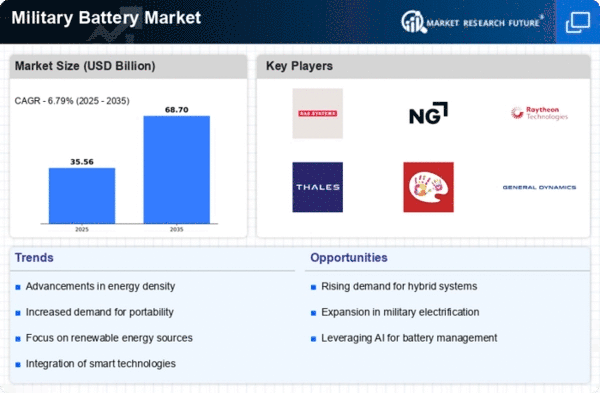
As per MRFR analysis, the Military Battery Market was estimated at 33.3 USD Billion in 2024. The Military Battery industry is projected to grow from 35.6 USD Billion in 2025 to 68.7 USD Billion by 2035, exhibiting a compound annual growth rate (CAGR) of 6.79 during the forecast period 2025 - 2035.

Key Market Trends & Highlights

The Military Battery Market is poised for substantial growth driven by technological advancements and increasing defense budgets.

  • Technological advancements are enhancing the performance and efficiency of military batteries, particularly in North America.
  • Sustainability initiatives are gaining traction, with a focus on eco-friendly battery solutions in the Asia-Pacific region.
  • The demand for portable power solutions is surging, especially in the Communication Equipment segment, which remains the largest market.
  • Rising defense budgets and geopolitical tensions are key drivers propelling growth in the Military Battery Market.

Market Size & Forecast

2024 Market Size 33.3 (USD Billion)
2035 Market Size 68.7 (USD Billion)
CAGR (2025 - 2035) 6.79%
Largest Regional Market Share in 2024 North America

Major Players

BAE Systems (GB), Northrop Grumman (US), Raytheon Technologies (US), Thales Group (FR), Leonardo (IT), General Dynamics (US), L3Harris Technologies (US), Saab (SE), Kongsberg Gruppen (NO)

Market Trends

defense

Military Battery Market Market Drivers

Increasing Defense Budgets

The Global Military Battery Industry is experiencing growth driven by increasing defense budgets across various nations. Countries are allocating substantial resources to enhance their military capabilities, which includes investing in advanced battery technologies for equipment such as drones, communication devices, and vehicles. For instance, in 2024, the market is projected to reach 25.75 USD Billion, reflecting a commitment to modernizing military assets. This trend is particularly evident in nations like the United States and China, where defense spending continues to rise, thereby creating a robust demand for high-performance batteries that can support extended operational capabilities.

Market Segment Insights

By Application: Communication Equipment (Largest) vs. Unmanned Aerial Vehicles (Fastest-Growing)

In the Military Battery Market, Communication Equipment is the largest segment, holding a significant share of market demand due to its critical role in defense operations. With the increasing reliance on advanced communication systems for operational efficiency, this segment continues to be the cornerstone of military investments in battery technology. Following closely is the Unmanned Aerial Vehicles segment, which has emerged rapidly, driven by advancements in drone technology and their growing application in surveillance, reconnaissance, and combat missions. The dynamics of growth in these segments are fueled by innovation and the rise of smart technologies. Communication Equipment benefits from ongoing demand for robust, durable batteries that ensure uninterrupted operations even in hostile environments. Conversely, Unmanned Aerial Vehicles are witnessing a surge in adoption thanks to the increasing need for unmanned platforms in military operations, marking it as the fastest-growing segment with diverse applications.

Communication Equipment (Dominant) vs. Unmanned Aerial Vehicles (Emerging)

Communication Equipment is characterized by its indispensable role in military operations, necessitating high-performance battery solutions that guarantee reliability and endurance. This segment traditionally benefits from established military contracts and continuous technological upgrades to improve communication capabilities. On the other hand, Unmanned Aerial Vehicles represent a burgeoning market, driven by technological innovations and operational efficiencies they offer in reconnaissance and combat scenarios. These vehicles require lightweight, high-capacity batteries that can support long flight times and operational flexibility. As innovations continue to emerge, the competition between these two segments is likely to intensify, with Communication Equipment maintaining its dominance while Unmanned Aerial Vehicles are poised for significant growth.

By End Use: Defense (Largest) vs. Homeland Security (Fastest-Growing)

In the Military Battery Market, the distribution of market share across different end use segments highlights the prominence of Defense, which accounts for the largest share due to continuous military modernization efforts and extensive deployments. Homeland Security is not far behind, growing rapidly as governments emphasize enhanced safety measures and effective crisis response capabilities, thus driving the adoption of advanced battery solutions designed for rugged environments.

Defense (Dominant) vs. Homeland Security (Emerging)

The Defense segment remains the dominant force within the Military Battery Market, as military operations increasingly rely on advanced energy solutions to support equipment, communication, and weaponry. The defense sector consistently demands high-performance batteries capable of enduring harsh conditions while offering reliable power for extended missions. On the other hand, the Homeland Security segment emerges with significant growth potential driven by escalating security threats and the need for reliable energy sources in diverse applications like surveillance and emergency response. This evolution signifies a shift towards integrating innovative battery technologies that meet stringent operational criteria for both sectors.

By Battery Type: Lithium-Ion (Largest) vs. Solid-State (Fastest-Growing)

In the Military Battery Market, Lithium-Ion batteries hold the largest market share due to their lightweight, high energy density, and superior lifespan, making them the preferred choice for various military applications. Following Lithium-Ion, Lead-Acid and Nickel-Cadmium batteries have been traditional choices, but their market share is declining as newer technologies emerge. Solid-State batteries are beginning to capture attention due to their potential for higher energy density and safety, positioning them as strong contenders moving forward. Growth trends in this segment are driven by advancements in battery technologies and increasing demands for powered military equipment. The military sector is emphasizing enhanced performance, efficiency, and safety in operations, pushing for innovations like Solid-State and Flow batteries. The shift towards greener energy solutions and the need for long-duration power backup in field operations are expected to further accelerate the growth of these emerging technologies. This shift not only addresses the performance needs of military applications but also aligns with sustainability goals.

Battery Type: Lithium-Ion (Dominant) vs. Solid-State (Emerging)

Lithium-Ion batteries are dominant in the military battery market due to their outstanding characteristics such as high energy density, low self-discharge rates, and a long cycle life, enabling their usage in tactical and strategic military systems. Their reliability in extreme conditions makes them the go-to option for military operations. Conversely, Solid-State batteries are emerging with great potential, offering significant advantages over traditional battery technologies, such as enhanced safety and higher energy density due to their solid electrolytes. This rapidly evolving technology is gaining traction as military forces seek efficient and safer power solutions for autonomous operations and advanced weapon systems, marking a transformative shift in the military battery landscape.

By Technology: Rechargeable (Largest) vs. Smart Battery (Fastest-Growing)

In the Military Battery Market, the technology segment is notably diverse, with rechargeable batteries leading in market share due to their efficiency and longevity in demanding military operations. Non-rechargeable batteries, while valuable for specific applications, follow behind. In contrast, smart batteries are emerging as a significant player, driven by their advanced features such as integrated monitoring and analytics, catering to the sophisticated needs of military applications.

Technology: Rechargeable (Dominant) vs. Smart Battery (Emerging)

Rechargeable batteries play a dominant role in the Military Battery Market, characterized by their ability to withstand repeated use, which is crucial for prolonged military engagements. They provide exceptional performance under extreme conditions, making them a preferred choice for various military applications. Emerging as an innovative option, smart batteries employ cutting-edge technology to provide real-time monitoring and management of battery performance, thereby enhancing the operational efficiency and lifespan of military equipment. As militaries increasingly adopt technology-driven solutions, smart batteries are expected to witness rapid growth, fulfilling the demand for intelligent power management.

By Form Factor: Portable (Largest) vs. Modular (Fastest-Growing)

The Military Battery Market showcases a diverse range of form factors, with the portable segment commanding the largest share. This popularity stems from its flexibility and ease of transport, making it ideal for various military applications. Stationary and integrated forms follow, yet their roles are often specific to certain operational needs, contributing to a more balanced market share distribution. On the other hand, custom form factors cater to specialized military requirements, adding to the market's complexity.

Portable (Dominant) vs. Modular (Emerging)

The portable battery segment stands out as the dominant player in the Military Battery Market, primarily due to its versatility and extensive use across different military operations, ranging from communication systems to portable weaponry. Its rugged design and lightweight characteristics allow soldiers to carry power sources that can adapt to multiple situations, enhancing operational readiness. Conversely, the modular battery segment is emerging rapidly, reflecting a desire for adaptable and upgradable energy solutions. Modular systems can accommodate various configurations based on mission requirements, making them particularly appealing in an era where military operations necessitate quick adaptability to changing circumstances. This flexibility is driving significant growth in the modular segment.

Get more detailed insights about Military Battery Market Research Report - Forecast till 2035

Regional Insights

North America : Market Leader in Military Batteries

North America continues to lead the military battery market, holding a significant share of 16.65% in 2024. The region's growth is driven by increasing defense budgets, technological advancements, and a focus on energy efficiency in military operations. Regulatory support for innovation and sustainability further propels market demand, as governments prioritize modernizing their military capabilities. The United States is the primary contributor to this market, with key players like Northrop Grumman, Raytheon Technologies, and BAE Systems driving competition. The presence of advanced research facilities and a robust supply chain enhances the region's competitive landscape. As military operations evolve, the demand for high-performance batteries is expected to rise, solidifying North America's position as a market leader.

Europe : Emerging Market with Growth Potential

Europe's military battery market is valued at 9.99%, reflecting a growing emphasis on defense modernization and technological innovation. The region is witnessing increased investments in military capabilities, driven by geopolitical tensions and the need for enhanced operational efficiency. Regulatory frameworks are evolving to support sustainable energy solutions, which is crucial for future military applications. Leading countries such as France, Germany, and the UK are at the forefront of this market, with companies like Thales Group and Leonardo playing pivotal roles. The competitive landscape is characterized by collaborations between defense contractors and government agencies, fostering innovation. As Europe seeks to bolster its defense posture, the military battery market is poised for significant growth.

Asia-Pacific : Rapidly Growing Defense Sector

The Asia-Pacific military battery market, valued at 5.0%, is experiencing rapid growth due to increasing defense expenditures and modernization efforts across the region. Countries are investing heavily in advanced military technologies, driven by regional security concerns and the need for enhanced operational capabilities. Regulatory initiatives are also promoting the adoption of innovative battery technologies to support military applications. Key players in this region include companies from Japan, South Korea, and Australia, with a focus on developing high-performance batteries. The competitive landscape is evolving, with local manufacturers emerging alongside established global players. As nations prioritize defense readiness, the demand for reliable and efficient military batteries is expected to surge, contributing to market expansion.

Middle East and Africa : Emerging Market with Unique Challenges

The Middle East and Africa military battery market, valued at 1.66%, is gradually emerging as countries in the region prioritize defense modernization. The growth is driven by geopolitical instability and the need for enhanced military capabilities. Regulatory frameworks are being developed to support the adoption of advanced technologies, which is crucial for meeting the demands of modern warfare. Countries like the UAE and South Africa are leading the charge in military investments, with a focus on acquiring advanced battery technologies. The competitive landscape is characterized by partnerships between local and international firms, aiming to enhance technological capabilities. As the region navigates unique challenges, the military battery market is expected to grow steadily, driven by strategic investments.

Key Players and Competitive Insights

The Military Battery Market is currently characterized by a dynamic competitive landscape, driven by technological advancements and increasing demand for portable power solutions in defense applications. Key players such as BAE Systems (GB), Northrop Grumman (US), and Raytheon Technologies (US) are strategically positioned to leverage innovation and partnerships to enhance their market presence. BAE Systems (GB) focuses on developing advanced battery technologies that support next-generation military systems, while Northrop Grumman (US) emphasizes digital transformation and supply chain optimization to improve operational efficiency. Raytheon Technologies (US) is actively pursuing collaborations with other defense contractors to integrate cutting-edge battery solutions into their systems, thereby shaping a competitive environment that prioritizes technological superiority and strategic alliances.In terms of business tactics, companies are increasingly localizing manufacturing to reduce lead times and enhance supply chain resilience. The market structure appears moderately fragmented, with several key players exerting influence over various segments. This fragmentation allows for niche players to emerge, yet the collective strength of major companies like Thales Group (FR) and General Dynamics (US) ensures that competition remains robust. Thales Group (FR) has been focusing on optimizing its supply chain to enhance the reliability of its battery solutions, which is crucial for military applications where performance is paramount.In November 2025, Thales Group (FR) announced a strategic partnership with a leading battery technology firm to co-develop next-generation lithium-sulfur batteries. This collaboration is expected to significantly enhance energy density and reduce weight, which are critical factors for military applications. The strategic importance of this partnership lies in its potential to position Thales as a leader in advanced battery technologies, thereby strengthening its competitive edge in the market.In October 2025, L3Harris Technologies (US) unveiled a new line of modular battery systems designed for use in unmanned aerial vehicles (UAVs). This innovation is particularly noteworthy as it addresses the growing demand for longer flight times and operational flexibility in military UAVs. The introduction of these modular systems indicates L3Harris's commitment to innovation and responsiveness to evolving military needs, which could enhance its market share.In September 2025, Kongsberg Gruppen (NO) expanded its battery production capabilities by investing in a new manufacturing facility in Norway. This strategic move is aimed at increasing production capacity to meet the rising demand for military-grade batteries. The establishment of this facility not only signifies Kongsberg's commitment to local production but also enhances its ability to deliver timely solutions to its defense clients, thereby reinforcing its competitive position.As of December 2025, the Military Battery Market is witnessing trends such as digitalization, sustainability, and the integration of artificial intelligence (AI) into battery management systems. These trends are reshaping the competitive landscape, with companies increasingly forming strategic alliances to enhance their technological capabilities. The shift from price-based competition to a focus on innovation and supply chain reliability is evident, suggesting that future competitive differentiation will hinge on the ability to deliver advanced, reliable, and sustainable battery solutions.

Key Companies in the Military Battery Market include

Industry Developments

Market Growth and Trends:

February 2024:

 A report by GlobeNewswire highlights the projected growthof the Military Aircraft Battery Market with a CAGR (Compound Annual Growth Rate) until 2030. The report emphasizes the evolving needs of modern warfare, increasing reliance on sophisticated electronics, and demand for high-performance batteries driving this growth.

Technological Advancements:

October 2023:

 A report on LinkedIn highlights various companies like Saft and EaglePicher Technologies engaged in research and development efforts to improve battery energy density and operational life. This focus on technological advancements remains a key area of interest for the market.

Competitive Landscape Analysis

As per the Military Battery Market Forecast report, the major key players of the global market are:

  • BST Systems, Inc. (US)
  • Bren-Tronics (US)
  • Concorde Battery Corporation (US)
  • Arotech Corporation (US)
  • Cell-Con, Inc. (US)
  • Saft Group SA (France)
  • Eaglepicher (US)
  • Kokam (South Korea)
  • Enersys (US)
  • Denchi Power Ltd (UK).

Apart from these, there are other prominent players such as Mathews Associates Inc. (US), Lincad (UK), Teledyne Battery Products (US), Navitas Systems (US), and Ultralife Corporation (US). These market players are implementing new innovations and strategies to enhance the performance of the Military Battery Market during the assessment period. 

Recent Developments

  • In May 2018, a subsidiary of Arotech Corporation named Epsilor-Electric Fuel Ltd. had signed a contract with Harris Corporation. This agreement was proposed to supply rechargeable batteries for its PRC-117 manpack radios and Falcon PRC-152 handheld radios for a customer of Southeast Asia.


Future Outlook

Military Battery Market Future Outlook

The Military Battery Market is projected to grow at a 6.79% CAGR from 2024 to 2035, driven by advancements in energy density, demand for portable power, and military modernization initiatives.

New opportunities lie in:

  • Development of advanced lithium-sulfur batteries for enhanced energy capacity.
  • Integration of smart battery management systems for operational efficiency.
  • Expansion into renewable energy storage solutions for military applications.

By 2035, the Military Battery Market is expected to achieve substantial growth, driven by innovation and strategic investments.

Market Segmentation

Military Battery Market End Use Outlook

  • Defense
  • Homeland Security
  • Military Training
  • Logistics
  • Surveillance

Military Battery Market Technology Outlook

  • Rechargeable
  • Non-Rechargeable
  • Smart Battery
  • Energy Harvesting
  • Wireless Charging

Military Battery Market Application Outlook

  • Communication Equipment
  • Unmanned Aerial Vehicles
  • Ground Vehicles
  • Naval Systems
  • Weapon Systems

Military Battery Market Form Factor Outlook

  • Portable
  • Stationary
  • Integrated
  • Modular
  • Custom

Military Battery Market Battery Type Outlook

  • Lithium-Ion
  • Lead-Acid
  • Nickel-Cadmium
  • Solid-State
  • Flow Battery

Report Scope

MARKET SIZE 202433.3(USD Billion)
MARKET SIZE 202535.6(USD Billion)
MARKET SIZE 203568.7(USD Billion)
COMPOUND ANNUAL GROWTH RATE (CAGR)6.79% (2025 - 2035)
REPORT COVERAGERevenue Forecast, Competitive Landscape, Growth Factors, and Trends
BASE YEAR2024
Market Forecast Period2025 - 2035
Historical Data2019 - 2024
Market Forecast UnitsUSD Billion
Key Companies ProfiledBAE Systems (GB), Northrop Grumman (US), Raytheon Technologies (US), Thales Group (FR), Leonardo (IT), General Dynamics (US), L3Harris Technologies (US), Saab (SE), Kongsberg Gruppen (NO)
Segments CoveredApplication, End Use, Battery Type, Technology, Form Factor
Key Market OpportunitiesAdvancements in solid-state battery technology enhance energy density and safety in the Military Battery Market.
Key Market DynamicsTechnological advancements drive competition in the Military Battery Market, enhancing performance and sustainability of energy solutions.
Countries CoveredNorth America, Europe, APAC, South America, MEA

FAQs

What will be the valuation of the market?

USD 3.81 Billion will be the valuation of the Military Battery Market

What is the CAGR calculated for the Military Battery Market?

Global Military Battery Market’s CAGR is calculated to be 5.8% by 2032

Who Are Top Key Players in Military Battery Market’?

BST Systems, Inc. (US),Bren-Tronics (US),Concorde Battery Corporation (US),Arotech Corporation (US),Cell-Con, Inc. (US),Saft Group SA (France),Eaglepicher (US),Kokam (South Korea),Enersys (US),Denchi Power Ltd (UK).

What is the USP of the Global Military Battery Market?

The market USP of the Global Military Battery Market is the escalating use of unmanned systems by military agencies need advanced batteries.

What are the segments of the Global Military Battery Industry?

Global Military Battery Market’s segments are type and platform.

  1. SECTION I: EXECUTIVE SUMMARY AND KEY HIGHLIGHTS
    1. | 1.1 EXECUTIVE SUMMARY
  2. SECTION II: SCOPING, METHODOLOGY AND MARKET STRUCTURE
    1. | 2.1 MARKET INTRODUCTION
    2. | 2.2 RESEARCH METHODOLOGY
  3. SECTION III: QUALITATIVE ANALYSIS
    1. | 3.1 MARKET DYNAMICS
    2. | 3.2 MARKET FACTOR ANALYSIS
  4. SECTION IV: QUANTITATIVE ANALYSIS
    1. | 4.1 Aerospace & Defense, BY Application (USD Billion)
    2. | 4.2 Aerospace & Defense, BY End Use (USD Billion)
    3. | 4.3 Aerospace & Defense, BY Battery Type (USD Billion)
    4. | 4.4 Aerospace & Defense, BY Technology (USD Billion)
    5. | 4.5 Aerospace & Defense, BY Form Factor (USD Billion)
    6. | 4.6 Aerospace & Defense, BY Region (USD Billion)
  5. SECTION V: COMPETITIVE ANALYSIS
    1. | 5.1 Competitive Landscape
    2. | 5.2 Company Profiles
    3. | 5.3 Appendix

Military Battery Market Segmentation

Market Segmentation Overview

  • Detailed segmentation data will be available in the full report
  • Comprehensive analysis by multiple parameters
  • Regional and country-level breakdowns
  • Market size forecasts by segment
Infographic

Free Sample Request

Kindly complete the form below to receive a free sample of this Report

Get Free Sample

Customer Strories

Compare Licence

×
Features License Type
Single User Multiuser License Enterprise User
Price $4,950 $5,950 $7,250
Maximum User Access Limit 1 User Upto 10 Users Unrestricted Access Throughout the Organization
Free Customization
Direct Access to Analyst
Deliverable Format
Platform Access
Discount on Next Purchase 10% 15% 15%
Printable Versions