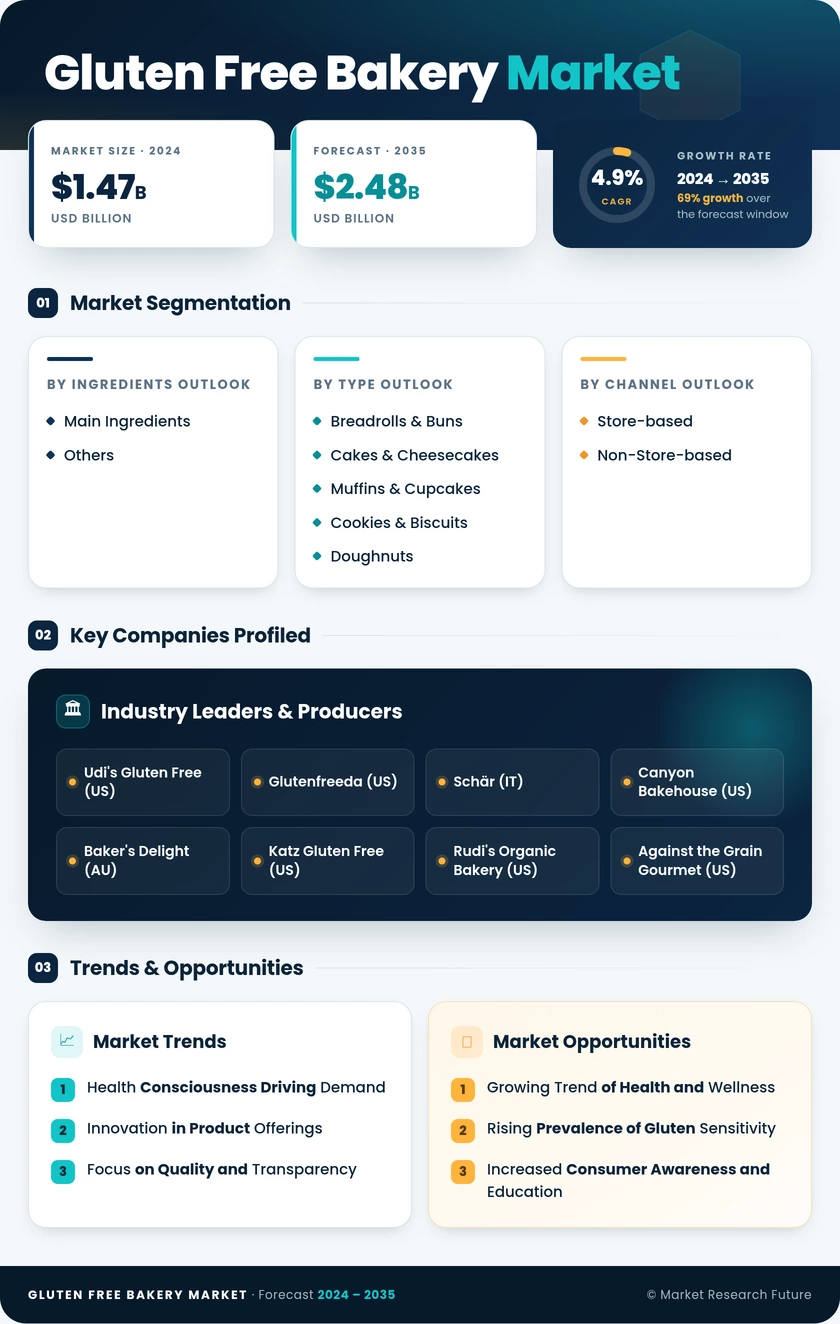
Gluten Free Bakery Market (2026 - 2035)

ID: MRFR/FnB/2337-HCR 128 Pages Snehal Singh Last Updated: November 18, 2026
Gluten-free Bakery Market Size, Share, Industry Trend & Analysis Research Report Information By Product Type (Bread, Cookies and Biscuits, Cakes and Muffins, Other Product Types), By Flour Type (Rice Flour, Corn Flour, Other Flour Types), By Distribution Channel (Supermarkets/Hypermarkets, Convenience Stores, Specialty Stores, Online Retail Stores, Other Distribution Channels), By Region (North America, Europe, Asia-Pacific, South America, Middle East & Africa) – Forecast Till 2035
Gluten Free Bakery Market
Market Size
Forecast Period2026-2035
CAGR (2026-2035)9.33%
2025 Market SizeUSD 8.22 Billion
2035 Market SizeUSD 19.89 Billion
Key Players
Dr. Schär AG/SpA
Grupo Bimbo SAB de CV
Flowers Foods Inc.
Conagra Brands Inc.
General Mills Inc.
Mondelez International Inc.
Opportunities
  • Protein- and Fibre-Fortified Indulgent Formats
  • Under-Served Demand in India and Southeast Asia
  • Direct-to-Consumer Subscriptions and Shopper Data Monetisation
  1. 1 Market Summary | |
  2. 2 Key Report Takeaways | |
    1. 2.1 By Product Type | |
    2. 2.2 By Flour Type | |
    3. 2.3 By Distribution Channel | |
    4. 2.4 By Region | |
  3. 3 Market Size and Forecast (2021–2035) | |
  4. 4 Driver Impact Analysis | |
    1. 4.1 Rising Diagnosis of Celiac Disease and Gluten Sensitivity | |
    2. 4.2 Harmonised Gluten-Free Labelling Thresholds | |
    3. 4.3 Lifestyle Adoption and Premium Clean-Label Reformulation | |
    4. 4.4 Stable Rice and Corn Flour Input Costs | |
    5. 4.5 Growth of E-Commerce and Direct-to-Consumer Sales | |
    6. 4.6 Strategic M&A by Large Packaged-Food Companies | |
    7. 4.7 Rice-Flour Baking Promotion in East Asia | |
  5. 5 Restraints Impact Analysis | |
    1. 5.1 Price Premium Over Wheat-Based Equivalents | |
    2. 5.2 Short Shelf Life and High Waste in Clean-Label Lines | |
    3. 5.3 Cross-Contact Risk and Certification Cost | |
    4. 5.4 Private-Label Substitution Compressing Brand Margins | |
    5. 5.5 Weather-Driven Volatility in Rice and Corn Supply | |
  6. 6 Opportunities | |
    1. 6.1 Protein- and Fibre-Fortified Indulgent Formats | |
    2. 6.2 Under-Served Demand in India and Southeast Asia | |
    3. 6.3 Direct-to-Consumer Subscriptions and Shopper Data Monetisation | |
    4. 6.4 Foodservice and Institutional Channels | |
    5. 6.5 Ancient-Grain and Legume Flour Platforms | |
  7. 7 Regional Market Share and Country-Level Analysis | |
    1. 7.1 North America | | |
      1. 7.1.1 US | | |
      2. 7.1.2 Canada | | |
      3. 7.1.3 Mexico | |
    2. 7.2 Europe | | |
      1. 7.2.1 Germany | | |
      2. 7.2.2 UK | | |
      3. 7.2.3 France | | |
      4. 7.2.4 Italy | | |
      5. 7.2.5 Spain | | |
      6. 7.2.6 Nordic Countries | | |
      7. 7.2.7 Russia | | |
      8. 7.2.8 Rest of Europe | |
    3. 7.3 Asia-Pacific | | |
      1. 7.3.1 China | | |
      2. 7.3.2 India | | |
      3. 7.3.3 Japan | | |
      4. 7.3.4 South Korea | | |
      5. 7.3.5 ASEAN | | |
      6. 7.3.6 Rest of Asia-Pacific | |
    4. 7.4 South America | | |
      1. 7.4.1 Brazil | | |
      2. 7.4.2 Argentina | | |
      3. 7.4.3 Rest of South America | |
    5. 7.5 Middle East & Africa | | |
      1. 7.5.1 Saudi Arabia | | |
      2. 7.5.2 UAE | | |
      3. 7.5.3 South Africa | | |
      4. 7.5.4 Egypt | | |
      5. 7.5.5 Rest of MEA | |
  8. 8 Future Outlook (2026–2035) | |
    1. 8.1 AI-Driven Formulation and Demand Planning | |
    2. 8.2 Enzyme and Fermentation Technology | |
    3. 8.3 Climate-Resilient Grain Sourcing | |
    4. 8.4 Sustainability Reporting and Packaging Regulation | |
  9. 9 Segmentation Analysis | |
    1. 9.1 By Product Type | | |
      1. 9.1.1 Bread | | |
      2. 9.1.2 Cookies and Biscuits | | |
      3. 9.1.3 Cakes and Muffins | | |
      4. 9.1.4 Other Product Types | |
    2. 9.2 By Flour Type | | |
      1. 9.2.1 Rice Flour | | |
      2. 9.2.2 Corn Flour | | |
      3. 9.2.3 Other Flour Types | |
    3. 9.3 By Distribution Channel | | |
      1. 9.3.1 Supermarkets/Hypermarkets | | |
      2. 9.3.2 Convenience Stores | | |
      3. 9.3.3 Specialty Stores | | |
      4. 9.3.4 Online Retail Stores | | |
      5. 9.3.5 Other Distribution Channels | |
  10. 10 Competitive Landscape | |
    1. 10.1 Market Concentration Analysis | |
    2. 10.2 Competitive Benchmarking Table | |
  11. 11 Recent News & Developments | |
  12. 12 Report Scope and Methodology | |
  13. 13 Detailed Sources and Citations | |
  14. 14 Frequently Asked Questions (FAQs) | | LIST OF TABLES | |
  15. TABLE 1 Market Snapshot – Study Period, Market Size, CAGR and Leading Regions | |
  16. TABLE 2 Global Market Size & Forecast, by Revenue (USD Billion), 2021–2035 | |
  17. TABLE 3 Driver Impact Analysis – Impact on CAGR, Geography and Timeline | |
  18. TABLE 4 Restraints Impact Analysis – Impact on CAGR, Geography and Timeline | |
  19. TABLE 5 Regional Summary, 2025 | |
  20. TABLE 6 North America – Country-Level Analysis, 2025 | |
  21. TABLE 7 Europe – Country-Level Analysis, 2025 | |
  22. TABLE 8 Asia-Pacific – Country-Level Analysis, 2025 | |
  23. TABLE 9 South America – Country-Level Analysis, 2025 | |
  24. TABLE 10 Middle East & Africa – Country-Level Analysis, 2025 | |
  25. TABLE 11 Global Market, by Product Type, 2025 | |
  26. TABLE 12 Global Market, by Flour Type, 2025 | |
  27. TABLE 13 Global Market, by Distribution Channel, 2025 | |
  28. TABLE 14 Competitive Benchmarking Table – Key Players, 2025 | |
  29. TABLE 15 Report Scope and Methodology | |
  30. TABLE 16 Detailed Sources and Citations | |
  31. TABLE 17 Segmentation Quick Reference | | LIST OF FIGURES | |
  32. FIGURE 1 Market Dynamics – Drivers, Restraints and Opportunities | |
  33. FIGURE 2 Industry Value Chain Analysis | |
  34. FIGURE 3 Porter's Five Forces Analysis | |
  35. FIGURE 4 Global Market Size Trend (USD Billion), 2021–2035 | |
  36. FIGURE 5 Market Share, by Product Type, 2025 | |
  37. FIGURE 6 Market Share, by Flour Type, 2025 | |
  38. FIGURE 7 Market Share, by Distribution Channel, 2025 | |
  39. FIGURE 8 Regional Market Share, 2025 | |
  40. FIGURE 9 Country-Level Market Share within Each Region, 2025 | |
  41. FIGURE 10 Competitive Landscape – Estimated Revenue Share Ranges of Key Players, 2025

Segmentation Quick Reference

DimensionSub-SegmentsDominant SegmentFastest Growing Segment
By Product TypeBread; Cookies and Biscuits; Cakes and Muffins; Other Product TypesBread (33.4% share)Cookies and Biscuits (10.6% CAGR)
By Flour TypeRice Flour; Corn Flour; Other Flour TypesRice Flour (43.2% share)Other Flour Types (10.5% CAGR)
By Distribution ChannelSupermarkets/Hypermarkets; Convenience Stores; Specialty Stores; Online Retail Stores; Other Distribution ChannelsSupermarkets/Hypermarkets (42.4% share)Online Retail Stores (13.2% CAGR)
By RegionNorth America; Europe; Asia-Pacific; South America; Middle East & AfricaNorth America (38.4% share)Asia-Pacific (11.4% CAGR)

Market Segmentation Overview

By Product Type

Sub-SegmentKey Trend
BreadTexture upgrades from enzyme-modified starches and psyllium narrow the gap with wheat loaves.
Cookies and BiscuitsProtein- and fibre-fortified, portion-controlled snacks win impulse purchases.
Cakes and MuffinsIn-store bakery and celebration formats lift premium sales.
Other Product TypesPizza bases, wraps and crackers extend gluten-free into meal occasions.

Bread leads product type because diagnosed celiac households replace their daily loaf first, giving it the highest purchase frequency. Cookies and Biscuits grow fastest because indulgent, single-serve treats face less price resistance than staples and can carry added protein and fibre. Cakes and Muffins sit between the two, relying on premium occasions rather than routine buying.

By Flour Type

Sub-SegmentKey Trend
Rice FlourAmple global rice supply keeps costs stable and supports broad use in bread and cakes.
Corn FlourLow input cost and heritage positioning appeal to value and artisan brands
Other Flour TypesAlmond, chickpea, sorghum and cassava blends add protein and differentiation.

Rice Flour leads because its neutral flavour and fine texture work across almost every bakery format, and large rice stocks keep it affordable. Other Flour Types grow fastest as manufacturers blend legume and ancient-grain flours with rice to raise nutrition and justify premium pricing. Corn Flour remains the cost-efficient option, though weather risk in key maize exporters can disrupt supply.

By Distribution Channel

Sub-SegmentKey Trend
Supermarkets/HypermarketsDedicated free-from aisles and private-label expansion
Convenience StoresSingle-serve gluten-free snacks for on-the-go buyers
Specialty StoresCurated certified ranges for strict celiac shoppers
Online Retail StoresSubscriptions, marketplaces and brand-owned websites widen reach.
Other Distribution ChannelsFoodservice, pharmacy and institutional supply

Supermarkets/Hypermarkets lead distribution because shoppers want gluten-free staples in the same basket as their regular groceries, and retailers back this with dedicated shelving. Online Retail Stores grow fastest because certified products are easier to find, compare and reorder online, and subscriptions reduce waste for short-shelf-life items. Specialty Stores keep strict celiac buyers loyal, while Convenience Stores benefit from single-serve snack formats.


Download PDF ×

We do not share your information with anyone. However, we may send you emails based on your report interest from time to time. You may contact us at any time to opt-out.