Request Free Sample ×

Kindly complete the form below to receive a free sample of this Report

* Please use a valid business email

Leading companies partner with us for data-driven Insights

clients tt-cursor
Hero Background
English
Chinese
French
Japanese
Korean
German
Spanish

Fermentation Ingredients Market Analysis

ID: MRFR/FnB/1564-CR
200 Pages
Snehal Singh
July 2025

Fermentation Ingredients Market Size, Share, Industry Trend & Analysis Research Report By Application (Food Beverages, Pharmaceuticals, Animal Feed, Biofuels), By Type (Yeast, Bacterial Cultures, Enzymes, Acids), By Source (Natural, Synthetic), By Form (Liquid, Powder, Granular), and By Regional (North America, Europe, South America, Asia Pacific, Middle East and Africa)-Forecast to 2035

Share:
Download PDF ×

We do not share your information with anyone. However, we may send you emails based on your report interest from time to time. You may contact us at any time to opt-out.

Fermentation Ingredients Market Infographic
Purchase Options

Market Analysis

In-depth Analysis of Fermentation Ingredients Market Industry Landscape

The increase in fermented foods’ acceptance as well as drinks is one of the most important factors driving growth into this sector (fermentation ingredient). Fermented food items such as kimchi, sauerkraut, yoghurt, cheese and kombucha have become extremely popular due to their distinctive taste, texture and nutrition. Fermentation process makes food digestible & also increases its life shelf hence it is commonly used when making foods that will enhance the growth of beneficial bacteria especially probiotics that aid in gut health and immune systems. As a result, demand for fermentation ingredients has risen sharply given that individuals are seeking functional food products with more probiotics for better health.

The fermentation ingredients market has been affected by consumer shift towards natural clean-labels. People are now more inclined to take foods and beverages which have recognizable ingredients that are simple, safe from additives and preservatives such as those involved during fermentation like starter cultures or yeast enzymes rather than synthetic ones. Moreover, vegetarianism and veganism have resulted in an escalating need for non-animal source fermentation inputs like microbial cultures or plant-based enzymes.

Technological advancements have played a significant role in driving innovation and growth within the fermentation ingredients market. Some of these methods include controlled fermentation, continuous fermentation and solid-state fermentation among others which enable production of high-quality consistent fermented products on large scale. Novel ferments with enhanced functionality as well as stability plus improved performance can be developed through enzyme engineering coupled with improving strains selection during fermentations optimizing these processes too.

This has become a significant issue for the fermentation ingredients market because many of these are influenced by regulatory frameworks. Therefore, there are several rules that regulate the food safety, labeling and quality standards which affects how the industry operates and how consumers view things. Fermentation ingredient producers must abide with laws concerning food additives, microbial safety and fermentation processes to be in accordance with relevant statutory provisions in order to gain consumer trust. Additionally, brand credibility and competitive edge in the market can also be achieved through compliance with organic and non-GMO certifications.

Competitive rivalry is stiff among players in the fermentation ingredients market who adopt product differentiation, branding strategies as well as marketing activities for positioning their offerings into the minds of consumers. In this regard, major actors include multinational suppliers of ingredients compared to small niche fermenters. It is important to note that brand reputation, product quality as well as price competitiveness are vital factors determining consumer purchasing behavior. Also, strategic partnerships with food processors or retailers or other firms that channel products directly to end users increase brand visibility thus helping penetrate markets.

Author
Author Profile
Snehal Singh
Manager - Research

High acumen in analyzing complex macro & micro markets with more than 6 years of work experience in the field of market research. By implementing her analytical skills in forecasting and estimation into market research reports, she has expertise in Packaging, Construction, and Equipment domains. She handles a team size of 20-25 resources and ensures smooth running of the projects, associated marketing activities, and client servicing.

Leave a Comment

FAQs

What is the current valuation of the Fermentation Ingredients Market?

<p>As of 2024, the Fermentation Ingredients Market was valued at 66.4 USD Billion.</p>

What is the projected market size for the Fermentation Ingredients Market by 2035?

<p>The market is expected to reach a valuation of 107.44 USD Billion by 2035.</p>

What is the expected CAGR for the Fermentation Ingredients Market during the forecast period?

<p>The anticipated CAGR for the Fermentation Ingredients Market from 2025 to 2035 is 4.47%.</p>

Which application segments are driving growth in the Fermentation Ingredients Market?

<p>The Food & Beverages segment, valued at 40.0 USD Billion in 2024, is a key driver, alongside Pharmaceuticals and Biofuels.</p>

What types of fermentation ingredients are most prevalent in the market?

<p>Yeast, with a valuation of 32.0 USD Billion in 2024, and Enzymes, valued at 28.0 USD Billion, are among the most prevalent types.</p>

How does the source of fermentation ingredients impact market dynamics?

<p>Natural fermentation ingredients, valued at 64.0 USD Billion in 2024, significantly influence market dynamics compared to synthetic sources.</p>

What forms of fermentation ingredients are currently available in the market?

<p>Liquid forms, valued at 48.0 USD Billion in 2024, dominate the market, followed by Powder and Granular forms.</p>

Who are the key players in the Fermentation Ingredients Market?

<p>Prominent players include BASF SE, DuPont de Nemours Inc, and Cargill Inc, among others.</p>

What is the growth outlook for the Animal Feed segment in the Fermentation Ingredients Market?

<p>The Animal Feed segment, valued at 15.0 USD Billion in 2024, is expected to grow steadily during the forecast period.</p>

How do bacterial cultures contribute to the Fermentation Ingredients Market?

<p>Bacterial cultures, valued at 25.0 USD Billion in 2024, play a crucial role in various applications, enhancing market growth.</p>

Market Summary

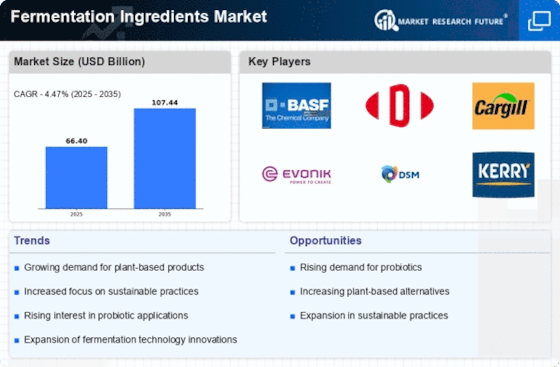
As per Market Research Future analysis, the Fermentation Ingredients Market was estimated at 66.4 USD Billion in 2024. The fermentation ingredients industry is projected to grow from 69.37 USD Billion in 2025 to 107.44 USD Billion by 2035, exhibiting a compound annual growth rate (CAGR) of 4.47% during the forecast period 2025 - 2035

Key Market Trends & Highlights

The Fermentation Ingredients Market is experiencing robust growth driven by health trends and technological advancements.

  • The market is witnessing a rising demand for natural ingredients, particularly in North America, which remains the largest market. Technological innovations in fermentation are enhancing production efficiency and product quality across various sectors. The expansion of plant-based fermentation is particularly notable in the Asia-Pacific region, which is the fastest-growing market. Key drivers include growing health consciousness and sustainability concerns, significantly impacting the food and beverage sector.

Market Size & Forecast

2024 Market Size 66.4 (USD Billion)
2035 Market Size 107.44 (USD Billion)
CAGR (2025 - 2035) 4.47%
Largest Regional Market Share in 2024 North America

Major Players

BASF SE (DE), DuPont de Nemours Inc (US), <a href="https://www.cargill.co.in/">Cargill Inc (US)</a>, Evonik Industries AG (DE), DSM Nutritional Products (CH), Kerry Group plc (IE), Archer Daniels Midland Company (US), Novozymes A/S (DK)

Market Trends

The Fermentation Ingredients Market is currently experiencing a dynamic evolution, driven by a growing consumer preference for natural and organic products. This shift is largely influenced by increasing awareness regarding health benefits associated with fermented foods and beverages. As consumers become more health-conscious, the demand for fermentation ingredients, such as probiotics, enzymes, and organic acids, appears to be on the rise. Additionally, the food and beverage industry is increasingly incorporating these ingredients to enhance flavor, texture, and nutritional value, thereby expanding their applications beyond traditional uses. Moreover, the Fermentation Ingredients Market is likely to witness advancements in technology that facilitate more efficient production processes. Innovations in fermentation techniques may lead to improved yields and reduced costs, making these ingredients more accessible to manufacturers. Furthermore, the growing trend of plant-based diets is expected to bolster the demand for fermentation ingredients derived from non-animal sources. This evolving landscape suggests that the market will continue to adapt to changing consumer preferences and technological advancements, positioning itself for sustained growth in the foreseeable future.

Rising Demand for Natural Ingredients

There is an observable trend towards the use of natural fermentation ingredients as consumers increasingly seek healthier alternatives. This inclination is prompting manufacturers to explore organic sources and traditional fermentation methods, which are perceived as more wholesome.

Technological Innovations in Fermentation

Advancements in fermentation technology are reshaping the Fermentation Ingredients Market. New methodologies and equipment are enhancing production efficiency, allowing for the development of novel ingredients that meet diverse consumer needs.

Expansion of Plant-Based Fermentation

The growing popularity of plant-based diets is influencing the Fermentation Ingredients Market. Ingredients derived from plants are gaining traction, as they align with consumer preferences for sustainable and ethical food choices.

Fermentation Ingredients Market Market Drivers

Growing Health Consciousness

The increasing awareness of health and wellness among consumers appears to be a pivotal driver for the Fermentation Ingredients Market. As individuals become more health-conscious, there is a notable shift towards natural and organic products. This trend is reflected in the rising demand for fermented foods, which are often perceived as healthier alternatives due to their probiotic content. According to recent data, the market for fermented foods is projected to grow at a compound annual growth rate of approximately 8% over the next five years. This growth is likely to be fueled by the increasing popularity of gut health, as consumers seek products that promote digestive wellness. Consequently, manufacturers in the Fermentation Ingredients Market are focusing on developing innovative fermentation processes to cater to this health-driven demand.

Rising Popularity of Plant-Based Products

The surge in plant-based diets is significantly influencing the Fermentation Ingredients Market. As more consumers adopt vegetarian and vegan lifestyles, the demand for plant-based fermentation ingredients is on the rise. This trend is driven by a combination of health benefits associated with plant-based diets and ethical considerations regarding animal welfare. Data suggests that the plant-based food market is projected to grow at a rate of 10% annually, which is likely to bolster the demand for fermentation ingredients derived from plant sources. Manufacturers are responding to this trend by developing innovative plant-based fermentation products, which not only cater to the dietary preferences of consumers but also align with broader sustainability goals. This shift towards plant-based fermentation is expected to reshape the landscape of the Fermentation Ingredients Market.

Sustainability and Environmental Concerns

Sustainability has emerged as a critical factor influencing consumer choices, thereby impacting the Fermentation Ingredients Market. As environmental concerns escalate, consumers are increasingly favoring products that are produced through sustainable practices. Fermentation processes often utilize renewable resources, which can reduce waste and lower carbon footprints. This shift towards sustainability is prompting companies to adopt eco-friendly fermentation methods, which not only appeal to environmentally conscious consumers but also align with regulatory trends favoring sustainable production. The market for sustainable fermentation ingredients is expected to witness substantial growth, as businesses strive to meet the demands of a more eco-aware consumer base. This trend indicates a potential for innovation in the Fermentation Ingredients Market, as companies explore new ways to enhance sustainability in their production processes.

Technological Advancements in Fermentation

Technological advancements are playing a crucial role in shaping the Fermentation Ingredients Market. Innovations in fermentation technology, such as precision fermentation and bioprocess optimization, are enhancing the efficiency and quality of fermentation processes. These advancements enable manufacturers to produce high-quality fermentation ingredients at a lower cost, thereby increasing competitiveness in the market. Furthermore, the integration of artificial intelligence and machine learning in fermentation processes is likely to streamline production and improve yield. As a result, the Fermentation Ingredients Market is expected to benefit from reduced production times and enhanced product consistency. This technological evolution not only meets the growing demand for diverse fermentation products but also positions companies to respond more effectively to market trends.

Increased Application in Food and Beverage Sector

The food and beverage sector continues to be a dominant force driving the Fermentation Ingredients Market. The versatility of fermentation ingredients allows for their application in a wide range of products, from dairy alternatives to alcoholic beverages. As consumer preferences evolve, there is a growing interest in unique flavors and health benefits associated with fermented products. Recent market analysis indicates that the food and beverage segment accounts for over 60% of the total demand for fermentation ingredients. This trend is likely to persist as manufacturers innovate to create new products that appeal to diverse consumer tastes. Additionally, the rise of craft beverages and artisanal foods is expected to further propel the demand for fermentation ingredients, as consumers seek authentic and high-quality options in their food and drink choices.

Market Segment Insights

By Application: Food Beverages (Largest) vs. Pharmaceuticals (Fastest-Growing)

The Fermentation Ingredients Market exhibits a diverse landscape with applications predominantly in Food Beverages, Pharmaceuticals, Animal Feed, and Biofuels. Among these, the <a href="https://www.marketresearchfuture.com/reports/food-and-beverages-global-market-32019">Food Beverages</a> segment holds the largest share, driven by the increasing consumer preference for fermented drinks like kombucha and craft beers. Conversely, the Pharmaceuticals sector is rapidly gaining traction as bio-based therapies and probiotics become prevalent, leading to a notable uptick in its demand and market participation.

Food Beverages (Dominant) vs. Pharmaceuticals (Emerging)

The Food Beverages segment remains dominant in the Fermentation Ingredients Market, leveraging its wide-ranging appeal and established consumer base. With trends favoring health and wellness, this segment incorporates a vast array of ingredients that enhance flavor and functional benefits in beverages. In contrast, the Pharmaceuticals sector is emerging strongly, spurred by innovations in biotech and the rising awareness of gut health. This segment focuses on integrating fermentation processes to produce high-demand ingredients for health supplements, highlighting the pivotal role of fermentation in developing next-generation pharmaceuticals.

By Type: Yeast (Largest) vs. Bacterial Cultures (Fastest-Growing)

In the Fermentation Ingredients Market, the type segment showcases yeast as the predominant player, commanding a significant market share. This segment is mainly driven by the rising demand for yeast in various applications including food and beverage, nutrition, and pharmaceuticals. On the other hand, bacterial cultures are emerging rapidly, attributed to their increasing utilization in <a href="https://www.marketresearchfuture.com/reports/dairy-market-11483">dairy </a>products and probiotic formulations. The growth of functional foods is further propelling the need for efficient fermentation processes, thus expanding the bacterial cultures segment.

Yeast (Dominant) vs. Bacterial Cultures (Emerging)

Yeast remains a dominant ingredient in the fermentation market due to its extensive application in bread, <a href="https://www.marketresearchfuture.com/reports/beer-market-1647" target="_blank">beer</a>, and wine production. It is favored for its ability to enhance flavor, texture, and nutritional value of food products. Meanwhile, bacterial cultures are gaining traction as an emerging segment, particularly with the growing interest in gut health and probiotics. These cultures are instrumental in producing yogurt, <a href="https://www.marketresearchfuture.com/reports/cheese-market-2213" target="_blank">cheese</a>, and other fermented products that offer health benefits. Together, they illustrate a dynamic interplay in the fermentation ingredients landscape as consumers lean toward both traditional and health-oriented options.

By Source: Natural (Largest) vs. Synthetic (Fastest-Growing)

In the Fermentation Ingredients Market, the source segment is primarily dominated by natural ingredients, which command a significant share due to their increasing demand in health-oriented products. Natural fermentation ingredients are favored by consumers for their perceived benefits, such as organic health claims and sustainability. In contrast, synthetic ingredients, although currently smaller in market share, are quickly gaining traction as manufacturers seek cost-effective solutions and scalability in production.

Source: Natural (Dominant) vs. Synthetic (Emerging)

Natural fermentation ingredients are revered in the market for their authenticity and alignment with consumer preferences for clean-label products. They are primarily derived from naturally sourced raw materials, catering to health-conscious consumers and trends toward organic products. On the other hand, synthetic fermentation ingredients are emerging rapidly, driven by advancements in technology and the need for efficient production methods. While natural ingredients remain the dominant choice, synthetic alternatives are being increasingly integrated within the industry due to their consistency, cost-effectiveness, and ability to meet large-scale demands.

By Form: Liquid (Largest) vs. Powder (Fastest-Growing)

In the Fermentation Ingredients Market, the segment distribution reveals that Liquid forms dominate the landscape, appealing to various applications due to their ease of use and superior solubility. The prevalence of Liquid fermentation ingredients is attributed to their versatility in numerous end-use industries, including food, beverages, and pharmaceuticals, where seamless implementation is crucial for production efficiency. Conversely, the Powder segment is steadily gaining traction, marking its position as the fastest-growing area, driven by increasing consumer preferences for convenience and storage stability. Growth trends for the Form segment indicate a noticeable shift towards Powder fermentation ingredients, as they cater to the rising demand for ready-to-use products in home brewing and food manufacturing processes. Additionally, advancements in production technologies and the expansion of distribution networks have further fueled this demand, allowing manufacturers to reach a broader customer base seeking innovative and diverse fermentation solutions.

Liquid (Dominant) vs. Powder (Emerging)

Liquid fermentation ingredients have established themselves as the dominant form in the market, mainly due to their dynamic applicability across various industries. Their liquidity enhances mixing abilities and allows for efficient transportation within manufacturing systems. In contrast, Powder fermentation ingredients, recognized as an emerging category, offer significant advantages in terms of storage and shelf life. This form is increasingly favored by manufacturers seeking to optimize their processes and reduce operational costs. The growth in the Powder segment is indicative of a broader trend towards convenient, user-friendly fermentation products that align with consumer lifestyles, which demand flexibility and efficiency. As a result, while Liquid remains the go-to choice, Powder is swiftly carving out its own niche.

Get more detailed insights about Fermentation Ingredients Market Research Report - Forecast to 2035

Regional Insights

North America : Innovation and Demand Surge

North America is the largest market for fermentation ingredients, holding approximately 40% of the global share. The region's growth is driven by increasing consumer demand for natural and organic products, alongside stringent regulations promoting sustainable practices. The rise in health-conscious consumers and the expansion of the food and beverage sector are significant catalysts for market growth. The United States is the dominant player, with key companies like DuPont and Cargill leading the charge. Canada also contributes significantly, focusing on innovative fermentation technologies. The competitive landscape is characterized by a mix of established players and emerging startups, all vying for market share in this rapidly evolving sector.

Europe : Sustainability and Innovation Focus

Europe is the second-largest market for fermentation ingredients, accounting for around 30% of the global market share. The region's growth is fueled by a strong emphasis on sustainability and innovation, with regulations encouraging the use of bio-based ingredients. The European Green Deal and various national policies are pivotal in shaping market dynamics, promoting eco-friendly practices across industries. Germany and France are the leading countries in this market, with significant contributions from companies like BASF and Evonik. The competitive landscape is robust, featuring a mix of multinational corporations and local firms. The presence of research institutions further enhances innovation, driving the development of new fermentation technologies and applications.

Asia-Pacific : Emerging Market Potential

Asia-Pacific is witnessing rapid growth in the fermentation ingredients market, holding approximately 20% of the global share. The region's expansion is driven by increasing urbanization, rising disposable incomes, and a growing preference for processed foods. Countries like China and India are at the forefront, with significant investments in food and beverage sectors, further propelling market demand. China is the largest market in the region, supported by local giants like Novozymes and DSM. India is also emerging as a key player, with a focus on innovative fermentation processes. The competitive landscape is evolving, with both domestic and international companies striving to capture market share in this burgeoning sector, driven by consumer trends and technological advancements.

Middle East and Africa : Untapped Market Opportunities

The Middle East and Africa region is gradually emerging in the fermentation ingredients market, holding about 10% of the global share. The growth is primarily driven by diversification in food production and increasing investments in biotechnology. Countries like South Africa and the UAE are focusing on enhancing their food security through innovative fermentation technologies, which are gaining traction in various sectors. South Africa leads the market in the region, with a growing number of local players entering the fermentation space. The competitive landscape is characterized by a mix of established companies and new entrants, all aiming to leverage the region's untapped potential. As awareness of fermentation benefits increases, the market is expected to expand significantly in the coming years.

Key Players and Competitive Insights

The Fermentation Ingredients Market is currently characterized by a dynamic competitive landscape, driven by increasing consumer demand for natural and sustainable products. Key players are actively engaging in innovation and strategic partnerships to enhance their market positioning. Companies such as BASF SE (DE), DuPont de Nemours Inc (US), and Novozymes A/S (DK) are at the forefront, focusing on developing advanced fermentation technologies and expanding their product portfolios. Their collective strategies not only foster competition but also contribute to the overall growth of the market, as they seek to meet the evolving needs of various industries, including food and beverage, pharmaceuticals, and biofuels.In terms of business tactics, companies are increasingly localizing manufacturing to reduce supply chain vulnerabilities and enhance responsiveness to regional market demands. The competitive structure of the market appears moderately fragmented, with several players vying for market share. However, the influence of major companies like Cargill Inc (US) and DSM Nutritional Products (CH) is substantial, as they leverage their extensive distribution networks and technological capabilities to maintain a competitive edge.

In September DuPont de Nemours Inc (US) announced a strategic partnership with a leading biotechnology firm to co-develop next-generation fermentation processes aimed at producing sustainable ingredients for the food industry. This collaboration is likely to enhance DuPont's innovation capabilities and strengthen its position in the market, as it aligns with the growing consumer preference for environmentally friendly products.

In August Novozymes A/S (DK) launched a new line of enzymes specifically designed for plant-based protein fermentation. This initiative not only reflects Novozymes' commitment to sustainability but also positions the company to capitalize on the burgeoning plant-based food sector. The introduction of these enzymes could potentially revolutionize the production processes for plant-based products, thereby increasing efficiency and reducing costs.

In July BASF SE (DE) expanded its fermentation ingredient offerings by acquiring a small biotech firm specializing in microbial fermentation technologies. This acquisition is indicative of BASF's strategy to enhance its technological capabilities and diversify its product range, which may lead to increased market share and improved competitive positioning.

As of October the Fermentation Ingredients Market is witnessing significant trends such as digitalization, sustainability, and the integration of artificial intelligence in production processes. Strategic alliances are becoming increasingly important, as companies recognize the value of collaboration in driving innovation and efficiency. Looking ahead, competitive differentiation is expected to evolve, with a shift from traditional price-based competition towards a focus on innovation, technological advancements, and supply chain reliability. This transition may redefine the competitive landscape, compelling companies to invest in research and development to stay ahead.

Key Companies in the Fermentation Ingredients Market include

Industry Developments

China's Ministry of Agriculture and Rural Affairs approved Calysta's FeedKind® single-cell protein for use in aquaculture feeds in January 2024, allowing its Chongqing factory to provide sustainable protein for shrimp and fish farming.

Just over a year after its establishment, Fonterra and DSM's joint company Vivici declared in February 2024 that it could provide the U.S. market with animal-free whey protein produced by fermentation. Nestlé expanded its functional nutrition portfolio in February 2024 by launching Better Whey, a lactose- and animal-free whey protein powder under the Orgain brand.

Chr. Hansen Holding A/S introduced a next-generation probiotic strain in March 2024 with the goal of improving immunological and intestinal health, in line with the rising demand from consumers for functional foods and supplements.

Ajinomoto increased its capacity to produce amino acids by fermentation in April 2024 in response to growing demand in the biopharma, sports nutrition, and food fortification industries. Lesaffre introduced a new yeast-based bioactive component in June 2024 that is intended for use in plant-based food applications and is intended to enhance the nutritional profiles and texture of substitute protein products.

As part of a larger industry trend toward sustainability and efficiency, Ferm Solutions and Cargill forged a strategic alliance in July 2023 to enhance fermentation processes. Lesaffre and DSM-Firmenich teamed together in February 2024 to integrate yeast-extract processing technology, opening the door to new fermentation-based and savory product developments.

Future Outlook

Fermentation Ingredients Market Future Outlook

The Fermentation Ingredients Market is projected to grow at a 4.47% CAGR from 2025 to 2035, driven by increasing demand for natural ingredients and sustainable production methods.

New opportunities lie in:

  • Expansion into plant-based fermentation products</p><p>Development of customized fermentation solutions for niche markets</p><p>Investment in advanced fermentation technologies for efficiency gains

By 2035, the market is expected to be robust, reflecting strong growth and innovation.

Market Segmentation

Fermentation Ingredients Market Form Outlook

  • Liquid
  • Powder
  • Granular

Fermentation Ingredients Market Type Outlook

  • Yeast
  • Bacterial Cultures
  • Enzymes
  • Acids

Fermentation Ingredients Market Source Outlook

  • Natural
  • Synthetic

Fermentation Ingredients Market Application Outlook

  • Food Beverages
  • Pharmaceuticals
  • Animal Feed
  • Biofuels

Report Scope

MARKET SIZE 2024 66.4(USD Billion)
MARKET SIZE 2025 69.37(USD Billion)
MARKET SIZE 2035 107.44(USD Billion)
COMPOUND ANNUAL GROWTH RATE (CAGR) 4.47% (2025 - 2035)
REPORT COVERAGE Revenue Forecast, Competitive Landscape, Growth Factors, and Trends
BASE YEAR 2024
Market Forecast Period 2025 - 2035
Historical Data 2019 - 2024
Market Forecast Units USD Billion
Key Companies Profiled BASF SE (DE), DuPont de Nemours Inc (US), Cargill Inc (US), Evonik Industries AG (DE), DSM Nutritional Products (CH), Kerry Group plc (IE), Archer Daniels Midland Company (US), Novozymes A/S (DK)
Segments Covered Application, Type, Source, Form, Regional
Key Market Opportunities Growing demand for plant-based proteins drives innovation in the Fermentation Ingredients Market.
Key Market Dynamics Rising demand for plant-based products drives innovation in fermentation ingredients and enhances competitive market dynamics.
Countries Covered North America, Europe, APAC, South America, MEA

FAQs

What is the current valuation of the Fermentation Ingredients Market?

<p>As of 2024, the Fermentation Ingredients Market was valued at 66.4 USD Billion.</p>

What is the projected market size for the Fermentation Ingredients Market by 2035?

<p>The market is expected to reach a valuation of 107.44 USD Billion by 2035.</p>

What is the expected CAGR for the Fermentation Ingredients Market during the forecast period?

<p>The anticipated CAGR for the Fermentation Ingredients Market from 2025 to 2035 is 4.47%.</p>

Which application segments are driving growth in the Fermentation Ingredients Market?

<p>The Food & Beverages segment, valued at 40.0 USD Billion in 2024, is a key driver, alongside Pharmaceuticals and Biofuels.</p>

What types of fermentation ingredients are most prevalent in the market?

<p>Yeast, with a valuation of 32.0 USD Billion in 2024, and Enzymes, valued at 28.0 USD Billion, are among the most prevalent types.</p>

How does the source of fermentation ingredients impact market dynamics?

<p>Natural fermentation ingredients, valued at 64.0 USD Billion in 2024, significantly influence market dynamics compared to synthetic sources.</p>

What forms of fermentation ingredients are currently available in the market?

<p>Liquid forms, valued at 48.0 USD Billion in 2024, dominate the market, followed by Powder and Granular forms.</p>

Who are the key players in the Fermentation Ingredients Market?

<p>Prominent players include BASF SE, DuPont de Nemours Inc, and Cargill Inc, among others.</p>

What is the growth outlook for the Animal Feed segment in the Fermentation Ingredients Market?

<p>The Animal Feed segment, valued at 15.0 USD Billion in 2024, is expected to grow steadily during the forecast period.</p>

How do bacterial cultures contribute to the Fermentation Ingredients Market?

<p>Bacterial cultures, valued at 25.0 USD Billion in 2024, play a crucial role in various applications, enhancing market growth.</p>

  1. SECTION I: EXECUTIVE SUMMARY AND KEY HIGHLIGHTS
    1. | 1.1 EXECUTIVE SUMMARY
    2. | | 1.1.1 Market Overview
    3. | | 1.1.2 Key Findings
    4. | | 1.1.3 Market Segmentation
    5. | | 1.1.4 Competitive Landscape
    6. | | 1.1.5 Challenges and Opportunities
    7. | | 1.1.6 Future Outlook
  2. SECTION II: SCOPING, METHODOLOGY AND MARKET STRUCTURE
    1. | 2.1 MARKET INTRODUCTION
    2. | | 2.1.1 Definition
    3. | | 2.1.2 Scope of the study
    4. | | | 2.1.2.1 Research Objective
    5. | | | 2.1.2.2 Assumption
    6. | | | 2.1.2.3 Limitations
    7. | 2.2 RESEARCH METHODOLOGY
    8. | | 2.2.1 Overview
    9. | | 2.2.2 Data Mining
    10. | | 2.2.3 Secondary Research
    11. | | 2.2.4 Primary Research
    12. | | | 2.2.4.1 Primary Interviews and Information Gathering Process
    13. | | | 2.2.4.2 Breakdown of Primary Respondents
    14. | | 2.2.5 Forecasting Model
    15. | | 2.2.6 Market Size Estimation
    16. | | | 2.2.6.1 Bottom-Up Approach
    17. | | | 2.2.6.2 Top-Down Approach
    18. | | 2.2.7 Data Triangulation
    19. | | 2.2.8 Validation
  3. SECTION III: QUALITATIVE ANALYSIS
    1. | 3.1 MARKET DYNAMICS
    2. | | 3.1.1 Overview
    3. | | 3.1.2 Drivers
    4. | | 3.1.3 Restraints
    5. | | 3.1.4 Opportunities
    6. | 3.2 MARKET FACTOR ANALYSIS
    7. | | 3.2.1 Value chain Analysis
    8. | | 3.2.2 Porter's Five Forces Analysis
    9. | | | 3.2.2.1 Bargaining Power of Suppliers
    10. | | | 3.2.2.2 Bargaining Power of Buyers
    11. | | | 3.2.2.3 Threat of New Entrants
    12. | | | 3.2.2.4 Threat of Substitutes
    13. | | | 3.2.2.5 Intensity of Rivalry
    14. | | 3.2.3 COVID-19 Impact Analysis
    15. | | | 3.2.3.1 Market Impact Analysis
    16. | | | 3.2.3.2 Regional Impact
    17. | | | 3.2.3.3 Opportunity and Threat Analysis
  4. SECTION IV: QUANTITATIVE ANALYSIS
    1. | 4.1 Food, Beverages & Nutrition, BY Application (USD Billion)
    2. | | 4.1.1 Food Beverages
    3. | | 4.1.2 Pharmaceuticals
    4. | | 4.1.3 Animal Feed
    5. | | 4.1.4 Biofuels
    6. | 4.2 Food, Beverages & Nutrition, BY Type (USD Billion)
    7. | | 4.2.1 Yeast
    8. | | 4.2.2 Bacterial Cultures
    9. | | 4.2.3 Enzymes
    10. | | 4.2.4 Acids
    11. | 4.3 Food, Beverages & Nutrition, BY Source (USD Billion)
    12. | | 4.3.1 Natural
    13. | | 4.3.2 Synthetic
    14. | 4.4 Food, Beverages & Nutrition, BY Form (USD Billion)
    15. | | 4.4.1 Liquid
    16. | | 4.4.2 Powder
    17. | | 4.4.3 Granular
    18. | 4.5 Food, Beverages & Nutrition, BY Region (USD Billion)
    19. | | 4.5.1 North America
    20. | | | 4.5.1.1 US
    21. | | | 4.5.1.2 Canada
    22. | | 4.5.2 Europe
    23. | | | 4.5.2.1 Germany
    24. | | | 4.5.2.2 UK
    25. | | | 4.5.2.3 France
    26. | | | 4.5.2.4 Russia
    27. | | | 4.5.2.5 Italy
    28. | | | 4.5.2.6 Spain
    29. | | | 4.5.2.7 Rest of Europe
    30. | | 4.5.3 APAC
    31. | | | 4.5.3.1 China
    32. | | | 4.5.3.2 India
    33. | | | 4.5.3.3 Japan
    34. | | | 4.5.3.4 South Korea
    35. | | | 4.5.3.5 Malaysia
    36. | | | 4.5.3.6 Thailand
    37. | | | 4.5.3.7 Indonesia
    38. | | | 4.5.3.8 Rest of APAC
    39. | | 4.5.4 South America
    40. | | | 4.5.4.1 Brazil
    41. | | | 4.5.4.2 Mexico
    42. | | | 4.5.4.3 Argentina
    43. | | | 4.5.4.4 Rest of South America
    44. | | 4.5.5 MEA
    45. | | | 4.5.5.1 GCC Countries
    46. | | | 4.5.5.2 South Africa
    47. | | | 4.5.5.3 Rest of MEA
  5. SECTION V: COMPETITIVE ANALYSIS
    1. | 5.1 Competitive Landscape
    2. | | 5.1.1 Overview
    3. | | 5.1.2 Competitive Analysis
    4. | | 5.1.3 Market share Analysis
    5. | | 5.1.4 Major Growth Strategy in the Food, Beverages & Nutrition
    6. | | 5.1.5 Competitive Benchmarking
    7. | | 5.1.6 Leading Players in Terms of Number of Developments in the Food, Beverages & Nutrition
    8. | | 5.1.7 Key developments and growth strategies
    9. | | | 5.1.7.1 New Product Launch/Service Deployment
    10. | | | 5.1.7.2 Merger & Acquisitions
    11. | | | 5.1.7.3 Joint Ventures
    12. | | 5.1.8 Major Players Financial Matrix
    13. | | | 5.1.8.1 Sales and Operating Income
    14. | | | 5.1.8.2 Major Players R&D Expenditure. 2023
    15. | 5.2 Company Profiles
    16. | | 5.2.1 BASF SE (DE)
    17. | | | 5.2.1.1 Financial Overview
    18. | | | 5.2.1.2 Products Offered
    19. | | | 5.2.1.3 Key Developments
    20. | | | 5.2.1.4 SWOT Analysis
    21. | | | 5.2.1.5 Key Strategies
    22. | | 5.2.2 DuPont de Nemours Inc (US)
    23. | | | 5.2.2.1 Financial Overview
    24. | | | 5.2.2.2 Products Offered
    25. | | | 5.2.2.3 Key Developments
    26. | | | 5.2.2.4 SWOT Analysis
    27. | | | 5.2.2.5 Key Strategies
    28. | | 5.2.3 Cargill Inc (US)
    29. | | | 5.2.3.1 Financial Overview
    30. | | | 5.2.3.2 Products Offered
    31. | | | 5.2.3.3 Key Developments
    32. | | | 5.2.3.4 SWOT Analysis
    33. | | | 5.2.3.5 Key Strategies
    34. | | 5.2.4 Evonik Industries AG (DE)
    35. | | | 5.2.4.1 Financial Overview
    36. | | | 5.2.4.2 Products Offered
    37. | | | 5.2.4.3 Key Developments
    38. | | | 5.2.4.4 SWOT Analysis
    39. | | | 5.2.4.5 Key Strategies
    40. | | 5.2.5 DSM Nutritional Products (CH)
    41. | | | 5.2.5.1 Financial Overview
    42. | | | 5.2.5.2 Products Offered
    43. | | | 5.2.5.3 Key Developments
    44. | | | 5.2.5.4 SWOT Analysis
    45. | | | 5.2.5.5 Key Strategies
    46. | | 5.2.6 Kerry Group plc (IE)
    47. | | | 5.2.6.1 Financial Overview
    48. | | | 5.2.6.2 Products Offered
    49. | | | 5.2.6.3 Key Developments
    50. | | | 5.2.6.4 SWOT Analysis
    51. | | | 5.2.6.5 Key Strategies
    52. | | 5.2.7 Archer Daniels Midland Company (US)
    53. | | | 5.2.7.1 Financial Overview
    54. | | | 5.2.7.2 Products Offered
    55. | | | 5.2.7.3 Key Developments
    56. | | | 5.2.7.4 SWOT Analysis
    57. | | | 5.2.7.5 Key Strategies
    58. | | 5.2.8 Novozymes A/S (DK)
    59. | | | 5.2.8.1 Financial Overview
    60. | | | 5.2.8.2 Products Offered
    61. | | | 5.2.8.3 Key Developments
    62. | | | 5.2.8.4 SWOT Analysis
    63. | | | 5.2.8.5 Key Strategies
    64. | 5.3 Appendix
    65. | | 5.3.1 References
    66. | | 5.3.2 Related Reports
  6. LIST OF FIGURES
    1. | 6.1 MARKET SYNOPSIS
    2. | 6.2 NORTH AMERICA MARKET ANALYSIS
    3. | 6.3 US MARKET ANALYSIS BY APPLICATION
    4. | 6.4 US MARKET ANALYSIS BY TYPE
    5. | 6.5 US MARKET ANALYSIS BY SOURCE
    6. | 6.6 US MARKET ANALYSIS BY FORM
    7. | 6.7 CANADA MARKET ANALYSIS BY APPLICATION
    8. | 6.8 CANADA MARKET ANALYSIS BY TYPE
    9. | 6.9 CANADA MARKET ANALYSIS BY SOURCE
    10. | 6.10 CANADA MARKET ANALYSIS BY FORM
    11. | 6.11 EUROPE MARKET ANALYSIS
    12. | 6.12 GERMANY MARKET ANALYSIS BY APPLICATION
    13. | 6.13 GERMANY MARKET ANALYSIS BY TYPE
    14. | 6.14 GERMANY MARKET ANALYSIS BY SOURCE
    15. | 6.15 GERMANY MARKET ANALYSIS BY FORM
    16. | 6.16 UK MARKET ANALYSIS BY APPLICATION
    17. | 6.17 UK MARKET ANALYSIS BY TYPE
    18. | 6.18 UK MARKET ANALYSIS BY SOURCE
    19. | 6.19 UK MARKET ANALYSIS BY FORM
    20. | 6.20 FRANCE MARKET ANALYSIS BY APPLICATION
    21. | 6.21 FRANCE MARKET ANALYSIS BY TYPE
    22. | 6.22 FRANCE MARKET ANALYSIS BY SOURCE
    23. | 6.23 FRANCE MARKET ANALYSIS BY FORM
    24. | 6.24 RUSSIA MARKET ANALYSIS BY APPLICATION
    25. | 6.25 RUSSIA MARKET ANALYSIS BY TYPE
    26. | 6.26 RUSSIA MARKET ANALYSIS BY SOURCE
    27. | 6.27 RUSSIA MARKET ANALYSIS BY FORM
    28. | 6.28 ITALY MARKET ANALYSIS BY APPLICATION
    29. | 6.29 ITALY MARKET ANALYSIS BY TYPE
    30. | 6.30 ITALY MARKET ANALYSIS BY SOURCE
    31. | 6.31 ITALY MARKET ANALYSIS BY FORM
    32. | 6.32 SPAIN MARKET ANALYSIS BY APPLICATION
    33. | 6.33 SPAIN MARKET ANALYSIS BY TYPE
    34. | 6.34 SPAIN MARKET ANALYSIS BY SOURCE
    35. | 6.35 SPAIN MARKET ANALYSIS BY FORM
    36. | 6.36 REST OF EUROPE MARKET ANALYSIS BY APPLICATION
    37. | 6.37 REST OF EUROPE MARKET ANALYSIS BY TYPE
    38. | 6.38 REST OF EUROPE MARKET ANALYSIS BY SOURCE
    39. | 6.39 REST OF EUROPE MARKET ANALYSIS BY FORM
    40. | 6.40 APAC MARKET ANALYSIS
    41. | 6.41 CHINA MARKET ANALYSIS BY APPLICATION
    42. | 6.42 CHINA MARKET ANALYSIS BY TYPE
    43. | 6.43 CHINA MARKET ANALYSIS BY SOURCE
    44. | 6.44 CHINA MARKET ANALYSIS BY FORM
    45. | 6.45 INDIA MARKET ANALYSIS BY APPLICATION
    46. | 6.46 INDIA MARKET ANALYSIS BY TYPE
    47. | 6.47 INDIA MARKET ANALYSIS BY SOURCE
    48. | 6.48 INDIA MARKET ANALYSIS BY FORM
    49. | 6.49 JAPAN MARKET ANALYSIS BY APPLICATION
    50. | 6.50 JAPAN MARKET ANALYSIS BY TYPE
    51. | 6.51 JAPAN MARKET ANALYSIS BY SOURCE
    52. | 6.52 JAPAN MARKET ANALYSIS BY FORM
    53. | 6.53 SOUTH KOREA MARKET ANALYSIS BY APPLICATION
    54. | 6.54 SOUTH KOREA MARKET ANALYSIS BY TYPE
    55. | 6.55 SOUTH KOREA MARKET ANALYSIS BY SOURCE
    56. | 6.56 SOUTH KOREA MARKET ANALYSIS BY FORM
    57. | 6.57 MALAYSIA MARKET ANALYSIS BY APPLICATION
    58. | 6.58 MALAYSIA MARKET ANALYSIS BY TYPE
    59. | 6.59 MALAYSIA MARKET ANALYSIS BY SOURCE
    60. | 6.60 MALAYSIA MARKET ANALYSIS BY FORM
    61. | 6.61 THAILAND MARKET ANALYSIS BY APPLICATION
    62. | 6.62 THAILAND MARKET ANALYSIS BY TYPE
    63. | 6.63 THAILAND MARKET ANALYSIS BY SOURCE
    64. | 6.64 THAILAND MARKET ANALYSIS BY FORM
    65. | 6.65 INDONESIA MARKET ANALYSIS BY APPLICATION
    66. | 6.66 INDONESIA MARKET ANALYSIS BY TYPE
    67. | 6.67 INDONESIA MARKET ANALYSIS BY SOURCE
    68. | 6.68 INDONESIA MARKET ANALYSIS BY FORM
    69. | 6.69 REST OF APAC MARKET ANALYSIS BY APPLICATION
    70. | 6.70 REST OF APAC MARKET ANALYSIS BY TYPE
    71. | 6.71 REST OF APAC MARKET ANALYSIS BY SOURCE
    72. | 6.72 REST OF APAC MARKET ANALYSIS BY FORM
    73. | 6.73 SOUTH AMERICA MARKET ANALYSIS
    74. | 6.74 BRAZIL MARKET ANALYSIS BY APPLICATION
    75. | 6.75 BRAZIL MARKET ANALYSIS BY TYPE
    76. | 6.76 BRAZIL MARKET ANALYSIS BY SOURCE
    77. | 6.77 BRAZIL MARKET ANALYSIS BY FORM
    78. | 6.78 MEXICO MARKET ANALYSIS BY APPLICATION
    79. | 6.79 MEXICO MARKET ANALYSIS BY TYPE
    80. | 6.80 MEXICO MARKET ANALYSIS BY SOURCE
    81. | 6.81 MEXICO MARKET ANALYSIS BY FORM
    82. | 6.82 ARGENTINA MARKET ANALYSIS BY APPLICATION
    83. | 6.83 ARGENTINA MARKET ANALYSIS BY TYPE
    84. | 6.84 ARGENTINA MARKET ANALYSIS BY SOURCE
    85. | 6.85 ARGENTINA MARKET ANALYSIS BY FORM
    86. | 6.86 REST OF SOUTH AMERICA MARKET ANALYSIS BY APPLICATION
    87. | 6.87 REST OF SOUTH AMERICA MARKET ANALYSIS BY TYPE
    88. | 6.88 REST OF SOUTH AMERICA MARKET ANALYSIS BY SOURCE
    89. | 6.89 REST OF SOUTH AMERICA MARKET ANALYSIS BY FORM
    90. | 6.90 MEA MARKET ANALYSIS
    91. | 6.91 GCC COUNTRIES MARKET ANALYSIS BY APPLICATION
    92. | 6.92 GCC COUNTRIES MARKET ANALYSIS BY TYPE
    93. | 6.93 GCC COUNTRIES MARKET ANALYSIS BY SOURCE
    94. | 6.94 GCC COUNTRIES MARKET ANALYSIS BY FORM
    95. | 6.95 SOUTH AFRICA MARKET ANALYSIS BY APPLICATION
    96. | 6.96 SOUTH AFRICA MARKET ANALYSIS BY TYPE
    97. | 6.97 SOUTH AFRICA MARKET ANALYSIS BY SOURCE
    98. | 6.98 SOUTH AFRICA MARKET ANALYSIS BY FORM
    99. | 6.99 REST OF MEA MARKET ANALYSIS BY APPLICATION
    100. | 6.100 REST OF MEA MARKET ANALYSIS BY TYPE
    101. | 6.101 REST OF MEA MARKET ANALYSIS BY SOURCE
    102. | 6.102 REST OF MEA MARKET ANALYSIS BY FORM
    103. | 6.103 KEY BUYING CRITERIA OF FOOD, BEVERAGES & NUTRITION
    104. | 6.104 RESEARCH PROCESS OF MRFR
    105. | 6.105 DRO ANALYSIS OF FOOD, BEVERAGES & NUTRITION
    106. | 6.106 DRIVERS IMPACT ANALYSIS: FOOD, BEVERAGES & NUTRITION
    107. | 6.107 RESTRAINTS IMPACT ANALYSIS: FOOD, BEVERAGES & NUTRITION
    108. | 6.108 SUPPLY / VALUE CHAIN: FOOD, BEVERAGES & NUTRITION
    109. | 6.109 FOOD, BEVERAGES & NUTRITION, BY APPLICATION, 2024 (% SHARE)
    110. | 6.110 FOOD, BEVERAGES & NUTRITION, BY APPLICATION, 2024 TO 2035 (USD Billion)
    111. | 6.111 FOOD, BEVERAGES & NUTRITION, BY TYPE, 2024 (% SHARE)
    112. | 6.112 FOOD, BEVERAGES & NUTRITION, BY TYPE, 2024 TO 2035 (USD Billion)
    113. | 6.113 FOOD, BEVERAGES & NUTRITION, BY SOURCE, 2024 (% SHARE)
    114. | 6.114 FOOD, BEVERAGES & NUTRITION, BY SOURCE, 2024 TO 2035 (USD Billion)
    115. | 6.115 FOOD, BEVERAGES & NUTRITION, BY FORM, 2024 (% SHARE)
    116. | 6.116 FOOD, BEVERAGES & NUTRITION, BY FORM, 2024 TO 2035 (USD Billion)
    117. | 6.117 BENCHMARKING OF MAJOR COMPETITORS
  7. LIST OF TABLES
    1. | 7.1 LIST OF ASSUMPTIONS
    2. | | 7.1.1
    3. | 7.2 North America MARKET SIZE ESTIMATES; FORECAST
    4. | | 7.2.1 BY APPLICATION, 2025-2035 (USD Billion)
    5. | | 7.2.2 BY TYPE, 2025-2035 (USD Billion)
    6. | | 7.2.3 BY SOURCE, 2025-2035 (USD Billion)
    7. | | 7.2.4 BY FORM, 2025-2035 (USD Billion)
    8. | 7.3 US MARKET SIZE ESTIMATES; FORECAST
    9. | | 7.3.1 BY APPLICATION, 2025-2035 (USD Billion)
    10. | | 7.3.2 BY TYPE, 2025-2035 (USD Billion)
    11. | | 7.3.3 BY SOURCE, 2025-2035 (USD Billion)
    12. | | 7.3.4 BY FORM, 2025-2035 (USD Billion)
    13. | 7.4 Canada MARKET SIZE ESTIMATES; FORECAST
    14. | | 7.4.1 BY APPLICATION, 2025-2035 (USD Billion)
    15. | | 7.4.2 BY TYPE, 2025-2035 (USD Billion)
    16. | | 7.4.3 BY SOURCE, 2025-2035 (USD Billion)
    17. | | 7.4.4 BY FORM, 2025-2035 (USD Billion)
    18. | 7.5 Europe MARKET SIZE ESTIMATES; FORECAST
    19. | | 7.5.1 BY APPLICATION, 2025-2035 (USD Billion)
    20. | | 7.5.2 BY TYPE, 2025-2035 (USD Billion)
    21. | | 7.5.3 BY SOURCE, 2025-2035 (USD Billion)
    22. | | 7.5.4 BY FORM, 2025-2035 (USD Billion)
    23. | 7.6 Germany MARKET SIZE ESTIMATES; FORECAST
    24. | | 7.6.1 BY APPLICATION, 2025-2035 (USD Billion)
    25. | | 7.6.2 BY TYPE, 2025-2035 (USD Billion)
    26. | | 7.6.3 BY SOURCE, 2025-2035 (USD Billion)
    27. | | 7.6.4 BY FORM, 2025-2035 (USD Billion)
    28. | 7.7 UK MARKET SIZE ESTIMATES; FORECAST
    29. | | 7.7.1 BY APPLICATION, 2025-2035 (USD Billion)
    30. | | 7.7.2 BY TYPE, 2025-2035 (USD Billion)
    31. | | 7.7.3 BY SOURCE, 2025-2035 (USD Billion)
    32. | | 7.7.4 BY FORM, 2025-2035 (USD Billion)
    33. | 7.8 France MARKET SIZE ESTIMATES; FORECAST
    34. | | 7.8.1 BY APPLICATION, 2025-2035 (USD Billion)
    35. | | 7.8.2 BY TYPE, 2025-2035 (USD Billion)
    36. | | 7.8.3 BY SOURCE, 2025-2035 (USD Billion)
    37. | | 7.8.4 BY FORM, 2025-2035 (USD Billion)
    38. | 7.9 Russia MARKET SIZE ESTIMATES; FORECAST
    39. | | 7.9.1 BY APPLICATION, 2025-2035 (USD Billion)
    40. | | 7.9.2 BY TYPE, 2025-2035 (USD Billion)
    41. | | 7.9.3 BY SOURCE, 2025-2035 (USD Billion)
    42. | | 7.9.4 BY FORM, 2025-2035 (USD Billion)
    43. | 7.10 Italy MARKET SIZE ESTIMATES; FORECAST
    44. | | 7.10.1 BY APPLICATION, 2025-2035 (USD Billion)
    45. | | 7.10.2 BY TYPE, 2025-2035 (USD Billion)
    46. | | 7.10.3 BY SOURCE, 2025-2035 (USD Billion)
    47. | | 7.10.4 BY FORM, 2025-2035 (USD Billion)
    48. | 7.11 Spain MARKET SIZE ESTIMATES; FORECAST
    49. | | 7.11.1 BY APPLICATION, 2025-2035 (USD Billion)
    50. | | 7.11.2 BY TYPE, 2025-2035 (USD Billion)
    51. | | 7.11.3 BY SOURCE, 2025-2035 (USD Billion)
    52. | | 7.11.4 BY FORM, 2025-2035 (USD Billion)
    53. | 7.12 Rest of Europe MARKET SIZE ESTIMATES; FORECAST
    54. | | 7.12.1 BY APPLICATION, 2025-2035 (USD Billion)
    55. | | 7.12.2 BY TYPE, 2025-2035 (USD Billion)
    56. | | 7.12.3 BY SOURCE, 2025-2035 (USD Billion)
    57. | | 7.12.4 BY FORM, 2025-2035 (USD Billion)
    58. | 7.13 APAC MARKET SIZE ESTIMATES; FORECAST
    59. | | 7.13.1 BY APPLICATION, 2025-2035 (USD Billion)
    60. | | 7.13.2 BY TYPE, 2025-2035 (USD Billion)
    61. | | 7.13.3 BY SOURCE, 2025-2035 (USD Billion)
    62. | | 7.13.4 BY FORM, 2025-2035 (USD Billion)
    63. | 7.14 China MARKET SIZE ESTIMATES; FORECAST
    64. | | 7.14.1 BY APPLICATION, 2025-2035 (USD Billion)
    65. | | 7.14.2 BY TYPE, 2025-2035 (USD Billion)
    66. | | 7.14.3 BY SOURCE, 2025-2035 (USD Billion)
    67. | | 7.14.4 BY FORM, 2025-2035 (USD Billion)
    68. | 7.15 India MARKET SIZE ESTIMATES; FORECAST
    69. | | 7.15.1 BY APPLICATION, 2025-2035 (USD Billion)
    70. | | 7.15.2 BY TYPE, 2025-2035 (USD Billion)
    71. | | 7.15.3 BY SOURCE, 2025-2035 (USD Billion)
    72. | | 7.15.4 BY FORM, 2025-2035 (USD Billion)
    73. | 7.16 Japan MARKET SIZE ESTIMATES; FORECAST
    74. | | 7.16.1 BY APPLICATION, 2025-2035 (USD Billion)
    75. | | 7.16.2 BY TYPE, 2025-2035 (USD Billion)
    76. | | 7.16.3 BY SOURCE, 2025-2035 (USD Billion)
    77. | | 7.16.4 BY FORM, 2025-2035 (USD Billion)
    78. | 7.17 South Korea MARKET SIZE ESTIMATES; FORECAST
    79. | | 7.17.1 BY APPLICATION, 2025-2035 (USD Billion)
    80. | | 7.17.2 BY TYPE, 2025-2035 (USD Billion)
    81. | | 7.17.3 BY SOURCE, 2025-2035 (USD Billion)
    82. | | 7.17.4 BY FORM, 2025-2035 (USD Billion)
    83. | 7.18 Malaysia MARKET SIZE ESTIMATES; FORECAST
    84. | | 7.18.1 BY APPLICATION, 2025-2035 (USD Billion)
    85. | | 7.18.2 BY TYPE, 2025-2035 (USD Billion)
    86. | | 7.18.3 BY SOURCE, 2025-2035 (USD Billion)
    87. | | 7.18.4 BY FORM, 2025-2035 (USD Billion)
    88. | 7.19 Thailand MARKET SIZE ESTIMATES; FORECAST
    89. | | 7.19.1 BY APPLICATION, 2025-2035 (USD Billion)
    90. | | 7.19.2 BY TYPE, 2025-2035 (USD Billion)
    91. | | 7.19.3 BY SOURCE, 2025-2035 (USD Billion)
    92. | | 7.19.4 BY FORM, 2025-2035 (USD Billion)
    93. | 7.20 Indonesia MARKET SIZE ESTIMATES; FORECAST
    94. | | 7.20.1 BY APPLICATION, 2025-2035 (USD Billion)
    95. | | 7.20.2 BY TYPE, 2025-2035 (USD Billion)
    96. | | 7.20.3 BY SOURCE, 2025-2035 (USD Billion)
    97. | | 7.20.4 BY FORM, 2025-2035 (USD Billion)
    98. | 7.21 Rest of APAC MARKET SIZE ESTIMATES; FORECAST
    99. | | 7.21.1 BY APPLICATION, 2025-2035 (USD Billion)
    100. | | 7.21.2 BY TYPE, 2025-2035 (USD Billion)
    101. | | 7.21.3 BY SOURCE, 2025-2035 (USD Billion)
    102. | | 7.21.4 BY FORM, 2025-2035 (USD Billion)
    103. | 7.22 South America MARKET SIZE ESTIMATES; FORECAST
    104. | | 7.22.1 BY APPLICATION, 2025-2035 (USD Billion)
    105. | | 7.22.2 BY TYPE, 2025-2035 (USD Billion)
    106. | | 7.22.3 BY SOURCE, 2025-2035 (USD Billion)
    107. | | 7.22.4 BY FORM, 2025-2035 (USD Billion)
    108. | 7.23 Brazil MARKET SIZE ESTIMATES; FORECAST
    109. | | 7.23.1 BY APPLICATION, 2025-2035 (USD Billion)
    110. | | 7.23.2 BY TYPE, 2025-2035 (USD Billion)
    111. | | 7.23.3 BY SOURCE, 2025-2035 (USD Billion)
    112. | | 7.23.4 BY FORM, 2025-2035 (USD Billion)
    113. | 7.24 Mexico MARKET SIZE ESTIMATES; FORECAST
    114. | | 7.24.1 BY APPLICATION, 2025-2035 (USD Billion)
    115. | | 7.24.2 BY TYPE, 2025-2035 (USD Billion)
    116. | | 7.24.3 BY SOURCE, 2025-2035 (USD Billion)
    117. | | 7.24.4 BY FORM, 2025-2035 (USD Billion)
    118. | 7.25 Argentina MARKET SIZE ESTIMATES; FORECAST
    119. | | 7.25.1 BY APPLICATION, 2025-2035 (USD Billion)
    120. | | 7.25.2 BY TYPE, 2025-2035 (USD Billion)
    121. | | 7.25.3 BY SOURCE, 2025-2035 (USD Billion)
    122. | | 7.25.4 BY FORM, 2025-2035 (USD Billion)
    123. | 7.26 Rest of South America MARKET SIZE ESTIMATES; FORECAST
    124. | | 7.26.1 BY APPLICATION, 2025-2035 (USD Billion)
    125. | | 7.26.2 BY TYPE, 2025-2035 (USD Billion)
    126. | | 7.26.3 BY SOURCE, 2025-2035 (USD Billion)
    127. | | 7.26.4 BY FORM, 2025-2035 (USD Billion)
    128. | 7.27 MEA MARKET SIZE ESTIMATES; FORECAST
    129. | | 7.27.1 BY APPLICATION, 2025-2035 (USD Billion)
    130. | | 7.27.2 BY TYPE, 2025-2035 (USD Billion)
    131. | | 7.27.3 BY SOURCE, 2025-2035 (USD Billion)
    132. | | 7.27.4 BY FORM, 2025-2035 (USD Billion)
    133. | 7.28 GCC Countries MARKET SIZE ESTIMATES; FORECAST
    134. | | 7.28.1 BY APPLICATION, 2025-2035 (USD Billion)
    135. | | 7.28.2 BY TYPE, 2025-2035 (USD Billion)
    136. | | 7.28.3 BY SOURCE, 2025-2035 (USD Billion)
    137. | | 7.28.4 BY FORM, 2025-2035 (USD Billion)
    138. | 7.29 South Africa MARKET SIZE ESTIMATES; FORECAST
    139. | | 7.29.1 BY APPLICATION, 2025-2035 (USD Billion)
    140. | | 7.29.2 BY TYPE, 2025-2035 (USD Billion)
    141. | | 7.29.3 BY SOURCE, 2025-2035 (USD Billion)
    142. | | 7.29.4 BY FORM, 2025-2035 (USD Billion)
    143. | 7.30 Rest of MEA MARKET SIZE ESTIMATES; FORECAST
    144. | | 7.30.1 BY APPLICATION, 2025-2035 (USD Billion)
    145. | | 7.30.2 BY TYPE, 2025-2035 (USD Billion)
    146. | | 7.30.3 BY SOURCE, 2025-2035 (USD Billion)
    147. | | 7.30.4 BY FORM, 2025-2035 (USD Billion)
    148. | 7.31 PRODUCT LAUNCH/PRODUCT DEVELOPMENT/APPROVAL
    149. | | 7.31.1
    150. | 7.32 ACQUISITION/PARTNERSHIP
    151. | | 7.32.1

Food, Beverages & Nutrition Market Segmentation

Food, Beverages & Nutrition By Application (USD Billion, 2025-2035)

  • Food Beverages
  • Pharmaceuticals
  • Animal Feed
  • Biofuels

Food, Beverages & Nutrition By Type (USD Billion, 2025-2035)

  • Yeast
  • Bacterial Cultures
  • Enzymes
  • Acids

Food, Beverages & Nutrition By Source (USD Billion, 2025-2035)

  • Natural
  • Synthetic

Food, Beverages & Nutrition By Form (USD Billion, 2025-2035)

  • Liquid
  • Powder
  • Granular
Infographic

Free Sample Request

Kindly complete the form below to receive a free sample of this Report

Get Free Sample

Customer Strories

Compare Licence

×
Features License Type
Single User Multiuser License Enterprise User
Price $4,950 $5,950 $7,250
Maximum User Access Limit 1 User Upto 10 Users Unrestricted Access Throughout the Organization
Free Customization
Direct Access to Analyst
Deliverable Format
Platform Access
Discount on Next Purchase 10% 15% 15%
Printable Versions