×
Request Free Sample ×

Kindly complete the form below to receive a free sample of this Report

* Please use a valid business email

Leading companies partner with us for data-driven Insights

clients tt-cursor
Hero Background

Smart TV Market

ID: MRFR/SEM/6916-HCR
100 Pages
Aarti Dhapte
February 2026

Smart TV Market Size, Share and Research Report By Resolution (4K UHD TV, HDTV, Full HD TV, and 8K TV), By Operating System (Android TV, Tizen, WebOS, Roku, and Other), By Screen Size (Light, Below 32 inches, 32 to 45 inches, 46 to 55 inches, 56 to 65 inches, Above 65 inches), By Screen Shape (Flat and Curved), And By Region (North America, Europe, Asia-Pacific, And Rest Of The World) – Industry Forecast Till 2035

Share:
Download PDF ×

We do not share your information with anyone. However, we may send you emails based on your report interest from time to time. You may contact us at any time to opt-out.

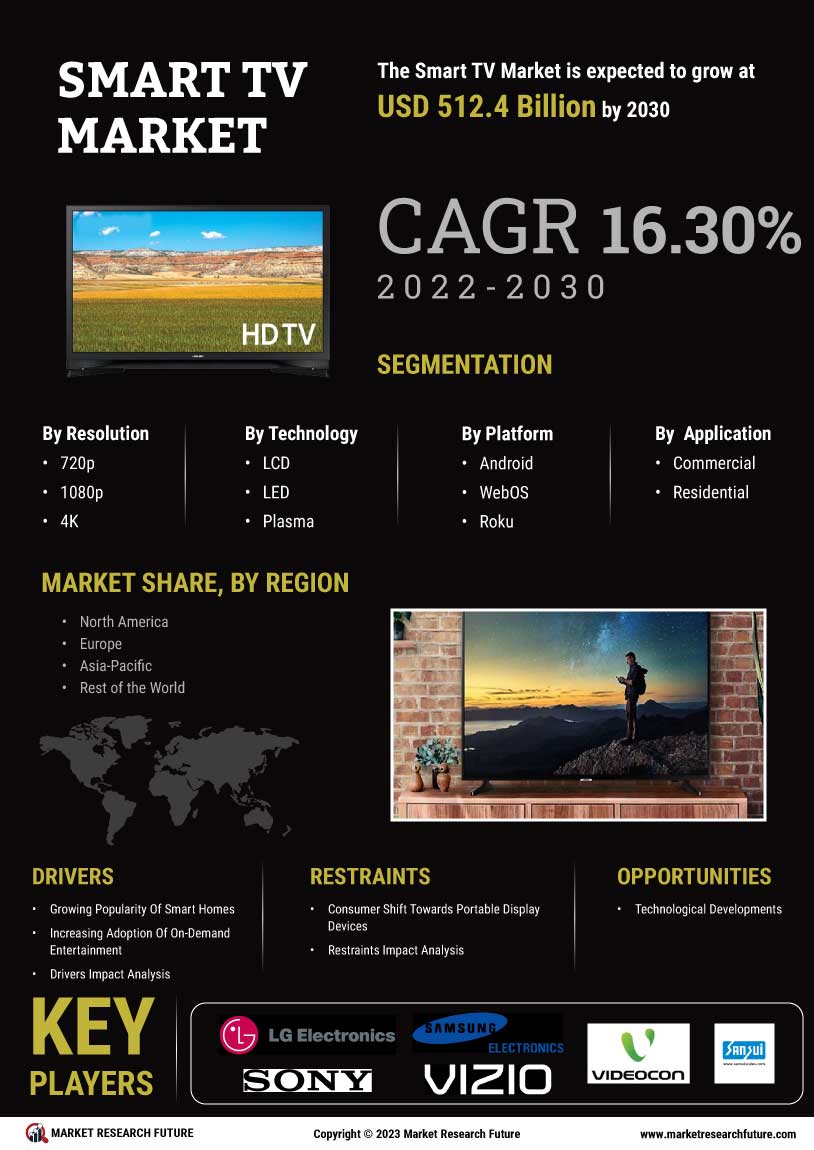
Smart TV Market Infographic
Purchase Options

Smart TV Market Summary

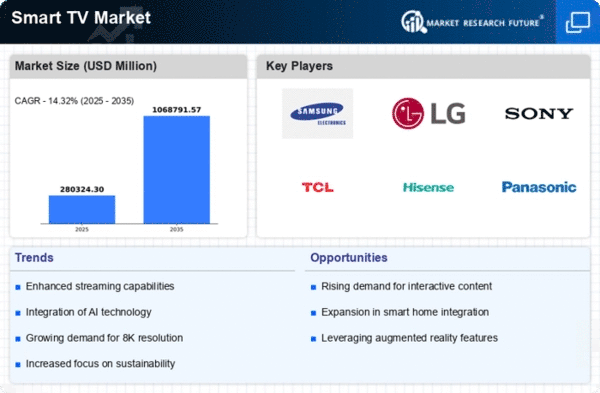
As per MRFR analysis, the Smart TV Market Size was estimated at 245210.2 USD Million in 2024. The Smart TV industry is projected to grow from 280324.89 USD Million in 2025 to 1068791.57 USD Million by 2035, exhibiting a compound annual growth rate (CAGR) of 14.32 during the forecast period 2025 - 2035.

Key Market Trends & Highlights

The Smart TV market is experiencing robust growth driven by technological advancements and evolving consumer preferences.

  • The integration of streaming services continues to reshape viewing habits in North America, the largest market for Smart TVs.
  • Enhanced user interaction features are becoming increasingly important, particularly in the Asia-Pacific region, which is the fastest-growing market.
  • The focus on home entertainment is driving demand for larger screen sizes, with the 56 to 75 inches segment witnessing rapid growth.
  • Rising demand for smart home devices and increased consumer awareness of smart features are key drivers propelling the Smart TV market forward.

Market Size & Forecast

2024 Market Size 245210.2 (USD Million)
2035 Market Size 1068791.57 (USD Million)
CAGR (2025 - 2035) 14.32%

Major Players

Samsung Electronics (KR), LG Electronics (KR), Sony Corporation (JP), TCL Technology (CN), Hisense (CN), Panasonic Corporation (JP), Philips (NL), Sharp Corporation (JP), Vizio (US)

Our Impact
Enabled $4.3B Revenue Impact for Fortune 500 and Leading Multinationals
Partnering with 2000+ Global Organizations Each Year
30K+ Citations by Top-Tier Firms in the Industry

Smart TV Market Trends

The television market share is influenced by technological advancements and changing consumer preferences. As households increasingly seek integrated entertainment solutions, the demand for smart tv hdtv continues to rise. These devices not only provide access to traditional broadcasting but also facilitate streaming services, gaming, and internet browsing, enhancing the overall viewing experience. Furthermore, the integration of artificial intelligence and voice recognition features is reshaping user interactions, making these devices more intuitive and user-friendly.

In addition to technological innovations, the market share tv is influenced by the growing trend of content consumption. Consumers are gravitating towards platforms that offer personalized viewing experiences, leading manufacturers to focus on enhancing user interfaces and content accessibility. This shift suggests that companies must remain agile and responsive to evolving market demands. As the landscape continues to develop, the Smart TV Market is poised for further growth, with potential opportunities emerging in areas such as augmented reality and interactive content, which could redefine how audiences engage with media.

Integration of Streaming Services

The Smart TV Market is witnessing a notable trend towards the integration of various streaming platforms. Consumers increasingly prefer devices that offer seamless access to multiple content providers, allowing for a more convenient viewing experience. This trend also impacts smart tv market share globally. This trend indicates a shift in how content is consumed, with traditional cable subscriptions declining in favor of on-demand services.

Enhanced User Interaction

Artificial intelligence is playing a pivotal role in transforming the Smart TV Market. Manufacturers are incorporating AI-driven features that personalize content recommendations and improve user interactions, influencing rate tv brands among consumers. Manufacturers are incorporating AI-driven features that personalize content recommendations and improve user interactions. This enhancement suggests a growing emphasis on creating intuitive interfaces that cater to individual preferences, thereby increasing user satisfaction.

Focus on Gaming Capabilities

The big tv screen sizes trend is growing as consumers seek immersive viewing experiences. Manufacturers are developing televisions that support high-performance gaming experiences, bridging the gap between smart tv vs hdtv functionalities. As gaming becomes a mainstream form of entertainment, manufacturers are developing televisions that support high-performance gaming experiences. This trend indicates a potential shift in consumer expectations, as users seek devices that can accommodate both traditional viewing and interactive gaming.

Smart TV Market Drivers

Market Growth Projections

The Global Smart TV Market Industry is poised for remarkable growth, with projections indicating a market size of 245.2 USD Billion in 2024 and an astonishing 1061.4 USD Billion by 2035. This trajectory suggests a robust compound annual growth rate (CAGR) of 14.25% from 2025 to 2035. The anticipated growth is driven by various factors, including technological advancements, increasing consumer demand for interactive content, and the integration of smart home technologies. As the market evolves, it is likely to witness innovations that further enhance user experiences and expand the functionalities of Smart TVs, solidifying their position in the entertainment landscape.

Rising Demand for Streaming Services

The Global Smart TV Market Industry is experiencing a surge in demand for streaming services, driven by the increasing popularity of platforms such as Netflix, Hulu, and Amazon Prime Video. As consumers seek high-quality content and convenience, Smart TVs equipped with advanced streaming capabilities are becoming essential. In 2024, the market is projected to reach 245.2 USD Billion, reflecting a shift in viewing habits. This trend indicates that consumers prefer on-demand content over traditional cable subscriptions, leading to a significant increase in Smart TV Market sales. The integration of user-friendly interfaces and smart features further enhances the appeal of these devices.

Integration of Smart Home Technologies

The integration of Smart home technologies is significantly influencing the Global Smart TV Market Industry. As households increasingly adopt smart devices, Smart TVs serve as central hubs for controlling various home automation systems. This interconnectedness enhances user convenience and promotes the adoption of Smart TVs. The growing trend of voice-activated assistants and IoT connectivity further solidifies the role of Smart TVs in modern homes. With the market projected to grow at a CAGR of 14.25% from 2025 to 2035, the synergy between Smart TVs and other smart devices is likely to drive substantial growth, as consumers seek seamless integration and enhanced functionalities.

Expansion of Global Internet Connectivity

The expansion of global internet connectivity is a crucial driver of the Global Smart TV Market Industry. As internet access becomes more widespread, particularly in developing regions, the potential customer base for Smart TVs is expanding. Improved broadband infrastructure and the proliferation of affordable internet services are enabling more households to access streaming content and online services. This trend is likely to contribute to the overall growth of the Smart TV Market, as consumers in these regions increasingly adopt Smart TVs to take advantage of available online content. The combination of enhanced connectivity and growing consumer awareness is expected to propel market growth.

Technological Advancements in Display Quality

Technological advancements in display quality are a pivotal driver of the Global Smart TV Market Industry. Innovations such as 4K and 8K resolution, OLED, and QLED technologies are enhancing the viewing experience, making Smart TVs more appealing to consumers. As these technologies become more affordable, a broader audience is likely to adopt Smart TVs. The market's growth trajectory suggests that by 2035, it could reach 1061.4 USD Billion, indicating a robust demand for high-definition viewing experiences. Enhanced picture quality not only attracts consumers but also encourages content providers to produce more high-resolution content, creating a positive feedback loop.

Increasing Consumer Preference for Interactive Content

Increasing consumer preference for interactive content is reshaping the Global Smart TV Market Industry. Viewers are gravitating towards content that allows for engagement, such as gaming, live streaming, and interactive applications. This shift is prompting manufacturers to enhance Smart TV Market features, including gaming capabilities and interactive interfaces. As a result, Smart TVs are becoming more than just passive viewing devices; they are evolving into platforms for immersive experiences. The anticipated growth in the market underscores the importance of catering to this demand, as consumers seek devices that offer diverse entertainment options and interactive functionalities.

Market Segment Insights

By Display Technology: Light Emitting Diode (Largest) vs. Organic Light Emitting Diode (Fastest-Growing)

In the Smart TV market, Light Emitting Diode (LED) technology holds the largest market share, thanks to its widespread adoption and affordability. Following closely, Organic Light Emitting Diode (OLED) is rapidly gaining traction due to its superior picture quality and energy efficiency. Liquid Crystal Display (LCD) remains a stable player, while Quantum Dot Display (QLED) appeals to premium segments, blending enhanced color accuracy with LED technology, albeit with a smaller market share overall.

Technology: LED (Dominant) vs. OLED (Emerging)

LED technology has become synonymous with Smart TVs, offering robust performance and a cost-effective solution for manufacturers and consumers alike. It provides impressive brightness, longevity, and energy efficiency, making it the dominant choice. In contrast, OLED technology is emerging as a strong competitor; it excels in delivering deep blacks and vibrant colors through its self-emissive pixels. While still more expensive than LED, OLED televisions are quickly gaining popularity among consumers looking for top-tier visual experiences, driving manufacturers to invest heavily in this segment.

By Screen Size: 32 to 55 inches (Largest) vs. 56 to 75 inches (Fastest-Growing)

In the Smart TV Market, The segment '32 to 55 inches' dominates the smart television sizes category. This size category appeals primarily to a wide range of households, balancing screen real estate with affordability, making it a go-to choice for many. Conversely, The '56 to 75 inches' segment is emerging rapidly, aligning with big tv screen sizes trends. This shift signifies a trend towards larger screen sizes that is reshaping consumer preferences.

32 to 55 inches (Dominant) vs. 56 to 75 inches (Emerging)

The 32 to 55 inches segment dominates the Smart TV Market, appealing to a wide audience due to its balance of size and price. It is ideal for consumers who enjoy standard TV viewing and gaming in moderate-sized areas. Conversely, the 56 to 75 inches segment is emerging rapidly, reflecting a shift towards larger screens for immersive viewing experiences, especially in homes where dedicated spaces for entertainment are available. The increased consumption of high-definition content and advancements in display technology are major drivers boosting the popularity of this segment.

By Resolution: Ultra HD (Largest) vs. 4K (Fastest-Growing)

In the Smart TV Market, the resolution segment is highly competitive, with Full HD, Ultra HD, 4K, and 8K all vying for consumer preference. Ultra HD holds the largest share, while 4K is quickly gaining traction. These resolutions are significant factors affecting the smart tv market share. Meanwhile, 4K technology is quickly gaining traction among consumers seeking superior picture quality, resulting in rapid growth and increasing adoption rates. As consumers upgrade their viewing experiences, Ultra HD remains the preferred choice for mainstream buyers.

Resolution: Ultra HD (Dominant) vs. 4K (Emerging)

Ultra HD resolution stands out as the dominant force in the Smart TV market, appealing to consumers through its superior clarity and depth of color, enhancing the overall viewing experience. With an established presence in households, Ultra HD TVs are widely recognized for their quality, making them a staple in modern entertainment setups. In contrast, 4K resolution, although still emerging, is rapidly gaining traction. Driven by the surge in 4K content offerings from streaming platforms, these TVs appeal to consumers eager for high-definition entertainment. The ongoing advancements in panel technology and affordability are also positioning 4K TVs as a compelling choice, increasingly seen as the future of home viewing.

By Smart Features: Voice Control (Largest) vs. Smart Home Integration (Fastest-Growing)

In the Smart TV market, key features such as Voice Control, Streaming Services, Internet Connectivity, and Smart Home Integration dominate the landscape. Voice Control leads due to its increased adoption, enhancing the tv market experience. Smart Home Integration is emerging as a key trend in the smart tv market. Streaming Services remain integral, with major platforms competing to attract subscribers, representing a significant portion of market share.

Voice Control (Dominant) vs. Smart Home Integration (Emerging)

Voice Control systems in Smart TVs represent a dominant force in the market, characterized by their ability to facilitate hands-free operation and ease of access to content. Major brands have invested heavily in refining AI-driven capabilities, leading to intuitive features that resonate well with tech-savvy consumers. On the other hand, Smart Home Integration is quickly gaining traction as consumers seek interconnected devices that enhance their lifestyle. This emerging segment focuses on seamless compatibility with various smart home ecosystems, enabling users to control their Smart TVs alongside other devices, reinforcing the convenience and efficiency of smart living. As the market evolves, the synergy between these two segments will likely define future consumer experiences.

By Price Range: Mid (Largest) vs. Premium (Fastest-Growing)

In the Smart TV Market, the distribution among price ranges showcases a clear preference for Mid-range models, which hold the largest market share due to their balance of price and features. Low-priced models appeal to budget-conscious consumers, while High-priced offerings cater to premium buyers looking for advanced technology and features. However, the rising demand for smart home integration has also increased competition within these segments, making them critical to market dynamics.

Mid (Dominant) vs. Premium (Emerging)

Mid-range Smart TVs are known for offering a diverse array of features at a competitive price point, making them the most popular choice among consumers. These models typically incorporate essential smart functionalities alongside good display quality, which satisfies the average buyer. On the other hand, Premium Smart TVs are rapidly emerging as a significant market force, driven by enhanced features such as 8K resolution, advanced display technologies, and superior sound systems. The increasing consumer preference for immersive viewing experiences positions Premium models as leaders in innovation, appealing to tech-savvy buyers who are willing to invest in high-quality home entertainment.

Get more detailed insights about Smart TV Market

Regional Insights

North America : Tech-Driven Entertainment Hub

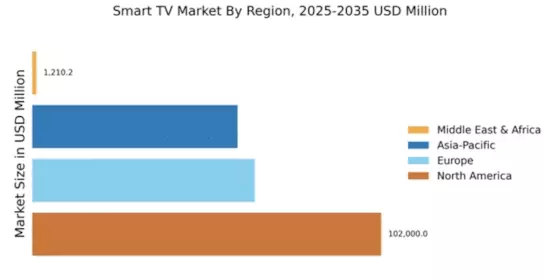
The North American smart TV market is projected to reach $60,000M by December 2025, driven by increasing consumer demand for high-definition content and smart home integration. Regulatory support for digital innovation and broadband expansion further fuels growth. The region's focus on advanced technologies, such as 4K and OLED displays, enhances user experience, making smart TVs a staple in households. The us tv market size is projected to reach $60,000M by December 2025, driven by high-definition content and smart home integration. Major players like Samsung, LG, and Vizio dominate the Smart TV Market, influencing market share of television. The competitive environment is characterized by rapid technological advancements and aggressive marketing strategies. Partnerships with streaming services like Roku and Netflix are also pivotal, ensuring a diverse content offering that attracts consumers, solidifying North America's position as a key player in The Smart TV.

Europe : Emerging Smart TV Hub

Europe's smart TV market is expected to reach $50,000M by December 2025, driven by a growing preference for smart home devices and enhanced viewing experiences. Europe’s market benefits from strong regulatory frameworks promoting digital content accessibility. Key players like Sony, LG, and Philips are boosting the smart tv market with innovative products. The region benefits from strong regulatory frameworks promoting digital content accessibility and consumer protection. Countries like Germany, the UK, and France are leading the charge, with increasing investments in broadband infrastructure and smart technology adoption. The competitive landscape is marked by innovation, with manufacturers focusing on features like AI integration and eco-friendly designs. The presence of major tech expos and consumer electronics shows in Europe further stimulates market growth, showcasing the latest advancements in smart TV technology. "The European market is witnessing a significant shift towards smart technologies, enhancing consumer engagement and satisfaction," European Commission report.

Asia-Pacific : Rapid Growth in Smart TVs

The Asia-Pacific region is experiencing rapid growth in the Smart TV market, with a projected size of 60000.0 units by 2025. This growth is driven by increasing urbanization, rising disposable incomes, and a growing appetite for digital content. Government initiatives promoting digital literacy and technology adoption are also playing a crucial role in expanding the market, making smart TVs more accessible to a broader audience. China and Japan are leading the charge in this region, with companies like TCL and Hisense making significant strides in market penetration. The competitive landscape is vibrant, with numerous local and international players vying for market share. The focus on affordable yet feature-rich models is attracting a diverse consumer base, ensuring sustained growth in the Smart TV sector.

Middle East and Africa : Emerging Market Potential

The Middle East and Africa (MEA) region is gradually emerging in the Smart TV market, with a market size of 1210.2 units projected for 2025. The growth is primarily driven by increasing internet penetration and a rising middle class that is eager to adopt new technologies. Regulatory frameworks aimed at enhancing digital infrastructure are also contributing to the market's expansion, making smart TVs more accessible to consumers. Countries like South Africa and the UAE are leading the way in Smart TV adoption, with a growing presence of international brands. The competitive landscape is characterized by a mix of global players and local manufacturers, all striving to meet the diverse needs of consumers. The focus on affordability and value-added features is crucial for capturing market share in this region, which is still in its nascent stages of Smart TV adoption.

Smart TV Market Regional Image

Key Players and Competitive Insights

The Smart TV Market is currently characterized by intense competition and rapid technological advancements, driven by consumer demand for enhanced viewing experiences and smart home integration. Major players such as Samsung Electronics (KR), LG Electronics (KR), and TCL Technology (CN) are at the forefront, each adopting distinct strategies to solidify their market positions. Samsung focuses on innovation through its QLED technology and expanding its ecosystem of smart devices, while LG emphasizes OLED technology and sustainability initiatives. TCL, on the other hand, leverages cost-effective production and aggressive pricing strategies to capture market share, particularly in emerging economies. Collectively, these strategies contribute to a dynamic competitive environment where differentiation is increasingly based on technology and user experience rather than mere pricing. Key business tactics within the Smart TV Market include localizing manufacturing and optimizing supply chains to enhance efficiency and reduce costs. The market structure appears moderately fragmented, with several key players holding substantial market shares while also facing competition from numerous smaller brands. This fragmentation allows for a diverse range of products and price points, catering to various consumer preferences and budgets. The collective influence of these major companies shapes market trends, as they continuously innovate and adapt to changing consumer demands. In November 2025, LG Electronics (KR) announced a strategic partnership with a leading AI firm to enhance its smart TV capabilities, integrating advanced AI features for personalized content recommendations. This move is likely to strengthen LG's position in the market by offering consumers a more tailored viewing experience, thereby increasing customer loyalty and engagement. The integration of AI into smart TVs is becoming a critical differentiator, and LG's proactive approach may set a new standard in the industry. In October 2025, Samsung Electronics (KR) unveiled its latest line of smart TVs featuring enhanced gaming capabilities and cloud gaming services. This strategic launch aligns with the growing trend of gaming on smart TVs, appealing to a younger demographic and potentially expanding Samsung's market reach. By focusing on gaming, Samsung not only diversifies its product offerings but also positions itself as a leader in a rapidly evolving segment of the market. In September 2025, TCL Technology (CN) expanded its manufacturing operations in Southeast Asia, aiming to increase production capacity and reduce lead times. This strategic move is indicative of TCL's commitment to meeting rising global demand while maintaining competitive pricing. By localizing production, TCL can respond more swiftly to market changes and consumer preferences, enhancing its competitive edge in the Smart TV Market. As of December 2025, current competitive trends in the Smart TV Market are heavily influenced by digitalization, sustainability, and the integration of AI technologies. Strategic alliances among key players are shaping the landscape, fostering innovation and collaboration. Looking ahead, competitive differentiation is expected to evolve, with a pronounced shift from price-based competition to a focus on technological innovation, user experience, and supply chain reliability. Companies that can effectively leverage these trends are likely to secure a more robust position in the market.

Key Companies in the Smart TV Market include

Industry Developments

  • Q2 2024: Samsung launches new AI-powered Neo QLED 8K Smart TVs globally Samsung announced the global launch of its 2024 Neo QLED 8K Smart TV Market lineup, featuring advanced AI upscaling and enhanced smart home integration, marking a major product refresh in its premium segment.
  • Q2 2024: Roku and Walmart announce strategic partnership to integrate commerce into Smart TVs Roku and Walmart revealed a partnership to enable direct shopping experiences on Roku-powered Smart TVs, allowing viewers to purchase products featured in streaming content using their remote.
  • Q2 2024: Vizio acquired by Walmart for $2.3 billion to expand Smart TV Market and streaming footprint Walmart completed the acquisition of Vizio, a leading Smart TV Market manufacturer, aiming to strengthen its presence in the connected TV and streaming advertising market.
  • Q3 2024: LG Electronics opens new Smart TV Market manufacturing facility in Mexico LG Electronics inaugurated a new state-of-the-art Smart TV Market manufacturing plant in Mexico to boost production capacity for North and South American markets.
  • Q3 2024: TCL signs multi-year content partnership with Disney+ for Smart TV Market integration TCL announced a multi-year agreement with Disney+ to pre-install the streaming app and offer exclusive content bundles on its Smart TVs sold in Europe and North America.
  • Q3 2024: Sony unveils Bravia XR Master Series Smart TVs with Google TV platform Sony launched its 2024 Bravia XR Master Series Smart TVs, featuring the latest Google TV platform and advanced cognitive processor technology for improved picture and sound quality.
  • Q4 2024: Samsung and Google announce partnership to bring Matter-certified smart home features to Smart TVs Samsung and Google entered a partnership to integrate Matter-certified smart home interoperability into Samsung Smart TVs, enabling seamless control of connected devices.
  • Q4 2024: Vizio shareholders approve acquisition by Walmart Vizio shareholders voted to approve the acquisition by Walmart, clearing the final regulatory hurdle for the transaction to close.
  • Q1 2025: Hisense launches new ULED X Smart TV Market series with Mini-LED technology Hisense introduced its ULED X Smart TV Market series featuring Mini-LED backlighting and advanced gaming features, targeting premium consumers in North America and Europe.
  • Q1 2025: LG Electronics appoints new head of Smart TV Market division LG Electronics announced the appointment of Dr. Min-ho Kim as the new head of its Smart TV Market division, signaling a strategic focus on AI and content partnerships.
  • Q2 2025: Amazon launches Fire TV Omni QLED Series in Europe Amazon expanded its Fire TV Omni QLED Series to European markets, offering built-in Alexa voice control and enhanced smart home features.
  • Q2 2025: Google announces new Chromecast integration for third-party Smart TV Market brands Google revealed expanded Chromecast integration for select third-party Smart TV Market brands, enabling seamless casting and voice control across more devices.

Future Outlook

Smart TV Market Future Outlook

The Smart TV Market is projected to grow at a 14.32% CAGR from 2025 to 2035, driven by advancements in display technology, increased content availability, and rising consumer demand for smart home integration.

New opportunities lie in:

  • Development of AI-driven content recommendation systems Expansion of subscription-based streaming services Integration of smart home ecosystems with Smart TVs

By 2035, the Smart TV Market is expected to be a dominant force in global consumer electronics.

Market Segmentation

Smart TV Market Resolution Outlook

  • Full HD
  • Ultra HD
  • 4K
  • 8K

Smart TV Market Price Range Outlook

  • Low
  • Mid
  • High
  • Premium

Smart TV Market Screen Size Outlook

  • Less than 32 inches
  • 32 to 55 inches
  • 56 to 75 inches
  • Above 75 inches

Smart TV Market Smart Features Outlook

  • Voice Control
  • Streaming Services
  • Internet Connectivity
  • Smart Home Integration

Smart TV Market Display Technology Outlook

  • Light Emitting Diode
  • Organic Light Emitting Diode
  • Liquid Crystal Display
  • Quantum Dot Display

Report Scope

MARKET SIZE 2024 245210.2(USD Million)
MARKET SIZE 2025 280324.89(USD Million)
MARKET SIZE 2035 1068791.57(USD Million)
COMPOUND ANNUAL GROWTH RATE (CAGR) 14.32% (2025 - 2035)
REPORT COVERAGE Revenue Forecast, Competitive Landscape, Growth Factors, and Trends
BASE YEAR 2024
Market Forecast Period 2025 - 2035
Historical Data 2019 - 2024
Market Forecast Units USD Million
Key Companies Profiled Samsung Electronics (KR), LG Electronics (KR), Sony Corporation (JP), TCL Technology (CN), Hisense (CN), Panasonic Corporation (JP), Philips (NL), Sharp Corporation (JP), Vizio (US)
Segments Covered Display Technology, Screen Size, Resolution, Smart Features, Price Range
Key Market Opportunities Integration of advanced artificial intelligence features enhances user experience in the Smart TV Market.
Key Market Dynamics Rising consumer demand for advanced features drives intense competition among Smart TV manufacturers and technology providers.
Countries Covered North America, Europe, APAC, South America, MEA

Market Highlights

Author
Aarti Dhapte
Team Lead - Research

She holds an experience of about 6+ years in Market Research and Business Consulting, working under the spectrum of Information Communication Technology, Telecommunications and Semiconductor domains. Aarti conceptualizes and implements a scalable business strategy and provides strategic leadership to the clients. Her expertise lies in market estimation, competitive intelligence, pipeline analysis, customer assessment, etc.

Leave a Comment

FAQs

How much is the Smart TV market?

The Smart TV Market size was valued at USD 245210.20 billion in 2024.

What is the growth rate of the Smart TV market?

The global market is projected to grow at a CAGR of 14.32% during the forecast period, 2025 to 2035.

Which region held the largest market share in the Smart TV market?

Asia Pacific had the largest share in the global market

Who are the key players in the Smart TV market?

The key players in the market are Medtronic Inc (Ireland), Abbott Laboratories (US), Stryker Corporation (US), DePuy Synthes (US), and B. Braun Melsungen AG (Germany).

Which Resolution led the Smart TV market?

The hull HD category dominated the market in 2023.

Which screen type had the largest market share in the Smart TV market?

The Flat had the largest share in the global market.

Download Free Sample

Kindly complete the form below to receive a free sample of this Report

Compare Licence

×
Features License Type
Single User Multiuser License Enterprise User
Price $4,950 $5,950 $7,250
Maximum User Access Limit 1 User Upto 10 Users Unrestricted Access Throughout the Organization
Free Customization
Direct Access to Analyst
Deliverable Format
Platform Access
Discount on Next Purchase 10% 15% 15%
Printable Versions