×
Request Free Sample ×

Kindly complete the form below to receive a free sample of this Report

* Please use a valid business email

Leading companies partner with us for data-driven Insights

clients tt-cursor
Hero Background
English
Chinese
French
Japanese
Korean
German
Spanish

Wearable Payment Device Market Share

ID: MRFR/SEM/9142-HCR
120 Pages
Ankit Gupta
October 2025

Wearable Payment Device Market Size, Share and Research Report By Type (Smartwatches, Fitness Trackers, Payment Wristbands), By Technology\t(Barcodes, Contactless Point of Sale (POS) Terminals, Near Fields Communication (NFC), Quick Response (QR) Codes, Radio Frequency Identification (RFID), By Application (Fitness, Healthcare, Retail, Transportation, Bar & Restaurants, Entertainment Centers, Others), And By Region (North America, Europe, Asia-Pacific, And Rest Of The World) – Industry Forecast Till 2035

Share:
Download PDF ×

We do not share your information with anyone. However, we may send you emails based on your report interest from time to time. You may contact us at any time to opt-out.

Wearable Payment Device Market Infographic
Purchase Options

Market Share

Wearable Payment Device Market Share Analysis

In the quickly developing scene of the Wearable Payment Device Market, organizations carry out an assortment of market share positioning procedures to gain an upper hand and flourish in this unique industry. A basic methodology is separation, where organizations center around offering exceptional highlights and plans in their wearable payment devices. This might include developments in structure factors, consolidating progressed biometric authentication, or coordinating extra functionalities past basic payment capacities. By offering particular benefit recommendations, organizations aim to draw in buyers searching for customized and state of the art wearable payment arrangements. Estimating methodology is a basic component in market share positioning inside the Wearable Payment Device Market. Organizations decisively set their costs to take special care of various customer sections. Some might take on a superior valuing methodology, underlining the high-quality materials, plan aesthetics, and high-level elements of their wearable payment devices, focusing on consumers ready to pay a premium for a top-notch insight.

Alternately, others might settle on an expense ingenuity technique, offering more reasonable choices without settling for less on fundamental functionalities. Finding some kind of harmony among cost and percieved value is fundamental for effective market positioning. Interest in innovative work is imperative for maintaining a momentous market share. Organizations assign assets to enhance and remain in front of mechanical headways constantly. Routinely refreshing wearable payment device contributions with the most recent security highlights, network choices, and configuration patterns guarantees that organizations remain at the cutting edge of the business, drawing in purchasers looking for the most recent and secure payment arrangements.

Compelling marketing and communication systems assume an essential part in market share situating in the Wearable Payment Device Market. Organizations take part in designated marketing campaigns to highlight the benefits of their devices, underscoring elements like security, convenience, and combination with famous payment platforms. Establishing areas of strength for an and web-based entertainment presence, teaming up with powerhouses, and taking part in industry occasions add to building brand validity and drawing in a more extensive buyer base.

Author
Ankit Gupta
Senior Research Analyst

Ankit Gupta is an analyst in market research industry in ICT and SEMI industry. With post-graduation in "Telecom and Marketing Management" and graduation in "Electronics and Telecommunication" vertical he is well versed with recent development in ICT industry as a whole. Having worked on more than 150+ reports including consultation for fortune 500 companies such as Microsoft and Rio Tinto in identifying solutions with respect to business problems his opinions are inclined towards mixture of technical and managerial aspects.

Leave a Comment

FAQs

How much is the Wearable Payment Device market?

The Wearable Payment Device market size was valued at USD 71.49 billion in 2024.

What is the growth rate of the Wearable Payment Device market?

The market is projected to grow at a CAGR of 19.01% during the forecast period, 2025 to 2035.

Which region held the largest market share in the Wearable Payment Devices market?

North America had the largest share of the Wearable Payment Device market.

Who are the key players in the Wearable Payment Device market?

The key players in the market are Apple Inc, Barclays, Fitbit Inc, Google Inc, Jawbone, Mastercard, PayPal Inc, Samsung Electronics Co. Ltd, and Visa Inc.

Which Type led the market of Wearable Payment Devices?

The Smartwatches category dominated the market in 2022.

Market Summary

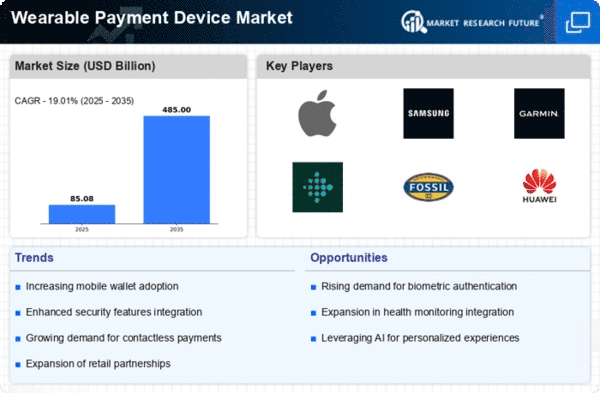
As per MRFR analysis, the Wearable Payment Device Market Size was estimated at 71.49 USD Billion in 2024. The Wearable Payment Device industry is projected to grow from 85.08 USD Billion in 2025 to 485.0 USD Billion by 2035, exhibiting a compound annual growth rate (CAGR) of 19.01 during the forecast period 2025 - 2035.

Key Market Trends & Highlights

The Wearable Payment Device Market is experiencing robust growth driven by technological advancements and evolving consumer preferences.

  • The integration of health monitoring features into wearable payment devices is becoming increasingly prevalent, appealing to health-conscious consumers.
  • Enhanced security features are being prioritized to address consumer concerns regarding data protection and fraud.
  • Retail partnerships are expanding, particularly in North America, to facilitate seamless payment experiences for consumers.
  • Technological advancements and rising consumer demand for convenience are key drivers propelling the market forward, especially in the retail and transportation segments.

Market Size & Forecast

2024 Market Size 71.49 (USD Billion)
2035 Market Size 485.0 (USD Billion)
CAGR (2025 - 2035) 19.01%
Largest Regional Market Share in 2024 North America

Major Players

<p>Apple (US), Samsung (KR), Garmin (US), Fitbit (US), Fossil (US), Huawei (CN), Xiaomi (CN), Nokia (FI), Sony (JP)</p>

Market Trends

The Wearable Payment Device Market is currently experiencing a notable transformation, driven by advancements in technology and changing consumer preferences. As individuals increasingly seek convenience and efficiency in their daily transactions, wearable devices such as smartwatches and fitness bands are becoming more prevalent. These devices not only facilitate seamless payments but also integrate various functionalities, enhancing user experience. The growing acceptance of contactless payments further propels the adoption of these devices, as consumers appreciate the speed and ease of transactions without the need for physical cards. Moreover, the market appears to be influenced by a rising emphasis on security and privacy. Manufacturers are investing in robust encryption technologies and biometric authentication methods to ensure that users feel safe while making transactions. This focus on security, combined with the convenience offered by wearable payment devices, suggests a promising future for the market. As more retailers and service providers embrace this technology, the potential for growth seems substantial, indicating a shift in how consumers engage with financial transactions in their everyday lives.

Integration with Health Monitoring

Wearable payment devices are increasingly incorporating health monitoring features, allowing users to track fitness metrics alongside making payments. This trend reflects a growing consumer interest in holistic health management, where financial transactions and health data coexist within a single device.

Enhanced Security Features

The emphasis on security within the Wearable Payment Device Market is becoming more pronounced. Manufacturers are implementing advanced security measures, such as biometric authentication and encryption, to protect user data and enhance trust in digital transactions.

Expansion of Retail Partnerships

There is a noticeable trend towards expanding partnerships between wearable payment device manufacturers and retailers. This collaboration aims to create a more integrated shopping experience, enabling consumers to utilize their devices for payments across a wider range of retail environments.

Wearable Payment Device Market Market Drivers

Rising Consumer Demand

Consumer demand for wearable payment devices is on the rise, driven by the increasing preference for convenience and efficiency in transactions. The Global Wearable Payment Device Market Industry is projected to reach 71.5 USD Billion in 2024, reflecting a growing acceptance of these devices among consumers. Factors such as the proliferation of e-commerce and the need for contactless payment options contribute to this trend. As more consumers seek quick and secure payment methods, the market is likely to expand, with wearable devices becoming an integral part of everyday transactions.

Market Growth Projections

The Global Wearable Payment Device Market Industry is projected to experience substantial growth, with estimates indicating a market size of 484.9 USD Billion by 2035. This growth trajectory suggests a compound annual growth rate (CAGR) of 19.01% from 2025 to 2035. Such projections underscore the increasing adoption of wearable payment devices across various demographics and regions. As technology continues to evolve and consumer preferences shift towards more integrated payment solutions, the market is poised for significant expansion, driven by both innovation and changing consumer behaviors.

Technological Advancements

The Global Wearable Payment Device Market Industry is experiencing rapid technological advancements that enhance functionality and user experience. Innovations such as biometric authentication, contactless payment capabilities, and integration with mobile applications are driving consumer adoption. For instance, devices equipped with NFC technology allow seamless transactions, making payments more convenient. As technology evolves, features like health monitoring and fitness tracking are increasingly integrated into payment devices, appealing to health-conscious consumers. This convergence of technology and payment solutions is likely to attract a broader audience, further propelling market growth.

Increased Focus on Security

Security concerns are paramount in the Global Wearable Payment Device Market Industry, prompting manufacturers to enhance security features. The integration of advanced encryption technologies and biometric authentication methods, such as fingerprint and facial recognition, is becoming standard practice. These measures not only protect user data but also instill confidence among consumers regarding the safety of their transactions. As security remains a critical factor in consumer decision-making, the emphasis on secure payment solutions is expected to drive market growth, attracting users who prioritize safety in their financial dealings.

Expansion of Retail Partnerships

The expansion of retail partnerships plays a crucial role in the Global Wearable Payment Device Market Industry. Retailers are increasingly adopting wearable payment solutions to enhance customer experience and streamline transactions. Collaborations between device manufacturers and retail chains facilitate the integration of wearable payment options at points of sale. This trend is likely to increase the visibility and accessibility of wearable payment devices, encouraging more consumers to adopt them. As retailers recognize the benefits of offering diverse payment methods, the market is expected to witness significant growth, driven by these strategic partnerships.

Growing Health and Fitness Trends

The Global Wearable Payment Device Market Industry is benefiting from the growing health and fitness trends among consumers. Wearable devices that combine payment functionality with health monitoring features are gaining traction, appealing to fitness enthusiasts. As individuals increasingly prioritize health and wellness, the demand for devices that track fitness metrics while facilitating payments is likely to rise. This dual functionality not only enhances user experience but also positions wearable payment devices as essential tools for health-conscious consumers. The convergence of health and payment technology is expected to further stimulate market growth.

Market Segment Insights

By Application: Retail (Largest) vs. Transportation (Fastest-Growing)

<p>The Wearable Payment Device Market is significantly influenced by diverse applications, notably retail, transportation, healthcare, entertainment, and fitness. In terms of market share, retail takes the lead, driven by increasing consumer preferences for convenient payment options in store environments. Following retail, sectors like healthcare and entertainment are also witnessing substantial participation, showcasing the versatility of wearable payment devices across various consumer activities. Growth trends indicate that while retail remains a dominant force, the transportation sector is expanding rapidly, thanks to the growing adoption of contactless payment solutions in public transit systems. The trend towards smart cities and technological advancements in payment systems supports this growth, making transportation the fastest-growing segment. Furthermore, the healthcare segment is gradually increasing its footprint, integrating payment functionalities within health-monitoring wearables, indicating broadening usage in various fields.</p>

<p>Retail (Dominant) vs. Transportation (Emerging)</p>

<p>The retail application of wearable payment devices stands as a robust pillar in the market, characterized by seamless payment transactions that ensure convenience for consumers. Retailers are integrating these devices to enhance customer experience, streamline checkout processes, and encourage cashless transactions. The attractiveness of wearables lies in their easy accessibility and innovative features, which cater to the purchasing habits of modern shoppers. On the contrary, the transportation segment is emerging as a promising area, driven by increasing investments in smart infrastructure and the proliferation of contactless payment systems in public transportation. Wearable payment solutions are being adopted for ease of fare payment, thereby enhancing efficiency and reducing congestion. As cities worldwide move towards digitization, transportation is set to become a more vital player in the wearable payment landscape.</p>

By End Use: Consumers (Largest) vs. Businesses (Fastest-Growing)

<p>The wearable payment device market sees significant share distribution among four primary end-use segments: Consumers, Businesses, Financial Institutions, and Healthcare Providers. Currently, the largest share is held by consumers, driven by the increasing adoption of smartwatches and fitness bands that facilitate seamless transactions. Conversely, businesses are emerging as a rapidly growing segment, leveraging wearable payment technology to enhance customer experiences and streamline payment processes.</p>

<p>Consumers (Dominant) vs. Businesses (Emerging)</p>

<p>Consumers represent a dominant force in the wearable payment device market, having embraced the convenience of making payments through wearable devices like smartwatches and fitness trackers. Their preference for these devices is fueled by the increasing integration of technology into everyday life, offering seamless and quick payment options without the need for cash or cards. Meanwhile, businesses are emerging as a key segment, adopting wearable payment solutions to improve operational efficiency and enhance customer service. This shift towards mobile and wearable technology is transforming traditional business transactions, making them more interactive and engaging, and driving increased market acceptance and innovation.</p>

By Technology: NFC (Largest) vs. Bluetooth (Fastest-Growing)

<p>In the Wearable Payment Device Market, Near Field Communication (NFC) technology commands the largest market share, serving as the most widely adopted method for facilitating transactions. It allows for quick and secure payments, leading to its dominance among tech-savvy consumers who prioritize efficiency and security in their payment methods. Conversely, Bluetooth technology, while historically slower in adoption for payment purposes, is witnessing rapid growth as advancements in connectivity improve its reliability and security, making it an appealing option in the wearables segment.</p>

<p>Technology: NFC (Dominant) vs. Bluetooth (Emerging)</p>

<p>NFC technology stands as the dominant force within the wearable payment device market, widely recognized for its ease of use and robust security protocols. It enables instant communication for transactions, making it a preferred choice for both consumers and manufacturers. Bluetooth, on the other hand, is emerging rapidly due to technological advancements that enhance its functionality and user experience. With its broader application potential beyond just payment, including features like connectivity with various devices, Bluetooth's growth is fueled by the increasing demand for versatile wearables that blend functionality with user-friendliness.</p>

By Device Type: Smartwatches (Largest) vs. Fitness Trackers (Fastest-Growing)

<p>The Wearable Payment Device Market is characterized by a diverse range of device types, with smartwatches holding the largest market share. Their multifunctionality, which merges fitness tracking with payment options, appeals to a broad consumer base. Fitness trackers, while having a smaller share, are rapidly gaining traction, especially among health-conscious consumers seeking budget-friendly options that emphasize fitness monitoring alongside payment capabilities. As consumer preferences shift towards integrated technology, these two segments play pivotal roles in the market.</p>

<p>Wearable Technology: Smartwatches (Dominant) vs. Fitness Trackers (Emerging)</p>

<p>Smartwatches represent the dominant force in the wearables market due to their comprehensive capabilities, including notifications, health tracking, and payment functions, appealing to tech-savvy consumers. Meanwhile, fitness trackers are emerging as a preferred choice for users desiring straightforward, effective health monitoring combined with payment features. Their lightweight design and cost-effectiveness cater to those looking to enhance their lifestyle without the complexity of a smartwatch. While smartwatches lead in versatility and brand recognition, fitness trackers offer simpler functionality, making both segments essential in the growth of wearable payment devices.</p>

By Payment Method: Contactless Payment (Largest) vs. Mobile Wallets (Fastest-Growing)

<p>The wearable payment device market is increasingly dominated by contactless payment methods, which hold the largest share due to their convenience and ease of use. Mobile wallets are rapidly gaining traction, appealing to tech-savvy consumers who prefer solutions that integrate seamlessly with their smartphones. Cryptocurrency is emerging but still captures a smaller segment of the market, mainly attracting niche users interested in digital currencies. Growth trends indicate a substantial increase in the adoption of contactless payments, driven by consumer demand for speed and security in transactions. Mobile wallets are positioned as the fastest-growing segment, bolstered by the surge in mobile internet usage and a preference for cashless payments, particularly in urban areas. Cryptocurrency, while not leading, is attracting attention as businesses begin to accept it as a payment method nearby.</p>

<p>Contactless Payment: Dominant vs. Cryptocurrency: Emerging</p>

<p>Contactless payment methods have emerged as the dominant force within the wearable payment device market, owing to their ability to facilitate quick and secure transactions. This segment appeals to consumers who prioritize convenience, particularly during high-traffic periods, such as commuting or shopping. In contrast, cryptocurrency is viewed as an emerging payment method, appealing mainly to a niche audience that values decentralized financial solutions. While cryptocurrency adoption is growing, its volatility and limited acceptance can pose challenges. Nevertheless, both segments contribute significantly to the evolution of payment methods, with contactless payment leading in practical usability and cryptocurrency capturing interest for its innovative nature.</p>

Get more detailed insights about Wearable Payment Device Market Research Report - Forecast 2035

Regional Insights

North America : Market Leader in Innovation

North America continues to lead the wearable payment device market, holding a significant share of 36.0% as of 2024. The growth is driven by increasing consumer demand for contactless payment solutions, coupled with advancements in technology and a robust regulatory framework that supports digital transactions. The region's focus on innovation and integration of wearable technology into daily life further propels market expansion. The United States stands out as the primary market, with key players like Apple, Garmin, and Fitbit driving competition. The presence of established tech giants fosters a dynamic environment for innovation, while partnerships with financial institutions enhance the adoption of wearable payment solutions. As consumer preferences shift towards convenience and security, the competitive landscape is expected to evolve, solidifying North America's position as a market leader.

Europe : Emerging Market with Potential

Europe is witnessing a growing interest in wearable payment devices, with a market size of €20.0 million. The region benefits from a strong regulatory environment that encourages digital payment solutions, alongside increasing consumer awareness of contactless technology. Factors such as the rise of e-commerce and mobile payments are driving demand, making Europe a promising market for future growth in wearable payments. Leading countries like Germany, the UK, and France are at the forefront of this trend, with companies such as Samsung and Garmin actively participating in the market. The competitive landscape is characterized by a mix of established brands and emerging startups, fostering innovation. As the European market matures, the integration of wearable payment solutions into everyday life is expected to accelerate, supported by favorable regulations. "The European Commission is committed to enhancing digital payment solutions to ensure a secure and efficient payment ecosystem."

Asia-Pacific : Rapid Growth and Adoption

The Asia-Pacific region is rapidly emerging as a significant player in the wearable payment device market, with a market size of $12.0 million. The growth is fueled by increasing smartphone penetration, a tech-savvy population, and rising disposable incomes. Additionally, government initiatives promoting digital payments and financial inclusion are acting as catalysts for market expansion, making this region a focal point for innovation in wearable technology. Countries like China, Japan, and South Korea are leading the charge, with major players such as Huawei and Xiaomi capitalizing on the growing demand. The competitive landscape is vibrant, with both local and international brands vying for market share. As consumer preferences shift towards seamless payment experiences, the Asia-Pacific market is poised for substantial growth, driven by technological advancements and evolving consumer behaviors.

Middle East and Africa : Untapped Market Potential

The Middle East and Africa region, with a market size of $3.49 million, presents untapped potential for wearable payment devices. The growth is primarily driven by increasing smartphone adoption and a young, tech-savvy population eager for innovative payment solutions. Additionally, government initiatives aimed at enhancing digital infrastructure are paving the way for the adoption of wearable payment technologies, making this region ripe for investment and development. Countries like South Africa and the UAE are leading the way in adopting wearable payment solutions, with local startups and international brands entering the market. The competitive landscape is evolving, with a focus on affordability and accessibility. As the region continues to develop its digital economy, the demand for wearable payment devices is expected to rise significantly, creating new opportunities for growth and innovation.

Key Players and Competitive Insights

The Wearable Payment Device Market is currently characterized by a dynamic competitive landscape, driven by rapid technological advancements and evolving consumer preferences. Major players such as Apple (US), Samsung (KR), and Garmin (US) are at the forefront, each adopting distinct strategies to enhance their market positioning. Apple (US) continues to innovate with its Apple Watch series, integrating advanced health monitoring features alongside payment capabilities, thereby appealing to health-conscious consumers. Samsung (KR) focuses on expanding its Galaxy Watch line, emphasizing seamless integration with its ecosystem of devices, which enhances user experience and loyalty. Garmin (US), traditionally known for its fitness devices, is increasingly incorporating payment functionalities into its wearables, targeting fitness enthusiasts who value convenience in transactions.

The business tactics employed by these companies reflect a concerted effort to optimize supply chains and localize manufacturing, which is crucial in maintaining competitive pricing and responsiveness to market demands. The market structure appears moderately fragmented, with a mix of established brands and emerging players vying for market share. This fragmentation allows for diverse consumer choices but also intensifies competition among key players, who are compelled to innovate continuously to retain their customer base.

In November 2025, Apple (US) announced a partnership with a leading financial institution to enhance its payment security features, which is expected to bolster consumer trust and drive adoption of its wearable payment devices. This strategic move underscores Apple's commitment to ensuring user security, a critical factor in the financial technology sector. Furthermore, this partnership may facilitate the introduction of new payment solutions, potentially expanding Apple's market reach.

In October 2025, Samsung (KR) launched a new version of its Galaxy Watch, which includes enhanced biometric sensors and a more robust payment interface. This development is significant as it not only improves the user experience but also positions Samsung as a leader in integrating health and payment functionalities, appealing to a broader audience. The emphasis on biometric security features may also address growing consumer concerns regarding data privacy and security in financial transactions.

In September 2025, Garmin (US) expanded its payment capabilities by integrating cryptocurrency options into its wearables. This strategic decision reflects a growing trend towards digital currencies and positions Garmin to attract tech-savvy consumers who are increasingly interested in alternative payment methods. By embracing this trend, Garmin may differentiate itself in a crowded market, appealing to a niche segment that values innovation and flexibility in payment options.

As of December 2025, the competitive trends in the Wearable Payment Device Market are increasingly defined by digitalization, sustainability, and the integration of artificial intelligence (AI). Strategic alliances among key players are shaping the landscape, fostering innovation and enhancing product offerings. The shift from price-based competition to a focus on technological advancement and supply chain reliability is evident, suggesting that future competitive differentiation will hinge on the ability to innovate and adapt to changing consumer expectations.

Key Companies in the Wearable Payment Device Market include

Industry Developments

  • Q2 2024: RBI expands CBDC accessibility by allowing non-bank payment system operators to offer CBDC wallets The Reserve Bank of India announced plans to allow non-bank payment system operators to offer Central Bank Digital Currency (CBDC) wallets, aiming to boost adoption and usage of the Digital Rupee in the retail segment. This regulatory move is expected to drive further integration of digital wallet platforms with wearable payment devices.

Future Outlook

Wearable Payment Device Market Future Outlook

<p>The Wearable Payment Device Market is projected to grow at a 19.01% CAGR from 2024 to 2035, driven by technological advancements, increasing consumer adoption, and enhanced security features.</p>

New opportunities lie in:

  • <p>Integration of biometric authentication for secure transactions.</p>
  • <p>Development of customizable wearable payment solutions for niche markets.</p>
  • <p>Partnerships with retail chains for exclusive wearable payment promotions.</p>

<p>By 2035, the market is expected to be robust, reflecting substantial growth and innovation.</p>

Market Segmentation

Wearable Payment Device Market End Use Outlook

  • Consumers
  • Businesses
  • Financial Institutions
  • Healthcare Providers

Wearable Payment Device Market Technology Outlook

  • NFC
  • RFID
  • Bluetooth
  • QR Code

Wearable Payment Device Market Application Outlook

  • Retail
  • Transportation
  • Healthcare
  • Entertainment
  • Fitness

Wearable Payment Device Market Device Type Outlook

  • Smartwatches
  • Fitness Trackers
  • Smart Rings
  • Wearable Patches

Wearable Payment Device Market Payment Method Outlook

  • Contactless Payment
  • Mobile Wallets
  • Cryptocurrency

Report Scope

MARKET SIZE 202471.49(USD Billion)
MARKET SIZE 202585.08(USD Billion)
MARKET SIZE 2035485.0(USD Billion)
COMPOUND ANNUAL GROWTH RATE (CAGR)19.01% (2024 - 2035)
REPORT COVERAGERevenue Forecast, Competitive Landscape, Growth Factors, and Trends
BASE YEAR2024
Market Forecast Period2025 - 2035
Historical Data2019 - 2024
Market Forecast UnitsUSD Billion
Key Companies ProfiledApple (US), Samsung (KR), Garmin (US), Fitbit (US), Fossil (US), Huawei (CN), Xiaomi (CN), Nokia (FI), Sony (JP)
Segments CoveredApplication, End Use, Technology, Device Type, Payment Method
Key Market OpportunitiesIntegration of biometric authentication enhances security in the Wearable Payment Device Market.
Key Market DynamicsRising consumer demand for contactless payments drives innovation and competition in the wearable payment device market.
Countries CoveredNorth America, Europe, APAC, South America, MEA

FAQs

How much is the Wearable Payment Device market?

The Wearable Payment Device market size was valued at USD 71.49 billion in 2024.

What is the growth rate of the Wearable Payment Device market?

The market is projected to grow at a CAGR of 19.01% during the forecast period, 2025 to 2035.

Which region held the largest market share in the Wearable Payment Devices market?

North America had the largest share of the Wearable Payment Device market.

Who are the key players in the Wearable Payment Device market?

The key players in the market are Apple Inc, Barclays, Fitbit Inc, Google Inc, Jawbone, Mastercard, PayPal Inc, Samsung Electronics Co. Ltd, and Visa Inc.

Which Type led the market of Wearable Payment Devices?

The Smartwatches category dominated the market in 2022.

  1. Executive Summary
  2. Market Introduction
    1. Market Definition
    2. Scope of the Study
    3. Markets Structure
  3. Research Methodology
    1. Research Process
    2. Secondary Research
    3. Primary Research
    4. Forecast Model
    5. List of Assumptions
  4. Market Dynamics
    1. Introduction
    2. Drivers
      1. Increasing
      2. Growing adoption of
      3. Increasing focus on offering enhanced
      4. Rising demand for wearable
    3. adoption owing to post-pandemic hygiene concerns
    4. secure digital payment solutions
    5. customer services with mobile applications
    6. electronic devices
    7. Restraint
      1. Battery safety issues for wearable
      2. Shorter life cycles of wearable payment devices
      3. Increasing adoption of advanced technologies
      4. Security concerns for wearable payment devices
      5. Threat of New Entrants
      6. Threat of Substitutes
      7. Intensity
      8. Bargaining Power of Suppliers
    8. payment devices
    9. Opportunities
    10. Challenges
    11. Porter’s Five Forces Analysis
    12. Bargaining Power of Buyers
    13. of Rivalry
    14. Value Chain/Supply
    15. Chain Analysis
  5. Global Wearable Payment Device Market,by Device Type
    1. Introduction
    2. Smart Watches
      1. Market Estimates & Forecast,
    3. Fitness Trackers
      1. Market Estimates & Forecast,
  6. Global Wearable Payment Device Market, by Technology
    1. Introduction
    2. RFID
      1. Market Estimates & Forecast, 2025-2034
    3. NFC
      1. Market Estimates & Forecast, 2025-2034
  7. Global
  8. Wearable Payment Device Market, by Application
    1. Introduction
      1. Market Estimates & Forecast, 2025-2034
    2. Retail Stores
    3. Restaurants
      1. Market Estimates & Forecast, 2025-2034
    4. Utility Outlets
      1. Market Estimates & Forecast, 2025-2034
    5. Entertainment Centers
      1. Market Estimates & Forecast, 2025-2034
  9. Global Wearable Payment
    1. DeviceMarket, by Region
    2. Introduction
    3. North America
  10. Market Estimates & Forecast, by Country, 2025-2034
    1. & Forecast, by Device Type, 2025-2034
    2. by Technology, 2025-2034
    3. Type, 2025-2034
    4. Canada
  11. Market Estimates
  12. Market Estimates & Forecast,
  13. Market Estimates & Forecast, by Application,
  14. US
  15. Market Estimates & Forecast, by Device
  16. Market Estimates & Forecast, by Technology, 2025-2034
  17. Market Estimates & Forecast, by Application, 2025-2034
  18. Market Estimates & Forecast, by Device Type, 2025-2034
  19. Market Estimates & Forecast, by Technology, 2025-2034
  20. Market Estimates & Forecast, by Application, 2025-2034
  21. Mexico
  22. Market Estimates & Forecast, by Device Type, 2025-2034
  23. Market Estimates & Forecast, by Technology, 2025-2034
    1. & Forecast, by Application, 2025-2034
    2. & Forecast, by Country, 2025-2034
    3. by Device Type, 2025-2034
  24. Market Estimates
    1. Europe
      1. Market Estimates
      2. Market Estimates & Forecast,
      3. Market Estimates & Forecast, by Technology,
      4. Market Estimates & Forecast, by Application, 2025-2034
      5. UK
  25. Market Estimates & Forecast, by Application, 2025-2034
  26. Germany
  27. Market Estimates & Forecast, by Device Type, 2025-2034
  28. Market Estimates & Forecast, by Technology, 2025-2034
    1. & Forecast, by Application, 2025-2034
    2. Estimates & Forecast, by Device Type, 2025-2034
    3. & Forecast, by Technology, 2025-2034
    4. by Application, 2025-2034
    5. Forecast, by Device Type, 2025-2034
    6. by Technology, 2025-2034
    7. by Device Type, 2025-2034
  29. Market Estimates
  30. France
  31. Market
  32. Market Estimates
  33. Market Estimates & Forecast,
  34. Italy
  35. Market Estimates &
  36. Market Estimates & Forecast,
  37. Market Estimates & Forecast, by Application,
  38. Rest of Europe
  39. Market Estimates & Forecast,
  40. Market Estimates & Forecast, by Technology,
  41. Market Estimates & Forecast, by Application, 2025-2034
    1. Asia-Pacific
      1. Market Estimates & Forecast, by Country, 2025-2034
      2. Market Estimates & Forecast, by Device Type, 2025-2034
  42. Market Estimates & Forecast, by Technology, 2025-2034
    1. & Forecast, by Application, 2025-2034
    2. Estimates & Forecast, by Device Type, 2025-2034
    3. & Forecast, by Technology, 2025-2034
    4. by Application, 2025-2034
    5. Forecast, by Device Type, 2025-2034
    6. by Technology, 2025-2034
  43. Market Estimates
  44. China
  45. Market
  46. Market Estimates
  47. Market Estimates & Forecast,
  48. Japan
  49. Market Estimates &
  50. Market Estimates & Forecast,
  51. Market Estimates & Forecast, by Diameter,
  52. Market Estimates & Forecast, by Application, 2025-2034
  53. India
  54. Market Estimates & Forecast, by Device Type, 2025-2034
  55. Market Estimates & Forecast, by Technology, 2025-2034
  56. Market Estimates & Forecast, by Application, 2025-2034
  57. Rest of Asia-Pacific
  58. Market Estimates & Forecast, by Device Type, 2025-2034
  59. Market Estimates & Forecast, by Technology, 2025-2034
    1. & Forecast, by Application, 2025-2034
    2. Market Estimates & Forecast, by, Country, 2025-2034
    3. & Forecast, by Device Type, 2025-2034
    4. by Technology, 2025-2034
    5. & Forecast, by Device Type, 2025-2034
    6. by Technology, 2025-2034
    7. by Device Type, 2025-2034
  60. Market Estimates
    1. Rest of the World
      1. Market Estimates
      2. Market Estimates & Forecast,
      3. Market Estimates & Forecast, by Application,
      4. The Middle East & Africa
      5. South America
  61. Company Profiles
    1. Microsoft Corporation
      1. Company Overview
      2. Product/Business Segment Overview
      3. Financial Updates
      4. SWOT Analysis
      5. Key Strategies
      6. Company Overview
      7. Product/Business Segment
      8. Financial Updates
      9. Key Developments
      10. Key Strategies
    2. Key Developments
    3. Huawei Technologies
    4. Overview
    5. SWOT Analysis
    6. Sony Corporation
      1. Product/Business Segment Overview
      2. Financial
      3. Key Developments
      4. SWOT Analysis
      5. Key Strategies
    7. Company Overview
    8. Updates
    9. Thales SA
      1. Company Overview
      2. Product/Business Segment
      3. Financial Updates
      4. Key Developments
      5. Key Strategies
    10. Overview
    11. SWOT Analysis
    12. Westpac
      1. Company Overview
      2. Product/Business Segment Overview
      3. Financial Updates
      4. SWOT Analysis
      5. Key Strategies
      6. Company Overview
      7. Product/Business
      8. Financial Updates
      9. Key Developments
      10. Key Strategies
    13. Key Developments
    14. Intelligent Venue Solutions
    15. Segment Overview
    16. SWOT Analysis
    17. Caixa Bank
      1. Company
      2. Product/Business Segment Overview
      3. Financial Updates
      4. Key Developments
      5. SWOT Analysis
      6. Key Strategies
    18. Overview
    19. IntelliX Software
      1. Company Overview
      2. Product/Business
      3. Financial Updates
      4. Key Developments
      5. Key Strategies
    20. Segment Overview
    21. SWOT Analysis
    22. Nymi Inc.
      1. Company
      2. Product/Business Segment Overview
      3. Financial Updates
      4. Key Developments
      5. SWOT Analysis
      6. Key Strategies
    23. Overview
    24. McLEAR LTD.
      1. Company Overview
      2. Product/Business
      3. Financial Updates
      4. Key Developments
      5. SWOT Analysis
      6. Key Strategies
    25. Segment Overview
    26. Jakcom Technology
      1. Company Overview
      2. Product/Business Segment Overview
      3. Financial Updates
      4. Key Developments
      5. SWOT Analysis
      6. Key Strategies
    27. CO.
    28. Token Inc.
      1. Company Overview
      2. Product/Business Segment Overview
      3. Financial Updates
      4. SWOT Analysis
      5. Key Strategies
      6. Company Overview
      7. Product/Business
      8. Financial Updates
      9. Key Developments
      10. SWOT Analysis
      11. Key Strategies
    29. Key Developments
    30. Infineon Technologies AG
    31. Segment Overview
    32. Printplast
      1. Product/Business Segment Overview
      2. Financial
      3. Key Developments
      4. SWOT Analysis
      5. Key
    33. Company Overview
    34. Updates
    35. Strategies
  62. LIST OF TABLES
    1. Table1 Global Wearable Payment
    2. DeviceMarket, by Country, 2025-2034
    3. Table2 North America: Wearable Payment
    4. DeviceMarket, by Country, 2025-2034
    5. Table3 Europe: Wearable Payment DeviceMarket,
    6. by Country, 2025-2034
    7. Table4 Asia-Pacific: Wearable Payment DeviceMarket, by
    8. Country, 2025-2034
    9. Table5 SouthAmerica: Wearable Payment DeviceMarket, by Country,
    10. Table6 North America: Wearable Payment DeviceMarket, by Country,
    11. Table7 North America: Wearable Payment DeviceMarket, by Device Type,
    12. Table8 North America: Wearable Payment DeviceMarket, byTechnology,
    13. Table9 North America: Wearable Payment DeviceMarket, by Application,
    14. Table10 Europe: Wearable Payment DeviceMarket, by Country, 2025-2034
    15. Table11 Europe: Wearable Payment DeviceMarket, by Device Type,2025-2034
    16. Table12
    17. Europe: Wearable Payment DeviceMarket, by Technology, 2025-2034
    18. Table13 Europe:
    19. Wearable Payment DeviceMarket, by Application, 2025-2034
    20. Table14 Asia-Pacific:
    21. Wearable Payment DeviceMarket, by Country, 2025-2034
    22. Table15 Asia-Pacific Wearable
    23. Payment DeviceMarket, by Device Type, 2025-2034
    24. Table16 Asia-Pacific: Wearable
    25. Payment DeviceMarket, by Technology, 2025-2034
    26. Table17 Asia-Pacific: Wearable
    27. Payment DeviceMarket, by Application, 2025-2034
    28. Table18 Middle East & Africa:
    29. Wearable Payment DeviceMarket, by Country, 2025-2034
    30. Table19 Middle East &
    31. Africa: Wearable Payment DeviceMarket, by Device Type, 2025-2034
    32. Table20 Middle
    33. East & Africa: Wearable Payment DeviceMarket, by Technology, 2025-2034
    34. Table21
    35. Middle East & Africa: Wearable Payment DeviceMarket, by Application, 2025-2034
    36. Table22 South America: Wearable Payment DeviceMarket, by Country, 2025-2034
    37. Table23 SouthAmerica: Wearable Payment DeviceMarket, by Device Type, 2025-2034
    38. Table24 South America: Wearable Payment DeviceMarket, by Technology, 2025-2034
    39. Table25 South America: Wearable Payment DeviceMarket, by Application, 2025-2034
  63. LIST OF FIGURES
  64. Market Synopsis
    1. Figure 2
    2. Global Wearable Payment DeviceMarketSegmentation
  65. Forecast Methodology
  66. Porter’s Five Forces Analysis of the Global Wearable Payment DeviceMarket
  67. Value Chain of the Global Wearable Payment DeviceMarket
    1. Figure 6
    2. Share of the Global Wearable Payment DeviceMarket in 2034, by country (in %)
  68. Global Wearable Payment DeviceMarket, 2025-2034
  69. Share of
    1. the Global Wearable Payment DeviceMarket by Industry, 2025-2034
  70. Global
    1. Wearable Payment DeviceMarket Size, by Device Type,2034
  71. Share of
    1. the Global Wearable Payment DeviceMarket, by Device Type,2025-2034
    2. Figure 11
    3. Global Wearable Payment DeviceMarket Size, by Technology, 2034
  72. Share
    1. of the Global Wearable Payment DeviceMarket, by Technology, 2025-2034
    2. Figure
  73. Global Wearable Payment DeviceMarket Size, by Application, 2034
    1. Figure 14
    2. Share of the Global Wearable Payment DeviceMarket, by Application, 2025-2034

Wearable Payment Device Market Segmentation

Wearable Payment Device Type Outlook (USD Million, 2020-2034)

  • Smart watches
  • Fitness Tracker
  • Payment Wristbands

Wearable Payment Device Technology Outlook (USD Million, 2020-2034)

  • Barcodes
  • Contactless Point of Sale (POS) Terminals
  • Near Fields Communication (NFC)
  • Quick Response (QR) Codes
  • Radio Frequency Identification (RFID)

Wearable Payment Device Application Outlook (USD Million, 2020-2034)

  • ​​​​​​​Fitness
  • Healthcare
  • Retail
  • Transportation
  • Bar & Restaurants
  • Entertainment Centers
  • Others

Wearable Payment Device Regional Outlook (USD Million, 2020-2034)

  • North America Outlook (USD Million, 2020-2034)
    • North America Wearable Payment Device by Type
      • Smart watches
      • Fitness Tracker
      • Payment Wristbands
    • North America Wearable Payment Device by Technology
      • Barcodes
      • Contactless Point of Sale (POS) Terminals
      • Near Fields Communication (NFC)
      • Quick Response (QR) Codes
      • Radio Frequency Identification (RFID)
    • North America Wearable Payment Device by Application
      • ​​​​​​​Fitness
      • Healthcare
      • Retail
      • Transportation
      • Bar & Restaurants
      • Entertainment Centers
      • Others
    • US Outlook (USD Million, 2020-2034)
    • US Wearable Payment Device by Type
      • Smart watches
      • Fitness Tracker
      • Payment Wristbands
    • US Wearable Payment Device by Technology
      • Barcodes
      • Contactless Point of Sale (POS) Terminals
      • Near Fields Communication (NFC)
      • Quick Response (QR) Codes
      • Radio Frequency Identification (RFID)
    • US Wearable Payment Device by Application
      • ​​​​​​​Fitness
      • Healthcare
      • Retail
      • Transportation
      • Bar & Restaurants
      • Entertainment Centers
      • Others
    • CANADA Outlook (USD Million, 2020-2034)
    • CANADA Wearable Payment Device by Type
      • Smart watches
      • Fitness Tracker
      • Payment Wristbands
    • CANADA Wearable Payment Device by Technology
      • Barcodes
      • Contactless Point of Sale (POS) Terminals
      • Near Fields Communication (NFC)
      • Quick Response (QR) Codes
      • Radio Frequency Identification (RFID)
    • CANADA Wearable Payment Device by Application
      • ​​​​​​​Fitness
      • Healthcare
      • Retail
      • Transportation
      • Bar & Restaurants
      • Entertainment Centers
      • Others
  • Europe Outlook (USD Million, 2020-2034)
    • Europe Wearable Payment Device by Type
      • Smart watches
      • Fitness Tracker
      • Payment Wristbands
    • Europe Wearable Payment Device by Technology
      • Barcodes
      • Contactless Point of Sale (POS) Terminals
      • Near Fields Communication (NFC)
      • Quick Response (QR) Codes
      • Radio Frequency Identification (RFID)
    • Europe Wearable Payment Device by Application
      • ​​​​​​​Fitness
      • Healthcare
      • Retail
      • Transportation
      • Bar & Restaurants
      • Entertainment Centers
      • Others
    • Germany Outlook (USD Million, 2020-2034)
    • Germany Wearable Payment Device by Type
      • Smart watches
      • Fitness Tracker
      • Payment Wristbands
    • Germany Wearable Payment Device by Technology
      • Barcodes
      • Contactless Point of Sale (POS) Terminals
      • Near Fields Communication (NFC)
      • Quick Response (QR) Codes
      • Radio Frequency Identification (RFID)
    • Germany Wearable Payment Device by Application
      • ​​​​​​​Fitness
      • Healthcare
      • Retail
      • Transportation
      • Bar & Restaurants
      • Entertainment Centers
      • Others
    • France Outlook (USD Million, 2020-2034)
    • France Wearable Payment Device by Type
      • Smart watches
      • Fitness Tracker
      • Payment Wristbands
    • France Wearable Payment Device by Technology
      • Barcodes
      • Contactless Point of Sale (POS) Terminals
      • Near Fields Communication (NFC)
      • Quick Response (QR) Codes
      • Radio Frequency Identification (RFID)
    • France Wearable Payment Device by Application
      • ​​​​​​​Fitness
      • Healthcare
      • Retail
      • Transportation
      • Bar & Restaurants
      • Entertainment Centers
      • Others
    • UK Outlook (USD Million, 2020-2034)
    • UK Wearable Payment Device by Type
      • Smart watches
      • Fitness Tracker
      • Payment Wristbands
    • UK Wearable Payment Device by Technology
      • Barcodes
      • Contactless Point of Sale (POS) Terminals
      • Near Fields Communication (NFC)
      • Quick Response (QR) Codes
      • Radio Frequency Identification (RFID)
    • UK Wearable Payment Device by Application
      • ​​​​​​​Fitness
      • Healthcare
      • Retail
      • Transportation
      • Bar & Restaurants
      • Entertainment Centers
      • Others
    • ITALY Outlook (USD Million, 2020-2034)
    • ITALY Wearable Payment Device by Type
      • Smart watches
      • Fitness Tracker
      • Payment Wristbands
    • ITALY Wearable Payment Device by Technology
      • Barcodes
      • Contactless Point of Sale (POS) Terminals
      • Near Fields Communication (NFC)
      • Quick Response (QR) Codes
      • Radio Frequency Identification (RFID)
    • ITALY Wearable Payment Device by Application
      • ​​​​​​​Fitness
      • Healthcare
      • Retail
      • Transportation
      • Bar & Restaurants
      • Entertainment Centers
      • Others
    • SPAIN Outlook (USD Million, 2020-2034)
    • Spain Wearable Payment Device by Type
      • Smart watches
      • Fitness Tracker
      • Payment Wristbands
    • Spain Wearable Payment Device by Technology
      • Barcodes
      • Contactless Point of Sale (POS) Terminals
      • Near Fields Communication (NFC)
      • Quick Response (QR) Codes
      • Radio Frequency Identification (RFID)
    • Spain Wearable Payment Device by Application
      • ​​​​​​​Fitness
      • Healthcare
      • Retail
      • Transportation
      • Bar & Restaurants
      • Entertainment Centers
      • Others
    • Rest Of Europe Outlook (USD Million, 2020-2034)
    • Rest Of Europe Wearable Payment Device by Type
      • Smart watches
      • Fitness Tracker
      • Payment Wristbands
    • REST OF EUROPE Wearable Payment Device by Technology
      • Barcodes
      • Contactless Point of Sale (POS) Terminals
      • Near Fields Communication (NFC)
      • Quick Response (QR) Codes
      • Radio Frequency Identification (RFID)
    • REST OF EUROPE Wearable Payment Device by Application
      • ​​​​​​​Fitness
      • Healthcare
      • Retail
      • Transportation
      • Bar & Restaurants
      • Entertainment Centers
      • Others
  • Asia-Pacific Outlook (USD Million, 2020-2034)
    • Asia-Pacific Wearable Payment Device by Type
      • Smart watches
      • Fitness Tracker
      • Payment Wristbands
    • Asia-Pacific Wearable Payment Device by Technology
      • Barcodes
      • Contactless Point of Sale (POS) Terminals
      • Near Fields Communication (NFC)
      • Quick Response (QR) Codes
      • Radio Frequency Identification (RFID)
    • Asia-Pacific Wearable Payment Device by Application
      • ​​​​​​​Fitness
      • Healthcare
      • Retail
      • Transportation
      • Bar & Restaurants
      • Entertainment Centers
      • Others
    • China Outlook (USD Million, 2020-2034)
    • China Wearable Payment Device by Type
      • Smart watches
      • Fitness Tracker
      • Payment Wristbands
    • China Wearable Payment Device by Technology
      • Barcodes
      • Contactless Point of Sale (POS) Terminals
      • Near Fields Communication (NFC)
      • Quick Response (QR) Codes
      • Radio Frequency Identification (RFID)
    • China Wearable Payment Device by Application
      • ​​​​​​​Fitness
      • Healthcare
      • Retail
      • Transportation
      • Bar & Restaurants
      • Entertainment Centers
      • Others
    • Japan Outlook (USD Million, 2020-2034)
    • Japan Wearable Payment Device by Type
      • Smart watches
      • Fitness Tracker
      • Payment Wristbands
    • Japan Wearable Payment Device by Technology
      • Barcodes
      • Contactless Point of Sale (POS) Terminals
      • Near Fields Communication (NFC)
      • Quick Response (QR) Codes
      • Radio Frequency Identification (RFID)
    • Japan Wearable Payment Device by Application
      • ​​​​​​​Fitness
      • Healthcare
      • Retail
      • Transportation
      • Bar & Restaurants
      • Entertainment Centers
      • Others
    • India Outlook (USD Million, 2020-2034)
    • India Wearable Payment Device by Type
      • Smart watches
      • Fitness Tracker
      • Payment Wristbands
    • India Wearable Payment Device by Technology
      • Barcodes
      • Contactless Point of Sale (POS) Terminals
      • Near Fields Communication (NFC)
      • Quick Response (QR) Codes
      • Radio Frequency Identification (RFID)
    • India Wearable Payment Device by Application
      • ​​​​​​​Fitness
      • Healthcare
      • Retail
      • Transportation
      • Bar & Restaurants
      • Entertainment Centers
      • Others
    • Australia Outlook (USD Million, 2020-2034)
    • Australia Wearable Payment Device by Type
      • Smart watches
      • Fitness Tracker
      • Payment Wristbands
    • Australia Wearable Payment Device by Technology
      • Barcodes
      • Contactless Point of Sale (POS) Terminals
      • Near Fields Communication (NFC)
      • Quick Response (QR) Codes
      • Radio Frequency Identification (RFID)
    • Australia Wearable Payment Device by Application
      • ​​​​​​​Fitness
      • Healthcare
      • Retail
      • Transportation
      • Bar & Restaurants
      • Entertainment Centers
      • Others
    • Rest of Asia-Pacific Outlook (USD Million, 2020-2034)
    • Rest of Asia-Pacific Wearable Payment Device by Type
      • Smart watches
      • Fitness Tracker
      • Payment Wristbands
    • Rest of Asia-Pacific Wearable Payment Device by Technology
      • Barcodes
      • Contactless Point of Sale (POS) Terminals
      • Near Fields Communication (NFC)
      • Quick Response (QR) Codes
      • Radio Frequency Identification (RFID)
    • Rest of Asia-Pacific Wearable Payment Device by Application
      • ​​​​​​​Fitness
      • Healthcare
      • Retail
      • Transportation
      • Bar & Restaurants
      • Entertainment Centers
      • Others
  • Rest of the World Outlook (USD Million, 2020-2034)
    • Rest of the World Wearable Payment Device by Type
      • Smart watches
      • Fitness Tracker
      • Payment Wristbands
    • Rest of the World Wearable Payment Device by Technology
      • Barcodes
      • Contactless Point of Sale (POS) Terminals
      • Near Fields Communication (NFC)
      • Quick Response (QR) Codes
      • Radio Frequency Identification (RFID)
    • Rest of the World Wearable Payment Device by Application
      • ​​​​​​​Fitness
      • Healthcare
      • Retail
      • Transportation
      • Bar & Restaurants
      • Entertainment Centers
      • Others
    • Middle East Outlook (USD Million, 2020-2034)
    • Middle East Wearable Payment Device by Type
      • Smart watches
      • Fitness Tracker
      • Payment Wristbands
    • Middle East Wearable Payment Device by Technology
      • Barcodes
      • Contactless Point of Sale (POS) Terminals
      • Near Fields Communication (NFC)
      • Quick Response (QR) Codes
      • Radio Frequency Identification (RFID)
    • Middle East Wearable Payment Device by Application
      • ​​​​​​​Fitness
      • Healthcare
      • Retail
      • Transportation
      • Bar & Restaurants
      • Entertainment Centers
      • Others
    • Africa Outlook (USD Million, 2020-2034)
    • Africa Wearable Payment Device by Type
      • Smart watches
      • Fitness Tracker
      • Payment Wristbands
    • Africa Wearable Payment Device by Technology
      • Barcodes
      • Contactless Point of Sale (POS) Terminals
      • Near Fields Communication (NFC)
      • Quick Response (QR) Codes
      • Radio Frequency Identification (RFID)
    • Africa Wearable Payment Device by Application
      • ​​​​​​​Fitness
      • Healthcare
      • Retail
      • Transportation
      • Bar & Restaurants
      • Entertainment Centers
      • Others
    • Latin America Outlook (USD Million, 2020-2034)
    • Latin America Wearable Payment Device by Type
      • Smart watches
      • Fitness Tracker
      • Payment Wristbands
    • Latin America Wearable Payment Device by Technology
      • Barcodes
      • Contactless Point of Sale (POS) Terminals
      • Near Fields Communication (NFC)
      • Quick Response (QR) Codes
      • Radio Frequency Identification (RFID)
    • Latin America Wearable Payment Device by Application
      • ​​​​​​​Fitness
      • Healthcare
      • Retail
      • Transportation
      • Bar & Restaurants
      • Entertainment Centers
      • Others
Infographic

Free Sample Request

Kindly complete the form below to receive a free sample of this Report

Get Free Sample

Customer Strories

Compare Licence

×
Features License Type
Single User Multiuser License Enterprise User
Price $4,950 $5,950 $7,250
Maximum User Access Limit 1 User Upto 10 Users Unrestricted Access Throughout the Organization
Free Customization
Direct Access to Analyst
Deliverable Format
Platform Access
Discount on Next Purchase 10% 15% 15%
Printable Versions