×
Hero Background
English
Chinese
French
Japanese
Korean
German
Spanish

Wearable Payment Device Market Size

ID: MRFR/SEM/9142-HCR
120 Pages
Ankit Gupta
October 2025

Wearable Payment Device Market Research Report Information By Type (Smartwatches, Fitness Trackers, Payment Wristbands), By Technology (Barcodes, Contactless Point of Sale (POS) Terminals, Near Fields Communication (NFC), Quick Response (QR) Codes, Radio Frequency Identification (RFID), By Application (Fitness, Healthcare, Retail, Transportation, Bar & Restaurants, Entertainment Centers, Others), And By Region (North America, Europe, Asia-Pacific, And Rest Of The World) – Industry Forecast Till 2035

Share:
Download PDF ×

We do not share your information with anyone. However, we may send you emails based on your report interest from time to time. You may contact us at any time to opt-out.

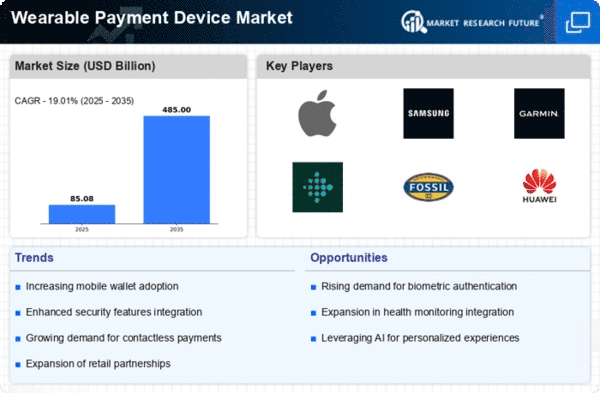
Wearable Payment Device Market Infographic
Purchase Options

Wearable Payment Device Size

Wearable Payment Device Market Growth Projections and Opportunities

Wearable payment devices, for example, smartwatches and wellness trackers furnished with payment functionalities, offer clients the comfort of making secure exchanges with an easy tap or wave. This pattern is especially articulated in metropolitan regions where customers look for quicker and more effective payment techniques, cultivating the far-reaching acknowledgment and combination of wearable payment devices into daily schedules. Numerous wearables, like wellness trackers and smartwatches, are furnished with payment abilities as well as health observing highlights. This double usefulness upgrades the incentive for buyers, empowering the reception of wearable payment devices as multifunctional embellishments. As health and wellbeing become indispensable parts of buyers' ways of life, wearables that consistently incorporate payment choices gain notoriety, driving market growth.

The rising pervasiveness of wearable innovation and the extending biological system of wearable devices similarly add to market elements. Wearables are not generally restricted to smartwatches; they presently incorporate a different scope of devices, from smart dress to audible devices. This assortment broadens the extent of wearable payment devices, offering customers more choices to look over considering their inclinations and way of life. The ceaseless development in wearable advances, including further developed sensors, longer battery duration, and improved network, further grows the opportunities for wearable payment arrangements. Furthermore, the rising mindfulness and concerns connected with security and protection in advanced exchanges impact the wearable payment device market.

Purchasers are increasingly watchful of the requirement for secure payment techniques, and wearable payment devices address this worry by consolidating progressed security elements, for example, biometric authentication and tokenization. The mix of comfort and vigorous safety efforts positions wearable payment devices as a trusted and secure method for managing monetary exchanges, encouraging buyer trust in their utilization. The impact of style and plan inclinations on shopper decisions is another critical element molding the wearable payment device market. Producers perceive the significance of aesthetics in wearable innovation, prompting the advancement of slick and adjustable devices that reverberate with customers' design sensibilities. The intermingling of design and usefulness improves the attraction of wearable payment devices, drawing in a more extensive customer base and empowering customary utilization.
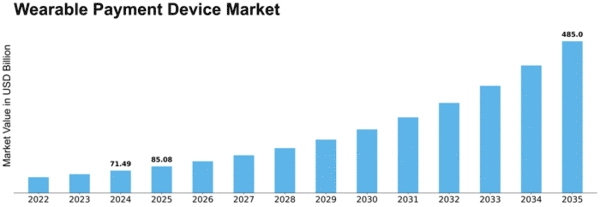
Wearable Payment Device Market Size Graph
Author
Ankit Gupta
Senior Research Analyst

Ankit Gupta is an analyst in market research industry in ICT and SEMI industry. With post-graduation in "Telecom and Marketing Management" and graduation in "Electronics and Telecommunication" vertical he is well versed with recent development in ICT industry as a whole. Having worked on more than 150+ reports including consultation for fortune 500 companies such as Microsoft and Rio Tinto in identifying solutions with respect to business problems his opinions are inclined towards mixture of technical and managerial aspects.

Leave a Comment

FAQs

How much is the Wearable Payment Device market?

The Wearable Payment Device market size was valued at USD 71.49 billion in 2024.

What is the growth rate of the Wearable Payment Device market?

The market is projected to grow at a CAGR of 19.01% during the forecast period, 2025 to 2035.

Which region held the largest market share in the Wearable Payment Devices market?

North America had the largest share of the Wearable Payment Device market.

Who are the key players in the Wearable Payment Device market?

The key players in the market are Apple Inc, Barclays, Fitbit Inc, Google Inc, Jawbone, Mastercard, PayPal Inc, Samsung Electronics Co. Ltd, and Visa Inc.

Which Type led the market of Wearable Payment Devices?

The Smartwatches category dominated the market in 2022.

Market Summary

As per MRFR analysis, the Wearable Payment Device Market Size was estimated at 71.49 USD Billion in 2024. The Wearable Payment Device industry is projected to grow from 85.08 USD Billion in 2025 to 485.0 USD Billion by 2035, exhibiting a compound annual growth rate (CAGR) of 19.01 during the forecast period 2025 - 2035.

Key Market Trends & Highlights

The Wearable Payment Device Market is experiencing robust growth driven by technological advancements and evolving consumer preferences.

  • North America remains the largest market for wearable payment devices, driven by high consumer adoption rates.
  • Asia-Pacific is emerging as the fastest-growing region, fueled by increasing smartphone penetration and digital payment adoption.
  • The retail payments segment continues to dominate, while health monitoring is rapidly gaining traction among consumers.
  • Key market drivers include the growing adoption of contactless payments and rising demand for fitness and health tracking.

Market Size & Forecast

2024 Market Size 71.49 (USD Billion)
2035 Market Size 485.0 (USD Billion)
CAGR (2025 - 2035) 19.01%
Largest Regional Market Share in 2024 North America

Major Players

<p>Apple (US), Samsung (KR), Garmin (US), Fitbit (US), Fossil (US), Huawei (CN), Xiaomi (CN), Nokia (FI), Sony (JP)</p>

Market Trends

The Wearable Payment Device Market is currently experiencing a notable transformation, driven by advancements in technology and changing consumer preferences. As individuals increasingly seek convenience and efficiency in their daily transactions, wearable devices such as smartwatches and fitness bands are becoming more prevalent. These devices not only facilitate seamless payments but also integrate various functionalities, enhancing user experience. The growing acceptance of contactless payments further propels the adoption of these devices, as consumers appreciate the speed and ease of transactions without the need for physical cards or cash. Moreover, the market is witnessing a surge in collaborations between technology firms and financial institutions, which appears to foster innovation and expand the range of services offered through wearable devices. This synergy may lead to the development of more secure payment solutions, addressing consumer concerns regarding data privacy and security. As the landscape evolves, it seems likely that the Wearable Payment Device Market will continue to expand, driven by ongoing technological advancements and a shift towards a cashless society.

Integration with Health Monitoring

Wearable payment devices are increasingly incorporating health monitoring features, allowing users to track fitness metrics while facilitating transactions. This dual functionality appeals to health-conscious consumers, enhancing the value proposition of these devices.

Enhanced Security Features

The market is witnessing a trend towards improved security measures, such as biometric authentication and encryption technologies. These advancements aim to build consumer trust and ensure safe transactions, addressing concerns about fraud and data breaches.

Personalization and Customization

There is a growing emphasis on personalization in wearable payment devices, with manufacturers offering customizable options for users. This trend allows consumers to tailor their devices to fit their individual preferences, enhancing user engagement and satisfaction.

Wearable Payment Device Market Market Drivers

Rising Consumer Demand

Consumer demand for wearable payment devices is on the rise, driven by the increasing preference for convenience and efficiency in transactions. The Global Wearable Payment Device Market Industry is projected to reach 71.5 USD Billion in 2024, reflecting a growing acceptance of these devices among consumers. Factors such as the proliferation of e-commerce and the need for contactless payment options contribute to this trend. As more consumers seek quick and secure payment methods, the market is likely to expand, with wearable devices becoming an integral part of everyday transactions.

Market Growth Projections

The Global Wearable Payment Device Market Industry is projected to experience substantial growth, with estimates indicating a market size of 484.9 USD Billion by 2035. This growth trajectory suggests a compound annual growth rate (CAGR) of 19.01% from 2025 to 2035. Such projections underscore the increasing adoption of wearable payment devices across various demographics and regions. As technology continues to evolve and consumer preferences shift towards more integrated payment solutions, the market is poised for significant expansion, driven by both innovation and changing consumer behaviors.

Technological Advancements

The Global Wearable Payment Device Market Industry is experiencing rapid technological advancements that enhance functionality and user experience. Innovations such as biometric authentication, contactless payment capabilities, and integration with mobile applications are driving consumer adoption. For instance, devices equipped with NFC technology allow seamless transactions, making payments more convenient. As technology evolves, features like health monitoring and fitness tracking are increasingly integrated into payment devices, appealing to health-conscious consumers. This convergence of technology and payment solutions is likely to attract a broader audience, further propelling market growth.

Increased Focus on Security

Security concerns are paramount in the Global Wearable Payment Device Market Industry, prompting manufacturers to enhance security features. The integration of advanced encryption technologies and biometric authentication methods, such as fingerprint and facial recognition, is becoming standard practice. These measures not only protect user data but also instill confidence among consumers regarding the safety of their transactions. As security remains a critical factor in consumer decision-making, the emphasis on secure payment solutions is expected to drive market growth, attracting users who prioritize safety in their financial dealings.

Expansion of Retail Partnerships

The expansion of retail partnerships plays a crucial role in the Global Wearable Payment Device Market Industry. Retailers are increasingly adopting wearable payment solutions to enhance customer experience and streamline transactions. Collaborations between device manufacturers and retail chains facilitate the integration of wearable payment options at points of sale. This trend is likely to increase the visibility and accessibility of wearable payment devices, encouraging more consumers to adopt them. As retailers recognize the benefits of offering diverse payment methods, the market is expected to witness significant growth, driven by these strategic partnerships.

Growing Health and Fitness Trends

The Global Wearable Payment Device Market Industry is benefiting from the growing health and fitness trends among consumers. Wearable devices that combine payment functionality with health monitoring features are gaining traction, appealing to fitness enthusiasts. As individuals increasingly prioritize health and wellness, the demand for devices that track fitness metrics while facilitating payments is likely to rise. This dual functionality not only enhances user experience but also positions wearable payment devices as essential tools for health-conscious consumers. The convergence of health and payment technology is expected to further stimulate market growth.

Market Segment Insights

By Application: Retail Payments (Largest) vs. Health Monitoring (Fastest-Growing)

<p>The wearable payment device market exhibits a diverse application landscape, with retail payments holding the largest share, driven by the increasing adoption of contactless payment technology among consumers and merchants alike. Public transport and fitness tracking also contribute significantly, while access control and health monitoring are seeing gradual increases in adoption, reflecting their unique use cases and consumer demands. Overall, retail payments dominate due to convenience and consumer preference, establishing a strong foundation for the market. Health monitoring is emerging as the fastest-growing segment due to the rising health consciousness among consumers and a growing emphasis on digital health solutions. The proliferation of wearable health devices, coupled with an increasing interest in personalized health data, is fostering significant growth in this area. The integration of advanced health metrics and continuous monitoring capabilities is aligning with consumer trends toward proactive health management, thereby contributing to the rapid expansion of this segment.</p>

<p>Retail Payments (Dominant) vs. Health Monitoring (Emerging)</p>

<p>Retail payments serve as the dominant application in the wearable payment device market, facilitated by high consumer demand for seamless and efficient payment methods. This segment benefits from widespread merchant acceptance and consumer familiarity with contactless transactions, positioning retail payments at the forefront of adoption rates. In contrast, health monitoring emerges as a rapidly growing application as consumers increasingly prioritize wellness and health management. Drivered by technological advancements in health tracking capabilities, this segment captures the attention of health-conscious individuals who seek real-time data and insights. The effect of wearable health technology enhancing user engagement and introducing innovative features has made health monitoring a compelling segment, highlighting its potential for substantial growth in Industry expert's.</p>

By End User: Consumers (Largest) vs. Retailers (Fastest-Growing)

<p>In the Wearable Payment Device Market, the 'Consumers' segment accounts for the largest share as individuals increasingly adopt wearable technology for convenient payment solutions. With the rise of contactless payment options, consumers are favored to drive market growth. The Retailers segment also holds significant importance, emerging as the fastest-growing sector as businesses look to implement innovative payment solutions to enhance customer experience and streamline transactions.</p>

<p>Consumers (Dominant) vs. Retailers (Emerging)</p>

<p>The 'Consumers' segment represents the dominant force in the wearable payment device market due to their growing preference for convenience and technology integration. As smartphones and wearables merge more functions, consumer demand surges for secure, accessible payment methods. In contrast, the 'Retailers' segment is emerging rapidly, adopting wearable payment solutions to boost sales and efficiency. Retailers are leveraging technology to enhance in-store experiences, offering loyalty rewards and personalized promotions through wearables, thus driving their growth and acceptance in the marketplace.</p>

By Technology: NFC (Largest) vs. Biometric Authentication (Fastest-Growing)

<p>The wearable payment device market is significantly influenced by various technological segments. Among these, NFC leads in market share, dominating the landscape due to its fast and secure transaction capabilities. Following NFC, Bluetooth technology is also prominent, facilitating connectivity with smartphones and other devices. Meanwhile, RFID and QR Code solutions are gaining traction but hold comparatively smaller shares within the market. Together, these technologies shape the preferences of consumers and businesses regarding wearable payment solutions.</p>

<p>Technology: NFC (Dominant) vs. Biometric Authentication (Emerging)</p>

<p>NFC technology has established itself as the dominant force in the wearable payment device market, enabling seamless contactless payments that are fast and secure. This technology enhances the overall user experience by allowing swift transactions that do not require physical contact with payment terminals. On the other hand, biometric authentication is rapidly emerging as a key player, gaining popularity due to the increasing demand for enhanced security and personalization in transactions. This technology leverages unique user characteristics, such as fingerprints or facial recognition, ensuring that payments are not only convenient but also secure. As consumers become more security-conscious, biometric solutions are expected to rise sharply in prominence.</p>

By Device Type: Smartwatches (Largest) vs. Fitness Bands (Fastest-Growing)

<p>In the Wearable Payment Device Market, Smartwatches hold the largest market share, driven by their multifunctionality and widespread adoption among consumers. They offer advanced features, blending everyday utility with payment capabilities, which fortifies their position in the market. Conversely, Fitness Bands, although smaller in overall market share, are gaining traction as an accessible and practical option for health-conscious consumers, focusing on fitness tracking alongside payment functions.</p>

<p>Smartwatches (Dominant) vs. Fitness Bands (Emerging)</p>

<p>Smartwatches represent the dominant segment in the wearable payment device market due to their extensive capabilities that extend beyond payments, including health monitoring, notifications, and app integration. These devices appeal to a tech-savvy audience seeking convenience in one device. Fitness Bands, on the other hand, are fast-emerging as a cost-effective alternative, particularly among fitness enthusiasts prioritizing health metrics. Their lightweight design and health-focused features, combined with growing interest in wearable technology, positions Fitness Bands as a lucrative market opportunity for innovative ventures in payment-enabled devices.</p>

By Payment Method: Contactless Payments (Largest) vs. Mobile Wallets (Fastest-Growing)

<p>In the wearable payment device market, various payment methods are gaining traction, with contactless payments leading the way as the largest segment. This method leverages NFC technology, allowing users to complete transactions swiftly and securely, contributing to its significant market presence. Mobile wallets are also emerging strongly, capturing a growing share as consumers increasingly prefer the convenience of accessing multiple payment options through their smartphones, enhancing user experience in wearable devices. The growth of these payment methods is driven by technological advances and changing consumer behaviors. The demand for quick and hassle-free transactions, especially in urban settings, has accelerated the adoption of contactless payments. Meanwhile, mobile wallets are experiencing rapid growth, fueled by the rise of e-commerce and digital transactions, supported by strategic partnerships between technology providers and financial institutions, making them a significant player in the wearable payment device landscape.</p>

<p>Contactless Payments (Dominant) vs. Cryptocurrency Transactions (Emerging)</p>

<p>Contactless payments represent the dominant payment method in the wearable payment device market, allowing users to make quick transactions without physical contact. This method benefits from established infrastructure in retail and widespread consumer acceptance, positioning it as a go-to payment option. On the other hand, cryptocurrency transactions are considered an emerging segment within this market. Although they currently hold a smaller share, the interest in cryptocurrencies is growing rapidly, driven by technological innovation and an increasing number of merchants accepting digital currencies. Combined with the rise of blockchain technology, these emerging payment methods present unique opportunities for consumer engagement and reshaping traditional payment paradigms.</p>

Get more detailed insights about Wearable Payment Device Market Research Report - Forecast 2035

Regional Insights

North America : Market Leader in Innovation

North America continues to lead the wearable payment device market, holding a significant share of 36.0% as of 2024. The growth is driven by increasing consumer demand for contactless payment solutions, coupled with advancements in technology and regulatory support for digital payments. The region's robust infrastructure and high smartphone penetration further enhance the adoption of wearable devices, making it a hotbed for innovation in this sector. The competitive landscape is dominated by key players such as Apple, Garmin, and Fitbit, which are continuously innovating to meet consumer needs. The U.S. stands out as the leading country, with a strong focus on integrating wearable technology into everyday life. Companies are investing heavily in R&D to enhance user experience and security features, ensuring that North America remains at the forefront of the wearable payment device market.

Europe : Emerging Market with Potential

Europe is witnessing a growing interest in wearable payment devices, with a market share of 20.0% as of 2024. The region's growth is fueled by increasing consumer awareness of contactless payments and supportive regulations promoting digital transactions. Countries like Germany and the UK are leading the charge, with initiatives aimed at enhancing the digital payment ecosystem, thus driving demand for wearable technology. The competitive landscape features major players like Samsung and Garmin, who are expanding their product offerings to cater to diverse consumer preferences. The presence of innovative startups also adds to the competitive dynamics, fostering a culture of creativity and technological advancement. As European consumers increasingly embrace digital solutions, the wearable payment device market is poised for significant growth.

Asia-Pacific : Rapid Growth and Adoption

Asia-Pacific is rapidly emerging as a significant player in the wearable payment device market, holding a market share of 12.0% as of 2024. The region's growth is driven by rising smartphone penetration, increasing disposable incomes, and a growing preference for contactless payment solutions. Countries like China and Japan are at the forefront, with strong government support for digital payment initiatives, further catalyzing market expansion. The competitive landscape is characterized by the presence of major brands like Huawei and Xiaomi, which are leveraging their technological expertise to innovate and capture market share. The region's diverse consumer base and varying preferences present both challenges and opportunities for companies. As the demand for wearable technology continues to rise, Asia-Pacific is set to become a key player in the global market.

Middle East and Africa : Emerging Market with Challenges

The Middle East and Africa region is gradually emerging in the wearable payment device market, with a market share of 3.49% as of 2024. The growth is primarily driven by increasing smartphone adoption and a shift towards digital payment solutions. However, challenges such as limited infrastructure and varying consumer awareness levels hinder rapid expansion. Countries like South Africa and the UAE are leading the way, with initiatives aimed at promoting cashless transactions. The competitive landscape is still developing, with a mix of local and international players vying for market share. Companies are focusing on educating consumers about the benefits of wearable payment devices, while also addressing security concerns. As the region continues to evolve, there is significant potential for growth in the wearable payment device market.

Key Players and Competitive Insights

The Wearable Payment Device Market is currently characterized by a dynamic competitive landscape, driven by technological advancements and evolving consumer preferences. Major players such as Apple (US), Samsung (KR), and Garmin (US) are at the forefront, each adopting distinct strategies to enhance their market positioning. Apple (US) continues to innovate with its Apple Watch series, integrating advanced health monitoring features alongside payment capabilities, thereby appealing to health-conscious consumers. Samsung (KR) focuses on expanding its Galaxy Watch line, emphasizing seamless integration with its ecosystem of devices, which enhances user experience and loyalty. Garmin (US), traditionally known for fitness tracking, is increasingly incorporating payment functionalities into its wearables, targeting fitness enthusiasts who value convenience in transactions.

The business tactics employed by these companies reflect a concerted effort to optimize supply chains and localize manufacturing, which is crucial in maintaining competitive pricing and responsiveness to market demands. The market structure appears moderately fragmented, with a mix of established brands and emerging players vying for market share. This fragmentation allows for diverse consumer choices but also intensifies competition among key players, who are compelled to differentiate through innovation and customer engagement.

In November 2025, Apple (US) announced a partnership with a leading financial institution to enhance its payment security features, which is expected to bolster consumer trust and drive adoption of its wearable payment devices. This strategic move underscores Apple's commitment to ensuring user security, a critical factor in the financial technology sector. Furthermore, it positions Apple to capture a larger share of the market by appealing to security-conscious consumers.

In October 2025, Samsung (KR) launched a new version of its Galaxy Watch, which includes advanced biometric payment options. This development not only enhances the functionality of the device but also aligns with the growing trend of contactless payments. By integrating biometric authentication, Samsung (KR) aims to provide a seamless and secure payment experience, potentially attracting a broader customer base.

In September 2025, Garmin (US) expanded its partnership with various fitness and health apps, allowing users to make payments directly through their devices while engaging in physical activities. This strategic initiative not only enhances user convenience but also positions Garmin (US) as a leader in the niche market of fitness-oriented wearables. By focusing on the intersection of health and payment technology, Garmin (US) is likely to strengthen its competitive edge in the market.

As of December 2025, the competitive trends in the Wearable Payment Device Market are increasingly defined by digitalization, sustainability, and the integration of artificial intelligence (AI). Strategic alliances among companies are shaping the landscape, fostering innovation and enhancing product offerings. The shift from price-based competition to a focus on technological advancement and supply chain reliability is evident, suggesting that future differentiation will hinge on the ability to innovate and respond to consumer needs effectively.

Key Companies in the Wearable Payment Device Market market include

Industry Developments

  • Q2 2024: RBI expands CBDC accessibility by allowing non-bank payment system operators to offer CBDC wallets The Reserve Bank of India announced plans to allow non-bank payment system operators to offer Central Bank Digital Currency (CBDC) wallets, aiming to boost adoption and usage of the Digital Rupee in the retail segment. This regulatory move is expected to drive further integration of digital wallet platforms with wearable payment devices.

Future Outlook

Wearable Payment Device Market Future Outlook

<p>The Wearable Payment Device Market is projected to grow at a 19.01% CAGR from 2024 to 2035, driven by technological advancements, increasing consumer adoption, and enhanced security features.</p>

New opportunities lie in:

  • <p>Integration of biometric authentication for enhanced security measures.</p>
  • <p>Development of customizable wearable payment solutions for niche markets.</p>
  • <p>Partnerships with retail chains for exclusive wearable payment promotions.</p>

<p>By 2035, the market is expected to be robust, driven by innovation and widespread consumer acceptance.</p>

Market Segmentation

Wearable Payment Device Market End User Outlook

  • Consumers
  • Retailers
  • Healthcare Providers
  • Corporate Employees
  • Financial Institutions

Wearable Payment Device Market Technology Outlook

  • NFC
  • RFID
  • Bluetooth
  • QR Code
  • Biometric Authentication

Wearable Payment Device Market Application Outlook

  • Retail Payments
  • Public Transport
  • Access Control
  • Health Monitoring
  • Fitness Tracking

Wearable Payment Device Market Device Type Outlook

  • Smartwatches
  • Fitness Bands
  • Smart Jewelry
  • Wearable Patches
  • Smart Glasses

Wearable Payment Device Market Payment Method Outlook

  • Contactless Payments
  • Mobile Wallets
  • Cryptocurrency Transactions
  • Bank Transfers
  • Loyalty Programs

Report Scope

MARKET SIZE 202471.49(USD Billion)
MARKET SIZE 202585.08(USD Billion)
MARKET SIZE 2035485.0(USD Billion)
COMPOUND ANNUAL GROWTH RATE (CAGR)19.01% (2024 - 2035)
REPORT COVERAGERevenue Forecast, Competitive Landscape, Growth Factors, and Trends
BASE YEAR2024
Market Forecast Period2025 - 2035
Historical Data2019 - 2024
Market Forecast UnitsUSD Billion
Key Companies ProfiledApple (US), Samsung (KR), Garmin (US), Fitbit (US), Fossil (US), Huawei (CN), Xiaomi (CN), Nokia (FI), Sony (JP)
Segments CoveredApplication, End User, Technology, Device Type, Payment Method
Key Market OpportunitiesIntegration of biometric authentication enhances security in the Wearable Payment Device Market.
Key Market DynamicsRising consumer demand for contactless payments drives innovation and competition in the wearable payment device sector.
Countries CoveredNorth America, Europe, APAC, South America, MEA

FAQs

How much is the Wearable Payment Device market?

The Wearable Payment Device market size was valued at USD 71.49 billion in 2024.

What is the growth rate of the Wearable Payment Device market?

The market is projected to grow at a CAGR of 19.01% during the forecast period, 2025 to 2035.

Which region held the largest market share in the Wearable Payment Devices market?

North America had the largest share of the Wearable Payment Device market.

Who are the key players in the Wearable Payment Device market?

The key players in the market are Apple Inc, Barclays, Fitbit Inc, Google Inc, Jawbone, Mastercard, PayPal Inc, Samsung Electronics Co. Ltd, and Visa Inc.

Which Type led the market of Wearable Payment Devices?

The Smartwatches category dominated the market in 2022.

  1. Executive Summary
  2. Market Introduction
    1. Market Definition
    2. Scope of the Study
    3. Markets Structure
  3. Research Methodology
    1. Research Process
    2. Secondary Research
    3. Primary Research
    4. Forecast Model
    5. List of Assumptions
  4. Market Dynamics
    1. Introduction
    2. Drivers
      1. Increasing
      2. Growing adoption of
      3. Increasing focus on offering enhanced
      4. Rising demand for wearable
    3. adoption owing to post-pandemic hygiene concerns
    4. secure digital payment solutions
    5. customer services with mobile applications
    6. electronic devices
    7. Restraint
      1. Battery safety issues for wearable
      2. Shorter life cycles of wearable payment devices
      3. Increasing adoption of advanced technologies
      4. Security concerns for wearable payment devices
      5. Threat of New Entrants
      6. Threat of Substitutes
      7. Intensity
      8. Bargaining Power of Suppliers
    8. payment devices
    9. Opportunities
    10. Challenges
    11. Porter’s Five Forces Analysis
    12. Bargaining Power of Buyers
    13. of Rivalry
    14. Value Chain/Supply
    15. Chain Analysis
  5. Global Wearable Payment Device Market,by Device Type
    1. Introduction
    2. Smart Watches
      1. Market Estimates & Forecast,
    3. Fitness Trackers
      1. Market Estimates & Forecast,
  6. Global Wearable Payment Device Market, by Technology
    1. Introduction
    2. RFID
      1. Market Estimates & Forecast, 2025-2034
    3. NFC
      1. Market Estimates & Forecast, 2025-2034
  7. Global
  8. Wearable Payment Device Market, by Application
    1. Introduction
      1. Market Estimates & Forecast, 2025-2034
    2. Retail Stores
    3. Restaurants
      1. Market Estimates & Forecast, 2025-2034
    4. Utility Outlets
      1. Market Estimates & Forecast, 2025-2034
    5. Entertainment Centers
      1. Market Estimates & Forecast, 2025-2034
  9. Global Wearable Payment
    1. DeviceMarket, by Region
    2. Introduction
    3. North America
  10. Market Estimates & Forecast, by Country, 2025-2034
    1. & Forecast, by Device Type, 2025-2034
    2. by Technology, 2025-2034
    3. Type, 2025-2034
    4. Canada
  11. Market Estimates
  12. Market Estimates & Forecast,
  13. Market Estimates & Forecast, by Application,
  14. US
  15. Market Estimates & Forecast, by Device
  16. Market Estimates & Forecast, by Technology, 2025-2034
  17. Market Estimates & Forecast, by Application, 2025-2034
  18. Market Estimates & Forecast, by Device Type, 2025-2034
  19. Market Estimates & Forecast, by Technology, 2025-2034
  20. Market Estimates & Forecast, by Application, 2025-2034
  21. Mexico
  22. Market Estimates & Forecast, by Device Type, 2025-2034
  23. Market Estimates & Forecast, by Technology, 2025-2034
    1. & Forecast, by Application, 2025-2034
    2. & Forecast, by Country, 2025-2034
    3. by Device Type, 2025-2034
  24. Market Estimates
    1. Europe
      1. Market Estimates
      2. Market Estimates & Forecast,
      3. Market Estimates & Forecast, by Technology,
      4. Market Estimates & Forecast, by Application, 2025-2034
      5. UK
  25. Market Estimates & Forecast, by Application, 2025-2034
  26. Germany
  27. Market Estimates & Forecast, by Device Type, 2025-2034
  28. Market Estimates & Forecast, by Technology, 2025-2034
    1. & Forecast, by Application, 2025-2034
    2. Estimates & Forecast, by Device Type, 2025-2034
    3. & Forecast, by Technology, 2025-2034
    4. by Application, 2025-2034
    5. Forecast, by Device Type, 2025-2034
    6. by Technology, 2025-2034
    7. by Device Type, 2025-2034
  29. Market Estimates
  30. France
  31. Market
  32. Market Estimates
  33. Market Estimates & Forecast,
  34. Italy
  35. Market Estimates &
  36. Market Estimates & Forecast,
  37. Market Estimates & Forecast, by Application,
  38. Rest of Europe
  39. Market Estimates & Forecast,
  40. Market Estimates & Forecast, by Technology,
  41. Market Estimates & Forecast, by Application, 2025-2034
    1. Asia-Pacific
      1. Market Estimates & Forecast, by Country, 2025-2034
      2. Market Estimates & Forecast, by Device Type, 2025-2034
  42. Market Estimates & Forecast, by Technology, 2025-2034
    1. & Forecast, by Application, 2025-2034
    2. Estimates & Forecast, by Device Type, 2025-2034
    3. & Forecast, by Technology, 2025-2034
    4. by Application, 2025-2034
    5. Forecast, by Device Type, 2025-2034
    6. by Technology, 2025-2034
  43. Market Estimates
  44. China
  45. Market
  46. Market Estimates
  47. Market Estimates & Forecast,
  48. Japan
  49. Market Estimates &
  50. Market Estimates & Forecast,
  51. Market Estimates & Forecast, by Diameter,
  52. Market Estimates & Forecast, by Application, 2025-2034
  53. India
  54. Market Estimates & Forecast, by Device Type, 2025-2034
  55. Market Estimates & Forecast, by Technology, 2025-2034
  56. Market Estimates & Forecast, by Application, 2025-2034
  57. Rest of Asia-Pacific
  58. Market Estimates & Forecast, by Device Type, 2025-2034
  59. Market Estimates & Forecast, by Technology, 2025-2034
    1. & Forecast, by Application, 2025-2034
    2. Market Estimates & Forecast, by, Country, 2025-2034
    3. & Forecast, by Device Type, 2025-2034
    4. by Technology, 2025-2034
    5. & Forecast, by Device Type, 2025-2034
    6. by Technology, 2025-2034
    7. by Device Type, 2025-2034
  60. Market Estimates
    1. Rest of the World
      1. Market Estimates
      2. Market Estimates & Forecast,
      3. Market Estimates & Forecast, by Application,
      4. The Middle East & Africa
      5. South America
  61. Company Profiles
    1. Microsoft Corporation
      1. Company Overview
      2. Product/Business Segment Overview
      3. Financial Updates
      4. SWOT Analysis
      5. Key Strategies
      6. Company Overview
      7. Product/Business Segment
      8. Financial Updates
      9. Key Developments
      10. Key Strategies
    2. Key Developments
    3. Huawei Technologies
    4. Overview
    5. SWOT Analysis
    6. Sony Corporation
      1. Product/Business Segment Overview
      2. Financial
      3. Key Developments
      4. SWOT Analysis
      5. Key Strategies
    7. Company Overview
    8. Updates
    9. Thales SA
      1. Company Overview
      2. Product/Business Segment
      3. Financial Updates
      4. Key Developments
      5. Key Strategies
    10. Overview
    11. SWOT Analysis
    12. Westpac
      1. Company Overview
      2. Product/Business Segment Overview
      3. Financial Updates
      4. SWOT Analysis
      5. Key Strategies
      6. Company Overview
      7. Product/Business
      8. Financial Updates
      9. Key Developments
      10. Key Strategies
    13. Key Developments
    14. Intelligent Venue Solutions
    15. Segment Overview
    16. SWOT Analysis
    17. Caixa Bank
      1. Company
      2. Product/Business Segment Overview
      3. Financial Updates
      4. Key Developments
      5. SWOT Analysis
      6. Key Strategies
    18. Overview
    19. IntelliX Software
      1. Company Overview
      2. Product/Business
      3. Financial Updates
      4. Key Developments
      5. Key Strategies
    20. Segment Overview
    21. SWOT Analysis
    22. Nymi Inc.
      1. Company
      2. Product/Business Segment Overview
      3. Financial Updates
      4. Key Developments
      5. SWOT Analysis
      6. Key Strategies
    23. Overview
    24. McLEAR LTD.
      1. Company Overview
      2. Product/Business
      3. Financial Updates
      4. Key Developments
      5. SWOT Analysis
      6. Key Strategies
    25. Segment Overview
    26. Jakcom Technology
      1. Company Overview
      2. Product/Business Segment Overview
      3. Financial Updates
      4. Key Developments
      5. SWOT Analysis
      6. Key Strategies
    27. CO.
    28. Token Inc.
      1. Company Overview
      2. Product/Business Segment Overview
      3. Financial Updates
      4. SWOT Analysis
      5. Key Strategies
      6. Company Overview
      7. Product/Business
      8. Financial Updates
      9. Key Developments
      10. SWOT Analysis
      11. Key Strategies
    29. Key Developments
    30. Infineon Technologies AG
    31. Segment Overview
    32. Printplast
      1. Product/Business Segment Overview
      2. Financial
      3. Key Developments
      4. SWOT Analysis
      5. Key
    33. Company Overview
    34. Updates
    35. Strategies
  62. LIST OF TABLES
    1. Table1 Global Wearable Payment
    2. DeviceMarket, by Country, 2025-2034
    3. Table2 North America: Wearable Payment
    4. DeviceMarket, by Country, 2025-2034
    5. Table3 Europe: Wearable Payment DeviceMarket,
    6. by Country, 2025-2034
    7. Table4 Asia-Pacific: Wearable Payment DeviceMarket, by
    8. Country, 2025-2034
    9. Table5 SouthAmerica: Wearable Payment DeviceMarket, by Country,
    10. Table6 North America: Wearable Payment DeviceMarket, by Country,
    11. Table7 North America: Wearable Payment DeviceMarket, by Device Type,
    12. Table8 North America: Wearable Payment DeviceMarket, byTechnology,
    13. Table9 North America: Wearable Payment DeviceMarket, by Application,
    14. Table10 Europe: Wearable Payment DeviceMarket, by Country, 2025-2034
    15. Table11 Europe: Wearable Payment DeviceMarket, by Device Type,2025-2034
    16. Table12
    17. Europe: Wearable Payment DeviceMarket, by Technology, 2025-2034
    18. Table13 Europe:
    19. Wearable Payment DeviceMarket, by Application, 2025-2034
    20. Table14 Asia-Pacific:
    21. Wearable Payment DeviceMarket, by Country, 2025-2034
    22. Table15 Asia-Pacific Wearable
    23. Payment DeviceMarket, by Device Type, 2025-2034
    24. Table16 Asia-Pacific: Wearable
    25. Payment DeviceMarket, by Technology, 2025-2034
    26. Table17 Asia-Pacific: Wearable
    27. Payment DeviceMarket, by Application, 2025-2034
    28. Table18 Middle East & Africa:
    29. Wearable Payment DeviceMarket, by Country, 2025-2034
    30. Table19 Middle East &
    31. Africa: Wearable Payment DeviceMarket, by Device Type, 2025-2034
    32. Table20 Middle
    33. East & Africa: Wearable Payment DeviceMarket, by Technology, 2025-2034
    34. Table21
    35. Middle East & Africa: Wearable Payment DeviceMarket, by Application, 2025-2034
    36. Table22 South America: Wearable Payment DeviceMarket, by Country, 2025-2034
    37. Table23 SouthAmerica: Wearable Payment DeviceMarket, by Device Type, 2025-2034
    38. Table24 South America: Wearable Payment DeviceMarket, by Technology, 2025-2034
    39. Table25 South America: Wearable Payment DeviceMarket, by Application, 2025-2034
  63. LIST OF FIGURES
  64. Market Synopsis
    1. Figure 2
    2. Global Wearable Payment DeviceMarketSegmentation
  65. Forecast Methodology
  66. Porter’s Five Forces Analysis of the Global Wearable Payment DeviceMarket
  67. Value Chain of the Global Wearable Payment DeviceMarket
    1. Figure 6
    2. Share of the Global Wearable Payment DeviceMarket in 2034, by country (in %)
  68. Global Wearable Payment DeviceMarket, 2025-2034
  69. Share of
    1. the Global Wearable Payment DeviceMarket by Industry, 2025-2034
  70. Global
    1. Wearable Payment DeviceMarket Size, by Device Type,2034
  71. Share of
    1. the Global Wearable Payment DeviceMarket, by Device Type,2025-2034
    2. Figure 11
    3. Global Wearable Payment DeviceMarket Size, by Technology, 2034
  72. Share
    1. of the Global Wearable Payment DeviceMarket, by Technology, 2025-2034
    2. Figure
  73. Global Wearable Payment DeviceMarket Size, by Application, 2034
    1. Figure 14
    2. Share of the Global Wearable Payment DeviceMarket, by Application, 2025-2034

Wearable Payment Device Market Segmentation

Wearable Payment Device Type Outlook (USD Million, 2020-2034)

  • Smart watches
  • Fitness Tracker
  • Payment Wristbands

Wearable Payment Device Technology Outlook (USD Million, 2020-2034)

  • Barcodes
  • Contactless Point of Sale (POS) Terminals
  • Near Fields Communication (NFC)
  • Quick Response (QR) Codes
  • Radio Frequency Identification (RFID)

Wearable Payment Device Application Outlook (USD Million, 2020-2034)

  • ​​​​​​​Fitness
  • Healthcare
  • Retail
  • Transportation
  • Bar & Restaurants
  • Entertainment Centers
  • Others

Wearable Payment Device Regional Outlook (USD Million, 2020-2034)

  • North America Outlook (USD Million, 2020-2034)
    • North America Wearable Payment Device by Type
      • Smart watches
      • Fitness Tracker
      • Payment Wristbands
    • North America Wearable Payment Device by Technology
      • Barcodes
      • Contactless Point of Sale (POS) Terminals
      • Near Fields Communication (NFC)
      • Quick Response (QR) Codes
      • Radio Frequency Identification (RFID)
    • North America Wearable Payment Device by Application
      • ​​​​​​​Fitness
      • Healthcare
      • Retail
      • Transportation
      • Bar & Restaurants
      • Entertainment Centers
      • Others
    • US Outlook (USD Million, 2020-2034)
    • US Wearable Payment Device by Type
      • Smart watches
      • Fitness Tracker
      • Payment Wristbands
    • US Wearable Payment Device by Technology
      • Barcodes
      • Contactless Point of Sale (POS) Terminals
      • Near Fields Communication (NFC)
      • Quick Response (QR) Codes
      • Radio Frequency Identification (RFID)
    • US Wearable Payment Device by Application
      • ​​​​​​​Fitness
      • Healthcare
      • Retail
      • Transportation
      • Bar & Restaurants
      • Entertainment Centers
      • Others
    • CANADA Outlook (USD Million, 2020-2034)
    • CANADA Wearable Payment Device by Type
      • Smart watches
      • Fitness Tracker
      • Payment Wristbands
    • CANADA Wearable Payment Device by Technology
      • Barcodes
      • Contactless Point of Sale (POS) Terminals
      • Near Fields Communication (NFC)
      • Quick Response (QR) Codes
      • Radio Frequency Identification (RFID)
    • CANADA Wearable Payment Device by Application
      • ​​​​​​​Fitness
      • Healthcare
      • Retail
      • Transportation
      • Bar & Restaurants
      • Entertainment Centers
      • Others
  • Europe Outlook (USD Million, 2020-2034)
    • Europe Wearable Payment Device by Type
      • Smart watches
      • Fitness Tracker
      • Payment Wristbands
    • Europe Wearable Payment Device by Technology
      • Barcodes
      • Contactless Point of Sale (POS) Terminals
      • Near Fields Communication (NFC)
      • Quick Response (QR) Codes
      • Radio Frequency Identification (RFID)
    • Europe Wearable Payment Device by Application
      • ​​​​​​​Fitness
      • Healthcare
      • Retail
      • Transportation
      • Bar & Restaurants
      • Entertainment Centers
      • Others
    • Germany Outlook (USD Million, 2020-2034)
    • Germany Wearable Payment Device by Type
      • Smart watches
      • Fitness Tracker
      • Payment Wristbands
    • Germany Wearable Payment Device by Technology
      • Barcodes
      • Contactless Point of Sale (POS) Terminals
      • Near Fields Communication (NFC)
      • Quick Response (QR) Codes
      • Radio Frequency Identification (RFID)
    • Germany Wearable Payment Device by Application
      • ​​​​​​​Fitness
      • Healthcare
      • Retail
      • Transportation
      • Bar & Restaurants
      • Entertainment Centers
      • Others
    • France Outlook (USD Million, 2020-2034)
    • France Wearable Payment Device by Type
      • Smart watches
      • Fitness Tracker
      • Payment Wristbands
    • France Wearable Payment Device by Technology
      • Barcodes
      • Contactless Point of Sale (POS) Terminals
      • Near Fields Communication (NFC)
      • Quick Response (QR) Codes
      • Radio Frequency Identification (RFID)
    • France Wearable Payment Device by Application
      • ​​​​​​​Fitness
      • Healthcare
      • Retail
      • Transportation
      • Bar & Restaurants
      • Entertainment Centers
      • Others
    • UK Outlook (USD Million, 2020-2034)
    • UK Wearable Payment Device by Type
      • Smart watches
      • Fitness Tracker
      • Payment Wristbands
    • UK Wearable Payment Device by Technology
      • Barcodes
      • Contactless Point of Sale (POS) Terminals
      • Near Fields Communication (NFC)
      • Quick Response (QR) Codes
      • Radio Frequency Identification (RFID)
    • UK Wearable Payment Device by Application
      • ​​​​​​​Fitness
      • Healthcare
      • Retail
      • Transportation
      • Bar & Restaurants
      • Entertainment Centers
      • Others
    • ITALY Outlook (USD Million, 2020-2034)
    • ITALY Wearable Payment Device by Type
      • Smart watches
      • Fitness Tracker
      • Payment Wristbands
    • ITALY Wearable Payment Device by Technology
      • Barcodes
      • Contactless Point of Sale (POS) Terminals
      • Near Fields Communication (NFC)
      • Quick Response (QR) Codes
      • Radio Frequency Identification (RFID)
    • ITALY Wearable Payment Device by Application
      • ​​​​​​​Fitness
      • Healthcare
      • Retail
      • Transportation
      • Bar & Restaurants
      • Entertainment Centers
      • Others
    • SPAIN Outlook (USD Million, 2020-2034)
    • Spain Wearable Payment Device by Type
      • Smart watches
      • Fitness Tracker
      • Payment Wristbands
    • Spain Wearable Payment Device by Technology
      • Barcodes
      • Contactless Point of Sale (POS) Terminals
      • Near Fields Communication (NFC)
      • Quick Response (QR) Codes
      • Radio Frequency Identification (RFID)
    • Spain Wearable Payment Device by Application
      • ​​​​​​​Fitness
      • Healthcare
      • Retail
      • Transportation
      • Bar & Restaurants
      • Entertainment Centers
      • Others
    • Rest Of Europe Outlook (USD Million, 2020-2034)
    • Rest Of Europe Wearable Payment Device by Type
      • Smart watches
      • Fitness Tracker
      • Payment Wristbands
    • REST OF EUROPE Wearable Payment Device by Technology
      • Barcodes
      • Contactless Point of Sale (POS) Terminals
      • Near Fields Communication (NFC)
      • Quick Response (QR) Codes
      • Radio Frequency Identification (RFID)
    • REST OF EUROPE Wearable Payment Device by Application
      • ​​​​​​​Fitness
      • Healthcare
      • Retail
      • Transportation
      • Bar & Restaurants
      • Entertainment Centers
      • Others
  • Asia-Pacific Outlook (USD Million, 2020-2034)
    • Asia-Pacific Wearable Payment Device by Type
      • Smart watches
      • Fitness Tracker
      • Payment Wristbands
    • Asia-Pacific Wearable Payment Device by Technology
      • Barcodes
      • Contactless Point of Sale (POS) Terminals
      • Near Fields Communication (NFC)
      • Quick Response (QR) Codes
      • Radio Frequency Identification (RFID)
    • Asia-Pacific Wearable Payment Device by Application
      • ​​​​​​​Fitness
      • Healthcare
      • Retail
      • Transportation
      • Bar & Restaurants
      • Entertainment Centers
      • Others
    • China Outlook (USD Million, 2020-2034)
    • China Wearable Payment Device by Type
      • Smart watches
      • Fitness Tracker
      • Payment Wristbands
    • China Wearable Payment Device by Technology
      • Barcodes
      • Contactless Point of Sale (POS) Terminals
      • Near Fields Communication (NFC)
      • Quick Response (QR) Codes
      • Radio Frequency Identification (RFID)
    • China Wearable Payment Device by Application
      • ​​​​​​​Fitness
      • Healthcare
      • Retail
      • Transportation
      • Bar & Restaurants
      • Entertainment Centers
      • Others
    • Japan Outlook (USD Million, 2020-2034)
    • Japan Wearable Payment Device by Type
      • Smart watches
      • Fitness Tracker
      • Payment Wristbands
    • Japan Wearable Payment Device by Technology
      • Barcodes
      • Contactless Point of Sale (POS) Terminals
      • Near Fields Communication (NFC)
      • Quick Response (QR) Codes
      • Radio Frequency Identification (RFID)
    • Japan Wearable Payment Device by Application
      • ​​​​​​​Fitness
      • Healthcare
      • Retail
      • Transportation
      • Bar & Restaurants
      • Entertainment Centers
      • Others
    • India Outlook (USD Million, 2020-2034)
    • India Wearable Payment Device by Type
      • Smart watches
      • Fitness Tracker
      • Payment Wristbands
    • India Wearable Payment Device by Technology
      • Barcodes
      • Contactless Point of Sale (POS) Terminals
      • Near Fields Communication (NFC)
      • Quick Response (QR) Codes
      • Radio Frequency Identification (RFID)
    • India Wearable Payment Device by Application
      • ​​​​​​​Fitness
      • Healthcare
      • Retail
      • Transportation
      • Bar & Restaurants
      • Entertainment Centers
      • Others
    • Australia Outlook (USD Million, 2020-2034)
    • Australia Wearable Payment Device by Type
      • Smart watches
      • Fitness Tracker
      • Payment Wristbands
    • Australia Wearable Payment Device by Technology
      • Barcodes
      • Contactless Point of Sale (POS) Terminals
      • Near Fields Communication (NFC)
      • Quick Response (QR) Codes
      • Radio Frequency Identification (RFID)
    • Australia Wearable Payment Device by Application
      • ​​​​​​​Fitness
      • Healthcare
      • Retail
      • Transportation
      • Bar & Restaurants
      • Entertainment Centers
      • Others
    • Rest of Asia-Pacific Outlook (USD Million, 2020-2034)
    • Rest of Asia-Pacific Wearable Payment Device by Type
      • Smart watches
      • Fitness Tracker
      • Payment Wristbands
    • Rest of Asia-Pacific Wearable Payment Device by Technology
      • Barcodes
      • Contactless Point of Sale (POS) Terminals
      • Near Fields Communication (NFC)
      • Quick Response (QR) Codes
      • Radio Frequency Identification (RFID)
    • Rest of Asia-Pacific Wearable Payment Device by Application
      • ​​​​​​​Fitness
      • Healthcare
      • Retail
      • Transportation
      • Bar & Restaurants
      • Entertainment Centers
      • Others
  • Rest of the World Outlook (USD Million, 2020-2034)
    • Rest of the World Wearable Payment Device by Type
      • Smart watches
      • Fitness Tracker
      • Payment Wristbands
    • Rest of the World Wearable Payment Device by Technology
      • Barcodes
      • Contactless Point of Sale (POS) Terminals
      • Near Fields Communication (NFC)
      • Quick Response (QR) Codes
      • Radio Frequency Identification (RFID)
    • Rest of the World Wearable Payment Device by Application
      • ​​​​​​​Fitness
      • Healthcare
      • Retail
      • Transportation
      • Bar & Restaurants
      • Entertainment Centers
      • Others
    • Middle East Outlook (USD Million, 2020-2034)
    • Middle East Wearable Payment Device by Type
      • Smart watches
      • Fitness Tracker
      • Payment Wristbands
    • Middle East Wearable Payment Device by Technology
      • Barcodes
      • Contactless Point of Sale (POS) Terminals
      • Near Fields Communication (NFC)
      • Quick Response (QR) Codes
      • Radio Frequency Identification (RFID)
    • Middle East Wearable Payment Device by Application
      • ​​​​​​​Fitness
      • Healthcare
      • Retail
      • Transportation
      • Bar & Restaurants
      • Entertainment Centers
      • Others
    • Africa Outlook (USD Million, 2020-2034)
    • Africa Wearable Payment Device by Type
      • Smart watches
      • Fitness Tracker
      • Payment Wristbands
    • Africa Wearable Payment Device by Technology
      • Barcodes
      • Contactless Point of Sale (POS) Terminals
      • Near Fields Communication (NFC)
      • Quick Response (QR) Codes
      • Radio Frequency Identification (RFID)
    • Africa Wearable Payment Device by Application
      • ​​​​​​​Fitness
      • Healthcare
      • Retail
      • Transportation
      • Bar & Restaurants
      • Entertainment Centers
      • Others
    • Latin America Outlook (USD Million, 2020-2034)
    • Latin America Wearable Payment Device by Type
      • Smart watches
      • Fitness Tracker
      • Payment Wristbands
    • Latin America Wearable Payment Device by Technology
      • Barcodes
      • Contactless Point of Sale (POS) Terminals
      • Near Fields Communication (NFC)
      • Quick Response (QR) Codes
      • Radio Frequency Identification (RFID)
    • Latin America Wearable Payment Device by Application
      • ​​​​​​​Fitness
      • Healthcare
      • Retail
      • Transportation
      • Bar & Restaurants
      • Entertainment Centers
      • Others
Infographic

Free Sample Request

Kindly complete the form below to receive a free sample of this Report

Get Free Sample

Customer Strories

Compare Licence

×
Features License Type
Single User Multiuser License Enterprise User
Price $4,950 $5,950 $7,250
Maximum User Access Limit 1 User Upto 10 Users Unrestricted Access Throughout the Organization
Free Customization
Direct Access to Analyst
Deliverable Format
Platform Access
Discount on Next Purchase 10% 15% 15%
Printable Versions