Request Free Sample ×

Kindly complete the form below to receive a free sample of this Report

* Please use a valid business email

Leading companies partner with us for data-driven Insights

clients tt-cursor
Hero Background
English
Chinese
French
Japanese
Korean
German
Spanish

Wearable Payment Device Market Analysis

ID: MRFR/SEM/9142-HCR
120 Pages
Ankit Gupta
Last Updated: April 06, 2026

Wearable Payment Device Market Size, Share and Research Report By Type (Smartwatches, Fitness Trackers, Payment Wristbands), By Technology\t(Barcodes, Contactless Point of Sale (POS) Terminals, Near Fields Communication (NFC), Quick Response (QR) Codes, Radio Frequency Identification (RFID), By Application (Fitness, Healthcare, Retail, Transportation, Bar & Restaurants, Entertainment Centers, Others), And By Region (North America, Europe, Asia-Pacific, And Rest Of The World) – Industry Forecast Till 2035

Share:
Download PDF ×

We do not share your information with anyone. However, we may send you emails based on your report interest from time to time. You may contact us at any time to opt-out.

Wearable Payment Device Market Infographic
Purchase Options

Market Analysis

In-depth Analysis of Wearable Payment Device Market Industry Landscape

The Wearable Payment Device Market is seeing huge movements powered by the rising reception of computerized payment arrangements, headways in wearable innovation, and the developing inclination for helpful and contactless exchanges. This market dynamic is impelled by an intermingling of elements, including the rise of portable payment ecosystems, the incorporation of payment functionalities into wearable devices, and the changing customer conduct towards more reliable and secure payment techniques. One of the key drivers affecting the Wearable Payment Device Market is the boundless reception of computerized payment systems. As purchasers progressively embrace credit only exchanges and versatile payment applications, there is a developing interest for wearable devices that can work with these exchanges easily.

Wearable payment devices, including smartwatches, wellness trackers, and payment-empowered gems, offer clients the accommodation of making secure transfers without the requirement for actual cards or money. Progressions in wearable innovation assume an urgent part in forming market elements. Wearable payment devices are developing past direct health following and notice highlights to consolidate secure payment functionalities. These devices influence advances like Near Field Communication (NFC) or Radio-Frequency Identification (RFID) to empower consistent contactless payments. The combination of biometric authentication strategies, for example, finger impression checking or pulse acknowledgment, upgrades security and adds an extra layer of insurance to wearable payment exchanges. The changing scene of retail and business is adding to the growth of the Wearable Payment Device Market. Retailers and organizations are progressively taking on contactless payment terminals, establishing a climate helpful for wearable payments.

The rise of versatile payment ecosystems and advanced wallets is another huge variable impacting market elements. Wearable payment devices frequently coordinate with well-known versatile payment platforms, permitting clients to interface their wearable devices to their favored computerized wallet. This interoperability cultivates a consistent and interconnected payment experience, where clients can start exchanges utilizing their wearables and deal with their payment techniques through a combined computerized stage.

Author
Author Profile
Ankit Gupta
Team Lead - Research

Ankit Gupta is a seasoned market intelligence and strategic research professional with over six plus years of experience in the ICT and Semiconductor industries. With academic roots in Telecom, Marketing, and Electronics, he blends technical insight with business strategy. Ankit has led 200+ projects, including work for Fortune 500 clients like Microsoft and Rio Tinto, covering market sizing, tech forecasting, and go-to-market strategies. Known for bridging engineering and enterprise decision-making, his insights support growth, innovation, and investment planning across diverse technology markets.

Leave a Comment

FAQs

What is the current valuation of the Wearable Payment Device Market?

<p>As of 2024, the market valuation was 71.49 USD Billion.</p>

What is the projected market size for the Wearable Payment Device Market by 2035?

<p>The market is expected to reach a valuation of 485.0 USD Billion by 2035.</p>

What is the expected CAGR for the Wearable Payment Device Market during the forecast period?

<p>The market is anticipated to grow at a CAGR of 19.01% from 2025 to 2035.</p>

Which companies are considered key players in the Wearable Payment Device Market?

<p>Key players include Apple, Samsung, Garmin, Fitbit, Fossil, Huawei, Xiaomi, Nokia, and Sony.</p>

What are the primary applications of wearable payment devices?

<p>The main applications include Retail Payments, Public Transport, Access Control, Health Monitoring, and Fitness Tracking.</p>

How do the segments of the Wearable Payment Device Market perform in terms of valuation?

For instance, Retail Payments reached 175.0 USD Billion, while Health Monitoring is projected at 100.0 USD Billion.

Who are the primary end users of wearable payment devices?

End users consist of Consumers, Retailers, Healthcare Providers, Corporate Employees, and Financial Institutions.

What technologies are utilized in wearable payment devices?

Technologies include NFC, RFID, Bluetooth, QR Code, and Biometric Authentication.

What types of devices are classified under wearable payment devices?

Device types encompass Smartwatches, Fitness Bands, Smart Jewelry, Wearable Patches, and Smart Glasses.

What payment methods are supported by wearable payment devices?

Supported payment methods include Contactless Payments, Mobile Wallets, Cryptocurrency Transactions, Bank Transfers, and Loyalty Programs.

Market Summary

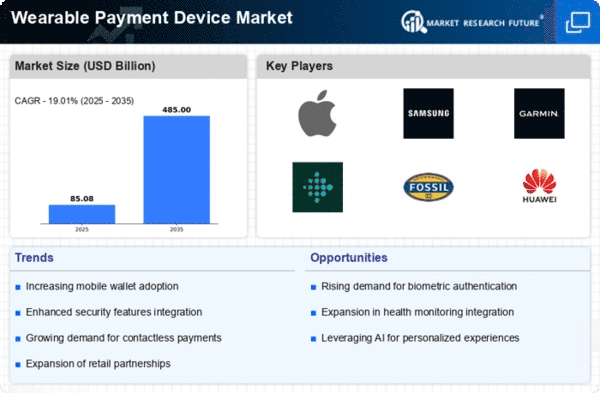
As per MRFR analysis, the Wearable Payment Device Market Size was estimated at 71.49 USD Billion in 2024. The Wearable Payment Device industry is projected to grow from 85.08 USD Billion in 2025 to 485.0 USD Billion by 2035, exhibiting a compound annual growth rate (CAGR) of 19.01% during the forecast period 2025 - 2035.

Key Market Trends & Highlights

The Wearable Payment Device Market is experiencing robust growth driven by technological advancements and evolving consumer preferences.

  • The integration of health monitoring features into wearable payment devices is becoming increasingly prevalent, appealing to health-conscious consumers. Enhanced security features are being prioritized to address consumer concerns regarding data protection and fraud. Retail partnerships are expanding, particularly in North America, to facilitate seamless payment experiences for consumers. Technological advancements and rising consumer demand for convenience are key drivers propelling the market forward, especially in the retail and transportation segments.

Market Size & Forecast

2024 Market Size 71.49 (USD Billion)
2035 Market Size 485.0 (USD Billion)
CAGR (2025 - 2035) 19.01%
Largest Regional Market Share in 2024 North America

Major Players

Apple (US), Samsung (KR), Garmin (US), Fitbit (US), Fossil (US), Huawei (CN), Xiaomi (CN), Nokia (FI), Sony (JP)

Market Trends

The Wearable Payment Device Market is currently experiencing a notable transformation, driven by advancements in technology and changing consumer preferences. As individuals increasingly seek convenience and efficiency in their daily transactions, wearable devices such as smartwatches and fitness bands are becoming more prevalent. These devices not only facilitate seamless payments but also integrate various functionalities, enhancing user experience. The growing acceptance of contactless payments further propels the adoption of these devices, as consumers appreciate the speed and ease of transactions without the need for physical cards or cash.  The wearable payment device market is experiencing steady growth, driven by increasing adoption of contactless payment technologies and growing consumer preference for convenient transaction methods. Key wearable payment device market trends include advancements in NFC technology, biometric authentication integration, and growing acceptance of digital wallets across retail and transit environments.

Moreover, the market is witnessing a surge in collaborations between technology firms and financial institutions, which appears to foster innovation and expand the range of services offered through wearable devices. This synergy may lead to the development of more secure payment solutions, addressing consumer concerns regarding data privacy and security. As the landscape evolves, it seems likely that the Wearable Payment Device Market will continue to expand, driven by ongoing technological advancements and a shift towards a cashless society. Expansion of the wearable payment devices market is supported by rising penetration of smartwatches, fitness bands, and other connected wearables with integrated payment capabilities.

Integration with Health Monitoring

Wearable payment devices are increasingly incorporating health monitoring features, allowing users to track fitness metrics alongside making payments. This trend reflects a growing consumer interest in holistic health management, where financial transactions and health data coexist within a single device.

Enhanced Security Features

The emphasis on security within the Wearable Payment Device Market is becoming more pronounced. Manufacturers are implementing advanced security measures, such as biometric authentication and encryption, to protect user data and enhance trust in digital transactions.

Expansion of Retail Partnerships

There is a noticeable trend towards expanding partnerships between wearable payment device manufacturers and retailers. This collaboration aims to create a more integrated shopping experience, enabling consumers to utilize their devices for payments across a wider range of retail environments.

Wearable Payment Device Market Market Drivers

Rising Consumer Demand

Consumer demand for wearable payment devices is on the rise, driven by the increasing preference for convenience and efficiency in transactions. The Global Wearable Payment Device Market Industry is projected to reach 71.5 USD Billion in 2024, reflecting a growing acceptance of these devices among consumers. Factors such as the proliferation of e-commerce and the need for contactless payment options contribute to this trend. As more consumers seek quick and secure payment methods, the market is likely to expand, with wearable devices becoming an integral part of everyday transactions.

Market Growth Projections

The Global Wearable Payment Device Market Industry is projected to experience substantial growth, with estimates indicating a market size of 484.9 USD Billion by 2035. This growth trajectory suggests a compound annual growth rate (CAGR) of 19.01% from 2025 to 2035. Such projections underscore the increasing adoption of wearable payment devices across various demographics and regions. As technology continues to evolve and consumer preferences shift towards more integrated payment solutions, the market is poised for significant expansion, driven by both innovation and changing consumer behaviors.

Technological Advancements

The Global Wearable Payment Device Market Industry is experiencing rapid technological advancements that enhance functionality and user experience. Innovations such as biometric authentication, contactless payment capabilities, and integration with mobile applications are driving consumer adoption. For instance, devices equipped with NFC technology allow seamless transactions, making payments more convenient. As technology evolves, features like health monitoring and fitness tracking are increasingly integrated into payment devices, appealing to health-conscious consumers. This convergence of technology and payment solutions is likely to attract a broader audience, further propelling market growth.

Increased Focus on Security

Security concerns are paramount in the Global Wearable Payment Device Market Industry, prompting manufacturers to enhance security features. The integration of advanced encryption technologies and biometric authentication methods, such as fingerprint and facial recognition, is becoming standard practice. These measures not only protect user data but also instill confidence among consumers regarding the safety of their transactions. As security remains a critical factor in consumer decision-making, the emphasis on secure payment solutions is expected to drive market growth, attracting users who prioritize safety in their financial dealings.

Expansion of Retail Partnerships

The expansion of retail partnerships plays a crucial role in the Global Wearable Payment Device Market Industry. Retailers are increasingly adopting wearable payment solutions to enhance customer experience and streamline transactions. Collaborations between device manufacturers and retail chains facilitate the integration of wearable payment options at points of sale. This trend is likely to increase the visibility and accessibility of wearable payment devices, encouraging more consumers to adopt them. As retailers recognize the benefits of offering diverse payment methods, the market is expected to witness significant growth, driven by these strategic partnerships.

Growing Health and Fitness Trends

The Global Wearable Payment Device Market Industry is benefiting from the growing health and fitness trends among consumers. Wearable devices that combine payment functionality with health monitoring features are gaining traction, appealing to fitness enthusiasts. As individuals increasingly prioritize health and wellness, the demand for devices that track fitness metrics while facilitating payments is likely to rise. This dual functionality not only enhances user experience but also positions wearable payment devices as essential tools for health-conscious consumers. The convergence of health and payment technology is expected to further stimulate market growth.

Market Segment Insights

By Application: Retail Payments (Largest) vs. Health Monitoring (Fastest-Growing)

<p>The wearable payment device market exhibits a diverse application landscape, with retail payments holding the largest share, driven by the increasing adoption of contactless payment technology among consumers and merchants alike. Public transport and fitness tracking also contribute significantly, while access control and health monitoring are seeing gradual increases in adoption, reflecting their unique use cases and consumer demands. Overall, retail payments dominate due to convenience and consumer preference, establishing a strong foundation for the market. Health monitoring is emerging as the fastest-growing segment due to the rising health consciousness among consumers and a growing emphasis on digital health solutions. The proliferation of wearable health devices, coupled with an increasing interest in personalized health data, is fostering significant growth in this area. The integration of advanced health metrics and continuous monitoring capabilities is aligning with consumer trends toward proactive health management, thereby contributing to the rapid expansion of this segment.</p>

<p>Retail Payments (Dominant) vs. Health Monitoring (Emerging)</p>

<p>Retail payments serve as the dominant application in the wearable payment device market, facilitated by high consumer demand for seamless and efficient payment methods. This segment benefits from widespread merchant acceptance and consumer familiarity with contactless transactions, positioning retail payments at the forefront of adoption rates. In contrast, health monitoring emerges as a rapidly growing application as consumers increasingly prioritize wellness and health management. Drivered by technological advancements in health tracking capabilities, this segment captures the attention of health-conscious individuals who seek real-time data and insights. The effect of wearable health technology enhancing user engagement and introducing innovative features has made health monitoring a compelling segment, highlighting its potential for substantial growth in Industry expert's.</p>

By End User: Consumers (Largest) vs. Retailers (Fastest-Growing)

<p>In the Wearable Payment Device Market, the 'Consumers' segment accounts for the largest share as individuals increasingly adopt wearable technology for convenient payment solutions. With the rise of contactless payment options, consumers are favored to drive market growth. The Retailers segment also holds significant importance, emerging as the fastest-growing sector as businesses look to implement innovative payment solutions to enhance customer experience and streamline transactions.</p>

<p>Consumers (Dominant) vs. Retailers (Emerging)</p>

<p>The 'Consumers' segment represents the dominant force in the wearable payment device market due to their growing preference for convenience and technology integration. As smartphones and wearables merge more functions, consumer demand surges for secure, accessible payment methods. In contrast, the 'Retailers' segment is emerging rapidly, adopting wearable payment solutions to boost sales and efficiency. Retailers are leveraging technology to enhance in-store experiences, offering loyalty rewards and personalized promotions through wearables, thus driving their growth and acceptance in the marketplace.</p>

By Technology: NFC (Largest) vs. Biometric Authentication (Fastest-Growing)

<p>The wearable payment device market is significantly influenced by various technological segments. Among these, NFC leads in market share, dominating the landscape due to its fast and secure transaction capabilities. Following NFC, Bluetooth technology is also prominent, facilitating connectivity with smartphones and other devices. Meanwhile, RFID and QR Code solutions are gaining traction but hold comparatively smaller shares within the market. Together, these technologies shape the preferences of consumers and businesses regarding wearable payment solutions.</p>

<p>Technology: NFC (Dominant) vs. Biometric Authentication (Emerging)</p>

<p>NFC technology has established itself as the dominant force in the wearable payment device market, enabling seamless contactless payments that are fast and secure. This technology enhances the overall user experience by allowing swift transactions that do not require physical contact with payment terminals. On the other hand, biometric authentication is rapidly emerging as a key player, gaining popularity due to the increasing demand for enhanced security and personalization in transactions. This technology leverages unique user characteristics, such as fingerprints or facial recognition, ensuring that payments are not only convenient but also secure. As consumers become more security-conscious, biometric solutions are expected to rise sharply in prominence.</p>

By Device Type: Smartwatches (Largest) vs. Fitness Bands (Fastest-Growing)

<p>In the Wearable Payment Device Market, Smartwatches hold the largest market share, driven by their multifunctionality and widespread adoption among consumers. They offer advanced features, blending everyday utility with payment capabilities, which fortifies their position in the market. Conversely, Fitness Bands, although smaller in overall market share, are gaining traction as an accessible and practical option for health-conscious consumers, focusing on fitness tracking alongside payment functions.</p>

<p>Smartwatches (Dominant) vs. Fitness Bands (Emerging)</p>

<p>Smartwatches represent the dominant segment in the wearable payment device market due to their extensive capabilities that extend beyond payments, including health monitoring, notifications, and app integration. These devices appeal to a tech-savvy audience seeking convenience in one device. Fitness Bands, on the other hand, are fast-emerging as a cost-effective alternative, particularly among fitness enthusiasts prioritizing health metrics. Their lightweight design and health-focused features, combined with growing interest in wearable technology, positions Fitness Bands as a lucrative market opportunity for innovative ventures in payment-enabled devices.</p>

By Payment Method: Contactless Payments (Largest) vs. Mobile Wallets (Fastest-Growing)

<p>In the wearable payment device market, various payment methods are gaining traction, with contactless payments leading the way as the largest segment. This method leverages NFC technology, allowing users to complete transactions swiftly and securely, contributing to its significant market presence. Mobile wallets are also emerging strongly, capturing a growing share as consumers increasingly prefer the convenience of accessing multiple payment options through their smartphones, enhancing user experience in wearable devices. The growth of these payment methods is driven by technological advances and changing consumer behaviors. The demand for quick and hassle-free transactions, especially in urban settings, has accelerated the adoption of contactless payments. Meanwhile, mobile wallets are experiencing rapid growth, fueled by the rise of e-commerce and digital transactions, supported by strategic partnerships between technology providers and financial institutions, making them a significant player in the wearable payment device landscape.</p>

<p>Contactless Payments (Dominant) vs. Cryptocurrency Transactions (Emerging)</p>

<p>Contactless payments represent the dominant payment method in the wearable payment device market, allowing users to make quick transactions without physical contact. This method benefits from established infrastructure in retail and widespread consumer acceptance, positioning it as a go-to payment option. On the other hand, cryptocurrency transactions are considered an emerging segment within this market. Although they currently hold a smaller share, the interest in cryptocurrencies is growing rapidly, driven by technological innovation and an increasing number of merchants accepting digital currencies. Combined with the rise of blockchain technology, these emerging payment methods present unique opportunities for consumer engagement and reshaping traditional payment paradigms.</p>

Get more detailed insights about Wearable Payment Device Market Research Report - Forecast 2035

Regional Insights

North America : Market Leader in Innovation

North America continues to lead the wearable payment device market, holding a significant share of 36.0% as of 2024. The growth is driven by increasing consumer demand for contactless payment solutions, coupled with advancements in technology and a robust regulatory framework that supports digital transactions. The region's focus on innovation and integration of wearable technology into daily life further propels market expansion. The United States stands out as the primary market, with key players like Apple, Garmin, and Fitbit driving competition. The presence of established tech giants fosters a dynamic environment for innovation, while partnerships with financial institutions enhance the adoption of wearable payment solutions. As consumer preferences shift towards convenience and security, the competitive landscape is expected to evolve, solidifying North America's position as a market leader.

Europe : Emerging Market with Potential

Europe is witnessing a growing interest in wearable payment devices, with a market size of €20.0 million. The region benefits from a strong regulatory environment that encourages digital payment solutions, alongside increasing consumer awareness of contactless technology. Factors such as the rise of e-commerce and mobile payments are driving demand, making Europe a promising market for future growth in wearable payments. Leading countries like Germany, the UK, and France are at the forefront of this trend, with companies such as Samsung and Garmin actively participating in the market. The competitive landscape is characterized by a mix of established brands and emerging startups, fostering innovation. As the European market matures, the integration of wearable payment solutions into everyday life is expected to accelerate, supported by favorable regulations. "The European Commission is committed to enhancing digital payment solutions to ensure a secure and efficient payment ecosystem."

Asia-Pacific : Rapid Growth and Adoption

The Asia-Pacific region is rapidly emerging as a significant player in the wearable payment device market, with a market size of $12.0 million. The growth is fueled by increasing smartphone penetration, a tech-savvy population, and rising disposable incomes. Additionally, government initiatives promoting digital payments and financial inclusion are acting as catalysts for market expansion, making this region a focal point for innovation in wearable technology. Countries like China, Japan, and South Korea are leading the charge, with major players such as Huawei and Xiaomi capitalizing on the growing demand. The competitive landscape is vibrant, with both local and international brands vying for market share. As consumer preferences shift towards seamless payment experiences, the Asia-Pacific market is poised for substantial growth, driven by technological advancements and evolving consumer behaviors.

Middle East and Africa : Untapped Market Potential

The Middle East and Africa region, with a market size of $3.49 million, presents untapped potential for wearable payment devices. The growth is primarily driven by increasing smartphone adoption and a young, tech-savvy population eager for innovative payment solutions. Additionally, government initiatives aimed at enhancing digital infrastructure are paving the way for the adoption of wearable payment technologies, making this region ripe for investment and development. Countries like South Africa and the UAE are leading the way in adopting wearable payment solutions, with local startups and international brands entering the market. The competitive landscape is evolving, with a focus on affordability and accessibility. As the region continues to develop its digital economy, the demand for wearable payment devices is expected to rise significantly, creating new opportunities for growth and innovation.

Key Players and Competitive Insights

The Wearable Payment Device Market is currently characterized by a dynamic competitive landscape, driven by technological advancements and evolving consumer preferences. Major players such as Apple (US), Samsung (KR), and Garmin (US) are at the forefront, each adopting distinct strategies to enhance their market positioning. Apple (US) continues to innovate with its Apple Watch series, integrating advanced health monitoring features alongside payment capabilities, thereby appealing to health-conscious consumers. Samsung (KR) focuses on expanding its Galaxy Watch line, emphasizing seamless integration with its ecosystem of devices, which enhances user experience and loyalty. Garmin (US), traditionally known for fitness tracking, is increasingly incorporating payment functionalities into its wearables, targeting fitness enthusiasts who value convenience in transactions. Analysis of wearable payment device market share highlights competitive dynamics influenced by ecosystem partnerships, security features, and compatibility with global payment networks. The business tactics employed by these companies reflect a concerted effort to optimize supply chains and localize manufacturing, which is crucial in maintaining competitive pricing and responsiveness to market demands. The market structure appears moderately fragmented, with a mix of established brands and emerging players vying for market share. This fragmentation allows for diverse consumer choices but also intensifies competition among key players, who are compelled to innovate continuously to retain their customer base. In November 2025, Apple (US) announced a partnership with a leading financial institution to enhance its payment security features, which is expected to bolster consumer trust and drive adoption of its wearable payment devices. This strategic move underscores Apple's commitment to ensuring user security, a critical factor in the financial technology sector. Furthermore, this partnership may facilitate the introduction of new payment solutions, potentially expanding Apple's market reach. In October 2025, Samsung (KR) launched a new version of its Galaxy Watch, which includes enhanced biometric sensors and a more robust payment interface. This development is significant as it not only improves the user experience but also positions Samsung as a leader in integrating health and payment functionalities, appealing to a broader audience. The emphasis on biometric security features may also address growing consumer concerns regarding data privacy and security in financial transactions. In September 2025, Garmin (US) expanded its payment capabilities by integrating cryptocurrency options into its wearables. This strategic decision reflects a growing trend towards digital currencies and positions Garmin to attract tech-savvy consumers who are increasingly interested in alternative payment methods. By embracing this trend, Garmin may differentiate itself in a crowded market, appealing to a niche segment that values innovation and flexibility in payment options. As of December 2025, the competitive trends in the Wearable Payment Device Market are increasingly defined by digitalization, sustainability, and the integration of artificial intelligence (AI). Strategic alliances among key players are shaping the landscape, fostering innovation and enhancing product offerings. The shift from price-based competition to a focus on technological advancement and supply chain reliability is evident, suggesting that future competitive differentiation will hinge on the ability to innovate and adapt to changing consumer expectations.

Key Companies in the Wearable Payment Device Market include

Industry Developments

  • Q2 2024: RBI expands CBDC accessibility by allowing non-bank payment system operators to offer CBDC wallets The Reserve Bank of India announced plans to allow non-bank payment system operators to offer Central Bank Digital Currency (CBDC) wallets, aiming to boost adoption and usage of the Digital Rupee in the retail segment. This regulatory move is expected to drive further integration of digital wallet platforms with wearable payment devices.

Future Outlook

Wearable Payment Device Market Future Outlook

The Wearable Payment Device Market is projected to grow at a 19.01% CAGR from 2025 to 2035, driven by technological advancements, increasing consumer adoption, and enhanced security features.

New opportunities lie in:

  • <p>Integration of biometric authentication for secure transactions. Development of customizable wearable payment solutions for niche markets. Partnerships with retail chains for exclusive wearable payment promotions.</p>

By 2035, the market is expected to be robust, driven by innovation and widespread consumer acceptance. The broader wearable payments devices market continues to expand as financial institutions and technology providers collaborate to enhance secure, tap-and-go payment experiences.

Market Segmentation

Wearable Payment Device Market End Use Outlook

  • Consumers
  • Businesses
  • Financial Institutions
  • Healthcare Providers

Wearable Payment Device Market Technology Outlook

  • NFC
  • RFID
  • Bluetooth
  • QR Code

Wearable Payment Device Market Application Outlook

  • Retail
  • Transportation
  • Healthcare
  • Entertainment
  • Fitness

Wearable Payment Device Market Device Type Outlook

  • Smartwatches
  • Fitness Trackers
  • Smart Rings
  • Wearable Patches

Wearable Payment Device Market Payment Method Outlook

  • Contactless Payment
  • Mobile Wallets
  • Cryptocurrency

Report Scope

MARKET SIZE 2024 71.49(USD Billion)
MARKET SIZE 2025 85.08(USD Billion)
MARKET SIZE 2035 485.0(USD Billion)
COMPOUND ANNUAL GROWTH RATE (CAGR) 19.01% (2025 - 2035)
REPORT COVERAGE Revenue Forecast, Competitive Landscape, Growth Factors, and Trends
BASE YEAR 2024
Market Forecast Period 2025 - 2035
Historical Data 2019 - 2024
Market Forecast Units USD Billion
Key Companies Profiled Apple (US), Samsung (KR), Garmin (US), Fitbit (US), Fossil (US), Huawei (CN), Xiaomi (CN), Nokia (FI), Sony (JP)
Segments Covered Application, End Use, Technology, Device Type, Payment Method
Key Market Opportunities Integration of biometric authentication enhances security in the Wearable Payment Device Market.
Key Market Dynamics Rising consumer demand for contactless payments drives innovation and competition in the wearable payment device market.
Countries Covered North America, Europe, APAC, South America, MEA

FAQs

What is the current valuation of the Wearable Payment Device Market?

<p>As of 2024, the market valuation was 71.49 USD Billion.</p>

What is the projected market size for the Wearable Payment Device Market by 2035?

<p>The market is expected to reach a valuation of 485.0 USD Billion by 2035.</p>

What is the expected CAGR for the Wearable Payment Device Market during the forecast period?

<p>The market is anticipated to grow at a CAGR of 19.01% from 2025 to 2035.</p>

Which companies are considered key players in the Wearable Payment Device Market?

<p>Key players include Apple, Samsung, Garmin, Fitbit, Fossil, Huawei, Xiaomi, Nokia, and Sony.</p>

What are the primary applications of wearable payment devices?

<p>The main applications include Retail Payments, Public Transport, Access Control, Health Monitoring, and Fitness Tracking.</p>

How do the segments of the Wearable Payment Device Market perform in terms of valuation?

For instance, Retail Payments reached 175.0 USD Billion, while Health Monitoring is projected at 100.0 USD Billion.

Who are the primary end users of wearable payment devices?

End users consist of Consumers, Retailers, Healthcare Providers, Corporate Employees, and Financial Institutions.

What technologies are utilized in wearable payment devices?

Technologies include NFC, RFID, Bluetooth, QR Code, and Biometric Authentication.

What types of devices are classified under wearable payment devices?

Device types encompass Smartwatches, Fitness Bands, Smart Jewelry, Wearable Patches, and Smart Glasses.

What payment methods are supported by wearable payment devices?

Supported payment methods include Contactless Payments, Mobile Wallets, Cryptocurrency Transactions, Bank Transfers, and Loyalty Programs.

  1. SECTION I: EXECUTIVE SUMMARY AND KEY HIGHLIGHTS
    1. | 1.1 EXECUTIVE SUMMARY
    2. | | 1.1.1 Market Overview
    3. | | 1.1.2 Key Findings
    4. | | 1.1.3 Market Segmentation
    5. | | 1.1.4 Competitive Landscape
    6. | | 1.1.5 Challenges and Opportunities
    7. | | 1.1.6 Future Outlook
  2. SECTION II: SCOPING, METHODOLOGY AND MARKET STRUCTURE
    1. | 2.1 MARKET INTRODUCTION
    2. | | 2.1.1 Definition
    3. | | 2.1.2 Scope of the study
    4. | | | 2.1.2.1 Research Objective
    5. | | | 2.1.2.2 Assumption
    6. | | | 2.1.2.3 Limitations
    7. | 2.2 RESEARCH METHODOLOGY
    8. | | 2.2.1 Overview
    9. | | 2.2.2 Data Mining
    10. | | 2.2.3 Secondary Research
    11. | | 2.2.4 Primary Research
    12. | | | 2.2.4.1 Primary Interviews and Information Gathering Process
    13. | | | 2.2.4.2 Breakdown of Primary Respondents
    14. | | 2.2.5 Forecasting Model
    15. | | 2.2.6 Market Size Estimation
    16. | | | 2.2.6.1 Bottom-Up Approach
    17. | | | 2.2.6.2 Top-Down Approach
    18. | | 2.2.7 Data Triangulation
    19. | | 2.2.8 Validation
  3. SECTION III: QUALITATIVE ANALYSIS
    1. | 3.1 MARKET DYNAMICS
    2. | | 3.1.1 Overview
    3. | | 3.1.2 Drivers
    4. | | 3.1.3 Restraints
    5. | | 3.1.4 Opportunities
    6. | 3.2 MARKET FACTOR ANALYSIS
    7. | | 3.2.1 Value chain Analysis
    8. | | 3.2.2 Porter's Five Forces Analysis
    9. | | | 3.2.2.1 Bargaining Power of Suppliers
    10. | | | 3.2.2.2 Bargaining Power of Buyers
    11. | | | 3.2.2.3 Threat of New Entrants
    12. | | | 3.2.2.4 Threat of Substitutes
    13. | | | 3.2.2.5 Intensity of Rivalry
    14. | | 3.2.3 COVID-19 Impact Analysis
    15. | | | 3.2.3.1 Market Impact Analysis
    16. | | | 3.2.3.2 Regional Impact
    17. | | | 3.2.3.3 Opportunity and Threat Analysis
  4. SECTION IV: QUANTITATIVE ANALYSIS
    1. | 4.1 Semiconductor & Electronics, BY Application (USD Billion)
    2. | | 4.1.1 Retail Payments
    3. | | 4.1.2 Public Transport
    4. | | 4.1.3 Access Control
    5. | | 4.1.4 Health Monitoring
    6. | | 4.1.5 Fitness Tracking
    7. | 4.2 Semiconductor & Electronics, BY End User (USD Billion)
    8. | | 4.2.1 Consumers
    9. | | 4.2.2 Retailers
    10. | | 4.2.3 Healthcare Providers
    11. | | 4.2.4 Corporate Employees
    12. | | 4.2.5 Financial Institutions
    13. | 4.3 Semiconductor & Electronics, BY Technology (USD Billion)
    14. | | 4.3.1 NFC
    15. | | 4.3.2 RFID
    16. | | 4.3.3 Bluetooth
    17. | | 4.3.4 QR Code
    18. | | 4.3.5 Biometric Authentication
    19. | 4.4 Semiconductor & Electronics, BY Device Type (USD Billion)
    20. | | 4.4.1 Smartwatches
    21. | | 4.4.2 Fitness Bands
    22. | | 4.4.3 Smart Jewelry
    23. | | 4.4.4 Wearable Patches
    24. | | 4.4.5 Smart Glasses
    25. | 4.5 Semiconductor & Electronics, BY Payment Method (USD Billion)
    26. | | 4.5.1 Contactless Payments
    27. | | 4.5.2 Mobile Wallets
    28. | | 4.5.3 Cryptocurrency Transactions
    29. | | 4.5.4 Bank Transfers
    30. | | 4.5.5 Loyalty Programs
    31. | 4.6 Semiconductor & Electronics, BY Region (USD Billion)
    32. | | 4.6.1 North America
    33. | | | 4.6.1.1 US
    34. | | | 4.6.1.2 Canada
    35. | | 4.6.2 Europe
    36. | | | 4.6.2.1 Germany
    37. | | | 4.6.2.2 UK
    38. | | | 4.6.2.3 France
    39. | | | 4.6.2.4 Russia
    40. | | | 4.6.2.5 Italy
    41. | | | 4.6.2.6 Spain
    42. | | | 4.6.2.7 Rest of Europe
    43. | | 4.6.3 APAC
    44. | | | 4.6.3.1 China
    45. | | | 4.6.3.2 India
    46. | | | 4.6.3.3 Japan
    47. | | | 4.6.3.4 South Korea
    48. | | | 4.6.3.5 Malaysia
    49. | | | 4.6.3.6 Thailand
    50. | | | 4.6.3.7 Indonesia
    51. | | | 4.6.3.8 Rest of APAC
    52. | | 4.6.4 South America
    53. | | | 4.6.4.1 Brazil
    54. | | | 4.6.4.2 Mexico
    55. | | | 4.6.4.3 Argentina
    56. | | | 4.6.4.4 Rest of South America
    57. | | 4.6.5 MEA
    58. | | | 4.6.5.1 GCC Countries
    59. | | | 4.6.5.2 South Africa
    60. | | | 4.6.5.3 Rest of MEA
  5. SECTION V: COMPETITIVE ANALYSIS
    1. | 5.1 Competitive Landscape
    2. | | 5.1.1 Overview
    3. | | 5.1.2 Competitive Analysis
    4. | | 5.1.3 Market share Analysis
    5. | | 5.1.4 Major Growth Strategy in the Semiconductor & Electronics
    6. | | 5.1.5 Competitive Benchmarking
    7. | | 5.1.6 Leading Players in Terms of Number of Developments in the Semiconductor & Electronics
    8. | | 5.1.7 Key developments and growth strategies
    9. | | | 5.1.7.1 New Product Launch/Service Deployment
    10. | | | 5.1.7.2 Merger & Acquisitions
    11. | | | 5.1.7.3 Joint Ventures
    12. | | 5.1.8 Major Players Financial Matrix
    13. | | | 5.1.8.1 Sales and Operating Income
    14. | | | 5.1.8.2 Major Players R&D Expenditure. 2023
    15. | 5.2 Company Profiles
    16. | | 5.2.1 Apple (US)
    17. | | | 5.2.1.1 Financial Overview
    18. | | | 5.2.1.2 Products Offered
    19. | | | 5.2.1.3 Key Developments
    20. | | | 5.2.1.4 SWOT Analysis
    21. | | | 5.2.1.5 Key Strategies
    22. | | 5.2.2 Samsung (KR)
    23. | | | 5.2.2.1 Financial Overview
    24. | | | 5.2.2.2 Products Offered
    25. | | | 5.2.2.3 Key Developments
    26. | | | 5.2.2.4 SWOT Analysis
    27. | | | 5.2.2.5 Key Strategies
    28. | | 5.2.3 Garmin (US)
    29. | | | 5.2.3.1 Financial Overview
    30. | | | 5.2.3.2 Products Offered
    31. | | | 5.2.3.3 Key Developments
    32. | | | 5.2.3.4 SWOT Analysis
    33. | | | 5.2.3.5 Key Strategies
    34. | | 5.2.4 Fitbit (US)
    35. | | | 5.2.4.1 Financial Overview
    36. | | | 5.2.4.2 Products Offered
    37. | | | 5.2.4.3 Key Developments
    38. | | | 5.2.4.4 SWOT Analysis
    39. | | | 5.2.4.5 Key Strategies
    40. | | 5.2.5 Fossil (US)
    41. | | | 5.2.5.1 Financial Overview
    42. | | | 5.2.5.2 Products Offered
    43. | | | 5.2.5.3 Key Developments
    44. | | | 5.2.5.4 SWOT Analysis
    45. | | | 5.2.5.5 Key Strategies
    46. | | 5.2.6 Huawei (CN)
    47. | | | 5.2.6.1 Financial Overview
    48. | | | 5.2.6.2 Products Offered
    49. | | | 5.2.6.3 Key Developments
    50. | | | 5.2.6.4 SWOT Analysis
    51. | | | 5.2.6.5 Key Strategies
    52. | | 5.2.7 Xiaomi (CN)
    53. | | | 5.2.7.1 Financial Overview
    54. | | | 5.2.7.2 Products Offered
    55. | | | 5.2.7.3 Key Developments
    56. | | | 5.2.7.4 SWOT Analysis
    57. | | | 5.2.7.5 Key Strategies
    58. | | 5.2.8 Nokia (FI)
    59. | | | 5.2.8.1 Financial Overview
    60. | | | 5.2.8.2 Products Offered
    61. | | | 5.2.8.3 Key Developments
    62. | | | 5.2.8.4 SWOT Analysis
    63. | | | 5.2.8.5 Key Strategies
    64. | | 5.2.9 Sony (JP)
    65. | | | 5.2.9.1 Financial Overview
    66. | | | 5.2.9.2 Products Offered
    67. | | | 5.2.9.3 Key Developments
    68. | | | 5.2.9.4 SWOT Analysis
    69. | | | 5.2.9.5 Key Strategies
    70. | 5.3 Appendix
    71. | | 5.3.1 References
    72. | | 5.3.2 Related Reports
  6. LIST OF FIGURES
    1. | 6.1 MARKET SYNOPSIS
    2. | 6.2 NORTH AMERICA MARKET ANALYSIS
    3. | 6.3 US MARKET ANALYSIS BY APPLICATION
    4. | 6.4 US MARKET ANALYSIS BY END USER
    5. | 6.5 US MARKET ANALYSIS BY TECHNOLOGY
    6. | 6.6 US MARKET ANALYSIS BY DEVICE TYPE
    7. | 6.7 US MARKET ANALYSIS BY PAYMENT METHOD
    8. | 6.8 CANADA MARKET ANALYSIS BY APPLICATION
    9. | 6.9 CANADA MARKET ANALYSIS BY END USER
    10. | 6.10 CANADA MARKET ANALYSIS BY TECHNOLOGY
    11. | 6.11 CANADA MARKET ANALYSIS BY DEVICE TYPE
    12. | 6.12 CANADA MARKET ANALYSIS BY PAYMENT METHOD
    13. | 6.13 EUROPE MARKET ANALYSIS
    14. | 6.14 GERMANY MARKET ANALYSIS BY APPLICATION
    15. | 6.15 GERMANY MARKET ANALYSIS BY END USER
    16. | 6.16 GERMANY MARKET ANALYSIS BY TECHNOLOGY
    17. | 6.17 GERMANY MARKET ANALYSIS BY DEVICE TYPE
    18. | 6.18 GERMANY MARKET ANALYSIS BY PAYMENT METHOD
    19. | 6.19 UK MARKET ANALYSIS BY APPLICATION
    20. | 6.20 UK MARKET ANALYSIS BY END USER
    21. | 6.21 UK MARKET ANALYSIS BY TECHNOLOGY
    22. | 6.22 UK MARKET ANALYSIS BY DEVICE TYPE
    23. | 6.23 UK MARKET ANALYSIS BY PAYMENT METHOD
    24. | 6.24 FRANCE MARKET ANALYSIS BY APPLICATION
    25. | 6.25 FRANCE MARKET ANALYSIS BY END USER
    26. | 6.26 FRANCE MARKET ANALYSIS BY TECHNOLOGY
    27. | 6.27 FRANCE MARKET ANALYSIS BY DEVICE TYPE
    28. | 6.28 FRANCE MARKET ANALYSIS BY PAYMENT METHOD
    29. | 6.29 RUSSIA MARKET ANALYSIS BY APPLICATION
    30. | 6.30 RUSSIA MARKET ANALYSIS BY END USER
    31. | 6.31 RUSSIA MARKET ANALYSIS BY TECHNOLOGY
    32. | 6.32 RUSSIA MARKET ANALYSIS BY DEVICE TYPE
    33. | 6.33 RUSSIA MARKET ANALYSIS BY PAYMENT METHOD
    34. | 6.34 ITALY MARKET ANALYSIS BY APPLICATION
    35. | 6.35 ITALY MARKET ANALYSIS BY END USER
    36. | 6.36 ITALY MARKET ANALYSIS BY TECHNOLOGY
    37. | 6.37 ITALY MARKET ANALYSIS BY DEVICE TYPE
    38. | 6.38 ITALY MARKET ANALYSIS BY PAYMENT METHOD
    39. | 6.39 SPAIN MARKET ANALYSIS BY APPLICATION
    40. | 6.40 SPAIN MARKET ANALYSIS BY END USER
    41. | 6.41 SPAIN MARKET ANALYSIS BY TECHNOLOGY
    42. | 6.42 SPAIN MARKET ANALYSIS BY DEVICE TYPE
    43. | 6.43 SPAIN MARKET ANALYSIS BY PAYMENT METHOD
    44. | 6.44 REST OF EUROPE MARKET ANALYSIS BY APPLICATION
    45. | 6.45 REST OF EUROPE MARKET ANALYSIS BY END USER
    46. | 6.46 REST OF EUROPE MARKET ANALYSIS BY TECHNOLOGY
    47. | 6.47 REST OF EUROPE MARKET ANALYSIS BY DEVICE TYPE
    48. | 6.48 REST OF EUROPE MARKET ANALYSIS BY PAYMENT METHOD
    49. | 6.49 APAC MARKET ANALYSIS
    50. | 6.50 CHINA MARKET ANALYSIS BY APPLICATION
    51. | 6.51 CHINA MARKET ANALYSIS BY END USER
    52. | 6.52 CHINA MARKET ANALYSIS BY TECHNOLOGY
    53. | 6.53 CHINA MARKET ANALYSIS BY DEVICE TYPE
    54. | 6.54 CHINA MARKET ANALYSIS BY PAYMENT METHOD
    55. | 6.55 INDIA MARKET ANALYSIS BY APPLICATION
    56. | 6.56 INDIA MARKET ANALYSIS BY END USER
    57. | 6.57 INDIA MARKET ANALYSIS BY TECHNOLOGY
    58. | 6.58 INDIA MARKET ANALYSIS BY DEVICE TYPE
    59. | 6.59 INDIA MARKET ANALYSIS BY PAYMENT METHOD
    60. | 6.60 JAPAN MARKET ANALYSIS BY APPLICATION
    61. | 6.61 JAPAN MARKET ANALYSIS BY END USER
    62. | 6.62 JAPAN MARKET ANALYSIS BY TECHNOLOGY
    63. | 6.63 JAPAN MARKET ANALYSIS BY DEVICE TYPE
    64. | 6.64 JAPAN MARKET ANALYSIS BY PAYMENT METHOD
    65. | 6.65 SOUTH KOREA MARKET ANALYSIS BY APPLICATION
    66. | 6.66 SOUTH KOREA MARKET ANALYSIS BY END USER
    67. | 6.67 SOUTH KOREA MARKET ANALYSIS BY TECHNOLOGY
    68. | 6.68 SOUTH KOREA MARKET ANALYSIS BY DEVICE TYPE
    69. | 6.69 SOUTH KOREA MARKET ANALYSIS BY PAYMENT METHOD
    70. | 6.70 MALAYSIA MARKET ANALYSIS BY APPLICATION
    71. | 6.71 MALAYSIA MARKET ANALYSIS BY END USER
    72. | 6.72 MALAYSIA MARKET ANALYSIS BY TECHNOLOGY
    73. | 6.73 MALAYSIA MARKET ANALYSIS BY DEVICE TYPE
    74. | 6.74 MALAYSIA MARKET ANALYSIS BY PAYMENT METHOD
    75. | 6.75 THAILAND MARKET ANALYSIS BY APPLICATION
    76. | 6.76 THAILAND MARKET ANALYSIS BY END USER
    77. | 6.77 THAILAND MARKET ANALYSIS BY TECHNOLOGY
    78. | 6.78 THAILAND MARKET ANALYSIS BY DEVICE TYPE
    79. | 6.79 THAILAND MARKET ANALYSIS BY PAYMENT METHOD
    80. | 6.80 INDONESIA MARKET ANALYSIS BY APPLICATION
    81. | 6.81 INDONESIA MARKET ANALYSIS BY END USER
    82. | 6.82 INDONESIA MARKET ANALYSIS BY TECHNOLOGY
    83. | 6.83 INDONESIA MARKET ANALYSIS BY DEVICE TYPE
    84. | 6.84 INDONESIA MARKET ANALYSIS BY PAYMENT METHOD
    85. | 6.85 REST OF APAC MARKET ANALYSIS BY APPLICATION
    86. | 6.86 REST OF APAC MARKET ANALYSIS BY END USER
    87. | 6.87 REST OF APAC MARKET ANALYSIS BY TECHNOLOGY
    88. | 6.88 REST OF APAC MARKET ANALYSIS BY DEVICE TYPE
    89. | 6.89 REST OF APAC MARKET ANALYSIS BY PAYMENT METHOD
    90. | 6.90 SOUTH AMERICA MARKET ANALYSIS
    91. | 6.91 BRAZIL MARKET ANALYSIS BY APPLICATION
    92. | 6.92 BRAZIL MARKET ANALYSIS BY END USER
    93. | 6.93 BRAZIL MARKET ANALYSIS BY TECHNOLOGY
    94. | 6.94 BRAZIL MARKET ANALYSIS BY DEVICE TYPE
    95. | 6.95 BRAZIL MARKET ANALYSIS BY PAYMENT METHOD
    96. | 6.96 MEXICO MARKET ANALYSIS BY APPLICATION
    97. | 6.97 MEXICO MARKET ANALYSIS BY END USER
    98. | 6.98 MEXICO MARKET ANALYSIS BY TECHNOLOGY
    99. | 6.99 MEXICO MARKET ANALYSIS BY DEVICE TYPE
    100. | 6.100 MEXICO MARKET ANALYSIS BY PAYMENT METHOD
    101. | 6.101 ARGENTINA MARKET ANALYSIS BY APPLICATION
    102. | 6.102 ARGENTINA MARKET ANALYSIS BY END USER
    103. | 6.103 ARGENTINA MARKET ANALYSIS BY TECHNOLOGY
    104. | 6.104 ARGENTINA MARKET ANALYSIS BY DEVICE TYPE
    105. | 6.105 ARGENTINA MARKET ANALYSIS BY PAYMENT METHOD
    106. | 6.106 REST OF SOUTH AMERICA MARKET ANALYSIS BY APPLICATION
    107. | 6.107 REST OF SOUTH AMERICA MARKET ANALYSIS BY END USER
    108. | 6.108 REST OF SOUTH AMERICA MARKET ANALYSIS BY TECHNOLOGY
    109. | 6.109 REST OF SOUTH AMERICA MARKET ANALYSIS BY DEVICE TYPE
    110. | 6.110 REST OF SOUTH AMERICA MARKET ANALYSIS BY PAYMENT METHOD
    111. | 6.111 MEA MARKET ANALYSIS
    112. | 6.112 GCC COUNTRIES MARKET ANALYSIS BY APPLICATION
    113. | 6.113 GCC COUNTRIES MARKET ANALYSIS BY END USER
    114. | 6.114 GCC COUNTRIES MARKET ANALYSIS BY TECHNOLOGY
    115. | 6.115 GCC COUNTRIES MARKET ANALYSIS BY DEVICE TYPE
    116. | 6.116 GCC COUNTRIES MARKET ANALYSIS BY PAYMENT METHOD
    117. | 6.117 SOUTH AFRICA MARKET ANALYSIS BY APPLICATION
    118. | 6.118 SOUTH AFRICA MARKET ANALYSIS BY END USER
    119. | 6.119 SOUTH AFRICA MARKET ANALYSIS BY TECHNOLOGY
    120. | 6.120 SOUTH AFRICA MARKET ANALYSIS BY DEVICE TYPE
    121. | 6.121 SOUTH AFRICA MARKET ANALYSIS BY PAYMENT METHOD
    122. | 6.122 REST OF MEA MARKET ANALYSIS BY APPLICATION
    123. | 6.123 REST OF MEA MARKET ANALYSIS BY END USER
    124. | 6.124 REST OF MEA MARKET ANALYSIS BY TECHNOLOGY
    125. | 6.125 REST OF MEA MARKET ANALYSIS BY DEVICE TYPE
    126. | 6.126 REST OF MEA MARKET ANALYSIS BY PAYMENT METHOD
    127. | 6.127 KEY BUYING CRITERIA OF SEMICONDUCTOR & ELECTRONICS
    128. | 6.128 RESEARCH PROCESS OF MRFR
    129. | 6.129 DRO ANALYSIS OF SEMICONDUCTOR & ELECTRONICS
    130. | 6.130 DRIVERS IMPACT ANALYSIS: SEMICONDUCTOR & ELECTRONICS
    131. | 6.131 RESTRAINTS IMPACT ANALYSIS: SEMICONDUCTOR & ELECTRONICS
    132. | 6.132 SUPPLY / VALUE CHAIN: SEMICONDUCTOR & ELECTRONICS
    133. | 6.133 SEMICONDUCTOR & ELECTRONICS, BY APPLICATION, 2024 (% SHARE)
    134. | 6.134 SEMICONDUCTOR & ELECTRONICS, BY APPLICATION, 2024 TO 2035 (USD Billion)
    135. | 6.135 SEMICONDUCTOR & ELECTRONICS, BY END USER, 2024 (% SHARE)
    136. | 6.136 SEMICONDUCTOR & ELECTRONICS, BY END USER, 2024 TO 2035 (USD Billion)
    137. | 6.137 SEMICONDUCTOR & ELECTRONICS, BY TECHNOLOGY, 2024 (% SHARE)
    138. | 6.138 SEMICONDUCTOR & ELECTRONICS, BY TECHNOLOGY, 2024 TO 2035 (USD Billion)
    139. | 6.139 SEMICONDUCTOR & ELECTRONICS, BY DEVICE TYPE, 2024 (% SHARE)
    140. | 6.140 SEMICONDUCTOR & ELECTRONICS, BY DEVICE TYPE, 2024 TO 2035 (USD Billion)
    141. | 6.141 SEMICONDUCTOR & ELECTRONICS, BY PAYMENT METHOD, 2024 (% SHARE)
    142. | 6.142 SEMICONDUCTOR & ELECTRONICS, BY PAYMENT METHOD, 2024 TO 2035 (USD Billion)
    143. | 6.143 BENCHMARKING OF MAJOR COMPETITORS
  7. LIST OF TABLES
    1. | 7.1 LIST OF ASSUMPTIONS
    2. | | 7.1.1
    3. | 7.2 North America MARKET SIZE ESTIMATES; FORECAST
    4. | | 7.2.1 BY APPLICATION, 2025-2035 (USD Billion)
    5. | | 7.2.2 BY END USER, 2025-2035 (USD Billion)
    6. | | 7.2.3 BY TECHNOLOGY, 2025-2035 (USD Billion)
    7. | | 7.2.4 BY DEVICE TYPE, 2025-2035 (USD Billion)
    8. | | 7.2.5 BY PAYMENT METHOD, 2025-2035 (USD Billion)
    9. | 7.3 US MARKET SIZE ESTIMATES; FORECAST
    10. | | 7.3.1 BY APPLICATION, 2025-2035 (USD Billion)
    11. | | 7.3.2 BY END USER, 2025-2035 (USD Billion)
    12. | | 7.3.3 BY TECHNOLOGY, 2025-2035 (USD Billion)
    13. | | 7.3.4 BY DEVICE TYPE, 2025-2035 (USD Billion)
    14. | | 7.3.5 BY PAYMENT METHOD, 2025-2035 (USD Billion)
    15. | 7.4 Canada MARKET SIZE ESTIMATES; FORECAST
    16. | | 7.4.1 BY APPLICATION, 2025-2035 (USD Billion)
    17. | | 7.4.2 BY END USER, 2025-2035 (USD Billion)
    18. | | 7.4.3 BY TECHNOLOGY, 2025-2035 (USD Billion)
    19. | | 7.4.4 BY DEVICE TYPE, 2025-2035 (USD Billion)
    20. | | 7.4.5 BY PAYMENT METHOD, 2025-2035 (USD Billion)
    21. | 7.5 Europe MARKET SIZE ESTIMATES; FORECAST
    22. | | 7.5.1 BY APPLICATION, 2025-2035 (USD Billion)
    23. | | 7.5.2 BY END USER, 2025-2035 (USD Billion)
    24. | | 7.5.3 BY TECHNOLOGY, 2025-2035 (USD Billion)
    25. | | 7.5.4 BY DEVICE TYPE, 2025-2035 (USD Billion)
    26. | | 7.5.5 BY PAYMENT METHOD, 2025-2035 (USD Billion)
    27. | 7.6 Germany MARKET SIZE ESTIMATES; FORECAST
    28. | | 7.6.1 BY APPLICATION, 2025-2035 (USD Billion)
    29. | | 7.6.2 BY END USER, 2025-2035 (USD Billion)
    30. | | 7.6.3 BY TECHNOLOGY, 2025-2035 (USD Billion)
    31. | | 7.6.4 BY DEVICE TYPE, 2025-2035 (USD Billion)
    32. | | 7.6.5 BY PAYMENT METHOD, 2025-2035 (USD Billion)
    33. | 7.7 UK MARKET SIZE ESTIMATES; FORECAST
    34. | | 7.7.1 BY APPLICATION, 2025-2035 (USD Billion)
    35. | | 7.7.2 BY END USER, 2025-2035 (USD Billion)
    36. | | 7.7.3 BY TECHNOLOGY, 2025-2035 (USD Billion)
    37. | | 7.7.4 BY DEVICE TYPE, 2025-2035 (USD Billion)
    38. | | 7.7.5 BY PAYMENT METHOD, 2025-2035 (USD Billion)
    39. | 7.8 France MARKET SIZE ESTIMATES; FORECAST
    40. | | 7.8.1 BY APPLICATION, 2025-2035 (USD Billion)
    41. | | 7.8.2 BY END USER, 2025-2035 (USD Billion)
    42. | | 7.8.3 BY TECHNOLOGY, 2025-2035 (USD Billion)
    43. | | 7.8.4 BY DEVICE TYPE, 2025-2035 (USD Billion)
    44. | | 7.8.5 BY PAYMENT METHOD, 2025-2035 (USD Billion)
    45. | 7.9 Russia MARKET SIZE ESTIMATES; FORECAST
    46. | | 7.9.1 BY APPLICATION, 2025-2035 (USD Billion)
    47. | | 7.9.2 BY END USER, 2025-2035 (USD Billion)
    48. | | 7.9.3 BY TECHNOLOGY, 2025-2035 (USD Billion)
    49. | | 7.9.4 BY DEVICE TYPE, 2025-2035 (USD Billion)
    50. | | 7.9.5 BY PAYMENT METHOD, 2025-2035 (USD Billion)
    51. | 7.10 Italy MARKET SIZE ESTIMATES; FORECAST
    52. | | 7.10.1 BY APPLICATION, 2025-2035 (USD Billion)
    53. | | 7.10.2 BY END USER, 2025-2035 (USD Billion)
    54. | | 7.10.3 BY TECHNOLOGY, 2025-2035 (USD Billion)
    55. | | 7.10.4 BY DEVICE TYPE, 2025-2035 (USD Billion)
    56. | | 7.10.5 BY PAYMENT METHOD, 2025-2035 (USD Billion)
    57. | 7.11 Spain MARKET SIZE ESTIMATES; FORECAST
    58. | | 7.11.1 BY APPLICATION, 2025-2035 (USD Billion)
    59. | | 7.11.2 BY END USER, 2025-2035 (USD Billion)
    60. | | 7.11.3 BY TECHNOLOGY, 2025-2035 (USD Billion)
    61. | | 7.11.4 BY DEVICE TYPE, 2025-2035 (USD Billion)
    62. | | 7.11.5 BY PAYMENT METHOD, 2025-2035 (USD Billion)
    63. | 7.12 Rest of Europe MARKET SIZE ESTIMATES; FORECAST
    64. | | 7.12.1 BY APPLICATION, 2025-2035 (USD Billion)
    65. | | 7.12.2 BY END USER, 2025-2035 (USD Billion)
    66. | | 7.12.3 BY TECHNOLOGY, 2025-2035 (USD Billion)
    67. | | 7.12.4 BY DEVICE TYPE, 2025-2035 (USD Billion)
    68. | | 7.12.5 BY PAYMENT METHOD, 2025-2035 (USD Billion)
    69. | 7.13 APAC MARKET SIZE ESTIMATES; FORECAST
    70. | | 7.13.1 BY APPLICATION, 2025-2035 (USD Billion)
    71. | | 7.13.2 BY END USER, 2025-2035 (USD Billion)
    72. | | 7.13.3 BY TECHNOLOGY, 2025-2035 (USD Billion)
    73. | | 7.13.4 BY DEVICE TYPE, 2025-2035 (USD Billion)
    74. | | 7.13.5 BY PAYMENT METHOD, 2025-2035 (USD Billion)
    75. | 7.14 China MARKET SIZE ESTIMATES; FORECAST
    76. | | 7.14.1 BY APPLICATION, 2025-2035 (USD Billion)
    77. | | 7.14.2 BY END USER, 2025-2035 (USD Billion)
    78. | | 7.14.3 BY TECHNOLOGY, 2025-2035 (USD Billion)
    79. | | 7.14.4 BY DEVICE TYPE, 2025-2035 (USD Billion)
    80. | | 7.14.5 BY PAYMENT METHOD, 2025-2035 (USD Billion)
    81. | 7.15 India MARKET SIZE ESTIMATES; FORECAST
    82. | | 7.15.1 BY APPLICATION, 2025-2035 (USD Billion)
    83. | | 7.15.2 BY END USER, 2025-2035 (USD Billion)
    84. | | 7.15.3 BY TECHNOLOGY, 2025-2035 (USD Billion)
    85. | | 7.15.4 BY DEVICE TYPE, 2025-2035 (USD Billion)
    86. | | 7.15.5 BY PAYMENT METHOD, 2025-2035 (USD Billion)
    87. | 7.16 Japan MARKET SIZE ESTIMATES; FORECAST
    88. | | 7.16.1 BY APPLICATION, 2025-2035 (USD Billion)
    89. | | 7.16.2 BY END USER, 2025-2035 (USD Billion)
    90. | | 7.16.3 BY TECHNOLOGY, 2025-2035 (USD Billion)
    91. | | 7.16.4 BY DEVICE TYPE, 2025-2035 (USD Billion)
    92. | | 7.16.5 BY PAYMENT METHOD, 2025-2035 (USD Billion)
    93. | 7.17 South Korea MARKET SIZE ESTIMATES; FORECAST
    94. | | 7.17.1 BY APPLICATION, 2025-2035 (USD Billion)
    95. | | 7.17.2 BY END USER, 2025-2035 (USD Billion)
    96. | | 7.17.3 BY TECHNOLOGY, 2025-2035 (USD Billion)
    97. | | 7.17.4 BY DEVICE TYPE, 2025-2035 (USD Billion)
    98. | | 7.17.5 BY PAYMENT METHOD, 2025-2035 (USD Billion)
    99. | 7.18 Malaysia MARKET SIZE ESTIMATES; FORECAST
    100. | | 7.18.1 BY APPLICATION, 2025-2035 (USD Billion)
    101. | | 7.18.2 BY END USER, 2025-2035 (USD Billion)
    102. | | 7.18.3 BY TECHNOLOGY, 2025-2035 (USD Billion)
    103. | | 7.18.4 BY DEVICE TYPE, 2025-2035 (USD Billion)
    104. | | 7.18.5 BY PAYMENT METHOD, 2025-2035 (USD Billion)
    105. | 7.19 Thailand MARKET SIZE ESTIMATES; FORECAST
    106. | | 7.19.1 BY APPLICATION, 2025-2035 (USD Billion)
    107. | | 7.19.2 BY END USER, 2025-2035 (USD Billion)
    108. | | 7.19.3 BY TECHNOLOGY, 2025-2035 (USD Billion)
    109. | | 7.19.4 BY DEVICE TYPE, 2025-2035 (USD Billion)
    110. | | 7.19.5 BY PAYMENT METHOD, 2025-2035 (USD Billion)
    111. | 7.20 Indonesia MARKET SIZE ESTIMATES; FORECAST
    112. | | 7.20.1 BY APPLICATION, 2025-2035 (USD Billion)
    113. | | 7.20.2 BY END USER, 2025-2035 (USD Billion)
    114. | | 7.20.3 BY TECHNOLOGY, 2025-2035 (USD Billion)
    115. | | 7.20.4 BY DEVICE TYPE, 2025-2035 (USD Billion)
    116. | | 7.20.5 BY PAYMENT METHOD, 2025-2035 (USD Billion)
    117. | 7.21 Rest of APAC MARKET SIZE ESTIMATES; FORECAST
    118. | | 7.21.1 BY APPLICATION, 2025-2035 (USD Billion)
    119. | | 7.21.2 BY END USER, 2025-2035 (USD Billion)
    120. | | 7.21.3 BY TECHNOLOGY, 2025-2035 (USD Billion)
    121. | | 7.21.4 BY DEVICE TYPE, 2025-2035 (USD Billion)
    122. | | 7.21.5 BY PAYMENT METHOD, 2025-2035 (USD Billion)
    123. | 7.22 South America MARKET SIZE ESTIMATES; FORECAST
    124. | | 7.22.1 BY APPLICATION, 2025-2035 (USD Billion)
    125. | | 7.22.2 BY END USER, 2025-2035 (USD Billion)
    126. | | 7.22.3 BY TECHNOLOGY, 2025-2035 (USD Billion)
    127. | | 7.22.4 BY DEVICE TYPE, 2025-2035 (USD Billion)
    128. | | 7.22.5 BY PAYMENT METHOD, 2025-2035 (USD Billion)
    129. | 7.23 Brazil MARKET SIZE ESTIMATES; FORECAST
    130. | | 7.23.1 BY APPLICATION, 2025-2035 (USD Billion)
    131. | | 7.23.2 BY END USER, 2025-2035 (USD Billion)
    132. | | 7.23.3 BY TECHNOLOGY, 2025-2035 (USD Billion)
    133. | | 7.23.4 BY DEVICE TYPE, 2025-2035 (USD Billion)
    134. | | 7.23.5 BY PAYMENT METHOD, 2025-2035 (USD Billion)
    135. | 7.24 Mexico MARKET SIZE ESTIMATES; FORECAST
    136. | | 7.24.1 BY APPLICATION, 2025-2035 (USD Billion)
    137. | | 7.24.2 BY END USER, 2025-2035 (USD Billion)
    138. | | 7.24.3 BY TECHNOLOGY, 2025-2035 (USD Billion)
    139. | | 7.24.4 BY DEVICE TYPE, 2025-2035 (USD Billion)
    140. | | 7.24.5 BY PAYMENT METHOD, 2025-2035 (USD Billion)
    141. | 7.25 Argentina MARKET SIZE ESTIMATES; FORECAST
    142. | | 7.25.1 BY APPLICATION, 2025-2035 (USD Billion)
    143. | | 7.25.2 BY END USER, 2025-2035 (USD Billion)
    144. | | 7.25.3 BY TECHNOLOGY, 2025-2035 (USD Billion)
    145. | | 7.25.4 BY DEVICE TYPE, 2025-2035 (USD Billion)
    146. | | 7.25.5 BY PAYMENT METHOD, 2025-2035 (USD Billion)
    147. | 7.26 Rest of South America MARKET SIZE ESTIMATES; FORECAST
    148. | | 7.26.1 BY APPLICATION, 2025-2035 (USD Billion)
    149. | | 7.26.2 BY END USER, 2025-2035 (USD Billion)
    150. | | 7.26.3 BY TECHNOLOGY, 2025-2035 (USD Billion)
    151. | | 7.26.4 BY DEVICE TYPE, 2025-2035 (USD Billion)
    152. | | 7.26.5 BY PAYMENT METHOD, 2025-2035 (USD Billion)
    153. | 7.27 MEA MARKET SIZE ESTIMATES; FORECAST
    154. | | 7.27.1 BY APPLICATION, 2025-2035 (USD Billion)
    155. | | 7.27.2 BY END USER, 2025-2035 (USD Billion)
    156. | | 7.27.3 BY TECHNOLOGY, 2025-2035 (USD Billion)
    157. | | 7.27.4 BY DEVICE TYPE, 2025-2035 (USD Billion)
    158. | | 7.27.5 BY PAYMENT METHOD, 2025-2035 (USD Billion)
    159. | 7.28 GCC Countries MARKET SIZE ESTIMATES; FORECAST
    160. | | 7.28.1 BY APPLICATION, 2025-2035 (USD Billion)
    161. | | 7.28.2 BY END USER, 2025-2035 (USD Billion)
    162. | | 7.28.3 BY TECHNOLOGY, 2025-2035 (USD Billion)
    163. | | 7.28.4 BY DEVICE TYPE, 2025-2035 (USD Billion)
    164. | | 7.28.5 BY PAYMENT METHOD, 2025-2035 (USD Billion)
    165. | 7.29 South Africa MARKET SIZE ESTIMATES; FORECAST
    166. | | 7.29.1 BY APPLICATION, 2025-2035 (USD Billion)
    167. | | 7.29.2 BY END USER, 2025-2035 (USD Billion)
    168. | | 7.29.3 BY TECHNOLOGY, 2025-2035 (USD Billion)
    169. | | 7.29.4 BY DEVICE TYPE, 2025-2035 (USD Billion)
    170. | | 7.29.5 BY PAYMENT METHOD, 2025-2035 (USD Billion)
    171. | 7.30 Rest of MEA MARKET SIZE ESTIMATES; FORECAST
    172. | | 7.30.1 BY APPLICATION, 2025-2035 (USD Billion)
    173. | | 7.30.2 BY END USER, 2025-2035 (USD Billion)
    174. | | 7.30.3 BY TECHNOLOGY, 2025-2035 (USD Billion)
    175. | | 7.30.4 BY DEVICE TYPE, 2025-2035 (USD Billion)
    176. | | 7.30.5 BY PAYMENT METHOD, 2025-2035 (USD Billion)
    177. | 7.31 PRODUCT LAUNCH/PRODUCT DEVELOPMENT/APPROVAL
    178. | | 7.31.1
    179. | 7.32 ACQUISITION/PARTNERSHIP
    180. | | 7.32.1

Semiconductor & Electronics Market Segmentation

Semiconductor & Electronics By Application (USD Billion, 2025-2035)

  • Retail Payments
  • Public Transport
  • Access Control
  • Health Monitoring
  • Fitness Tracking

Semiconductor & Electronics By End User (USD Billion, 2025-2035)

  • Consumers
  • Retailers
  • Healthcare Providers
  • Corporate Employees
  • Financial Institutions

Semiconductor & Electronics By Technology (USD Billion, 2025-2035)

  • NFC
  • RFID
  • Bluetooth
  • QR Code
  • Biometric Authentication

Semiconductor & Electronics By Device Type (USD Billion, 2025-2035)

  • Smartwatches
  • Fitness Bands
  • Smart Jewelry
  • Wearable Patches
  • Smart Glasses

Semiconductor & Electronics By Payment Method (USD Billion, 2025-2035)

  • Contactless Payments
  • Mobile Wallets
  • Cryptocurrency Transactions
  • Bank Transfers
  • Loyalty Programs
Infographic

Free Sample Request

Kindly complete the form below to receive a free sample of this Report

Get Free Sample

Customer Strories

Compare Licence

×
Features License Type
Single User Multiuser License Enterprise User
Price $4,950 $5,950 $7,250
Maximum User Access Limit 1 User Upto 10 Users Unrestricted Access Throughout the Organization
Free Customization
Direct Access to Analyst
Deliverable Format
Platform Access
Discount on Next Purchase 10% 15% 15%
Printable Versions