Request Free Sample ×

Kindly complete the form below to receive a free sample of this Report

* Please use a valid business email

Leading companies partner with us for data-driven Insights

clients tt-cursor
Hero Background
English
Chinese
French
Japanese
Korean
German
Spanish

Vitamin C Market Analysis

ID: MRFR/FnB/1406-HCR
110 Pages
Varsha More
March 2026

Vitamin C Market Size, Share, Industry Trend & Analysis Research Report Information By Type (Sodium Ascorbate, Calcium Ascorbate, Potassium Ascorbate, Magnesium Ascorbate, and Others), By Application (Pharmaceutical & Nutraceutical, Food and Beverages, Personal Care, and Others), And By Region (North America, Europe, Asia-Pacific, And Rest Of The World) – Forecast Till 2035

Share:
Download PDF ×

We do not share your information with anyone. However, we may send you emails based on your report interest from time to time. You may contact us at any time to opt-out.

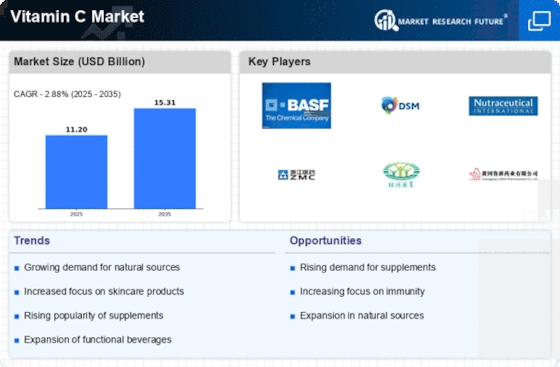
Vitamin C Market Infographic
Purchase Options

Market Analysis

In-depth Analysis of Vitamin C Market Industry Landscape

The Vitamin C market is subject to dynamic forces that reflect both consumer behaviors and broader industry trends. Vitamin C, also known as ascorbic acid, is a vital nutrient renowned for its immune-boosting properties and antioxidant benefits. The market dynamics of the Vitamin C industry are intricately linked to health and wellness trends, consumer awareness, and scientific advancements.

The primary driver behind the growth of the Vitamin C market is the increasing focus on preventive healthcare and wellness. Consumers are becoming more conscious of the role vitamins and minerals play in supporting overall health, and Vitamin C has emerged as a key player in this narrative. The demand for immune-boosting supplements has surged, particularly in the wake of global health concerns. As consumers seek ways to fortify their immune systems, the Vitamin C market has experienced a notable uptick in demand.

Furthermore, lifestyle changes and dietary patterns contribute significantly to the market dynamics. Busy lifestyles and a shift towards processed and convenience foods have led to dietary imbalances, prompting consumers to turn to supplements to meet their nutritional needs. Vitamin C supplements, available in various forms such as tablets, capsules, and gummies, offer a convenient solution for those looking to incorporate this essential vitamin into their daily routines.

Globalization and increased access to information also play a pivotal role in shaping the Vitamin C market. With the world becoming more interconnected, consumers have access to a plethora of choices from different regions. This has led to an influx of diverse Vitamin C products, including natural sources like fruits and vegetables, as well as synthetic supplements. The market has responded with a range of options to cater to varied consumer preferences, creating a competitive landscape with a wide array of products.

The market dynamics are further influenced by ongoing research and developments in the field of nutrition and wellness. Scientific studies highlighting the benefits of Vitamin C in areas beyond immune support, such as skin health and anti-aging, have expanded the market potential. Manufacturers are capitalizing on these findings to position Vitamin C as a versatile and multi-faceted supplement, appealing to a broader audience.

The Vitamin C market is characterized by a mix of established players and emerging entrants. Established brands often rely on their reputation for quality and reliability, while newer entrants focus on innovation and differentiation. Organic and natural formulations, as well as sustainably sourced Vitamin C, are gaining traction among consumers who prioritize clean and environmentally friendly products.

Retail channels also play a crucial role in the market dynamics of Vitamin C. Traditional brick-and-mortar stores, health food outlets, and pharmacies remain key distribution channels. However, the rise of e-commerce has provided consumers with the convenience of purchasing Vitamin C supplements online, contributing to the market's accessibility and reach.

Government regulations and quality standards are paramount in the Vitamin C market. Adherence to strict regulations regarding product labeling, safety, and quality is essential to build and maintain consumer trust. Manufacturers invest in quality control measures and certifications to meet regulatory requirements and ensure that their products meet the highest standards.

Author
Author Profile
Varsha More
Senior Research Analyst

Experienced business professional with a demonstrated history of working in the CFnB industry. Skilled in market research, and market estimation. Strong professional with a Masters focused in marketing management.

Leave a Comment

FAQs

What is the current valuation of the Vitamin C Market as of 2024?

<p>The Vitamin C Market was valued at 11.2 USD Billion in 2024.</p>

What is the projected market valuation for Vitamin C by 2035?

<p>The market is projected to reach 15.31 USD Billion by 2035.</p>

What is the expected CAGR for the Vitamin C Market during the forecast period 2025 - 2035?

<p>The expected CAGR for the Vitamin C Market during 2025 - 2035 is 2.88%.</p>

Which segments are included in the Vitamin C Market analysis?

<p>The segments include Sodium Ascorbate, Calcium Ascorbate, Potassium Ascorbate, Magnesium Ascorbate, and others.</p>

How did the Sodium Ascorbate segment perform in 2024?

<p>In 2024, the Sodium Ascorbate segment was valued at 2.5 USD Billion.</p>

What is the projected growth for the Food and Beverages application segment by 2035?

<p>The Food and Beverages application segment is projected to grow from 4.48 USD Billion in 2024 to 5.75 USD Billion by 2035.</p>

Who are the key players in the Vitamin C Market?

Key players include BASF SE, DSM Nutritional Products, and Nutraceutical International Corporation.

What was the valuation of the Personal Care application segment in 2024?

The Personal Care application segment was valued at 2.24 USD Billion in 2024.

How is the Others segment expected to perform by 2035?

The Others segment is expected to grow from 4.2 USD Billion in 2024 to 6.1 USD Billion by 2035.

What is the significance of the Magnesium Ascorbate segment in the market?

The Magnesium Ascorbate segment was valued at 1.0 USD Billion in 2024, indicating its role in the overall market.

Market Summary

As per Market Research Future analysis, the Vitamin C Market Size was estimated at 2.18 USD Billion in 2024. The Vitamin C industry is projected to grow from 2.3 USD Billion in 2025 to 3.7 USD Billion by 2035, exhibiting a compound annual growth rate (CAGR) of 4.88% during the forecast period 2025 - 2035

Key Market Trends & Highlights

The Vitamin C Market is experiencing robust growth driven by health trends and technological advancements.

  • The demand for natural products is rising, particularly in North America, which remains the largest market for Vitamin C Market. Sodium Ascorbate continues to dominate the market, while Calcium Ascorbate is emerging as the fastest-growing segment. Asia-Pacific is witnessing rapid growth in the Vitamin C Market, fueled by increasing health awareness and consumer preferences for natural ingredients. Key market drivers include the expansion of functional foods and the growth of e-commerce platforms, which are reshaping consumer access to Vitamin C Market products.

Market Size & Forecast

2024 Market Size 2.18 (USD Billion)
2035 Market Size 3.7 (USD Billion)
CAGR (2025 - 2035) 4.88%
Largest Regional Market Share in 2024 Asia Pacific

Major Players

BASF SE (DE), <a href="https://www.dsm-firmenich.com/en/businesses/health-nutrition-care/products.html">DSM Nutritional Products (CH),</a> Nutraceutical International Corporation (US), Zhejiang Medicine Co., Ltd. (CN), Shandong Luyin Pharmaceutical Co., Ltd. (CN), Huanggang Dongbang Pharmaceutical Co., Ltd. (CN), Kemin Industries, Inc. (US), Fujian Jianou Huaxin Pharmaceutical Co., Ltd. (CN)

Market Trends

The Vitamin C Market is currently experiencing a dynamic phase characterized by evolving consumer preferences and increasing awareness regarding health benefits. As individuals become more health-conscious, the demand for Vitamin C Market supplements and fortified products appears to be on the rise. This trend is likely influenced by a growing understanding of the role Vitamin C Market plays in immune support, skin health, and overall wellness. Additionally, the market is witnessing a shift towards natural and organic sources of Vitamin C Market, as consumers seek products that align with their values of sustainability and health. This inclination towards clean-label products suggests a potential for growth in sectors that prioritize transparency and quality in their offerings. Moreover, the Vitamin C Market is also adapting to technological advancements in product formulation and delivery methods. Innovations such as liposomal Vitamin C Market and time-release formulations may enhance bioavailability, thereby appealing to a broader audience. The rise of e-commerce platforms is further transforming the landscape, allowing consumers easier access to a variety of Vitamin C Market products. As the market continues to evolve, it seems poised for expansion, driven by both consumer demand and ongoing research into the benefits of Vitamin C Market. The interplay of these factors indicates a vibrant future for the Vitamin C Market, with opportunities for new entrants and established players alike.

Rise of Natural Products

There is a noticeable trend towards natural and organic Vitamin C Market sources. Consumers increasingly prefer products derived from fruits and vegetables, reflecting a broader shift towards clean-label and sustainable options. Industry experts often cite stabilized L-ascorbic acid formulas as the best Vitamin C serum in market for those seeking immediate skin-brightening and antioxidant protection.  

Technological Innovations and Consumer Awareness

Advancements in formulation technologies are emerging, with products like liposomal Vitamin C Market gaining traction. These innovations may enhance absorption and effectiveness, appealing to health-conscious consumers. Consumer reviews consistently highlight that the best vitamin c serum in market must offer a balance of high potency and skin-soothing ingredients like vitamin E and ferulic acid.

E-commerce Growth

The expansion of online retail channels is reshaping the Vitamin C Market. Consumers are increasingly turning to e-commerce for convenience and variety, which could lead to a broader market reach for Vitamin C Market products.

Vitamin C Market Market Drivers

Increasing Health Awareness

The rising awareness regarding health and wellness among consumers appears to be a pivotal driver for the Vitamin C Market. Individuals are increasingly seeking dietary supplements that bolster their immune systems and overall health. This trend is reflected in the growing demand for Vitamin C Market products, which are perceived as essential for maintaining health. According to recent data, the Vitamin C Market supplement segment has witnessed a compound annual growth rate of approximately 8%, indicating a robust market trajectory. As consumers become more health-conscious, the Vitamin C Market is likely to expand, driven by the demand for products that promote vitality and well-being.

Expansion of Functional Foods

The proliferation of functional foods, which are designed to provide health benefits beyond basic nutrition, is significantly influencing the Vitamin C Market. These foods often incorporate Vitamin C Market as a key ingredient, appealing to consumers who prioritize health-enhancing products. The market for functional foods is projected to grow at a rate of 7% annually, suggesting a strong inclination towards products that support immune function and overall health. This trend indicates that the Vitamin C Market may experience increased demand as manufacturers innovate and create new products that cater to health-conscious consumers seeking functional benefits.

Growth of E-commerce Platforms

The rapid growth of e-commerce platforms is transforming the Vitamin C Market by providing consumers with convenient access to a wide range of Vitamin C Market products. Online shopping has become increasingly popular, allowing consumers to compare products, read reviews, and make informed purchasing decisions from the comfort of their homes. Data suggests that e-commerce sales in the dietary supplement sector are expected to grow by 15% annually, indicating a shift in consumer purchasing behavior. This trend may lead to increased visibility and sales for Vitamin C Market products, as e-commerce platforms facilitate greater market reach and consumer engagement.

Rising Demand for Natural Ingredients

The growing preference for natural and organic ingredients among consumers is reshaping the Vitamin C Market. As individuals become more discerning about the products they consume, there is a marked shift towards Vitamin C Market sourced from natural origins, such as fruits and vegetables. This trend is supported by data indicating that the natural Vitamin C Market segment is expected to grow by 10% over the next five years. Consequently, manufacturers are adapting their offerings to align with consumer preferences, which may lead to a more diverse range of Vitamin C Market products in the market, further driving the industry's growth.

Technological Advancements in Production

Technological advancements in the production and extraction of Vitamin C Market are likely to play a crucial role in the Vitamin C Market. Innovations in extraction methods and formulation techniques can enhance the bioavailability and efficacy of Vitamin C Market products. This could lead to improved product offerings that meet the evolving needs of consumers. Furthermore, advancements in manufacturing processes may reduce production costs, allowing for competitive pricing in the market. As a result, the Vitamin C Market may benefit from increased accessibility and affordability of high-quality Vitamin C Market products, potentially expanding its consumer base.

Market Segment Insights

By Type: Sodium Ascorbate (Largest) vs. Calcium Ascorbate (Fastest-Growing)

In the Vitamin C Market, the segment is primarily dominated by Sodium Ascorbate, which holds a significant share. This segment is favored due to its high solubility in water, making it ideal for various applications, including pharmaceutical and nutritional products. Following closely is Calcium Ascorbate, which is gaining traction among health-conscious consumers seeking non-acidic options, as it combines Vitamin C Market with calcium, enhancing its appeal. The growth trends within the Vitamin C Market segment are notably influenced by increasing consumer awareness regarding health benefits and the rise in preventive healthcare practices. Calcium Ascorbate is emerging as a favorite due to its gentle nature on the stomach and is poised to capture a larger market share in the coming years as more consumers prioritize dietary supplements that align with their wellness goals.

Sodium Ascorbate (Dominant) vs. Magnesium Ascorbate (Emerging)

Sodium Ascorbate is currently the dominant type in the Vitamin C Market, known for its excellent solubility and effectiveness. This form of Vitamin C Market is widely used in dietary supplements, as well as in the food and beverage industry given its role as a preservative and antioxidant. In contrast, Magnesium Ascorbate is an emerging player that combines the benefits of Vitamin C Market with magnesium, which is essential for various bodily functions. The growing trend towards holistic health solutions has led to increased consumer interest in Magnesium Ascorbate, particularly among individuals looking for supplements that promote overall wellness and support cardiovascular health. Both segment values cater to specific consumer needs, with Sodium Ascorbate leading the charge while Magnesium Ascorbate is gradually making its mark.

By Application: Pharmaceutical & Nutraceutical (Largest) vs. Food and Beverages (Fastest-Growing)

In the Vitamin C Market, the applications are diverse, with Pharmaceutical &amp; Nutraceutical leading the way. This segment holds a substantial share as consumers increasingly turn to supplements for health benefits. In contrast, the Food and Beverages segment is witnessing rapid growth, fueled by rising health consciousness and consumer preference for fortified products. <a href="https://www.marketresearchfuture.com/reports/organic-personal-care-products-market-1957">Personal Care</a> and Others are smaller but contribute significantly to the overall landscape as well. The growth in the Pharmaceutical &amp; Nutraceutical segment is largely driven by the rising demand for dietary supplements that promote immunity and overall health. The Food and Beverages segment is also thriving, thanks to innovative product formulations and the trend towards functional foods. Additionally, the Personal Care sector is expanding due to the inclusion of Vitamin C Market in skincare products, addressing customer preferences for natural and effective ingredients.

Pharmaceutical &amp; Nutraceutical (Dominant) vs. Personal Care (Emerging)

The Pharmaceutical &amp; Nutraceutical segment remains the dominant force in the Vitamin C Market, leveraging its strong market position through a wide range of dietary supplements that cater to health-conscious consumers. This segment benefits from extensive research supporting the health benefits of Vitamin C Market, positioning it as a vital nutrient. On the other hand, the Personal Care segment is emerging rapidly, as more consumers seek Vitamin C Market-infused skincare products known for their anti-aging and brightening properties. This segment is distinguished by its focus on natural ingredients and sustainable sourcing, appealing to ethically-minded consumers. Together, these segments encapsulate the evolving landscape of the Vitamin C Market, each addressing different consumer needs.

Get more detailed insights about Vitamin C Market Research Report - Global Forecast till 2035

Regional Insights

North America : Health-Conscious Market Leader

North America is the largest market for Vitamin C Market, holding approximately 35% of the global share. The region's growth is driven by increasing health awareness, rising demand for dietary supplements, and stringent regulations promoting quality standards. The FDA's guidelines on dietary supplements further catalyze market expansion, ensuring consumer safety and product efficacy. The United States and Canada are the leading countries in this region, with a competitive landscape featuring key players like BASF SE and Nutraceutical International Corporation. The presence of established distribution channels and a growing trend towards natural and organic products are enhancing market dynamics, making North America a focal point for Vitamin C Market innovations.

Europe : Regulatory-Driven Market Growth

Europe is the second-largest market for Vitamin C Market, accounting for around 30% of the global share. The region's growth is propelled by increasing consumer demand for clean-label products and stringent regulations on food safety and supplements. The European Food Safety Authority (EFSA) plays a crucial role in setting guidelines that ensure product quality and safety, fostering consumer trust. Leading countries include Germany, France, and the UK, where companies like DSM Nutritional Products are prominent. The competitive landscape is characterized by a mix of established firms and innovative startups focusing on sustainable sourcing and production methods. This focus on sustainability aligns with the EU's Green Deal, further driving market growth.

Asia-Pacific : Emerging Market Potential

Asia-Pacific is witnessing rapid growth in the Vitamin C Market, holding approximately 25% of the global share. The region's expansion is driven by increasing health consciousness, rising disposable incomes, and a growing aging population. Countries like China and India are significant contributors, with favorable government policies promoting health supplements and wellness products. China is the largest producer and consumer of Vitamin C Market, with companies like Zhejiang Medicine Co., Ltd. leading the market. The competitive landscape is evolving, with both local and international players vying for market share. The increasing trend towards preventive healthcare is further boosting demand for Vitamin C Market products across various sectors, including food and beverages.

Middle East and Africa : Untapped Market Opportunities

The Middle East and Africa region is emerging as a significant player in the Vitamin C Market, holding about 10% of the global share. The growth is driven by increasing health awareness, urbanization, and a rising middle class seeking dietary supplements. Regulatory bodies are beginning to implement stricter guidelines, which are expected to enhance product quality and consumer safety in the coming years. Countries like South Africa and the UAE are leading the market, with a growing number of local manufacturers and distributors entering the space. The competitive landscape is characterized by a mix of established companies and new entrants focusing on innovative Vitamin C Market formulations. This region presents untapped opportunities for growth, particularly in the health and wellness sectors.

Key Players and Competitive Insights

The Vitamin C Market is currently characterized by a dynamic competitive landscape, driven by increasing consumer awareness regarding health benefits and a growing demand for dietary supplements. Key players such as BASF SE (Germany), DSM Nutritional Products (Switzerland), and Zhejiang Medicine Co., Ltd. (China) are strategically positioned to leverage these trends. BASF SE (Germany) focuses on innovation and sustainability, emphasizing the development of high-quality, bioavailable Vitamin C Market products. Meanwhile, DSM Nutritional Products (Switzerland) has been enhancing its product portfolio through strategic partnerships and acquisitions, aiming to expand its market reach and enhance its competitive edge. Collectively, these strategies contribute to a moderately fragmented market structure, where innovation and operational efficiency are paramount for maintaining competitive advantage.In terms of business tactics, companies are increasingly localizing manufacturing to reduce supply chain vulnerabilities and optimize logistics. This approach not only enhances responsiveness to regional market demands but also aligns with sustainability goals by minimizing carbon footprints. The competitive structure of the Vitamin C Market appears to be moderately fragmented, with several key players exerting influence through differentiated product offerings and strategic collaborations.
In August BASF SE (Germany) announced the launch of a new line of plant-based Vitamin C Market products, aimed at catering to the rising demand for vegan and sustainable health supplements. This strategic move underscores BASF's commitment to innovation and sustainability, positioning the company favorably in a market that increasingly values environmentally friendly products. The introduction of these products is likely to enhance BASF's market share and appeal to a broader consumer base.
In September DSM Nutritional Products (Switzerland) entered into a strategic partnership with a leading e-commerce platform to enhance its distribution capabilities. This collaboration is expected to facilitate direct-to-consumer sales, thereby increasing accessibility to its Vitamin C Market products. By leveraging digital channels, DSM aims to capture a larger segment of the health-conscious consumer market, reflecting a broader trend towards digital transformation in the industry.
In July Zhejiang Medicine Co., Ltd. (China) expanded its production capacity by investing in advanced manufacturing technologies. This investment is indicative of the company's strategy to enhance operational efficiency and meet the growing global demand for Vitamin C Market. By modernizing its production processes, Zhejiang Medicine is likely to improve product quality and reduce costs, thereby strengthening its competitive position in the market.
As of October the Vitamin C Market is witnessing significant trends such as digitalization, sustainability, and the integration of artificial intelligence in production processes. Strategic alliances are increasingly shaping the competitive landscape, enabling companies to pool resources and expertise. Looking ahead, competitive differentiation is expected to evolve, with a pronounced shift from price-based competition to a focus on innovation, technological advancements, and supply chain reliability. Companies that can effectively navigate these trends are likely to emerge as leaders in the Vitamin C Market.

Key Companies in the Vitamin C Market include

Industry Developments

  • Q1 2024: DSM launches new Quali®-C vitamin C ingredient for food and beverage applications DSM announced the launch of its new Quali®-C vitamin C ingredient, designed for enhanced stability in food and beverage formulations, expanding its portfolio in the functional nutrition sector.
  • Q4 2024: BASF expands vitamin C production capacity at China facility BASF announced the completion of a major expansion of its vitamin C manufacturing facility in China, aiming to meet growing global demand and improve supply chain resilience.
  • Q4 2024: Chinese vitamin C producers ramp up output to meet surging Western demand Leading Chinese vitamin C manufacturers increased production schedules and built inventories in late 2024 to capitalize on heightened international demand, particularly for holiday-related consumer products.
  • Q4 2024: European vitamin C importers face higher costs amid tight supply European buyers, especially in Germany, experienced rising vitamin C import costs and supply constraints in late 2024, leading to aggressive competition for available product.

Future Outlook

Vitamin C Market Future Outlook

The Vitamin C Market is projected to grow at a 4.88% CAGR from 2025 to 2035, driven by increasing health awareness, demand for <a href="https://www.marketresearchfuture.com/reports/dietary-supplements-market-1134" target="_blank" rel="noopener">dietary supplements</a>, and advancements in production technologies. The overall vitamin c market Size is expanding as emerging economies in the Asia-Pacific region increase their domestic production of pharmaceutical-grade ascorbic acid.<br>Rising healthcare awareness and the mainstream adoption of preventive nutrition are the key catalysts currently bolstering the global vitamin c market size.

New opportunities lie in:

  • <p>Expansion into emerging markets with tailored product offerings.</p>
  • <p> </p>
  • <p>Development of innovative delivery systems for enhanced bioavailability.</p>
  • <p>Strategic partnerships with health and wellness brands for co-marketing initiatives.</p>

By 2035, the Vitamin C Market is expected to solidify its growth trajectory, reflecting robust demand and innovation.

Market Segmentation

Vitamin C Market Type Outlook

  • Sodium Ascorbate
  • Calcium Ascorbate
  • Potassium Ascorbate
  • Magnesium Ascorbate
  • Others

Vitamin C Market Application Outlook

  • Pharmaceutical & Nutraceutical
  • Food and Beverages
  • Personal Care
  • Others

Report Scope

MARKET SIZE 2024 2.18(USD Billion)
MARKET SIZE 2025 2.3(USD Billion)
MARKET SIZE 2035 3.7(USD Billion)
COMPOUND ANNUAL GROWTH RATE (CAGR) 4.88% (2025 - 2035)
REPORT COVERAGE Revenue Forecast, Competitive Landscape, Growth Factors, and Trends
BASE YEAR 2024
Market Forecast Period 2025 - 2035
Historical Data 2019 - 2024
Market Forecast Units USD Billion
Key Companies Profiled BASF SE (DE), DSM Nutritional Products (CH), Nutraceutical International Corporation (US), Zhejiang Medicine Co., Ltd. (CN), Shandong Luyin Pharmaceutical Co., Ltd. (CN), Huanggang Dongbang Pharmaceutical Co., Ltd. (CN), Kemin Industries, Inc. (US), Fujian Jianou Huaxin Pharmaceutical Co., Ltd. (CN)
Segments Covered Type, Application, Region
Key Market Opportunities Growing demand for natural Vitamin C sources in dietary supplements and skincare products presents a market opportunity.
Key Market Dynamics Rising consumer demand for natural supplements drives innovation and competition in the Vitamin C market.
Countries Covered North America, Europe, APAC, South America, MEA

FAQs

What is the current valuation of the Vitamin C Market as of 2024?

<p>The Vitamin C Market was valued at 11.2 USD Billion in 2024.</p>

What is the projected market valuation for Vitamin C by 2035?

<p>The market is projected to reach 15.31 USD Billion by 2035.</p>

What is the expected CAGR for the Vitamin C Market during the forecast period 2025 - 2035?

<p>The expected CAGR for the Vitamin C Market during 2025 - 2035 is 2.88%.</p>

Which segments are included in the Vitamin C Market analysis?

<p>The segments include Sodium Ascorbate, Calcium Ascorbate, Potassium Ascorbate, Magnesium Ascorbate, and others.</p>

How did the Sodium Ascorbate segment perform in 2024?

<p>In 2024, the Sodium Ascorbate segment was valued at 2.5 USD Billion.</p>

What is the projected growth for the Food and Beverages application segment by 2035?

<p>The Food and Beverages application segment is projected to grow from 4.48 USD Billion in 2024 to 5.75 USD Billion by 2035.</p>

Who are the key players in the Vitamin C Market?

Key players include BASF SE, DSM Nutritional Products, and Nutraceutical International Corporation.

What was the valuation of the Personal Care application segment in 2024?

The Personal Care application segment was valued at 2.24 USD Billion in 2024.

How is the Others segment expected to perform by 2035?

The Others segment is expected to grow from 4.2 USD Billion in 2024 to 6.1 USD Billion by 2035.

What is the significance of the Magnesium Ascorbate segment in the market?

The Magnesium Ascorbate segment was valued at 1.0 USD Billion in 2024, indicating its role in the overall market.

  1. SECTION I: EXECUTIVE SUMMARY AND KEY HIGHLIGHTS
    1. | 1.1 EXECUTIVE SUMMARY
    2. | | 1.1.1 Market Overview
    3. | | 1.1.2 Key Findings
    4. | | 1.1.3 Market Segmentation
    5. | | 1.1.4 Competitive Landscape
    6. | | 1.1.5 Challenges and Opportunities
    7. | | 1.1.6 Future Outlook
  2. SECTION II: SCOPING, METHODOLOGY AND MARKET STRUCTURE
    1. | 2.1 MARKET INTRODUCTION
    2. | | 2.1.1 Definition
    3. | | 2.1.2 Scope of the study
    4. | | | 2.1.2.1 Research Objective
    5. | | | 2.1.2.2 Assumption
    6. | | | 2.1.2.3 Limitations
    7. | 2.2 RESEARCH METHODOLOGY
    8. | | 2.2.1 Overview
    9. | | 2.2.2 Data Mining
    10. | | 2.2.3 Secondary Research
    11. | | 2.2.4 Primary Research
    12. | | | 2.2.4.1 Primary Interviews and Information Gathering Process
    13. | | | 2.2.4.2 Breakdown of Primary Respondents
    14. | | 2.2.5 Forecasting Model
    15. | | 2.2.6 Market Size Estimation
    16. | | | 2.2.6.1 Bottom-Up Approach
    17. | | | 2.2.6.2 Top-Down Approach
    18. | | 2.2.7 Data Triangulation
    19. | | 2.2.8 Validation
  3. SECTION III: QUALITATIVE ANALYSIS
    1. | 3.1 MARKET DYNAMICS
    2. | | 3.1.1 Overview
    3. | | 3.1.2 Drivers
    4. | | 3.1.3 Restraints
    5. | | 3.1.4 Opportunities
    6. | 3.2 MARKET FACTOR ANALYSIS
    7. | | 3.2.1 Value chain Analysis
    8. | | 3.2.2 Porter's Five Forces Analysis
    9. | | | 3.2.2.1 Bargaining Power of Suppliers
    10. | | | 3.2.2.2 Bargaining Power of Buyers
    11. | | | 3.2.2.3 Threat of New Entrants
    12. | | | 3.2.2.4 Threat of Substitutes
    13. | | | 3.2.2.5 Intensity of Rivalry
    14. | | 3.2.3 COVID-19 Impact Analysis
    15. | | | 3.2.3.1 Market Impact Analysis
    16. | | | 3.2.3.2 Regional Impact
    17. | | | 3.2.3.3 Opportunity and Threat Analysis
  4. SECTION IV: QUANTITATIVE ANALYSIS
    1. | 4.1 Food, Beverages & Nutrition, BY Type (USD Billion)
    2. | | 4.1.1 Sodium Ascorbate
    3. | | 4.1.2 Calcium Ascorbate
    4. | | 4.1.3 Potassium Ascorbate
    5. | | 4.1.4 Magnesium Ascorbate
    6. | | 4.1.5 Others
    7. | 4.2 Food, Beverages & Nutrition, BY Application (USD Billion)
    8. | | 4.2.1 Pharmaceutical & Nutraceutical
    9. | | 4.2.2 Food and Beverages
    10. | | 4.2.3 Personal Care
    11. | | 4.2.4 Others
    12. | 4.3 Food, Beverages & Nutrition, BY Region (USD Billion)
    13. | | 4.3.1 North America
    14. | | | 4.3.1.1 US
    15. | | | 4.3.1.2 Canada
    16. | | 4.3.2 Europe
    17. | | | 4.3.2.1 Germany
    18. | | | 4.3.2.2 UK
    19. | | | 4.3.2.3 France
    20. | | | 4.3.2.4 Russia
    21. | | | 4.3.2.5 Italy
    22. | | | 4.3.2.6 Spain
    23. | | | 4.3.2.7 Rest of Europe
    24. | | 4.3.3 APAC
    25. | | | 4.3.3.1 China
    26. | | | 4.3.3.2 India
    27. | | | 4.3.3.3 Japan
    28. | | | 4.3.3.4 South Korea
    29. | | | 4.3.3.5 Malaysia
    30. | | | 4.3.3.6 Thailand
    31. | | | 4.3.3.7 Indonesia
    32. | | | 4.3.3.8 Rest of APAC
    33. | | 4.3.4 South America
    34. | | | 4.3.4.1 Brazil
    35. | | | 4.3.4.2 Mexico
    36. | | | 4.3.4.3 Argentina
    37. | | | 4.3.4.4 Rest of South America
    38. | | 4.3.5 MEA
    39. | | | 4.3.5.1 GCC Countries
    40. | | | 4.3.5.2 South Africa
    41. | | | 4.3.5.3 Rest of MEA
  5. SECTION V: COMPETITIVE ANALYSIS
    1. | 5.1 Competitive Landscape
    2. | | 5.1.1 Overview
    3. | | 5.1.2 Competitive Analysis
    4. | | 5.1.3 Market share Analysis
    5. | | 5.1.4 Major Growth Strategy in the Food, Beverages & Nutrition
    6. | | 5.1.5 Competitive Benchmarking
    7. | | 5.1.6 Leading Players in Terms of Number of Developments in the Food, Beverages & Nutrition
    8. | | 5.1.7 Key developments and growth strategies
    9. | | | 5.1.7.1 New Product Launch/Service Deployment
    10. | | | 5.1.7.2 Merger & Acquisitions
    11. | | | 5.1.7.3 Joint Ventures
    12. | | 5.1.8 Major Players Financial Matrix
    13. | | | 5.1.8.1 Sales and Operating Income
    14. | | | 5.1.8.2 Major Players R&D Expenditure. 2023
    15. | 5.2 Company Profiles
    16. | | 5.2.1 BASF SE (DE)
    17. | | | 5.2.1.1 Financial Overview
    18. | | | 5.2.1.2 Products Offered
    19. | | | 5.2.1.3 Key Developments
    20. | | | 5.2.1.4 SWOT Analysis
    21. | | | 5.2.1.5 Key Strategies
    22. | | 5.2.2 DSM Nutritional Products (CH)
    23. | | | 5.2.2.1 Financial Overview
    24. | | | 5.2.2.2 Products Offered
    25. | | | 5.2.2.3 Key Developments
    26. | | | 5.2.2.4 SWOT Analysis
    27. | | | 5.2.2.5 Key Strategies
    28. | | 5.2.3 Nutraceutical International Corporation (US)
    29. | | | 5.2.3.1 Financial Overview
    30. | | | 5.2.3.2 Products Offered
    31. | | | 5.2.3.3 Key Developments
    32. | | | 5.2.3.4 SWOT Analysis
    33. | | | 5.2.3.5 Key Strategies
    34. | | 5.2.4 Zhejiang Medicine Co., Ltd. (CN)
    35. | | | 5.2.4.1 Financial Overview
    36. | | | 5.2.4.2 Products Offered
    37. | | | 5.2.4.3 Key Developments
    38. | | | 5.2.4.4 SWOT Analysis
    39. | | | 5.2.4.5 Key Strategies
    40. | | 5.2.5 Shandong Luyin Pharmaceutical Co., Ltd. (CN)
    41. | | | 5.2.5.1 Financial Overview
    42. | | | 5.2.5.2 Products Offered
    43. | | | 5.2.5.3 Key Developments
    44. | | | 5.2.5.4 SWOT Analysis
    45. | | | 5.2.5.5 Key Strategies
    46. | | 5.2.6 Huanggang Dongbang Pharmaceutical Co., Ltd. (CN)
    47. | | | 5.2.6.1 Financial Overview
    48. | | | 5.2.6.2 Products Offered
    49. | | | 5.2.6.3 Key Developments
    50. | | | 5.2.6.4 SWOT Analysis
    51. | | | 5.2.6.5 Key Strategies
    52. | | 5.2.7 Kemin Industries, Inc. (US)
    53. | | | 5.2.7.1 Financial Overview
    54. | | | 5.2.7.2 Products Offered
    55. | | | 5.2.7.3 Key Developments
    56. | | | 5.2.7.4 SWOT Analysis
    57. | | | 5.2.7.5 Key Strategies
    58. | | 5.2.8 Fujian Jianou Huaxin Pharmaceutical Co., Ltd. (CN)
    59. | | | 5.2.8.1 Financial Overview
    60. | | | 5.2.8.2 Products Offered
    61. | | | 5.2.8.3 Key Developments
    62. | | | 5.2.8.4 SWOT Analysis
    63. | | | 5.2.8.5 Key Strategies
    64. | 5.3 Appendix
    65. | | 5.3.1 References
    66. | | 5.3.2 Related Reports
  6. LIST OF FIGURES
    1. | 6.1 MARKET SYNOPSIS
    2. | 6.2 NORTH AMERICA MARKET ANALYSIS
    3. | 6.3 US MARKET ANALYSIS BY TYPE
    4. | 6.4 US MARKET ANALYSIS BY APPLICATION
    5. | 6.5 CANADA MARKET ANALYSIS BY TYPE
    6. | 6.6 CANADA MARKET ANALYSIS BY APPLICATION
    7. | 6.7 EUROPE MARKET ANALYSIS
    8. | 6.8 GERMANY MARKET ANALYSIS BY TYPE
    9. | 6.9 GERMANY MARKET ANALYSIS BY APPLICATION
    10. | 6.10 UK MARKET ANALYSIS BY TYPE
    11. | 6.11 UK MARKET ANALYSIS BY APPLICATION
    12. | 6.12 FRANCE MARKET ANALYSIS BY TYPE
    13. | 6.13 FRANCE MARKET ANALYSIS BY APPLICATION
    14. | 6.14 RUSSIA MARKET ANALYSIS BY TYPE
    15. | 6.15 RUSSIA MARKET ANALYSIS BY APPLICATION
    16. | 6.16 ITALY MARKET ANALYSIS BY TYPE
    17. | 6.17 ITALY MARKET ANALYSIS BY APPLICATION
    18. | 6.18 SPAIN MARKET ANALYSIS BY TYPE
    19. | 6.19 SPAIN MARKET ANALYSIS BY APPLICATION
    20. | 6.20 REST OF EUROPE MARKET ANALYSIS BY TYPE
    21. | 6.21 REST OF EUROPE MARKET ANALYSIS BY APPLICATION
    22. | 6.22 APAC MARKET ANALYSIS
    23. | 6.23 CHINA MARKET ANALYSIS BY TYPE
    24. | 6.24 CHINA MARKET ANALYSIS BY APPLICATION
    25. | 6.25 INDIA MARKET ANALYSIS BY TYPE
    26. | 6.26 INDIA MARKET ANALYSIS BY APPLICATION
    27. | 6.27 JAPAN MARKET ANALYSIS BY TYPE
    28. | 6.28 JAPAN MARKET ANALYSIS BY APPLICATION
    29. | 6.29 SOUTH KOREA MARKET ANALYSIS BY TYPE
    30. | 6.30 SOUTH KOREA MARKET ANALYSIS BY APPLICATION
    31. | 6.31 MALAYSIA MARKET ANALYSIS BY TYPE
    32. | 6.32 MALAYSIA MARKET ANALYSIS BY APPLICATION
    33. | 6.33 THAILAND MARKET ANALYSIS BY TYPE
    34. | 6.34 THAILAND MARKET ANALYSIS BY APPLICATION
    35. | 6.35 INDONESIA MARKET ANALYSIS BY TYPE
    36. | 6.36 INDONESIA MARKET ANALYSIS BY APPLICATION
    37. | 6.37 REST OF APAC MARKET ANALYSIS BY TYPE
    38. | 6.38 REST OF APAC MARKET ANALYSIS BY APPLICATION
    39. | 6.39 SOUTH AMERICA MARKET ANALYSIS
    40. | 6.40 BRAZIL MARKET ANALYSIS BY TYPE
    41. | 6.41 BRAZIL MARKET ANALYSIS BY APPLICATION
    42. | 6.42 MEXICO MARKET ANALYSIS BY TYPE
    43. | 6.43 MEXICO MARKET ANALYSIS BY APPLICATION
    44. | 6.44 ARGENTINA MARKET ANALYSIS BY TYPE
    45. | 6.45 ARGENTINA MARKET ANALYSIS BY APPLICATION
    46. | 6.46 REST OF SOUTH AMERICA MARKET ANALYSIS BY TYPE
    47. | 6.47 REST OF SOUTH AMERICA MARKET ANALYSIS BY APPLICATION
    48. | 6.48 MEA MARKET ANALYSIS
    49. | 6.49 GCC COUNTRIES MARKET ANALYSIS BY TYPE
    50. | 6.50 GCC COUNTRIES MARKET ANALYSIS BY APPLICATION
    51. | 6.51 SOUTH AFRICA MARKET ANALYSIS BY TYPE
    52. | 6.52 SOUTH AFRICA MARKET ANALYSIS BY APPLICATION
    53. | 6.53 REST OF MEA MARKET ANALYSIS BY TYPE
    54. | 6.54 REST OF MEA MARKET ANALYSIS BY APPLICATION
    55. | 6.55 KEY BUYING CRITERIA OF FOOD, BEVERAGES & NUTRITION
    56. | 6.56 RESEARCH PROCESS OF MRFR
    57. | 6.57 DRO ANALYSIS OF FOOD, BEVERAGES & NUTRITION
    58. | 6.58 DRIVERS IMPACT ANALYSIS: FOOD, BEVERAGES & NUTRITION
    59. | 6.59 RESTRAINTS IMPACT ANALYSIS: FOOD, BEVERAGES & NUTRITION
    60. | 6.60 SUPPLY / VALUE CHAIN: FOOD, BEVERAGES & NUTRITION
    61. | 6.61 FOOD, BEVERAGES & NUTRITION, BY TYPE, 2024 (% SHARE)
    62. | 6.62 FOOD, BEVERAGES & NUTRITION, BY TYPE, 2024 TO 2035 (USD Billion)
    63. | 6.63 FOOD, BEVERAGES & NUTRITION, BY APPLICATION, 2024 (% SHARE)
    64. | 6.64 FOOD, BEVERAGES & NUTRITION, BY APPLICATION, 2024 TO 2035 (USD Billion)
    65. | 6.65 BENCHMARKING OF MAJOR COMPETITORS
  7. LIST OF TABLES
    1. | 7.1 LIST OF ASSUMPTIONS
    2. | | 7.1.1
    3. | 7.2 North America MARKET SIZE ESTIMATES; FORECAST
    4. | | 7.2.1 BY TYPE, 2025-2035 (USD Billion)
    5. | | 7.2.2 BY APPLICATION, 2025-2035 (USD Billion)
    6. | 7.3 US MARKET SIZE ESTIMATES; FORECAST
    7. | | 7.3.1 BY TYPE, 2025-2035 (USD Billion)
    8. | | 7.3.2 BY APPLICATION, 2025-2035 (USD Billion)
    9. | 7.4 Canada MARKET SIZE ESTIMATES; FORECAST
    10. | | 7.4.1 BY TYPE, 2025-2035 (USD Billion)
    11. | | 7.4.2 BY APPLICATION, 2025-2035 (USD Billion)
    12. | 7.5 Europe MARKET SIZE ESTIMATES; FORECAST
    13. | | 7.5.1 BY TYPE, 2025-2035 (USD Billion)
    14. | | 7.5.2 BY APPLICATION, 2025-2035 (USD Billion)
    15. | 7.6 Germany MARKET SIZE ESTIMATES; FORECAST
    16. | | 7.6.1 BY TYPE, 2025-2035 (USD Billion)
    17. | | 7.6.2 BY APPLICATION, 2025-2035 (USD Billion)
    18. | 7.7 UK MARKET SIZE ESTIMATES; FORECAST
    19. | | 7.7.1 BY TYPE, 2025-2035 (USD Billion)
    20. | | 7.7.2 BY APPLICATION, 2025-2035 (USD Billion)
    21. | 7.8 France MARKET SIZE ESTIMATES; FORECAST
    22. | | 7.8.1 BY TYPE, 2025-2035 (USD Billion)
    23. | | 7.8.2 BY APPLICATION, 2025-2035 (USD Billion)
    24. | 7.9 Russia MARKET SIZE ESTIMATES; FORECAST
    25. | | 7.9.1 BY TYPE, 2025-2035 (USD Billion)
    26. | | 7.9.2 BY APPLICATION, 2025-2035 (USD Billion)
    27. | 7.10 Italy MARKET SIZE ESTIMATES; FORECAST
    28. | | 7.10.1 BY TYPE, 2025-2035 (USD Billion)
    29. | | 7.10.2 BY APPLICATION, 2025-2035 (USD Billion)
    30. | 7.11 Spain MARKET SIZE ESTIMATES; FORECAST
    31. | | 7.11.1 BY TYPE, 2025-2035 (USD Billion)
    32. | | 7.11.2 BY APPLICATION, 2025-2035 (USD Billion)
    33. | 7.12 Rest of Europe MARKET SIZE ESTIMATES; FORECAST
    34. | | 7.12.1 BY TYPE, 2025-2035 (USD Billion)
    35. | | 7.12.2 BY APPLICATION, 2025-2035 (USD Billion)
    36. | 7.13 APAC MARKET SIZE ESTIMATES; FORECAST
    37. | | 7.13.1 BY TYPE, 2025-2035 (USD Billion)
    38. | | 7.13.2 BY APPLICATION, 2025-2035 (USD Billion)
    39. | 7.14 China MARKET SIZE ESTIMATES; FORECAST
    40. | | 7.14.1 BY TYPE, 2025-2035 (USD Billion)
    41. | | 7.14.2 BY APPLICATION, 2025-2035 (USD Billion)
    42. | 7.15 India MARKET SIZE ESTIMATES; FORECAST
    43. | | 7.15.1 BY TYPE, 2025-2035 (USD Billion)
    44. | | 7.15.2 BY APPLICATION, 2025-2035 (USD Billion)
    45. | 7.16 Japan MARKET SIZE ESTIMATES; FORECAST
    46. | | 7.16.1 BY TYPE, 2025-2035 (USD Billion)
    47. | | 7.16.2 BY APPLICATION, 2025-2035 (USD Billion)
    48. | 7.17 South Korea MARKET SIZE ESTIMATES; FORECAST
    49. | | 7.17.1 BY TYPE, 2025-2035 (USD Billion)
    50. | | 7.17.2 BY APPLICATION, 2025-2035 (USD Billion)
    51. | 7.18 Malaysia MARKET SIZE ESTIMATES; FORECAST
    52. | | 7.18.1 BY TYPE, 2025-2035 (USD Billion)
    53. | | 7.18.2 BY APPLICATION, 2025-2035 (USD Billion)
    54. | 7.19 Thailand MARKET SIZE ESTIMATES; FORECAST
    55. | | 7.19.1 BY TYPE, 2025-2035 (USD Billion)
    56. | | 7.19.2 BY APPLICATION, 2025-2035 (USD Billion)
    57. | 7.20 Indonesia MARKET SIZE ESTIMATES; FORECAST
    58. | | 7.20.1 BY TYPE, 2025-2035 (USD Billion)
    59. | | 7.20.2 BY APPLICATION, 2025-2035 (USD Billion)
    60. | 7.21 Rest of APAC MARKET SIZE ESTIMATES; FORECAST
    61. | | 7.21.1 BY TYPE, 2025-2035 (USD Billion)
    62. | | 7.21.2 BY APPLICATION, 2025-2035 (USD Billion)
    63. | 7.22 South America MARKET SIZE ESTIMATES; FORECAST
    64. | | 7.22.1 BY TYPE, 2025-2035 (USD Billion)
    65. | | 7.22.2 BY APPLICATION, 2025-2035 (USD Billion)
    66. | 7.23 Brazil MARKET SIZE ESTIMATES; FORECAST
    67. | | 7.23.1 BY TYPE, 2025-2035 (USD Billion)
    68. | | 7.23.2 BY APPLICATION, 2025-2035 (USD Billion)
    69. | 7.24 Mexico MARKET SIZE ESTIMATES; FORECAST
    70. | | 7.24.1 BY TYPE, 2025-2035 (USD Billion)
    71. | | 7.24.2 BY APPLICATION, 2025-2035 (USD Billion)
    72. | 7.25 Argentina MARKET SIZE ESTIMATES; FORECAST
    73. | | 7.25.1 BY TYPE, 2025-2035 (USD Billion)
    74. | | 7.25.2 BY APPLICATION, 2025-2035 (USD Billion)
    75. | 7.26 Rest of South America MARKET SIZE ESTIMATES; FORECAST
    76. | | 7.26.1 BY TYPE, 2025-2035 (USD Billion)
    77. | | 7.26.2 BY APPLICATION, 2025-2035 (USD Billion)
    78. | 7.27 MEA MARKET SIZE ESTIMATES; FORECAST
    79. | | 7.27.1 BY TYPE, 2025-2035 (USD Billion)
    80. | | 7.27.2 BY APPLICATION, 2025-2035 (USD Billion)
    81. | 7.28 GCC Countries MARKET SIZE ESTIMATES; FORECAST
    82. | | 7.28.1 BY TYPE, 2025-2035 (USD Billion)
    83. | | 7.28.2 BY APPLICATION, 2025-2035 (USD Billion)
    84. | 7.29 South Africa MARKET SIZE ESTIMATES; FORECAST
    85. | | 7.29.1 BY TYPE, 2025-2035 (USD Billion)
    86. | | 7.29.2 BY APPLICATION, 2025-2035 (USD Billion)
    87. | 7.30 Rest of MEA MARKET SIZE ESTIMATES; FORECAST
    88. | | 7.30.1 BY TYPE, 2025-2035 (USD Billion)
    89. | | 7.30.2 BY APPLICATION, 2025-2035 (USD Billion)
    90. | 7.31 PRODUCT LAUNCH/PRODUCT DEVELOPMENT/APPROVAL
    91. | | 7.31.1
    92. | 7.32 ACQUISITION/PARTNERSHIP
    93. | | 7.32.1

Food, Beverages & Nutrition Market Segmentation

Food, Beverages & Nutrition By Type (USD Billion, 2025-2035)

  • Sodium Ascorbate
  • Calcium Ascorbate
  • Potassium Ascorbate
  • Magnesium Ascorbate
  • Others

Food, Beverages & Nutrition By Application (USD Billion, 2025-2035)

  • Pharmaceutical & Nutraceutical
  • Food and Beverages
  • Personal Care
  • Others
Infographic

Free Sample Request

Kindly complete the form below to receive a free sample of this Report

Get Free Sample

Customer Strories

Compare Licence

×
Features License Type
Single User Multiuser License Enterprise User
Price $4,950 $5,950 $7,250
Maximum User Access Limit 1 User Upto 10 Users Unrestricted Access Throughout the Organization
Free Customization
Direct Access to Analyst
Deliverable Format
Platform Access
Discount on Next Purchase 10% 15% 15%
Printable Versions