×
Request Free Sample ×

Kindly complete the form below to receive a free sample of this Report

Leading companies partner with us for data-driven Insights

clients tt-cursor
Hero Background

POS Software Market

ID: MRFR/ICT/6912-HCR
100 Pages
Aarti Dhapte
October 2025

POS Software Market Research Report Information By Component (Software and Service), By Type (Fixed POS and Mobile POS), By Deployment (On-Cloud and On-Premise), By Operating System (iOS, Android, and Windows), By Application (Inventory Tracking, Sales Reporting, Purchasing Management, and Customer Engagement), And By Region (North America, Europe, Asia-Pacific, And Rest Of The World) – Market Forecast Till 2035.

Share:
Download PDF ×

We do not share your information with anyone. However, we may send you emails based on your report interest from time to time. You may contact us at any time to opt-out.

POS Software Market Infographic
Purchase Options

POS Software Market Summary

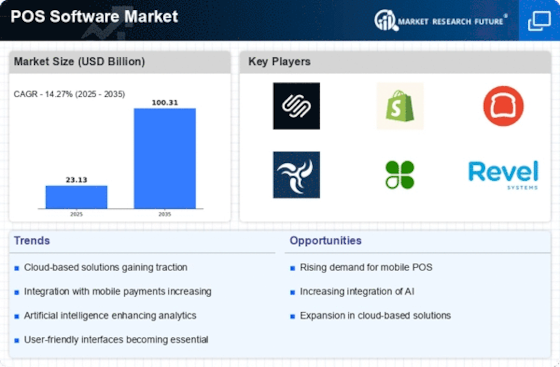
As per MRFR analysis, the POS Software Market Size was estimated at 23.13 USD Billion in 2024. The POS Software industry is projected to grow from 26.43 USD Billion in 2025 to 100.31 USD Billion by 2035, exhibiting a compound annual growth rate (CAGR) of 14.27 during the forecast period 2025 - 2035.

Key Market Trends & Highlights

The POS Software Market is experiencing robust growth driven by technological advancements and evolving consumer preferences.

  • Integration with e-commerce platforms is becoming increasingly prevalent, enhancing the functionality of POS systems.
  • There is a notable emphasis on data security, as businesses prioritize protecting customer information.
  • The adoption of cloud-based solutions is on the rise, with this segment being the largest in the market.
  • Rising demand for contactless payments and growth in the retail and hospitality sectors are key drivers propelling market expansion.

Market Size & Forecast

2024 Market Size 23.13 (USD Billion)
2035 Market Size 100.31 (USD Billion)
CAGR (2025 - 2035) 14.27%

Major Players

Square (US), Shopify (CA), Toast (US), Lightspeed (CA), Clover (US), Revel Systems (US), NCR (US), Epicor (US), Zettle (SE)

POS Software Market Trends

The POS Software Market is currently experiencing a transformative phase, driven by advancements in technology and changing consumer behaviors. Businesses are increasingly adopting integrated solutions that streamline operations, enhance customer experiences, and provide valuable insights through data analytics. This shift towards digitalization is not merely a trend but appears to be a fundamental change in how transactions are processed and managed. As organizations seek to improve efficiency and reduce operational costs, the demand for sophisticated POS systems that offer multi-channel capabilities is likely to grow. Moreover, the rise of mobile payment solutions and contactless transactions indicates a shift in consumer preferences, suggesting that convenience and speed are paramount in today's retail environment. Retailers are investing in POS systems that not only facilitate transactions but also integrate with inventory management and customer relationship management tools. This holistic approach may enhance customer loyalty and drive sales, positioning businesses to thrive in a competitive landscape. As the POS Software Market evolves, it seems poised to play a crucial role in shaping the future of commerce, adapting to the needs of both businesses and consumers alike.

Integration with E-commerce Platforms

The integration of POS systems with e-commerce platforms is becoming increasingly prevalent. This trend allows businesses to manage both online and offline sales seamlessly, providing a unified view of inventory and customer data. Such integration enhances operational efficiency and improves customer experience, as it enables retailers to offer consistent service across multiple channels.

Emphasis on Data Security

As cyber threats continue to evolve, the emphasis on data security within the POS Software Market is intensifying. Businesses are prioritizing solutions that offer robust security features to protect sensitive customer information. This focus on safeguarding data not only helps in compliance with regulations but also builds trust with consumers.

Adoption of Cloud-Based Solutions

The shift towards cloud-based POS systems is gaining momentum, as businesses seek flexibility and scalability. Cloud solutions allow for real-time data access and remote management, which can enhance decision-making processes. This trend indicates a move away from traditional on-premise systems, reflecting a broader acceptance of cloud technology in various sectors.

POS Software Market Drivers

Shift Towards Omnichannel Retailing

The POS Software Market is witnessing a shift towards omnichannel retailing, which is reshaping how businesses interact with customers. As consumers increasingly engage with brands across multiple channels, the need for integrated POS systems that can provide a seamless shopping experience is becoming paramount. This trend is supported by data indicating that businesses with omnichannel strategies retain an average of 89% of their customers, compared to 33% for those with weak omnichannel strategies. Consequently, retailers are investing in POS solutions that facilitate real-time inventory management and customer data integration across various platforms. This shift not only enhances customer satisfaction but also drives sales, making it a crucial driver in the POS Software Market.

Rising Demand for Contactless Payments

The POS Software Market is experiencing a notable surge in demand for contactless payment solutions. As consumers increasingly prefer the convenience and speed of contactless transactions, businesses are compelled to adapt their payment systems accordingly. This shift is evidenced by a significant increase in contactless payment transactions, which are projected to account for over 30% of total payment transactions by 2025. Consequently, POS software providers are enhancing their offerings to include advanced contactless payment capabilities, thereby driving growth in the industry. The integration of Near Field Communication (NFC) technology into POS systems is becoming a standard feature, allowing merchants to cater to evolving consumer preferences. This trend not only enhances customer satisfaction but also streamlines the checkout process, making it a critical driver in the POS Software Market.

Growth of Retail and Hospitality Sectors

The POS Software Market is significantly influenced by the expansion of the retail and hospitality sectors. As these industries continue to grow, the demand for efficient and reliable POS systems is expected to rise correspondingly. Recent data indicates that the retail sector alone is projected to reach a market size of over 5 trillion dollars by 2025, necessitating advanced POS solutions to manage transactions effectively. In the hospitality sector, the need for integrated POS systems that can handle reservations, orders, and payments seamlessly is becoming increasingly apparent. This growth is prompting businesses to invest in sophisticated POS software that can enhance operational efficiency and improve customer experiences. As a result, the POS Software Market is poised for substantial growth, driven by the evolving needs of these key sectors.

Regulatory Compliance and Data Protection

The POS Software Market is also driven by the increasing emphasis on regulatory compliance and data protection. With the rise in data breaches and cyber threats, businesses are under pressure to ensure that their POS systems comply with stringent security standards. Regulations such as the Payment Card Industry Data Security Standard (PCI DSS) mandate that businesses implement robust security measures to protect customer data. As a result, POS software providers are focusing on developing solutions that not only meet these compliance requirements but also enhance overall data security. This focus on regulatory compliance is likely to drive demand for advanced POS systems that offer integrated security features, thereby contributing to the growth of the POS Software Market.

Technological Advancements in POS Systems

Technological advancements are playing a pivotal role in shaping the POS Software Market. Innovations such as artificial intelligence, machine learning, and big data analytics are being integrated into POS systems, enabling businesses to gain valuable insights into customer behavior and sales trends. These technologies allow for more personalized customer experiences and improved inventory management, which are essential for maintaining competitiveness in the market. Furthermore, the introduction of mobile POS systems is transforming traditional retail environments, allowing for greater flexibility and efficiency. As businesses increasingly recognize the value of these technological enhancements, investment in advanced POS software is likely to escalate, further propelling the growth of the POS Software Market.

Market Segment Insights

POS Software Market Component Insights

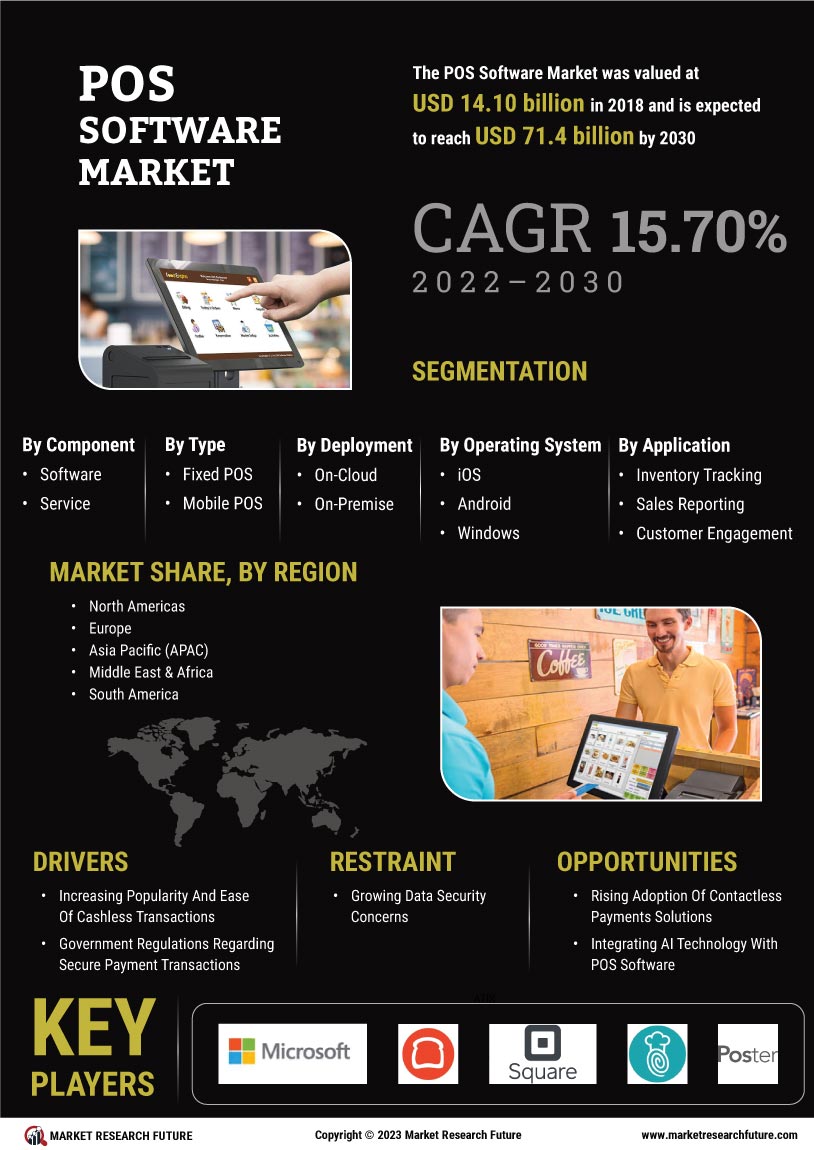
Based on the component, the global POS software market segmentation includes software and service. The service segment held the majority share in 2021, accounting for approximately 51-55% of the global POS software market revenue. The increasing demand for cloud-based systems is accelerating the segment's growth, providing numerous additional benefits such as on-demand services and flexibility. In addition, it also benefits the retailers to run their businesses anywhere via any mobile device services. POS services include payment services, along with management services, gateway services, and maintenance services.

These services help business clients as well as organizations by maximizing resource usage and streamlining marketing operations. SaaS, compared to traditional POS systems, is a partnership model with no up-front payments made as in the case of a traditional POS system. The monthly fees cover software, support, backups, and future upgrades.

Figure 2: POS software market, by technology, 2022 & 2030 (USD billion)

POS Software Market Deployment Insights

Based on deployment, the global POS software market segment includes on-cloud and on-premises. On-premise dominated the global market in 2021 and is expected to be the fastest-growing segment during the forecast period of 2022-2030 primarily due to data security and greater control offered by this deployment model. The large enterprises contributed to the high demand for on-premise deployment of POS software as they need separate front-end and back-end solutions to limit access to critical financial and business information. Moreover, the control over data and security concerns have compelled large enterprises to opt for on-premise software deployment.

Furthermore, the cloud deployment POS software is expected to exhibit the highest CAGR from 2023 to 2030. This growth is credited to the high demand due to low-cost deployment on the cloud, which enables the adaption of changing business landscape. The cloud-based deployment is ideal for small- and medium-sized businesses that require timely software up-gradation to support expanded business requirements. The cloud deployment offers remote access, affordable subscription-based pricing, endpoint security, sales management, and an all-in-one solution for inventory management.

POS Software Market Operating System Insights

The global POS software market segmentation, based on the operating system, includes iOS, android, and windows. The windows segment had the highest global market revenue share in 2021. Fixed systems are more secure in terms of data privacy, hence a popular choice among several end-users.

POS Software Market Application Insights

Based on the application, the global POS software market segment includes inventory tracking, sales reporting, purchasing management, and customer engagement. In 2021, the sales reporting segment held the highest market revenue share. The vast retail sector includes clothing, accessories, grocery, packaged product, electronics, and much more that require POS software as per the nature of the business function. The retail industry gradually shifted from brick-and-mortar stores to multi-channel (social media) and e-commerce retailing, thereby driving sales reporting POS software market revenue.

POS Software Market Type Insights

Based on type, the global POS software market segment includes fixed POS and mobile POS. Fixed POS dominated the global market in 2021 and is expected to be the fastest-growing segment during the forecast period of 2022-2030 owing to the increased preference among FSRs and QSRs. Fixed systems are more secure in terms of data privacy, hence a popular choice among several end-users.

Moreover, the introduction of wireless technology evolved the payment method and business operations. The POS software integrated on tablets or smartphones provides a quick payment option via apps without the need to connect local networks with the system. This ease of payment has propelled the segment's growth. Moreover, small businesses are adopting mobile POS due to its affordability, mobility, and broader application for payment processing and inventory & store management, contributing to the segment growth.

Get more detailed insights about POS Software Market

Regional Insights

North America : Innovation and Market Leadership

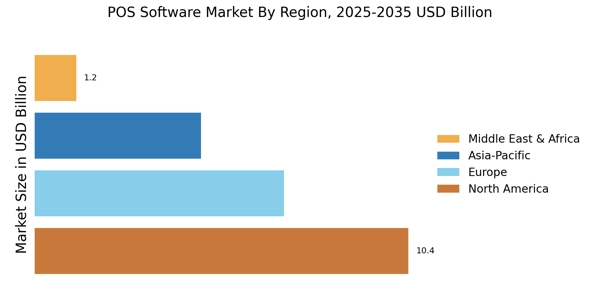
North America remains the largest market for POS software, accounting for approximately 45% of the global market share. The region's growth is driven by the increasing adoption of cloud-based solutions, the rise of e-commerce, and regulatory support for digital transactions. The demand for integrated payment solutions and enhanced customer experiences further fuels this growth, making it a hub for technological advancements in the retail sector. The United States leads the market, followed by Canada, with key players like Square, Toast, and Clover dominating the landscape. The competitive environment is characterized by continuous innovation and partnerships among technology providers and retailers. The presence of established companies and startups alike fosters a vibrant ecosystem, ensuring that North America remains at the forefront of POS software development.

Europe : Emerging Trends and Regulations

Europe is witnessing significant growth in the POS software market, holding approximately 30% of the global share. The region's expansion is driven by increasing consumer demand for seamless payment experiences and the implementation of regulations that promote digital transactions. The European Union's initiatives to enhance payment security and interoperability among payment systems are key catalysts for market growth, encouraging businesses to adopt advanced POS solutions. Leading countries in this region include the United Kingdom, Germany, and France, where companies like Shopify and Lightspeed are making substantial inroads. The competitive landscape is marked by a mix of established players and innovative startups, all vying for market share. The presence of diverse payment methods and a strong focus on customer experience further enhance the region's attractiveness for POS software solutions.

Asia-Pacific : Rapid Growth and Adoption

Asia-Pacific is rapidly emerging as a powerhouse in the POS software market, accounting for approximately 20% of the global share. The region's growth is fueled by the increasing penetration of smartphones, the rise of e-commerce, and a growing middle class that demands efficient payment solutions. Government initiatives aimed at promoting digital payments and financial inclusion are also significant drivers of market expansion, making it a vibrant landscape for POS software providers. Countries like China, India, and Australia are leading the charge, with a competitive landscape featuring both local and international players. Companies such as NCR and Revel Systems are establishing a strong presence, catering to diverse industries from retail to hospitality. The region's dynamic market conditions and evolving consumer preferences create ample opportunities for innovation and growth in the POS software sector.

Middle East and Africa : Untapped Potential and Growth

The Middle East and Africa (MEA) region is characterized by untapped potential in the POS software market, holding approximately 5% of the global share. The growth in this region is driven by increasing smartphone penetration, a shift towards cashless transactions, and government initiatives aimed at enhancing digital infrastructure. The demand for POS solutions is expected to rise as businesses seek to improve operational efficiency and customer engagement in a rapidly evolving market landscape. Leading countries include South Africa, UAE, and Nigeria, where the competitive landscape is becoming increasingly dynamic. Key players like Zettle and local startups are entering the market, offering tailored solutions to meet regional needs. The presence of diverse industries, from retail to hospitality, presents significant opportunities for growth and innovation in the POS software sector.

POS Software Market Regional Image

Key Players and Competitive Insights

The POS Software Market is currently characterized by a dynamic competitive landscape, driven by rapid technological advancements and evolving consumer preferences. Key players such as Square (US), Shopify (CA), and Toast (US) are strategically positioning themselves through innovation and digital transformation. Square (US) has focused on enhancing its payment processing capabilities, while Shopify (CA) has expanded its offerings to include integrated e-commerce solutions. Toast (US) has carved a niche in the restaurant sector, emphasizing tailored solutions that streamline operations. Collectively, these strategies not only enhance their market presence but also intensify competition, as companies vie for dominance in a landscape that is increasingly reliant on technology and customer-centric solutions.

In terms of business tactics, companies are increasingly localizing their operations and optimizing supply chains to enhance efficiency and responsiveness. The market appears moderately fragmented, with a mix of established players and emerging startups. This fragmentation allows for diverse offerings, yet the influence of key players remains substantial, as they set benchmarks for innovation and service quality that smaller competitors often strive to emulate.

In September 2025, Square (US) announced a partnership with a leading fintech firm to integrate advanced AI capabilities into its POS systems. This strategic move is likely to enhance transaction security and improve customer insights, positioning Square as a frontrunner in leveraging technology for operational efficiency. The integration of AI could potentially redefine user experiences, making transactions smoother and more secure, thereby attracting a broader customer base.

In August 2025, Shopify (CA) launched a new feature that allows merchants to utilize augmented reality (AR) in their POS systems. This initiative is indicative of Shopify's commitment to enhancing the retail experience through innovative technology. By enabling customers to visualize products in their own environments before purchase, Shopify is likely to increase conversion rates and customer satisfaction, thereby solidifying its competitive edge in the market.

In July 2025, Toast (US) expanded its service offerings by acquiring a leading inventory management software provider. This acquisition is strategically significant as it allows Toast to offer a more comprehensive solution to its restaurant clients, integrating inventory management with POS functionalities. Such a move not only enhances Toast's value proposition but also reflects a broader trend of consolidation in the market, where companies seek to provide all-in-one solutions to meet diverse customer needs.

As of October 2025, the competitive trends in the POS Software Market are increasingly defined by digitalization, sustainability, and the integration of AI technologies. Strategic alliances are becoming more prevalent, as companies recognize the value of collaboration in enhancing their service offerings and market reach. Looking ahead, competitive differentiation is likely to evolve from traditional price-based strategies to a focus on innovation, technological advancements, and supply chain reliability. This shift underscores the importance of adaptability and forward-thinking in a rapidly changing market environment.

Key Companies in the POS Software Market market include

Industry Developments

April 2022: Toast Inc launched a solution for Quick-Service Restaurants. This solution will help restaurants function their business across all activities, including Point of Sale (PoS), digital ordering, operations, and team management. Furthermore, this will help restaurants speed up processes, increase revenue, and deliver unique guest experiences.

April 2020: PAX Global Technology Limited launched its Android PayTablet, M8, with a fully-integrated Smart PoS payment processing system. This device is specifically designed for hospitality operators and high-end retailers wherein android apps for online orders, in-store checkout, and VAT refunds can run parallel with payment acceptance.

Future Outlook

POS Software Market Future Outlook

The POS Software Market is projected to grow at a 14.27% CAGR from 2024 to 2035, driven by technological advancements, increased digital payments, and enhanced customer experiences.

New opportunities lie in:

  • Integration of AI-driven analytics for personalized customer engagement.
  • Expansion into mobile POS solutions for small businesses.
  • Development of cloud-based POS systems for remote management.

By 2035, the POS Software Market is expected to be robust, reflecting substantial growth and innovation.

Market Segmentation

POS Software Market Type Outlook

  • Fixed POS
  • Mobile POS

POS Software Market Component Outlook

  • Software
  • Service

POS Software Market Deployment Outlook

  • On-Cloud
  • On-Premises

POS Software Market Application Outlook

  • Inventory Tracking
  • Sales Reporting
  • Purchasing Management
  • Customer Engagement

POS Software Market Operating System Outlook

  • iOS
  • Android
  • Windows

Report Scope

MARKET SIZE 2024 23.13(USD Billion)
MARKET SIZE 2025 26.43(USD Billion)
MARKET SIZE 2035 100.31(USD Billion)
COMPOUND ANNUAL GROWTH RATE (CAGR) 14.27% (2024 - 2035)
REPORT COVERAGE Revenue Forecast, Competitive Landscape, Growth Factors, and Trends
BASE YEAR 2024
Market Forecast Period 2025 - 2035
Historical Data 2019 - 2024
Market Forecast Units USD Billion
Key Companies Profiled Market analysis in progress
Segments Covered Market segmentation analysis in progress
Key Market Opportunities Integration of artificial intelligence and machine learning in the POS Software Market enhances customer experience and operational efficiency.
Key Market Dynamics Rising demand for integrated solutions drives innovation and competition in the POS Software Market.

Countries Covered North America, Europe, APAC, South America, MEA

Market Highlights

Author
Aarti Dhapte
Team Lead - Research

She holds an experience of about 6+ years in Market Research and Business Consulting, working under the spectrum of Information Communication Technology, Telecommunications and Semiconductor domains. Aarti conceptualizes and implements a scalable business strategy and provides strategic leadership to the clients. Her expertise lies in market estimation, competitive intelligence, pipeline analysis, customer assessment, etc.

Leave a Comment

FAQs

What is the current valuation of the POS Software Market as of 2024?

The POS Software Market was valued at 23.13 USD Billion in 2024.

What is the projected market size for the POS Software Market by 2035?

The market is projected to reach 100.31 USD Billion by 2035.

What is the expected CAGR for the POS Software Market during the forecast period 2025 - 2035?

The expected CAGR for the POS Software Market during 2025 - 2035 is 14.27%.

Which companies are considered key players in the POS Software Market?

Key players in the market include Square, Shopify, Toast, Lightspeed, Clover, Revel Systems, NCR, Epicor, and Zettle.

What are the main components of the POS Software Market?

The main components include Software, valued at 40.0 USD Billion, and Service, valued at 60.31 USD Billion.

How is the POS Software Market segmented by deployment type?

The market is segmented into On-Cloud, valued at 42.0 USD Billion, and On-Premises, valued at 58.31 USD Billion.

Download Free Sample

Kindly complete the form below to receive a free sample of this Report

Compare Licence

×
Features License Type
Single User Multiuser License Enterprise User
Price $4,950 $5,950 $7,250
Maximum User Access Limit 1 User Upto 10 Users Unrestricted Access Throughout the Organization
Free Customization
Direct Access to Analyst
Deliverable Format
Platform Access
Discount on Next Purchase 10% 15% 15%
Printable Versions