×
Request Free Sample ×

Kindly complete the form below to receive a free sample of this Report

* Please use a valid business email

Leading companies partner with us for data-driven Insights

clients tt-cursor
Hero Background
English
Chinese
French
Japanese
Korean
German
Spanish

Personal Services Robotics Market Trends

ID: MRFR/SEM/1824-HCR
100 Pages
Ankit Gupta
October 2025

Personal Service Robotics Market Size, Share and Research Report By Component (Hardware, Software), By Application (Cleaning Robot, Entertainment & Toy Robot, Education Robot, Handicap Assistance Robot, Companion Robot, Personal Transportation Robot, Security Robot), And By Region (North America, Europe, Asia-Pacific, And Rest Of The World) – Industry Forecast Till 2035

Share:
Download PDF ×

We do not share your information with anyone. However, we may send you emails based on your report interest from time to time. You may contact us at any time to opt-out.

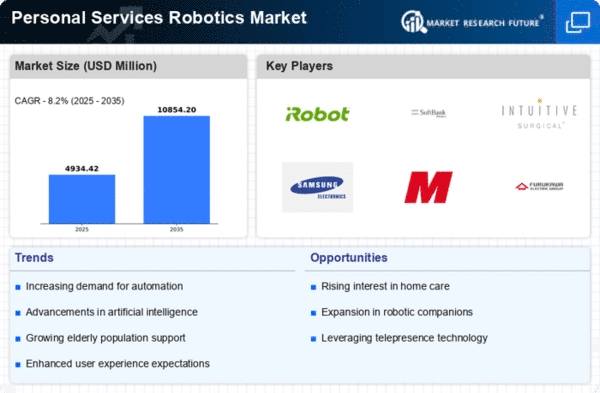
Personal Services Robotics Market Infographic
Purchase Options

Market Trends

Key Emerging Trends in the Personal Services Robotics Market

The growing incorporation of machine learning and artificial intelligence (AI) into personal service robots is one such development. These robots are programmed with capabilities that allow them to converse, identify emotions, and provide company, meeting the emotional and social requirements of their users. In response, businesses in the industry are providing modular designs that let users add or update features in accordance with their needs. This pattern indicates a move toward customized robotics solutions, in which consumers can design own robots to perform a range of functions, from housework to medical support. The creation of environmentally friendly robots is a growing phenomenon in the personal service robotics market, in response to the international push for sustainability. In order to develop robots with a less environmental impact, manufacturers place a strong emphasis on employing energy-efficient components and sustainable materials. Redefining the market is the decentralization of personal service robots, which is another noteworthy trend. Personal service robots have become more widely available and reasonably priced, meaning that their use is no longer restricted to niche niches. These robots are now accessible to a wider range of customers, including small businesses and individual consumers, thanks to the democratization movement. Because of its accessibility, the market is made more inclusive and a wider spectrum of users can take use of personal service robots' capabilities. Furthermore, there is a growing emphasis in the industry on human-robot collaboration, wherein robots are engineered to operate in harmony with humans. Cobots, or collaborative robots, are being researched to help with a variety of activities without endangering human safety. This tendency is especially noticeable in sectors like healthcare, where robots work beside medical professionals to improve patient care and optimize processes. To guarantee the appropriate use of data, manufacturers and programmers are proactively addressing these issues by putting in place comprehensive safety and privacy protocols. From the introduction of machine learning and AI to the creation of socially supportive robots, the industry is going through a revolutionary time. Customization, ecological responsibility, and democratization are highlighted, highlighting a market that is both technologically sophisticated and sensitive to the varied requirements and tastes of its customers.

Author
Ankit Gupta
Senior Research Analyst

Ankit Gupta is an analyst in market research industry in ICT and SEMI industry. With post-graduation in "Telecom and Marketing Management" and graduation in "Electronics and Telecommunication" vertical he is well versed with recent development in ICT industry as a whole. Having worked on more than 150+ reports including consultation for fortune 500 companies such as Microsoft and Rio Tinto in identifying solutions with respect to business problems his opinions are inclined towards mixture of technical and managerial aspects.

Leave a Comment

FAQs

How much is the Personal Service Robotics market?

The Personal Service Robotics Market size was valued at USD 4.56 billion in 2024.

What is the growth rate of the Personal Service Robotics market?

The Personal Service Robotics Market is projected to grow at a CAGR of 8.20% during the forecast period, 2025 to 2035.

Which Region held the largest market share in the Personal Service Robotics market?

North America had the largest share in the Personal Service Robotics Market.

Who are the key players in the Personal Service Robotics market?

The key players in the Personal Service Robotics market are Samsung Electronics Co. Ltd. (Korea), Hasbro Inc.(U.S.), Ecovacs Robotics Inc (China), ZMP Inc (Japan), Hansol Robotics Corp. (Korea), Neato Robotics Inc (U.S.), F&P Robotics AG(Switzerland), Segway Inc.(U.S.), Honda Motor Co Ltd. (Japan), iRobot Corporation (U.S.)

Which material led the Personal Service Robotics market?

The Non-adhesive category dominated the Personal Service Robotics market in 2022.

Which End-user had the largest market share in the Personal Service Robotics market?

Consumer electronics had the largest share in the Personal Service Robotics Market.

Market Summary

As per MRFR analysis, the Personal Services Robotics Market Size was estimated at 4560.46 USD Million in 2024. The Personal Services Robotics industry is projected to grow from 4934.51 USD Million in 2025 to 10854.2 USD Million by 2035, exhibiting a compound annual growth rate (CAGR) of 8.2 during the forecast period 2025 - 2035.

Key Market Trends & Highlights

The Personal Services Robotics Market is experiencing robust growth driven by technological advancements and changing consumer needs.

  • The market is witnessing increased adoption in healthcare, particularly in North America, which remains the largest market. Home automation is on the rise, especially in the Asia-Pacific region, which is recognized as the fastest-growing market. Customization and personalization are becoming focal points, with the domestic segment showing rapid growth. Key drivers include the growing aging population and rising consumer awareness, significantly impacting both healthcare facilities and residential segments.

Market Size & Forecast

2024 Market Size 4560.46 (USD Million)
2035 Market Size 10854.2 (USD Million)
CAGR (2025 - 2035) 8.2%
Largest Regional Market Share in 2024 North America

Major Players

iRobot (US), SoftBank Robotics (JP), Intuitive Surgical (US), Samsung Electronics (KR), Honda Motor Co (JP), Furukawa Electric Co (JP), LG Electronics (KR), Adept Technology (US), Blue Frog Robotics (FR)

Market Trends

The Personal Services Robotics Market is currently experiencing a transformative phase, characterized by rapid advancements in technology and increasing consumer acceptance. This sector encompasses a diverse range of robotic applications, including domestic assistance, healthcare support, and personal companionship. As societal needs evolve, the demand for robots that can perform tasks such as cleaning, cooking, and providing companionship appears to be on the rise. Furthermore, the integration of artificial intelligence and machine learning into these robots enhances their functionality, making them more adaptable to individual user preferences. In addition to technological advancements, the Personal Services Robotics Market is influenced by demographic shifts, particularly the aging population. As more individuals seek assistance with daily activities, the potential for robots to fill this gap becomes increasingly apparent. Moreover, the growing emphasis on convenience and efficiency in everyday life suggests that consumers are more inclined to embrace robotic solutions. This evolving landscape indicates a promising future for personal services robotics, where innovation and user-centric design will likely play pivotal roles in shaping market dynamics.

Increased Adoption in Healthcare

The Personal Services Robotics Market is witnessing a notable trend towards the adoption of robots in healthcare settings. These robots assist with tasks such as patient monitoring, medication delivery, and rehabilitation support. Their integration into healthcare systems appears to enhance efficiency and improve patient outcomes, thereby driving further interest in robotic solutions.

Rise of Home Automation

Another significant trend is the rise of home automation systems that incorporate personal service robots. These robots are designed to work seamlessly with smart home technologies, providing users with enhanced control over their living environments. This integration not only simplifies daily tasks but also promotes a more connected lifestyle.

Focus on Customization and Personalization

The Personal Services Robotics Market is increasingly focusing on customization and personalization of robotic solutions. Manufacturers are developing robots that can be tailored to meet the specific needs and preferences of users. This trend suggests a shift towards more user-centric designs, which may enhance user satisfaction and engagement.

Personal Services Robotics Market Market Drivers

Growing Demand for Automation

The Global Personal Service Robotics Market Industry experiences a surge in demand for automation across various sectors, including healthcare, hospitality, and domestic services. As consumers increasingly seek efficient solutions to enhance their daily lives, robots that can perform tasks such as cleaning, cooking, and caregiving are gaining traction. This trend is reflected in the market's projected growth, with a valuation of 4.56 USD Billion in 2024 and an anticipated increase to 10.9 USD Billion by 2035. The compound annual growth rate (CAGR) of 8.2% from 2025 to 2035 underscores the potential for innovation and investment in this sector.

Market Segment Insights

By Application: Healthcare (Largest) vs. Domestic (Fastest-Growing)

In the Personal Services Robotics Market, the application segments display a diverse distribution of capabilities and target demographics. Healthcare stands as the largest segment, driven by an increasing aging population and advancements in medical technology. Domestic applications, while not as extensive in overall market share, have been experiencing rapid growth as consumer interest in household automation and assistance rises. Other applications, such as entertainment and education, contribute to the market but with relatively smaller shares. The growth trends within the Personal Services Robotics Market suggest a notable shift towards domestic and elderly care applications. The demand for robots in healthcare continues to be strong, supported by innovations in surgical assistance and health monitoring. Meanwhile, technology, such as AI and machine learning, is the backbone of advancements in domestic robotics, enhancing interactivity and usability. Overall, the market is poised for expansion with an increase in consumer awareness and acceptance of personal robotics.

Healthcare: Robotics for Surgery (Dominant) vs. Domestic Cleaners (Emerging)

The Healthcare application of personal services robotics primarily focuses on surgical assistance, rehabilitation, and patient care, making it a dominant segment in the market. Robotics in surgery enhances precision and reduces recovery times, making them invaluable in modern healthcare settings. In contrast, domestic cleaners represent an emerging market, focusing on <a href="https://www.marketresearchfuture.com/reports/smart-home-automation-market-12426">home automation</a> and enhancing people's daily lives through convenience. These robots are equipped with advanced sensors and AI capabilities, allowing them to operate effectively in various home environments. As the consumer base grows, particularly among tech-savvy and busy families, domestic cleaners are expected to disrupt traditional cleaning paradigms and redefine household chores.

By End Use: Residential (Largest) vs. Healthcare Facilities (Fastest-Growing)

The Personal Services Robotics Market is primarily segmented into Residential, Commercial, Industrial, Healthcare Facilities, and Educational Institutions. Among these, the Residential segment holds the largest market share, as consumers increasingly adopt robotic solutions for home automation, companionship, and assistance with daily tasks. Meanwhile, Healthcare Facilities are rapidly emerging as a significant segment due to the growing demand for robotic assistance in surgical procedures, elder care, and rehabilitation processes.

Residential (Dominant) vs. Healthcare Facilities (Emerging)

The Residential segment dominates the Personal Services Robotics Market as it caters to a wide range of needs, such as cleaning, personal assistance, and security, appealing to tech-savvy households. As smart home technology advances, the integration of robots in daily life is becoming more commonplace, leading to increased adoption rates. Conversely, Healthcare Facilities represent the fastest-growing segment, driven by advancements in medical robotics and an aging population. Hospitals and clinics are leveraging robotics for applications like surgery, patient monitoring, and logistical support, indicating a trend towards automation in healthcare that enhances efficiency and patient care.

By Technology: Artificial Intelligence (Largest) vs. Natural Language Processing (Fastest-Growing)

The Personal Services Robotics Market is heavily influenced by various technology segments, most notably Artificial Intelligence (AI), which currently holds the largest market share. AI technologies are integral in making personal service robots more intuitive and responsive to human interactions, enhancing service quality significantly. Following AI is Sensor Technology, which plays a crucial role in enabling robots to perceive their environment, while Machine Learning and Computer Vision contribute to improving operational efficiency and user experience. Slowly emerging but gaining traction is Natural Language Processing (NLP), which is poised to reshape how humans interact with robots, fostering smoother communication. Growth trends in the Personal Services Robotics Market indicate a rising demand for more sophisticated robotic solutions, driven by advancements in AI and Machine Learning. The growing need for efficient home assistance, healthcare support, and quality personal services is propelling innovation within these technology segments. Notably, the increased investment in research and development, along with the integration of AI and NLP technologies, is making robots more adaptive and customizable, enhancing user engagement and overall satisfaction. As technology continues to evolve, segments like Natural Language Processing are rapidly gaining ground, indicating a shift towards more interactive and communicative robotic applications.

Technology: AI (Dominant) vs. NLP (Emerging)

Artificial Intelligence (AI) stands as the dominant force within the Personal Services Robotics Market due to its foundational role in automating tasks, enhancing operational capabilities, and enabling robots to perform complex interactions. Companies leveraging AI enjoy a competitive edge, connecting with consumers more effectively and improving user experience. On the other hand, Natural Language Processing (NLP) represents an emerging technology that enhances communication between humans and robots. As NLP matures, it's expected to facilitate more seamless and intuitive interactions in personal services like therapy bots and customer service assistants. The ongoing development in NLP technology not only opens up new application areas but also reflects the consumer shift towards robots that can understand and respond to verbal commands more naturally.

By Type: Service Robots (Largest) vs. Companion Robots (Fastest-Growing)

Within the Personal Services Robotics Market, the distribution of market share among various types reflects a growing demand for automation and assistance. Service Robots hold the largest share, primarily due to their extensive applications in hospitality, healthcare, and logistics. Conversely, Companion Robots, while currently smaller in market share, are gaining momentum due to increasing societal trends towards aging populations and the need for companionship. As consumer behavior evolves, growth trends indicate that Companion Robots are emerging as the fastest-growing segment within the market. This surge can be attributed to advancements in artificial intelligence and robotics technology, which enhance their capabilities and applications. Furthermore, the rising popularity of smart home devices and a greater emphasis on mental health and wellness drive the demand for interactive and intelligent companion solutions.

Service Robots (Dominant) vs. Companion Robots (Emerging)

Service Robots are positioned as the dominant category in the Personal Services Robotics Market, owing to their versatility and utility in diverse settings, including hospitals, restaurants, and retail environments. They are designed to perform specific tasks, such as cleaning, delivery, and assistance, helping to enhance operational efficiency and customer experience. On the other hand, Companion Robots represent an emerging trend, reflecting society's changing dynamics, particularly as it relates to companionship and emotional support. With features that allow for social interaction and personalized engagement, these robots are increasingly popular among families, elderly individuals, and in therapy contexts, addressing various emotional and psychological needs.

By Functionality: Cleaning (Largest) vs. Delivery (Fastest-Growing)

In the Personal Services Robotics Market, the functionality segment reveals a diversity of applications that serve various consumer needs. Cleaning robots currently dominate the market share, owing to their widespread adoption in both residential and commercial settings. This segment appeals to consumers looking for convenience and efficient cleaning solutions, leading to significant market presence compared to other functionalities. Monitoring, Assistance, and Companionship functionalities follow, each gaining traction as consumers increasingly embrace robotics for enhanced safety and companionship. Notably, the Delivery segment has emerged as the fastest-growing area, spurred by the rise in e-commerce and the need for last-mile delivery solutions. As technology advances, these functionalities are expected to see unique growth trajectories, shaped by consumer preferences and market demands.

Cleaning (Dominant) vs. Delivery (Emerging)

The Cleaning segment remains the dominant player in the Personal Services Robotics Market, showcasing advanced robotic technologies that facilitate everyday cleaning tasks efficiently. This segment benefits from years of market development and consumer trust, with devices designed for specialized cleaning functions, such as vacuuming and mopping. Meanwhile, the Delivery segment is rapidly emerging, driven by increasing consumer demand for convenience in package delivery, especially within urban areas. Innovations in autonomous navigation and robotic systems enable delivery robots to navigate complex environments, making them a promising solution for businesses looking to enhance service efficiency. The competitiveness of both segments illustrates the shifting dynamics in consumer needs, with Cleaning robots offering reliability and Delivery robots paving the way for convenience-oriented services.

Get more detailed insights about Personal Service Robotics Market Research Report- Global Forecast 2035

Regional Insights

North America : Innovation and Market Leadership

North America continues to dominate the Personal Services Robotics Market, holding a significant market share of $2280.23M in 2025. The region's growth is driven by technological advancements, increasing consumer demand for automation, and supportive regulatory frameworks. The rise in disposable income and a growing aging population further fuel the demand for personal robotics, particularly in healthcare and home assistance sectors. The competitive landscape is robust, with key players like iRobot, Intuitive Surgical, and Adept Technology leading the charge. The U.S. remains the largest market, supported by a strong focus on R&D and innovation. Companies are increasingly investing in AI and machine learning to enhance product capabilities, ensuring they meet the evolving needs of consumers. The presence of major tech firms and startups alike fosters a vibrant ecosystem for personal services robotics.

Europe : Emerging Market with Regulatory Support

Europe's Personal Services Robotics Market is projected to reach $1365.28M by 2025, driven by increasing investments in technology and a growing emphasis on automation across various sectors. The region benefits from favorable regulations that encourage innovation and the adoption of robotics in healthcare and domestic applications. The European Union's initiatives to promote smart technologies are pivotal in shaping market dynamics. Leading countries such as Germany, France, and the UK are at the forefront of this growth, with a strong presence of companies like Blue Frog Robotics and SoftBank Robotics. The competitive landscape is characterized by collaborations between tech firms and research institutions, enhancing product development. The focus on sustainability and energy efficiency in robotics is also gaining traction, aligning with broader EU goals for a greener economy.

Asia-Pacific : Rapid Growth and Adoption

The Asia-Pacific region is witnessing rapid growth in the Personal Services Robotics Market, projected to reach $765.14M by 2025. Factors such as urbanization, increasing disposable incomes, and a rising aging population are driving demand for personal robotics. Countries like Japan and South Korea are leading the charge, with significant investments in robotics technology and automation. Government initiatives aimed at enhancing technological capabilities further support market expansion. Japan, home to key players like SoftBank Robotics and Honda Motor Co, is a leader in robotics innovation. The competitive landscape is vibrant, with numerous startups emerging alongside established firms. The focus on healthcare robotics, particularly in elder care, is a significant trend, reflecting the region's demographic shifts and the need for innovative solutions to support an aging population.

Middle East and Africa : Untapped Potential and Growth

The Middle East and Africa region is gradually emerging in the Personal Services Robotics Market, with a projected size of $149.81M by 2025. The growth is driven by increasing investments in technology and a rising interest in automation across various sectors, including healthcare and hospitality. Governments are beginning to recognize the potential of robotics to enhance service delivery and efficiency, leading to supportive policies and initiatives. Countries like the UAE and South Africa are at the forefront of this growth, with a focus on integrating robotics into public services and healthcare. The competitive landscape is still developing, with opportunities for both local and international players. As awareness of robotics benefits increases, the market is expected to expand, driven by innovation and investment in technology.

Key Players and Competitive Insights

The Personal Services Robotics Market is currently characterized by a dynamic competitive landscape, driven by technological advancements and increasing consumer demand for automation in daily tasks. Key players such as iRobot (US), SoftBank Robotics (JP), and Intuitive Surgical (US) are at the forefront, each adopting distinct strategies to enhance their market presence. iRobot (US) focuses on innovation in home cleaning robots, emphasizing smart technology integration, while SoftBank Robotics (JP) is expanding its portfolio with humanoid robots aimed at customer service applications. Intuitive Surgical (US) continues to lead in the medical robotics sector, leveraging its expertise in minimally invasive surgical systems. Collectively, these strategies contribute to a competitive environment that is increasingly shaped by innovation and technological integration.
In terms of business tactics, companies are localizing manufacturing and optimizing supply chains to enhance efficiency and reduce costs. The market structure appears moderately fragmented, with several players vying for market share. However, the influence of major companies is substantial, as they set trends and standards that smaller firms often follow. This competitive structure fosters an environment where innovation is crucial for survival and growth.
In November 2025, iRobot (US) announced the launch of its latest robotic vacuum, which features advanced AI capabilities for improved navigation and cleaning efficiency. This strategic move is significant as it not only reinforces iRobot's commitment to innovation but also positions the company to capture a larger share of the growing smart home market. The integration of AI technology is likely to enhance user experience and operational efficiency, setting a new benchmark in the industry.
In October 2025, SoftBank Robotics (JP) unveiled a new partnership with a leading hospitality chain to deploy its humanoid robots for customer service roles. This collaboration is indicative of SoftBank's strategy to penetrate the service sector, where automation is increasingly being embraced. By leveraging its robotics technology in real-world applications, the company aims to enhance customer engagement and operational efficiency, potentially transforming the hospitality experience.
In September 2025, Intuitive Surgical (US) expanded its global footprint by entering into a joint venture with a European medical technology firm. This strategic alliance is poised to enhance Intuitive Surgical's capabilities in the European market, allowing for greater access to advanced surgical robotics. The partnership underscores the importance of collaboration in navigating regulatory landscapes and meeting diverse market needs.
As of December 2025, the competitive trends in the Personal Services Robotics Market are heavily influenced by digitalization, sustainability, and AI integration. Companies are increasingly forming strategic alliances to bolster their technological capabilities and market reach. The shift from price-based competition to a focus on innovation and technology is evident, as firms recognize that reliability in supply chains and cutting-edge solutions are paramount for differentiation. Looking ahead, it is likely that the competitive landscape will continue to evolve, with an emphasis on technological advancements and strategic partnerships shaping the future of the market.

Key Companies in the Personal Services Robotics Market include

Industry Developments

    • February 2020: Orpheus Medical supplies hospitals with information technology connections and competence in processing and preserving surgical footage; therefore, Intuitive Surgical purchased the company to expand its integrated informatics platform.

    • May 2022: In two locations in California, Uber Technologies Inc. began testing autonomous food delivery services. The business also disclosed a test program utilizing sidewalk robots and an autonomous vehicle-based food delivery service. Users in West Hollywood and Santa Monica, both in California, can use both services. The self-driving joint venture of Hyundai Motor Co. and Aptiv PLC, Motional, is working with the autonomous vehicle pilot project.

    • February 2022: To increase the capabilities of its digital process automation, Ricoh bought Axon Ivy AG as part of a strategic investment.

    • November 2021: Working together on the Smart Intelligence Robotic Project Cockpit was KUKA AG and MHP (SIRPCO).

Future Outlook

Personal Services Robotics Market Future Outlook

The Personal Services Robotics Market is projected to grow at an 8.2% CAGR from 2025 to 2035, driven by technological advancements, increasing demand for automation, and an aging population.

New opportunities lie in:

  • Development of AI-driven personal assistant robots for home care
  • Integration of robotics in hospitality services for enhanced customer experience
  • Expansion of telepresence robots in remote healthcare services

By 2035, the market is expected to be robust, reflecting substantial growth and innovation.

Market Segmentation

Personal Services Robotics Market Type Outlook

  • Humanoid Robots
  • Service Robots
  • Telepresence Robots
  • Companion Robots
  • Assistive Robots

Personal Services Robotics Market End Use Outlook

  • Residential
  • Commercial
  • Industrial
  • Healthcare Facilities
  • Educational Institutions

Personal Services Robotics Market Technology Outlook

  • Artificial Intelligence
  • Machine Learning
  • Sensor Technology
  • Natural Language Processing
  • Computer Vision

Personal Services Robotics Market Application Outlook

  • Healthcare
  • Domestic
  • Entertainment
  • Education
  • Elderly Care

Personal Services Robotics Market Functionality Outlook

  • Cleaning
  • Monitoring
  • Assistance
  • Companionship
  • Delivery

Report Scope

MARKET SIZE 2024 4560.46(USD Million)
MARKET SIZE 2025 4934.51(USD Million)
MARKET SIZE 2035 10854.2(USD Million)
COMPOUND ANNUAL GROWTH RATE (CAGR) 8.2% (2025 - 2035)
REPORT COVERAGE Revenue Forecast, Competitive Landscape, Growth Factors, and Trends
BASE YEAR 2024
Market Forecast Period 2025 - 2035
Historical Data 2019 - 2024
Market Forecast Units USD Million
Key Companies Profiled iRobot (US), SoftBank Robotics (JP), Intuitive Surgical (US), Samsung Electronics (KR), Honda Motor Co (JP), Furukawa Electric Co (JP), LG Electronics (KR), Adept Technology (US), Blue Frog Robotics (FR)
Segments Covered Application, End Use, Technology, Type, Functionality
Key Market Opportunities Integration of artificial intelligence enhances personalization in the Personal Services Robotics Market.
Key Market Dynamics Rising consumer demand for automation drives innovation and competition in the Personal Services Robotics Market.
Countries Covered North America, Europe, APAC, South America, MEA

FAQs

How much is the Personal Service Robotics market?

The Personal Service Robotics Market size was valued at USD 4.56 billion in 2024.

What is the growth rate of the Personal Service Robotics market?

The Personal Service Robotics Market is projected to grow at a CAGR of 8.20% during the forecast period, 2025 to 2035.

Which Region held the largest market share in the Personal Service Robotics market?

North America had the largest share in the Personal Service Robotics Market.

Who are the key players in the Personal Service Robotics market?

The key players in the Personal Service Robotics market are Samsung Electronics Co. Ltd. (Korea), Hasbro Inc.(U.S.), Ecovacs Robotics Inc (China), ZMP Inc (Japan), Hansol Robotics Corp. (Korea), Neato Robotics Inc (U.S.), F&amp;P Robotics AG(Switzerland), Segway Inc.(U.S.), Honda Motor Co Ltd. (Japan), iRobot Corporation (U.S.)

Which material led the Personal Service Robotics market?

The Non-adhesive category dominated the Personal Service Robotics market in 2022.

Which End-user had the largest market share in the Personal Service Robotics market?

Consumer electronics had the largest share in the Personal Service Robotics Market.

  1. SECTION I: EXECUTIVE SUMMARY AND KEY HIGHLIGHTS
    1. | 1.1 EXECUTIVE SUMMARY
    2. | 1.1.1 Market Overview
    3. | 1.1.2 Key Findings
    4. | 1.1.3 Market Segmentation
    5. | 1.1.4 Competitive Landscape
    6. | 1.1.5 Challenges and Opportunities
    7. | 1.1.6 Future Outlook
  2. SECTION II: SCOPING, METHODOLOGY AND MARKET STRUCTURE
    1. | 2.1 MARKET INTRODUCTION
    2. | 2.1.1 Definition
    3. | 2.1.2 Scope of the study
    4. |-- 2.1.2.1 Research Objective
    5. |-- 2.1.2.2 Assumption
    6. |-- 2.1.2.3 Limitations
    7. | 2.2 RESEARCH METHODOLOGY
    8. | 2.2.1 Overview
    9. | 2.2.2 Data Mining
    10. | 2.2.3 Secondary Research
    11. | 2.2.4 Primary Research
    12. |-- 2.2.4.1 Primary Interviews and Information Gathering Process
    13. |-- 2.2.4.2 Breakdown of Primary Respondents
    14. | 2.2.5 Forecasting Model
    15. | 2.2.6 Market Size Estimation
    16. |-- 2.2.6.1 Bottom-Up Approach
    17. |-- 2.2.6.2 Top-Down Approach
    18. | 2.2.7 Data Triangulation
    19. | 2.2.8 Validation
  3. SECTION III: QUALITATIVE ANALYSIS
    1. | 3.1 MARKET DYNAMICS
    2. | 3.1.1 Overview
    3. | 3.1.2 Drivers
    4. | 3.1.3 Restraints
    5. | 3.1.4 Opportunities
    6. | 3.2 MARKET FACTOR ANALYSIS
    7. | 3.2.1 Value chain Analysis
    8. | 3.2.2 Porter's Five Forces Analysis
    9. |-- 3.2.2.1 Bargaining Power of Suppliers
    10. |-- 3.2.2.2 Bargaining Power of Buyers
    11. |-- 3.2.2.3 Threat of New Entrants
    12. |-- 3.2.2.4 Threat of Substitutes
    13. |-- 3.2.2.5 Intensity of Rivalry
    14. | 3.2.3 COVID-19 Impact Analysis
    15. |-- 3.2.3.1 Market Impact Analysis
    16. |-- 3.2.3.2 Regional Impact
    17. |-- 3.2.3.3 Opportunity and Threat Analysis
  4. SECTION IV: QUANTITATIVE ANALYSIS
    1. | 4.1 Semiconductor & Electronics, BY Application (USD Million)
    2. | 4.1.1 Healthcare
    3. | 4.1.2 Domestic
    4. | 4.1.3 Entertainment
    5. | 4.1.4 Education
    6. | 4.1.5 Elderly Care
    7. | 4.2 Semiconductor & Electronics, BY End Use (USD Million)
    8. | 4.2.1 Residential
    9. | 4.2.2 Commercial
    10. | 4.2.3 Industrial
    11. | 4.2.4 Healthcare Facilities
    12. | 4.2.5 Educational Institutions
    13. | 4.3 Semiconductor & Electronics, BY Technology (USD Million)
    14. | 4.3.1 Artificial Intelligence
    15. | 4.3.2 Machine Learning
    16. | 4.3.3 Sensor Technology
    17. | 4.3.4 Natural Language Processing
    18. | 4.3.5 Computer Vision
    19. | 4.4 Semiconductor & Electronics, BY Type (USD Million)
    20. | 4.4.1 Humanoid Robots
    21. | 4.4.2 Service Robots
    22. | 4.4.3 Telepresence Robots
    23. | 4.4.4 Companion Robots
    24. | 4.4.5 Assistive Robots
    25. | 4.5 Semiconductor & Electronics, BY Functionality (USD Million)
    26. | 4.5.1 Cleaning
    27. | 4.5.2 Monitoring
    28. | 4.5.3 Assistance
    29. | 4.5.4 Companionship
    30. | 4.5.5 Delivery
    31. | 4.6 Semiconductor & Electronics, BY Region (USD Million)
    32. | 4.6.1 North America
    33. |-- 4.6.1.1 US
    34. |-- 4.6.1.2 Canada
    35. | 4.6.2 Europe
    36. |-- 4.6.2.1 Germany
    37. |-- 4.6.2.2 UK
    38. |-- 4.6.2.3 France
    39. |-- 4.6.2.4 Russia
    40. |-- 4.6.2.5 Italy
    41. |-- 4.6.2.6 Spain
    42. |-- 4.6.2.7 Rest of Europe
    43. | 4.6.3 APAC
    44. |-- 4.6.3.1 China
    45. |-- 4.6.3.2 India
    46. |-- 4.6.3.3 Japan
    47. |-- 4.6.3.4 South Korea
    48. |-- 4.6.3.5 Malaysia
    49. |-- 4.6.3.6 Thailand
    50. |-- 4.6.3.7 Indonesia
    51. |-- 4.6.3.8 Rest of APAC
    52. | 4.6.4 South America
    53. |-- 4.6.4.1 Brazil
    54. |-- 4.6.4.2 Mexico
    55. |-- 4.6.4.3 Argentina
    56. |-- 4.6.4.4 Rest of South America
    57. | 4.6.5 MEA
    58. |-- 4.6.5.1 GCC Countries
    59. |-- 4.6.5.2 South Africa
    60. |-- 4.6.5.3 Rest of MEA
  5. SECTION V: COMPETITIVE ANALYSIS
    1. | 5.1 Competitive Landscape
    2. | 5.1.1 Overview
    3. | 5.1.2 Competitive Analysis
    4. | 5.1.3 Market share Analysis
    5. | 5.1.4 Major Growth Strategy in the Semiconductor & Electronics
    6. | 5.1.5 Competitive Benchmarking
    7. | 5.1.6 Leading Players in Terms of Number of Developments in the Semiconductor & Electronics
    8. | 5.1.7 Key developments and growth strategies
    9. |-- 5.1.7.1 New Product Launch/Service Deployment
    10. |-- 5.1.7.2 Merger & Acquisitions
    11. |-- 5.1.7.3 Joint Ventures
    12. | 5.1.8 Major Players Financial Matrix
    13. |-- 5.1.8.1 Sales and Operating Income
    14. |-- 5.1.8.2 Major Players R&D Expenditure. 2023
    15. | 5.2 Company Profiles
    16. | 5.2.1 iRobot (US)
    17. |-- 5.2.1.1 Financial Overview
    18. |-- 5.2.1.2 Products Offered
    19. |-- 5.2.1.3 Key Developments
    20. |-- 5.2.1.4 SWOT Analysis
    21. |-- 5.2.1.5 Key Strategies
    22. | 5.2.2 SoftBank Robotics (JP)
    23. |-- 5.2.2.1 Financial Overview
    24. |-- 5.2.2.2 Products Offered
    25. |-- 5.2.2.3 Key Developments
    26. |-- 5.2.2.4 SWOT Analysis
    27. |-- 5.2.2.5 Key Strategies
    28. | 5.2.3 Intuitive Surgical (US)
    29. |-- 5.2.3.1 Financial Overview
    30. |-- 5.2.3.2 Products Offered
    31. |-- 5.2.3.3 Key Developments
    32. |-- 5.2.3.4 SWOT Analysis
    33. |-- 5.2.3.5 Key Strategies
    34. | 5.2.4 Samsung Electronics (KR)
    35. |-- 5.2.4.1 Financial Overview
    36. |-- 5.2.4.2 Products Offered
    37. |-- 5.2.4.3 Key Developments
    38. |-- 5.2.4.4 SWOT Analysis
    39. |-- 5.2.4.5 Key Strategies
    40. | 5.2.5 Honda Motor Co (JP)
    41. |-- 5.2.5.1 Financial Overview
    42. |-- 5.2.5.2 Products Offered
    43. |-- 5.2.5.3 Key Developments
    44. |-- 5.2.5.4 SWOT Analysis
    45. |-- 5.2.5.5 Key Strategies
    46. | 5.2.6 Furukawa Electric Co (JP)
    47. |-- 5.2.6.1 Financial Overview
    48. |-- 5.2.6.2 Products Offered
    49. |-- 5.2.6.3 Key Developments
    50. |-- 5.2.6.4 SWOT Analysis
    51. |-- 5.2.6.5 Key Strategies
    52. | 5.2.7 LG Electronics (KR)
    53. |-- 5.2.7.1 Financial Overview
    54. |-- 5.2.7.2 Products Offered
    55. |-- 5.2.7.3 Key Developments
    56. |-- 5.2.7.4 SWOT Analysis
    57. |-- 5.2.7.5 Key Strategies
    58. | 5.2.8 Adept Technology (US)
    59. |-- 5.2.8.1 Financial Overview
    60. |-- 5.2.8.2 Products Offered
    61. |-- 5.2.8.3 Key Developments
    62. |-- 5.2.8.4 SWOT Analysis
    63. |-- 5.2.8.5 Key Strategies
    64. | 5.2.9 Blue Frog Robotics (FR)
    65. |-- 5.2.9.1 Financial Overview
    66. |-- 5.2.9.2 Products Offered
    67. |-- 5.2.9.3 Key Developments
    68. |-- 5.2.9.4 SWOT Analysis
    69. |-- 5.2.9.5 Key Strategies
    70. | 5.3 Appendix
    71. | 5.3.1 References
    72. | 5.3.2 Related Reports

Semiconductor & Electronics Market Segmentation

Semiconductor & Electronics By Application (USD Million, 2025-2035)

  • Healthcare
  • Domestic
  • Entertainment
  • Education
  • Elderly Care

Semiconductor & Electronics By End Use (USD Million, 2025-2035)

  • Residential
  • Commercial
  • Industrial
  • Healthcare Facilities
  • Educational Institutions

Semiconductor & Electronics By Technology (USD Million, 2025-2035)

  • Artificial Intelligence
  • Machine Learning
  • Sensor Technology
  • Natural Language Processing
  • Computer Vision

Semiconductor & Electronics By Type (USD Million, 2025-2035)

  • Humanoid Robots
  • Service Robots
  • Telepresence Robots
  • Companion Robots
  • Assistive Robots

Semiconductor & Electronics By Functionality (USD Million, 2025-2035)

  • Cleaning
  • Monitoring
  • Assistance
  • Companionship
  • Delivery
Infographic

Free Sample Request

Kindly complete the form below to receive a free sample of this Report

Get Free Sample

Customer Strories

Compare Licence

×
Features License Type
Single User Multiuser License Enterprise User
Price $4,950 $5,950 $7,250
Maximum User Access Limit 1 User Upto 10 Users Unrestricted Access Throughout the Organization
Free Customization
Direct Access to Analyst
Deliverable Format
Platform Access
Discount on Next Purchase 10% 15% 15%
Printable Versions