
Request Free Sample ×

Kindly complete the form below to receive a free sample of this Report

* Please use a valid business email

Leading companies partner with us for data-driven Insights

clients tt-cursor
Hero Background
English
Chinese
French
Japanese
Korean
German
Spanish

PC as a Service Market Analysis

ID: MRFR/ICT/4919-CR
115 Pages
Ankit Gupta
July 2019

Personal Computer as a Service (PCaaS) Market Research Report Information By Organization Size (SMEs and Large Enterprises), By Component (Hardware and Software), By Vertical (BFSI, Government, Education, Healthcare & Life Science, and IT & Telecommunication), And By Region (North America, Europe, Asia-Pacific, And Rest Of The World) – Market Forecast Till 2035

Share:
Download PDF ×

We do not share your information with anyone. However, we may send you emails based on your report interest from time to time. You may contact us at any time to opt-out.

PC as a Service Market Infographic
Purchase Options

Market Analysis

In-depth Analysis of PC as a Service Market Industry Landscape

The market dynamics of PC as a Service (PCaaS) represent a complex interplay of various factors that shape its growth, trends, and competitiveness. PCaaS, a subscription-based model offering PCs and associated services, has witnessed a significant surge in demand owing to its cost-effectiveness, flexibility, and scalability. One of the key drivers propelling the growth of the PCaaS market is the increasing adoption of cloud computing and as-a-service models across industries. Businesses are increasingly gravitating towards opex-centric models that alleviate the burden of upfront capital expenditure, making PCaaS an attractive proposition. Moreover, the evolving workforce dynamics, characterized by remote and hybrid work setups, have fueled the demand for PCaaS solutions that enable seamless access to computing resources from anywhere, anytime.

The competitive landscape of the PCaaS market is marked by intense rivalry among established players and new entrants vying for market share. Established technology giants, including Dell, HP, and Lenovo, have been actively expanding their PCaaS portfolios to capitalize on the growing demand. Simultaneously, niche players and startups are leveraging innovative pricing models and value-added services to carve out a niche in the market. This competitive intensity has led to constant innovation, with vendors striving to differentiate their offerings through enhanced security features, advanced management capabilities, and customized service packages tailored to specific industry verticals.

Customer preferences and requirements play a pivotal role in shaping the trajectory of the PCaaS market. Organizations across diverse sectors, ranging from healthcare and education to finance and retail, are increasingly turning to PCaaS solutions to address their evolving IT needs. The appeal of PCaaS lies in its ability to offer a holistic solution encompassing hardware procurement, software provisioning, deployment, maintenance, and support, thereby freeing up IT resources to focus on strategic initiatives. Furthermore, the scalability inherent in PCaaS models enables businesses to align their computing infrastructure with fluctuating demand, thereby optimizing resource utilization and operational efficiency.

Regulatory compliance and data security concerns exert a significant influence on the PCaaS market dynamics. With stringent data protection regulations such as GDPR and CCPA in place, organizations are prioritizing vendors that adhere to robust security protocols and compliance standards. Consequently, vendors offering PCaaS solutions with built-in security features, data encryption, and regulatory compliance certifications gain a competitive edge in the market. Additionally, the emergence of edge computing and IoT ecosystems necessitates PCaaS solutions that can seamlessly integrate with distributed computing environments while ensuring data integrity and confidentiality.

The evolving technological landscape, characterized by advancements in virtualization, artificial intelligence, and 5G connectivity, presents both opportunities and challenges for the PCaaS market. Virtual desktop infrastructure (VDI) and desktop-as-a-service (DaaS) solutions are gaining traction as organizations seek to centralize management, enhance data security, and facilitate remote collaboration. Moreover, the proliferation of AI-driven analytics and predictive maintenance capabilities enables PCaaS providers to offer proactive monitoring and optimization services, thereby enhancing the overall user experience and reducing downtime.

Market consolidation and strategic partnerships are prevalent trends shaping the PCaaS market dynamics. Mergers, acquisitions, and alliances among key players enable them to broaden their product portfolios, expand market reach, and achieve economies of scale. Furthermore, collaborations between PCaaS providers and software vendors, cloud service providers, and managed service providers foster innovation and enable seamless integration of complementary technologies. These strategic alliances enable organizations to leverage best-of-breed solutions tailored to their specific requirements, thereby driving adoption and fueling market growth.

The global COVID-19 pandemic has exerted a profound impact on the PCaaS market dynamics, accelerating the shift towards remote work and digital transformation initiatives. Organizations compelled to enable remote workforces overnight turned to PCaaS solutions to rapidly provision, deploy, and manage remote computing resources at scale. This surge in demand for PCaaS solutions is expected to persist in the post-pandemic era as businesses embrace hybrid work models and prioritize resilience, agility, and flexibility in their IT infrastructure.


Author
Author Profile
Ankit Gupta
Team Lead - Research

Ankit Gupta is a seasoned market intelligence and strategic research professional with over six plus years of experience in the ICT and Semiconductor industries. With academic roots in Telecom, Marketing, and Electronics, he blends technical insight with business strategy. Ankit has led 200+ projects, including work for Fortune 500 clients like Microsoft and Rio Tinto, covering market sizing, tech forecasting, and go-to-market strategies. Known for bridging engineering and enterprise decision-making, his insights support growth, innovation, and investment planning across diverse technology markets.

Leave a Comment

FAQs

What is the projected market valuation for the Personal Computer as a Service (PCaaS) market by 2035?

<p>The projected market valuation for the PCaaS market by 2035 is 20.41 USD Billion.</p>

What was the overall market valuation of the PCaaS market in 2024?

<p>The overall market valuation of the PCaaS market in 2024 was 0.3551 USD Billion.</p>

What is the expected compound annual growth rate (CAGR) for the PCaaS market from 2025 to 2035?

<p>The expected CAGR for the PCaaS market during the forecast period 2025 - 2035 is 44.53%.</p>

Which organization size segments are included in the PCaaS market analysis?

<p>The PCaaS market analysis includes segments for SMEs, valued at 0.1065 USD Billion, and Large Enterprises, valued at 0.2486 USD Billion.</p>

What are the key components analyzed in the PCaaS market?

<p>The key components analyzed in the PCaaS market are Hardware, valued at 0.2131 USD Billion, and Software, valued at 0.142 USD Billion.</p>

Which verticals are contributing to the PCaaS market growth?

<p>The verticals contributing to the PCaaS market growth include BFSI, Government, Education, Healthcare & Life Science, and IT & Telecommunication.</p>

What is the valuation of the IT & Telecommunication segment in the PCaaS market?

<p>The valuation of the IT & Telecommunication segment in the PCaaS market is 0.1391 USD Billion.</p>

Who are the key players in the PCaaS market?

<p>Key players in the PCaaS market include HP Inc., Dell Technologies, Lenovo Group, Microsoft Corporation, and Apple Inc.</p>

What is the valuation of the Government segment in the PCaaS market?

<p>The valuation of the Government segment in the PCaaS market is 0.0535 USD Billion.</p>

How does the PCaaS market's growth potential compare to its current valuation?

<p>The PCaaS market's growth potential appears substantial, with a projected increase from 0.3551 USD Billion in 2024 to 20.41 USD Billion by 2035.</p>

Market Summary

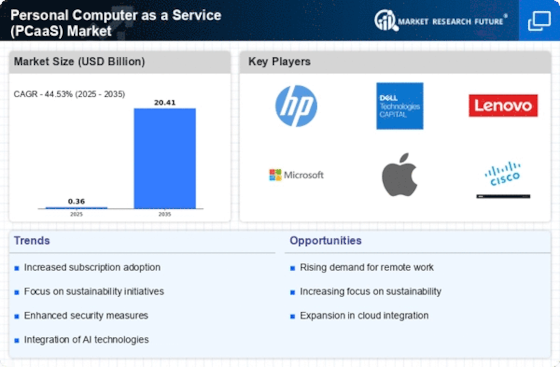
As per Market Research Future analysis, the Personal Computer as a Service (PCaaS) Market Size was estimated at 0.3551 USD Billion in 2024. The PCaaS industry is projected to grow from USD 0.5132 Billion in 2025 to USD 20.41 Billion by 2035, exhibiting a compound annual growth rate (CAGR) of 44.53% during the forecast period 2025 - 2035

Key Market Trends & Highlights

The Personal Computer as a Service (PCaaS) market is experiencing robust growth driven by evolving business needs and technological advancements.

  • The adoption of subscription models for PCs is increasing, particularly among small and medium enterprises in North America. Security and compliance are becoming paramount as organizations integrate PCaaS with cloud services, especially in the Asia-Pacific region. Large enterprises are rapidly embracing PCaaS solutions, while the software segment is witnessing the fastest growth in this market. Cost efficiency and enhanced flexibility are key drivers propelling the PCaaS market forward, as businesses seek to optimize IT management.

Market Size & Forecast

2024 Market Size 0.3551 (USD Billion)
2035 Market Size 20.41 (USD Billion)
CAGR (2025 - 2035) 44.53%
Largest Regional Market Share in 2024 North America

Major Players

HP Inc. (US), Dell Technologies (US), Lenovo Group (CN), Microsoft Corporation (US), Apple Inc. (US), Cisco Systems (US), Fujitsu Limited (JP), Atos SE (FR), Wipro Limited (IN)

Market Trends

The Personal Computer as a Service (PCaaS) Market is currently experiencing a transformative phase, driven by the increasing demand for flexible computing solutions. Organizations are increasingly recognizing the advantages of adopting PCaaS models, which offer a subscription-based approach to hardware and software provisioning. This shift allows businesses to optimize their IT expenditures while ensuring access to the latest technology without the burden of ownership. As companies seek to enhance operational efficiency, the appeal of PCaaS continues to grow, particularly among small and medium-sized enterprises that may lack the resources for large-scale IT investments. Moreover, the ongoing evolution of remote work practices is influencing the landscape of the Personal Computer as a Service (PCaaS) Market. With a greater emphasis on mobility and collaboration, organizations are looking for solutions that can seamlessly integrate with their existing workflows. This trend suggests that PCaaS providers must adapt their offerings to meet the diverse needs of their clients, potentially leading to more customized and scalable solutions. As the market matures, the focus on security, support, and user experience is likely to become increasingly paramount, shaping the future direction of this innovative service model.

Increased Adoption of Subscription Models

The trend towards subscription-based services is gaining traction within the Personal Computer as a Service (PCaaS) Market. Organizations are increasingly opting for flexible payment structures that allow them to manage costs more effectively while accessing the latest technology.

Focus on Security and Compliance

As businesses migrate to PCaaS solutions, there is a heightened emphasis on security and compliance. Providers are likely to enhance their offerings to ensure that data protection and regulatory requirements are met, thereby fostering trust among clients.

Integration with Cloud Services

The integration of PCaaS with cloud services is becoming more prevalent. This trend indicates a shift towards hybrid solutions that combine the benefits of on-premises hardware with the scalability and flexibility of cloud computing.

PC as a Service Market Market Drivers

Enhanced Flexibility and Scalability

The Personal Computer as a Service (PCaaS) Market offers enhanced flexibility and scalability, which are crucial for modern businesses. Organizations can easily adjust their computing resources based on fluctuating demands, allowing them to respond swiftly to market changes. This adaptability is particularly beneficial for companies experiencing growth or seasonal variations in workload. The ability to scale up or down without the need for significant capital investment is a key driver for many enterprises. Data indicates that businesses utilizing PCaaS can increase or decrease their device count by as much as 50% within a short timeframe, ensuring that they only pay for what they need. This level of flexibility not only supports operational efficiency but also aligns with the dynamic nature of today’s business environment.

Cost Efficiency and Budget Management

The Personal Computer as a Service (PCaaS) Market is increasingly appealing to organizations seeking cost efficiency. By adopting PCaaS, businesses can convert capital expenditures into predictable operational expenses. This shift allows for better budget management, as companies can allocate funds more effectively without the burden of large upfront costs associated with traditional hardware purchases. According to recent data, organizations that have transitioned to PCaaS report a reduction in IT costs by up to 30%. This financial flexibility is particularly attractive to small and medium-sized enterprises, which often face tighter budgets. Furthermore, the ability to scale services according to demand enhances financial predictability, making PCaaS a compelling option for organizations aiming to optimize their financial resources.

Streamlined IT Management and Support

The Personal Computer as a Service (PCaaS) Market simplifies IT management and support, which is a significant driver for many organizations. With PCaaS, businesses can offload the complexities of hardware maintenance, software updates, and technical support to service providers. This allows internal IT teams to focus on strategic initiatives rather than day-to-day operational tasks. Data indicates that organizations utilizing PCaaS can reduce their IT support workload by up to 40%, leading to improved service delivery and faster response times. Additionally, the centralized management of devices ensures that all systems are up-to-date and secure, minimizing the risk of cyber threats. This streamlined approach not only enhances operational efficiency but also contributes to a more secure IT environment.

Sustainability and Environmental Considerations

The Personal Computer as a Service (PCaaS) Market is increasingly aligned with sustainability and environmental considerations. As organizations become more aware of their ecological footprint, the demand for sustainable IT solutions is rising. PCaaS providers often implement recycling programs and energy-efficient technologies, which contribute to reduced electronic waste and lower energy consumption. This focus on sustainability is not only beneficial for the environment but also enhances corporate social responsibility initiatives. Data suggests that companies adopting PCaaS can reduce their carbon emissions by up to 25% compared to traditional IT procurement methods. This alignment with sustainability goals is becoming a key differentiator for businesses, as consumers and stakeholders increasingly favor environmentally responsible practices.

Focus on Employee Productivity and Collaboration

The Personal Computer as a Service (PCaaS) Market is increasingly recognized for its potential to enhance employee productivity and collaboration. By providing employees with the latest technology and tools, organizations can foster a more efficient work environment. PCaaS solutions often include integrated collaboration tools and software, which facilitate seamless communication among team members. Research suggests that companies leveraging PCaaS experience a productivity increase of approximately 20%, as employees are equipped with devices that meet their needs. This focus on productivity is particularly relevant in a competitive landscape where organizations strive to attract and retain top talent. By investing in PCaaS, companies not only improve operational efficiency but also create a more engaging workplace culture.

Market Segment Insights

By Organization Size: SMEs (Largest) vs. Large Enterprises (Fastest-Growing)

<p>In the Personal Computer as a Service (PCaaS) market, Small and Medium Enterprises (SMEs) represent the largest share of the overall market. This segment benefits from the flexibility and cost-effective solutions that PCaaS offers, allowing SMEs to optimize their technology expenditures without the burden of large upfront investments. On the other hand, Large Enterprises are emerging as the fastest-growing segment, driven by their increasing needs for scalable and customizable IT solutions that enhance efficiency and productivity across various departments.</p>

<p>Organization Size: SMEs (Dominant) vs. Large Enterprises (Emerging)</p>

<p>SMEs dominate the PCaaS market primarily due to their demand for budget-friendly technology solutions that allow for easy management and maintenance. These organizations often face the challenge of limited resources, making PCaaS an attractive option that facilitates access to high-quality computing resources without upfront costs. Conversely, Large Enterprises are characterized by their ability to leverage PCaaS solutions to foster innovation and operational efficiency. With a focus on digital transformation, they are adopting these services at a rapid pace, enhancing their agility in responding to market demands, thereby establishing a significant foothold in this evolving landscape.</p>

By Component: Hardware (Largest) vs. Software (Fastest-Growing)

<p>The Personal Computer as a Service (PCaaS) market is primarily driven by the hardware component, which holds the largest share of the market. This segment includes essential physical equipment such as processing units, storage devices, and peripherals. Meanwhile, the software segment, crucial for enhancing the functionality and productivity of PCaaS offerings, is rapidly gaining prominence and is now recognized as the fastest-growing segment within the market. Businesses are increasingly investing in innovative software solutions to enhance user experience and operational efficiency.</p>

<p>Component: Hardware (Dominant) vs. Software (Emerging)</p>

<p>The hardware segment remains the dominant component of the PCaaS market, characterized by its robust demand for various devices that offer reliable performance and versatility. Companies leverage advanced hardware to meet diverse consumer needs, from basic office tasks to high-performance computing. Conversely, the software segment is emerging dynamically, focusing on subscription-based models and cloud computing solutions. With heightened emphasis on remote work and collaboration tools, software is becoming increasingly integral to PCaaS, enabling enhanced resource management and seamless user experiences. As organizations seek to harness the flexibility and scalability offered by software solutions, this segment is poised for significant growth in the coming years.</p>

By Vertical: BFSI (Largest) vs. Government (Fastest-Growing)

<p>In the Personal Computer as a Service (PCaaS) market, the distribution among verticals reveals that the Banking, Financial Services, and Insurance (BFSI) sector holds a dominant position due to its extensive reliance on technology and secure computing environments. This segment benefits from the need for robust IT infrastructure, data security, and scalability, allowing BFSI to leverage PCaaS solutions for enhanced efficiency and agility. On the other hand, the Government sector is rapidly growing, reflecting increased digital transformation initiatives and the adoption of flexible IT solutions to improve service delivery and operational efficiency. Government entities are actively pursuing PCaaS to modernize their IT assets and foster innovation in public service.</p>

<p>BFSI (Dominant) vs. Government (Emerging)</p>

<p>The BFSI sector is characterized by its significant technological investments and stringent regulatory requirements, making it a natural fit for the PCaaS model. Organizations in this vertical prioritize high security, compliance, and data management capabilities, driving demand for customized PCaaS solutions that can cater to these needs. Conversely, the Government sector is witnessing an emerging trend toward the adoption of PCaaS as agencies seek to reduce overhead costs and enhance operational efficiency. This trend is fueled by the need for modernization in IT infrastructure, with a focus on providing seamless access to technology for public servants and citizens alike. The government's push for innovation and improved public service delivery positions it as a compelling arena for PCaaS growth.</p>

Get more detailed insights about Personal Computer as a Service (PCaaS) Market Research Report - Global Forecast till 2035

Regional Insights

North America : Tech Innovation Leader

North America is the largest market for Personal Computer as a Service (PCaaS), holding approximately 45% of the global market share. The region's growth is driven by increasing demand for flexible IT solutions, remote work trends, and significant investments in cloud technologies. Regulatory support for digital transformation initiatives further catalyzes market expansion, making it a hub for innovation and technology adoption. The competitive landscape in North America is robust, featuring key players such as HP Inc., Dell Technologies, and Microsoft Corporation. These companies leverage advanced technologies and strategic partnerships to enhance their service offerings. The presence of a well-established IT infrastructure and a high concentration of tech-savvy consumers contribute to the region's leading position in the PCaaS market.

Europe : Emerging Market Dynamics

Europe is witnessing a significant shift towards Personal Computer as a Service (PCaaS), capturing around 30% of the global market share. The region's growth is fueled by increasing digitalization efforts, regulatory frameworks promoting sustainable IT practices, and a rising demand for remote work solutions. Countries like Germany and the UK are at the forefront, driving innovation and adoption of PCaaS models across various sectors. Leading countries in Europe include Germany, the UK, and France, where major players like Atos SE and Fujitsu Limited are actively expanding their services. The competitive landscape is characterized by a mix of established firms and emerging startups, all vying to meet the growing demand for flexible and scalable IT solutions. The European market is also influenced by stringent data protection regulations, which shape service offerings and customer expectations.

Asia-Pacific : Rapid Growth Potential

Asia-Pacific is rapidly emerging as a significant player in the Personal Computer as a Service (PCaaS) market, holding approximately 20% of the global market share. The region's growth is driven by increasing urbanization, a burgeoning middle class, and a strong push towards digital transformation across various industries. Countries like China and India are leading this growth, supported by favorable government policies and investments in technology infrastructure. The competitive landscape in Asia-Pacific is diverse, with key players such as Lenovo Group and Wipro Limited making substantial inroads. The presence of a large consumer base and a growing demand for flexible IT solutions are propelling the adoption of PCaaS. Additionally, local startups are emerging, contributing to innovation and competition in the market, further enhancing the region's growth trajectory.

Middle East and Africa : Untapped Market Opportunities

The Middle East and Africa (MEA) region is gradually recognizing the potential of Personal Computer as a Service (PCaaS), currently holding about 5% of the global market share. The growth in this region is driven by increasing investments in technology infrastructure, a rising demand for remote work solutions, and government initiatives aimed at digital transformation. Countries like South Africa and the UAE are leading the charge, focusing on enhancing their IT capabilities. The competitive landscape in MEA is still developing, with a mix of local and international players entering the market. Companies are increasingly focusing on providing tailored solutions to meet the unique needs of businesses in the region. The presence of key players, along with a growing awareness of the benefits of PCaaS, is expected to drive further growth and adoption in the coming years.

Key Players and Competitive Insights

The presence of some key players, including HP, Fujitsu, and AWS, has led to intense competition among the players in the PCaaS market. Their capacity to continuously innovate their products has given them a competitive edge over rivals. Moreover, significant investments in research and development, business alliances, and mergers and acquisitions have facilitated them to expand their market footprint.

Dell Inc is a technology company based in the United States. It creates, sells, repairs, and maintains computers, services, and products. Dell PC as a Service Market (PCaaS) streamlines PC management. It integrates hardware, software, full life cycle services, and financing into a single comprehensive solution. Dell Technologies and Microsoft expanded their partnership in April 2019 to address a broader range of customer needs and aid in accelerating digital transformations. The companies wanted to provide a fully native, supported & certified VMware cloud infrastructure on Microsoft Azure, so they worked together to make that happen.

Furthermore, through cloud-based integration with Microsoft Intune and Azure Active Directory, joint Microsoft 365 & VMware Workspace ONE customers could manage Office 365 across devices.

CompuCom Systems collaborates with businesses across all industries to provide advanced technological solutions that assist their digital workplaces.

In August CompuCom and Office Depot collaborated to offer small and mid-sized businesses a range of IT hardware and service options to support their remote workplaces. Companies with 50 to 1,500 users can take advantage of various services, such as remote IT support, on-site hardware & software repair, and environmentally friendly IT equipment disposal.

Key Companies in the PC as a Service Market include

Industry Developments

April 2021: Lenovo's Intelligent Devices Group in North America has created a new device-as-a-service offering tailored to the needs of small and medium-sized businesses.

June 2019: HP and Xerox Corporation announced their expansion and agreed to collaborate in the Device as a Service market. This collaboration is intended to reach out to small and medium-sized businesses.

Future Outlook

PC as a Service Market Future Outlook

The Personal Computer as a Service (PCaaS) market is projected to grow at a 44.53% CAGR from 2025 to 2035, driven by increasing demand for flexible IT solutions and remote work capabilities.

New opportunities lie in:

  • Development of subscription-based hardware upgrade programs
  • Integration of AI-driven analytics for user experience optimization
  • Expansion into emerging markets with tailored service packages

By 2035, the PCaaS market is expected to be a dominant force in IT service delivery.

Market Segmentation

PC as a Service Market Vertical Outlook

  • BFSI
  • Government
  • Education
  • Healthcare & Life Science
  • IT & Telecommunication

PC as a Service Market Component Outlook

  • Hardware
  • Software

PC as a Service Market Organization Size Outlook

  • SMEs
  • Large Enterprises

Report Scope

MARKET SIZE 2024 0.3551(USD Billion)
MARKET SIZE 2025 0.5132(USD Billion)
MARKET SIZE 2035 20.41(USD Billion)
COMPOUND ANNUAL GROWTH RATE (CAGR) 44.53% (2025 - 2035)
REPORT COVERAGE Revenue Forecast, Competitive Landscape, Growth Factors, and Trends
BASE YEAR 2024
Market Forecast Period 2025 - 2035
Historical Data 2019 - 2024
Market Forecast Units USD Billion
Key Companies Profiled HP Inc. (US), Dell Technologies (US), Lenovo Group (CN), Microsoft Corporation (US), Apple Inc. (US), Cisco Systems (US), Fujitsu Limited (JP), Atos SE (FR), Wipro Limited (IN)
Segments Covered Organization Size, Component, Vertical, Region
Key Market Opportunities Growing demand for flexible IT solutions drives expansion in the Personal Computer as a Service (PCaaS) Market.
Key Market Dynamics Rising demand for flexible IT solutions drives growth in the Personal Computer as a Service market.
Countries Covered North America, Europe, APAC, South America, MEA

FAQs

What is the projected market valuation for the Personal Computer as a Service (PCaaS) market by 2035?

<p>The projected market valuation for the PCaaS market by 2035 is 20.41 USD Billion.</p>

What was the overall market valuation of the PCaaS market in 2024?

<p>The overall market valuation of the PCaaS market in 2024 was 0.3551 USD Billion.</p>

What is the expected compound annual growth rate (CAGR) for the PCaaS market from 2025 to 2035?

<p>The expected CAGR for the PCaaS market during the forecast period 2025 - 2035 is 44.53%.</p>

Which organization size segments are included in the PCaaS market analysis?

<p>The PCaaS market analysis includes segments for SMEs, valued at 0.1065 USD Billion, and Large Enterprises, valued at 0.2486 USD Billion.</p>

What are the key components analyzed in the PCaaS market?

<p>The key components analyzed in the PCaaS market are Hardware, valued at 0.2131 USD Billion, and Software, valued at 0.142 USD Billion.</p>

Which verticals are contributing to the PCaaS market growth?

<p>The verticals contributing to the PCaaS market growth include BFSI, Government, Education, Healthcare & Life Science, and IT & Telecommunication.</p>

What is the valuation of the IT & Telecommunication segment in the PCaaS market?

<p>The valuation of the IT & Telecommunication segment in the PCaaS market is 0.1391 USD Billion.</p>

Who are the key players in the PCaaS market?

<p>Key players in the PCaaS market include HP Inc., Dell Technologies, Lenovo Group, Microsoft Corporation, and Apple Inc.</p>

What is the valuation of the Government segment in the PCaaS market?

<p>The valuation of the Government segment in the PCaaS market is 0.0535 USD Billion.</p>

How does the PCaaS market's growth potential compare to its current valuation?

<p>The PCaaS market's growth potential appears substantial, with a projected increase from 0.3551 USD Billion in 2024 to 20.41 USD Billion by 2035.</p>

  1. SECTION I: EXECUTIVE SUMMARY AND KEY HIGHLIGHTS
    1. | 1.1 EXECUTIVE SUMMARY
    2. | | 1.1.1 Market Overview
    3. | | 1.1.2 Key Findings
    4. | | 1.1.3 Market Segmentation
    5. | | 1.1.4 Competitive Landscape
    6. | | 1.1.5 Challenges and Opportunities
    7. | | 1.1.6 Future Outlook
  2. SECTION II: SCOPING, METHODOLOGY AND MARKET STRUCTURE
    1. | 2.1 MARKET INTRODUCTION
    2. | | 2.1.1 Definition
    3. | | 2.1.2 Scope of the study
    4. | | | 2.1.2.1 Research Objective
    5. | | | 2.1.2.2 Assumption
    6. | | | 2.1.2.3 Limitations
    7. | 2.2 RESEARCH METHODOLOGY
    8. | | 2.2.1 Overview
    9. | | 2.2.2 Data Mining
    10. | | 2.2.3 Secondary Research
    11. | | 2.2.4 Primary Research
    12. | | | 2.2.4.1 Primary Interviews and Information Gathering Process
    13. | | | 2.2.4.2 Breakdown of Primary Respondents
    14. | | 2.2.5 Forecasting Model
    15. | | 2.2.6 Market Size Estimation
    16. | | | 2.2.6.1 Bottom-Up Approach
    17. | | | 2.2.6.2 Top-Down Approach
    18. | | 2.2.7 Data Triangulation
    19. | | 2.2.8 Validation
  3. SECTION III: QUALITATIVE ANALYSIS
    1. | 3.1 MARKET DYNAMICS
    2. | | 3.1.1 Overview
    3. | | 3.1.2 Drivers
    4. | | 3.1.3 Restraints
    5. | | 3.1.4 Opportunities
    6. | 3.2 MARKET FACTOR ANALYSIS
    7. | | 3.2.1 Value chain Analysis
    8. | | 3.2.2 Porter's Five Forces Analysis
    9. | | | 3.2.2.1 Bargaining Power of Suppliers
    10. | | | 3.2.2.2 Bargaining Power of Buyers
    11. | | | 3.2.2.3 Threat of New Entrants
    12. | | | 3.2.2.4 Threat of Substitutes
    13. | | | 3.2.2.5 Intensity of Rivalry
    14. | | 3.2.3 COVID-19 Impact Analysis
    15. | | | 3.2.3.1 Market Impact Analysis
    16. | | | 3.2.3.2 Regional Impact
    17. | | | 3.2.3.3 Opportunity and Threat Analysis
  4. SECTION IV: QUANTITATIVE ANALYSIS
    1. | 4.1 Information and Communications Technology, BY Organization Size (USD Billion)
    2. | | 4.1.1 SMEs
    3. | | 4.1.2 Large Enterprises
    4. | 4.2 Information and Communications Technology, BY Component (USD Billion)
    5. | | 4.2.1 Hardware
    6. | | 4.2.2 Software
    7. | 4.3 Information and Communications Technology, BY Vertical (USD Billion)
    8. | | 4.3.1 BFSI
    9. | | 4.3.2 Government
    10. | | 4.3.3 Education
    11. | | 4.3.4 Healthcare & Life Science
    12. | | 4.3.5 IT & Telecommunication
    13. | 4.4 Information and Communications Technology, BY Region (USD Billion)
    14. | | 4.4.1 North America
    15. | | | 4.4.1.1 US
    16. | | | 4.4.1.2 Canada
    17. | | 4.4.2 Europe
    18. | | | 4.4.2.1 Germany
    19. | | | 4.4.2.2 UK
    20. | | | 4.4.2.3 France
    21. | | | 4.4.2.4 Russia
    22. | | | 4.4.2.5 Italy
    23. | | | 4.4.2.6 Spain
    24. | | | 4.4.2.7 Rest of Europe
    25. | | 4.4.3 APAC
    26. | | | 4.4.3.1 China
    27. | | | 4.4.3.2 India
    28. | | | 4.4.3.3 Japan
    29. | | | 4.4.3.4 South Korea
    30. | | | 4.4.3.5 Malaysia
    31. | | | 4.4.3.6 Thailand
    32. | | | 4.4.3.7 Indonesia
    33. | | | 4.4.3.8 Rest of APAC
    34. | | 4.4.4 South America
    35. | | | 4.4.4.1 Brazil
    36. | | | 4.4.4.2 Mexico
    37. | | | 4.4.4.3 Argentina
    38. | | | 4.4.4.4 Rest of South America
    39. | | 4.4.5 MEA
    40. | | | 4.4.5.1 GCC Countries
    41. | | | 4.4.5.2 South Africa
    42. | | | 4.4.5.3 Rest of MEA
  5. SECTION V: COMPETITIVE ANALYSIS
    1. | 5.1 Competitive Landscape
    2. | | 5.1.1 Overview
    3. | | 5.1.2 Competitive Analysis
    4. | | 5.1.3 Market share Analysis
    5. | | 5.1.4 Major Growth Strategy in the Information and Communications Technology
    6. | | 5.1.5 Competitive Benchmarking
    7. | | 5.1.6 Leading Players in Terms of Number of Developments in the Information and Communications Technology
    8. | | 5.1.7 Key developments and growth strategies
    9. | | | 5.1.7.1 New Product Launch/Service Deployment
    10. | | | 5.1.7.2 Merger & Acquisitions
    11. | | | 5.1.7.3 Joint Ventures
    12. | | 5.1.8 Major Players Financial Matrix
    13. | | | 5.1.8.1 Sales and Operating Income
    14. | | | 5.1.8.2 Major Players R&D Expenditure. 2023
    15. | 5.2 Company Profiles
    16. | | 5.2.1 HP Inc. (US)
    17. | | | 5.2.1.1 Financial Overview
    18. | | | 5.2.1.2 Products Offered
    19. | | | 5.2.1.3 Key Developments
    20. | | | 5.2.1.4 SWOT Analysis
    21. | | | 5.2.1.5 Key Strategies
    22. | | 5.2.2 Dell Technologies (US)
    23. | | | 5.2.2.1 Financial Overview
    24. | | | 5.2.2.2 Products Offered
    25. | | | 5.2.2.3 Key Developments
    26. | | | 5.2.2.4 SWOT Analysis
    27. | | | 5.2.2.5 Key Strategies
    28. | | 5.2.3 Lenovo Group (CN)
    29. | | | 5.2.3.1 Financial Overview
    30. | | | 5.2.3.2 Products Offered
    31. | | | 5.2.3.3 Key Developments
    32. | | | 5.2.3.4 SWOT Analysis
    33. | | | 5.2.3.5 Key Strategies
    34. | | 5.2.4 Microsoft Corporation (US)
    35. | | | 5.2.4.1 Financial Overview
    36. | | | 5.2.4.2 Products Offered
    37. | | | 5.2.4.3 Key Developments
    38. | | | 5.2.4.4 SWOT Analysis
    39. | | | 5.2.4.5 Key Strategies
    40. | | 5.2.5 Apple Inc. (US)
    41. | | | 5.2.5.1 Financial Overview
    42. | | | 5.2.5.2 Products Offered
    43. | | | 5.2.5.3 Key Developments
    44. | | | 5.2.5.4 SWOT Analysis
    45. | | | 5.2.5.5 Key Strategies
    46. | | 5.2.6 Cisco Systems (US)
    47. | | | 5.2.6.1 Financial Overview
    48. | | | 5.2.6.2 Products Offered
    49. | | | 5.2.6.3 Key Developments
    50. | | | 5.2.6.4 SWOT Analysis
    51. | | | 5.2.6.5 Key Strategies
    52. | | 5.2.7 Fujitsu Limited (JP)
    53. | | | 5.2.7.1 Financial Overview
    54. | | | 5.2.7.2 Products Offered
    55. | | | 5.2.7.3 Key Developments
    56. | | | 5.2.7.4 SWOT Analysis
    57. | | | 5.2.7.5 Key Strategies
    58. | | 5.2.8 Atos SE (FR)
    59. | | | 5.2.8.1 Financial Overview
    60. | | | 5.2.8.2 Products Offered
    61. | | | 5.2.8.3 Key Developments
    62. | | | 5.2.8.4 SWOT Analysis
    63. | | | 5.2.8.5 Key Strategies
    64. | | 5.2.9 Wipro Limited (IN)
    65. | | | 5.2.9.1 Financial Overview
    66. | | | 5.2.9.2 Products Offered
    67. | | | 5.2.9.3 Key Developments
    68. | | | 5.2.9.4 SWOT Analysis
    69. | | | 5.2.9.5 Key Strategies
    70. | 5.3 Appendix
    71. | | 5.3.1 References
    72. | | 5.3.2 Related Reports
  6. LIST OF FIGURES
    1. | 6.1 MARKET SYNOPSIS
    2. | 6.2 NORTH AMERICA MARKET ANALYSIS
    3. | 6.3 US MARKET ANALYSIS BY ORGANIZATION SIZE
    4. | 6.4 US MARKET ANALYSIS BY COMPONENT
    5. | 6.5 US MARKET ANALYSIS BY VERTICAL
    6. | 6.6 CANADA MARKET ANALYSIS BY ORGANIZATION SIZE
    7. | 6.7 CANADA MARKET ANALYSIS BY COMPONENT
    8. | 6.8 CANADA MARKET ANALYSIS BY VERTICAL
    9. | 6.9 EUROPE MARKET ANALYSIS
    10. | 6.10 GERMANY MARKET ANALYSIS BY ORGANIZATION SIZE
    11. | 6.11 GERMANY MARKET ANALYSIS BY COMPONENT
    12. | 6.12 GERMANY MARKET ANALYSIS BY VERTICAL
    13. | 6.13 UK MARKET ANALYSIS BY ORGANIZATION SIZE
    14. | 6.14 UK MARKET ANALYSIS BY COMPONENT
    15. | 6.15 UK MARKET ANALYSIS BY VERTICAL
    16. | 6.16 FRANCE MARKET ANALYSIS BY ORGANIZATION SIZE
    17. | 6.17 FRANCE MARKET ANALYSIS BY COMPONENT
    18. | 6.18 FRANCE MARKET ANALYSIS BY VERTICAL
    19. | 6.19 RUSSIA MARKET ANALYSIS BY ORGANIZATION SIZE
    20. | 6.20 RUSSIA MARKET ANALYSIS BY COMPONENT
    21. | 6.21 RUSSIA MARKET ANALYSIS BY VERTICAL
    22. | 6.22 ITALY MARKET ANALYSIS BY ORGANIZATION SIZE
    23. | 6.23 ITALY MARKET ANALYSIS BY COMPONENT
    24. | 6.24 ITALY MARKET ANALYSIS BY VERTICAL
    25. | 6.25 SPAIN MARKET ANALYSIS BY ORGANIZATION SIZE
    26. | 6.26 SPAIN MARKET ANALYSIS BY COMPONENT
    27. | 6.27 SPAIN MARKET ANALYSIS BY VERTICAL
    28. | 6.28 REST OF EUROPE MARKET ANALYSIS BY ORGANIZATION SIZE
    29. | 6.29 REST OF EUROPE MARKET ANALYSIS BY COMPONENT
    30. | 6.30 REST OF EUROPE MARKET ANALYSIS BY VERTICAL
    31. | 6.31 APAC MARKET ANALYSIS
    32. | 6.32 CHINA MARKET ANALYSIS BY ORGANIZATION SIZE
    33. | 6.33 CHINA MARKET ANALYSIS BY COMPONENT
    34. | 6.34 CHINA MARKET ANALYSIS BY VERTICAL
    35. | 6.35 INDIA MARKET ANALYSIS BY ORGANIZATION SIZE
    36. | 6.36 INDIA MARKET ANALYSIS BY COMPONENT
    37. | 6.37 INDIA MARKET ANALYSIS BY VERTICAL
    38. | 6.38 JAPAN MARKET ANALYSIS BY ORGANIZATION SIZE
    39. | 6.39 JAPAN MARKET ANALYSIS BY COMPONENT
    40. | 6.40 JAPAN MARKET ANALYSIS BY VERTICAL
    41. | 6.41 SOUTH KOREA MARKET ANALYSIS BY ORGANIZATION SIZE
    42. | 6.42 SOUTH KOREA MARKET ANALYSIS BY COMPONENT
    43. | 6.43 SOUTH KOREA MARKET ANALYSIS BY VERTICAL
    44. | 6.44 MALAYSIA MARKET ANALYSIS BY ORGANIZATION SIZE
    45. | 6.45 MALAYSIA MARKET ANALYSIS BY COMPONENT
    46. | 6.46 MALAYSIA MARKET ANALYSIS BY VERTICAL
    47. | 6.47 THAILAND MARKET ANALYSIS BY ORGANIZATION SIZE
    48. | 6.48 THAILAND MARKET ANALYSIS BY COMPONENT
    49. | 6.49 THAILAND MARKET ANALYSIS BY VERTICAL
    50. | 6.50 INDONESIA MARKET ANALYSIS BY ORGANIZATION SIZE
    51. | 6.51 INDONESIA MARKET ANALYSIS BY COMPONENT
    52. | 6.52 INDONESIA MARKET ANALYSIS BY VERTICAL
    53. | 6.53 REST OF APAC MARKET ANALYSIS BY ORGANIZATION SIZE
    54. | 6.54 REST OF APAC MARKET ANALYSIS BY COMPONENT
    55. | 6.55 REST OF APAC MARKET ANALYSIS BY VERTICAL
    56. | 6.56 SOUTH AMERICA MARKET ANALYSIS
    57. | 6.57 BRAZIL MARKET ANALYSIS BY ORGANIZATION SIZE
    58. | 6.58 BRAZIL MARKET ANALYSIS BY COMPONENT
    59. | 6.59 BRAZIL MARKET ANALYSIS BY VERTICAL
    60. | 6.60 MEXICO MARKET ANALYSIS BY ORGANIZATION SIZE
    61. | 6.61 MEXICO MARKET ANALYSIS BY COMPONENT
    62. | 6.62 MEXICO MARKET ANALYSIS BY VERTICAL
    63. | 6.63 ARGENTINA MARKET ANALYSIS BY ORGANIZATION SIZE
    64. | 6.64 ARGENTINA MARKET ANALYSIS BY COMPONENT
    65. | 6.65 ARGENTINA MARKET ANALYSIS BY VERTICAL
    66. | 6.66 REST OF SOUTH AMERICA MARKET ANALYSIS BY ORGANIZATION SIZE
    67. | 6.67 REST OF SOUTH AMERICA MARKET ANALYSIS BY COMPONENT
    68. | 6.68 REST OF SOUTH AMERICA MARKET ANALYSIS BY VERTICAL
    69. | 6.69 MEA MARKET ANALYSIS
    70. | 6.70 GCC COUNTRIES MARKET ANALYSIS BY ORGANIZATION SIZE
    71. | 6.71 GCC COUNTRIES MARKET ANALYSIS BY COMPONENT
    72. | 6.72 GCC COUNTRIES MARKET ANALYSIS BY VERTICAL
    73. | 6.73 SOUTH AFRICA MARKET ANALYSIS BY ORGANIZATION SIZE
    74. | 6.74 SOUTH AFRICA MARKET ANALYSIS BY COMPONENT
    75. | 6.75 SOUTH AFRICA MARKET ANALYSIS BY VERTICAL
    76. | 6.76 REST OF MEA MARKET ANALYSIS BY ORGANIZATION SIZE
    77. | 6.77 REST OF MEA MARKET ANALYSIS BY COMPONENT
    78. | 6.78 REST OF MEA MARKET ANALYSIS BY VERTICAL
    79. | 6.79 KEY BUYING CRITERIA OF INFORMATION AND COMMUNICATIONS TECHNOLOGY
    80. | 6.80 RESEARCH PROCESS OF MRFR
    81. | 6.81 DRO ANALYSIS OF INFORMATION AND COMMUNICATIONS TECHNOLOGY
    82. | 6.82 DRIVERS IMPACT ANALYSIS: INFORMATION AND COMMUNICATIONS TECHNOLOGY
    83. | 6.83 RESTRAINTS IMPACT ANALYSIS: INFORMATION AND COMMUNICATIONS TECHNOLOGY
    84. | 6.84 SUPPLY / VALUE CHAIN: INFORMATION AND COMMUNICATIONS TECHNOLOGY
    85. | 6.85 INFORMATION AND COMMUNICATIONS TECHNOLOGY, BY ORGANIZATION SIZE, 2024 (% SHARE)
    86. | 6.86 INFORMATION AND COMMUNICATIONS TECHNOLOGY, BY ORGANIZATION SIZE, 2024 TO 2035 (USD Billion)
    87. | 6.87 INFORMATION AND COMMUNICATIONS TECHNOLOGY, BY COMPONENT, 2024 (% SHARE)
    88. | 6.88 INFORMATION AND COMMUNICATIONS TECHNOLOGY, BY COMPONENT, 2024 TO 2035 (USD Billion)
    89. | 6.89 INFORMATION AND COMMUNICATIONS TECHNOLOGY, BY VERTICAL, 2024 (% SHARE)
    90. | 6.90 INFORMATION AND COMMUNICATIONS TECHNOLOGY, BY VERTICAL, 2024 TO 2035 (USD Billion)
    91. | 6.91 BENCHMARKING OF MAJOR COMPETITORS
  7. LIST OF TABLES
    1. | 7.1 LIST OF ASSUMPTIONS
    2. | | 7.1.1
    3. | 7.2 North America MARKET SIZE ESTIMATES; FORECAST
    4. | | 7.2.1 BY ORGANIZATION SIZE, 2025-2035 (USD Billion)
    5. | | 7.2.2 BY COMPONENT, 2025-2035 (USD Billion)
    6. | | 7.2.3 BY VERTICAL, 2025-2035 (USD Billion)
    7. | 7.3 US MARKET SIZE ESTIMATES; FORECAST
    8. | | 7.3.1 BY ORGANIZATION SIZE, 2025-2035 (USD Billion)
    9. | | 7.3.2 BY COMPONENT, 2025-2035 (USD Billion)
    10. | | 7.3.3 BY VERTICAL, 2025-2035 (USD Billion)
    11. | 7.4 Canada MARKET SIZE ESTIMATES; FORECAST
    12. | | 7.4.1 BY ORGANIZATION SIZE, 2025-2035 (USD Billion)
    13. | | 7.4.2 BY COMPONENT, 2025-2035 (USD Billion)
    14. | | 7.4.3 BY VERTICAL, 2025-2035 (USD Billion)
    15. | 7.5 Europe MARKET SIZE ESTIMATES; FORECAST
    16. | | 7.5.1 BY ORGANIZATION SIZE, 2025-2035 (USD Billion)
    17. | | 7.5.2 BY COMPONENT, 2025-2035 (USD Billion)
    18. | | 7.5.3 BY VERTICAL, 2025-2035 (USD Billion)
    19. | 7.6 Germany MARKET SIZE ESTIMATES; FORECAST
    20. | | 7.6.1 BY ORGANIZATION SIZE, 2025-2035 (USD Billion)
    21. | | 7.6.2 BY COMPONENT, 2025-2035 (USD Billion)
    22. | | 7.6.3 BY VERTICAL, 2025-2035 (USD Billion)
    23. | 7.7 UK MARKET SIZE ESTIMATES; FORECAST
    24. | | 7.7.1 BY ORGANIZATION SIZE, 2025-2035 (USD Billion)
    25. | | 7.7.2 BY COMPONENT, 2025-2035 (USD Billion)
    26. | | 7.7.3 BY VERTICAL, 2025-2035 (USD Billion)
    27. | 7.8 France MARKET SIZE ESTIMATES; FORECAST
    28. | | 7.8.1 BY ORGANIZATION SIZE, 2025-2035 (USD Billion)
    29. | | 7.8.2 BY COMPONENT, 2025-2035 (USD Billion)
    30. | | 7.8.3 BY VERTICAL, 2025-2035 (USD Billion)
    31. | 7.9 Russia MARKET SIZE ESTIMATES; FORECAST
    32. | | 7.9.1 BY ORGANIZATION SIZE, 2025-2035 (USD Billion)
    33. | | 7.9.2 BY COMPONENT, 2025-2035 (USD Billion)
    34. | | 7.9.3 BY VERTICAL, 2025-2035 (USD Billion)
    35. | 7.10 Italy MARKET SIZE ESTIMATES; FORECAST
    36. | | 7.10.1 BY ORGANIZATION SIZE, 2025-2035 (USD Billion)
    37. | | 7.10.2 BY COMPONENT, 2025-2035 (USD Billion)
    38. | | 7.10.3 BY VERTICAL, 2025-2035 (USD Billion)
    39. | 7.11 Spain MARKET SIZE ESTIMATES; FORECAST
    40. | | 7.11.1 BY ORGANIZATION SIZE, 2025-2035 (USD Billion)
    41. | | 7.11.2 BY COMPONENT, 2025-2035 (USD Billion)
    42. | | 7.11.3 BY VERTICAL, 2025-2035 (USD Billion)
    43. | 7.12 Rest of Europe MARKET SIZE ESTIMATES; FORECAST
    44. | | 7.12.1 BY ORGANIZATION SIZE, 2025-2035 (USD Billion)
    45. | | 7.12.2 BY COMPONENT, 2025-2035 (USD Billion)
    46. | | 7.12.3 BY VERTICAL, 2025-2035 (USD Billion)
    47. | 7.13 APAC MARKET SIZE ESTIMATES; FORECAST
    48. | | 7.13.1 BY ORGANIZATION SIZE, 2025-2035 (USD Billion)
    49. | | 7.13.2 BY COMPONENT, 2025-2035 (USD Billion)
    50. | | 7.13.3 BY VERTICAL, 2025-2035 (USD Billion)
    51. | 7.14 China MARKET SIZE ESTIMATES; FORECAST
    52. | | 7.14.1 BY ORGANIZATION SIZE, 2025-2035 (USD Billion)
    53. | | 7.14.2 BY COMPONENT, 2025-2035 (USD Billion)
    54. | | 7.14.3 BY VERTICAL, 2025-2035 (USD Billion)
    55. | 7.15 India MARKET SIZE ESTIMATES; FORECAST
    56. | | 7.15.1 BY ORGANIZATION SIZE, 2025-2035 (USD Billion)
    57. | | 7.15.2 BY COMPONENT, 2025-2035 (USD Billion)
    58. | | 7.15.3 BY VERTICAL, 2025-2035 (USD Billion)
    59. | 7.16 Japan MARKET SIZE ESTIMATES; FORECAST
    60. | | 7.16.1 BY ORGANIZATION SIZE, 2025-2035 (USD Billion)
    61. | | 7.16.2 BY COMPONENT, 2025-2035 (USD Billion)
    62. | | 7.16.3 BY VERTICAL, 2025-2035 (USD Billion)
    63. | 7.17 South Korea MARKET SIZE ESTIMATES; FORECAST
    64. | | 7.17.1 BY ORGANIZATION SIZE, 2025-2035 (USD Billion)
    65. | | 7.17.2 BY COMPONENT, 2025-2035 (USD Billion)
    66. | | 7.17.3 BY VERTICAL, 2025-2035 (USD Billion)
    67. | 7.18 Malaysia MARKET SIZE ESTIMATES; FORECAST
    68. | | 7.18.1 BY ORGANIZATION SIZE, 2025-2035 (USD Billion)
    69. | | 7.18.2 BY COMPONENT, 2025-2035 (USD Billion)
    70. | | 7.18.3 BY VERTICAL, 2025-2035 (USD Billion)
    71. | 7.19 Thailand MARKET SIZE ESTIMATES; FORECAST
    72. | | 7.19.1 BY ORGANIZATION SIZE, 2025-2035 (USD Billion)
    73. | | 7.19.2 BY COMPONENT, 2025-2035 (USD Billion)
    74. | | 7.19.3 BY VERTICAL, 2025-2035 (USD Billion)
    75. | 7.20 Indonesia MARKET SIZE ESTIMATES; FORECAST
    76. | | 7.20.1 BY ORGANIZATION SIZE, 2025-2035 (USD Billion)
    77. | | 7.20.2 BY COMPONENT, 2025-2035 (USD Billion)
    78. | | 7.20.3 BY VERTICAL, 2025-2035 (USD Billion)
    79. | 7.21 Rest of APAC MARKET SIZE ESTIMATES; FORECAST
    80. | | 7.21.1 BY ORGANIZATION SIZE, 2025-2035 (USD Billion)
    81. | | 7.21.2 BY COMPONENT, 2025-2035 (USD Billion)
    82. | | 7.21.3 BY VERTICAL, 2025-2035 (USD Billion)
    83. | 7.22 South America MARKET SIZE ESTIMATES; FORECAST
    84. | | 7.22.1 BY ORGANIZATION SIZE, 2025-2035 (USD Billion)
    85. | | 7.22.2 BY COMPONENT, 2025-2035 (USD Billion)
    86. | | 7.22.3 BY VERTICAL, 2025-2035 (USD Billion)
    87. | 7.23 Brazil MARKET SIZE ESTIMATES; FORECAST
    88. | | 7.23.1 BY ORGANIZATION SIZE, 2025-2035 (USD Billion)
    89. | | 7.23.2 BY COMPONENT, 2025-2035 (USD Billion)
    90. | | 7.23.3 BY VERTICAL, 2025-2035 (USD Billion)
    91. | 7.24 Mexico MARKET SIZE ESTIMATES; FORECAST
    92. | | 7.24.1 BY ORGANIZATION SIZE, 2025-2035 (USD Billion)
    93. | | 7.24.2 BY COMPONENT, 2025-2035 (USD Billion)
    94. | | 7.24.3 BY VERTICAL, 2025-2035 (USD Billion)
    95. | 7.25 Argentina MARKET SIZE ESTIMATES; FORECAST
    96. | | 7.25.1 BY ORGANIZATION SIZE, 2025-2035 (USD Billion)
    97. | | 7.25.2 BY COMPONENT, 2025-2035 (USD Billion)
    98. | | 7.25.3 BY VERTICAL, 2025-2035 (USD Billion)
    99. | 7.26 Rest of South America MARKET SIZE ESTIMATES; FORECAST
    100. | | 7.26.1 BY ORGANIZATION SIZE, 2025-2035 (USD Billion)
    101. | | 7.26.2 BY COMPONENT, 2025-2035 (USD Billion)
    102. | | 7.26.3 BY VERTICAL, 2025-2035 (USD Billion)
    103. | 7.27 MEA MARKET SIZE ESTIMATES; FORECAST
    104. | | 7.27.1 BY ORGANIZATION SIZE, 2025-2035 (USD Billion)
    105. | | 7.27.2 BY COMPONENT, 2025-2035 (USD Billion)
    106. | | 7.27.3 BY VERTICAL, 2025-2035 (USD Billion)
    107. | 7.28 GCC Countries MARKET SIZE ESTIMATES; FORECAST
    108. | | 7.28.1 BY ORGANIZATION SIZE, 2025-2035 (USD Billion)
    109. | | 7.28.2 BY COMPONENT, 2025-2035 (USD Billion)
    110. | | 7.28.3 BY VERTICAL, 2025-2035 (USD Billion)
    111. | 7.29 South Africa MARKET SIZE ESTIMATES; FORECAST
    112. | | 7.29.1 BY ORGANIZATION SIZE, 2025-2035 (USD Billion)
    113. | | 7.29.2 BY COMPONENT, 2025-2035 (USD Billion)
    114. | | 7.29.3 BY VERTICAL, 2025-2035 (USD Billion)
    115. | 7.30 Rest of MEA MARKET SIZE ESTIMATES; FORECAST
    116. | | 7.30.1 BY ORGANIZATION SIZE, 2025-2035 (USD Billion)
    117. | | 7.30.2 BY COMPONENT, 2025-2035 (USD Billion)
    118. | | 7.30.3 BY VERTICAL, 2025-2035 (USD Billion)
    119. | 7.31 PRODUCT LAUNCH/PRODUCT DEVELOPMENT/APPROVAL
    120. | | 7.31.1
    121. | 7.32 ACQUISITION/PARTNERSHIP
    122. | | 7.32.1

Information and Communications Technology Market Segmentation

Information and Communications Technology By Organization Size (USD Billion, 2025-2035)

  • SMEs
  • Large Enterprises

Information and Communications Technology By Component (USD Billion, 2025-2035)

  • Hardware
  • Software

Information and Communications Technology By Vertical (USD Billion, 2025-2035)

  • BFSI
  • Government
  • Education
  • Healthcare & Life Science
  • IT & Telecommunication
Infographic

Free Sample Request

Kindly complete the form below to receive a free sample of this Report

Get Free Sample

Customer Strories

Compare Licence

×
Features License Type
Single User Multiuser License Enterprise User
Price $4,950 $5,950 $7,250
Maximum User Access Limit 1 User Upto 10 Users Unrestricted Access Throughout the Organization
Free Customization
Direct Access to Analyst
Deliverable Format
Platform Access
Discount on Next Purchase 10% 15% 15%
Printable Versions