×
Request Free Sample ×

Kindly complete the form below to receive a free sample of this Report

* Please use a valid business email

Leading companies partner with us for data-driven Insights

clients tt-cursor
Hero Background
English
Chinese
French
Japanese
Korean
German
Spanish

Medical Telemetry Market Analysis

ID: MRFR/MED/6364-HCR
160 Pages
Kinjoll Dey
February 2026

Medical Telemetry Market Research Report, by Component (Hardware, Software, Integrated, Standalone, Service (Real-time, Store and Forward, Remote Monitoring), Application (Radiology, Cardiology, Urgent Care, Remote ICU, Psychiatry, Dermatology), End User (Payers, Providers, Patients) - Forecast till 2035

Share:
Download PDF ×

We do not share your information with anyone. However, we may send you emails based on your report interest from time to time. You may contact us at any time to opt-out.

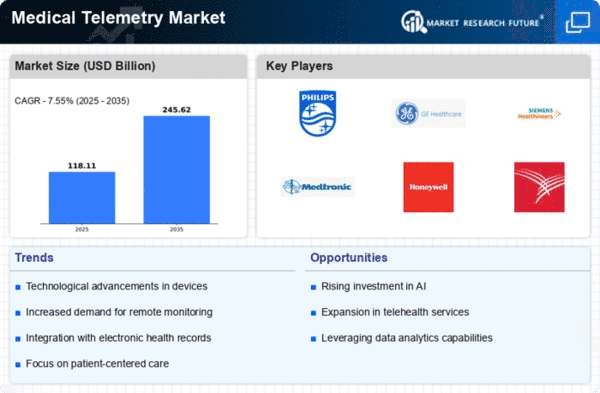
Medical Telemetry Market Infographic
Purchase Options

Market Analysis

In-depth Analysis of Medical Telemetry Market Industry Landscape

The Medical Telemetry market is witnessing dynamic shifts in response to technological advancements, increasing healthcare needs, and the growing demand for remote patient monitoring. This market segment plays a crucial role in revolutionizing healthcare by providing real-time data, enhancing patient care, and improving overall efficiency. Technology in medical telemetry is fast changing; market dynamics predominantly boil on this revolution. The innovations like miniature sensors, wireless communication, and data analytics have revolutionized the capabilities of telemetry devices greatly. Through these innovations, monitoring vital signs is a seamless process and as such healthcare professionals can respond accordingly. With the upsurge in the use of RPM solutions, the market of the medical telemetry has grown. Due to the increasing number of chronic diseases and the increasing population it could live at constant monitoring, outside of the traditional settings of health care. Medical telemetry contributes to the mobile sending of a patient’s data to medical specialists; such interventions can be prescribed pre-emptively in order to minimize the patron’s contacts with hospitals. Looking for help with writing a paper? Get professional thesis editing, thesis proofreading or thesis writing help from experienced experts! The integration of medical telemetry into the prevailing established health systems gives rise to the market dynamics globally. Data management via telemetry devices is facilitated with ease owing to their interoperability with the electronic health records and other healthcare platforms. As this implementation improves the efficiency of health care providers even overall quality of patient care is improved. The adoption of telemedicine services has greatly contributed to the demand for medical telemetry. That is one reason why telehealth was indeed bound to become a mainstream healthcare delivery model; patient data need to be not only be fast but also accurate. Medical telemetry assures smooth communication of vital signs thus enabling physicians to monitor and act on time. The market medical telemetry is characterised by the presence of many important players competing to provide new innovative solutions. Companies already into the field as well as new entrants are pumping enormous amounts into research and development, to catch the traffic ahead of the competition. The competition gives motivation to continue improvement of device functions, the cost-effective, and user friendliness features The regulatory frameworks are more affected by market dynamics. Standards and regulations adherence is essential for market players to build trust and provide safety and reliability for their medical telemetry devices. Regulatory compliance also shapes product development strategies as well as market entry. The medical telemetry market is not limited to particular regions rather it is a global phenomenon which is growing exponentially. Greater numbers of countries, both developed and developmental, are adopting to the telemetry solutions, due to the efforts of efficient healthcare systems, and better patient incomes. Such internationalisation also creates opportunities for market players to venture into other markets.

Despite the positive growth trajectory, the medical telemetry market faces challenges such as data security concerns, interoperability issues, and the need for standardized protocols. Addressing these challenges is crucial for sustaining market growth and ensuring the widespread adoption of telemetry solutions in healthcare settings. The future of the medical telemetry market looks promising, with continuous innovation and a growing emphasis on patient-centered care. As technology continues to advance, the integration of artificial intelligence and machine learning into telemetry devices is expected to further enhance their capabilities, offering new possibilities for personalized and efficient healthcare delivery.


Author
Kinjoll Dey
Senior Research Analyst

He is an extremely curious individual currently working in Healthcare and Medical Devices Domain. Kinjoll is comfortably versed in data centric research backed by healthcare educational background. He leverages extensive data mining and analytics tools such as Primary and Secondary Research, Statistical Analysis, Machine Learning, Data Modelling. His key role also involves Technical Sales Support, Client Interaction and Project management within the Healthcare team. Lastly, he showcases extensive affinity towards learning new skills and remain fascinated in implementing them.

Leave a Comment

FAQs

What is the current valuation of the Medical Telemetry Market as of 2024?

<p>The Medical Telemetry Market was valued at 109.82 USD Billion in 2024.</p>

What is the projected market size for the Medical Telemetry Market by 2035?

<p>The market is projected to reach 245.62 USD Billion by 2035.</p>

What is the expected CAGR for the Medical Telemetry Market during the forecast period 2025 - 2035?

<p>The expected CAGR for the Medical Telemetry Market during 2025 - 2035 is 7.55%.</p>

Which application segment is expected to have the highest valuation in the Medical Telemetry Market?

<p>The Cardiac Monitoring segment is expected to reach a valuation of 70.0 USD Billion by 2035.</p>

How does the Home Care Settings segment perform in the Medical Telemetry Market?

<p>The Home Care Settings segment was valued at 30.0 USD Billion in 2024 and is projected to grow to 70.0 USD Billion by 2035.</p>

What are the leading technologies in the Medical Telemetry Market?

Wireless Telemetry is expected to reach 70.0 USD Billion by 2035, indicating its leadership in the market.

Which key players dominate the Medical Telemetry Market?

Key players include Philips, GE Healthcare, Siemens Healthineers, and Medtronic, among others.

What is the projected growth for the Wearable Telemetry Devices segment?

The Wearable Telemetry Devices segment is projected to grow from 19.82 USD Billion in 2024 to 25.62 USD Billion by 2035.

What is the expected performance of the Telemetry Receivers segment?

The Telemetry Receivers segment is anticipated to grow from 20.0 USD Billion in 2024 to 50.0 USD Billion by 2035.

How does the market for Mobile Telemetry compare to other technologies?

Mobile Telemetry is projected to grow from 34.82 USD Billion in 2024 to 65.62 USD Billion by 2035, indicating strong potential.

Market Summary

As per MRFR analysis, the Medical Telemetry Market Size was estimated at 109.82 USD Billion in 2024. The Medical Telemetry industry is projected to grow from 119.37 USD Billion in 2025 to 245.62 USD Billion by 2035, exhibiting a compound annual growth rate (CAGR) of 7.55% during the forecast period 2025 - 2035.

Key Market Trends & Highlights

The Medical Telemetry Market is experiencing robust growth driven by technological advancements and a shift towards patient-centric care.

  • The integration of Artificial Intelligence is transforming telemetry systems, enhancing data analysis and decision-making capabilities. North America remains the largest market, while the Asia-Pacific region is emerging as the fastest-growing area for medical telemetry solutions. Cardiac Monitoring continues to dominate the market, whereas Remote Patient Monitoring is rapidly gaining traction due to increasing demand for at-home care. Rising demand for remote patient monitoring and regulatory support for telehealth initiatives are key drivers propelling market expansion.

Market Size & Forecast

2024 Market Size 109.82 (USD Billion)
2035 Market Size 245.62 (USD Billion)
CAGR (2025 - 2035) 7.55%
Largest Regional Market Share in 2024 North America

Major Players

<a href="https://www.usa.philips.com/a-w/about/news/archive/standard/news/press/2025/philips-launches-smart-telemetry-platform-for-cardiac-monitoring-that-provides-continuous-enterprise-wide-connectivity-beyond-the-bedside.html?srsltid=AfmBOoo0Ui-LGJp00M4GfYTmMIKuQYoJfe8UxgDRj22291Xur4_L-fAT">Philips</a> (NL), GE Healthcare (US), Siemens Healthineers (DE), Medtronic (US), Honeywell (US), <a href="https://www.cardinalhealth.com/en/product-solutions/medical/patient-monitoring.html">Cardinal Health</a> (US), Zebra Medical Vision (IL), Nihon Kohden (JP), Mindray (CN)

Market Trends

The Medical Telemetry Market is currently experiencing a transformative phase, driven by advancements in technology and an increasing demand for remote patient monitoring solutions. This market encompasses a range of devices and systems that facilitate the real-time transmission of patient data, enabling healthcare providers to make informed decisions swiftly. The integration of wireless communication technologies and the Internet of Things (IoT) has further enhanced the capabilities of telemetry systems, allowing for seamless data exchange and improved patient outcomes. As healthcare systems worldwide strive for efficiency and better patient care, the relevance of medical telemetry continues to grow, suggesting a robust future for this sector. Moreover, the ongoing evolution of healthcare delivery models, particularly the shift towards value-based care, appears to be a significant driver of growth within the Medical Telemetry Market. Stakeholders are increasingly recognizing the importance of continuous monitoring and data analytics in managing chronic conditions and enhancing patient engagement. This trend indicates a potential for innovative solutions that not only improve clinical outcomes but also optimize operational efficiencies within healthcare facilities. As the landscape evolves, the Medical Telemetry Market is poised to play a crucial role in shaping the future of healthcare delivery, emphasizing the need for ongoing investment and development in this area.

Integration of Artificial Intelligence

The incorporation of artificial intelligence into medical telemetry systems is becoming increasingly prevalent. AI algorithms can analyze vast amounts of patient data, identifying patterns and predicting potential health issues before they escalate. This capability enhances decision-making processes for healthcare providers, potentially leading to improved patient outcomes and more efficient resource allocation.

Focus on Patient-Centric Solutions

There is a growing emphasis on developing patient-centric telemetry solutions that prioritize user experience and engagement. Devices are being designed with intuitive interfaces and features that empower patients to take an active role in their health management. This trend reflects a broader shift towards personalized healthcare, where patient preferences and needs are at the forefront.

Regulatory Advancements

Regulatory bodies are increasingly recognizing the importance of medical telemetry in modern healthcare. As a result, there are ongoing efforts to establish clearer guidelines and standards for the development and implementation of telemetry devices. These advancements may enhance market credibility and encourage innovation, ultimately benefiting both providers and patients.

Medical Telemetry Market Market Drivers

Growing Aging Population

The aging population is a critical driver of the Global Medical Telemetry Market Industry. As the global demographic shifts towards an older population, the demand for healthcare services, including telemetry solutions, is expected to rise. Older adults often have multiple chronic conditions that require continuous monitoring, making telemetry systems essential for effective management. The increasing life expectancy and the associated healthcare needs are likely to propel the market forward. This demographic trend aligns with the projected growth rate of 12.36% CAGR from 2025 to 2035, indicating a strong correlation between the aging population and the demand for advanced telemetry technologies.

Market Growth Projections

The Global Medical Telemetry Market Industry is poised for substantial growth in the coming years. Projections indicate that the market will expand from 0.06 USD Billion in 2024 to 0.21 USD Billion by 2035. This growth trajectory suggests a robust demand for telemetry solutions, driven by factors such as technological advancements, regulatory support, and the increasing prevalence of chronic diseases. The anticipated compound annual growth rate of 12.36% from 2025 to 2035 further underscores the market's potential. As healthcare systems continue to evolve, the integration of telemetry technologies is likely to play a crucial role in enhancing patient care and operational efficiency.

Increasing Focus on Patient-Centric Care

The Global Medical Telemetry Market Industry is witnessing a shift towards patient-centric care models, which prioritize individual patient needs and preferences. This paradigm shift encourages healthcare providers to adopt telemetry solutions that empower patients to take an active role in managing their health. Telemetry systems enable patients to monitor their vital signs from home, fostering a sense of autonomy and engagement. As the market evolves, the emphasis on personalized healthcare solutions is likely to drive demand for telemetry technologies. This trend aligns with the projected compound annual growth rate of 12.36% from 2025 to 2035, indicating a sustained interest in patient-centered approaches.

Rising Demand for Remote Patient Monitoring

The Global Medical Telemetry Market Industry experiences a notable increase in demand for remote patient monitoring solutions. This trend is driven by the growing prevalence of chronic diseases, which necessitate continuous health monitoring. For instance, conditions such as diabetes and cardiovascular diseases require regular tracking of vital signs. The market is projected to reach 0.06 USD Billion in 2024, reflecting the increasing adoption of telemetry systems. As healthcare providers seek to enhance patient outcomes and reduce hospital readmissions, the integration of telemetry technology into home care settings is likely to expand, thereby contributing to market growth.

Regulatory Support for Telehealth Initiatives

Regulatory frameworks are increasingly supportive of telehealth initiatives, which significantly impacts the Global Medical Telemetry Market Industry. Governments worldwide are implementing policies that promote the use of telemedicine and remote monitoring technologies. For example, recent legislative measures aim to expand reimbursement for telehealth services, thereby incentivizing healthcare providers to adopt telemetry solutions. This regulatory support is expected to facilitate market growth, as it encourages investment in innovative telemetry technologies. The anticipated increase in market value from 0.06 USD Billion in 2024 to 0.21 USD Billion by 2035 underscores the potential for growth driven by favorable regulatory environments.

Technological Advancements in Telemetry Systems

Technological innovations play a pivotal role in shaping the Global Medical Telemetry Market Industry. The introduction of advanced telemetry devices, such as wearable sensors and mobile health applications, enhances the accuracy and efficiency of patient monitoring. These devices facilitate real-time data transmission, allowing healthcare professionals to make informed decisions promptly. The anticipated growth from 0.06 USD Billion in 2024 to 0.21 USD Billion by 2035 indicates a robust market trajectory, driven by these technological advancements. Furthermore, the integration of artificial intelligence and machine learning algorithms into telemetry systems may improve predictive analytics, thus enhancing patient care.

Market Segment Insights

By Application: Cardiac Monitoring (Largest) vs. Remote Patient Monitoring (Fastest-Growing)

In the Medical Telemetry Market, the application segment is characterized by distinct values, with cardiac monitoring holding the largest market share. This is largely attributed to the increasing prevalence of cardiovascular diseases and the growing demand for continuous monitoring solutions. Following closely, remote patient monitoring is experiencing swift growth due to advancements in technology and heightened healthcare awareness, making it a viable solution for chronic disease management. The growth trends in this segment demonstrate a significant shift towards technological adoption. The incorporation of wearable devices and mobile health applications is driving innovation in cardiac, neurological, and respiratory monitoring. The ongoing focus on improving patient outcomes, coupled with the expansion of telehealth services, is further propelling the demand for remote patient monitoring solutions, establishing it as the fastest-growing segment in the market.

Cardiac Monitoring (Dominant) vs. Wearable Devices (Emerging)

Cardiac monitoring remains the dominant application in the Medical Telemetry Market, centered on the need for real-time data to manage heart-related conditions effectively. Hospitals and health systems extensively employ these solutions for critical care, enabling prompt interventions. Conversely, wearable devices are emerging as a significant player in this landscape, leveraging technology to allow consumers to monitor their health metrics conveniently. The growth of wearable devices is fueled by the increasing shift towards proactive healthcare management, with users actively tracking their vital signs. As both segments evolve, they reflect the broader trend towards personalized medicine, with cardiac monitoring serving a vital role in clinical environments while wearable technology gains traction in everyday health management.

By End Use: Hospitals (Largest) vs. Home Care Settings (Fastest-Growing)

The Medical Telemetry Market exhibits a diverse distribution across various end-use segments. Hospitals hold the largest share due to their extensive demand for telemetry systems that enhance patient monitoring capabilities. In comparison, home care settings are rapidly gaining traction, driven by an increasing preference for remote patient monitoring, especially in light of recent healthcare trends focusing on home-based care.

Hospitals (Dominant) vs. Home Care Settings (Emerging)

Hospitals remain the dominant end-use segment in the Medical Telemetry Market, characterized by high patient volumes and complex monitoring needs. They leverage advanced telemetry solutions to improve patient outcomes and operational efficiency. Conversely, home care settings are emerging as a vital segment, catering to a growing population seeking convenient healthcare solutions at home. This shift is propelled by technological advancements in medical devices, increased healthcare spending, and a desire for personalized care, creating a competitive landscape between traditional and innovative care settings.

By Technology: Wireless Telemetry (Largest) vs. Cloud-based Telemetry (Fastest-Growing)

<p>In the Medical Telemetry Market, Wireless Telemetry holds a significant position, accounting for a considerable share due to its widespread adoption in healthcare facilities. The convenience of wireless connectivity and enhanced patient mobility facilitated by wireless systems contribute greatly to their dominance. On the other hand, Cloud-based Telemetry is rapidly gaining traction, allowing for real-time data access and improved collaboration among healthcare professionals, which makes it an attractive alternative. As the healthcare industry shifts towards digital solutions, growth trends reveal increasing investments in technological advancements for patient monitoring. The emphasis on remote healthcare services, particularly following the pandemic, serves as a key driver for the rise of Cloud-based Telemetry. Additionally, the capacity for integrating AI and big data analytics into cloud systems is expected to further propel the adoption of this emerging technology within the market.</p>

<p>Wireless Telemetry (Dominant) vs. Mobile Telemetry (Emerging)</p>

<p>Wireless Telemetry is recognized as the dominant technology in the Medical Telemetry Market, largely due to its ability to facilitate continuous patient monitoring without the constraints of traditional wiring. This technology enhances flexibility, allowing healthcare providers to maintain high-quality patient care while utilizing the latest communication protocols for robust data transmission. In contrast, Mobile Telemetry, while currently an emerging technology, shows promise as it leverages mobile devices for patient monitoring. It is particularly appealing for health settings looking to adapt to on-the-go healthcare services, thus making it increasingly relevant in contemporary medical environments. Both technologies complement each other, with Wireless Telemetry establishing a strong foundation while Mobile Telemetry introduces innovative solutions aligning with the telehealth trend.</p>

By Device Type: Patient Monitors (Largest) vs. Mobile Health Devices (Fastest-Growing)

<p>In the Medical Telemetry Market, Patient Monitors dominate the device type segment, holding a significant market share due to their critical role in continuous patient surveillance. Telemetry Transmitters and Receivers also play vital roles, facilitating data transfer between patients and healthcare providers. Mobile Health Devices are a growing segment, capitalizing on wellness trends and increasing consumer preference for remote health management. Overall, the segment represents a robust landscape with innovative devices designed to improve patient outcomes. Growth trends in the Medical Telemetry Market are driven by technological advancements and the rising demand for remote patient monitoring. The adoption of wireless communication technology and the Internet of Things (IoT) has enhanced the functionality and scope of telemetry devices, making them increasingly indispensable. The COVID-19 pandemic has also accelerated the shift towards telehealth solutions, with Mobile Health Devices witnessing the fastest growth as they offer convenient, real-time health monitoring. Emerging technologies and patient-centric services are shaping the market dynamics significantly.</p>

<p>Telemetry Transmitters (Dominant) vs. Telemetry Receivers (Emerging)</p>

<p>Telemetry Transmitters have established themselves as a dominant force within the Medical Telemetry Market, enabling reliable data transmission from patient monitors to healthcare systems. Their critical role in ensuring timely and accurate reporting of vital signs makes them indispensable in patient care. On the other hand, Telemetry Receivers are emerging as a new area of growth, providing healthcare professionals with the ability to receive and interpret data effectively. While Transmitters focus on sending information, Receivers are becoming increasingly sophisticated with features like advanced analytics and integration capabilities. As technology evolves, the complementarity of both segments enhances overall patient monitoring efficiency, indicating a collaborative growth trajectory in the market.</p>

By Component: Sensors (Largest) vs. Software (Fastest-Growing)

<p>In the Medical Telemetry Market, the component segment is dominated by sensors, which hold the largest market share due to their critical role in collecting real-time patient data. Following sensors, software solutions are emerging rapidly as they enhance data management, interpretation, and integrate with various telemetry devices. Transmitters and receivers, although essential, occupy a smaller portion of the market, as their roles are often more specialized and dependent on the types of sensors used.</p>

<p>Sensors (Dominant) vs. Software (Emerging)</p>

<p>In the Medical Telemetry Market, sensors are the dominant players, facilitating essential functions like heart rate monitoring, oxygen saturation detection, and temperature recording. Their reliability and accuracy are paramount in patient care, making them indispensable in hospitals and clinics. On the other hand, software solutions are emerging as vital tools for data analysis and remote monitoring, allowing healthcare providers to interpret sensor data effectively and respond promptly. This software innovation is driving growth in real-time patient management and telehealth solutions, thereby playing a significant role in meeting the increasing demand for digital health services.</p>

Get more detailed insights about Medical Telemetry Market Research Report - Forecast till 2035

Regional Insights

North America : Market Leader in Telemetry

North America is poised to maintain its leadership in the Medical Telemetry Market, holding a significant market share of 55.0% as of 2024. The region's growth is driven by advanced healthcare infrastructure, increasing adoption of telehealth solutions, and stringent regulatory frameworks that promote innovation. The demand for remote patient monitoring and real-time data analytics is surging, fueled by an aging population and rising chronic diseases. The competitive landscape in North America is robust, featuring key players such as GE Healthcare, Medtronic, and Philips. These companies are at the forefront of technological advancements, focusing on integrating AI and IoT into telemetry solutions. The U.S. remains the largest market, supported by favorable reimbursement policies and a strong emphasis on patient-centered care. The presence of established healthcare systems further enhances market dynamics, ensuring sustained growth.

Europe : Emerging Telemetry Innovations

Europe is witnessing a significant transformation in the Medical Telemetry Market, with a market share of 30.0% as of 2024. The region's growth is propelled by increasing investments in healthcare technology, a rising prevalence of chronic diseases, and supportive government initiatives aimed at enhancing healthcare delivery. Regulatory bodies are actively promoting telehealth solutions, which are becoming integral to patient management strategies across member states. Leading countries such as Germany, France, and the UK are driving the market forward, with key players like Siemens Healthineers and Philips leading the charge. The competitive landscape is characterized by a mix of established firms and innovative startups, all vying for market share. The European market is also witnessing collaborations between technology firms and healthcare providers, enhancing the development of advanced telemetry solutions. "The European Commission emphasizes the importance of digital health technologies in improving patient outcomes and healthcare efficiency."

Asia-Pacific : Rapid Growth in Telemetry

The Asia-Pacific region is emerging as a vital player in the Medical Telemetry Market, holding a market share of 20.0% as of 2024. The growth is driven by increasing healthcare expenditure, a rising population, and a growing focus on telemedicine solutions. Governments are implementing policies to enhance healthcare access, which is further propelling the demand for telemetry systems. The region's diverse healthcare landscape presents both challenges and opportunities for market players. Countries like China, Japan, and India are at the forefront of this expansion, with significant investments in healthcare infrastructure. Key players such as Nihon Kohden and Mindray are actively innovating to meet the growing demand. The competitive environment is marked by rapid technological advancements and collaborations between local and international firms, ensuring a dynamic market landscape. The region's potential for growth is substantial, driven by a tech-savvy population and increasing health awareness.

Middle East and Africa : Developing Telemetry Solutions

The Middle East and Africa (MEA) region is gradually developing its Medical Telemetry Market, currently holding a market share of 4.82% as of 2024. The growth in this region is primarily driven by increasing healthcare investments, a rising prevalence of chronic diseases, and the need for improved healthcare delivery systems. Governments are focusing on enhancing healthcare infrastructure, which is crucial for the adoption of telemetry solutions in hospitals and clinics. Countries like South Africa and the UAE are leading the charge in adopting advanced medical technologies. The competitive landscape is characterized by a mix of local and international players, with companies looking to establish a foothold in this emerging market. The presence of key players is growing, and partnerships with healthcare providers are becoming essential for market penetration. "The World Health Organization highlights the need for innovative healthcare solutions to address the unique challenges faced by the region."

Key Players and Competitive Insights

The Medical Telemetry Market is currently characterized by a dynamic competitive landscape, driven by technological advancements and an increasing demand for remote patient monitoring solutions. Key players such as Philips (NL), GE Healthcare (US), and Siemens Healthineers (DE) are at the forefront, each adopting distinct strategies to enhance their market positioning. Philips (NL) emphasizes innovation through its focus on integrated solutions that combine telemetry with advanced analytics, while GE Healthcare (US) is pursuing strategic partnerships to expand its digital health offerings. Siemens Healthineers (DE) is concentrating on regional expansion, particularly in emerging markets, to capitalize on the growing need for healthcare infrastructure.The business tactics employed by these companies include localizing manufacturing and optimizing supply chains to enhance operational efficiency. The market structure appears moderately fragmented, with a mix of established players and emerging companies vying for market share. The collective influence of these key players shapes competitive dynamics, as they leverage their technological capabilities and market reach to establish a foothold in various regions.
In November Philips (NL) announced the launch of a new telemetry platform designed to integrate seamlessly with existing hospital systems, enhancing real-time data access for healthcare providers. This strategic move is likely to strengthen Philips' position in the market by addressing the growing demand for interoperability in healthcare technology. The platform's ability to provide actionable insights could significantly improve patient outcomes and operational efficiency in clinical settings.
In October GE Healthcare (US) entered into a partnership with a leading telecommunication company to enhance its remote monitoring capabilities. This collaboration aims to leverage 5G technology to facilitate faster data transmission and improve the reliability of telemetry systems. Such a strategic alliance not only positions GE Healthcare as a leader in digital health solutions but also underscores the importance of connectivity in modern healthcare delivery.

In September Siemens Healthineers (DE) acquired a startup specializing in AI-driven analytics for telemetry data. This acquisition is expected to bolster Siemens' capabilities in predictive analytics, allowing healthcare providers to anticipate patient needs more effectively. By integrating AI into its telemetry solutions, Siemens Healthineers is likely to enhance its competitive edge, aligning with the broader trend of digital transformation in healthcare.
As of December the Medical Telemetry Market is witnessing trends such as increased digitalization, a focus on sustainability, and the integration of AI technologies. Strategic alliances are becoming increasingly pivotal, as companies recognize the need to collaborate to enhance their technological offerings. Looking ahead, competitive differentiation is expected to evolve, shifting from price-based competition to a focus on innovation, technology, and supply chain reliability. This transition may redefine how companies position themselves in the market, emphasizing the importance of delivering value through advanced solutions.

Key Companies in the Medical Telemetry Market include

Industry Developments

Future Outlook

Medical Telemetry Market Future Outlook

The Medical Telemetry Market is projected to grow at a 7.55% CAGR from 2025 to 2035, driven by technological advancements, increasing demand for remote patient monitoring, and enhanced healthcare infrastructure.

New opportunities lie in:

  • <p>Development of AI-driven predictive analytics tools for patient monitoring. Expansion of wireless telemetry solutions in home healthcare settings. Integration of telemetry systems with electronic health records for streamlined data access.</p>

By 2035, the Medical Telemetry Market is expected to be robust, reflecting substantial growth and innovation.

Market Segmentation

Medical Telemetry Market End Use Outlook

  • Hospitals
  • Home Care Settings
  • Ambulatory Surgical Centers
  • Long-term Care Facilities

Medical Telemetry Market Technology Outlook

  • Wireless Technology
  • Wired Technology
  • Cloud-based Technology
  • Mobile Technology

Medical Telemetry Market Application Outlook

  • Cardiac Monitoring
  • Neurological Monitoring
  • Respiratory Monitoring
  • Remote Patient Monitoring
  • Wearable Devices

Medical Telemetry Market Device Type Outlook

  • Patient Monitors
  • Telemetry Systems
  • Wearable Monitors
  • Mobile Health Devices

Report Scope

MARKET SIZE 2024 109.82(USD Billion)
MARKET SIZE 2025 119.37(USD Billion)
MARKET SIZE 2035 245.62(USD Billion)
COMPOUND ANNUAL GROWTH RATE (CAGR) 7.55% (2025 - 2035)
REPORT COVERAGE Revenue Forecast, Competitive Landscape, Growth Factors, and Trends
BASE YEAR 2024
Market Forecast Period 2025 - 2035
Historical Data 2019 - 2024
Market Forecast Units USD Billion
Key Companies Profiled Philips (NL), GE Healthcare (US), Siemens Healthineers (DE), Medtronic (US), Honeywell (US), Cardinal Health (US), Zebra Medical Vision (IL), Nihon Kohden (JP), Mindray (CN)
Segments Covered Application, End Use, Technology, Device Type
Key Market Opportunities Integration of advanced artificial intelligence in Medical Telemetry Market enhances patient monitoring and data analysis capabilities.
Key Market Dynamics Rising demand for remote patient monitoring drives innovation and competition in the Medical Telemetry Market.
Countries Covered North America, Europe, APAC, South America, MEA

FAQs

What is the current valuation of the Medical Telemetry Market as of 2024?

<p>The Medical Telemetry Market was valued at 109.82 USD Billion in 2024.</p>

What is the projected market size for the Medical Telemetry Market by 2035?

<p>The market is projected to reach 245.62 USD Billion by 2035.</p>

What is the expected CAGR for the Medical Telemetry Market during the forecast period 2025 - 2035?

<p>The expected CAGR for the Medical Telemetry Market during 2025 - 2035 is 7.55%.</p>

Which application segment is expected to have the highest valuation in the Medical Telemetry Market?

<p>The Cardiac Monitoring segment is expected to reach a valuation of 70.0 USD Billion by 2035.</p>

How does the Home Care Settings segment perform in the Medical Telemetry Market?

<p>The Home Care Settings segment was valued at 30.0 USD Billion in 2024 and is projected to grow to 70.0 USD Billion by 2035.</p>

What are the leading technologies in the Medical Telemetry Market?

Wireless Telemetry is expected to reach 70.0 USD Billion by 2035, indicating its leadership in the market.

Which key players dominate the Medical Telemetry Market?

Key players include Philips, GE Healthcare, Siemens Healthineers, and Medtronic, among others.

What is the projected growth for the Wearable Telemetry Devices segment?

The Wearable Telemetry Devices segment is projected to grow from 19.82 USD Billion in 2024 to 25.62 USD Billion by 2035.

What is the expected performance of the Telemetry Receivers segment?

The Telemetry Receivers segment is anticipated to grow from 20.0 USD Billion in 2024 to 50.0 USD Billion by 2035.

How does the market for Mobile Telemetry compare to other technologies?

Mobile Telemetry is projected to grow from 34.82 USD Billion in 2024 to 65.62 USD Billion by 2035, indicating strong potential.

  1. SECTION I: EXECUTIVE SUMMARY AND KEY HIGHLIGHTS
    1. | 1.1 EXECUTIVE SUMMARY
    2. | | 1.1.1 Market Overview
    3. | | 1.1.2 Key Findings
    4. | | 1.1.3 Market Segmentation
    5. | | 1.1.4 Competitive Landscape
    6. | | 1.1.5 Challenges and Opportunities
    7. | | 1.1.6 Future Outlook
  2. SECTION II: SCOPING, METHODOLOGY AND MARKET STRUCTURE
    1. | 2.1 MARKET INTRODUCTION
    2. | | 2.1.1 Definition
    3. | | 2.1.2 Scope of the study
    4. | | | 2.1.2.1 Research Objective
    5. | | | 2.1.2.2 Assumption
    6. | | | 2.1.2.3 Limitations
    7. | 2.2 RESEARCH METHODOLOGY
    8. | | 2.2.1 Overview
    9. | | 2.2.2 Data Mining
    10. | | 2.2.3 Secondary Research
    11. | | 2.2.4 Primary Research
    12. | | | 2.2.4.1 Primary Interviews and Information Gathering Process
    13. | | | 2.2.4.2 Breakdown of Primary Respondents
    14. | | 2.2.5 Forecasting Model
    15. | | 2.2.6 Market Size Estimation
    16. | | | 2.2.6.1 Bottom-Up Approach
    17. | | | 2.2.6.2 Top-Down Approach
    18. | | 2.2.7 Data Triangulation
    19. | | 2.2.8 Validation
  3. SECTION III: QUALITATIVE ANALYSIS
    1. | 3.1 MARKET DYNAMICS
    2. | | 3.1.1 Overview
    3. | | 3.1.2 Drivers
    4. | | 3.1.3 Restraints
    5. | | 3.1.4 Opportunities
    6. | 3.2 MARKET FACTOR ANALYSIS
    7. | | 3.2.1 Value chain Analysis
    8. | | 3.2.2 Porter's Five Forces Analysis
    9. | | | 3.2.2.1 Bargaining Power of Suppliers
    10. | | | 3.2.2.2 Bargaining Power of Buyers
    11. | | | 3.2.2.3 Threat of New Entrants
    12. | | | 3.2.2.4 Threat of Substitutes
    13. | | | 3.2.2.5 Intensity of Rivalry
    14. | | 3.2.3 COVID-19 Impact Analysis
    15. | | | 3.2.3.1 Market Impact Analysis
    16. | | | 3.2.3.2 Regional Impact
    17. | | | 3.2.3.3 Opportunity and Threat Analysis
  4. SECTION IV: QUANTITATIVE ANALYSIS
    1. | 4.1 Healthcare, BY Application (USD Billion)
    2. | | 4.1.1 Cardiac Monitoring
    3. | | 4.1.2 Neurological Monitoring
    4. | | 4.1.3 Respiratory Monitoring
    5. | | 4.1.4 Remote Patient Monitoring
    6. | | 4.1.5 Wearable Telemetry Devices
    7. | 4.2 Healthcare, BY End Use (USD Billion)
    8. | | 4.2.1 Hospitals
    9. | | 4.2.2 Home Care Settings
    10. | | 4.2.3 Ambulatory Surgical Centers
    11. | | 4.2.4 Long-term Care Facilities
    12. | 4.3 Healthcare, BY Technology (USD Billion)
    13. | | 4.3.1 Wireless Telemetry
    14. | | 4.3.2 Wired Telemetry
    15. | | 4.3.3 Cloud-based Telemetry
    16. | | 4.3.4 Mobile Telemetry
    17. | 4.4 Healthcare, BY Device Type (USD Billion)
    18. | | 4.4.1 Patient Monitors
    19. | | 4.4.2 Telemetry Transmitters
    20. | | 4.4.3 Telemetry Receivers
    21. | | 4.4.4 Mobile Health Devices
    22. | 4.5 Healthcare, BY Component (USD Billion)
    23. | | 4.5.1 Sensors
    24. | | 4.5.2 Software
    25. | | 4.5.3 Transmitters
    26. | | 4.5.4 Receivers
    27. | 4.6 Healthcare, BY Region (USD Billion)
    28. | | 4.6.1 North America
    29. | | | 4.6.1.1 US
    30. | | | 4.6.1.2 Canada
    31. | | 4.6.2 Europe
    32. | | | 4.6.2.1 Germany
    33. | | | 4.6.2.2 UK
    34. | | | 4.6.2.3 France
    35. | | | 4.6.2.4 Russia
    36. | | | 4.6.2.5 Italy
    37. | | | 4.6.2.6 Spain
    38. | | | 4.6.2.7 Rest of Europe
    39. | | 4.6.3 APAC
    40. | | | 4.6.3.1 China
    41. | | | 4.6.3.2 India
    42. | | | 4.6.3.3 Japan
    43. | | | 4.6.3.4 South Korea
    44. | | | 4.6.3.5 Malaysia
    45. | | | 4.6.3.6 Thailand
    46. | | | 4.6.3.7 Indonesia
    47. | | | 4.6.3.8 Rest of APAC
    48. | | 4.6.4 South America
    49. | | | 4.6.4.1 Brazil
    50. | | | 4.6.4.2 Mexico
    51. | | | 4.6.4.3 Argentina
    52. | | | 4.6.4.4 Rest of South America
    53. | | 4.6.5 MEA
    54. | | | 4.6.5.1 GCC Countries
    55. | | | 4.6.5.2 South Africa
    56. | | | 4.6.5.3 Rest of MEA
  5. SECTION V: COMPETITIVE ANALYSIS
    1. | 5.1 Competitive Landscape
    2. | | 5.1.1 Overview
    3. | | 5.1.2 Competitive Analysis
    4. | | 5.1.3 Market share Analysis
    5. | | 5.1.4 Major Growth Strategy in the Healthcare
    6. | | 5.1.5 Competitive Benchmarking
    7. | | 5.1.6 Leading Players in Terms of Number of Developments in the Healthcare
    8. | | 5.1.7 Key developments and growth strategies
    9. | | | 5.1.7.1 New Product Launch/Service Deployment
    10. | | | 5.1.7.2 Merger & Acquisitions
    11. | | | 5.1.7.3 Joint Ventures
    12. | | 5.1.8 Major Players Financial Matrix
    13. | | | 5.1.8.1 Sales and Operating Income
    14. | | | 5.1.8.2 Major Players R&D Expenditure. 2023
    15. | 5.2 Company Profiles
    16. | | 5.2.1 Philips (NL)
    17. | | | 5.2.1.1 Financial Overview
    18. | | | 5.2.1.2 Products Offered
    19. | | | 5.2.1.3 Key Developments
    20. | | | 5.2.1.4 SWOT Analysis
    21. | | | 5.2.1.5 Key Strategies
    22. | | 5.2.2 GE Healthcare (US)
    23. | | | 5.2.2.1 Financial Overview
    24. | | | 5.2.2.2 Products Offered
    25. | | | 5.2.2.3 Key Developments
    26. | | | 5.2.2.4 SWOT Analysis
    27. | | | 5.2.2.5 Key Strategies
    28. | | 5.2.3 Siemens Healthineers (DE)
    29. | | | 5.2.3.1 Financial Overview
    30. | | | 5.2.3.2 Products Offered
    31. | | | 5.2.3.3 Key Developments
    32. | | | 5.2.3.4 SWOT Analysis
    33. | | | 5.2.3.5 Key Strategies
    34. | | 5.2.4 Medtronic (US)
    35. | | | 5.2.4.1 Financial Overview
    36. | | | 5.2.4.2 Products Offered
    37. | | | 5.2.4.3 Key Developments
    38. | | | 5.2.4.4 SWOT Analysis
    39. | | | 5.2.4.5 Key Strategies
    40. | | 5.2.5 Honeywell (US)
    41. | | | 5.2.5.1 Financial Overview
    42. | | | 5.2.5.2 Products Offered
    43. | | | 5.2.5.3 Key Developments
    44. | | | 5.2.5.4 SWOT Analysis
    45. | | | 5.2.5.5 Key Strategies
    46. | | 5.2.6 Cardinal Health (US)
    47. | | | 5.2.6.1 Financial Overview
    48. | | | 5.2.6.2 Products Offered
    49. | | | 5.2.6.3 Key Developments
    50. | | | 5.2.6.4 SWOT Analysis
    51. | | | 5.2.6.5 Key Strategies
    52. | | 5.2.7 Zebra Medical Vision (IL)
    53. | | | 5.2.7.1 Financial Overview
    54. | | | 5.2.7.2 Products Offered
    55. | | | 5.2.7.3 Key Developments
    56. | | | 5.2.7.4 SWOT Analysis
    57. | | | 5.2.7.5 Key Strategies
    58. | | 5.2.8 Nihon Kohden (JP)
    59. | | | 5.2.8.1 Financial Overview
    60. | | | 5.2.8.2 Products Offered
    61. | | | 5.2.8.3 Key Developments
    62. | | | 5.2.8.4 SWOT Analysis
    63. | | | 5.2.8.5 Key Strategies
    64. | | 5.2.9 Mindray (CN)
    65. | | | 5.2.9.1 Financial Overview
    66. | | | 5.2.9.2 Products Offered
    67. | | | 5.2.9.3 Key Developments
    68. | | | 5.2.9.4 SWOT Analysis
    69. | | | 5.2.9.5 Key Strategies
    70. | 5.3 Appendix
    71. | | 5.3.1 References
    72. | | 5.3.2 Related Reports
  6. LIST OF FIGURES
    1. | 6.1 MARKET SYNOPSIS
    2. | 6.2 NORTH AMERICA MARKET ANALYSIS
    3. | 6.3 US MARKET ANALYSIS BY APPLICATION
    4. | 6.4 US MARKET ANALYSIS BY END USE
    5. | 6.5 US MARKET ANALYSIS BY TECHNOLOGY
    6. | 6.6 US MARKET ANALYSIS BY DEVICE TYPE
    7. | 6.7 US MARKET ANALYSIS BY COMPONENT
    8. | 6.8 CANADA MARKET ANALYSIS BY APPLICATION
    9. | 6.9 CANADA MARKET ANALYSIS BY END USE
    10. | 6.10 CANADA MARKET ANALYSIS BY TECHNOLOGY
    11. | 6.11 CANADA MARKET ANALYSIS BY DEVICE TYPE
    12. | 6.12 CANADA MARKET ANALYSIS BY COMPONENT
    13. | 6.13 EUROPE MARKET ANALYSIS
    14. | 6.14 GERMANY MARKET ANALYSIS BY APPLICATION
    15. | 6.15 GERMANY MARKET ANALYSIS BY END USE
    16. | 6.16 GERMANY MARKET ANALYSIS BY TECHNOLOGY
    17. | 6.17 GERMANY MARKET ANALYSIS BY DEVICE TYPE
    18. | 6.18 GERMANY MARKET ANALYSIS BY COMPONENT
    19. | 6.19 UK MARKET ANALYSIS BY APPLICATION
    20. | 6.20 UK MARKET ANALYSIS BY END USE
    21. | 6.21 UK MARKET ANALYSIS BY TECHNOLOGY
    22. | 6.22 UK MARKET ANALYSIS BY DEVICE TYPE
    23. | 6.23 UK MARKET ANALYSIS BY COMPONENT
    24. | 6.24 FRANCE MARKET ANALYSIS BY APPLICATION
    25. | 6.25 FRANCE MARKET ANALYSIS BY END USE
    26. | 6.26 FRANCE MARKET ANALYSIS BY TECHNOLOGY
    27. | 6.27 FRANCE MARKET ANALYSIS BY DEVICE TYPE
    28. | 6.28 FRANCE MARKET ANALYSIS BY COMPONENT
    29. | 6.29 RUSSIA MARKET ANALYSIS BY APPLICATION
    30. | 6.30 RUSSIA MARKET ANALYSIS BY END USE
    31. | 6.31 RUSSIA MARKET ANALYSIS BY TECHNOLOGY
    32. | 6.32 RUSSIA MARKET ANALYSIS BY DEVICE TYPE
    33. | 6.33 RUSSIA MARKET ANALYSIS BY COMPONENT
    34. | 6.34 ITALY MARKET ANALYSIS BY APPLICATION
    35. | 6.35 ITALY MARKET ANALYSIS BY END USE
    36. | 6.36 ITALY MARKET ANALYSIS BY TECHNOLOGY
    37. | 6.37 ITALY MARKET ANALYSIS BY DEVICE TYPE
    38. | 6.38 ITALY MARKET ANALYSIS BY COMPONENT
    39. | 6.39 SPAIN MARKET ANALYSIS BY APPLICATION
    40. | 6.40 SPAIN MARKET ANALYSIS BY END USE
    41. | 6.41 SPAIN MARKET ANALYSIS BY TECHNOLOGY
    42. | 6.42 SPAIN MARKET ANALYSIS BY DEVICE TYPE
    43. | 6.43 SPAIN MARKET ANALYSIS BY COMPONENT
    44. | 6.44 REST OF EUROPE MARKET ANALYSIS BY APPLICATION
    45. | 6.45 REST OF EUROPE MARKET ANALYSIS BY END USE
    46. | 6.46 REST OF EUROPE MARKET ANALYSIS BY TECHNOLOGY
    47. | 6.47 REST OF EUROPE MARKET ANALYSIS BY DEVICE TYPE
    48. | 6.48 REST OF EUROPE MARKET ANALYSIS BY COMPONENT
    49. | 6.49 APAC MARKET ANALYSIS
    50. | 6.50 CHINA MARKET ANALYSIS BY APPLICATION
    51. | 6.51 CHINA MARKET ANALYSIS BY END USE
    52. | 6.52 CHINA MARKET ANALYSIS BY TECHNOLOGY
    53. | 6.53 CHINA MARKET ANALYSIS BY DEVICE TYPE
    54. | 6.54 CHINA MARKET ANALYSIS BY COMPONENT
    55. | 6.55 INDIA MARKET ANALYSIS BY APPLICATION
    56. | 6.56 INDIA MARKET ANALYSIS BY END USE
    57. | 6.57 INDIA MARKET ANALYSIS BY TECHNOLOGY
    58. | 6.58 INDIA MARKET ANALYSIS BY DEVICE TYPE
    59. | 6.59 INDIA MARKET ANALYSIS BY COMPONENT
    60. | 6.60 JAPAN MARKET ANALYSIS BY APPLICATION
    61. | 6.61 JAPAN MARKET ANALYSIS BY END USE
    62. | 6.62 JAPAN MARKET ANALYSIS BY TECHNOLOGY
    63. | 6.63 JAPAN MARKET ANALYSIS BY DEVICE TYPE
    64. | 6.64 JAPAN MARKET ANALYSIS BY COMPONENT
    65. | 6.65 SOUTH KOREA MARKET ANALYSIS BY APPLICATION
    66. | 6.66 SOUTH KOREA MARKET ANALYSIS BY END USE
    67. | 6.67 SOUTH KOREA MARKET ANALYSIS BY TECHNOLOGY
    68. | 6.68 SOUTH KOREA MARKET ANALYSIS BY DEVICE TYPE
    69. | 6.69 SOUTH KOREA MARKET ANALYSIS BY COMPONENT
    70. | 6.70 MALAYSIA MARKET ANALYSIS BY APPLICATION
    71. | 6.71 MALAYSIA MARKET ANALYSIS BY END USE
    72. | 6.72 MALAYSIA MARKET ANALYSIS BY TECHNOLOGY
    73. | 6.73 MALAYSIA MARKET ANALYSIS BY DEVICE TYPE
    74. | 6.74 MALAYSIA MARKET ANALYSIS BY COMPONENT
    75. | 6.75 THAILAND MARKET ANALYSIS BY APPLICATION
    76. | 6.76 THAILAND MARKET ANALYSIS BY END USE
    77. | 6.77 THAILAND MARKET ANALYSIS BY TECHNOLOGY
    78. | 6.78 THAILAND MARKET ANALYSIS BY DEVICE TYPE
    79. | 6.79 THAILAND MARKET ANALYSIS BY COMPONENT
    80. | 6.80 INDONESIA MARKET ANALYSIS BY APPLICATION
    81. | 6.81 INDONESIA MARKET ANALYSIS BY END USE
    82. | 6.82 INDONESIA MARKET ANALYSIS BY TECHNOLOGY
    83. | 6.83 INDONESIA MARKET ANALYSIS BY DEVICE TYPE
    84. | 6.84 INDONESIA MARKET ANALYSIS BY COMPONENT
    85. | 6.85 REST OF APAC MARKET ANALYSIS BY APPLICATION
    86. | 6.86 REST OF APAC MARKET ANALYSIS BY END USE
    87. | 6.87 REST OF APAC MARKET ANALYSIS BY TECHNOLOGY
    88. | 6.88 REST OF APAC MARKET ANALYSIS BY DEVICE TYPE
    89. | 6.89 REST OF APAC MARKET ANALYSIS BY COMPONENT
    90. | 6.90 SOUTH AMERICA MARKET ANALYSIS
    91. | 6.91 BRAZIL MARKET ANALYSIS BY APPLICATION
    92. | 6.92 BRAZIL MARKET ANALYSIS BY END USE
    93. | 6.93 BRAZIL MARKET ANALYSIS BY TECHNOLOGY
    94. | 6.94 BRAZIL MARKET ANALYSIS BY DEVICE TYPE
    95. | 6.95 BRAZIL MARKET ANALYSIS BY COMPONENT
    96. | 6.96 MEXICO MARKET ANALYSIS BY APPLICATION
    97. | 6.97 MEXICO MARKET ANALYSIS BY END USE
    98. | 6.98 MEXICO MARKET ANALYSIS BY TECHNOLOGY
    99. | 6.99 MEXICO MARKET ANALYSIS BY DEVICE TYPE
    100. | 6.100 MEXICO MARKET ANALYSIS BY COMPONENT
    101. | 6.101 ARGENTINA MARKET ANALYSIS BY APPLICATION
    102. | 6.102 ARGENTINA MARKET ANALYSIS BY END USE
    103. | 6.103 ARGENTINA MARKET ANALYSIS BY TECHNOLOGY
    104. | 6.104 ARGENTINA MARKET ANALYSIS BY DEVICE TYPE
    105. | 6.105 ARGENTINA MARKET ANALYSIS BY COMPONENT
    106. | 6.106 REST OF SOUTH AMERICA MARKET ANALYSIS BY APPLICATION
    107. | 6.107 REST OF SOUTH AMERICA MARKET ANALYSIS BY END USE
    108. | 6.108 REST OF SOUTH AMERICA MARKET ANALYSIS BY TECHNOLOGY
    109. | 6.109 REST OF SOUTH AMERICA MARKET ANALYSIS BY DEVICE TYPE
    110. | 6.110 REST OF SOUTH AMERICA MARKET ANALYSIS BY COMPONENT
    111. | 6.111 MEA MARKET ANALYSIS
    112. | 6.112 GCC COUNTRIES MARKET ANALYSIS BY APPLICATION
    113. | 6.113 GCC COUNTRIES MARKET ANALYSIS BY END USE
    114. | 6.114 GCC COUNTRIES MARKET ANALYSIS BY TECHNOLOGY
    115. | 6.115 GCC COUNTRIES MARKET ANALYSIS BY DEVICE TYPE
    116. | 6.116 GCC COUNTRIES MARKET ANALYSIS BY COMPONENT
    117. | 6.117 SOUTH AFRICA MARKET ANALYSIS BY APPLICATION
    118. | 6.118 SOUTH AFRICA MARKET ANALYSIS BY END USE
    119. | 6.119 SOUTH AFRICA MARKET ANALYSIS BY TECHNOLOGY
    120. | 6.120 SOUTH AFRICA MARKET ANALYSIS BY DEVICE TYPE
    121. | 6.121 SOUTH AFRICA MARKET ANALYSIS BY COMPONENT
    122. | 6.122 REST OF MEA MARKET ANALYSIS BY APPLICATION
    123. | 6.123 REST OF MEA MARKET ANALYSIS BY END USE
    124. | 6.124 REST OF MEA MARKET ANALYSIS BY TECHNOLOGY
    125. | 6.125 REST OF MEA MARKET ANALYSIS BY DEVICE TYPE
    126. | 6.126 REST OF MEA MARKET ANALYSIS BY COMPONENT
    127. | 6.127 KEY BUYING CRITERIA OF HEALTHCARE
    128. | 6.128 RESEARCH PROCESS OF MRFR
    129. | 6.129 DRO ANALYSIS OF HEALTHCARE
    130. | 6.130 DRIVERS IMPACT ANALYSIS: HEALTHCARE
    131. | 6.131 RESTRAINTS IMPACT ANALYSIS: HEALTHCARE
    132. | 6.132 SUPPLY / VALUE CHAIN: HEALTHCARE
    133. | 6.133 HEALTHCARE, BY APPLICATION, 2024 (% SHARE)
    134. | 6.134 HEALTHCARE, BY APPLICATION, 2024 TO 2035 (USD Billion)
    135. | 6.135 HEALTHCARE, BY END USE, 2024 (% SHARE)
    136. | 6.136 HEALTHCARE, BY END USE, 2024 TO 2035 (USD Billion)
    137. | 6.137 HEALTHCARE, BY TECHNOLOGY, 2024 (% SHARE)
    138. | 6.138 HEALTHCARE, BY TECHNOLOGY, 2024 TO 2035 (USD Billion)
    139. | 6.139 HEALTHCARE, BY DEVICE TYPE, 2024 (% SHARE)
    140. | 6.140 HEALTHCARE, BY DEVICE TYPE, 2024 TO 2035 (USD Billion)
    141. | 6.141 HEALTHCARE, BY COMPONENT, 2024 (% SHARE)
    142. | 6.142 HEALTHCARE, BY COMPONENT, 2024 TO 2035 (USD Billion)
    143. | 6.143 BENCHMARKING OF MAJOR COMPETITORS
  7. LIST OF TABLES
    1. | 7.1 LIST OF ASSUMPTIONS
    2. | | 7.1.1
    3. | 7.2 North America MARKET SIZE ESTIMATES; FORECAST
    4. | | 7.2.1 BY APPLICATION, 2025-2035 (USD Billion)
    5. | | 7.2.2 BY END USE, 2025-2035 (USD Billion)
    6. | | 7.2.3 BY TECHNOLOGY, 2025-2035 (USD Billion)
    7. | | 7.2.4 BY DEVICE TYPE, 2025-2035 (USD Billion)
    8. | | 7.2.5 BY COMPONENT, 2025-2035 (USD Billion)
    9. | 7.3 US MARKET SIZE ESTIMATES; FORECAST
    10. | | 7.3.1 BY APPLICATION, 2025-2035 (USD Billion)
    11. | | 7.3.2 BY END USE, 2025-2035 (USD Billion)
    12. | | 7.3.3 BY TECHNOLOGY, 2025-2035 (USD Billion)
    13. | | 7.3.4 BY DEVICE TYPE, 2025-2035 (USD Billion)
    14. | | 7.3.5 BY COMPONENT, 2025-2035 (USD Billion)
    15. | 7.4 Canada MARKET SIZE ESTIMATES; FORECAST
    16. | | 7.4.1 BY APPLICATION, 2025-2035 (USD Billion)
    17. | | 7.4.2 BY END USE, 2025-2035 (USD Billion)
    18. | | 7.4.3 BY TECHNOLOGY, 2025-2035 (USD Billion)
    19. | | 7.4.4 BY DEVICE TYPE, 2025-2035 (USD Billion)
    20. | | 7.4.5 BY COMPONENT, 2025-2035 (USD Billion)
    21. | 7.5 Europe MARKET SIZE ESTIMATES; FORECAST
    22. | | 7.5.1 BY APPLICATION, 2025-2035 (USD Billion)
    23. | | 7.5.2 BY END USE, 2025-2035 (USD Billion)
    24. | | 7.5.3 BY TECHNOLOGY, 2025-2035 (USD Billion)
    25. | | 7.5.4 BY DEVICE TYPE, 2025-2035 (USD Billion)
    26. | | 7.5.5 BY COMPONENT, 2025-2035 (USD Billion)
    27. | 7.6 Germany MARKET SIZE ESTIMATES; FORECAST
    28. | | 7.6.1 BY APPLICATION, 2025-2035 (USD Billion)
    29. | | 7.6.2 BY END USE, 2025-2035 (USD Billion)
    30. | | 7.6.3 BY TECHNOLOGY, 2025-2035 (USD Billion)
    31. | | 7.6.4 BY DEVICE TYPE, 2025-2035 (USD Billion)
    32. | | 7.6.5 BY COMPONENT, 2025-2035 (USD Billion)
    33. | 7.7 UK MARKET SIZE ESTIMATES; FORECAST
    34. | | 7.7.1 BY APPLICATION, 2025-2035 (USD Billion)
    35. | | 7.7.2 BY END USE, 2025-2035 (USD Billion)
    36. | | 7.7.3 BY TECHNOLOGY, 2025-2035 (USD Billion)
    37. | | 7.7.4 BY DEVICE TYPE, 2025-2035 (USD Billion)
    38. | | 7.7.5 BY COMPONENT, 2025-2035 (USD Billion)
    39. | 7.8 France MARKET SIZE ESTIMATES; FORECAST
    40. | | 7.8.1 BY APPLICATION, 2025-2035 (USD Billion)
    41. | | 7.8.2 BY END USE, 2025-2035 (USD Billion)
    42. | | 7.8.3 BY TECHNOLOGY, 2025-2035 (USD Billion)
    43. | | 7.8.4 BY DEVICE TYPE, 2025-2035 (USD Billion)
    44. | | 7.8.5 BY COMPONENT, 2025-2035 (USD Billion)
    45. | 7.9 Russia MARKET SIZE ESTIMATES; FORECAST
    46. | | 7.9.1 BY APPLICATION, 2025-2035 (USD Billion)
    47. | | 7.9.2 BY END USE, 2025-2035 (USD Billion)
    48. | | 7.9.3 BY TECHNOLOGY, 2025-2035 (USD Billion)
    49. | | 7.9.4 BY DEVICE TYPE, 2025-2035 (USD Billion)
    50. | | 7.9.5 BY COMPONENT, 2025-2035 (USD Billion)
    51. | 7.10 Italy MARKET SIZE ESTIMATES; FORECAST
    52. | | 7.10.1 BY APPLICATION, 2025-2035 (USD Billion)
    53. | | 7.10.2 BY END USE, 2025-2035 (USD Billion)
    54. | | 7.10.3 BY TECHNOLOGY, 2025-2035 (USD Billion)
    55. | | 7.10.4 BY DEVICE TYPE, 2025-2035 (USD Billion)
    56. | | 7.10.5 BY COMPONENT, 2025-2035 (USD Billion)
    57. | 7.11 Spain MARKET SIZE ESTIMATES; FORECAST
    58. | | 7.11.1 BY APPLICATION, 2025-2035 (USD Billion)
    59. | | 7.11.2 BY END USE, 2025-2035 (USD Billion)
    60. | | 7.11.3 BY TECHNOLOGY, 2025-2035 (USD Billion)
    61. | | 7.11.4 BY DEVICE TYPE, 2025-2035 (USD Billion)
    62. | | 7.11.5 BY COMPONENT, 2025-2035 (USD Billion)
    63. | 7.12 Rest of Europe MARKET SIZE ESTIMATES; FORECAST
    64. | | 7.12.1 BY APPLICATION, 2025-2035 (USD Billion)
    65. | | 7.12.2 BY END USE, 2025-2035 (USD Billion)
    66. | | 7.12.3 BY TECHNOLOGY, 2025-2035 (USD Billion)
    67. | | 7.12.4 BY DEVICE TYPE, 2025-2035 (USD Billion)
    68. | | 7.12.5 BY COMPONENT, 2025-2035 (USD Billion)
    69. | 7.13 APAC MARKET SIZE ESTIMATES; FORECAST
    70. | | 7.13.1 BY APPLICATION, 2025-2035 (USD Billion)
    71. | | 7.13.2 BY END USE, 2025-2035 (USD Billion)
    72. | | 7.13.3 BY TECHNOLOGY, 2025-2035 (USD Billion)
    73. | | 7.13.4 BY DEVICE TYPE, 2025-2035 (USD Billion)
    74. | | 7.13.5 BY COMPONENT, 2025-2035 (USD Billion)
    75. | 7.14 China MARKET SIZE ESTIMATES; FORECAST
    76. | | 7.14.1 BY APPLICATION, 2025-2035 (USD Billion)
    77. | | 7.14.2 BY END USE, 2025-2035 (USD Billion)
    78. | | 7.14.3 BY TECHNOLOGY, 2025-2035 (USD Billion)
    79. | | 7.14.4 BY DEVICE TYPE, 2025-2035 (USD Billion)
    80. | | 7.14.5 BY COMPONENT, 2025-2035 (USD Billion)
    81. | 7.15 India MARKET SIZE ESTIMATES; FORECAST
    82. | | 7.15.1 BY APPLICATION, 2025-2035 (USD Billion)
    83. | | 7.15.2 BY END USE, 2025-2035 (USD Billion)
    84. | | 7.15.3 BY TECHNOLOGY, 2025-2035 (USD Billion)
    85. | | 7.15.4 BY DEVICE TYPE, 2025-2035 (USD Billion)
    86. | | 7.15.5 BY COMPONENT, 2025-2035 (USD Billion)
    87. | 7.16 Japan MARKET SIZE ESTIMATES; FORECAST
    88. | | 7.16.1 BY APPLICATION, 2025-2035 (USD Billion)
    89. | | 7.16.2 BY END USE, 2025-2035 (USD Billion)
    90. | | 7.16.3 BY TECHNOLOGY, 2025-2035 (USD Billion)
    91. | | 7.16.4 BY DEVICE TYPE, 2025-2035 (USD Billion)
    92. | | 7.16.5 BY COMPONENT, 2025-2035 (USD Billion)
    93. | 7.17 South Korea MARKET SIZE ESTIMATES; FORECAST
    94. | | 7.17.1 BY APPLICATION, 2025-2035 (USD Billion)
    95. | | 7.17.2 BY END USE, 2025-2035 (USD Billion)
    96. | | 7.17.3 BY TECHNOLOGY, 2025-2035 (USD Billion)
    97. | | 7.17.4 BY DEVICE TYPE, 2025-2035 (USD Billion)
    98. | | 7.17.5 BY COMPONENT, 2025-2035 (USD Billion)
    99. | 7.18 Malaysia MARKET SIZE ESTIMATES; FORECAST
    100. | | 7.18.1 BY APPLICATION, 2025-2035 (USD Billion)
    101. | | 7.18.2 BY END USE, 2025-2035 (USD Billion)
    102. | | 7.18.3 BY TECHNOLOGY, 2025-2035 (USD Billion)
    103. | | 7.18.4 BY DEVICE TYPE, 2025-2035 (USD Billion)
    104. | | 7.18.5 BY COMPONENT, 2025-2035 (USD Billion)
    105. | 7.19 Thailand MARKET SIZE ESTIMATES; FORECAST
    106. | | 7.19.1 BY APPLICATION, 2025-2035 (USD Billion)
    107. | | 7.19.2 BY END USE, 2025-2035 (USD Billion)
    108. | | 7.19.3 BY TECHNOLOGY, 2025-2035 (USD Billion)
    109. | | 7.19.4 BY DEVICE TYPE, 2025-2035 (USD Billion)
    110. | | 7.19.5 BY COMPONENT, 2025-2035 (USD Billion)
    111. | 7.20 Indonesia MARKET SIZE ESTIMATES; FORECAST
    112. | | 7.20.1 BY APPLICATION, 2025-2035 (USD Billion)
    113. | | 7.20.2 BY END USE, 2025-2035 (USD Billion)
    114. | | 7.20.3 BY TECHNOLOGY, 2025-2035 (USD Billion)
    115. | | 7.20.4 BY DEVICE TYPE, 2025-2035 (USD Billion)
    116. | | 7.20.5 BY COMPONENT, 2025-2035 (USD Billion)
    117. | 7.21 Rest of APAC MARKET SIZE ESTIMATES; FORECAST
    118. | | 7.21.1 BY APPLICATION, 2025-2035 (USD Billion)
    119. | | 7.21.2 BY END USE, 2025-2035 (USD Billion)
    120. | | 7.21.3 BY TECHNOLOGY, 2025-2035 (USD Billion)
    121. | | 7.21.4 BY DEVICE TYPE, 2025-2035 (USD Billion)
    122. | | 7.21.5 BY COMPONENT, 2025-2035 (USD Billion)
    123. | 7.22 South America MARKET SIZE ESTIMATES; FORECAST
    124. | | 7.22.1 BY APPLICATION, 2025-2035 (USD Billion)
    125. | | 7.22.2 BY END USE, 2025-2035 (USD Billion)
    126. | | 7.22.3 BY TECHNOLOGY, 2025-2035 (USD Billion)
    127. | | 7.22.4 BY DEVICE TYPE, 2025-2035 (USD Billion)
    128. | | 7.22.5 BY COMPONENT, 2025-2035 (USD Billion)
    129. | 7.23 Brazil MARKET SIZE ESTIMATES; FORECAST
    130. | | 7.23.1 BY APPLICATION, 2025-2035 (USD Billion)
    131. | | 7.23.2 BY END USE, 2025-2035 (USD Billion)
    132. | | 7.23.3 BY TECHNOLOGY, 2025-2035 (USD Billion)
    133. | | 7.23.4 BY DEVICE TYPE, 2025-2035 (USD Billion)
    134. | | 7.23.5 BY COMPONENT, 2025-2035 (USD Billion)
    135. | 7.24 Mexico MARKET SIZE ESTIMATES; FORECAST
    136. | | 7.24.1 BY APPLICATION, 2025-2035 (USD Billion)
    137. | | 7.24.2 BY END USE, 2025-2035 (USD Billion)
    138. | | 7.24.3 BY TECHNOLOGY, 2025-2035 (USD Billion)
    139. | | 7.24.4 BY DEVICE TYPE, 2025-2035 (USD Billion)
    140. | | 7.24.5 BY COMPONENT, 2025-2035 (USD Billion)
    141. | 7.25 Argentina MARKET SIZE ESTIMATES; FORECAST
    142. | | 7.25.1 BY APPLICATION, 2025-2035 (USD Billion)
    143. | | 7.25.2 BY END USE, 2025-2035 (USD Billion)
    144. | | 7.25.3 BY TECHNOLOGY, 2025-2035 (USD Billion)
    145. | | 7.25.4 BY DEVICE TYPE, 2025-2035 (USD Billion)
    146. | | 7.25.5 BY COMPONENT, 2025-2035 (USD Billion)
    147. | 7.26 Rest of South America MARKET SIZE ESTIMATES; FORECAST
    148. | | 7.26.1 BY APPLICATION, 2025-2035 (USD Billion)
    149. | | 7.26.2 BY END USE, 2025-2035 (USD Billion)
    150. | | 7.26.3 BY TECHNOLOGY, 2025-2035 (USD Billion)
    151. | | 7.26.4 BY DEVICE TYPE, 2025-2035 (USD Billion)
    152. | | 7.26.5 BY COMPONENT, 2025-2035 (USD Billion)
    153. | 7.27 MEA MARKET SIZE ESTIMATES; FORECAST
    154. | | 7.27.1 BY APPLICATION, 2025-2035 (USD Billion)
    155. | | 7.27.2 BY END USE, 2025-2035 (USD Billion)
    156. | | 7.27.3 BY TECHNOLOGY, 2025-2035 (USD Billion)
    157. | | 7.27.4 BY DEVICE TYPE, 2025-2035 (USD Billion)
    158. | | 7.27.5 BY COMPONENT, 2025-2035 (USD Billion)
    159. | 7.28 GCC Countries MARKET SIZE ESTIMATES; FORECAST
    160. | | 7.28.1 BY APPLICATION, 2025-2035 (USD Billion)
    161. | | 7.28.2 BY END USE, 2025-2035 (USD Billion)
    162. | | 7.28.3 BY TECHNOLOGY, 2025-2035 (USD Billion)
    163. | | 7.28.4 BY DEVICE TYPE, 2025-2035 (USD Billion)
    164. | | 7.28.5 BY COMPONENT, 2025-2035 (USD Billion)
    165. | 7.29 South Africa MARKET SIZE ESTIMATES; FORECAST
    166. | | 7.29.1 BY APPLICATION, 2025-2035 (USD Billion)
    167. | | 7.29.2 BY END USE, 2025-2035 (USD Billion)
    168. | | 7.29.3 BY TECHNOLOGY, 2025-2035 (USD Billion)
    169. | | 7.29.4 BY DEVICE TYPE, 2025-2035 (USD Billion)
    170. | | 7.29.5 BY COMPONENT, 2025-2035 (USD Billion)
    171. | 7.30 Rest of MEA MARKET SIZE ESTIMATES; FORECAST
    172. | | 7.30.1 BY APPLICATION, 2025-2035 (USD Billion)
    173. | | 7.30.2 BY END USE, 2025-2035 (USD Billion)
    174. | | 7.30.3 BY TECHNOLOGY, 2025-2035 (USD Billion)
    175. | | 7.30.4 BY DEVICE TYPE, 2025-2035 (USD Billion)
    176. | | 7.30.5 BY COMPONENT, 2025-2035 (USD Billion)
    177. | 7.31 PRODUCT LAUNCH/PRODUCT DEVELOPMENT/APPROVAL
    178. | | 7.31.1
    179. | 7.32 ACQUISITION/PARTNERSHIP
    180. | | 7.32.1

Healthcare Market Segmentation

Healthcare By Application (USD Billion, 2025-2035)

  • Cardiac Monitoring
  • Neurological Monitoring
  • Respiratory Monitoring
  • Remote Patient Monitoring
  • Wearable Telemetry Devices

Healthcare By End Use (USD Billion, 2025-2035)

  • Hospitals
  • Home Care Settings
  • Ambulatory Surgical Centers
  • Long-term Care Facilities

Healthcare By Technology (USD Billion, 2025-2035)

  • Wireless Telemetry
  • Wired Telemetry
  • Cloud-based Telemetry
  • Mobile Telemetry

Healthcare By Device Type (USD Billion, 2025-2035)

  • Patient Monitors
  • Telemetry Transmitters
  • Telemetry Receivers
  • Mobile Health Devices

Healthcare By Component (USD Billion, 2025-2035)

  • Sensors
  • Software
  • Transmitters
  • Receivers
Infographic

Free Sample Request

Kindly complete the form below to receive a free sample of this Report

Get Free Sample

Customer Strories

Compare Licence

×
Features License Type
Single User Multiuser License Enterprise User
Price $4,950 $5,950 $7,250
Maximum User Access Limit 1 User Upto 10 Users Unrestricted Access Throughout the Organization
Free Customization
Direct Access to Analyst
Deliverable Format
Platform Access
Discount on Next Purchase 10% 15% 15%
Printable Versions