
×
Request Free Sample ×

Kindly complete the form below to receive a free sample of this Report

* Please use a valid business email

Leading companies partner with us for data-driven Insights

clients tt-cursor
Hero Background
English
Chinese
French
Japanese
Korean
German
Spanish

Immersive Technology in Education Sector Market Analysis

ID: MRFR/ICT/10613-HCR
128 Pages
Aarti Dhapte
February 2026

Immersive Technology in Education Sector Market Research Report Information By Component (Hardware (Head-Mounted Display, Gesture Tracking Devices, Projectors & Display Walls, Software/Platform, Services (Professional and Managed)), Technology (Mixed Reality, Virtual Reality, Augmented Reality and 360 Film), Application (Training & Learning, Emergency Services, Product Development and Sales & Marketing) And By Region (North America, Europe, Asia-Pacific, And Rest Of The World) –Market Forecast Till 2035.

Share:
Download PDF ×

We do not share your information with anyone. However, we may send you emails based on your report interest from time to time. You may contact us at any time to opt-out.

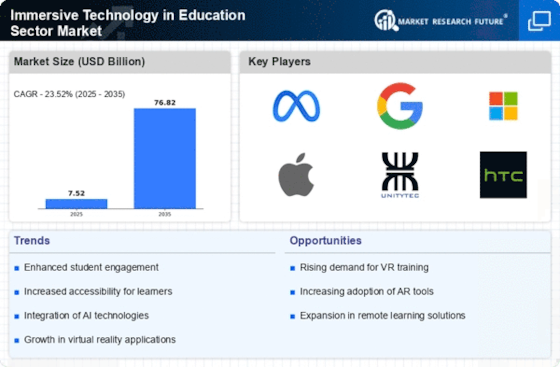
Immersive Technology in Education Sector Market Infographic
Purchase Options

Market Analysis

In-depth Analysis of Immersive Technology in Education Sector Market Industry Landscape

The immersive technology in education industry is growing due to a variety of variables that demonstrate immersive technologies' transformative influence on education. This rise is driven by the growing acknowledgment of immersive technologies like VR and AR's potential to improve learning. These immersive and interactive technologies make complicated subjects easier to learn and involve students more than traditional techniques.

The rising emphasis on experience learning is also driving immersive technology uptake in education. Immersive experiences allow students to investigate historical events, perform virtual experiments, or visit distant places, going beyond typical classroom approaches. Experiential learning makes learning more fun and reinforces concepts by letting students engage.

Immersive technology gadgets are integrated into education due to their price and accessibility. As VR headsets, AR apps, and other immersive tools grow cheaper, educational institutions may invest in them without breaking the bank. Immersive technology enabled virtual classrooms, labs, and collaboration spaces, making online learning more dynamic and participatory. Immersive technology can improve distant and hybrid learning, as shown by pandemic-induced education reforms.

Immersive learning experiences' personalization and adaptability drive the Immersive Technology in Education industry. These tools allow instructors to adapt curriculum to varied student learning styles and paces. Immersive technology can adjust simulations to different learning levels and create individualized virtual situations for skill development to reach a wide range of pupils.

Immersive technologies are gamifying education, which is motivating students. Teachers may make learning more fun and participatory by adding prizes, challenges, and interactive simulations. Gamification makes learning fun and motivates students to engage and keep learning.

Industry collaboration and immersive technology education are propelling the market. High-quality immersive learning experiences that meet curricular standards are being created by educational content providers, technology developers, and educators. This collaboration makes immersive technology in education an important element of the educational environment with educational and academically related material.


Author
Aarti Dhapte
AVP - Research

A consulting professional focused on helping businesses navigate complex markets through structured research and strategic insights. I partner with clients to solve high-impact business problems across market entry strategy, competitive intelligence, and opportunity assessment. Over the course of my experience, I have led and contributed to 100+ market research and consulting engagements, delivering insights across multiple industries and geographies, and supporting strategic decisions linked to $500M+ market opportunities. My core expertise lies in building robust market sizing, forecasting, and commercial models (top-down and bottom-up), alongside deep-dive competitive and industry analysis. I have played a key role in shaping go-to-market strategies, investment cases, and growth roadmaps, enabling clients to make confident, data-backed decisions in dynamic markets.

Leave a Comment

FAQs

What is the current market valuation of Immersive Technology in the Education Sector?

<p>The market valuation of Immersive Technology in the Education Sector was 7.522 USD Billion in 2024.</p>

What is the projected market size for Immersive Technology in Education by 2035?

<p>The projected market size for Immersive Technology in Education is expected to reach 76.82 USD Billion by 2035.</p>

What is the expected CAGR for the Immersive Technology in Education Sector from 2025 to 2035?

<p>The expected CAGR for the Immersive Technology in Education Sector during the forecast period 2025 - 2035 is 23.52%.</p>

Which companies are leading the Immersive Technology in Education Sector market?

<p>Key players in the market include Meta Platforms, Google, Microsoft, Apple, Unity Technologies, HTC, Samsung Electronics, Sony, and Immersive VR Education.</p>

What are the main components of the Immersive Technology market in education?

<p>The main components include Hardware, Software/Platform, and Services, with valuations ranging from 1.5 to 31.82 USD Billion.</p>

How does the market for Mixed Reality compare to Virtual and Augmented Reality in education?

<p>In 2024, the market for Mixed Reality was valued at 1.5 USD Billion, while Virtual Reality and Augmented Reality were valued at 2.0 and 2.5 USD Billion, respectively.</p>

What applications are driving growth in the Immersive Technology in Education Sector?

Key applications driving growth include Training &amp; Learning, Emergency Services, Product Development, and Sales &amp; Marketing, with valuations from 1.0 to 26.82 USD Billion.

What is the valuation range for Software/Platform in the Immersive Technology market?

The valuation range for Software/Platform in the Immersive Technology market spans from 3.0 to 30.0 USD Billion.

How does the 2025 market valuation compare to that of 2024?

The market valuation in 2025 is anticipated to reflect growth from the 7.522 USD Billion valuation recorded in 2024.

What trends are expected to shape the Immersive Technology market in education by 2035?

Trends likely to shape the market by 2035 include advancements in technology and increased adoption across various educational applications.

Market Summary

As per Market Research Future analysis, the Immersive Technology in Education Sector Market was estimated at 7.522 USD Billion in 2024. The immersive technology industry is projected to grow from 9.292 USD Billion in 2025 to 76.82 USD Billion by 2035, exhibiting a compound annual growth rate (CAGR) of 23.52% during the forecast period 2025 - 2035

Key Market Trends & Highlights

The Immersive Technology in Education Sector Market is experiencing robust growth driven by innovative learning solutions.

  • The market witnesses increased adoption of Virtual Reality, particularly in North America, which remains the largest market. There is a notable focus on personalized learning experiences, especially within the Asia-Pacific region, recognized as the fastest-growing area. Integration of gamification elements is becoming prevalent, enhancing student engagement and motivation across various educational settings. Key market drivers include enhanced engagement through immersive experiences and a growing demand for remote learning solutions, which are shaping the future of education.

Market Size & Forecast

2024 Market Size 7.522 (USD Billion)
2035 Market Size 76.82 (USD Billion)
CAGR (2025 - 2035) 23.52%
Largest Regional Market Share in 2024 North America

Major Players

Meta Platforms (US), Google (US), Microsoft (US), Apple (US), Unity Technologies (US), HTC (TW), Samsung Electronics (KR), Sony (JP), Immersive VR Education (IE)

Market Trends

The Immersive Technology in Education Sector Market is currently experiencing a notable transformation, driven by advancements in virtual reality, augmented reality, and mixed reality applications. These technologies are increasingly integrated into educational settings, enhancing the learning experience by providing interactive and engaging environments. Educators and institutions are recognizing the potential of immersive technology to facilitate deeper understanding and retention of complex subjects. As a result, there is a growing demand for innovative solutions that cater to diverse learning styles and preferences. Moreover, the market appears to be influenced by a shift towards personalized learning experiences. This trend suggests that immersive technologies can be tailored to meet individual student needs, thereby fostering a more inclusive educational landscape. Institutions are exploring partnerships with technology providers to develop customized content and tools that align with their specific curricula. The ongoing evolution of the Immersive Technology in Education Sector Market indicates a promising future, where technology plays a pivotal role in shaping educational methodologies and outcomes.

Increased Adoption of Virtual Reality

Educational institutions are increasingly embracing virtual reality as a tool for immersive learning. This trend indicates a shift towards experiential education, where students can engage with content in a more interactive manner. Virtual reality allows learners to explore complex concepts through simulations, enhancing their understanding and retention.

Focus on Personalized Learning

There is a growing emphasis on personalized learning experiences within the Immersive Technology in Education Sector Market. This trend suggests that educational technologies are being designed to cater to individual learning styles and preferences, allowing students to progress at their own pace and engage with material that resonates with them.

Integration of Gamification Elements

The incorporation of gamification elements into educational content is becoming more prevalent. This trend indicates that immersive technologies are being utilized to create engaging and motivating learning environments. By integrating game-like features, educators aim to enhance student participation and foster a sense of achievement.

Immersive Technology in Education Sector Market Market Drivers

Increased Investment in EdTech Innovations

The Immersive Technology in Education Sector Market is benefiting from increased investment in educational technology innovations. Governments and private investors are recognizing the potential of immersive technologies to revolutionize education. Funding for research and development in VR and AR applications is on the rise, with projections suggesting that the EdTech market could reach substantial figures in the coming years. This influx of capital is likely to accelerate the development of new immersive tools and resources, making them more accessible to educators and learners alike. As a result, the integration of immersive technology in education is expected to expand rapidly.

Growing Demand for Remote Learning Solutions

The Immersive Technology in Education Sector Market is experiencing a surge in demand for remote learning solutions. As educational institutions seek to provide flexible learning options, immersive technologies such as VR and AR are being integrated into online platforms. This trend is driven by the need for interactive and engaging content that can be accessed from anywhere. Market data indicates that the remote learning segment is projected to grow significantly, with immersive technologies playing a crucial role in enhancing the online learning experience. This shift not only broadens access to education but also encourages the adoption of innovative teaching methods.

Enhanced Engagement through Immersive Experiences

The Immersive Technology in Education Sector Market is witnessing a notable shift towards enhanced engagement through immersive experiences. Educational institutions are increasingly adopting virtual reality (VR) and augmented reality (AR) to create interactive learning environments. This approach not only captivates students' attention but also fosters deeper understanding of complex subjects. According to recent data, immersive learning experiences can improve retention rates by up to 75% compared to traditional methods. As a result, educators are more inclined to invest in immersive technologies, recognizing their potential to transform the learning landscape.

Focus on Skill Development and Workforce Readiness

The Immersive Technology in Education Sector Market is aligning with the growing emphasis on skill development and workforce readiness. Educational institutions are increasingly incorporating immersive technologies to prepare students for the demands of the modern job market. By simulating real-world scenarios, VR and AR can provide hands-on training experiences that enhance practical skills. This trend is particularly relevant in fields such as healthcare, engineering, and vocational training, where experiential learning is essential. As employers seek candidates with relevant skills, the integration of immersive technology in education is likely to become a key strategy for institutions aiming to enhance employability.

Rising Popularity of Collaborative Learning Environments

The Immersive Technology in Education Sector Market is witnessing a rise in the popularity of collaborative learning environments. Immersive technologies facilitate group interactions and teamwork, allowing students to engage in shared learning experiences. This collaborative approach not only enhances social skills but also promotes critical thinking and problem-solving abilities. Data suggests that students who participate in collaborative immersive learning environments demonstrate improved academic performance. As educational institutions recognize the benefits of collaborative learning, the integration of immersive technologies is expected to grow, fostering a more interactive and inclusive educational experience.

Market Segment Insights

By Component: Hardware (Largest) vs. Software/Platform (Fastest-Growing)

The Immersive Technology in Education Sector Market showcases a significant market share distribution across its component segments. Hardware, including devices like VR headsets and AR glasses, holds the largest share, reflecting the high demand for tangible tools necessary for immersive learning experiences. In contrast, the Software/Platform segment is rapidly gaining traction, driven by the increasing integration of immersive technologies into educational curricula and enhanced user experiences. This shift suggests a diverse adoption where both hardware and software play pivotal roles in the educational landscape. As educational institutions continue to embrace immersive technologies, the growth trends indicate a robust upward trajectory for the Software/Platform segment. Key drivers include the need for engaging learning environments, advancements in software development, and the rising popularity of gamified learning solutions. Additionally, factors such as accessibility of quality content and collaborative learning tools contribute significantly to this growth, positioning software as an essential component of immersive education that complements existing hardware frameworks.

Hardware (Dominant) vs. Software/Platform (Emerging)

The Hardware segment in the Immersive Technology in Education Sector Market remains dominant due to its critical role in providing the physical infrastructure necessary for immersive learning experiences. Hardware solutions, which encompass VR headsets, AR devices, and simulation tools, are essential for implementing immersive curricula and enhancing student engagement. On the other hand, the Software/Platform segment is emerging, characterized by its agility in developing adaptive learning environments and interactive platforms that cater to diverse educational needs. This segment leverages cloud-based technologies and AI to create personalized learning experiences, making it increasingly vital as educational institutions seek innovative ways to deliver content effectively and foster collaborative learning through seamless integration with existing hardware.

By Technology: Virtual Reality (Largest) vs. Augmented Reality (Fastest-Growing)

In the Immersive Technology in the Education Sector Market, Virtual Reality (VR) holds the largest market share, dominating the landscape due to its immersive and engaging learning experiences. This segment is highly favored for its ability to create realistic simulations that enhance retention and understanding, making it a preferred choice among educational institutions. Conversely, Augmented Reality (AR) is emerging rapidly, capturing attention with its interactive overlays that enhance traditional teaching methodologies. Both technologies contribute significantly to the ongoing transformation in education, appealing to different learning modalities.

Mixed Reality (Dominant) vs. 360 Film (Emerging)

Mixed Reality (MR) is positioned as a dominant force within the Immersive Technology in Education Sector Market, facilitating a unique blend of physical and digital learning environments. Its capacity to engage learners through interactive elements makes it a valuable tool for a range of subjects. Meanwhile, 360 Film is recognized as an emerging segment, gaining traction due to its ability to present content in an immersive format that enhances storytelling and experiential learning. While MR is championing complex user interactions, 360 Film offers an accessible entry point for institutions looking to integrate immersive experiences into their curricula, promoting innovative methods of content delivery.

By Application: Training & Learning (Largest) vs. Sales & Marketing (Fastest-Growing)

The application segment in the Immersive Technology in Education Sector Market is primarily dominated by Training &amp; Learning, which captures a significant share of the market. This segment benefits from the increasing adoption of immersive technologies by educational institutions for a more engaging and effective learning experience. In contrast, Sales &amp; Marketing is rapidly emerging, driven by the need for innovative ways to reach and engage customers through immersive experiences that showcase products and services in a more interactive way.

Training &amp; Learning (Dominant) vs. Sales &amp; Marketing (Emerging)

The Training &amp; Learning application stands out as the dominant force in the Immersive Technology in Education Sector Market, leveraging virtual and augmented reality to enhance educational outcomes. This segment focuses on delivering interactive and experiential learning opportunities that improve student engagement and retention. On the other hand, Sales &amp; Marketing is an emerging segment characterized by its adoption of immersive technologies to revolutionize promotional strategies, offering innovative ways for brands to connect with their audience. The use of simulations and immersive scenarios allows companies to demonstrate products effectively, positioning this segment for robust growth as organizations increasingly prioritize immersive experiences.

Get more detailed insights about Immersive Technology in Education Sector Market Research Report – Forecast till 2035

Regional Insights

North America : Innovation and Leadership Hub

North America is the largest market for immersive technology in education, holding approximately 45% of the global share. The region's growth is driven by significant investments in technology, increasing adoption of virtual and augmented reality in classrooms, and supportive government initiatives. The demand for innovative educational tools is further fueled by the need for remote learning solutions and enhanced student engagement. The United States leads the market, with key players like Meta Platforms, Google, and Microsoft driving innovation. Canada also plays a significant role, focusing on integrating immersive technologies into its educational framework. The competitive landscape is characterized by rapid advancements and collaborations among tech giants, ensuring a robust ecosystem for immersive learning solutions.

Europe : Emerging Market with Potential

Europe is the second-largest market for immersive technology in education, accounting for around 30% of the global market share. The region's growth is propelled by increasing investments in digital education, government initiatives promoting technology in schools, and a rising demand for personalized learning experiences. Countries like Germany and the UK are at the forefront, implementing policies that encourage the adoption of immersive technologies in educational settings. Germany, the UK, and France are leading the charge, with numerous startups and established companies focusing on immersive educational solutions. The competitive landscape is vibrant, with a mix of local and international players. The European market is characterized by a strong emphasis on regulatory compliance and quality standards, ensuring that immersive technologies meet educational needs effectively.

Asia-Pacific : Rapid Growth and Adoption

Asia-Pacific is witnessing rapid growth in the immersive technology education sector, holding approximately 20% of the global market share. The region's expansion is driven by increasing smartphone penetration, a growing emphasis on digital literacy, and government initiatives aimed at modernizing education. Countries like China and India are leading this growth, with significant investments in educational technology and infrastructure. China is a key player, with numerous tech companies developing immersive learning solutions tailored to local needs. India is also emerging as a significant market, focusing on affordable and scalable immersive technologies. The competitive landscape is marked by a mix of established players and innovative startups, creating a dynamic environment for immersive education solutions.

Middle East and Africa : Emerging Frontier for Innovation

The Middle East and Africa region is an emerging frontier for immersive technology in education, holding about 5% of the global market share. The growth is driven by increasing investments in educational infrastructure, a rising demand for innovative learning solutions, and government initiatives aimed at enhancing digital education. Countries like the UAE and South Africa are leading the way, focusing on integrating technology into their educational systems. The UAE is particularly notable for its ambitious plans to incorporate immersive technologies in schools, supported by government funding and partnerships with tech companies. South Africa is also making strides, with a growing number of startups focusing on educational technology. The competitive landscape is evolving, with both local and international players seeking to capitalize on the region's potential for immersive learning solutions.

Key Players and Competitive Insights

Leading market players are investing heavily in research and development in order to expand their product lines, which will help the Immersive Technology in Education Sector Market, grow even more. Market participants are also undertaking a variety of strategic activities to expand their footprint, with important market developments including new product launches, contractual agreements, mergers and acquisitions, higher investments, and collaboration with other organizations. To expand and survive in a more competitive and rising market climate, Immersive Technology in Education Sector industry must offer cost-effective items. Manufacturing locally to minimize operational costs is one of the key business tactics used by manufacturers in the Immersive Technology in Education Sector industry to benefit clients and increase the market sector. In recent years, the Immersive Technology in Education Sector industry has offered some of the most significant advantages to medicine. Major players in the Immersive Technology in Education Sector Market, including Acer Inc., Atheer, Inc., AVEVA Group PLC, Barco NV, Blippar Ltd., Carl Zeiss AG, CM Labs Simulations Inc., EON Reality, Inc., FAAC Incorporated, Google, LLC, HCL Technologies Limited, Honeywell International, Inc., HTC Corporation, Immersive Media Company, Immersive Technologies Pty Limited, Lockheed Martin Corporation, Magic Leap, Inc., NCTech Limited, Oculus (Facebook Technologies, LLC.), Samsung Group, Sony Corporation, Unity Software Inc., Varjo Technologies Oy, VI-grade GmbH, Zeality Inc. and others, are attempting to increase market demand by investing in research and development operations. Honeywell International Inc. is a business that deals with engineering and technology. In order to address issues in a variety of industries, including energy, security, safety, productivity, and urbanization, the company develops and produces technologies. Among Honeywell's offerings are specialty chemicals, process technologies, electrical and complex materials, productivity, sensing, safety and security technology, and replacement parts. It also provides management, technical, maintenance, and repair services. In the building, petrochemical, aerospace, and refining industries, Honeywell serves customers in North America, Europe, and other continents. It runs manufacturing and other enterprises all around the world. The corporate headquarters of Honeywell are located in Charlotte, North Carolina, in the US. Among the smart handheld gadgets that HTC Corp (HTC) creates and makes are smartphones and tablets. The company's product line includes PDA phones, virtual reality gear and related accessories, as well as other IoT products. Additionally, the company offers a variety of accessories for sale, including true wireless earbuds, adaptive audio earphones, USB type-c connections, power banks, and dual port car chargers. It provides products through important carriers, local retailers, online stores, and its own eStores. For smart mobile devices, it provides marketing, maintenance, and after-sales services, media streaming and download, as well as examination and consultation services. The company conducts business throughout the Americas, Europe, and Asia-Pacific. HTC's headquarters are in Taipei's Taoyuan City.

Key Companies in the Immersive Technology in Education Sector Market include

Industry Developments

April 2023: To create its business consulting services, EON Reality Inc. collaborated with Holistic EHS. Holistic EHS is able to provide its consulting clients with new and improved services in a variety of XR fields thanks to EON Reality's AI-powered XR solutions. The improved procedural and immersive software that Holistic EHS and its clients may create thanks to the new spatial AI-based capabilities of the EON Reality suite.

April 2023: In order to improve Sarawak's digital talent development paths and training programs, the Center of Technical Excellence and EON Reality have announced an expanded relationship to introduce Malaysia's first spatial AI-based collaboration. CENTEXS seeks to improve the learning and upskilling processes for nearby students and members of the growing workforce with its AI-powered XR solution from EON Reality.

Future Outlook

Immersive Technology in Education Sector Market Future Outlook

The Immersive Technology in Education Sector Market is projected to grow at a 23.52% CAGR from 2025 to 2035, driven by technological advancements, increased investment, and demand for personalized learning experiences.

New opportunities lie in:

  • <p>Development of immersive learning platforms for remote education Integration of AR/VR in vocational training programs Creation of subscription-based content libraries for educational institutions</p>

By 2035, the market is expected to be robust, reflecting substantial growth and innovation.

Market Segmentation

Immersive Technology in Education Sector Market Component Outlook

  • Hardware
  • Software/Platform
  • Services

Immersive Technology in Education Sector Market Technology Outlook

  • Mixed Reality (MR)
  • Virtual Reality (VR)
  • Augmented Reality (AR)
  • 360 Film

Immersive Technology in Education Sector Market Application Outlook

  • Training & Learning
  • Emergency Services
  • Product Development
  • Sales & Marketing

Report Scope

MARKET SIZE 2024 7.522(USD Billion)
MARKET SIZE 2025 9.292(USD Billion)
MARKET SIZE 2035 76.82(USD Billion)
COMPOUND ANNUAL GROWTH RATE (CAGR) 23.52% (2025 - 2035)
REPORT COVERAGE Revenue Forecast, Competitive Landscape, Growth Factors, and Trends
BASE YEAR 2024
Market Forecast Period 2025 - 2035
Historical Data 2019 - 2024
Market Forecast Units USD Billion
Key Companies Profiled Meta Platforms (US), Google (US), Microsoft (US), Apple (US), Unity Technologies (US), HTC (TW), Samsung Electronics (KR), Sony (JP), Immersive VR Education (IE)
Segments Covered Component, Region
Key Market Opportunities Integration of augmented reality and virtual reality enhances experiential learning in the Immersive Technology in Education Sector Market.
Key Market Dynamics Rising demand for immersive learning experiences drives innovation and competition in the education technology landscape.
Countries Covered North America, Europe, APAC, South America, MEA

FAQs

What is the current market valuation of Immersive Technology in the Education Sector?

<p>The market valuation of Immersive Technology in the Education Sector was 7.522 USD Billion in 2024.</p>

What is the projected market size for Immersive Technology in Education by 2035?

<p>The projected market size for Immersive Technology in Education is expected to reach 76.82 USD Billion by 2035.</p>

What is the expected CAGR for the Immersive Technology in Education Sector from 2025 to 2035?

<p>The expected CAGR for the Immersive Technology in Education Sector during the forecast period 2025 - 2035 is 23.52%.</p>

Which companies are leading the Immersive Technology in Education Sector market?

<p>Key players in the market include Meta Platforms, Google, Microsoft, Apple, Unity Technologies, HTC, Samsung Electronics, Sony, and Immersive VR Education.</p>

What are the main components of the Immersive Technology market in education?

<p>The main components include Hardware, Software/Platform, and Services, with valuations ranging from 1.5 to 31.82 USD Billion.</p>

How does the market for Mixed Reality compare to Virtual and Augmented Reality in education?

<p>In 2024, the market for Mixed Reality was valued at 1.5 USD Billion, while Virtual Reality and Augmented Reality were valued at 2.0 and 2.5 USD Billion, respectively.</p>

What applications are driving growth in the Immersive Technology in Education Sector?

Key applications driving growth include Training &amp; Learning, Emergency Services, Product Development, and Sales &amp; Marketing, with valuations from 1.0 to 26.82 USD Billion.

What is the valuation range for Software/Platform in the Immersive Technology market?

The valuation range for Software/Platform in the Immersive Technology market spans from 3.0 to 30.0 USD Billion.

How does the 2025 market valuation compare to that of 2024?

The market valuation in 2025 is anticipated to reflect growth from the 7.522 USD Billion valuation recorded in 2024.

What trends are expected to shape the Immersive Technology market in education by 2035?

Trends likely to shape the market by 2035 include advancements in technology and increased adoption across various educational applications.

  1. SECTION I: EXECUTIVE SUMMARY AND KEY HIGHLIGHTS
    1. | 1.1 EXECUTIVE SUMMARY
    2. | | 1.1.1 Market Overview
    3. | | 1.1.2 Key Findings
    4. | | 1.1.3 Market Segmentation
    5. | | 1.1.4 Competitive Landscape
    6. | | 1.1.5 Challenges and Opportunities
    7. | | 1.1.6 Future Outlook
  2. SECTION II: SCOPING, METHODOLOGY AND MARKET STRUCTURE
    1. | 2.1 MARKET INTRODUCTION
    2. | | 2.1.1 Definition
    3. | | 2.1.2 Scope of the study
    4. | | | 2.1.2.1 Research Objective
    5. | | | 2.1.2.2 Assumption
    6. | | | 2.1.2.3 Limitations
    7. | 2.2 RESEARCH METHODOLOGY
    8. | | 2.2.1 Overview
    9. | | 2.2.2 Data Mining
    10. | | 2.2.3 Secondary Research
    11. | | 2.2.4 Primary Research
    12. | | | 2.2.4.1 Primary Interviews and Information Gathering Process
    13. | | | 2.2.4.2 Breakdown of Primary Respondents
    14. | | 2.2.5 Forecasting Model
    15. | | 2.2.6 Market Size Estimation
    16. | | | 2.2.6.1 Bottom-Up Approach
    17. | | | 2.2.6.2 Top-Down Approach
    18. | | 2.2.7 Data Triangulation
    19. | | 2.2.8 Validation
  3. SECTION III: QUALITATIVE ANALYSIS
    1. | 3.1 MARKET DYNAMICS
    2. | | 3.1.1 Overview
    3. | | 3.1.2 Drivers
    4. | | 3.1.3 Restraints
    5. | | 3.1.4 Opportunities
    6. | 3.2 MARKET FACTOR ANALYSIS
    7. | | 3.2.1 Value chain Analysis
    8. | | 3.2.2 Porter's Five Forces Analysis
    9. | | | 3.2.2.1 Bargaining Power of Suppliers
    10. | | | 3.2.2.2 Bargaining Power of Buyers
    11. | | | 3.2.2.3 Threat of New Entrants
    12. | | | 3.2.2.4 Threat of Substitutes
    13. | | | 3.2.2.5 Intensity of Rivalry
    14. | | 3.2.3 COVID-19 Impact Analysis
    15. | | | 3.2.3.1 Market Impact Analysis
    16. | | | 3.2.3.2 Regional Impact
    17. | | | 3.2.3.3 Opportunity and Threat Analysis
  4. SECTION IV: QUANTITATIVE ANALYSIS
    1. | 4.1 Information and Communications Technology, BY Component (USD Billion)
    2. | | 4.1.1 Hardware
    3. | | 4.1.2 Software/Platform
    4. | | 4.1.3 Services
    5. | 4.2 Information and Communications Technology, BY Technology (USD Billion)
    6. | | 4.2.1 Mixed Reality (MR)
    7. | | 4.2.2 Virtual Reality (VR)
    8. | | 4.2.3 Augmented Reality (AR)
    9. | | 4.2.4 360 Film
    10. | 4.3 Information and Communications Technology, BY Application (USD Billion)
    11. | | 4.3.1 Training & Learning
    12. | | 4.3.2 Emergency Services
    13. | | 4.3.3 Product Development
    14. | | 4.3.4 Sales & Marketing
    15. | 4.4 Information and Communications Technology, BY Region (USD Billion)
    16. | | 4.4.1 North America
    17. | | | 4.4.1.1 US
    18. | | | 4.4.1.2 Canada
    19. | | 4.4.2 Europe
    20. | | | 4.4.2.1 Germany
    21. | | | 4.4.2.2 UK
    22. | | | 4.4.2.3 France
    23. | | | 4.4.2.4 Russia
    24. | | | 4.4.2.5 Italy
    25. | | | 4.4.2.6 Spain
    26. | | | 4.4.2.7 Rest of Europe
    27. | | 4.4.3 APAC
    28. | | | 4.4.3.1 China
    29. | | | 4.4.3.2 India
    30. | | | 4.4.3.3 Japan
    31. | | | 4.4.3.4 South Korea
    32. | | | 4.4.3.5 Malaysia
    33. | | | 4.4.3.6 Thailand
    34. | | | 4.4.3.7 Indonesia
    35. | | | 4.4.3.8 Rest of APAC
    36. | | 4.4.4 South America
    37. | | | 4.4.4.1 Brazil
    38. | | | 4.4.4.2 Mexico
    39. | | | 4.4.4.3 Argentina
    40. | | | 4.4.4.4 Rest of South America
    41. | | 4.4.5 MEA
    42. | | | 4.4.5.1 GCC Countries
    43. | | | 4.4.5.2 South Africa
    44. | | | 4.4.5.3 Rest of MEA
  5. SECTION V: COMPETITIVE ANALYSIS
    1. | 5.1 Competitive Landscape
    2. | | 5.1.1 Overview
    3. | | 5.1.2 Competitive Analysis
    4. | | 5.1.3 Market share Analysis
    5. | | 5.1.4 Major Growth Strategy in the Information and Communications Technology
    6. | | 5.1.5 Competitive Benchmarking
    7. | | 5.1.6 Leading Players in Terms of Number of Developments in the Information and Communications Technology
    8. | | 5.1.7 Key developments and growth strategies
    9. | | | 5.1.7.1 New Product Launch/Service Deployment
    10. | | | 5.1.7.2 Merger & Acquisitions
    11. | | | 5.1.7.3 Joint Ventures
    12. | | 5.1.8 Major Players Financial Matrix
    13. | | | 5.1.8.1 Sales and Operating Income
    14. | | | 5.1.8.2 Major Players R&D Expenditure. 2023
    15. | 5.2 Company Profiles
    16. | | 5.2.1 Meta Platforms (US)
    17. | | | 5.2.1.1 Financial Overview
    18. | | | 5.2.1.2 Products Offered
    19. | | | 5.2.1.3 Key Developments
    20. | | | 5.2.1.4 SWOT Analysis
    21. | | | 5.2.1.5 Key Strategies
    22. | | 5.2.2 Google (US)
    23. | | | 5.2.2.1 Financial Overview
    24. | | | 5.2.2.2 Products Offered
    25. | | | 5.2.2.3 Key Developments
    26. | | | 5.2.2.4 SWOT Analysis
    27. | | | 5.2.2.5 Key Strategies
    28. | | 5.2.3 Microsoft (US)
    29. | | | 5.2.3.1 Financial Overview
    30. | | | 5.2.3.2 Products Offered
    31. | | | 5.2.3.3 Key Developments
    32. | | | 5.2.3.4 SWOT Analysis
    33. | | | 5.2.3.5 Key Strategies
    34. | | 5.2.4 Apple (US)
    35. | | | 5.2.4.1 Financial Overview
    36. | | | 5.2.4.2 Products Offered
    37. | | | 5.2.4.3 Key Developments
    38. | | | 5.2.4.4 SWOT Analysis
    39. | | | 5.2.4.5 Key Strategies
    40. | | 5.2.5 Unity Technologies (US)
    41. | | | 5.2.5.1 Financial Overview
    42. | | | 5.2.5.2 Products Offered
    43. | | | 5.2.5.3 Key Developments
    44. | | | 5.2.5.4 SWOT Analysis
    45. | | | 5.2.5.5 Key Strategies
    46. | | 5.2.6 HTC (TW)
    47. | | | 5.2.6.1 Financial Overview
    48. | | | 5.2.6.2 Products Offered
    49. | | | 5.2.6.3 Key Developments
    50. | | | 5.2.6.4 SWOT Analysis
    51. | | | 5.2.6.5 Key Strategies
    52. | | 5.2.7 Samsung Electronics (KR)
    53. | | | 5.2.7.1 Financial Overview
    54. | | | 5.2.7.2 Products Offered
    55. | | | 5.2.7.3 Key Developments
    56. | | | 5.2.7.4 SWOT Analysis
    57. | | | 5.2.7.5 Key Strategies
    58. | | 5.2.8 Sony (JP)
    59. | | | 5.2.8.1 Financial Overview
    60. | | | 5.2.8.2 Products Offered
    61. | | | 5.2.8.3 Key Developments
    62. | | | 5.2.8.4 SWOT Analysis
    63. | | | 5.2.8.5 Key Strategies
    64. | | 5.2.9 Immersive VR Education (IE)
    65. | | | 5.2.9.1 Financial Overview
    66. | | | 5.2.9.2 Products Offered
    67. | | | 5.2.9.3 Key Developments
    68. | | | 5.2.9.4 SWOT Analysis
    69. | | | 5.2.9.5 Key Strategies
    70. | 5.3 Appendix
    71. | | 5.3.1 References
    72. | | 5.3.2 Related Reports
  6. LIST OF FIGURES
    1. | 6.1 MARKET SYNOPSIS
    2. | 6.2 NORTH AMERICA MARKET ANALYSIS
    3. | 6.3 US MARKET ANALYSIS BY COMPONENT
    4. | 6.4 US MARKET ANALYSIS BY TECHNOLOGY
    5. | 6.5 US MARKET ANALYSIS BY APPLICATION
    6. | 6.6 CANADA MARKET ANALYSIS BY COMPONENT
    7. | 6.7 CANADA MARKET ANALYSIS BY TECHNOLOGY
    8. | 6.8 CANADA MARKET ANALYSIS BY APPLICATION
    9. | 6.9 EUROPE MARKET ANALYSIS
    10. | 6.10 GERMANY MARKET ANALYSIS BY COMPONENT
    11. | 6.11 GERMANY MARKET ANALYSIS BY TECHNOLOGY
    12. | 6.12 GERMANY MARKET ANALYSIS BY APPLICATION
    13. | 6.13 UK MARKET ANALYSIS BY COMPONENT
    14. | 6.14 UK MARKET ANALYSIS BY TECHNOLOGY
    15. | 6.15 UK MARKET ANALYSIS BY APPLICATION
    16. | 6.16 FRANCE MARKET ANALYSIS BY COMPONENT
    17. | 6.17 FRANCE MARKET ANALYSIS BY TECHNOLOGY
    18. | 6.18 FRANCE MARKET ANALYSIS BY APPLICATION
    19. | 6.19 RUSSIA MARKET ANALYSIS BY COMPONENT
    20. | 6.20 RUSSIA MARKET ANALYSIS BY TECHNOLOGY
    21. | 6.21 RUSSIA MARKET ANALYSIS BY APPLICATION
    22. | 6.22 ITALY MARKET ANALYSIS BY COMPONENT
    23. | 6.23 ITALY MARKET ANALYSIS BY TECHNOLOGY
    24. | 6.24 ITALY MARKET ANALYSIS BY APPLICATION
    25. | 6.25 SPAIN MARKET ANALYSIS BY COMPONENT
    26. | 6.26 SPAIN MARKET ANALYSIS BY TECHNOLOGY
    27. | 6.27 SPAIN MARKET ANALYSIS BY APPLICATION
    28. | 6.28 REST OF EUROPE MARKET ANALYSIS BY COMPONENT
    29. | 6.29 REST OF EUROPE MARKET ANALYSIS BY TECHNOLOGY
    30. | 6.30 REST OF EUROPE MARKET ANALYSIS BY APPLICATION
    31. | 6.31 APAC MARKET ANALYSIS
    32. | 6.32 CHINA MARKET ANALYSIS BY COMPONENT
    33. | 6.33 CHINA MARKET ANALYSIS BY TECHNOLOGY
    34. | 6.34 CHINA MARKET ANALYSIS BY APPLICATION
    35. | 6.35 INDIA MARKET ANALYSIS BY COMPONENT
    36. | 6.36 INDIA MARKET ANALYSIS BY TECHNOLOGY
    37. | 6.37 INDIA MARKET ANALYSIS BY APPLICATION
    38. | 6.38 JAPAN MARKET ANALYSIS BY COMPONENT
    39. | 6.39 JAPAN MARKET ANALYSIS BY TECHNOLOGY
    40. | 6.40 JAPAN MARKET ANALYSIS BY APPLICATION
    41. | 6.41 SOUTH KOREA MARKET ANALYSIS BY COMPONENT
    42. | 6.42 SOUTH KOREA MARKET ANALYSIS BY TECHNOLOGY
    43. | 6.43 SOUTH KOREA MARKET ANALYSIS BY APPLICATION
    44. | 6.44 MALAYSIA MARKET ANALYSIS BY COMPONENT
    45. | 6.45 MALAYSIA MARKET ANALYSIS BY TECHNOLOGY
    46. | 6.46 MALAYSIA MARKET ANALYSIS BY APPLICATION
    47. | 6.47 THAILAND MARKET ANALYSIS BY COMPONENT
    48. | 6.48 THAILAND MARKET ANALYSIS BY TECHNOLOGY
    49. | 6.49 THAILAND MARKET ANALYSIS BY APPLICATION
    50. | 6.50 INDONESIA MARKET ANALYSIS BY COMPONENT
    51. | 6.51 INDONESIA MARKET ANALYSIS BY TECHNOLOGY
    52. | 6.52 INDONESIA MARKET ANALYSIS BY APPLICATION
    53. | 6.53 REST OF APAC MARKET ANALYSIS BY COMPONENT
    54. | 6.54 REST OF APAC MARKET ANALYSIS BY TECHNOLOGY
    55. | 6.55 REST OF APAC MARKET ANALYSIS BY APPLICATION
    56. | 6.56 SOUTH AMERICA MARKET ANALYSIS
    57. | 6.57 BRAZIL MARKET ANALYSIS BY COMPONENT
    58. | 6.58 BRAZIL MARKET ANALYSIS BY TECHNOLOGY
    59. | 6.59 BRAZIL MARKET ANALYSIS BY APPLICATION
    60. | 6.60 MEXICO MARKET ANALYSIS BY COMPONENT
    61. | 6.61 MEXICO MARKET ANALYSIS BY TECHNOLOGY
    62. | 6.62 MEXICO MARKET ANALYSIS BY APPLICATION
    63. | 6.63 ARGENTINA MARKET ANALYSIS BY COMPONENT
    64. | 6.64 ARGENTINA MARKET ANALYSIS BY TECHNOLOGY
    65. | 6.65 ARGENTINA MARKET ANALYSIS BY APPLICATION
    66. | 6.66 REST OF SOUTH AMERICA MARKET ANALYSIS BY COMPONENT
    67. | 6.67 REST OF SOUTH AMERICA MARKET ANALYSIS BY TECHNOLOGY
    68. | 6.68 REST OF SOUTH AMERICA MARKET ANALYSIS BY APPLICATION
    69. | 6.69 MEA MARKET ANALYSIS
    70. | 6.70 GCC COUNTRIES MARKET ANALYSIS BY COMPONENT
    71. | 6.71 GCC COUNTRIES MARKET ANALYSIS BY TECHNOLOGY
    72. | 6.72 GCC COUNTRIES MARKET ANALYSIS BY APPLICATION
    73. | 6.73 SOUTH AFRICA MARKET ANALYSIS BY COMPONENT
    74. | 6.74 SOUTH AFRICA MARKET ANALYSIS BY TECHNOLOGY
    75. | 6.75 SOUTH AFRICA MARKET ANALYSIS BY APPLICATION
    76. | 6.76 REST OF MEA MARKET ANALYSIS BY COMPONENT
    77. | 6.77 REST OF MEA MARKET ANALYSIS BY TECHNOLOGY
    78. | 6.78 REST OF MEA MARKET ANALYSIS BY APPLICATION
    79. | 6.79 KEY BUYING CRITERIA OF INFORMATION AND COMMUNICATIONS TECHNOLOGY
    80. | 6.80 RESEARCH PROCESS OF MRFR
    81. | 6.81 DRO ANALYSIS OF INFORMATION AND COMMUNICATIONS TECHNOLOGY
    82. | 6.82 DRIVERS IMPACT ANALYSIS: INFORMATION AND COMMUNICATIONS TECHNOLOGY
    83. | 6.83 RESTRAINTS IMPACT ANALYSIS: INFORMATION AND COMMUNICATIONS TECHNOLOGY
    84. | 6.84 SUPPLY / VALUE CHAIN: INFORMATION AND COMMUNICATIONS TECHNOLOGY
    85. | 6.85 INFORMATION AND COMMUNICATIONS TECHNOLOGY, BY COMPONENT, 2024 (% SHARE)
    86. | 6.86 INFORMATION AND COMMUNICATIONS TECHNOLOGY, BY COMPONENT, 2024 TO 2035 (USD Billion)
    87. | 6.87 INFORMATION AND COMMUNICATIONS TECHNOLOGY, BY TECHNOLOGY, 2024 (% SHARE)
    88. | 6.88 INFORMATION AND COMMUNICATIONS TECHNOLOGY, BY TECHNOLOGY, 2024 TO 2035 (USD Billion)
    89. | 6.89 INFORMATION AND COMMUNICATIONS TECHNOLOGY, BY APPLICATION, 2024 (% SHARE)
    90. | 6.90 INFORMATION AND COMMUNICATIONS TECHNOLOGY, BY APPLICATION, 2024 TO 2035 (USD Billion)
    91. | 6.91 BENCHMARKING OF MAJOR COMPETITORS
  7. LIST OF TABLES
    1. | 7.1 LIST OF ASSUMPTIONS
    2. | | 7.1.1
    3. | 7.2 North America MARKET SIZE ESTIMATES; FORECAST
    4. | | 7.2.1 BY COMPONENT, 2025-2035 (USD Billion)
    5. | | 7.2.2 BY TECHNOLOGY, 2025-2035 (USD Billion)
    6. | | 7.2.3 BY APPLICATION, 2025-2035 (USD Billion)
    7. | 7.3 US MARKET SIZE ESTIMATES; FORECAST
    8. | | 7.3.1 BY COMPONENT, 2025-2035 (USD Billion)
    9. | | 7.3.2 BY TECHNOLOGY, 2025-2035 (USD Billion)
    10. | | 7.3.3 BY APPLICATION, 2025-2035 (USD Billion)
    11. | 7.4 Canada MARKET SIZE ESTIMATES; FORECAST
    12. | | 7.4.1 BY COMPONENT, 2025-2035 (USD Billion)
    13. | | 7.4.2 BY TECHNOLOGY, 2025-2035 (USD Billion)
    14. | | 7.4.3 BY APPLICATION, 2025-2035 (USD Billion)
    15. | 7.5 Europe MARKET SIZE ESTIMATES; FORECAST
    16. | | 7.5.1 BY COMPONENT, 2025-2035 (USD Billion)
    17. | | 7.5.2 BY TECHNOLOGY, 2025-2035 (USD Billion)
    18. | | 7.5.3 BY APPLICATION, 2025-2035 (USD Billion)
    19. | 7.6 Germany MARKET SIZE ESTIMATES; FORECAST
    20. | | 7.6.1 BY COMPONENT, 2025-2035 (USD Billion)
    21. | | 7.6.2 BY TECHNOLOGY, 2025-2035 (USD Billion)
    22. | | 7.6.3 BY APPLICATION, 2025-2035 (USD Billion)
    23. | 7.7 UK MARKET SIZE ESTIMATES; FORECAST
    24. | | 7.7.1 BY COMPONENT, 2025-2035 (USD Billion)
    25. | | 7.7.2 BY TECHNOLOGY, 2025-2035 (USD Billion)
    26. | | 7.7.3 BY APPLICATION, 2025-2035 (USD Billion)
    27. | 7.8 France MARKET SIZE ESTIMATES; FORECAST
    28. | | 7.8.1 BY COMPONENT, 2025-2035 (USD Billion)
    29. | | 7.8.2 BY TECHNOLOGY, 2025-2035 (USD Billion)
    30. | | 7.8.3 BY APPLICATION, 2025-2035 (USD Billion)
    31. | 7.9 Russia MARKET SIZE ESTIMATES; FORECAST
    32. | | 7.9.1 BY COMPONENT, 2025-2035 (USD Billion)
    33. | | 7.9.2 BY TECHNOLOGY, 2025-2035 (USD Billion)
    34. | | 7.9.3 BY APPLICATION, 2025-2035 (USD Billion)
    35. | 7.10 Italy MARKET SIZE ESTIMATES; FORECAST
    36. | | 7.10.1 BY COMPONENT, 2025-2035 (USD Billion)
    37. | | 7.10.2 BY TECHNOLOGY, 2025-2035 (USD Billion)
    38. | | 7.10.3 BY APPLICATION, 2025-2035 (USD Billion)
    39. | 7.11 Spain MARKET SIZE ESTIMATES; FORECAST
    40. | | 7.11.1 BY COMPONENT, 2025-2035 (USD Billion)
    41. | | 7.11.2 BY TECHNOLOGY, 2025-2035 (USD Billion)
    42. | | 7.11.3 BY APPLICATION, 2025-2035 (USD Billion)
    43. | 7.12 Rest of Europe MARKET SIZE ESTIMATES; FORECAST
    44. | | 7.12.1 BY COMPONENT, 2025-2035 (USD Billion)
    45. | | 7.12.2 BY TECHNOLOGY, 2025-2035 (USD Billion)
    46. | | 7.12.3 BY APPLICATION, 2025-2035 (USD Billion)
    47. | 7.13 APAC MARKET SIZE ESTIMATES; FORECAST
    48. | | 7.13.1 BY COMPONENT, 2025-2035 (USD Billion)
    49. | | 7.13.2 BY TECHNOLOGY, 2025-2035 (USD Billion)
    50. | | 7.13.3 BY APPLICATION, 2025-2035 (USD Billion)
    51. | 7.14 China MARKET SIZE ESTIMATES; FORECAST
    52. | | 7.14.1 BY COMPONENT, 2025-2035 (USD Billion)
    53. | | 7.14.2 BY TECHNOLOGY, 2025-2035 (USD Billion)
    54. | | 7.14.3 BY APPLICATION, 2025-2035 (USD Billion)
    55. | 7.15 India MARKET SIZE ESTIMATES; FORECAST
    56. | | 7.15.1 BY COMPONENT, 2025-2035 (USD Billion)
    57. | | 7.15.2 BY TECHNOLOGY, 2025-2035 (USD Billion)
    58. | | 7.15.3 BY APPLICATION, 2025-2035 (USD Billion)
    59. | 7.16 Japan MARKET SIZE ESTIMATES; FORECAST
    60. | | 7.16.1 BY COMPONENT, 2025-2035 (USD Billion)
    61. | | 7.16.2 BY TECHNOLOGY, 2025-2035 (USD Billion)
    62. | | 7.16.3 BY APPLICATION, 2025-2035 (USD Billion)
    63. | 7.17 South Korea MARKET SIZE ESTIMATES; FORECAST
    64. | | 7.17.1 BY COMPONENT, 2025-2035 (USD Billion)
    65. | | 7.17.2 BY TECHNOLOGY, 2025-2035 (USD Billion)
    66. | | 7.17.3 BY APPLICATION, 2025-2035 (USD Billion)
    67. | 7.18 Malaysia MARKET SIZE ESTIMATES; FORECAST
    68. | | 7.18.1 BY COMPONENT, 2025-2035 (USD Billion)
    69. | | 7.18.2 BY TECHNOLOGY, 2025-2035 (USD Billion)
    70. | | 7.18.3 BY APPLICATION, 2025-2035 (USD Billion)
    71. | 7.19 Thailand MARKET SIZE ESTIMATES; FORECAST
    72. | | 7.19.1 BY COMPONENT, 2025-2035 (USD Billion)
    73. | | 7.19.2 BY TECHNOLOGY, 2025-2035 (USD Billion)
    74. | | 7.19.3 BY APPLICATION, 2025-2035 (USD Billion)
    75. | 7.20 Indonesia MARKET SIZE ESTIMATES; FORECAST
    76. | | 7.20.1 BY COMPONENT, 2025-2035 (USD Billion)
    77. | | 7.20.2 BY TECHNOLOGY, 2025-2035 (USD Billion)
    78. | | 7.20.3 BY APPLICATION, 2025-2035 (USD Billion)
    79. | 7.21 Rest of APAC MARKET SIZE ESTIMATES; FORECAST
    80. | | 7.21.1 BY COMPONENT, 2025-2035 (USD Billion)
    81. | | 7.21.2 BY TECHNOLOGY, 2025-2035 (USD Billion)
    82. | | 7.21.3 BY APPLICATION, 2025-2035 (USD Billion)
    83. | 7.22 South America MARKET SIZE ESTIMATES; FORECAST
    84. | | 7.22.1 BY COMPONENT, 2025-2035 (USD Billion)
    85. | | 7.22.2 BY TECHNOLOGY, 2025-2035 (USD Billion)
    86. | | 7.22.3 BY APPLICATION, 2025-2035 (USD Billion)
    87. | 7.23 Brazil MARKET SIZE ESTIMATES; FORECAST
    88. | | 7.23.1 BY COMPONENT, 2025-2035 (USD Billion)
    89. | | 7.23.2 BY TECHNOLOGY, 2025-2035 (USD Billion)
    90. | | 7.23.3 BY APPLICATION, 2025-2035 (USD Billion)
    91. | 7.24 Mexico MARKET SIZE ESTIMATES; FORECAST
    92. | | 7.24.1 BY COMPONENT, 2025-2035 (USD Billion)
    93. | | 7.24.2 BY TECHNOLOGY, 2025-2035 (USD Billion)
    94. | | 7.24.3 BY APPLICATION, 2025-2035 (USD Billion)
    95. | 7.25 Argentina MARKET SIZE ESTIMATES; FORECAST
    96. | | 7.25.1 BY COMPONENT, 2025-2035 (USD Billion)
    97. | | 7.25.2 BY TECHNOLOGY, 2025-2035 (USD Billion)
    98. | | 7.25.3 BY APPLICATION, 2025-2035 (USD Billion)
    99. | 7.26 Rest of South America MARKET SIZE ESTIMATES; FORECAST
    100. | | 7.26.1 BY COMPONENT, 2025-2035 (USD Billion)
    101. | | 7.26.2 BY TECHNOLOGY, 2025-2035 (USD Billion)
    102. | | 7.26.3 BY APPLICATION, 2025-2035 (USD Billion)
    103. | 7.27 MEA MARKET SIZE ESTIMATES; FORECAST
    104. | | 7.27.1 BY COMPONENT, 2025-2035 (USD Billion)
    105. | | 7.27.2 BY TECHNOLOGY, 2025-2035 (USD Billion)
    106. | | 7.27.3 BY APPLICATION, 2025-2035 (USD Billion)
    107. | 7.28 GCC Countries MARKET SIZE ESTIMATES; FORECAST
    108. | | 7.28.1 BY COMPONENT, 2025-2035 (USD Billion)
    109. | | 7.28.2 BY TECHNOLOGY, 2025-2035 (USD Billion)
    110. | | 7.28.3 BY APPLICATION, 2025-2035 (USD Billion)
    111. | 7.29 South Africa MARKET SIZE ESTIMATES; FORECAST
    112. | | 7.29.1 BY COMPONENT, 2025-2035 (USD Billion)
    113. | | 7.29.2 BY TECHNOLOGY, 2025-2035 (USD Billion)
    114. | | 7.29.3 BY APPLICATION, 2025-2035 (USD Billion)
    115. | 7.30 Rest of MEA MARKET SIZE ESTIMATES; FORECAST
    116. | | 7.30.1 BY COMPONENT, 2025-2035 (USD Billion)
    117. | | 7.30.2 BY TECHNOLOGY, 2025-2035 (USD Billion)
    118. | | 7.30.3 BY APPLICATION, 2025-2035 (USD Billion)
    119. | 7.31 PRODUCT LAUNCH/PRODUCT DEVELOPMENT/APPROVAL
    120. | | 7.31.1
    121. | 7.32 ACQUISITION/PARTNERSHIP
    122. | | 7.32.1

Information and Communications Technology Market Segmentation

Information and Communications Technology By Component (USD Billion, 2025-2035)

  • Hardware
  • Software/Platform
  • Services

Information and Communications Technology By Technology (USD Billion, 2025-2035)

  • Mixed Reality (MR)
  • Virtual Reality (VR)
  • Augmented Reality (AR)
  • 360 Film

Information and Communications Technology By Application (USD Billion, 2025-2035)

  • Training & Learning
  • Emergency Services
  • Product Development
  • Sales & Marketing
Infographic

Free Sample Request

Kindly complete the form below to receive a free sample of this Report

Get Free Sample

Customer Strories

Compare Licence

×
Features License Type
Single User Multiuser License Enterprise User
Price $4,950 $5,950 $7,250
Maximum User Access Limit 1 User Upto 10 Users Unrestricted Access Throughout the Organization
Free Customization
Direct Access to Analyst
Deliverable Format
Platform Access
Discount on Next Purchase 10% 15% 15%
Printable Versions