Hyperlipidemia Drugs Market

ID: MRFR/Pharma/28270-HCR
128 Pages
Rahul Gotadki
Last Updated: June 27, 2026
Hyperlipidemia Drugs Market Research Report By Drug Class (Statins, PCSK9 Inhibitors, Bempedoic Acid, Antisense Oligonucleotides, Bile Acid Sequestrants), By Indication (Primary Hyperlipidemia, Secondary Hyperlipidemia, Mixed Dyslipidemia, Cardiovascular Disease Prevention), By Route of Administration (Oral, Injectable, Transdermal), By Patient Population (Adults, Pediatric, Geriatric) and By Regional (North America, Europe, South America, Asia Pacific, Middle East and Africa) - Growth & Industry Forecast 2025 To 2035
Download PDF ×

We do not share your information with anyone. However, we may send you emails based on your report interest from time to time. You may contact us at any time to opt-out.

Hyperlipidemia Drugs Market

Market Size

Forecast Period2026-2035
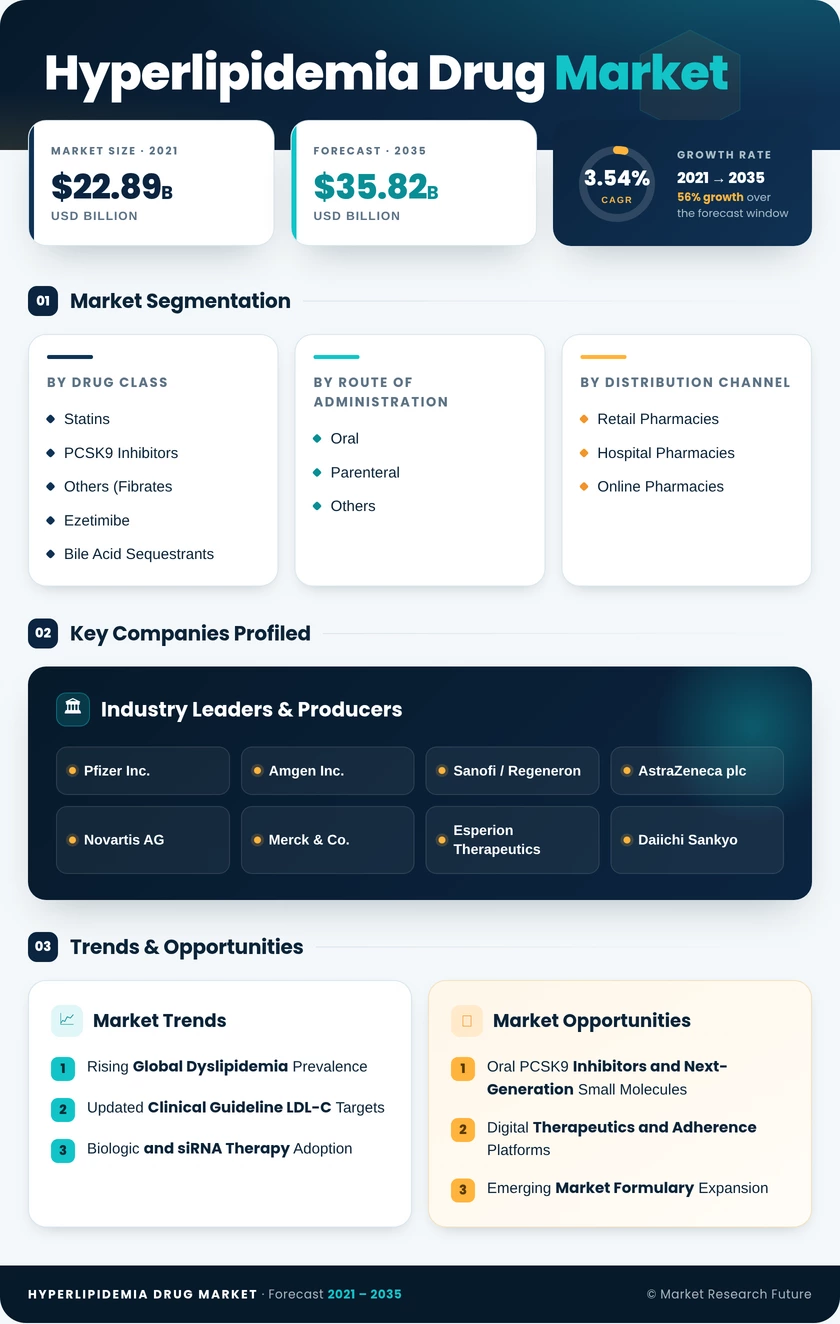
CAGR (2026-2035)3.54%
2025 Market SizeUSD 25.38 Billion
2035 Market SizeUSD 35.82 Billion

Key Players

Pfizer Inc.
Amgen Inc.
Sanofi / Regeneron
AstraZeneca plc
Novartis AG
Merck & Co.
Opportunities
  • Oral PCSK9 Inhibitors and Next-Generation Small Molecules
  • Digital Therapeutics and Adherence Platforms
  • Emerging Market Formulary Expansion
  1. 1 Market Overview |
    1. 1.1 Study Assumptions & Market Definition |
    2. 1.2 Scope of the Study |
    3. 1.3 Research Methodology
  2. 2 Market Summary & Key Takeaways
  3. 3 Market Dynamics |
    1. 3.1 Market Drivers Analysis | |
      1. 3.1.1 Rising Global Dyslipidemia Prevalence | |
      2. 3.1.2 Updated Clinical Guideline LDL-C Targets | |
      3. 3.1.3 Biologic and siRNA Therapy Adoption | |
      4. 3.1.4 Government Screening and Affordability Programs | |
      5. 3.1.5 Value-Based and Outcomes-Linked Contracting | |
      6. 3.1.6 Digital Pharmacy and DTC Prescription Platforms | |
      7. 3.1.7 Combination Fixed-Dose Product Launches |
    2. 3.2 Market Restraints Analysis | |
      1. 3.2.1 Generic Statin Price Erosion | |
      2. 3.2.2 Payer Access Restrictions on Biologics | |
      3. 3.2.3 Patient Adherence and Discontinuation | |
      4. 3.2.4 Biosimilar Entry for PCSK9 Monoclonals | |
      5. 3.2.5 Lifestyle Intervention Substitution |
    3. 3.3 Market Opportunity Analysis | |
      1. 3.3.1 Oral PCSK9 Inhibitors and Next-Generation Small Molecules | |
      2. 3.3.2 Digital Therapeutics and Adherence Platforms | |
      3. 3.3.3 Emerging Market Formulary Expansion | |
      4. 3.3.4 Combination Fixed-Dose Therapies | |
      5. 3.3.5 Real-World Evidence and Outcomes-Based Contracting |
    4. 3.4 Industry Value Chain Analysis |
    5. 3.5 Porter's Five Forces Analysis
  4. 4 Global Hyperlipidemia Drug Market Size & Forecast (2021–2035) |
    1. 4.1 Historical Market Size (2021–2025) |
    2. 4.2 Current & Forecast Market Size (2026–2035) |
    3. 4.3 Market Size by Revenue (USD Billion) |
    4. 4.4 Year-over-Year Growth Analysis
  5. 5 Segmentation Analysis |
    1. 5.1 By Drug Class | |
      1. 5.1.1 Statins | |
      2. 5.1.2 PCSK9 Inhibitors | |
      3. 5.1.3 Others (Fibrates, Ezetimibe, Bile Acid Sequestrants, siRNA, Bempedoic Acid) |
    2. 5.2 By Route of Administration | |
      1. 5.2.1 Oral | |
      2. 5.2.2 Parenteral | |
      3. 5.2.3 Others |
    3. 5.3 By Distribution Channel | |
      1. 5.3.1 Retail Pharmacies | |
      2. 5.3.2 Hospital Pharmacies | |
      3. 5.3.3 Online Pharmacies
  6. 6 Regional Analysis |
    1. 6.1 North America | |
      1. 6.1.1 United States | |
      2. 6.1.2 Canada | |
      3. 6.1.3 Mexico |
    2. 6.2 Europe | |
      1. 6.2.1 Germany | |
      2. 6.2.2 United Kingdom | |
      3. 6.2.3 France | |
      4. 6.2.4 Italy | |
      5. 6.2.5 Spain | |
      6. 6.2.6 Nordic Countries | |
      7. 6.2.7 Russia | |
      8. 6.2.8 Rest of Europe |
    3. 6.3 Asia-Pacific | |
      1. 6.3.1 China | |
      2. 6.3.2 India | |
      3. 6.3.3 Japan | |
      4. 6.3.4 South Korea | |
      5. 6.3.5 ASEAN | |
      6. 6.3.6 Rest of Asia-Pacific |
    4. 6.4 South America | |
      1. 6.4.1 Brazil | |
      2. 6.4.2 Argentina | |
      3. 6.4.3 Rest of South America |
    5. 6.5 Middle East & Africa | |
      1. 6.5.1 Saudi Arabia | |
      2. 6.5.2 UAE | |
      3. 6.5.3 South Africa | |
      4. 6.5.4 Egypt | |
      5. 6.5.5 Rest of MEA
  7. 7 Competitive Landscape |
    1. 7.1 Market Share Analysis (2025) |
    2. 7.2 Competitive Benchmarking Matrix |
    3. 7.3 Company Profiles | |
      1. 7.3.1 Pfizer Inc. | |
      2. 7.3.2 Amgen Inc. | |
      3. 7.3.3 Sanofi / Regeneron | |
      4. 7.3.4 AstraZeneca plc | |
      5. 7.3.5 Novartis AG | |
      6. 7.3.6 Merck & Co. | |
      7. 7.3.7 Esperion Therapeutics | |
      8. 7.3.8 Daiichi Sankyo | |
      9. 7.3.9 Kowa Pharmaceuticals | |
      10. 7.3.10 Abbott Laboratories
  8. 8 Future Outlook & Strategic Recommendations (2026–2035) |
    1. 8.1 Precision Lipidology and Pharmacogenomics |
    2. 8.2 RNA-Based Therapeutics Platform Expansion |
    3. 8.3 Value-Based Healthcare and Pay-for-Outcomes Models |
    4. 8.4 Preventive Cardiology and Population Health Strategies
  9. 9 Recent Developments & News
  10. 10 Frequently Asked Questions (FAQs)
  11. 11 Report Scope & Methodology |
    1. 11.1 Study Period & Base Year |
    2. 11.2 Data Sources & Citations |
    3. 11.3 Abbreviations
  12. 1 LIST OF TABLES
  13. 2 LIST OF FIGURES

Segmentation Quick Reference

DimensionSub-SegmentsDominant SegmentFastest Growing Segment
Drug ClassStatins; PCSK9 Inhibitors; Others (Fibrates, Ezetimibe, Bile Acid Sequestrants, siRNA, Bempedoic Acid)StatinsPCSK9 Inhibitors
Route of AdministrationOral; Parenteral; OthersOralParenteral
Distribution ChannelRetail Pharmacies; Hospital Pharmacies; Online PharmaciesRetail PharmaciesOnline Pharmacies
RegionNorth America; Europe; Asia-Pacific; South America; Middle East & AfricaNorth AmericaAsia-Pacific


Market Segmentation Overview

By Drug Class

Sub-SegmentKey Trend
StatinsGeneric price erosion sustains volume dominance but limits value growth
PCSK9 InhibitorsExpanding label indications and outcomes data drive premium adoption.
OthersFixed-dose combinations and siRNA therapies create new prescribing niches.


Statins remain the foundation of the Hyperlipidemia Drug Market due to guideline-mandated first-line positioning and global generic availability. PCSK9 inhibitors are gaining commercial momentum as cardiovascular outcome trial data strengthen payer justification, while emerging siRNA and non-statin oral agents carve differentiated positions in add-on therapy and statin-intolerant populations.

By Route of Administration

Sub-SegmentKey Trend
OralDaily pill regimens dominate chronic therapy but face adherence challenges
ParenteralTwice-yearly and monthly injectable formats improve compliance profiles.
OthersNovel delivery platforms (transdermal, implantable) remain early-stage


Oral administration leads by volume through established statin prescribing habits, while parenteral delivery captures an increasing share of value as injectable biologics demonstrate superior efficacy in high-risk patient cohorts. The potential approval of oral PCSK9 inhibitors could reshape this dynamic in the latter half of the forecast period.

By Distribution Channel

Sub-SegmentKey Trend
Retail PharmaciesBrick-and-mortar dispensing anchored by walk-in chronic prescription fills
Hospital PharmaciesSpecialty biologic initiation and inpatient cardiovascular risk management
Online PharmaciesRapid growth via telehealth integration and automated subscription refills


Retail pharmacies maintain the largest channel share through high-frequency chronic prescription dispensing, while online pharmacies represent the fastest-growing channel as digital health platforms reduce prescription abandonment and streamline mail-order fulfillment for long-term lipid therapy.