×
Hero Background
English
Chinese
French
Japanese
Korean
German
Spanish

Feed Pigments Market Trends

ID: MRFR/Agri/3911-HCR
110 Pages
Tejas Chaudhary
October 2025

Feed Pigments Market Information by Type (Carotenoids, Curcumin, Spirulina and others), Source (Natural Feed Pigments and Synthetic Feed Pigments), Livestock (Poultry, Swine, Ruminants and others) and Region Forecast till 2035

Share:
Download PDF ×

We do not share your information with anyone. However, we may send you emails based on your report interest from time to time. You may contact us at any time to opt-out.

Feed Pigments Market Infographic
Purchase Options

Market Trends

Key Emerging Trends in the Feed Pigments Market

The animal food color market is seeing important changes that show how things are changing in feeding animals and the different tastes of people. One big change is that many people want food coloring for animals to be more natural and friendly to the environment. Now, more and more people want food that doesn't have many ingredients they can't pronounce. This often comes from caring about the environment too. Feed makers are starting to use plant-based colours like those found in marigold flowers or paprika instead of fake ones made in a lab because it is what most consumers now prefer. This trend matches what people expect from products, especially those that are kind to animals and good for the environment. This is shaping companies to use more green ingredients in their items. This has caused a big increase in work to find new natural sources and ways of getting those things used for color. This is important because it helps meet the need for these pigments without harming our environment. Another important movement is paying attention to animal health and how they do things through special feed colors. Beside their usual job of making colors brighter, pigments like carotenoids are becoming known for helping to keep people healthy. Some colors work as protectors, helping the health of animals and birds by keeping their immune system strong. The move toward food items that do jobs shows a change in how the animal feed business thinks. They now focus more on overall health and energy benefits of dyes used to color their animals, besides making them look pretty. It's probably going to push for more progress in making pigments that have extra health benefits. The upswing of animal food nutrition is influencing the feed color market. This change comes from technology improvements and information-led methods. Farming technologies such as sensors and data analysis are being used to track animal health and diet needs more correctly. This also means that feed colors can be adjusted to meet specific needs. The way we feed animals is getting more accurate. This matches other moves to make farms better and use resources well. It helps the pigment market for animal food grow bigger and fancier too.


Author
Tejas Chaudhary
Research Analyst Level II

I have a degree in Engineering (Civil), with masters in Business Administration (Marketing). With more than 4 years of experience in market research and consulting, I am involved in end-to-end process of market research, proposals, project kickoffs and delivery. I have research knowledge and expertise in consumer goods/packaging domain. Also I have worked for various other domains like construction & equipment. Effectively managed and delivered more than 60 report studies for regional as well as global clientele.

Leave a Comment

FAQs

How much is the Feed Pigments market?

The Feed Pigments market Source was valued at USD 1.5 Billion in 2022.

What is the growth rate of the Feed Pigments market?

The market is projected to grow at a CAGR of 3.52% during the forecast period, 2025-2035.

Which region held the largest market share in the Feed Pigments market?

North America had the largest share in the market

Who are the key players in the Feed Pigments market?

The key players in the market are BASF SE, Royal DSM N.V., Novus International Inc., Nutrex NV, Kemin Industries Inc., Behn Meyer Group, Synthite Industries Ltd, and Kalsec Inc.

Which Type led the Feed Pigments market?

The Carotenoids Type dominated the market in 2022.

Which Source had the largest market share in the Feed Pigments market?

The Natural Feed Pigments Source had the largest share in the market.

Market Summary

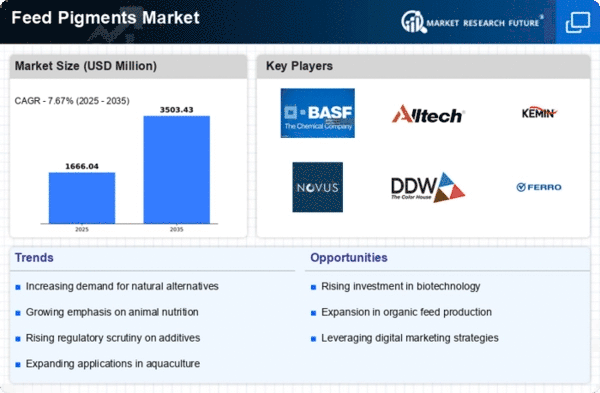
As per MRFR analysis, the Feed Pigments Market Size was estimated at 1547.36 USD Million in 2024. The Feed Pigments industry is projected to grow from 1683.78 in 2025 to 3503.43 by 2035, exhibiting a compound annual growth rate (CAGR) of 7.67 during the forecast period 2025 - 2035.

Key Market Trends & Highlights

The Feed Pigments Market is experiencing a notable shift towards natural solutions and technological advancements.

  • The market is witnessing a significant shift towards natural pigments, driven by consumer preferences for quality animal products.
  • North America remains the largest market for feed pigments, while Asia-Pacific is emerging as the fastest-growing region.
  • Poultry continues to dominate the feed pigments segment, whereas aquaculture is rapidly gaining traction.
  • Rising demand for animal nutrition and regulatory support for feed additives are key drivers propelling market growth.

Market Size & Forecast

2024 Market Size 1547.36 (USD Million)
2035 Market Size 3503.43 (USD Million)
CAGR (2025 - 2035) 7.67%
Largest Regional Market Share in 2024 North America

Major Players

<p>BASF SE (DE), Alltech Inc. (US), Kemin Industries Inc. (US), Novus International Inc. (US), D.D. Williamson & Co. Inc. (US), Ferrostaal GmbH (DE), Natural Color (DK), Sensient Technologies Corporation (US), Royal DSM (NL)</p>

Market Trends

The Feed Pigments Market is currently experiencing a dynamic evolution, driven by increasing consumer awareness regarding animal nutrition and the aesthetic appeal of animal products. This market encompasses a variety of natural and synthetic pigments that enhance the color of animal feed, thereby improving the visual quality of meat, eggs, and dairy products. As consumers become more discerning about the quality of their food, the demand for feed pigments that contribute to the overall health and appearance of livestock is likely to rise. Furthermore, regulatory frameworks are evolving, with a growing emphasis on the safety and efficacy of feed additives, which may influence market dynamics significantly. In addition, the Feed Pigments Market appears to be influenced by trends in sustainable agriculture and the shift towards natural ingredients. Producers are increasingly seeking alternatives to synthetic pigments, favoring natural sources that align with consumer preferences for clean label products. This shift not only addresses health concerns but also reflects a broader movement towards environmentally friendly practices in the agricultural sector. As the market continues to adapt to these changing consumer demands and regulatory landscapes, it is poised for further growth and innovation in the coming years.

Shift Towards Natural Pigments

There is a noticeable trend towards the use of natural pigments in the Feed Pigments Market. This shift is largely driven by consumer preferences for clean label products and concerns regarding synthetic additives. Natural pigments, derived from sources such as plants and minerals, are gaining traction as they are perceived to be safer and more environmentally friendly.

Technological Advancements in Production

Technological innovations are playing a crucial role in the Feed Pigments Market. Advances in extraction and formulation techniques are enhancing the efficiency and effectiveness of pigment production. These developments not only improve the quality of feed pigments but also reduce production costs, making them more accessible to a wider range of producers.

Regulatory Changes and Compliance

The Feed Pigments Market is experiencing shifts due to evolving regulatory frameworks. Governments are increasingly focusing on the safety and efficacy of feed additives, which may lead to stricter compliance requirements. This trend could impact market dynamics, as producers must adapt to new regulations while ensuring product quality and safety.

Feed Pigments Market Market Drivers

Market Growth Projections

The Global Feed Pigments Industry is projected to experience substantial growth over the next decade. In 2024, the market is expected to reach 1.6 USD Billion, with a forecasted increase to 2.34 USD Billion by 2035. This growth trajectory suggests a compound annual growth rate (CAGR) of 3.52% from 2025 to 2035. Factors contributing to this growth include rising livestock production, increasing consumer demand for high-quality animal products, and advancements in feed technology. The market's expansion reflects the evolving landscape of animal nutrition and the critical role of feed pigments in enhancing product quality.

Expansion of Livestock Production

The Global Feed Pigments Industry is significantly influenced by the expansion of livestock production across various regions. As the global population continues to grow, the demand for meat, dairy, and eggs is increasing, prompting farmers to enhance production efficiency. This expansion is particularly evident in developing countries, where rising incomes lead to higher meat consumption. Consequently, the demand for feed pigments, which improve the color and nutritional value of animal products, is expected to surge. By 2035, the market is anticipated to reach 2.34 USD Billion, indicating a robust growth trajectory driven by livestock sector advancements.

Rising Demand for Natural Feed Ingredients

The Global Feed Pigments Industry is witnessing a notable shift towards natural feed ingredients, driven by increasing consumer awareness regarding animal health and welfare. As livestock producers seek to enhance the quality of animal products, the demand for natural pigments, such as carotenoids and anthocyanins, is expected to rise. This trend aligns with the growing preference for organic and non-GMO products among consumers. In 2024, the market is projected to reach 1.6 USD Billion, reflecting a significant opportunity for producers of natural feed pigments. The emphasis on sustainability and health-conscious choices is likely to shape the industry's future.

Regulatory Support for Feed Quality Standards

Regulatory support for feed quality standards is a significant driver of the Global Feed Pigments Industry. Governments worldwide are increasingly implementing stringent regulations to ensure the safety and quality of animal feed. These regulations often mandate the inclusion of specific feed additives, including pigments, to enhance the nutritional value and appearance of animal products. Compliance with these standards not only boosts consumer confidence but also encourages producers to adopt high-quality feed pigments. As a result, the market is expected to benefit from this regulatory landscape, fostering growth and innovation in feed pigment formulations.

Technological Advancements in Feed Production

Technological advancements in feed production are playing a crucial role in shaping the Global Feed Pigments Industry. Innovations in feed formulation and processing techniques enable producers to enhance the efficacy of feed pigments, improving their bioavailability and effectiveness. For instance, the development of microencapsulation technology allows for better stability and release of pigments in animal diets. This not only enhances the visual appeal of animal products but also contributes to their nutritional profile. As these technologies become more widespread, the market is likely to experience accelerated growth, aligning with the projected CAGR of 3.52% from 2025 to 2035.

Consumer Preferences for Aesthetic Appeal in Animal Products

Consumer preferences for aesthetic appeal in animal products are increasingly influencing the Global Feed Pigments Industry. As consumers become more discerning about the appearance of meat, eggs, and dairy products, producers are compelled to enhance the color and visual quality of these items. Feed pigments play a vital role in achieving the desired coloration, which can significantly impact consumer purchasing decisions. This trend is particularly pronounced in markets where visual appeal is linked to perceived quality. As a result, the demand for feed pigments is likely to grow, driven by the need to meet evolving consumer expectations.

Market Segment Insights

By Application: Poultry (Largest) vs. Aquaculture (Fastest-Growing)

<p>The Feed Pigments Market shows significant market share distribution across various application segments, primarily including Poultry, Swine, Aquaculture, Ruminants, and Pet Food. Among these, Poultry emerges as the largest segment due to the high demand for poultry products globally. Following closely are Swine and Ruminants, which maintain considerable shares as livestock farming flourishes and consumers seek natural coloring in feed products.</p>

<p>Application: Poultry (Dominant) vs. Aquaculture (Emerging)</p>

<p>Poultry holds a dominant position in the Feed Pigments Market, driven by the substantial consumption of chicken and eggs worldwide. This segment benefits from the trend towards natural additives that improve the aesthetic appeal of poultry products, leading to a stronger preference for specific feed pigments. Alternatively, the Aquaculture segment is gaining traction as an emerging field, propelled by the increasing demand for sustainable seafood and the rising popularity of fish farming. With a focus on enhancing color and quality in aquaculture products, this segment shows promising growth potential, adapting to consumer preferences for healthier, visually appealing fish and seafood.</p>

By Type: Natural Pigments (Largest) vs. Synthetic Pigments (Fastest-Growing)

<p>The Feed Pigments Market is significantly influenced by the type of pigments utilized, with Natural Pigments leading the share distribution. They often account for a substantial portion of the market, driven by the growing consumer preference for natural and organic feed additives. In contrast, Synthetic Pigments are gaining traction, focusing on cost efficiency and consistency, which presents an exciting growth opportunity, appealing to manufacturers looking for reliable pigment sources.</p>

<p>Natural Pigments (Dominant) vs. Synthetic Pigments (Emerging)</p>

<p>Natural Pigments, derived from plant sources and minerals, dominate the Feed Pigments Market due to their extensive application as additives in animal feed. They meet the growing demand for natural products among consumers, ensuring better health and nutrition for livestock. Synthetic Pigments, meanwhile, present an emerging option in the market, known for their stability and affordability, which allows for enhanced production efficiency. As consumer awareness increases regarding the benefits of both types, the competition between these two segment values shapes the market dynamics, dictating trends and innovations.</p>

By Form: Powder (Largest) vs. Liquid (Fastest-Growing)

<p>In the Feed Pigments Market, the 'Form' segment reveals interesting dynamics among its components: Powder, Liquid, Granular, and Emulsified. Currently, Powder stands out as the largest segment, commanding a significant share due to its versatility and stability. Liquid follows closely behind as the fastest-growing form, driven by increasing demand for easy-to-use and highly bioavailable formulations. Granular and Emulsified forms appeal to niche applications, making essential contributions to the market but lacking the prominence of the top two.</p>

<p>Powder (Dominant) vs. Liquid (Emerging)</p>

<p>Powdered feed pigments represent the dominant force in the Feed Pigments Market owing to their established usage and effective performance metrics. This form is favored for its long shelf life and ease of incorporation into various feed formulations, ensuring consistent color and nutrient delivery. In contrast, Liquid feed pigments are emerging rapidly due to their convenience and flexibility, providing a more uniform distribution in feed mixtures. Their ability to enhance the bioavailability of nutrients positions them well for growth, particularly as manufacturers recognize the benefits of accommodating evolving consumer preferences for natural and efficient feed solutions.</p>

By Source: Plant-Based (Largest) vs. Microbial (Fastest-Growing)

<p>In the Feed Pigments Market, the segment values are primarily classified into Plant-Based, Animal-Based, and Microbial sources. Among these, Plant-Based pigments continue to hold the largest market share, driven by the rising demand for natural ingredients in animal feed. Meanwhile, Microbial sources are emerging rapidly due to their innovative production methods and sustainability benefits, contributing significantly to the overall market dynamics.</p>

<p>Plant-Based (Dominant) vs. Microbial (Emerging)</p>

<p>The Plant-Based segment is currently dominating the Feed Pigments Market, characterized by its extensive use of high-quality natural pigment sources like beetroot and marigold. These pigments not only enhance the color of animal feed but also boast health benefits, appealing to consumers looking for organic and safe feed solutions. In contrast, the Microbial segment represents an emerging market trend, leveraging advancements in biotechnology to produce pigments through fermentation processes. This segment is gaining traction due to its low environmental impact and ability to produce consistent quality pigments, positioning it as a critical player for future growth in the industry.</p>

By End Use: Feed Industry (Largest) vs. Food Industry (Fastest-Growing)

<p>The Feed Pigments Market shows a clear dominance of the Feed Industry segment, which commands the largest share due to the high demand for animal nutrition and the incorporation of pigments for enhancing the aesthetic appeal of feed products. The integration of natural feed pigments in livestock feed not only improves the visual attributes but also addresses nutritional deficiencies, making this segment crucial for livestock health and consumer appeal. On the other hand, the Food Industry segment is rapidly expanding, driven by a growing consumer preference for natural colorants over synthetic alternatives. The shift towards healthier food options and clean-label products is influencing manufacturers to adopt feed pigments, thereby boosting this segment's growth.</p>

<p>Feed Industry: Dominant vs. Food Industry: Emerging</p>

<p>The Feed Industry is currently the dominant force in the Feed Pigments Market, characterized by its entrenched position due to the extensive use of pigments in livestock feed for achieving desired coloration and enhancing product quality. This segment benefits from an established supply chain and strong customer loyalty among farmers and feed manufacturers. In contrast, the Food Industry is emerging as a key player, driven by the increasing consumer demand for natural ingredients in food products. As companies compete to offer visually appealing products without synthetic additives, the Food Industry segment is witnessing accelerated growth. The interplay between health trends and consumer preferences is propelling the adoption of feed pigments, positioning this segment as a significant focus for growth in the coming years.</p>

Get more detailed insights about Feed Pigments Market Research Report– Forecast to 2035

Regional Insights

North America : Market Leader in Feed Pigments

North America is poised to maintain its leadership in the Feed Pigments Market, holding a significant market share of 600.0 million in 2024. The region's growth is driven by increasing demand for natural feed additives, stringent regulations promoting animal health, and a shift towards sustainable farming practices. The regulatory environment is supportive, encouraging innovation and the adoption of high-quality feed pigments. The United States stands out as the leading country, with major players like BASF SE, Alltech Inc., and Kemin Industries Inc. dominating the landscape. The competitive environment is characterized by continuous product development and strategic partnerships. The presence of established companies ensures a robust supply chain, catering to the growing needs of the livestock industry.

Europe : Emerging Market with Growth Potential

Europe's Feed Pigments Market is projected to grow significantly, with a market size of 450.0 million. The region benefits from increasing consumer awareness regarding animal nutrition and health, alongside regulatory frameworks that promote the use of natural pigments. The European Union's stringent regulations on feed quality and safety are key drivers, fostering innovation and compliance among manufacturers. Leading countries such as Germany, France, and the Netherlands are at the forefront of this market, with key players like Royal DSM and Natural Color making substantial contributions. The competitive landscape is marked by a focus on research and development, ensuring that products meet both consumer and regulatory demands. This dynamic environment positions Europe as a promising market for feed pigments.

Asia-Pacific : Rapid Growth in Feed Pigments

The Asia-Pacific region is witnessing rapid growth in the Feed Pigments Market, with a market size of 400.0 million. This growth is fueled by rising livestock production, increasing disposable incomes, and a growing awareness of the benefits of natural feed additives. Regulatory support for animal health and nutrition is also a significant catalyst, driving demand for high-quality feed pigments across the region. Countries like China and India are leading the charge, with a burgeoning livestock sector and a rising number of key players entering the market. Companies such as Kemin Industries and Alltech are expanding their operations to meet the increasing demand. The competitive landscape is evolving, with a focus on innovation and sustainability, ensuring that the region remains a vital player in The Feed Pigments.

Middle East and Africa : Emerging Market with Unique Challenges

The Middle East and Africa region, with a market size of 97.36 million, presents unique challenges and opportunities in the Feed Pigments Market. The growth is driven by increasing livestock production and a rising demand for quality animal feed. However, regulatory frameworks are still developing, which can impact market dynamics. The region's diverse agricultural practices also influence the adoption of feed pigments, necessitating tailored solutions. Countries like South Africa and the UAE are leading the market, with a mix of local and international players. The competitive landscape is characterized by a focus on cost-effective solutions and the need for education on the benefits of feed pigments. As the market matures, there is potential for significant growth, particularly in enhancing livestock health and productivity.

Key Players and Competitive Insights

The Feed Pigments Market is characterized by a dynamic competitive landscape, driven by increasing demand for natural and synthetic colorants in animal feed. Key players are actively engaging in strategies that emphasize innovation, sustainability, and regional expansion. For instance, BASF SE (DE) has been focusing on enhancing its product portfolio through research and development, aiming to meet the growing consumer preference for natural feed additives. Similarly, Alltech Inc. (US) is leveraging its expertise in fermentation technology to develop novel feed pigments that align with the rising trend towards organic farming. These strategic initiatives collectively shape a competitive environment that is increasingly oriented towards sustainability and product differentiation.

In terms of business tactics, companies are localizing manufacturing and optimizing supply chains to enhance operational efficiency. The market structure appears moderately fragmented, with several key players exerting influence over specific regions. This fragmentation allows for niche players to thrive, while larger corporations like Kemin Industries Inc. (US) and Novus International Inc. (US) consolidate their market positions through strategic partnerships and acquisitions, thereby enhancing their competitive edge.

In November 2025, Kemin Industries Inc. (US) announced the launch of a new line of natural feed pigments derived from plant sources, aimed at reducing reliance on synthetic alternatives. This move is strategically significant as it not only addresses consumer demand for cleaner products but also positions Kemin as a leader in sustainable feed solutions. The introduction of these products is likely to enhance their market share and appeal to environmentally conscious consumers.

In October 2025, Novus International Inc. (US) expanded its operations in Asia by establishing a new manufacturing facility in Vietnam. This strategic expansion is indicative of Novus's commitment to tapping into the growing Asian market, which is witnessing an increase in livestock production. By localizing production, Novus aims to reduce logistics costs and improve supply chain responsiveness, thereby enhancing its competitive positioning in the region.

In September 2025, D.D. Williamson & Co. Inc. (US) entered into a strategic partnership with a leading agricultural technology firm to develop AI-driven solutions for optimizing feed pigment formulations. This collaboration is poised to revolutionize the way feed pigments are produced and utilized, potentially leading to more efficient and tailored solutions for livestock producers. The integration of AI into their operations suggests a forward-thinking approach that could set new industry standards.

As of December 2025, the Feed Pigments Market is witnessing trends that emphasize digitalization, sustainability, and technological integration. Strategic alliances are increasingly shaping the competitive landscape, allowing companies to pool resources and expertise. The shift from price-based competition to a focus on innovation and supply chain reliability is evident, as firms strive to differentiate themselves through advanced technologies and sustainable practices. Looking ahead, it appears that competitive differentiation will increasingly hinge on the ability to innovate and adapt to changing consumer preferences, rather than merely competing on price.

Key Companies in the Feed Pigments Market market include

Industry Developments

  • Q1 2024: DSM-Firmenich launches new carotenoid feed pigment blend for poultry DSM-Firmenich announced the commercial launch of a new carotenoid-based feed pigment blend designed to enhance egg yolk coloration and poultry health, expanding its portfolio in the animal nutrition sector.
  • Q2 2024: Evonik opens new animal nutrition innovation center in Singapore Evonik inaugurated a state-of-the-art innovation center focused on feed additives and pigments for livestock and aquaculture, aiming to accelerate product development and regional partnerships.
  • Q2 2024: BASF partners with Cargill to develop sustainable feed pigment solutions BASF and Cargill announced a strategic partnership to co-develop sustainable, natural feed pigment solutions targeting poultry and aquaculture markets, leveraging BASF’s expertise in carotenoids.
  • Q2 2024: Novus International launches AXIS pigment for aquaculture feed Novus International introduced AXIS, a new pigment product for aquaculture feed, designed to improve coloration and health in farmed fish, with initial rollout in Southeast Asia.
  • Q3 2024: ADM acquires Spanish feed pigment producer NutraColor ADM completed the acquisition of NutraColor, a leading Spanish manufacturer of natural feed pigments, strengthening ADM’s position in the European animal nutrition market.
  • Q3 2024: Kemin Industries announces expansion of pigment production facility in Brazil Kemin Industries revealed a major expansion of its feed pigment production facility in Brazil to meet rising demand for natural colorants in Latin American poultry and aquaculture sectors.
  • Q3 2024: DSM-Firmenich receives EU regulatory approval for new natural pigment additive DSM-Firmenich secured European Union regulatory approval for its latest natural pigment additive for animal feed, enabling commercial sales across EU member states.
  • Q4 2024: Cargill launches new algae-derived pigment for salmon feed Cargill announced the launch of a new algae-derived pigment for salmon feed, designed to enhance fillet coloration and support sustainable aquaculture practices.
  • Q4 2024: BASF unveils XanthinPro, a next-generation feed pigment for poultry BASF introduced XanthinPro, a next-generation feed pigment for poultry, featuring improved stability and bioavailability, targeting premium egg and broiler markets.
  • Q1 2025: Evonik signs supply agreement with Thai poultry producer for feed pigments Evonik entered into a multi-year supply agreement with a major Thai poultry producer to provide carotenoid-based feed pigments, supporting the producer’s premium egg segment.
  • Q2 2025: Kemin Industries acquires Indian feed pigment startup ColorFeed Kemin Industries acquired ColorFeed, an Indian startup specializing in natural feed pigments, expanding Kemin’s footprint in South Asia and its product portfolio.
  • Q2 2025: ADM announces $50M investment in US feed pigment R&D center ADM announced a $50 million investment to establish a new research and development center in the US focused on innovative feed pigment technologies for livestock and aquaculture.

Future Outlook

Feed Pigments Market Future Outlook

<p>The Feed Pigments Market is projected to grow at a 7.67% CAGR from 2024 to 2035, driven by rising demand for natural colorants and animal nutrition enhancements.</p>

New opportunities lie in:

  • <p>Development of innovative natural feed pigments to meet consumer demand.</p>
  • <p>Expansion into emerging markets with tailored product offerings.</p>
  • <p>Investment in R&D for sustainable and cost-effective pigment solutions.</p>

<p>By 2035, the Feed Pigments Market is expected to achieve robust growth, reflecting evolving consumer preferences and industry advancements.</p>

Market Segmentation

Feed Pigments Market Form Outlook

  • Powder
  • Liquid
  • Granular
  • Emulsified

Feed Pigments Market Type Outlook

  • Natural Pigments
  • Synthetic Pigments
  • Carotenoids
  • Beetroot Red
  • Anthocyanins

Feed Pigments Market Source Outlook

  • Plant-Based
  • Animal-Based
  • Microbial

Feed Pigments Market End Use Outlook

  • Feed Industry
  • Food Industry
  • Nutraceuticals

Feed Pigments Market Application Outlook

  • Poultry
  • Swine
  • Aquaculture
  • Ruminants
  • Pet Food

Report Scope

MARKET SIZE 20241547.36(USD Million)
MARKET SIZE 20251683.78(USD Million)
MARKET SIZE 20353503.43(USD Million)
COMPOUND ANNUAL GROWTH RATE (CAGR)7.67% (2024 - 2035)
REPORT COVERAGERevenue Forecast, Competitive Landscape, Growth Factors, and Trends
BASE YEAR2024
Market Forecast Period2025 - 2035
Historical Data2019 - 2024
Market Forecast UnitsUSD Million
Key Companies ProfiledBASF SE (DE), Alltech Inc. (US), Kemin Industries Inc. (US), Novus International Inc. (US), D.D. Williamson & Co. Inc. (US), Ferrostaal GmbH (DE), Natural Color (DK), Sensient Technologies Corporation (US), Royal DSM (NL)
Segments CoveredApplication, Type, Form, Source, End Use
Key Market OpportunitiesGrowing demand for natural feed pigments driven by consumer preference for clean-label products.
Key Market DynamicsRising demand for natural feed pigments driven by consumer preference for healthier livestock products and sustainable practices.
Countries CoveredNorth America, Europe, APAC, South America, MEA

FAQs

How much is the Feed Pigments market?

The Feed Pigments market Source was valued at USD 1.5 Billion in 2022.

What is the growth rate of the Feed Pigments market?

The market is projected to grow at a CAGR of 3.52% during the forecast period, 2025-2035.

Which region held the largest market share in the Feed Pigments market?

North America had the largest share in the market

Who are the key players in the Feed Pigments market?

The key players in the market are BASF SE, Royal DSM N.V., Novus International Inc., Nutrex NV, Kemin Industries Inc., Behn Meyer Group, Synthite Industries Ltd, and Kalsec Inc.

Which Type led the Feed Pigments market?

The Carotenoids Type dominated the market in 2022.

Which Source had the largest market share in the Feed Pigments market?

The Natural Feed Pigments Source had the largest share in the market.

  1. Research Methodology
  2. Initial Data Exploration
  3. Statistical Modelling and Forecast
  4. Industry Insights and Validation
    1. Data Sources
    2. Agricultural enzymes Industry Market Synopsis, 2024-2032
      1. Business Trends
      2. Product Type Trends
      3. Product Source Trends
      4. Product Livestock Trends
    3. Industry Segmentation
    4. Industry Size and Forecast
    5. Industry Ecosystem Analysis
    6. Industry Impact forces
      1. Growth Drivers
      2. Industry Pitfalls & Challenges
    7. Growth Potential Analysis
    8. Company Market Share Analysis, 2022
    9. Porter’s analysis
    10. PESTEL analysis
    11. Global Agricultural enzymes Market Volume Share by Type, 2024-2032
      1. Carotenoids
      2. Curcumin
      3. Spirulina
      4. Others
    12. Global Agricultural enzymes Market Volume Share by Source, 2024-2032
      1. Natural Feed Pigments
      2. Synthetic Feed Pigments
    13. Global Agricultural enzymes Market Volume Share by Livestock, 2024-2032
      1. Poultry
      2. Swine
      3. Ruminants
      4. Others
    14. Agricultural enzymes Market Volume Share by Region, 2024-2032.
    15. North America
    16. A Market Estimates & Forecast, 2024-2032
    17. B Market Estimates & Forecast, by Type, 2024-2032
    18. C Market Estimates & Forecast, by Source, 2024-2032
    19. D Market Estimates & Forecast, by Livestock, 2024-2032
      1. U.S.
      2. Canada
      3. Mexico
    20. Europe
    21. A Market Estimates & Forecast, 2024-2032
    22. B Market Estimates & Forecast, by Type, 2024-2032
    23. C Market Estimates & Forecast, by Source, 2024-2032
    24. D Market Estimates & Forecast, by Livestock, 2024-2032
      1. Germany
      2. U.K
      3. France
      4. Italy
    25. Asia Pacific
    26. A Market Estimates & Forecast, 2024-2032
    27. B Market Estimates & Forecast, by Type, 2024-2032
    28. C Market Estimates & Forecast, by Source, 2024-2032
    29. D Market Estimates & Forecast, by Livestock, 2024-2032
      1. China
      2. India
      3. Japan
    30. RoW
    31. A Market Estimates & Forecast, 2024-2032
    32. B Market Estimates & Forecast, by Type, 2024-2032
    33. C Market Estimates & Forecast, by Source, 2024-2032
    34. D Market Estimates & Forecast, by Livestock, 2024-2032
    35. BASF SE (Germany)
      1. Business Overview
      2. Financial Data
      3. Product Landscape
      4. Key Developments
      5. Business Strategy
      6. SWOT Analysis
    36. Royal DSM N.V. (The Netherlands)
      1. Business Overview
      2. Financial Data
      3. Product Landscape
      4. Key Developments
      5. Business Strategy
      6. SWOT Analysis
    37. Novus International, Inc. (U.S.)
      1. Business Overview
      2. Financial Data
      3. Product Landscape
      4. Key Developments
      5. Business Strategy
      6. SWOT Analysis
    38. Nutrex NV (Belgium)
      1. Business Overview
      2. Financial Data
      3. Product Landscape
      4. Key Developments
      5. Business Strategy
      6. SWOT Analysis
    39. Kemin Industries Inc. (U.S.)
      1. Business Overview
      2. Financial Data
      3. Product Landscape
      4. Key Developments
      5. Business Strategy
      6. SWOT Analysis
    40. Behn Meyer Group (Singapore)
      1. Business Overview
      2. Financial Data
      3. Product Landscape
      4. Key Developments
      5. Business Strategy
      6. SWOT Analysis
    41. Synthite Industries Ltd (India)
      1. Business Overview
      2. Financial Data
      3. Product Landscape
      4. Key Developments
      5. Business Strategy
      6. SWOT Analysis
    42. Kalsec Inc. (U.S.)
      1. Business Overview
      2. Financial Data
      3. Product Landscape
      4. Key Developments
      5. Business Strategy
      6. SWOT Analysis
  5. PESTLE ANALYSIS – U.S.
  6. PESTLE ANALYSIS- JAPAN
  7. PESTLE ANALYSIS- CHINA
  8. PESTLE ANALYSIS- FRANCE
  9. PESTLE ANALYSIS- GERMANY
  10. KEY SUPPLIERS OF AGRICULTURAL ENZYMES MARKET
  11. GLOBAL MARKET FOR AGRICULTURAL ENZYMES MARKET, BY TYPE, (2024-2032), USD MILLION
  12. GLOBAL MARKET FOR AGRICULTURAL ENZYMES MARKET, BY SOURCE, (2024-2032), USD MILLION
  13. GLOBAL MARKET FOR AGRICULTURAL ENZYMES MARKET, BY LIVESTOCK, (2024-2032), USD MILLION
  14. GLOBAL AGRICULTURAL ENZYMES MARKET SALES AND GROWTH RATE (2024-2032) USD MILLION
  15. GLOBAL MARKET FOR AGRICULTURAL ENZYMES MARKET TOP 5 COUNTRIES
  16. GLOBAL MARKET FOR AGRICULTURAL ENZYMES MARKET TOP COMPANIES-USD MILLION
  17. NORTH AMERICAN GLOBAL MARKET FOR AGRICULTURAL ENZYMES MARKET, BY TYPE, (2024-2032) USD MILLION
  18. NORTH AMERICAN MARKET FOR AGRICULTURAL ENZYMES MARKET, BY SOURCE, (2024-2032), USD MILLION
  19. NORTH AMERICAN MARKET FOR AGRICULTURAL ENZYMES MARKET, BY LIVESTOCK, (2024-2032), USD MILLION
  20. EUROPEAN GLOBAL MARKET FOR AGRICULTURAL ENZYMES MARKET, BY TYPE, (2024-2032) USD MILLION
  21. EUROPEAN MARKET FOR AGRICULTURAL ENZYMES MARKET, BY SOURCE, (2024-2032), USD MILLION
  22. EUROPEAN MARKET FOR AGRICULTURAL ENZYMES MARKET, BY LIVESTOCK, (2024-2032), USD MILLION
  23. APAC GLOBAL MARKET FOR AGRICULTURAL ENZYMES MARKET, BY TYPE, (2024-2032) USD MILLION
  24. APAC MARKET FOR AGRICULTURAL ENZYMES MARKET, BY SOURCE, (2024-2032), USD MILLION
  25. APAC MARKET FOR AGRICULTURAL ENZYMES MARKET, BY LIVESTOCK, (2024-2032), USD MILLION
  26. REST OF THE WORLD MARKET FOR AGRICULTURAL ENZYMES MARKET, BY TYPE, (2024-2032) USD MILLION
  27. REST OF THE WORLD MARKET FOR AGRICULTURAL ENZYMES MARKET, BY SOURCE, (2024-2032), USD MILLION
  28. REST OF THE WORLD MARKET FOR AGRICULTURAL ENZYMES MARKET, BY LIVESTOCK, (2024-2032), USD MILLION
  29. COMPETITIVE LANDSCAPING BASED ON FINACIALS DURING THE YEAR 2022
    1. Charts & Figures
  30. LIST OF FIGURES
  31. RESEARCH METHODOLOGY
  32. PRIMARY DATA ANALYSIS APPROACH
  33. SECONDARY DATA ANALYSIS APPROACH
  34. TRENDS IN AGRICULTURAL ENZYMES MARKET IMPORTS 2022
  35. GROWTH RATE IN AGRICULTURAL ENZYMES MARKET IMPORTS 2022
  36. AGRICULTURAL ENZYMES MARKET IMPORTS MARKET SHARE BY TOP 5 IMPORTERS (2022)
  37. TRENDS IN AGRICULTURAL ENZYMES MARKET EXPORTS 2022
  38. GROWTH RATE AGRICULTURAL ENZYMES MARKET EXPORTS 2022
  39. AGRICULTURAL ENZYMES MARKET EXPORTS MARKET SHARE BY TOP 5 EXPORTERS (2022)
  40. VALUE CHAIN ANALYSIS
  41. COST ANALYSIS: AGRICULTURAL ENZYMES MARKET
  42. PORTER’S FIVE FORCES ANALYSIS
  43. GLOBAL MARKET FOR AGRICULTURAL ENZYMES MARKET TRENDS BY TYPE
  44. GLOBAL MARKET FOR AGRICULTURAL ENZYMES MARKET TRENDS BY SOURCE
  45. GLOBAL MARKET FOR AGRICULTURAL ENZYMES MARKET TRENDS BY LIVESTOCK
  46. FINANCIALS

Feed Pigments Market Segmentation

Feed Pigments Market Type Outlook (USD Billion, 2018-2032)

Carotenoids

Curcumin

Spirulina

Others

Feed Pigments Market Source Outlook (USD Billion, 2018-2032)

Natural Feed Pigments

Synthetic Feed Pigments

Feed Pigments Market Livestock Outlook (USD Billion, 2018-2032)

Poultry

Ruminants

Swine

Others

Feed Pigments Market Regional Outlook (USD Billion, 2018-2032)

North America Outlook (USD Billion, 2018-2032)

Feed Pigments Market by Type

Carotenoids

Curcumin

Spirulina

Others

Feed Pigments Market by Source

Natural Feed Pigments

Synthetic Feed Pigments

Feed Pigments Market by Livestock

Poultry

Ruminants

Swine

Others

US Outlook (USD Billion, 2018-2032)

Feed Pigments Market by Type

Carotenoids

Curcumin

Spirulina

Others

Feed Pigments Market by Source

Natural Feed Pigments

Synthetic Feed Pigments

Feed Pigments Market by Livestock

Poultry

Ruminants

Swine

Others

Canada Outlook (USD Billion, 2018-2032)

Feed Pigments Market by Type

Carotenoids

Curcumin

Spirulina

Others

Feed Pigments Market by Source

Natural Feed Pigments

Synthetic Feed Pigments

Feed Pigments Market by Livestock

Poultry

Ruminants

Swine

Others

Europe Outlook (USD Billion, 2018-2032)

Feed Pigments Market by Type

Carotenoids

Curcumin

Spirulina

Others

Feed Pigments Market by Source

Natural Feed Pigments

Synthetic Feed Pigments

Feed Pigments Market by Livestock

Poultry

Ruminants

Swine

Others

Germany Outlook (USD Billion, 2018-2032)

Feed Pigments Market by Type

Carotenoids

Curcumin

Spirulina

Others

Feed Pigments Market by Source

Natural Feed Pigments

Synthetic Feed Pigments

Feed Pigments Market by Livestock

Poultry

Ruminants

Swine

Others

France Outlook (USD Billion, 2018-2032)

Feed Pigments Market by Type

Carotenoids

Curcumin

Spirulina

Others

Feed Pigments Market by Source

Natural Feed Pigments

Synthetic Feed Pigments

Feed Pigments Market by Livestock

Poultry

Ruminants

Swine

Others

UK Outlook (USD Billion, 2018-2032)

Feed Pigments Market by Type

Carotenoids

Curcumin

Spirulina

Others

Feed Pigments Market by Source

Natural Feed Pigments

Synthetic Feed Pigments

Feed Pigments Market by Livestock

Poultry

Ruminants

Swine

Others

Italy Outlook (USD Billion, 2018-2032)

Feed Pigments Market by Type

Carotenoids

Curcumin

Spirulina

Others

Feed Pigments Market by Source

Natural Feed Pigments

Synthetic Feed Pigments

Feed Pigments Market by Livestock

Poultry

Ruminants

Swine

Others

Spain Outlook (USD Billion, 2018-2032)

Feed Pigments Market by Type

Carotenoids

Curcumin

Spirulina

Others

Feed Pigments Market by Source

Natural Feed Pigments

Synthetic Feed Pigments

Feed Pigments Market by Livestock

Poultry

Ruminants

Swine

Others

Rest Of Europe Outlook (USD Billion, 2018-2032)

Feed Pigments Market by Type

Carotenoids

Curcumin

Spirulina

Others

Feed Pigments Market by Source

Natural Feed Pigments

Synthetic Feed Pigments

Feed Pigments Market by Livestock

Poultry

Ruminants

Swine

Others

Asia-Pacific Outlook (USD Billion, 2018-2032)

Feed Pigments Market by Type

Carotenoids

Curcumin

Spirulina

Others

Feed Pigments Market by Source

Natural Feed Pigments

Synthetic Feed Pigments

Feed Pigments Market by Livestock

Poultry

Ruminants

Swine

Others

China Outlook (USD Billion, 2018-2032)

Feed Pigments Market by Type

Carotenoids

Curcumin

Spirulina

Others

Feed Pigments Market by Source

Natural Feed Pigments

Synthetic Feed Pigments

Feed Pigments Market by Livestock

Poultry

Ruminants

Swine

Others

Japan Outlook (USD Billion, 2018-2032)

Feed Pigments Market by Type

Carotenoids

Curcumin

Spirulina

Others

Feed Pigments Market by Source

Natural Feed Pigments

Synthetic Feed Pigments

Feed Pigments Market by Livestock

Poultry

Ruminants

Swine

Others

India Outlook (USD Billion, 2018-2032)

Feed Pigments Market by Type

Carotenoids

Curcumin

Spirulina

Others

Feed Pigments Market by Source

Natural Feed Pigments

Synthetic Feed Pigments

Feed Pigments Market by Livestock

Poultry

Ruminants

Swine

Others

Australia Outlook (USD Billion, 2018-2032)

Feed Pigments Market by Type

Carotenoids

Curcumin

Spirulina

Others

Feed Pigments Market by Source

Natural Feed Pigments

Synthetic Feed Pigments

Feed Pigments Market by Livestock

Poultry

Ruminants

Swine

Others

Rest of Asia-Pacific Outlook (USD Billion, 2018-2032)

Feed Pigments Market by Type

Carotenoids

Curcumin

Spirulina

Others

Feed Pigments Market by Source

Natural Feed Pigments

Synthetic Feed Pigments

Feed Pigments Market by Livestock

Poultry

Ruminants

Swine

Others

Rest of the World Outlook (USD Billion, 2018-2032)

Feed Pigments Market by Type

Carotenoids

Curcumin

Spirulina

Others

Feed Pigments Market by Source

Natural Feed Pigments

Synthetic Feed Pigments

Feed Pigments Market by Livestock

Poultry

Ruminants

Swine

Others

Middle East Outlook (USD Billion, 2018-2032)

Feed Pigments Market by Type

Carotenoids

Curcumin

Spirulina

Others

Feed Pigments Market by Source

Natural Feed Pigments

Synthetic Feed Pigments

Feed Pigments Market by Livestock

Poultry

Ruminants

Swine

Others

Africa Outlook (USD Billion, 2018-2032)

Feed Pigments Market by Type

Carotenoids

Curcumin

Spirulina

Others

Feed Pigments Market by Source

Natural Feed Pigments

Synthetic Feed Pigments

Feed Pigments Market by Livestock

Poultry

Ruminants

Swine

Others

Latin America Outlook (USD Billion, 2018-2032)

Feed Pigments Market by Type

Carotenoids

Curcumin

Spirulina

Others

Feed Pigments Market by Source

Natural Feed Pigments

Synthetic Feed Pigments

Feed Pigments Market by Livestock

Poultry

Ruminants

Swine

Others

Infographic

Free Sample Request

Kindly complete the form below to receive a free sample of this Report

Get Free Sample

Customer Strories

Compare Licence

×
Features License Type
Single User Multiuser License Enterprise User
Price $4,950 $5,950 $7,250
Maximum User Access Limit 1 User Upto 10 Users Unrestricted Access Throughout the Organization
Free Customization
Direct Access to Analyst
Deliverable Format
Platform Access
Discount on Next Purchase 10% 15% 15%
Printable Versions