×
Request Free Sample ×

Kindly complete the form below to receive a free sample of this Report

* Please use a valid business email

Leading companies partner with us for data-driven Insights

clients tt-cursor
Hero Background
English
Chinese
French
Japanese
Korean
German
Spanish

Feed Pigments Market Share

ID: MRFR/Agri/3911-HCR
110 Pages
Tejas Chaudhary
October 2025

Feed Pigments Market Size, Share, Industry Trend & Analysis Information by Type (Carotenoids, Curcumin, Spirulina and others), Source (Natural Feed Pigments and Synthetic Feed Pigments), Livestock (Poultry, Swine, Ruminants and others) and Region Forecast till 2035

Share:
Download PDF ×

We do not share your information with anyone. However, we may send you emails based on your report interest from time to time. You may contact us at any time to opt-out.

Feed Pigments Market Infographic
×
Feed Pigments Market Infographic Full View
Purchase Options

Market Share

Feed Pigments Market Share Analysis

In the tough business of making color pigments for feed, companies use different methods to get a big piece of the market. This helps them stand out and beat others in competition. A common approach is to make products different from others. Pigment makers work hard to create special and new pigments that are noticed in the market. This can mean making special blends with increased strength or colors from new, eco-friendly places. Businesses try to stand out by offering special things, aiming for a big piece of the market share. This is because feed makers look for help that can give more value and follow specific food or environmental rules. Working together and teaming up are also important for getting a good position in the feed pigments business area. Many times, businesses team up with research places or schools to use everyone's knowledge and resources. These teams allow you to use new tools, learn from research and find safe ways for getting colors. This helps sell more products in the market or make them better overall. By matching up with important partners, businesses can make themselves stronger in the market and get more share by adding useful skills together. Another important way to get more market share is by expanding in different geographic areas. Pigment makers look for chances to enter new areas. They want to use different food needs and choices of livestock, poultry around the world. This growth can means setting up supply lines, joining forces with local friends and changing colors to match farming methods in different areas. By expanding in more places, businesses can reach new markets they couldn't before. This helps them grow and keep going strong. Also, paying attention to strategies that focus on customers is very important for getting a good place in the feed pigments market. Understanding what feed makers, farmers and other important people want helps companies to make their colors and services just for them. This way of putting the customer first means giving them special services, good help with technology and fast ways to talk. Companies can win customers' trust and get a bigger share of the market by understanding their needs. Happy clients will stay loyal and tell others about good pigments from them.

Author
Tejas Chaudhary
Research Analyst Level II

I have a degree in Engineering (Civil), with masters in Business Administration (Marketing). With more than 4 years of experience in market research and consulting, I am involved in end-to-end process of market research, proposals, project kickoffs and delivery. I have research knowledge and expertise in consumer goods/packaging domain. Also I have worked for various other domains like construction & equipment. Effectively managed and delivered more than 60 report studies for regional as well as global clientele.

Leave a Comment

FAQs

How much is the Feed Pigments market?

The Feed Pigments market Source was valued at USD 1.5 Billion in 2022.

What is the growth rate of the Feed Pigments market?

The market is projected to grow at a CAGR of 3.52% during the forecast period, 2025-2035.

Which region held the largest market share in the Feed Pigments market?

North America had the largest share in the market

Who are the key players in the Feed Pigments market?

The key players in the market are BASF SE, Royal DSM N.V., Novus International Inc., Nutrex NV, Kemin Industries Inc., Behn Meyer Group, Synthite Industries Ltd, and Kalsec Inc.

Which Type led the Feed Pigments market?

The Carotenoids Type dominated the market in 2022.

Which Source had the largest market share in the Feed Pigments market?

The Natural Feed Pigments Source had the largest share in the market.

Market Summary

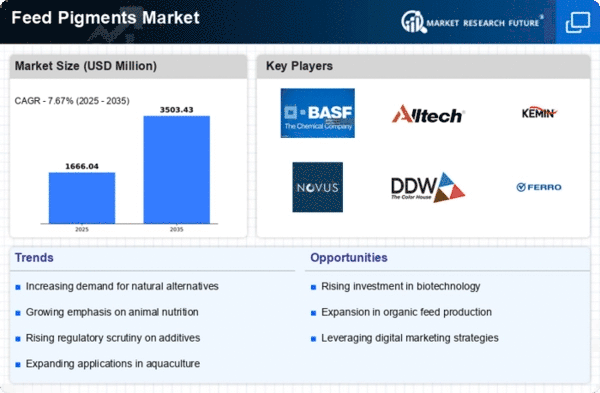
As per MRFR analysis, the Feed Pigments Market Size was estimated at 1547.36 USD Million in 2024. The Feed Pigments industry is projected to grow from 1683.78 in 2025 to 3503.43 by 2035, exhibiting a compound annual growth rate (CAGR) of 7.67 during the forecast period 2025 - 2035.

Key Market Trends & Highlights

The Feed Pigments Market is experiencing a notable shift towards natural solutions driven by consumer preferences and regulatory standards.

  • The market is witnessing a significant shift towards natural pigments, particularly in North America, where consumer demand for clean-label products is rising.
  • Poultry remains the largest segment in the Feed Pigments Market, while aquaculture is emerging as the fastest-growing segment, particularly in the Asia-Pacific region.
  • Regulatory influences are shaping product development, compelling manufacturers to innovate and comply with stringent standards.
  • Increasing livestock production and consumer awareness of animal welfare are key drivers propelling the growth of the Feed Pigments Market.

Market Size & Forecast

2024 Market Size 1547.36 (USD Million)
2035 Market Size 3503.43 (USD Million)
CAGR (2025 - 2035) 7.67%
Largest Regional Market Share in 2024 North America

Major Players

BASF SE (DE), Alltech Inc. (US), Kemin Industries Inc. (US), Novus International Inc. (US), D.D. Williamson & Co. Inc. (US), Ferro Corporation (US), Royal DSM N.V. (NL), Natural Color (DK)

Market Trends

The Feed Pigments Market is currently experiencing a dynamic evolution, driven by increasing consumer awareness regarding animal health and nutrition. This market encompasses a variety of natural and synthetic pigments that enhance the color of animal feed, thereby improving the visual appeal and nutritional value of the products. As the demand for high-quality animal products rises, manufacturers are increasingly focusing on incorporating feed pigments to meet consumer expectations. Furthermore, the growing trend towards organic and natural feed ingredients is likely to influence the market positively, as stakeholders seek sustainable alternatives to synthetic additives. In addition, regulatory frameworks are becoming more stringent, compelling producers to adopt safer and more environmentally friendly practices. This shift may lead to a gradual decline in the use of certain artificial pigments, while simultaneously boosting the demand for natural options. The Feed Pigments Market appears poised for growth, with innovations in product development and a heightened focus on sustainability. As the industry adapts to these changes, it is essential for stakeholders to remain vigilant and responsive to evolving consumer preferences and regulatory requirements.

Shift Towards Natural Pigments

There is a noticeable trend towards the adoption of natural pigments in the Feed Pigments Market. This shift is largely driven by consumer demand for cleaner labels and healthier animal products. Natural pigments, derived from plant sources, are perceived as safer and more environmentally friendly compared to synthetic alternatives.

Regulatory Influence on Product Development

Regulatory bodies are increasingly imposing stricter guidelines regarding the use of feed additives, including pigments. This trend compels manufacturers to innovate and reformulate their products to comply with new standards, potentially leading to the development of safer and more sustainable feed pigment options.

Rising Demand for Aesthetic Appeal

The aesthetic quality of animal products is gaining importance among consumers. As a result, there is a growing emphasis on the visual appeal of meat, eggs, and dairy products, which drives the Feed Pigments Market. Producers are likely to invest in pigments that enhance color, thereby improving marketability and consumer acceptance.

Feed Pigments Market Market Drivers

Market Growth Projections

The Global Feed Pigments Industry is projected to experience substantial growth over the next decade. In 2024, the market is expected to reach 1.6 USD Billion, with a forecasted increase to 2.34 USD Billion by 2035. This growth trajectory suggests a compound annual growth rate (CAGR) of 3.52% from 2025 to 2035. Factors contributing to this growth include rising livestock production, increasing consumer demand for high-quality animal products, and advancements in feed technology. The market's expansion reflects the evolving landscape of animal nutrition and the critical role of feed pigments in enhancing product quality.

Expansion of Livestock Production

The Global Feed Pigments Industry is significantly influenced by the expansion of livestock production across various regions. As the global population continues to grow, the demand for meat, dairy, and eggs is increasing, prompting farmers to enhance production efficiency. This expansion is particularly evident in developing countries, where rising incomes lead to higher meat consumption. Consequently, the demand for feed pigments, which improve the color and nutritional value of animal products, is expected to surge. By 2035, the market is anticipated to reach 2.34 USD Billion, indicating a robust growth trajectory driven by livestock sector advancements.

Rising Demand for Natural Feed Ingredients

The Global Feed Pigments Industry is witnessing a notable shift towards natural feed ingredients, driven by increasing consumer awareness regarding animal health and welfare. As livestock producers seek to enhance the quality of animal products, the demand for natural pigments, such as carotenoids and anthocyanins, is expected to rise. This trend aligns with the growing preference for organic and non-GMO products among consumers. In 2024, the market is projected to reach 1.6 USD Billion, reflecting a significant opportunity for producers of natural feed pigments. The emphasis on sustainability and health-conscious choices is likely to shape the industry's future.

Regulatory Support for Feed Quality Standards

Regulatory support for feed quality standards is a significant driver of the Global Feed Pigments Industry. Governments worldwide are increasingly implementing stringent regulations to ensure the safety and quality of animal feed. These regulations often mandate the inclusion of specific feed additives, including pigments, to enhance the nutritional value and appearance of animal products. Compliance with these standards not only boosts consumer confidence but also encourages producers to adopt high-quality feed pigments. As a result, the market is expected to benefit from this regulatory landscape, fostering growth and innovation in feed pigment formulations.

Technological Advancements in Feed Production

Technological advancements in feed production are playing a crucial role in shaping the Global Feed Pigments Industry. Innovations in feed formulation and processing techniques enable producers to enhance the efficacy of feed pigments, improving their bioavailability and effectiveness. For instance, the development of microencapsulation technology allows for better stability and release of pigments in animal diets. This not only enhances the visual appeal of animal products but also contributes to their nutritional profile. As these technologies become more widespread, the market is likely to experience accelerated growth, aligning with the projected CAGR of 3.52% from 2025 to 2035.

Consumer Preferences for Aesthetic Appeal in Animal Products

Consumer preferences for aesthetic appeal in animal products are increasingly influencing the Global Feed Pigments Industry. As consumers become more discerning about the appearance of meat, eggs, and dairy products, producers are compelled to enhance the color and visual quality of these items. Feed pigments play a vital role in achieving the desired coloration, which can significantly impact consumer purchasing decisions. This trend is particularly pronounced in markets where visual appeal is linked to perceived quality. As a result, the demand for feed pigments is likely to grow, driven by the need to meet evolving consumer expectations.

Market Segment Insights

By Application: Poultry (Largest) vs. Aquaculture (Fastest-Growing)

In the Feed Pigments Market, the application segment displays a diverse distribution of shares among five key areas: Poultry, Swine, Aquaculture, Ruminants, and Pet Food. Poultry takes the largest market share due to the rising consumer demand for high-quality protein sources and healthier poultry products. Following Poultry, Swine and Ruminants also hold significant portions of the market, catering to the increasing demand for meat products globally. Meanwhile, Pet Food continues to grow in relevance owing to the rising pet ownership trends, while Aquaculture emerges as a pivotal player driven by the escalating need for sustainable seafood solutions. Examining growth trends, Aquaculture is identified as the fastest-growing application segment, propelled by increasing fish farming practices and the emphasis on high pigment content for enhancing fish appearance and nutritional value. Poultry remains robust due to consistent demand in both domestic and international markets, while Swine and Ruminants show moderate growth, influenced by evolving farming practices. Trends in consumer preferences toward color-enhanced meat products propel the market further, making these segments more competitive in the near future.

Poultry (Dominant) vs. Aquaculture (Emerging)

Poultry, as the dominant application in the Feed Pigments Market, emphasizes providing products that enhance the quality and appearance of poultry meat. This segment thrives on advancements in breeding practices and feeding regimes that prioritize pigment supplementation to improve the visual appeal of poultry products. The growing demand for naturally colored meats aligns with consumer preferences for healthier options. In contrast, Aquaculture is rapidly emerging as a critical application, driven by the necessity for sustainable seafood practices and enhanced nutritional value in fish farming. With consumers more focused on the source of their food, the interest in aquaculture feed pigments that deliver health benefits and improve product aesthetics is gaining momentum. As both segments advance, collaborations between producers, feed manufacturers, and aquaculture operations become vital in achieving comprehensive market growth.

By Type: Natural Pigments (Largest) vs. Synthetic Pigments (Fastest-Growing)

The Feed Pigments Market is predominantly driven by Natural Pigments, which hold the largest market share due to consumers' increasing preference for natural and organic products in animal feed. Segments such as Carotenoids, Beetroot Red, and Anthocyanins contribute significantly to this category, appealing to nutritionally-conscious consumers and aligning with the rise of clean labeling trends in the food industry. In contrast, Synthetic Pigments have gained traction as a cost-effective alternative, with many manufacturers adopting innovative formulations that provide significant color enhancement without compromising quality. This segment is notably expanding as more feed producers seek to balance cost-efficiency with the growing demand for quality in the livestock sector.

Natural Pigments (Dominant) vs. Synthetic Pigments (Emerging)

Natural Pigments, such as Carotenoids and Beetroot Red, dominate the Feed Pigments Market due to their health benefits and alignment with consumer preferences for natural sources. These pigments are favored for their ability to enhance animal growth and improve the quality of derived products like meat and eggs. On the other hand, Synthetic Pigments, while currently emerging, are rapidly becoming popular due to their lower cost and consistent quality. They enable manufacturers to achieve desired color attributes and improve product aesthetics effectively. However, there is an ongoing debate regarding their long-term health implications, which might hinder their growth in the future. As the market evolves, both segments will likely continue to influence feed formulations significantly.

By Form: Powder (Largest) vs. Liquid (Fastest-Growing)

The Feed Pigments Market is characterized by the distribution of various forms, with Powder holding the largest market share. It is favored for its ease of use and stable characteristics, making it the preferred choice among feed manufacturers. Liquid forms, while currently smaller in share compared to Powder, are rapidly gaining traction due to their versatility and ability to be easily integrated into various feeds. This growing preference indicates a shift in production practices and consumer demand.

Powder (Dominant) vs. Liquid (Emerging)

Powder pigments dominate the Feed Pigments Market due to their stability, cost-effectiveness, and convenience in formulation. They are widely used across different types of animal feeds, offering consistent quality and performance. On the other hand, Liquid pigments represent the emerging trend, driven by increasing demand for innovative feeding solutions. Their flexibility allows for enhanced absorption and bioavailability of nutrients, appealing to modern feeding practices. As consumers push for more efficient and effective solutions, the liquid segment is expected to flourish, providing dynamic options to meet the evolving needs of the industry.

By Source: Plant-based (Largest) vs. Animal-based (Fastest-Growing)

The Feed Pigments Market showcases a diverse array of sources, with plant-based pigments leading in market share due to their sustainability and natural appeal. Among the various segment values, this category particularly attracts manufacturers focusing on clean-label products, tapping into the growing demand for natural alternatives in animal diets. In contrast, animal-based pigments, traditionally used for their efficacy, represent the fastest-growing segment as they continue to find applications in enhancing feed quality and animal health. Emerging trends are fueling the growth of the Feed Pigments Market, particularly with the rising consumer preference for natural and organic products. This shift drives innovation, with manufacturers seeking new plant-based solutions that are both effective and appealing. Meanwhile, the animal-based segment is being propelled by the increasing livestock population and the need for health-boosting additives. As a result, these factors significantly influence market dynamics and will shape future sourcing strategies.

Plant-based (Dominant) vs. Microbial (Emerging)

The dominant segment in the Feed Pigments Market is plant-based pigments, revered for their natural origin and appeal to the eco-conscious consumer. This segment benefits from the increasing global trend toward sustainable agriculture, where farmers are increasingly adopting natural feed additives. On the other hand, microbial pigments are emerging as an innovative addition to the market, driven by advances in biotechnology. These pigments are produced through fermentation processes, offering unique colors and health benefits that contribute to livestock vitality. As research in this area progresses, microbial pigments may provide a competitive alternative, particularly in niche markets focused on specialty feeds. The interplay between these two segments reflects broader trends toward sustainability and innovation in feed formulation.

By Functionality: Color Enhancement (Largest) vs. Nutritional Value (Fastest-Growing)

In the Feed Pigments Market, the 'Functionality' segment is primarily driven by 'Color Enhancement', which commands the largest share due to its essential role in enhancing the visual appeal of animal feed. This segment allows producers to create more appealing products for consumers, particularly in poultry and aquaculture. Following closely, 'Nutritional Value' is emerging as a fast-growing segment, driven by the increasing awareness of health and nutrition among livestock producers, focusing on premium feed ingredients that ensure better health outcomes for animals.

Color Enhancement (Dominant) vs. Nutritional Value (Emerging)

The 'Color Enhancement' function represents the dominant force in the Feed Pigments Market, reflecting the demand for visually appealing animal products. It is characterized by the use of natural and synthetic pigments that improve the color of animal feed, ultimately leading to better marketability of meat and eggs. On the other hand, 'Nutritional Value' is rapidly gaining traction as an emerging segment, appealing to a growing number of producers who prioritize animal health and performance. This segment emphasizes the incorporation of pigments that not only improve color but also enhance the nutritional profiles of feed, thus ensuring overall better health and productivity in livestock.

Get more detailed insights about Feed Pigments Market Research Report– Forecast to 2035

Regional Insights

North America : Market Leader in Feed Pigments

North America continues to lead the Feed Pigments Market, holding a significant share of 600.0 million in 2024. The region's growth is driven by increasing demand for natural feed additives, stringent regulations promoting animal health, and a shift towards sustainable farming practices. The regulatory environment is supportive, encouraging innovation and the adoption of advanced feed technologies. The United States is the primary market in this region, with key players like BASF SE, Alltech Inc., and Kemin Industries Inc. leading the competitive landscape. These companies are investing heavily in R&D to develop new products that meet consumer demands for quality and sustainability. The presence of established firms ensures a robust supply chain and innovation pipeline, further solidifying North America's market position.

Europe : Emerging Trends in Feed Pigments

Europe's Feed Pigments Market is valued at 450.0 million, reflecting a growing trend towards sustainability and natural ingredients in animal feed. Regulatory frameworks, such as the European Union's Green Deal, are pushing for reduced antibiotic use and promoting natural alternatives. This shift is expected to enhance market growth as consumers demand healthier livestock products. Leading countries like Germany, France, and the Netherlands are at the forefront of this transition, with companies such as Royal DSM N.V. and Natural Color driving innovation. The competitive landscape is characterized by a mix of established players and emerging startups focusing on eco-friendly solutions. This dynamic environment fosters collaboration and investment in sustainable practices, positioning Europe as a key player in the global market.

Asia-Pacific : Rapid Growth in Feed Pigments

Asia-Pacific's Feed Pigments Market is projected at 400.0 million, driven by rising livestock production and increasing consumer awareness regarding animal health. The region is witnessing a shift towards high-quality feed products, supported by government initiatives aimed at enhancing food safety and quality standards. This regulatory support is crucial for market expansion as it encourages the adoption of innovative feed solutions. Countries like China and India are leading the market, with significant investments from key players such as Kemin Industries Inc. and Novus International Inc. The competitive landscape is evolving, with both local and international companies vying for market share. The growing demand for natural feed pigments is expected to further stimulate growth in this region, making it a focal point for future investments.

Middle East and Africa : Untapped Potential in Feed Pigments

The Middle East and Africa region, with a market size of 97.36 million, presents untapped potential in the Feed Pigments Market. The growth is driven by increasing livestock production and a rising demand for quality animal feed. Regulatory bodies are beginning to implement standards that promote the use of natural feed additives, which is expected to catalyze market growth in the coming years. Countries like South Africa and the UAE are emerging as key players in this market, with local companies and international firms exploring opportunities. The competitive landscape is characterized by a mix of established players and new entrants, focusing on innovative solutions to meet the growing demand. As the region develops its agricultural sector, the Feed Pigments Market is poised for significant growth.

Key Players and Competitive Insights

The Feed Pigments Market is currently characterized by a dynamic competitive landscape, driven by increasing demand for natural colorants in animal feed and a growing emphasis on sustainability. Key players such as BASF SE (DE), Alltech Inc. (US), and Kemin Industries Inc. (US) are strategically positioning themselves through innovation and partnerships. For instance, BASF SE (DE) has focused on enhancing its product portfolio with natural pigments, which aligns with the rising consumer preference for clean-label products. This strategic focus on innovation not only strengthens their market presence but also fosters a competitive environment where companies are compelled to adapt to evolving consumer demands.In terms of business tactics, companies are increasingly localizing manufacturing to reduce supply chain vulnerabilities and optimize logistics. The Feed Pigments Market appears moderately fragmented, with several players vying for market share. The collective influence of major companies, including Novus International Inc. (US) and D.D. Williamson & Co. Inc. (US), suggests a competitive structure where collaboration and strategic alliances are becoming essential for maintaining market relevance.

In November Alltech Inc. (US) announced a partnership with a leading agricultural technology firm to develop advanced feed pigment solutions that enhance animal health and performance. This collaboration is strategically significant as it not only broadens Alltech's product offerings but also positions the company at the forefront of innovation in the feed pigments sector. Such partnerships are likely to drive growth and improve competitive positioning in a market that increasingly values technological advancements.

In October Kemin Industries Inc. (US) launched a new line of natural feed pigments derived from plant sources, aimed at meeting the rising demand for sustainable animal nutrition. This strategic move underscores Kemin's commitment to sustainability and innovation, potentially allowing the company to capture a larger share of the market as consumers and producers alike prioritize environmentally friendly options. The introduction of such products may also influence competitors to enhance their own offerings in response.

In September Royal DSM N.V. (NL) expanded its production capabilities in Asia to better serve the growing demand for feed pigments in the region. This expansion is indicative of DSM's strategy to localize production and enhance supply chain efficiency, which could provide a competitive edge in a market where responsiveness to regional demands is crucial. Such strategic expansions are likely to reshape the competitive dynamics, as companies that can effectively localize their operations may gain a significant advantage.

As of December the Feed Pigments Market is witnessing trends such as digitalization and sustainability becoming central to competitive strategies. The integration of AI in production processes and the emphasis on sustainable sourcing are reshaping how companies operate. Strategic alliances are increasingly pivotal, as they enable firms to leverage complementary strengths and enhance their market offerings. Looking ahead, the competitive differentiation in this market is expected to evolve from traditional price-based competition to a focus on innovation, technology, and supply chain reliability, reflecting a broader shift in consumer preferences and industry standards.

Key Companies in the Feed Pigments Market include

Industry Developments

  • Q1 2024: DSM-Firmenich launches new carotenoid feed pigment blend for poultry DSM-Firmenich announced the commercial launch of a new carotenoid-based feed pigment blend designed to enhance egg yolk coloration and poultry health, expanding its portfolio in the animal nutrition sector.
  • Q2 2024: Evonik opens new animal nutrition innovation center in Singapore Evonik inaugurated a state-of-the-art innovation center focused on feed additives and pigments for livestock and aquaculture, aiming to accelerate product development and regional partnerships.
  • Q2 2024: BASF partners with Cargill to develop sustainable feed pigment solutions BASF and Cargill announced a strategic partnership to co-develop sustainable, natural feed pigment solutions targeting poultry and aquaculture markets, leveraging BASF’s expertise in carotenoids.
  • Q2 2024: Novus International launches AXIS pigment for aquaculture feed Novus International introduced AXIS, a new pigment product for aquaculture feed, designed to improve coloration and health in farmed fish, with initial rollout in Southeast Asia.
  • Q3 2024: ADM acquires Spanish feed pigment producer NutraColor ADM completed the acquisition of NutraColor, a leading Spanish manufacturer of natural feed pigments, strengthening ADM’s position in the European animal nutrition market.
  • Q3 2024: Kemin Industries announces expansion of pigment production facility in Brazil Kemin Industries revealed a major expansion of its feed pigment production facility in Brazil to meet rising demand for natural colorants in Latin American poultry and aquaculture sectors.
  • Q3 2024: DSM-Firmenich receives EU regulatory approval for new natural pigment additive DSM-Firmenich secured European Union regulatory approval for its latest natural pigment additive for animal feed, enabling commercial sales across EU member states.
  • Q4 2024: Cargill launches new algae-derived pigment for salmon feed Cargill announced the launch of a new algae-derived pigment for salmon feed, designed to enhance fillet coloration and support sustainable aquaculture practices.
  • Q4 2024: BASF unveils XanthinPro, a next-generation feed pigment for poultry BASF introduced XanthinPro, a next-generation feed pigment for poultry, featuring improved stability and bioavailability, targeting premium egg and broiler markets.
  • Q1 2025: Evonik signs supply agreement with Thai poultry producer for feed pigments Evonik entered into a multi-year supply agreement with a major Thai poultry producer to provide carotenoid-based feed pigments, supporting the producer’s premium egg segment.
  • Q2 2025: Kemin Industries acquires Indian feed pigment startup ColorFeed Kemin Industries acquired ColorFeed, an Indian startup specializing in natural feed pigments, expanding Kemin’s footprint in South Asia and its product portfolio.
  • Q2 2025: ADM announces $50M investment in US feed pigment R&D center ADM announced a $50 million investment to establish a new research and development center in the US focused on innovative feed pigment technologies for livestock and aquaculture.

Future Outlook

Feed Pigments Market Future Outlook

The Feed Pigments Market is projected to grow at a 7.67% CAGR from 2025 to 2035, driven by increasing demand for natural colorants and animal nutrition enhancements.

New opportunities lie in:

  • Development of innovative natural feed pigments to meet consumer demand.
  • Expansion into emerging markets with tailored product offerings.
  • Investment in sustainable production technologies to reduce environmental impact.

By 2035, the Feed Pigments Market is expected to achieve robust growth, driven by innovation and sustainability.

Market Segmentation

Feed Pigments Market Form Outlook

  • Powder
  • Liquid
  • Granular
  • Emulsified

Feed Pigments Market Type Outlook

  • Natural Pigments
  • Synthetic Pigments
  • Carotenoids
  • Beetroot Red
  • Anthocyanins

Feed Pigments Market Source Outlook

  • Plant-based
  • Animal-based
  • Microbial
  • Synthetic

Feed Pigments Market Application Outlook

  • Poultry
  • Swine
  • Aquaculture
  • Ruminants
  • Pet Food

Feed Pigments Market Functionality Outlook

  • Color Enhancement
  • Nutritional Value
  • Antioxidant Properties
  • Health Benefits

Report Scope

MARKET SIZE 20241547.36(USD Million)
MARKET SIZE 20251683.78(USD Million)
MARKET SIZE 20353503.43(USD Million)
COMPOUND ANNUAL GROWTH RATE (CAGR)7.67% (2025 - 2035)
REPORT COVERAGERevenue Forecast, Competitive Landscape, Growth Factors, and Trends
BASE YEAR2024
Market Forecast Period2025 - 2035
Historical Data2019 - 2024
Market Forecast UnitsUSD Million
Key Companies ProfiledBASF SE (DE), Alltech Inc. (US), Kemin Industries Inc. (US), Novus International Inc. (US), D.D. Williamson & Co. Inc. (US), Ferro Corporation (US), Royal DSM N.V. (NL), Natural Color (DK)
Segments CoveredApplication, Type, Form, Source, Functionality
Key Market OpportunitiesGrowing demand for natural feed pigments driven by consumer preference for clean-label products.
Key Market DynamicsRising demand for natural feed pigments driven by consumer preference for healthier livestock products and sustainable practices.
Countries CoveredNorth America, Europe, APAC, South America, MEA

FAQs

How much is the Feed Pigments market?

The Feed Pigments market Source was valued at USD 1.5 Billion in 2022.

What is the growth rate of the Feed Pigments market?

The market is projected to grow at a CAGR of 3.52% during the forecast period, 2025-2035.

Which region held the largest market share in the Feed Pigments market?

North America had the largest share in the market

Who are the key players in the Feed Pigments market?

The key players in the market are BASF SE, Royal DSM N.V., Novus International Inc., Nutrex NV, Kemin Industries Inc., Behn Meyer Group, Synthite Industries Ltd, and Kalsec Inc.

Which Type led the Feed Pigments market?

The Carotenoids Type dominated the market in 2022.

Which Source had the largest market share in the Feed Pigments market?

The Natural Feed Pigments Source had the largest share in the market.

  1. SECTION I: EXECUTIVE SUMMARY AND KEY HIGHLIGHTS
    1. | 1.1 EXECUTIVE SUMMARY
    2. | 1.1.1 Market Overview
    3. | 1.1.2 Key Findings
    4. | 1.1.3 Market Segmentation
    5. | 1.1.4 Competitive Landscape
    6. | 1.1.5 Challenges and Opportunities
    7. | 1.1.6 Future Outlook
  2. SECTION II: SCOPING, METHODOLOGY AND MARKET STRUCTURE
    1. | 2.1 MARKET INTRODUCTION
    2. | 2.1.1 Definition
    3. | 2.1.2 Scope of the study
    4. |-- 2.1.2.1 Research Objective
    5. |-- 2.1.2.2 Assumption
    6. |-- 2.1.2.3 Limitations
    7. | 2.2 RESEARCH METHODOLOGY
    8. | 2.2.1 Overview
    9. | 2.2.2 Data Mining
    10. | 2.2.3 Secondary Research
    11. | 2.2.4 Primary Research
    12. |-- 2.2.4.1 Primary Interviews and Information Gathering Process
    13. |-- 2.2.4.2 Breakdown of Primary Respondents
    14. | 2.2.5 Forecasting Model
    15. | 2.2.6 Market Size Estimation
    16. |-- 2.2.6.1 Bottom-Up Approach
    17. |-- 2.2.6.2 Top-Down Approach
    18. | 2.2.7 Data Triangulation
    19. | 2.2.8 Validation
  3. SECTION III: QUALITATIVE ANALYSIS
    1. | 3.1 MARKET DYNAMICS
    2. | 3.1.1 Overview
    3. | 3.1.2 Drivers
    4. | 3.1.3 Restraints
    5. | 3.1.4 Opportunities
    6. | 3.2 MARKET FACTOR ANALYSIS
    7. | 3.2.1 Value chain Analysis
    8. | 3.2.2 Porter's Five Forces Analysis
    9. |-- 3.2.2.1 Bargaining Power of Suppliers
    10. |-- 3.2.2.2 Bargaining Power of Buyers
    11. |-- 3.2.2.3 Threat of New Entrants
    12. |-- 3.2.2.4 Threat of Substitutes
    13. |-- 3.2.2.5 Intensity of Rivalry
    14. | 3.2.3 COVID-19 Impact Analysis
    15. |-- 3.2.3.1 Market Impact Analysis
    16. |-- 3.2.3.2 Regional Impact
    17. |-- 3.2.3.3 Opportunity and Threat Analysis
  4. SECTION IV: QUANTITATIVE ANALYSIS
    1. | 4.1 Security, Access Control and Robotics, BY Application (USD Million)
    2. | 4.1.1 Poultry
    3. | 4.1.2 Swine
    4. | 4.1.3 Aquaculture
    5. | 4.1.4 Ruminants
    6. | 4.1.5 Pet Food
    7. | 4.2 Security, Access Control and Robotics, BY Type (USD Million)
    8. | 4.2.1 Natural Pigments
    9. | 4.2.2 Synthetic Pigments
    10. | 4.2.3 Carotenoids
    11. | 4.2.4 Beetroot Red
    12. | 4.2.5 Anthocyanins
    13. | 4.3 Security, Access Control and Robotics, BY Form (USD Million)
    14. | 4.3.1 Powder
    15. | 4.3.2 Liquid
    16. | 4.3.3 Granular
    17. | 4.3.4 Emulsified
    18. | 4.4 Security, Access Control and Robotics, BY Source (USD Million)
    19. | 4.4.1 Plant-based
    20. | 4.4.2 Animal-based
    21. | 4.4.3 Microbial
    22. | 4.4.4 Synthetic
    23. | 4.5 Security, Access Control and Robotics, BY Functionality (USD Million)
    24. | 4.5.1 Color Enhancement
    25. | 4.5.2 Nutritional Value
    26. | 4.5.3 Antioxidant Properties
    27. | 4.5.4 Health Benefits
    28. | 4.6 Security, Access Control and Robotics, BY Region (USD Million)
    29. | 4.6.1 North America
    30. |-- 4.6.1.1 US
    31. |-- 4.6.1.2 Canada
    32. | 4.6.2 Europe
    33. |-- 4.6.2.1 Germany
    34. |-- 4.6.2.2 UK
    35. |-- 4.6.2.3 France
    36. |-- 4.6.2.4 Russia
    37. |-- 4.6.2.5 Italy
    38. |-- 4.6.2.6 Spain
    39. |-- 4.6.2.7 Rest of Europe
    40. | 4.6.3 APAC
    41. |-- 4.6.3.1 China
    42. |-- 4.6.3.2 India
    43. |-- 4.6.3.3 Japan
    44. |-- 4.6.3.4 South Korea
    45. |-- 4.6.3.5 Malaysia
    46. |-- 4.6.3.6 Thailand
    47. |-- 4.6.3.7 Indonesia
    48. |-- 4.6.3.8 Rest of APAC
    49. | 4.6.4 South America
    50. |-- 4.6.4.1 Brazil
    51. |-- 4.6.4.2 Mexico
    52. |-- 4.6.4.3 Argentina
    53. |-- 4.6.4.4 Rest of South America
    54. | 4.6.5 MEA
    55. |-- 4.6.5.1 GCC Countries
    56. |-- 4.6.5.2 South Africa
    57. |-- 4.6.5.3 Rest of MEA
  5. SECTION V: COMPETITIVE ANALYSIS
    1. | 5.1 Competitive Landscape
    2. | 5.1.1 Overview
    3. | 5.1.2 Competitive Analysis
    4. | 5.1.3 Market share Analysis
    5. | 5.1.4 Major Growth Strategy in the Security, Access Control and Robotics
    6. | 5.1.5 Competitive Benchmarking
    7. | 5.1.6 Leading Players in Terms of Number of Developments in the Security, Access Control and Robotics
    8. | 5.1.7 Key developments and growth strategies
    9. |-- 5.1.7.1 New Product Launch/Service Deployment
    10. |-- 5.1.7.2 Merger & Acquisitions
    11. |-- 5.1.7.3 Joint Ventures
    12. | 5.1.8 Major Players Financial Matrix
    13. |-- 5.1.8.1 Sales and Operating Income
    14. |-- 5.1.8.2 Major Players R&D Expenditure. 2023
    15. | 5.2 Company Profiles
    16. | 5.2.1 BASF SE (DE)
    17. |-- 5.2.1.1 Financial Overview
    18. |-- 5.2.1.2 Products Offered
    19. |-- 5.2.1.3 Key Developments
    20. |-- 5.2.1.4 SWOT Analysis
    21. |-- 5.2.1.5 Key Strategies
    22. | 5.2.2 Alltech Inc. (US)
    23. |-- 5.2.2.1 Financial Overview
    24. |-- 5.2.2.2 Products Offered
    25. |-- 5.2.2.3 Key Developments
    26. |-- 5.2.2.4 SWOT Analysis
    27. |-- 5.2.2.5 Key Strategies
    28. | 5.2.3 Kemin Industries Inc. (US)
    29. |-- 5.2.3.1 Financial Overview
    30. |-- 5.2.3.2 Products Offered
    31. |-- 5.2.3.3 Key Developments
    32. |-- 5.2.3.4 SWOT Analysis
    33. |-- 5.2.3.5 Key Strategies
    34. | 5.2.4 Novus International Inc. (US)
    35. |-- 5.2.4.1 Financial Overview
    36. |-- 5.2.4.2 Products Offered
    37. |-- 5.2.4.3 Key Developments
    38. |-- 5.2.4.4 SWOT Analysis
    39. |-- 5.2.4.5 Key Strategies
    40. | 5.2.5 D.D. Williamson & Co. Inc. (US)
    41. |-- 5.2.5.1 Financial Overview
    42. |-- 5.2.5.2 Products Offered
    43. |-- 5.2.5.3 Key Developments
    44. |-- 5.2.5.4 SWOT Analysis
    45. |-- 5.2.5.5 Key Strategies
    46. | 5.2.6 Ferro Corporation (US)
    47. |-- 5.2.6.1 Financial Overview
    48. |-- 5.2.6.2 Products Offered
    49. |-- 5.2.6.3 Key Developments
    50. |-- 5.2.6.4 SWOT Analysis
    51. |-- 5.2.6.5 Key Strategies
    52. | 5.2.7 Royal DSM N.V. (NL)
    53. |-- 5.2.7.1 Financial Overview
    54. |-- 5.2.7.2 Products Offered
    55. |-- 5.2.7.3 Key Developments
    56. |-- 5.2.7.4 SWOT Analysis
    57. |-- 5.2.7.5 Key Strategies
    58. | 5.2.8 Natural Color (DK)
    59. |-- 5.2.8.1 Financial Overview
    60. |-- 5.2.8.2 Products Offered
    61. |-- 5.2.8.3 Key Developments
    62. |-- 5.2.8.4 SWOT Analysis
    63. |-- 5.2.8.5 Key Strategies
    64. | 5.3 Appendix
    65. | 5.3.1 References
    66. | 5.3.2 Related Reports

Security, Access Control and Robotics Market Segmentation

Security, Access Control and Robotics By Application (USD Million, 2025-2035)

  • Poultry
  • Swine
  • Aquaculture
  • Ruminants
  • Pet Food

Security, Access Control and Robotics By Type (USD Million, 2025-2035)

  • Natural Pigments
  • Synthetic Pigments
  • Carotenoids
  • Beetroot Red
  • Anthocyanins

Security, Access Control and Robotics By Form (USD Million, 2025-2035)

  • Powder
  • Liquid
  • Granular
  • Emulsified

Security, Access Control and Robotics By Source (USD Million, 2025-2035)

  • Plant-based
  • Animal-based
  • Microbial
  • Synthetic

Security, Access Control and Robotics By Functionality (USD Million, 2025-2035)

  • Color Enhancement
  • Nutritional Value
  • Antioxidant Properties
  • Health Benefits
Infographic

Free Sample Request

Kindly complete the form below to receive a free sample of this Report

Get Free Sample

Customer Strories

Compare Licence

×
Features License Type
Single User Multiuser License Enterprise User
Price $4,950 $5,950 $7,250
Maximum User Access Limit 1 User Upto 10 Users Unrestricted Access Throughout the Organization
Free Customization
Direct Access to Analyst
Deliverable Format
Platform Access
Discount on Next Purchase 10% 15% 15%
Printable Versions