×
Request Free Sample ×

Kindly complete the form below to receive a free sample of this Report

* Please use a valid business email

Leading companies partner with us for data-driven Insights

clients tt-cursor
Hero Background
English
Chinese
French
Japanese
Korean
German
Spanish

Elastography Imaging Market Analysis

ID: MRFR/MED/6598-HCR
90 Pages
Rahul Gotadki
October 2025

Elastography Imaging Market Research Report: Size, Share, Trend Analysis By Imaging Modality (Ultrasound Elastography, Magnetic Resonance Elastography, Computed Tomography Elastography), By Applications (Liver Diseases, Breast Cancer, Musculoskeletal Disorders, Cardiovascular Diseases), By End Users (Hospitals, Diagnostic Centers, Research Institutes), By Technology (Strain Elastography, shear Wave Elastography, Transverse Wave Elastography) and By Regional (North America, Europe, South America, Asia Pacific, Middle East and Africa) - Growth... read more

Share:
Download PDF ×

We do not share your information with anyone. However, we may send you emails based on your report interest from time to time. You may contact us at any time to opt-out.

Elastography Imaging Market Infographic
×
Elastography Imaging Market Infographic Full View
Purchase Options

Market Analysis

In-depth Analysis of Elastography Imaging Market Industry Landscape

Recent advances in medical imaging have driven the elastography imaging sector. Non-invasive elastography detects liver fibrosis, breast cancer, and prostate diseases by measuring tissue stiffness. Elastography imaging tools' constant improvement affects the market. Because shear wave and strain elastography make tissue stiffness measurements more precise and dependable, the market has grown. Elastography imaging are needed increasingly due to chronic conditions like liver failure and breast cancer. This testing tool offers an alternative to previous methods. The disorders may be detected early and treated efficiently. Elastography imaging is popular in cancer because it reliably describes tumor cells. Oncological testing is increasingly using elastography to distinguish between normal and malignant tumors. This boosts markets. Non-invasive elastography imaging is effective at diagnosing abnormalities, thus patients tolerate it. Elastography is more pleasant and accurate than invasive biopsy, which boosts the market. There are promising indicators, yet difficulties remain. Elastography imaging instruments are expensive, making them difficult for low-income healthcare facilities to obtain. Healthcare personnel and clients don't know much about elastography imaging's advantages, which hinders its adoption. Elastography imaging is expanding outside its primary sectors, affecting the industry. Researchers are investigating its heart and bone benefits. This might expand markets and help businesses develop. Elastography imaging industry leaders compete to be the best, driving innovation. Companies concentrate on easy-to-use, affordable solutions to use issues. The market becomes more competitive. Regulatory licenses and standards are crucial to market functioning. Following regulators' regulations and developing standard elastography imaging processes builds medical personnel' confidence, growing the industry. Collaboration between enterprises, study centers, and healthcare organizations is growing common. These partnerships accelerate research and development, enhance product lines, and expand elastography imaging capabilities.

The global market for elastography imaging is expanding. Developing nations are realizing the value of this testing instrument. This is broadening the market and boosting corporate optimism. Artificial intelligence (AI) in elastography photos will change the business. Elastography is crucial in the era of enhanced medical imaging because AI algorithms improve image processing, help clinicians diagnose more accurately, and speed up work.


Author
Rahul Gotadki
Assistant Manager

He holds an experience of about 7+ years in Market Research and Business Consulting, working under the spectrum of Life Sciences and Healthcare domains. Rahul conceptualizes and implements a scalable business strategy and provides strategic leadership to the clients. His expertise lies in market estimation, competitive intelligence, pipeline analysis, customer assessment, etc. In addition to the above, his other responsibility includes strategic tracking of high growth markets & advising clients on the potential areas of focus they could direct their business initiatives

Leave a Comment

FAQs

What is the projected growth of the Elastography Imaging market?

The Elastography Imaging market is the expected increase in total market value of 40.37 USD billion over a defined forecast period 2025–2035. It is driven by factors such as demand trends, technological advances, regulatory changes, and geographic expansion.

What is the size of the Elastography Imaging market?

Elastography Imaging market size was valued at approximately 12.61 billion USD in 2024. This figure will reach 40.37 billion USD covering all regions (America, Europe, Asia, MEA and ROW), focusing its segments / services / distribution channels till 2035.

What is the CAGR of the Elastography Imaging market?

Elastography Imaging market is expected to grow at a CAGR of 11.16% between 2025 and 2035.

How much will the Elastography Imaging market be worth by 2035?

Elastography Imaging market is expected to be worth of 40.37 billion USD, reflecting growth driven by usage, technology and global demands by the end of 2035.

How will the Elastography Imaging market perform over the next 10 years?

Over the next 10 years the Elastography Imaging market is expected to shift from usd billion 12.61 to 40.37 billion USD, led by adoption of advanced tech, demographic trends, regulatory approvals, with potential headwinds from 2025 to 2035.

What was the current market size of the Elastography Imaging Market in 2024?

The Elastography Imaging Market was valued at 0.94 billion USD in 2024.

What is the projected market valuation for the Elastography Imaging Market by 2035?

By 2035, the Elastography Imaging Market is expected to reach a valuation of 2.5 billion USD.

Which region is expected to have the largest market share in the Elastography Imaging Market by 2035?

North America is expected to dominate the market, reaching a valuation of 1.05 billion USD by 2035.

What will be the market size for Magnetic Resonance Elastography in 2035?

The market for Magnetic Resonance Elastography is projected to reach 0.8 billion USD by 2035.

Who are the key players in the Elastography Imaging Market?

Major players include Samsung Medison, Bracco Imaging, Hitachi, Esaote, and GE Healthcare, among others.

Market Summary

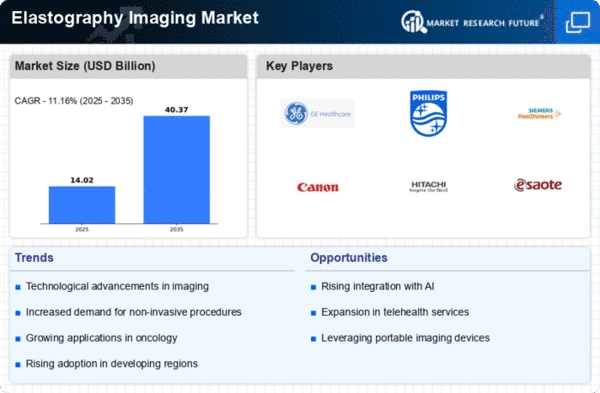
As per MRFR analysis, the Elastography Imaging Market Size was estimated at 12.61 USD Billion in 2024. The Elastography Imaging industry is projected to grow from 14.01 USD Billion in 2025 to 40.37 USD Billion by 2035, exhibiting a compound annual growth rate (CAGR) of 11.16 during the forecast period 2025 - 2035.

Key Market Trends & Highlights

The Elastography Imaging Market is poised for substantial growth driven by technological advancements and increasing clinical adoption.

  • Technological advancements are enhancing the precision and efficiency of elastography imaging techniques. North America remains the largest market, while the Asia-Pacific region is emerging as the fastest-growing area for elastography applications. Liver elastography continues to dominate the market, whereas breast elastography is witnessing rapid growth due to rising awareness. The expansion of healthcare infrastructure in emerging markets and the rising demand for non-invasive diagnostic tools are key drivers propelling market growth.

Market Size & Forecast

2024 Market Size 12.61 (USD Billion)
2035 Market Size 40.37 (USD Billion)
CAGR (2025 - 2035) 11.16%
Largest Regional Market Share in 2024 North America

Major Players

<a href="https://www.gehealthcare.com/about/newsroom/press-releases/ge-healthcare-introduces-new-ultrasound-elastography-capability?npclid=botnpclid&amp;srsltid=AfmBOopoGCohvEDJ0xLrRKKeZI8zdbKOD3hn3vpKIdx4UJ8_ZmvBGiYr">GE Healthcare</a> (US), Philips (NL), Siemens Healthineers (DE), Canon Medical Systems (JP), Hitachi Medical Systems (JP), Esaote (IT), Fujifilm (JP), Mindray (CN), Samsung Medison (KR)

Market Trends

The Elastography Imaging Market is currently experiencing a notable transformation, driven by advancements in imaging technologies and an increasing emphasis on non-invasive diagnostic methods. This market encompasses various techniques that assess tissue stiffness, providing critical insights into conditions such as liver disease, tumors, and musculoskeletal disorders. As healthcare providers seek to enhance patient outcomes, the demand for elastography imaging solutions appears to be on the rise, reflecting a broader trend towards personalized medicine and early disease detection. Furthermore, the integration of artificial intelligence and machine learning into imaging modalities is likely to enhance diagnostic accuracy and efficiency, potentially reshaping clinical practices. In addition to technological advancements, the Elastography Imaging Market is influenced by growing awareness among healthcare professionals regarding the benefits of elastography. This awareness is fostering increased adoption of elastography techniques in clinical settings, as practitioners recognize the value of precise assessments in guiding treatment decisions. Moreover, the expansion of healthcare infrastructure in emerging economies may further propel market growth, as access to advanced imaging technologies becomes more widespread. Overall, the future of the Elastography Imaging Market appears promising, with ongoing innovations and a shift towards more effective diagnostic approaches likely to drive its evolution in the coming years.

Technological Advancements

Recent innovations in imaging technologies are significantly enhancing the capabilities of elastography. The introduction of high-resolution imaging systems and improved software algorithms is likely to provide more accurate assessments of tissue stiffness, thereby improving diagnostic outcomes.

Increased Adoption in Clinical Practice

There is a growing trend among healthcare providers to incorporate elastography into routine clinical practice. This shift is driven by the recognition of its non-invasive nature and the ability to provide critical information for patient management.

Emerging Markets Expansion

The expansion of healthcare infrastructure in developing regions is expected to facilitate greater access to elastography imaging technologies. As these markets evolve, the demand for advanced diagnostic tools is likely to increase, contributing to overall market growth.

Elastography Imaging Market Market Drivers

Technological Advancements in Imaging Techniques

The Global Elastography Imaging Market Industry is experiencing a surge in technological advancements that enhance imaging techniques. Innovations such as shear wave elastography and acoustic radiation force impulse imaging are becoming more prevalent, allowing for improved diagnostic accuracy and patient outcomes. These advancements facilitate the non-invasive assessment of tissue stiffness, which is crucial in diagnosing liver diseases and tumors. As a result, the market is projected to grow from 0.94 USD Billion in 2024 to 2.5 USD Billion by 2035, reflecting a compound annual growth rate of 9.3% from 2025 to 2035. This growth underscores the importance of integrating cutting-edge technology in clinical practice.

Market Segment Insights

By Application: Liver Elastography (Largest) vs. Breast Elastography (Fastest-Growing)

The Elastography Imaging Market exhibits a diverse application landscape, with Liver Elastography leading in market share due to its significance in diagnosing liver-related diseases. This segment accounts for a substantial proportion of the overall market, driven by the increasing prevalence of liver cirrhosis and hepatitis. Following closely is Breast Elastography, which has emerged as a critical tool in breast cancer diagnosis, capturing a growing market share as awareness and acceptance of elastography techniques rise among healthcare providers and patients alike.

Liver Elastography (Dominant) vs. Breast Elastography (Emerging)

Liver Elastography serves as the dominant application within the Elastography Imaging Market, primarily utilized for assessing liver stiffness and monitoring conditions like fibrosis and cirrhosis. Its widespread adoption is supported by its non-invasive nature and the increasing demand for accurate liver diagnostics. On the other hand, Breast Elastography is gaining traction as an emerging application, providing complementary information to traditional imaging techniques. Its ability to differentiate benign from malignant lesions enhances diagnostic accuracy. The growing emphasis on early cancer detection and technological advancements in elastography are driving its rapid growth, positioning it as a significant player in the market moving forward.

By Technology: Ultrasound Elastography (Largest) vs. Magnetic Resonance Elastography (Fastest-Growing)

In the Elastography Imaging Market, Ultrasound Elastography holds a prominent position as the largest segment due to its widespread adoption and affordability. It offers non-invasive and real-time assessments of tissue elasticity, making it a preferred choice among clinicians. In contrast, Magnetic Resonance Elastography, though smaller in market share currently, is recognized for its advanced imaging capabilities and precision in assessing liver stiffness, thus catering to specialized segments of healthcare. The growth trends in this market segment are significantly driven by technological advancements and increasing awareness among healthcare professionals regarding the benefits of elastography. As hospitals and clinics continue to invest in state-of-the-art imaging technologies, Magnetic Resonance Elastography is gaining traction, signaling a shift in preference towards non-invasive diagnostic tools. Additionally, the demand for advanced diagnostic procedures, particularly in oncology and hepatology, is further accelerating the growth of this segment.

Technology: Ultrasound Elastography (Dominant) vs. Magnetic Resonance Elastography (Emerging)

Ultrasound Elastography remains the dominant player in the Elastography Imaging Market, primarily due to its cost-effectiveness, ease of integration into existing ultrasound systems, and ability to provide immediate results. This technology utilizes ultrasonic waves to measure tissue stiffness, supporting various clinical applications, particularly in assessing liver and thyroid conditions. In contrast, Magnetic Resonance Elastography, as an emerging segment, is rapidly gaining popularity due to its high-resolution imaging and capability for evaluating deeper tissue structures. Its application in liver disease assessment is particularly noteworthy as it offers a non-invasive alternative to liver biopsies. As healthcare providers become increasingly cognizant of the advantages these technologies offer in accurate diagnostics, both segments are expected to evolve and capture a greater share of the market.

By End User: Hospitals (Largest) vs. Diagnostic Imaging Centers (Fastest-Growing)

In the Elastography Imaging Market, hospitals dominate the end-user segment, capturing the largest share due to their comprehensive healthcare services and increasing adoption of advanced imaging technologies. Diagnostic imaging centers follow closely, benefiting from the rising demand for specialized imaging services and a growing number of outpatient referrals that boost their market presence. Other segments like research institutions, outpatient clinics, and specialty clinics maintain a significant yet smaller share, reflecting their specialized applications and targeted services in the elastography field.

Hospitals (Dominant) vs. Diagnostic Imaging Centers (Emerging)

Hospitals represent the dominant segment in the Elastography Imaging Market due to their extensive resources, capacity for advanced diagnostics, and integration of elastography into routine patient care, significantly enhancing patient outcomes. They leverage cutting-edge technology and skilled personnel to offer comprehensive diagnostic services. In contrast, diagnostic imaging centers are emerging rapidly, driven by technological advancements and specialty offerings that cater to the increasing demand for non-invasive imaging solutions. Their focused approach allows for quicker access to elastography services, drawing patients seeking specialized care and thus fostering their growth within the healthcare landscape.

Get more detailed insights about Elastography Imaging Market Research Report - Forecast till 2035

Regional Insights

North America : Market Leader in Innovation

North America continues to lead the Elastography Imaging Market, holding a significant share of 6.3 billion in 2024. The region's growth is driven by advanced healthcare infrastructure, increasing prevalence of chronic diseases, and rising demand for non-invasive diagnostic techniques. Regulatory support and technological advancements further catalyze market expansion, making it a hub for innovation in medical imaging. The competitive landscape in North America is robust, featuring key players such as GE Healthcare, Siemens Healthineers, and Philips. These companies are at the forefront of developing cutting-edge elastography technologies, enhancing diagnostic accuracy and patient outcomes. The U.S. remains the largest market, supported by substantial investments in healthcare and research, while Canada and Mexico are also emerging as significant contributors to market growth.

Europe : Emerging Market with Growth Potential

Europe's Elastography Imaging Market is valued at 3.8 billion, reflecting a growing demand for advanced imaging solutions. The region benefits from a strong regulatory framework that encourages innovation and adoption of new technologies. Increasing awareness of early disease detection and the rising geriatric population are key drivers of market growth, alongside government initiatives aimed at improving healthcare services. Leading countries in Europe include Germany, France, and the UK, where major players like Siemens Healthineers and Philips are actively investing in research and development. The competitive landscape is characterized by collaborations and partnerships aimed at enhancing product offerings. The European market is poised for growth, driven by technological advancements and a focus on improving patient care.

Asia-Pacific : Rapidly Growing Market Segment

The Asia-Pacific Elastography Imaging Market, valued at 2.8 billion, is experiencing rapid growth due to increasing healthcare expenditure and rising awareness of advanced diagnostic techniques. Countries like China and India are leading this growth, supported by government initiatives to enhance healthcare infrastructure. The demand for non-invasive imaging solutions is on the rise, driven by a growing population and increasing prevalence of chronic diseases. The competitive landscape in Asia-Pacific is evolving, with key players such as Canon Medical Systems and Fujifilm expanding their presence. Local manufacturers are also emerging, contributing to market dynamics. The region's growth is further supported by collaborations between healthcare providers and technology companies, aiming to improve diagnostic capabilities and patient outcomes.

Middle East and Africa : Developing Market with Opportunities

The Middle East and Africa Elastography Imaging Market, valued at 0.71 billion, is gradually developing, driven by increasing investments in healthcare infrastructure and rising awareness of advanced imaging technologies. Governments in the region are focusing on improving healthcare services, which is expected to boost the adoption of elastography imaging solutions. The demand for non-invasive diagnostic methods is growing, particularly in countries like UAE and South Africa. The competitive landscape is characterized by a mix of global and local players, with companies like Mindray and Samsung Medison making significant inroads. The region presents opportunities for growth, particularly as healthcare systems evolve and the demand for advanced diagnostic tools increases. Collaborative efforts between governments and private sectors are essential for fostering market development.

Key Players and Competitive Insights

The Elastography Imaging Market is currently characterized by a dynamic competitive landscape, driven by technological advancements and increasing demand for non-invasive diagnostic techniques. Key players such as GE Healthcare (US), Siemens Healthineers (DE), and Philips (NL) are at the forefront, focusing on innovation and strategic partnerships to enhance their market presence. GE Healthcare (US) emphasizes the integration of artificial intelligence (AI) in its elastography solutions, aiming to improve diagnostic accuracy and streamline workflows. Siemens Healthineers (DE) is actively pursuing regional expansion, particularly in emerging markets, to capitalize on the growing healthcare infrastructure. Meanwhile, Philips (NL) is concentrating on digital transformation, leveraging cloud-based platforms to enhance data accessibility and patient management, thereby shaping a competitive environment that prioritizes technological integration and customer-centric solutions.
In terms of business tactics, companies are increasingly localizing manufacturing to reduce costs and optimize supply chains. The market appears moderately fragmented, with several players vying for market share, yet the collective influence of major companies is significant. This competitive structure fosters innovation, as companies strive to differentiate their offerings through advanced technology and improved service delivery.
In November 2025, Siemens Healthineers (DE) announced a strategic partnership with a leading AI firm to develop next-generation elastography imaging solutions. This collaboration is poised to enhance the capabilities of their imaging systems, potentially leading to more accurate and efficient diagnostic processes. The strategic importance of this partnership lies in its potential to position Siemens as a leader in AI-driven imaging technologies, thereby attracting a broader customer base.
In October 2025, GE Healthcare (US) launched a new elastography imaging system that incorporates real-time data analytics. This innovation is expected to significantly improve the speed and accuracy of diagnoses, addressing a critical need in the market. The launch underscores GE's commitment to leveraging cutting-edge technology to enhance patient outcomes, which may strengthen its competitive position in the elastography segment.
In September 2025, Philips (NL) expanded its elastography imaging portfolio by acquiring a startup specializing in advanced imaging algorithms. This acquisition is likely to bolster Philips' technological capabilities, enabling the company to offer more sophisticated imaging solutions. The strategic move reflects Philips' focus on enhancing its product offerings through innovation, which could lead to increased market share and customer loyalty.
As of December 2025, current competitive trends in the Elastography Imaging Market are heavily influenced by digitalization, sustainability, and AI integration. Strategic alliances are increasingly shaping the landscape, as companies recognize the value of collaboration in driving innovation. Looking ahead, competitive differentiation is expected to evolve, with a notable shift from price-based competition to a focus on technological advancement, innovation, and supply chain reliability. This transition suggests that companies that prioritize these elements will likely emerge as leaders in the market.

Key Companies in the Elastography Imaging Market include

Industry Developments

The Elastography Imaging Market has seen significant developments recently, particularly with advancements in ultrasound technologies from companies such as Samsung Medison and Siemens Healthineers.

In September 2023, GE HealthCare did indeed enhance its ultrasound portfolio's elastography capabilities. The company illustrated improvements to its LOGIQ E10 and Venue Go systems, which incorporate sophisticated 2D shear wave and strain elastography technologies to facilitate liver, breast, and musculoskeletal evaluations.

GE HealthCare's commitment to improving the accuracy of disease detection through the use of non-invasive imaging modalities is reflected in these updates.

Through the implementation of the DeepInsight AI engine in its ARIETTA ultrasound systems, Fujifilm has maintained its commitment to enhancing its elastography capabilities.

Although AI-driven elastography enhancements were not explicitly announced in September 2023, the company did emphasize them at medical imaging conferences in late 2023, such as RSNA and ECR. Particularly for the quantification of thyroid rigidity and the staging of liver fibrosis, these enhancements are comprised of image optimization algorithms.

Esaote unveiled new features in its MyLab X9 and MyLab Sigma ultrasound platforms in July 2023. These features were designed to improve real-time elastography for liver and musculoskeletal applications.

With an emphasis on high-demand applications such as liver fibrosis staging, Esaote has developed compact, AI-powered ultrasound systems that are designed for hospital and ambulatory use.

Future Outlook

Elastography Imaging Market Future Outlook

The Elastography Imaging Market is projected to grow at 11.16% CAGR from 2024 to 2035, driven by technological advancements, increasing prevalence of chronic diseases, and rising demand for non-invasive diagnostic techniques.

New opportunities lie in:

  • Development of portable elastography devices for remote diagnostics
  • Integration of AI algorithms for enhanced image analysis
  • Expansion into emerging markets with tailored elastography solutions

By 2035, the Elastography Imaging Market is expected to achieve substantial growth and innovation.

Market Segmentation

Elastography Imaging Market End User Outlook

  • Hospitals
  • Diagnostic Imaging Centers
  • Research Institutions
  • Outpatient Clinics
  • Specialty Clinics

Elastography Imaging Market Technology Outlook

  • Ultrasound Elastography
  • Magnetic Resonance Elastography
  • Computed Tomography Elastography
  • Optical Coherence Elastography
  • Shear Wave Elastography

Elastography Imaging Market Application Outlook

  • Liver Elastography
  • Breast Elastography
  • Thyroid Elastography
  • Musculoskeletal Elastography
  • Cardiac Elastography

Report Scope

MARKET SIZE 2024 12.61(USD Billion)
MARKET SIZE 2025 14.01(USD Billion)
MARKET SIZE 2035 40.37(USD Billion)
COMPOUND ANNUAL GROWTH RATE (CAGR) 11.16% (2025 - 2035)
REPORT COVERAGE Revenue Forecast, Competitive Landscape, Growth Factors, and Trends
BASE YEAR 2024
Market Forecast Period 2025 - 2035
Historical Data 2019 - 2024
Market Forecast Units USD Billion
Key Companies Profiled GE Healthcare (US), Philips (NL), Siemens Healthineers (DE), Canon Medical Systems (JP), Hitachi Medical Systems (JP), Esaote (IT), Fujifilm (JP), Mindray (CN), Samsung Medison (KR)
Segments Covered Application, Technology, End User
Key Market Opportunities Advancements in non-invasive diagnostic techniques drive growth in the Elastography Imaging Market.
Key Market Dynamics Technological advancements in elastography imaging drive competitive dynamics and enhance diagnostic capabilities across healthcare sectors.
Countries Covered North America, Europe, APAC, South America, MEA

FAQs

What is the projected growth of the Elastography Imaging market?

The Elastography Imaging market is the expected increase in total market value of 40.37 USD billion over a defined forecast period 2025–2035. It is driven by factors such as demand trends, technological advances, regulatory changes, and geographic expansion.

What is the size of the Elastography Imaging market?

Elastography Imaging market size was valued at approximately 12.61 billion USD in 2024. This figure will reach 40.37 billion USD covering all regions (America, Europe, Asia, MEA and ROW), focusing its segments / services / distribution channels till 2035.

What is the CAGR of the Elastography Imaging market?

Elastography Imaging market is expected to grow at a CAGR of 11.16% between 2025 and 2035.

How much will the Elastography Imaging market be worth by 2035?

Elastography Imaging market is expected to be worth of 40.37 billion USD, reflecting growth driven by usage, technology and global demands by the end of 2035.

How will the Elastography Imaging market perform over the next 10 years?

Over the next 10 years the Elastography Imaging market is expected to shift from usd billion 12.61 to 40.37 billion USD, led by adoption of advanced tech, demographic trends, regulatory approvals, with potential headwinds from 2025 to 2035.

What was the current market size of the Elastography Imaging Market in 2024?

The Elastography Imaging Market was valued at 0.94 billion USD in 2024.

What is the projected market valuation for the Elastography Imaging Market by 2035?

By 2035, the Elastography Imaging Market is expected to reach a valuation of 2.5 billion USD.

Which region is expected to have the largest market share in the Elastography Imaging Market by 2035?

North America is expected to dominate the market, reaching a valuation of 1.05 billion USD by 2035.

What will be the market size for Magnetic Resonance Elastography in 2035?

The market for Magnetic Resonance Elastography is projected to reach 0.8 billion USD by 2035.

Who are the key players in the Elastography Imaging Market?

Major players include Samsung Medison, Bracco Imaging, Hitachi, Esaote, and GE Healthcare, among others.

  1. SECTION I: EXECUTIVE SUMMARY AND KEY HIGHLIGHTS
    1. | 1.1 EXECUTIVE SUMMARY
  2. SECTION II: SCOPING, METHODOLOGY AND MARKET STRUCTURE
    1. | 2.1 MARKET INTRODUCTION
    2. | 2.2 RESEARCH METHODOLOGY
  3. SECTION III: QUALITATIVE ANALYSIS
    1. | 3.1 MARKET DYNAMICS
    2. | 3.2 MARKET FACTOR ANALYSIS
  4. SECTION IV: QUANTITATIVE ANALYSIS
    1. | 4.1 Healthcare, BY Application (USD Billion)
    2. | 4.2 Healthcare, BY Technology (USD Billion)
    3. | 4.3 Healthcare, BY End User (USD Billion)
    4. | 4.4 Healthcare, BY Region (USD Billion)
  5. SECTION V: COMPETITIVE ANALYSIS
    1. | 5.1 Competitive Landscape
    2. | 5.2 Company Profiles
    3. | 5.3 Appendix

Elastography Imaging Market Segmentation

Market Segmentation Overview

  • Detailed segmentation data will be available in the full report
  • Comprehensive analysis by multiple parameters
  • Regional and country-level breakdowns
  • Market size forecasts by segment
Infographic

Free Sample Request

Kindly complete the form below to receive a free sample of this Report

Get Free Sample

Customer Strories

Compare Licence

×
Features License Type
Single User Multiuser License Enterprise User
Price $4,950 $5,950 $7,250
Maximum User Access Limit 1 User Upto 10 Users Unrestricted Access Throughout the Organization
Free Customization
Direct Access to Analyst
Deliverable Format
Platform Access
Discount on Next Purchase 10% 15% 15%
Printable Versions