
×
Request Free Sample ×

Kindly complete the form below to receive a free sample of this Report

* Please use a valid business email

Leading companies partner with us for data-driven Insights

clients tt-cursor
Hero Background
English
Chinese
French
Japanese
Korean
German
Spanish

Drone Sensor Market Size

ID: MRFR/SEM/5970-HCR
200 Pages
Shubham Munde
October 2025

Drone Sensor Market Size, Share and Research Report By Application (Agriculture, Surveillance, Environmental Monitoring, Logistics, Infrastructure Inspection), By Sensor Type (Lidar, Camera, Thermal Sensors, Ultrasonic Sensors, Multi-Spectral Sensors), By End Use (Government, Commercial, Defense, Research and Development), By Platform Type (Fixed-Wing, Rotary-Wing, Hybrid) and By Regional (North America, Europe, South America, Asia Pacific, Middle East and Africa) - Industry Forecast Till 2035

Share:
Download PDF ×

We do not share your information with anyone. However, we may send you emails based on your report interest from time to time. You may contact us at any time to opt-out.

Drone Sensor Market Infographic
Purchase Options

Drone Sensor Size

Drone Sensor Market Growth Projections and Opportunities

The Drone Sensor Market is influenced by diverse market factors that play a crucial position in shaping its growth and trajectory. One of the primary drivers of this market is the increasing adoption of drones across various industries. Drones geared up with advanced sensors discover programs in agriculture, surveillance, environmental tracking, and infrastructure inspection, among others. The demand for green and accurate statistics collection solutions has brought about a surge in the use of Drone Sensors, propelling marketplace growth. Regulatory factors additionally play a pivotal function in shaping the Drone Sensor marketplace. Governments globally are setting up and refining rules to govern the usage of drones, ensuring safety and privacy. Compliance with those policies is essential for drone operators, influencing their desire for sensors to satisfy criminal requirements. As guidelines evolve and end up more standardized, the marketplace for Drone Sensors is predicted to witness a positive effect, with producers aligning their merchandise to fulfill compliance standards. The competitive panorama is every other marketplace thing that appreciably affects the Drone Sensor market. As the demand for Drone Sensors rises, diverse companies are getting into the market with revolutionary sensor solutions. This opposition fosters product improvement and encourages agencies to differentiate their services to gain a competitive side. Pricing strategies, product functions, and partnerships grow to be crucial elements for businesses striving to seize marketplace proportion in this dynamic and increasing marketplace. The value of Drone Sensors is an essential consideration for cease-users and influences marketplace dynamics. While advancements in generation have led to greater, less expensive sensor options, the general price of Drone Sensor structures remains a key element influencing adoption. Companies that can provide price-powerful answers without compromising on overall performance are likely to witness better demand for their merchandise, especially in sectors where budget considerations are substantial. Global financial conditions also influence the Drone Sensor market. Economic stability and increase make contributions to accelerated investments in diverse sectors, together with those that heavily rely on the drone era. Conversely, financial downturns might also cause reduced spending on Drone Sensor structures as groups prioritize crucial expenses. Lastly, the combination of artificial intelligence (AI) and device-gaining knowledge of (ML) technologies with Drone Sensors is a market factor that is gaining prominence. These technologies beautify the abilities of drone sensors by permitting autonomous selection-making and fact evaluation. The ability to system and interpret substantial quantities of data in real-time enhances the efficiency and effectiveness of drone operations, making AI and ML integration a key driving force of market growth.
Drone Sensor Market Size Graph
Author
Shubham Munde
Research Analyst Level II

With a technical background in information technology & semiconductors, Shubham has 4.5+ years of experience in market research and analytics with the tasks of data mining, analysis, and project execution. He is the POC for our clients, for their consulting projects running under the ICT/Semiconductor domain. Shubham holds a Bachelor’s in Information and Technology and a Master of Business Administration (MBA). Shubham has executed over 150 research projects for our clients under the brand name Market Research Future in the last 2 years. His core skill is building the research respondent relation for gathering the primary information from industry and market estimation for niche markets. He is having expertise in conducting secondary & primary research, market estimations, market projections, competitive analysis, analysing current market trends and market dynamics, deep-dive analysis on market scenarios, consumer behaviour, technological impact analysis, consulting, analytics, etc. He has worked on fortune 500 companies' syndicate and consulting projects along with several government projects. He has worked on the projects of top tech brands such as IBM, Google, Microsoft, AWS, Meta, Oracle, Cisco Systems, Samsung, Accenture, VMware, Schneider Electric, Dell, HP, Ericsson, and so many others. He has worked on Metaverse, Web 3.0, Zero-Trust security, cyber-security, blockchain, quantum computing, robotics, 5G technology, High-Performance computing, data centers, AI, automation, IT equipment, sensors, semiconductors, consumer electronics and so many tech domain projects.

Leave a Comment

FAQs

What is the expected market size of the Drone Sensor Market in 2024?

The Drone Sensor Market is expected to be valued at 5.51 USD billion in 2024.

What will be the market value of the Drone Sensor Market by 2035?

By 2035, the Drone Sensor Market is projected to reach 15.0 USD billion.

What is the projected compound annual growth rate (CAGR) for the Drone Sensor Market from 2025 to 2035?

The expected CAGR for the Drone Sensor Market from 2025 to 2035 is 9.53%.

Which region holds the largest market share in the Drone Sensor Market in 2024?

In 2024, North America holds the largest market share with a valuation of 2.2 USD billion.

What is the anticipated market size of the Drone Sensor Market in Europe for 2024?

The European market for Drone Sensors is expected to be valued at 1.5 USD billion in 2024.

What are the expected market sizes for the Agriculture application in the Drone Sensor Market by 2035?

The Agriculture application segment is projected to be valued at 3.5 USD billion by 2035.

Who are the key players in the Drone Sensor Market?

Major players in the Drone Sensor Market include companies like 3D Robotics, FLIR Systems, and DJI.

What is the market size for the Surveillance application in the Drone Sensor Market in 2024?

The Surveillance application segment is expected to be valued at 1.25 USD billion in 2024.

How much is the Logistics application expected to grow by 2035 in the Drone Sensor Market?

The Logistics application segment is anticipated to reach a market size of 3.0 USD billion by 2035.

What is the value of the Middle East and Africa market for Drone Sensors in 2024?

The Middle East and Africa market for Drone Sensors is expected to be valued at 0.21 USD billion in 2024.

Market Summary

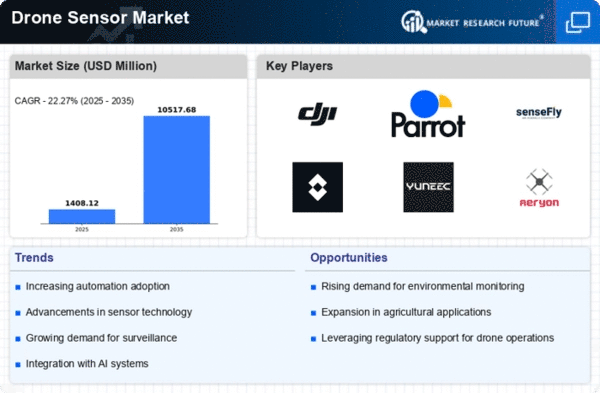
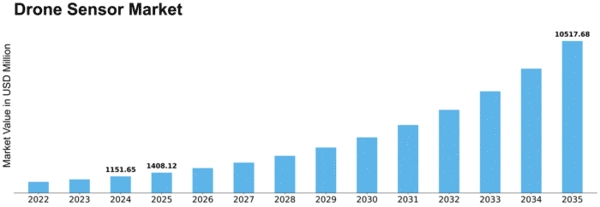
As per Market Research Future analysis, the Drone Sensor Market Size was estimated at 1151.65 USD Million in 2024. The Drone Sensor industry is projected to grow from 1408.15 USD Million in 2025 to 10517.68 USD Million by 2035, exhibiting a compound annual growth rate (CAGR) of 22.27% during the forecast period 2025 – 2035. The rapid adoption of drone sensors across multiple industries is a key contributor to this growth.

Key Market Trends & Highlights

The Drone Sensor Market is poised for substantial growth driven by technological advancements and increasing applications across various sectors.

  • Technological advancements in sensors are enhancing the capabilities and efficiency of drone operations. The agriculture segment remains the largest market, driven by the growing demand for precision farming solutions. North America continues to dominate the market, while the Asia-Pacific region is emerging as the fastest-growing area for drone sensor adoption. Key market drivers include the increasing adoption of drone sensors in agriculture and a supportive regulatory environment that fosters innovation.

Market Size & Forecast

2024 Market Size 1151.65 (USD Million)
2035 Market Size 10517.68 (USD Million)
CAGR (2025 - 2035) 22.27%
Largest Regional Market Share in 2024 North America

Major Players

DJI (CN), Parrot (FR), senseFly (CH), FLIR Systems (US), Yuneec (CN), Aeryon Labs (CA), Insitu (US), 3D Robotics (US), Skycatch (US)

Market Trends

The Drone Sensor Market is currently experiencing a transformative phase, driven by advancements in technology and increasing applications across various sectors. The integration of sophisticated drone sensors into unmanned aerial vehicles enhances their capabilities, enabling them to perform complex tasks such as surveillance, mapping, and environmental monitoring. As industries recognize the potential of drones sensors for real-time data acquisition, demand is likely to rise. Furthermore, regulatory frameworks are evolving to accommodate the growing use of drone with sensors, which may further stimulate market growth.

In addition to technological advancements, the Drone Sensor Market is influenced by the rising need for data collection and analysis in real-time. Industries such as agriculture, construction, logistics, and conservation drones applications are increasingly adopting drone sensors to improve efficiency and reduce operational costs. This trend suggests a shift toward automated and data-driven decision-making processes. As the market continues to mature, collaboration between technology providers and end-users appears essential for developing tailored solutions that meet specific industry needs. Overall, the Drone Sensor Market is poised for substantial growth, driven by innovation, regulatory support, and the increasing demand for efficient data collection methods.

Technological Advancements in Sensors

The Drone Sensor Market is witnessing rapid technological advancements, particularly in drone sensor capabilities. Innovations in imaging, LiDAR, and thermal drone sensors are enhancing the functionality of drones, allowing for more precise data collection and analysis. This trend indicates a shift towards more sophisticated applications across various sectors.

Growing Demand in Agriculture

The agricultural sector is increasingly adopting drone sensors for precision farming. A drone with sensors enables farmers to monitor crop health, optimize resource usage, and improve yield. This trend also supports the deployment of conservation drones for environmental sustainability and land monitoring.

Regulatory Developments and Support

Regulatory bodies are actively developing frameworks to support the safe integration of drones into national airspace. This regulatory environment is likely to encourage investment and innovation within the Drone Sensor Market, as companies seek to comply with new standards while exploring novel applications for drone technology.

Drone Sensor Market Market Drivers

Market Growth Projections

The Global Drone Sensor Market Industry is poised for substantial growth, with projections indicating a market value of 5.51 USD Billion in 2024 and an anticipated rise to 15 USD Billion by 2035. This growth reflects a compound annual growth rate of 9.53% from 2025 to 2035, driven by advancements in technology and increasing adoption across various sectors. The market is likely to expand as industries recognize the potential of drone sensors for enhancing operational efficiency and data collection capabilities. As a result, stakeholders are expected to invest significantly in research and development to innovate and improve drone sensor technologies.

Technological Advancements

The Global Drone Sensor Market Industry is propelled by rapid technological advancements in sensor technologies. Innovations such as LiDAR, multispectral, and thermal imaging sensors enhance the capabilities of drones, enabling them to perform complex tasks across various sectors. For instance, LiDAR sensors are increasingly utilized in agriculture for precision farming, allowing farmers to monitor crop health and optimize resource usage. The integration of artificial intelligence with drone sensors further augments data analysis, leading to improved decision-making. As a result, the market is projected to reach 5.51 USD Billion in 2024, reflecting the growing demand for sophisticated drone applications.

Increased Adoption in Agriculture

The Global Drone Sensor Market Industry experiences significant growth due to the increased adoption of drones in agriculture. Farmers leverage drone sensors for crop monitoring, soil analysis, and pest detection, which enhances productivity and reduces operational costs. For example, drones equipped with multispectral sensors can assess crop health by capturing data on vegetation indices. This technology allows for timely interventions, ultimately improving yield. The agricultural sector's reliance on drone technology is expected to contribute to the market's expansion, with projections indicating a rise to 15 USD Billion by 2035, driven by the need for efficient farming practices.

Government Initiatives and Regulations

Government initiatives and regulations play a crucial role in shaping the Global Drone Sensor Market Industry. Many countries are implementing policies to promote the use of drones for various applications, including surveillance, disaster management, and infrastructure inspection. For instance, regulatory frameworks are being established to ensure safe drone operations, which encourages investment in drone technology. Additionally, government funding for research and development in drone sensors fosters innovation. These supportive measures are likely to enhance market growth, with a compound annual growth rate of 9.53% anticipated from 2025 to 2035, as more sectors adopt drone solutions.

Growing Demand for Surveillance and Security

The Global Drone Sensor Market Industry is significantly influenced by the growing demand for surveillance and security applications. Drones equipped with advanced sensors are increasingly deployed for monitoring critical infrastructure, border security, and public safety. For example, law enforcement agencies utilize drones with thermal imaging sensors for search and rescue operations, enhancing situational awareness. The rising concerns over security threats and the need for efficient monitoring solutions are driving investments in drone technology. This trend is expected to contribute to the market's growth trajectory, reinforcing the importance of drone sensors in enhancing security measures.

Emerging Applications in Infrastructure Inspection

Emerging applications in infrastructure inspection are driving the Global Drone Sensor Market Industry forward. Drones equipped with high-resolution cameras and specialized sensors are utilized for inspecting bridges, power lines, and pipelines, enabling efficient and safe assessments. For instance, utility companies employ drones to monitor power lines, reducing the need for manual inspections that can be hazardous. This application not only enhances safety but also improves operational efficiency. As industries increasingly recognize the benefits of drone technology for infrastructure maintenance, the market is poised for growth, with a projected increase to 15 USD Billion by 2035.

Market Segment Insights

By Application: Agriculture (Largest) vs. Mapping (Fastest-Growing)

The Drone Sensor Market demonstrates a diverse distribution across various applications, with agriculture leading as the largest segment. This sector employs drone sensors for precision farming, crop monitoring, and yield optimization, making it a pivotal area for technological advancement. Conversely, mapping is emerging rapidly, driven by the increasing demand for geographical data and survey capabilities in both urban and rural planning. As drone technology evolves, these applications are gaining traction, catering to a growing market need.

Agriculture (Dominant) vs. Delivery (Emerging)

The agriculture application leads the Drone Sensor Market, primarily driven by its ability to enhance farming efficiency and productivity. Farmers utilize drone sensors for accurate field analysis, crop health monitoring, and pest control, solidifying agriculture's dominant position in the market. On the other hand, delivery, although currently an emerging segment, is experiencing explosive growth due to advancements in drone technology and logistics. Companies are increasingly deploying drones for last-mile delivery solutions, reducing costs and improving service speed. This segment's potential lies in its capacity to disrupt traditional logistics frameworks, complemented by regulatory support and technological advancements.

By Sensor Type: LiDAR (Largest) vs. Camera (Fastest-Growing)

In the Drone Sensor Market, the sensor type segment shows a diverse distribution among various technologies. LiDAR holds the largest market share due to its high precision and effectiveness in mapping and surveying applications. Meanwhile, Camera sensors are emerging rapidly, gaining traction for their use in aerial photography, inspections, and surveillance. Ultrasonic, Infrared, and GPS sensors also contribute to the market, albeit at a smaller scale, catering to specialized applications in agriculture, environmental monitoring, and navigation. The growth trends within the sensor type segment are primarily driven by advancements in technology and increasing applications of drones across various sectors. The demand for high-resolution imaging and real-time data collection has significantly bolstered the use of Camera sensors. Conversely, LiDAR technology continues to see improvements in data processing capabilities, which solidifies its position as the dominant sensor type. Overall, innovative integration and expanding use cases will enhance the growth of these sensors in the drone industry.

LiDAR (Dominant) vs. Camera (Emerging)

LiDAR sensors are known for their unparalleled accuracy in mapping, making them the dominant choice for industries such as construction, forestry, and archaeology. They utilize laser technology to create detailed 3D models of the environment, allowing for precise topographic measurements. As the need for detailed environmental assessments and planning increases, LiDAR's market position remains robust. On the other hand, Camera sensors are rapidly emerging due to their versatility and affordability. With advancements in imaging technology, they have become essential in applications like monitoring crops, inspecting infrastructure, and capturing high-quality videos. The ease of integrating Camera sensors with drones enhances their appeal, thereby solidifying their position as a key player in the ever-evolving sensor market.

By End Use: Commercial (Largest) vs. Military (Fastest-Growing)

In the Drone Sensor Market, the commercial segment leads the way, capturing a substantial share with its extensive applications across various industries such as agriculture, logistics, and infrastructure. The military segment, while smaller, demonstrates rapid growth as defense organizations increasingly adopt drone technology for surveillance and reconnaissance. This landscape reflects a clear stratification of market needs, where commercial applications drive stability while military enhancements propel innovation. Looking to the future, the demand for drone sensors in the military sector is expected to outpace that of commercial uses. Factors influencing this trend include escalating defense budgets, the urgent need for advanced surveillance capabilities, and the integration of artificial intelligence in military drones. In contrast, while the commercial field remains significant, its growth is steady rather than explosive. Thus, military applications emerge as a focal point for growth in the Drone Sensor Market.

Commercial (Dominant) vs. Military (Emerging)

The commercial segment in the Drone Sensor Market stands out as the dominant player, marked by widespread integration across various industries including agriculture, construction, and logistics. This segment's growth is bolstered by increasing demand for aerial imaging, crop monitoring, and delivery services, highlighting the versatility of drone sensors in optimizing operational efficiencies. The technological advancements in sensor accuracy and data analysis also enhance commercial applications, positioning this segment at the forefront of market development. On the other hand, the military segment is emerging rapidly, focusing on advanced technologies that enhance combat readiness and strategic advantages. Military applications of drone sensors are centered around intelligence gathering, target acquisition, and real-time situational awareness, emphasizing the need for high precision and reliability in hostile environments. As government agencies invest in next-gen drone capabilities, the military segment is expected to capture a larger share of the market, driven by the growing emphasis on national security and defense modernization.

By Technology: AI-Enabled (Largest) vs. Autonomous (Fastest-Growing)

The Drone Sensor Market showcases a diverse distribution of technology segments, with AI-Enabled sensors commanding the largest share. These sensors have transformed operational efficiency and decision-making in drones. In contrast, the Autonomous segment is growing at the fastest rate as advancements in autonomy technology enhance operational capabilities and reduce the need for human intervention. This shifting preference indicates an evolving market that is increasingly prioritizing efficiency and automation in drone applications. Growth trends in the Drone Sensor Market are being driven by a surge in demand for sophisticated capabilities in various sectors, including agriculture and surveillance. Emerging technologies like AI are improving sensor accuracy and reliability, thereby enabling new use cases. Additionally, the rising interest in hybrid models signals that consumers are seeking versatile solutions that combine features of multiple technologies, further fueling market growth.

AI-Enabled: Dominant vs. Remote Control: Emerging

AI-Enabled sensors in the Drone Sensor Market are clearly positioned as the dominant technology, offering advanced data processing capabilities and adaptive algorithms. These sensors allow drones to operate autonomously in complex environments, thus enhancing operational efficiency. On the other hand, Remote Control sensors are classified as an emerging segment, providing operators a direct interface for maneuvering drones. While this technology is user-friendly, its growth is being overshadowed by the rising demand for autonomous systems. The competition between these technologies highlights a market poised for innovation, emphasizing the move towards more automated solutions and redefining traditional paradigms in drone operations.

Get more detailed insights about Drone Sensor Market Research Report – Forecast till 2035

Regional Insights

North America : Market Leader in Innovation

North America continues to lead the drone sensor market, holding a significant share of 575.83M in 2025. The region's growth is driven by advancements in technology, increasing demand for aerial surveillance, and favorable regulations promoting drone usage across various sectors. The integration of AI and machine learning in drone sensors is also enhancing operational efficiency, making them indispensable in industries like agriculture and logistics. The United States is the primary contributor to this market, with key players such as DJI, FLIR Systems, and 3D Robotics leading the charge. The competitive landscape is characterized by continuous innovation and strategic partnerships among companies. The presence of a robust infrastructure and investment in R&D further solidifies North America's position as a hub for drone technology development.

Europe : Emerging Market with Potential

Europe's drone sensor market is projected to reach 325.99M by 2025, driven by increasing applications in agriculture, surveillance, and environmental monitoring. Regulatory frameworks, such as the European Union's drone regulations, are facilitating market growth by ensuring safety and promoting the use of drones in commercial applications. The region is witnessing a surge in demand for advanced sensors that enhance data collection and operational efficiency. Leading countries in this market include Germany, France, and the UK, where companies like Parrot and senseFly are making significant strides. The competitive landscape is marked by a mix of established players and startups, fostering innovation. The European market is characterized by a strong emphasis on sustainability and compliance with stringent regulations, which is shaping the future of drone technology in the region.

Asia-Pacific : Rapidly Growing Market

Asia-Pacific shows strong demand for drone sensors, with China and India accelerating deployment of drone with sensors across commercial sectors. Countries like China and India are leading the charge, with a surge in demand for drones in agriculture, surveillance, and delivery services. The region's favorable regulatory environment is also encouraging the adoption of drone technology, making it a hotspot for innovation and development.

China, home to major players like DJI and Yuneec, is a significant contributor to the market. The competitive landscape is evolving, with numerous startups emerging to capitalize on the growing demand. As the region continues to embrace drone technology, the market is expected to expand further, supported by government initiatives and investments in research and development.

Middle East and Africa : Emerging Market Opportunities

The Middle East and Africa (MEA) region is gradually emerging in the drone sensor market, with a projected size of 49.83M by 2025. The growth is primarily driven by increasing investments in smart city initiatives and infrastructure development. Governments are recognizing the potential of drones for surveillance, agriculture, and logistics, leading to favorable regulations that encourage their adoption. The region's unique geographical challenges also create opportunities for specialized drone applications. Countries like the UAE and South Africa are leading the way in adopting drone technology, with local companies exploring innovative solutions. The competitive landscape is still developing, with a mix of international and regional players. As awareness of drone capabilities grows, the MEA market is expected to expand, driven by technological advancements and strategic partnerships.

Key Players and Competitive Insights

The Drone Sensor Market is currently characterized by a dynamic competitive landscape, driven by technological advancements and increasing demand across various sectors such as agriculture, surveillance, and logistics. Key players like DJI (CN), Parrot (FR), and FLIR Systems (US) are at the forefront, each adopting distinct strategies to enhance their market positioning. DJI (CN) continues to lead with a focus on innovation, particularly in developing advanced imaging sensors that cater to both consumer and commercial applications. Meanwhile, Parrot (FR) emphasizes partnerships with agricultural firms to integrate drone technology into precision farming, thereby expanding its operational focus. FLIR Systems (US) is strategically positioned in the thermal imaging segment, leveraging its expertise to cater to security and industrial applications, which collectively shapes a competitive environment that is increasingly reliant on technological differentiation. In terms of business tactics, companies are localizing manufacturing and optimizing supply chains to enhance efficiency and reduce costs. The market structure appears moderately fragmented, with several players vying for market share. This fragmentation allows for a diverse range of products and services, but also intensifies competition among key players. The collective influence of these companies is significant, as they drive innovation and set industry standards, thereby shaping the overall market dynamics. In November 2025, DJI (CN) announced the launch of its latest drone equipped with a state-of-the-art multispectral sensor designed for agricultural applications. This strategic move is likely to enhance DJI's competitive edge by addressing the growing demand for precision agriculture solutions, thereby solidifying its market leadership. The introduction of this technology not only showcases DJI's commitment to innovation but also reflects a broader trend towards integrating advanced sensors into drone platforms. In October 2025, FLIR Systems (US) expanded its product line by introducing a new thermal sensor specifically designed for search and rescue operations. This development underscores FLIR's strategic focus on niche markets where thermal imaging is critical. By enhancing its offerings in this area, FLIR is likely to strengthen its position in the emergency response sector, which is increasingly reliant on drone technology for effective operations. In September 2025, Parrot (FR) entered into a strategic partnership with a leading agricultural technology firm to develop integrated drone solutions for crop monitoring. This collaboration is indicative of Parrot's strategy to leverage partnerships to enhance its product capabilities and market reach. By aligning with established players in the agricultural sector, Parrot is poised to capitalize on the growing trend of digital agriculture, thereby expanding its influence in the market. As of December 2025, current competitive trends in the Drone Sensor Market are heavily influenced by digitalization, sustainability, and the integration of artificial intelligence (AI). Strategic alliances are becoming increasingly important, as companies seek to combine their strengths to innovate and meet evolving customer demands. The competitive differentiation is likely to shift from price-based strategies to a focus on technological innovation and supply chain reliability. This evolution suggests that companies that prioritize R&D and strategic partnerships will be better positioned to thrive in the future.

Key Companies in the Drone Sensor Market include

Industry Developments

Recent developments highlight investments in drone sensors such as multispectral, LiDAR, and thermal technologies. The growing role of conservation drones and AI-enabled drone sensor platforms is shaping future innovation. These companies, including DJI, Northrop Grumman, and Teledyne Technologies, are continuing to make significant investments in drone sensor technologies, particularly multispectral, LiDAR, thermal, and hyperspectral sensors, for use in agriculture, surveillance, infrastructure inspection, and disaster response.

DJI has recently disclosed its latest Zenmuse X9-H hyperspectral payload, which is scheduled to be released in February 2025. This payload is designed to monitor environmental conditions and crop health. Northrop and Teledyne continue to improve their advanced thermal and LiDAR modules for industrial and defense applications.The FAA and CAAC (China) signed a mutual recognition agreement for Remote ID in April 2024, which will facilitate cross-border sensor-equipped drone operations for international drone flights.Sony Semiconductor Solutions initiated the distribution of its IMX500 series smart vision sensors (AI-capable) for drone-based agricultural surveillance in November 2023.

These sensors have been widely adopted in India and Southeast Asia.

Future Outlook

Drone Sensor Market Future Outlook

The Drone Sensor Market is poised for robust growth at 22.27% CAGR from 2025 to 2035, driven by technological advancements, increased demand for automation, and regulatory support.

New opportunities lie in:

  • <p>Development of advanced multispectral sensors for precision agriculture applications. Integration of AI-driven analytics for real-time data processing and decision-making. Expansion into emerging markets with tailored drone sensor solutions.</p>

By 2035, the Drone Sensor Market is expected to achieve substantial growth, solidifying its position as a key industry.

Market Segmentation

Drone Sensor Market End Use Outlook

  • Commercial
  • Military
  • Civil
  • Research
  • Industrial

Drone Sensor Market Technology Outlook

  • Autonomous
  • Remote Control
  • Hybrid
  • AI-Enabled
  • Cloud-Based

Drone Sensor Market Application Outlook

  • Agriculture
  • Surveillance
  • Mapping
  • Inspection
  • Delivery

Drone Sensor Market Sensor Type Outlook

  • LiDAR
  • Camera
  • Ultrasonic
  • Infrared
  • GPS

Report Scope

MARKET SIZE 2024 1151.65(USD Million)
MARKET SIZE 2025 1408.15(USD Million)
MARKET SIZE 2035 10517.68(USD Million)
COMPOUND ANNUAL GROWTH RATE (CAGR) 22.27% (2025 - 2035)
REPORT COVERAGE Revenue Forecast, Competitive Landscape, Growth Factors, and Trends
BASE YEAR 2024
Market Forecast Period 2025 - 2035
Historical Data 2019 - 2024
Market Forecast Units USD Million
Key Companies Profiled DJI (CN), Parrot (FR), senseFly (CH), FLIR Systems (US), Yuneec (CN), Aeryon Labs (CA), Insitu (US), 3D Robotics (US), Skycatch (US)
Segments Covered Application, Sensor Type, End Use, Technology
Key Market Opportunities Integration of advanced artificial intelligence in Drone Sensor Market enhances operational efficiency and data accuracy.
Key Market Dynamics Technological advancements in sensor capabilities drive competitive dynamics and regulatory adaptations in the Drone Sensor Market.
Countries Covered North America, Europe, APAC, South America, MEA

FAQs

What is the expected market size of the Drone Sensor Market in 2024?

The Drone Sensor Market is expected to be valued at 5.51 USD billion in 2024.

What will be the market value of the Drone Sensor Market by 2035?

By 2035, the Drone Sensor Market is projected to reach 15.0 USD billion.

What is the projected compound annual growth rate (CAGR) for the Drone Sensor Market from 2025 to 2035?

The expected CAGR for the Drone Sensor Market from 2025 to 2035 is 9.53%.

Which region holds the largest market share in the Drone Sensor Market in 2024?

In 2024, North America holds the largest market share with a valuation of 2.2 USD billion.

What is the anticipated market size of the Drone Sensor Market in Europe for 2024?

The European market for Drone Sensors is expected to be valued at 1.5 USD billion in 2024.

What are the expected market sizes for the Agriculture application in the Drone Sensor Market by 2035?

The Agriculture application segment is projected to be valued at 3.5 USD billion by 2035.

Who are the key players in the Drone Sensor Market?

Major players in the Drone Sensor Market include companies like 3D Robotics, FLIR Systems, and DJI.

What is the market size for the Surveillance application in the Drone Sensor Market in 2024?

The Surveillance application segment is expected to be valued at 1.25 USD billion in 2024.

How much is the Logistics application expected to grow by 2035 in the Drone Sensor Market?

The Logistics application segment is anticipated to reach a market size of 3.0 USD billion by 2035.

What is the value of the Middle East and Africa market for Drone Sensors in 2024?

The Middle East and Africa market for Drone Sensors is expected to be valued at 0.21 USD billion in 2024.

  1. SECTION I: EXECUTIVE SUMMARY AND KEY HIGHLIGHTS |
    1. EXECUTIVE SUMMARY |
      1. Market Overview |
      2. Key Findings |
      3. Market Segmentation |
      4. Competitive Landscape |
      5. Challenges and Opportunities |
      6. Future Outlook 2
  2. SECTION II: SCOPING, METHODOLOGY AND MARKET STRUCTURE |
    1. MARKET INTRODUCTION |
      1. Definition |
      2. Scope of the study |--
    2. RESEARCH METHODOLOGY |
      1. Overview |
      2. Data Mining |
      3. Secondary Research |
      4. Primary Research |--
      5. Forecasting Model |
      6. Market Size Estimation |--
      7. Data Triangulation |
      8. Validation 3
  3. SECTION III: QUALITATIVE ANALYSIS |
    1. MARKET DYNAMICS |
      1. Overview |
      2. Drivers |
      3. Restraints |
      4. Opportunities |
    2. MARKET FACTOR ANALYSIS |
      1. Value chain Analysis |
      2. Porter's Five Forces Analysis |--
      3. COVID-19 Impact Analysis |--
  4. SECTION IV: QUANTITATIVE ANALYSIS |
    1. Semiconductor & Electronics, BY Application (USD Million) |
      1. Agriculture |
      2. Surveillance |
      3. Mapping |
      4. Inspection |
      5. Delivery |
    2. Semiconductor & Electronics, BY Sensor Type (USD Million) |
      1. LiDAR |
      2. Camera |
      3. Ultrasonic |
      4. Infrared |
      5. GPS |
    3. Semiconductor & Electronics, BY End Use (USD Million) |
      1. Commercial |
      2. Military |
      3. Civil |
      4. Research |
      5. Industrial |
    4. Semiconductor & Electronics, BY Technology (USD Million) |
      1. Autonomous |
      2. Remote Control |
      3. Hybrid |
      4. AI-Enabled |
      5. Cloud-Based |
    5. Semiconductor & Electronics, BY Region (USD Million) |
      1. North America |--
      2. Europe |--
      3. APAC |--
      4. South America |--
      5. MEA |--
  5. SECTION V: COMPETITIVE ANALYSIS |
    1. Competitive Landscape |
      1. Overview |
      2. Competitive Analysis |
      3. Market share Analysis |
      4. Major Growth Strategy in the Semiconductor & Electronics |
      5. Competitive Benchmarking |
      6. Leading Players in Terms of Number of Developments in the Semiconductor & Electronics |
      7. Key developments and growth strategies |--
      8. Major Players Financial Matrix |--
    2. Company Profiles |
      1. DJI (CN) |--
      2. Parrot (FR) |--
      3. senseFly (CH) |--
      4. FLIR Systems (US) |--
      5. Yuneec (CN) |--
      6. Aeryon Labs (CA) |--
      7. Insitu (US) |--
      8. 3D Robotics (US) |--
      9. Skycatch (US) |--
    3. Appendix |
      1. References |
      2. Related Reports

Semiconductor & Electronics Market Segmentation

Semiconductor & Electronics By Application (USD Million, 2025-2035)

  • Agriculture
  • Surveillance
  • Mapping
  • Inspection
  • Delivery

Semiconductor & Electronics By Sensor Type (USD Million, 2025-2035)

  • LiDAR
  • Camera
  • Ultrasonic
  • Infrared
  • GPS

Semiconductor & Electronics By End Use (USD Million, 2025-2035)

  • Commercial
  • Military
  • Civil
  • Research
  • Industrial

Semiconductor & Electronics By Technology (USD Million, 2025-2035)

  • Autonomous
  • Remote Control
  • Hybrid
  • AI-Enabled
  • Cloud-Based
Infographic

Free Sample Request

Kindly complete the form below to receive a free sample of this Report

Get Free Sample

Customer Strories

Compare Licence

×
Features License Type
Single User Multiuser License Enterprise User
Price $4,950 $5,950 $7,250
Maximum User Access Limit 1 User Upto 10 Users Unrestricted Access Throughout the Organization
Free Customization
Direct Access to Analyst
Deliverable Format
Platform Access
Discount on Next Purchase 10% 15% 15%
Printable Versions