
Request Free Sample ×

Kindly complete the form below to receive a free sample of this Report

* Please use a valid business email

Leading companies partner with us for data-driven Insights

clients tt-cursor
Hero Background
English
Chinese
French
Japanese
Korean
German
Spanish

Drone Sensor Market Share

ID: MRFR/SEM/5970-HCR
200 Pages
Ankit Gupta
Last Updated: April 06, 2026

Drone Sensor Market Size, Share and Research Report By Application (Agriculture, Surveillance, Environmental Monitoring, Logistics, Infrastructure Inspection), By Sensor Type (Lidar, Camera, Thermal Sensors, Ultrasonic Sensors, Multi-Spectral Sensors), By End Use (Government, Commercial, Defense, Research and Development), By Platform Type (Fixed-Wing, Rotary-Wing, Hybrid) and By Regional (North America, Europe, South America, Asia Pacific, Middle East and Africa) - Industry Forecast Till 2035

Share:
Download PDF ×

We do not share your information with anyone. However, we may send you emails based on your report interest from time to time. You may contact us at any time to opt-out.

Drone Sensor Market Infographic
Purchase Options

Market Share

Drone Sensor Market Share Analysis

The market proportion positioning strategies within the Drone Sensor Market are critical for organizations aiming to establish a sturdy presence and gain a competitive benefit. One commonplace method employed by agencies is product differentiation. By imparting Drone Sensors with particular capabilities, advanced overall performance, or specialized applications, organizations can carve out an awesome marketplace niche. Pricing techniques are another enormous issue of market proportion positioning. Some corporations choose a value management approach, aiming to offer Drone Sensors at lower costs than their competitors. This strategy appeals to value-aware customers and may assist in capturing a larger market percentage, mainly in charge-sensitive segments. Conversely, a premium pricing method makes a specialty of positioning Drone Sensors as excessive-give-up merchandise, emphasizing superior capabilities, best, and reliability. Companies adopting this method target clients who prioritize performance over fees and are willing to pay a top class for pinnacle-tier merchandise. Market segmentation is an approach that entails targeting particular customer segments with tailored merchandise or advertising procedures. Companies can perceive and cater to the specific wishes of various industries or applications, along with agriculture, infrastructure inspection, or environmental monitoring. Geographical expansion is a not unusual strategy for businesses aiming to increase their market percentage in the Drone Sensor industry. By getting into new markets or increasing their presence in current ones, corporations can tap into rising possibilities and diversify their purchaser base. Understanding nearby variations in regulations, alternatives, and marketplace demands is important for a hit geographical expansion, allowing groups to conform their merchandise and techniques to local conditions. Investments in studies and improvement (R &D) play a pivotal role in market share positioning. Companies that consistently innovate and introduce cutting-edge technologies stay ahead of the competition. By investing in R&D, companies can enhance the capabilities of their Drone Sensors, address emerging market trends, and maintain a leadership position in terms of technological advancements. Building a strong brand image is an integral part of market share positioning in the Drone Sensor market. A reputable brand conveys trust, reliability, and quality to customers. Companies that invest in building and maintaining a positive brand image are likely to attract a loyal customer base. Branding efforts can include effective marketing campaigns, customer engagement initiatives, and a commitment to delivering consistent and high-quality products, all of which contribute to a favorable market position.


Author
Author Profile
Ankit Gupta
Team Lead - Research

Ankit Gupta is a seasoned market intelligence and strategic research professional with over six plus years of experience in the ICT and Semiconductor industries. With academic roots in Telecom, Marketing, and Electronics, he blends technical insight with business strategy. Ankit has led 200+ projects, including work for Fortune 500 clients like Microsoft and Rio Tinto, covering market sizing, tech forecasting, and go-to-market strategies. Known for bridging engineering and enterprise decision-making, his insights support growth, innovation, and investment planning across diverse technology markets.

Leave a Comment

FAQs

What is the current valuation of the Drone Sensor Market as of 2025?

<p>The Drone Sensor Market is valued at approximately 1151.65 USD Million in 2024.</p>

What is the projected market size for the Drone Sensor Market by 2035?

<p>The market is expected to reach a valuation of 10517.68 USD Million by 2035.</p>

What is the expected CAGR for the Drone Sensor Market during the forecast period 2025 - 2035?

<p>The expected CAGR for the Drone Sensor Market during the forecast period 2025 - 2035 is 22.27%.</p>

Which application segments are driving growth in the Drone Sensor Market?

<p>Key application segments include Surveillance, valued at 2800.0 USD Million, and Agriculture, valued at 2100.0 USD Million.</p>

How does the military sector contribute to the Drone Sensor Market?

<p>The military sector contributes significantly, with a valuation of 4500.0 USD Million.</p>

What are the leading sensor types in the Drone Sensor Market?

<p>Camera sensors dominate the market, with a valuation of 2700.0 USD Million, followed by GPS sensors at 3767.68 USD Million.</p>

Which companies are considered key players in the Drone Sensor Market?

<p>Key players include DJI, Parrot, FLIR Systems, and Yuneec, among others.</p>

What is the market valuation for hybrid technology in the Drone Sensor Market?

<p>Hybrid technology is valued at approximately 5217.68 USD Million.</p>

How does the commercial sector perform in the Drone Sensor Market?

<p>The commercial sector is valued at 3000.0 USD Million, indicating robust growth.</p>

What trends are anticipated in the Drone Sensor Market by 2035?

<p>Trends suggest a substantial increase in demand across all segments, particularly in military and civil applications.</p>

Market Summary

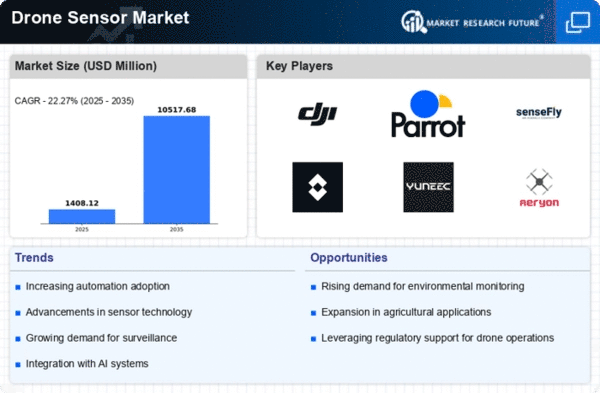
As per Market Research Future analysis, the Drone Sensor Market Size was estimated at 1151.65 USD Million in 2024. The Drone Sensor industry is projected to grow from 1408.15 USD Million in 2025 to 10517.68 USD Million by 2035, exhibiting a compound annual growth rate (CAGR) of 22.27% during the forecast period 2025 – 2035. The rapid adoption of drone sensors across multiple industries is a key contributor to this growth.

Key Market Trends & Highlights

The Drone Sensor Market is poised for substantial growth driven by technological advancements and increasing applications across various sectors.

  • Technological advancements in sensors are enhancing the capabilities and efficiency of drone operations. The agriculture segment remains the largest market, driven by the growing demand for precision farming solutions. North America continues to dominate the market, while the Asia-Pacific region is emerging as the fastest-growing area for drone sensor adoption. Key market drivers include the increasing adoption of drone sensors in agriculture and a supportive regulatory environment that fosters innovation.

Market Size & Forecast

2024 Market Size 1151.65 (USD Million)
2035 Market Size 10517.68 (USD Million)
CAGR (2025 - 2035) 22.27%
Largest Regional Market Share in 2024 North America

Major Players

DJI (CN), Parrot (FR), senseFly (CH), FLIR Systems (US), Yuneec (CN), Aeryon Labs (CA), Insitu (US), 3D Robotics (US), Skycatch (US)

Market Trends

The Drone Sensor Market is currently experiencing a transformative phase, driven by advancements in technology and increasing applications across various sectors. The integration of sophisticated drone sensors into unmanned aerial vehicles enhances their capabilities, enabling them to perform complex tasks such as surveillance, mapping, and environmental monitoring. As industries recognize the potential of drones sensors for real-time data acquisition, demand is likely to rise. Furthermore, regulatory frameworks are evolving to accommodate the growing use of drone with sensors, which may further stimulate market growth.

In addition to technological advancements, the Drone Sensor Market is influenced by the rising need for data collection and analysis in real-time. Industries such as agriculture, construction, logistics, and conservation drones applications are increasingly adopting drone sensors to improve efficiency and reduce operational costs. This trend suggests a shift toward automated and data-driven decision-making processes. As the market continues to mature, collaboration between technology providers and end-users appears essential for developing tailored solutions that meet specific industry needs. Overall, the Drone Sensor Market is poised for substantial growth, driven by innovation, regulatory support, and the increasing demand for efficient data collection methods.

Technological Advancements in Sensors

The Drone Sensor Market is witnessing rapid technological advancements, particularly in drone sensor capabilities. Innovations in imaging, LiDAR, and thermal drone sensors are enhancing the functionality of drones, allowing for more precise data collection and analysis. This trend indicates a shift towards more sophisticated applications across various sectors.

Growing Demand in Agriculture

The agricultural sector is increasingly adopting drone sensors for precision farming. A drone with sensors enables farmers to monitor crop health, optimize resource usage, and improve yield. This trend also supports the deployment of conservation drones for environmental sustainability and land monitoring.

Regulatory Developments and Support

Regulatory bodies are actively developing frameworks to support the safe integration of drones into national airspace. This regulatory environment is likely to encourage investment and innovation within the Drone Sensor Market, as companies seek to comply with new standards while exploring novel applications for drone technology.

Drone Sensor Market Market Drivers

Market Growth Projections

The Global Drone Sensor Market Industry is poised for substantial growth, with projections indicating a market value of 5.51 USD Billion in 2024 and an anticipated rise to 15 USD Billion by 2035. This growth reflects a compound annual growth rate of 9.53% from 2025 to 2035, driven by advancements in technology and increasing adoption across various sectors. The market is likely to expand as industries recognize the potential of drone sensors for enhancing operational efficiency and data collection capabilities. As a result, stakeholders are expected to invest significantly in research and development to innovate and improve drone sensor technologies.

Technological Advancements

The Global Drone Sensor Market Industry is propelled by rapid technological advancements in sensor technologies. Innovations such as LiDAR, multispectral, and thermal imaging sensors enhance the capabilities of drones, enabling them to perform complex tasks across various sectors. For instance, LiDAR sensors are increasingly utilized in agriculture for precision farming, allowing farmers to monitor crop health and optimize resource usage. The integration of artificial intelligence with drone sensors further augments data analysis, leading to improved decision-making. As a result, the market is projected to reach 5.51 USD Billion in 2024, reflecting the growing demand for sophisticated drone applications.

Increased Adoption in Agriculture

The Global Drone Sensor Market Industry experiences significant growth due to the increased adoption of drones in agriculture. Farmers leverage drone sensors for crop monitoring, soil analysis, and pest detection, which enhances productivity and reduces operational costs. For example, drones equipped with multispectral sensors can assess crop health by capturing data on vegetation indices. This technology allows for timely interventions, ultimately improving yield. The agricultural sector's reliance on drone technology is expected to contribute to the market's expansion, with projections indicating a rise to 15 USD Billion by 2035, driven by the need for efficient farming practices.

Government Initiatives and Regulations

Government initiatives and regulations play a crucial role in shaping the Global Drone Sensor Market Industry. Many countries are implementing policies to promote the use of drones for various applications, including surveillance, disaster management, and infrastructure inspection. For instance, regulatory frameworks are being established to ensure safe drone operations, which encourages investment in drone technology. Additionally, government funding for research and development in drone sensors fosters innovation. These supportive measures are likely to enhance market growth, with a compound annual growth rate of 9.53% anticipated from 2025 to 2035, as more sectors adopt drone solutions.

Growing Demand for Surveillance and Security

The Global Drone Sensor Market Industry is significantly influenced by the growing demand for surveillance and security applications. Drones equipped with advanced sensors are increasingly deployed for monitoring critical infrastructure, border security, and public safety. For example, law enforcement agencies utilize drones with thermal imaging sensors for search and rescue operations, enhancing situational awareness. The rising concerns over security threats and the need for efficient monitoring solutions are driving investments in drone technology. This trend is expected to contribute to the market's growth trajectory, reinforcing the importance of drone sensors in enhancing security measures.

Emerging Applications in Infrastructure Inspection

Emerging applications in infrastructure inspection are driving the Global Drone Sensor Market Industry forward. Drones equipped with high-resolution cameras and specialized sensors are utilized for inspecting bridges, power lines, and pipelines, enabling efficient and safe assessments. For instance, utility companies employ drones to monitor power lines, reducing the need for manual inspections that can be hazardous. This application not only enhances safety but also improves operational efficiency. As industries increasingly recognize the benefits of drone technology for infrastructure maintenance, the market is poised for growth, with a projected increase to 15 USD Billion by 2035.

Market Segment Insights

By Application: Agriculture (Largest) vs. Delivery (Fastest-Growing)

<p>The Drone Sensor Market is notably segmented into various applications including Agriculture, Surveillance, Mapping, Inspection, and Delivery. Among these, Agriculture holds the largest market share, driven by the increasing adoption of drones for precision farming and crop monitoring. Surveillance follows closely, benefitting from the growing demand for aerial surveillance solutions in security and monitoring operations. Mapping and Inspection also contribute significantly but are comparatively smaller in share, while Delivery is emerging as a critical segment due to advancements in logistics and e-commerce.</p>

<p>Agriculture (Dominant) vs. Delivery (Emerging)</p>

<p>In the Drone Sensor Market, Agriculture stands out as the dominant application segment due to its extensive utilization of drones equipped with sensors for crop health monitoring, land surveys, and yield prediction. This segment leverages advanced technologies such as multispectral imaging and thermal sensors enhancing farming efficiency. On the other hand, Delivery is an emerging segment that has gained traction owing to the rising e-commerce sector and the need for faster logistics solutions. Drones in this segment are equipped with payload sensors to ensure safe transport and delivery of goods, thus showcasing the evolving landscape of drone utilization in commercial sectors.</p>

By End Use: Commercial (Largest) vs. Military (Fastest-Growing)

<p>In the Drone Sensor Market, the end use segment is divided into Commercial, Military, and Civil applications. The Commercial segment holds the largest market share as businesses increasingly leverage drone technology for various applications such as agriculture, surveillance, and logistics. Meanwhile, the Military segment, focusing on defense applications, shows significant potential for growth due to advancements in surveillance and reconnaissance capabilities.</p>

<p>Commercial (Dominant) vs. Military (Emerging)</p>

<p>The Commercial sector in the Drone Sensor Market remains dominant, driven by the rising adoption of drones for tasks ranging from agriculture monitoring to delivery services. This segment benefits from technological advancements that enhance operational efficiency and safety. On the other hand, the Military segment is emerging rapidly, characterized by increasing investments in defense technologies and the integration of sophisticated sensor systems. Drones used in military contexts are becoming critical for intelligence gathering, reconnaissance missions, and tactical operations, suggesting a robust growth trajectory fueled by ongoing defense modernization efforts.</p>

By Sensor Type: LiDAR (Largest) vs. Camera (Fastest-Growing)

<p>The Drone Sensor Market exhibits a diverse segment distribution with LiDAR emerging as the largest segment. This technology, known for its precision and reliability, encompasses a significant share of the market due to its advanced capabilities in mapping and terrain analysis. Camera sensors follow closely, leveraging advancements in imaging technology to enhance aerial photography and videography, thus appealing to various industries including agriculture, construction, and surveillance. The growth trends within the Drone Sensor Market reveal a thriving landscape driven by technological advancements and increasing adoption across sectors. Camera sensors are rapidly gaining popularity as they continuously evolve with improved resolution and multi-spectral capabilities, making them the fastest-growing segment. As industries seek smarter surveillance and analysis solutions, these sensor types are becoming indispensable in achieving efficiency and innovation in operations.</p>

<p>LiDAR (Dominant) vs. Infrared (Emerging)</p>

<p>LiDAR technology stands out as the dominant force in the Drone Sensor Market, primarily due to its unprecedented accuracy in capturing detailed geographical and environmental data. It excels in applications such as topographic mapping, forestry management, and disaster response, providing insights that other sensor types cannot match. On the other hand, Infrared sensors are emerging as notable contenders, particularly in thermal imaging applications like search and rescue missions, agricultural monitoring, and environmental studies. As industries increasingly recognize the value of remote sensing capabilities, Infrared sensors are carving a niche for themselves, exemplifying innovation in detecting heat signatures and aiding in energy efficiency assessments.</p>

By Technology: Active (Largest) vs. Passive (Fastest-Growing)

<p>In the Drone Sensor Market, the technology segment is primarily dominated by active sensors, which are known for their reliable data collection capabilities and accuracy. Active sensors, utilizing signals they emit, have gained significant traction due to their effectiveness in various applications such as mapping and surveillance. Passive sensors are rapidly gaining attention as well, being the fastest-growing segment driven by their cost-effectiveness and minimal energy requirements, making them appealing for new drone designs and environmental monitoring.</p>

<p>Technology: Active (Dominant) vs. Passive (Emerging)</p>

<p>Active sensors are at the forefront of the Drone Sensor Market, characterized by their ability to emit signals and interpret the responses from objects in their environment. This technology provides excellent distance measurement and imaging capabilities, which is crucial for applications like precision agriculture and search and rescue missions. On the other hand, passive sensors, which detect natural radiation, are emerging as a viable alternative due to their lower operational costs and efficiency in monitoring environmental conditions. The growing demand for energy-efficient solutions and the need for continuous monitoring of climate change impacts are propelling passive sensors into a more competitive stance within the market.</p>

Get more detailed insights about Drone Sensor Market Research Report – Forecast till 2035

Regional Insights

North America : Market Leader in Innovation

North America continues to lead the drone sensor market, holding a significant share of 575.83M in 2025. The region's growth is driven by advancements in technology, increasing demand for aerial surveillance, and favorable regulations promoting drone usage across various sectors. The integration of AI and machine learning in drone sensors is also enhancing operational efficiency, making them indispensable in industries like agriculture and logistics. The United States is the primary contributor to this market, with key players such as DJI, FLIR Systems, and 3D Robotics leading the charge. The competitive landscape is characterized by continuous innovation and strategic partnerships among companies. The presence of a robust infrastructure and investment in R&D further solidifies North America's position as a hub for drone technology development.

Europe : Emerging Market with Potential

Europe's drone sensor market is projected to reach 325.99M by 2025, driven by increasing applications in agriculture, surveillance, and environmental monitoring. Regulatory frameworks, such as the European Union's drone regulations, are facilitating market growth by ensuring safety and promoting the use of drones in commercial applications. The region is witnessing a surge in demand for advanced sensors that enhance data collection and operational efficiency. Leading countries in this market include Germany, France, and the UK, where companies like Parrot and senseFly are making significant strides. The competitive landscape is marked by a mix of established players and startups, fostering innovation. The European market is characterized by a strong emphasis on sustainability and compliance with stringent regulations, which is shaping the future of drone technology in the region.

Asia-Pacific : Rapidly Growing Market

Asia-Pacific shows strong demand for drone sensors, with China and India accelerating deployment of drone with sensors across commercial sectors. Countries like China and India are leading the charge, with a surge in demand for drones in agriculture, surveillance, and delivery services. The region's favorable regulatory environment is also encouraging the adoption of drone technology, making it a hotspot for innovation and development.

China, home to major players like DJI and Yuneec, is a significant contributor to the market. The competitive landscape is evolving, with numerous startups emerging to capitalize on the growing demand. As the region continues to embrace drone technology, the market is expected to expand further, supported by government initiatives and investments in research and development.

Middle East and Africa : Emerging Market Opportunities

The Middle East and Africa (MEA) region is gradually emerging in the drone sensor market, with a projected size of 49.83M by 2025. The growth is primarily driven by increasing investments in smart city initiatives and infrastructure development. Governments are recognizing the potential of drones for surveillance, agriculture, and logistics, leading to favorable regulations that encourage their adoption. The region's unique geographical challenges also create opportunities for specialized drone applications. Countries like the UAE and South Africa are leading the way in adopting drone technology, with local companies exploring innovative solutions. The competitive landscape is still developing, with a mix of international and regional players. As awareness of drone capabilities grows, the MEA market is expected to expand, driven by technological advancements and strategic partnerships.

Key Players and Competitive Insights

The Drone Sensor Market is currently characterized by a dynamic competitive landscape, driven by technological advancements and increasing demand across various sectors such as agriculture, surveillance, and logistics. Key players like DJI (CN), Parrot (FR), and FLIR Systems (US) are at the forefront, each adopting distinct strategies to enhance their market positioning. DJI (CN) continues to lead with a focus on innovation, particularly in developing advanced imaging sensors that cater to both consumer and commercial applications. Meanwhile, Parrot (FR) emphasizes partnerships with agricultural firms to integrate drone technology into precision farming, thereby expanding its operational focus. FLIR Systems (US) is strategically positioned in the thermal imaging segment, leveraging its expertise to cater to security and industrial applications, which collectively shapes a competitive environment that is increasingly reliant on technological differentiation. In terms of business tactics, companies are localizing manufacturing and optimizing supply chains to enhance efficiency and reduce costs. The market structure appears moderately fragmented, with several players vying for market share. This fragmentation allows for a diverse range of products and services, but also intensifies competition among key players. The collective influence of these companies is significant, as they drive innovation and set industry standards, thereby shaping the overall market dynamics. In November 2025, DJI (CN) announced the launch of its latest drone equipped with a state-of-the-art multispectral sensor designed for agricultural applications. This strategic move is likely to enhance DJI's competitive edge by addressing the growing demand for precision agriculture solutions, thereby solidifying its market leadership. The introduction of this technology not only showcases DJI's commitment to innovation but also reflects a broader trend towards integrating advanced sensors into drone platforms. In October 2025, FLIR Systems (US) expanded its product line by introducing a new thermal sensor specifically designed for search and rescue operations. This development underscores FLIR's strategic focus on niche markets where thermal imaging is critical. By enhancing its offerings in this area, FLIR is likely to strengthen its position in the emergency response sector, which is increasingly reliant on drone technology for effective operations. In September 2025, Parrot (FR) entered into a strategic partnership with a leading agricultural technology firm to develop integrated drone solutions for crop monitoring. This collaboration is indicative of Parrot's strategy to leverage partnerships to enhance its product capabilities and market reach. By aligning with established players in the agricultural sector, Parrot is poised to capitalize on the growing trend of digital agriculture, thereby expanding its influence in the market. As of December 2025, current competitive trends in the Drone Sensor Market are heavily influenced by digitalization, sustainability, and the integration of artificial intelligence (AI). Strategic alliances are becoming increasingly important, as companies seek to combine their strengths to innovate and meet evolving customer demands. The competitive differentiation is likely to shift from price-based strategies to a focus on technological innovation and supply chain reliability. This evolution suggests that companies that prioritize R&D and strategic partnerships will be better positioned to thrive in the future.

Key Companies in the Drone Sensor Market include

Industry Developments

Recent developments highlight investments in drone sensors such as multispectral, LiDAR, and thermal technologies. The growing role of conservation drones and AI-enabled drone sensor platforms is shaping future innovation. These companies, including DJI, Northrop Grumman, and Teledyne Technologies, are continuing to make significant investments in drone sensor technologies, particularly multispectral, LiDAR, thermal, and hyperspectral sensors, for use in agriculture, surveillance, infrastructure inspection, and disaster response.

DJI has recently disclosed its latest Zenmuse X9-H hyperspectral payload, which is scheduled to be released in February 2025. This payload is designed to monitor environmental conditions and crop health. Northrop and Teledyne continue to improve their advanced thermal and LiDAR modules for industrial and defense applications.The FAA and CAAC (China) signed a mutual recognition agreement for Remote ID in April 2024, which will facilitate cross-border sensor-equipped drone operations for international drone flights.Sony Semiconductor Solutions initiated the distribution of its IMX500 series smart vision sensors (AI-capable) for drone-based agricultural surveillance in November 2023.

These sensors have been widely adopted in India and Southeast Asia.

Future Outlook

Drone Sensor Market Future Outlook

The Drone Sensor Market is poised for robust growth at 22.27% CAGR from 2025 to 2035, driven by technological advancements, increased demand for automation, and regulatory support.

New opportunities lie in:

  • <p>Development of advanced multispectral sensors for precision agriculture applications. Integration of AI-driven analytics for real-time data processing and decision-making. Expansion into emerging markets with tailored drone sensor solutions.</p>

By 2035, the Drone Sensor Market is expected to achieve substantial growth, solidifying its position as a key industry.

Market Segmentation

Drone Sensor Market End Use Outlook

  • Commercial
  • Military
  • Civil
  • Research
  • Industrial

Drone Sensor Market Technology Outlook

  • Autonomous
  • Remote Control
  • Hybrid
  • AI-Enabled
  • Cloud-Based

Drone Sensor Market Application Outlook

  • Agriculture
  • Surveillance
  • Mapping
  • Inspection
  • Delivery

Drone Sensor Market Sensor Type Outlook

  • LiDAR
  • Camera
  • Ultrasonic
  • Infrared
  • GPS

Report Scope

MARKET SIZE 2024 1151.65(USD Million)
MARKET SIZE 2025 1408.15(USD Million)
MARKET SIZE 2035 10517.68(USD Million)
COMPOUND ANNUAL GROWTH RATE (CAGR) 22.27% (2025 - 2035)
REPORT COVERAGE Revenue Forecast, Competitive Landscape, Growth Factors, and Trends
BASE YEAR 2024
Market Forecast Period 2025 - 2035
Historical Data 2019 - 2024
Market Forecast Units USD Million
Key Companies Profiled DJI (CN), Parrot (FR), senseFly (CH), FLIR Systems (US), Yuneec (CN), Aeryon Labs (CA), Insitu (US), 3D Robotics (US), Skycatch (US)
Segments Covered Application, Sensor Type, End Use, Technology
Key Market Opportunities Integration of advanced artificial intelligence in Drone Sensor Market enhances operational efficiency and data accuracy.
Key Market Dynamics Technological advancements in sensor capabilities drive competitive dynamics and regulatory adaptations in the Drone Sensor Market.
Countries Covered North America, Europe, APAC, South America, MEA

FAQs

What is the current valuation of the Drone Sensor Market as of 2025?

<p>The Drone Sensor Market is valued at approximately 1151.65 USD Million in 2024.</p>

What is the projected market size for the Drone Sensor Market by 2035?

<p>The market is expected to reach a valuation of 10517.68 USD Million by 2035.</p>

What is the expected CAGR for the Drone Sensor Market during the forecast period 2025 - 2035?

<p>The expected CAGR for the Drone Sensor Market during the forecast period 2025 - 2035 is 22.27%.</p>

Which application segments are driving growth in the Drone Sensor Market?

<p>Key application segments include Surveillance, valued at 2800.0 USD Million, and Agriculture, valued at 2100.0 USD Million.</p>

How does the military sector contribute to the Drone Sensor Market?

<p>The military sector contributes significantly, with a valuation of 4500.0 USD Million.</p>

What are the leading sensor types in the Drone Sensor Market?

<p>Camera sensors dominate the market, with a valuation of 2700.0 USD Million, followed by GPS sensors at 3767.68 USD Million.</p>

Which companies are considered key players in the Drone Sensor Market?

<p>Key players include DJI, Parrot, FLIR Systems, and Yuneec, among others.</p>

What is the market valuation for hybrid technology in the Drone Sensor Market?

<p>Hybrid technology is valued at approximately 5217.68 USD Million.</p>

How does the commercial sector perform in the Drone Sensor Market?

<p>The commercial sector is valued at 3000.0 USD Million, indicating robust growth.</p>

What trends are anticipated in the Drone Sensor Market by 2035?

<p>Trends suggest a substantial increase in demand across all segments, particularly in military and civil applications.</p>

  1. SECTION I: EXECUTIVE SUMMARY AND KEY HIGHLIGHTS
    1. | 1.1 EXECUTIVE SUMMARY
    2. | | 1.1.1 Market Overview
    3. | | 1.1.2 Key Findings
    4. | | 1.1.3 Market Segmentation
    5. | | 1.1.4 Competitive Landscape
    6. | | 1.1.5 Challenges and Opportunities
    7. | | 1.1.6 Future Outlook
  2. SECTION II: SCOPING, METHODOLOGY AND MARKET STRUCTURE
    1. | 2.1 MARKET INTRODUCTION
    2. | | 2.1.1 Definition
    3. | | 2.1.2 Scope of the study
    4. | | | 2.1.2.1 Research Objective
    5. | | | 2.1.2.2 Assumption
    6. | | | 2.1.2.3 Limitations
    7. | 2.2 RESEARCH METHODOLOGY
    8. | | 2.2.1 Overview
    9. | | 2.2.2 Data Mining
    10. | | 2.2.3 Secondary Research
    11. | | 2.2.4 Primary Research
    12. | | | 2.2.4.1 Primary Interviews and Information Gathering Process
    13. | | | 2.2.4.2 Breakdown of Primary Respondents
    14. | | 2.2.5 Forecasting Model
    15. | | 2.2.6 Market Size Estimation
    16. | | | 2.2.6.1 Bottom-Up Approach
    17. | | | 2.2.6.2 Top-Down Approach
    18. | | 2.2.7 Data Triangulation
    19. | | 2.2.8 Validation
  3. SECTION III: QUALITATIVE ANALYSIS
    1. | 3.1 MARKET DYNAMICS
    2. | | 3.1.1 Overview
    3. | | 3.1.2 Drivers
    4. | | 3.1.3 Restraints
    5. | | 3.1.4 Opportunities
    6. | 3.2 MARKET FACTOR ANALYSIS
    7. | | 3.2.1 Value chain Analysis
    8. | | 3.2.2 Porter's Five Forces Analysis
    9. | | | 3.2.2.1 Bargaining Power of Suppliers
    10. | | | 3.2.2.2 Bargaining Power of Buyers
    11. | | | 3.2.2.3 Threat of New Entrants
    12. | | | 3.2.2.4 Threat of Substitutes
    13. | | | 3.2.2.5 Intensity of Rivalry
    14. | | 3.2.3 COVID-19 Impact Analysis
    15. | | | 3.2.3.1 Market Impact Analysis
    16. | | | 3.2.3.2 Regional Impact
    17. | | | 3.2.3.3 Opportunity and Threat Analysis
  4. SECTION IV: QUANTITATIVE ANALYSIS
    1. | 4.1 Semiconductor & Electronics, BY Application (USD Million)
    2. | | 4.1.1 Agriculture
    3. | | 4.1.2 Surveillance
    4. | | 4.1.3 Mapping
    5. | | 4.1.4 Inspection
    6. | | 4.1.5 Delivery
    7. | 4.2 Semiconductor & Electronics, BY End Use (USD Million)
    8. | | 4.2.1 Commercial
    9. | | 4.2.2 Military
    10. | | 4.2.3 Civil
    11. | 4.3 Semiconductor & Electronics, BY Sensor Type (USD Million)
    12. | | 4.3.1 LiDAR
    13. | | 4.3.2 Camera
    14. | | 4.3.3 Ultrasonic
    15. | | 4.3.4 Infrared
    16. | | 4.3.5 GPS
    17. | 4.4 Semiconductor & Electronics, BY Technology (USD Million)
    18. | | 4.4.1 Active
    19. | | 4.4.2 Passive
    20. | | 4.4.3 Hybrid
    21. | 4.5 Semiconductor & Electronics, BY Region (USD Million)
    22. | | 4.5.1 North America
    23. | | | 4.5.1.1 US
    24. | | | 4.5.1.2 Canada
    25. | | 4.5.2 Europe
    26. | | | 4.5.2.1 Germany
    27. | | | 4.5.2.2 UK
    28. | | | 4.5.2.3 France
    29. | | | 4.5.2.4 Russia
    30. | | | 4.5.2.5 Italy
    31. | | | 4.5.2.6 Spain
    32. | | | 4.5.2.7 Rest of Europe
    33. | | 4.5.3 APAC
    34. | | | 4.5.3.1 China
    35. | | | 4.5.3.2 India
    36. | | | 4.5.3.3 Japan
    37. | | | 4.5.3.4 South Korea
    38. | | | 4.5.3.5 Malaysia
    39. | | | 4.5.3.6 Thailand
    40. | | | 4.5.3.7 Indonesia
    41. | | | 4.5.3.8 Rest of APAC
    42. | | 4.5.4 South America
    43. | | | 4.5.4.1 Brazil
    44. | | | 4.5.4.2 Mexico
    45. | | | 4.5.4.3 Argentina
    46. | | | 4.5.4.4 Rest of South America
    47. | | 4.5.5 MEA
    48. | | | 4.5.5.1 GCC Countries
    49. | | | 4.5.5.2 South Africa
    50. | | | 4.5.5.3 Rest of MEA
  5. SECTION V: COMPETITIVE ANALYSIS
    1. | 5.1 Competitive Landscape
    2. | | 5.1.1 Overview
    3. | | 5.1.2 Competitive Analysis
    4. | | 5.1.3 Market share Analysis
    5. | | 5.1.4 Major Growth Strategy in the Semiconductor & Electronics
    6. | | 5.1.5 Competitive Benchmarking
    7. | | 5.1.6 Leading Players in Terms of Number of Developments in the Semiconductor & Electronics
    8. | | 5.1.7 Key developments and growth strategies
    9. | | | 5.1.7.1 New Product Launch/Service Deployment
    10. | | | 5.1.7.2 Merger & Acquisitions
    11. | | | 5.1.7.3 Joint Ventures
    12. | | 5.1.8 Major Players Financial Matrix
    13. | | | 5.1.8.1 Sales and Operating Income
    14. | | | 5.1.8.2 Major Players R&D Expenditure. 2023
    15. | 5.2 Company Profiles
    16. | | 5.2.1 DJI (CN)
    17. | | | 5.2.1.1 Financial Overview
    18. | | | 5.2.1.2 Products Offered
    19. | | | 5.2.1.3 Key Developments
    20. | | | 5.2.1.4 SWOT Analysis
    21. | | | 5.2.1.5 Key Strategies
    22. | | 5.2.2 Parrot (FR)
    23. | | | 5.2.2.1 Financial Overview
    24. | | | 5.2.2.2 Products Offered
    25. | | | 5.2.2.3 Key Developments
    26. | | | 5.2.2.4 SWOT Analysis
    27. | | | 5.2.2.5 Key Strategies
    28. | | 5.2.3 senseFly (CH)
    29. | | | 5.2.3.1 Financial Overview
    30. | | | 5.2.3.2 Products Offered
    31. | | | 5.2.3.3 Key Developments
    32. | | | 5.2.3.4 SWOT Analysis
    33. | | | 5.2.3.5 Key Strategies
    34. | | 5.2.4 FLIR Systems (US)
    35. | | | 5.2.4.1 Financial Overview
    36. | | | 5.2.4.2 Products Offered
    37. | | | 5.2.4.3 Key Developments
    38. | | | 5.2.4.4 SWOT Analysis
    39. | | | 5.2.4.5 Key Strategies
    40. | | 5.2.5 Yuneec (CN)
    41. | | | 5.2.5.1 Financial Overview
    42. | | | 5.2.5.2 Products Offered
    43. | | | 5.2.5.3 Key Developments
    44. | | | 5.2.5.4 SWOT Analysis
    45. | | | 5.2.5.5 Key Strategies
    46. | | 5.2.6 Aeryon Labs (CA)
    47. | | | 5.2.6.1 Financial Overview
    48. | | | 5.2.6.2 Products Offered
    49. | | | 5.2.6.3 Key Developments
    50. | | | 5.2.6.4 SWOT Analysis
    51. | | | 5.2.6.5 Key Strategies
    52. | | 5.2.7 Insitu (US)
    53. | | | 5.2.7.1 Financial Overview
    54. | | | 5.2.7.2 Products Offered
    55. | | | 5.2.7.3 Key Developments
    56. | | | 5.2.7.4 SWOT Analysis
    57. | | | 5.2.7.5 Key Strategies
    58. | | 5.2.8 3D Robotics (US)
    59. | | | 5.2.8.1 Financial Overview
    60. | | | 5.2.8.2 Products Offered
    61. | | | 5.2.8.3 Key Developments
    62. | | | 5.2.8.4 SWOT Analysis
    63. | | | 5.2.8.5 Key Strategies
    64. | | 5.2.9 Skycatch (US)
    65. | | | 5.2.9.1 Financial Overview
    66. | | | 5.2.9.2 Products Offered
    67. | | | 5.2.9.3 Key Developments
    68. | | | 5.2.9.4 SWOT Analysis
    69. | | | 5.2.9.5 Key Strategies
    70. | 5.3 Appendix
    71. | | 5.3.1 References
    72. | | 5.3.2 Related Reports
  6. LIST OF FIGURES
    1. | 6.1 MARKET SYNOPSIS
    2. | 6.2 NORTH AMERICA MARKET ANALYSIS
    3. | 6.3 US MARKET ANALYSIS BY APPLICATION
    4. | 6.4 US MARKET ANALYSIS BY END USE
    5. | 6.5 US MARKET ANALYSIS BY SENSOR TYPE
    6. | 6.6 US MARKET ANALYSIS BY TECHNOLOGY
    7. | 6.7 CANADA MARKET ANALYSIS BY APPLICATION
    8. | 6.8 CANADA MARKET ANALYSIS BY END USE
    9. | 6.9 CANADA MARKET ANALYSIS BY SENSOR TYPE
    10. | 6.10 CANADA MARKET ANALYSIS BY TECHNOLOGY
    11. | 6.11 EUROPE MARKET ANALYSIS
    12. | 6.12 GERMANY MARKET ANALYSIS BY APPLICATION
    13. | 6.13 GERMANY MARKET ANALYSIS BY END USE
    14. | 6.14 GERMANY MARKET ANALYSIS BY SENSOR TYPE
    15. | 6.15 GERMANY MARKET ANALYSIS BY TECHNOLOGY
    16. | 6.16 UK MARKET ANALYSIS BY APPLICATION
    17. | 6.17 UK MARKET ANALYSIS BY END USE
    18. | 6.18 UK MARKET ANALYSIS BY SENSOR TYPE
    19. | 6.19 UK MARKET ANALYSIS BY TECHNOLOGY
    20. | 6.20 FRANCE MARKET ANALYSIS BY APPLICATION
    21. | 6.21 FRANCE MARKET ANALYSIS BY END USE
    22. | 6.22 FRANCE MARKET ANALYSIS BY SENSOR TYPE
    23. | 6.23 FRANCE MARKET ANALYSIS BY TECHNOLOGY
    24. | 6.24 RUSSIA MARKET ANALYSIS BY APPLICATION
    25. | 6.25 RUSSIA MARKET ANALYSIS BY END USE
    26. | 6.26 RUSSIA MARKET ANALYSIS BY SENSOR TYPE
    27. | 6.27 RUSSIA MARKET ANALYSIS BY TECHNOLOGY
    28. | 6.28 ITALY MARKET ANALYSIS BY APPLICATION
    29. | 6.29 ITALY MARKET ANALYSIS BY END USE
    30. | 6.30 ITALY MARKET ANALYSIS BY SENSOR TYPE
    31. | 6.31 ITALY MARKET ANALYSIS BY TECHNOLOGY
    32. | 6.32 SPAIN MARKET ANALYSIS BY APPLICATION
    33. | 6.33 SPAIN MARKET ANALYSIS BY END USE
    34. | 6.34 SPAIN MARKET ANALYSIS BY SENSOR TYPE
    35. | 6.35 SPAIN MARKET ANALYSIS BY TECHNOLOGY
    36. | 6.36 REST OF EUROPE MARKET ANALYSIS BY APPLICATION
    37. | 6.37 REST OF EUROPE MARKET ANALYSIS BY END USE
    38. | 6.38 REST OF EUROPE MARKET ANALYSIS BY SENSOR TYPE
    39. | 6.39 REST OF EUROPE MARKET ANALYSIS BY TECHNOLOGY
    40. | 6.40 APAC MARKET ANALYSIS
    41. | 6.41 CHINA MARKET ANALYSIS BY APPLICATION
    42. | 6.42 CHINA MARKET ANALYSIS BY END USE
    43. | 6.43 CHINA MARKET ANALYSIS BY SENSOR TYPE
    44. | 6.44 CHINA MARKET ANALYSIS BY TECHNOLOGY
    45. | 6.45 INDIA MARKET ANALYSIS BY APPLICATION
    46. | 6.46 INDIA MARKET ANALYSIS BY END USE
    47. | 6.47 INDIA MARKET ANALYSIS BY SENSOR TYPE
    48. | 6.48 INDIA MARKET ANALYSIS BY TECHNOLOGY
    49. | 6.49 JAPAN MARKET ANALYSIS BY APPLICATION
    50. | 6.50 JAPAN MARKET ANALYSIS BY END USE
    51. | 6.51 JAPAN MARKET ANALYSIS BY SENSOR TYPE
    52. | 6.52 JAPAN MARKET ANALYSIS BY TECHNOLOGY
    53. | 6.53 SOUTH KOREA MARKET ANALYSIS BY APPLICATION
    54. | 6.54 SOUTH KOREA MARKET ANALYSIS BY END USE
    55. | 6.55 SOUTH KOREA MARKET ANALYSIS BY SENSOR TYPE
    56. | 6.56 SOUTH KOREA MARKET ANALYSIS BY TECHNOLOGY
    57. | 6.57 MALAYSIA MARKET ANALYSIS BY APPLICATION
    58. | 6.58 MALAYSIA MARKET ANALYSIS BY END USE
    59. | 6.59 MALAYSIA MARKET ANALYSIS BY SENSOR TYPE
    60. | 6.60 MALAYSIA MARKET ANALYSIS BY TECHNOLOGY
    61. | 6.61 THAILAND MARKET ANALYSIS BY APPLICATION
    62. | 6.62 THAILAND MARKET ANALYSIS BY END USE
    63. | 6.63 THAILAND MARKET ANALYSIS BY SENSOR TYPE
    64. | 6.64 THAILAND MARKET ANALYSIS BY TECHNOLOGY
    65. | 6.65 INDONESIA MARKET ANALYSIS BY APPLICATION
    66. | 6.66 INDONESIA MARKET ANALYSIS BY END USE
    67. | 6.67 INDONESIA MARKET ANALYSIS BY SENSOR TYPE
    68. | 6.68 INDONESIA MARKET ANALYSIS BY TECHNOLOGY
    69. | 6.69 REST OF APAC MARKET ANALYSIS BY APPLICATION
    70. | 6.70 REST OF APAC MARKET ANALYSIS BY END USE
    71. | 6.71 REST OF APAC MARKET ANALYSIS BY SENSOR TYPE
    72. | 6.72 REST OF APAC MARKET ANALYSIS BY TECHNOLOGY
    73. | 6.73 SOUTH AMERICA MARKET ANALYSIS
    74. | 6.74 BRAZIL MARKET ANALYSIS BY APPLICATION
    75. | 6.75 BRAZIL MARKET ANALYSIS BY END USE
    76. | 6.76 BRAZIL MARKET ANALYSIS BY SENSOR TYPE
    77. | 6.77 BRAZIL MARKET ANALYSIS BY TECHNOLOGY
    78. | 6.78 MEXICO MARKET ANALYSIS BY APPLICATION
    79. | 6.79 MEXICO MARKET ANALYSIS BY END USE
    80. | 6.80 MEXICO MARKET ANALYSIS BY SENSOR TYPE
    81. | 6.81 MEXICO MARKET ANALYSIS BY TECHNOLOGY
    82. | 6.82 ARGENTINA MARKET ANALYSIS BY APPLICATION
    83. | 6.83 ARGENTINA MARKET ANALYSIS BY END USE
    84. | 6.84 ARGENTINA MARKET ANALYSIS BY SENSOR TYPE
    85. | 6.85 ARGENTINA MARKET ANALYSIS BY TECHNOLOGY
    86. | 6.86 REST OF SOUTH AMERICA MARKET ANALYSIS BY APPLICATION
    87. | 6.87 REST OF SOUTH AMERICA MARKET ANALYSIS BY END USE
    88. | 6.88 REST OF SOUTH AMERICA MARKET ANALYSIS BY SENSOR TYPE
    89. | 6.89 REST OF SOUTH AMERICA MARKET ANALYSIS BY TECHNOLOGY
    90. | 6.90 MEA MARKET ANALYSIS
    91. | 6.91 GCC COUNTRIES MARKET ANALYSIS BY APPLICATION
    92. | 6.92 GCC COUNTRIES MARKET ANALYSIS BY END USE
    93. | 6.93 GCC COUNTRIES MARKET ANALYSIS BY SENSOR TYPE
    94. | 6.94 GCC COUNTRIES MARKET ANALYSIS BY TECHNOLOGY
    95. | 6.95 SOUTH AFRICA MARKET ANALYSIS BY APPLICATION
    96. | 6.96 SOUTH AFRICA MARKET ANALYSIS BY END USE
    97. | 6.97 SOUTH AFRICA MARKET ANALYSIS BY SENSOR TYPE
    98. | 6.98 SOUTH AFRICA MARKET ANALYSIS BY TECHNOLOGY
    99. | 6.99 REST OF MEA MARKET ANALYSIS BY APPLICATION
    100. | 6.100 REST OF MEA MARKET ANALYSIS BY END USE
    101. | 6.101 REST OF MEA MARKET ANALYSIS BY SENSOR TYPE
    102. | 6.102 REST OF MEA MARKET ANALYSIS BY TECHNOLOGY
    103. | 6.103 KEY BUYING CRITERIA OF SEMICONDUCTOR & ELECTRONICS
    104. | 6.104 RESEARCH PROCESS OF MRFR
    105. | 6.105 DRO ANALYSIS OF SEMICONDUCTOR & ELECTRONICS
    106. | 6.106 DRIVERS IMPACT ANALYSIS: SEMICONDUCTOR & ELECTRONICS
    107. | 6.107 RESTRAINTS IMPACT ANALYSIS: SEMICONDUCTOR & ELECTRONICS
    108. | 6.108 SUPPLY / VALUE CHAIN: SEMICONDUCTOR & ELECTRONICS
    109. | 6.109 SEMICONDUCTOR & ELECTRONICS, BY APPLICATION, 2024 (% SHARE)
    110. | 6.110 SEMICONDUCTOR & ELECTRONICS, BY APPLICATION, 2024 TO 2035 (USD Million)
    111. | 6.111 SEMICONDUCTOR & ELECTRONICS, BY END USE, 2024 (% SHARE)
    112. | 6.112 SEMICONDUCTOR & ELECTRONICS, BY END USE, 2024 TO 2035 (USD Million)
    113. | 6.113 SEMICONDUCTOR & ELECTRONICS, BY SENSOR TYPE, 2024 (% SHARE)
    114. | 6.114 SEMICONDUCTOR & ELECTRONICS, BY SENSOR TYPE, 2024 TO 2035 (USD Million)
    115. | 6.115 SEMICONDUCTOR & ELECTRONICS, BY TECHNOLOGY, 2024 (% SHARE)
    116. | 6.116 SEMICONDUCTOR & ELECTRONICS, BY TECHNOLOGY, 2024 TO 2035 (USD Million)
    117. | 6.117 BENCHMARKING OF MAJOR COMPETITORS
  7. LIST OF TABLES
    1. | 7.1 LIST OF ASSUMPTIONS
    2. | | 7.1.1
    3. | 7.2 North America MARKET SIZE ESTIMATES; FORECAST
    4. | | 7.2.1 BY APPLICATION, 2025-2035 (USD Million)
    5. | | 7.2.2 BY END USE, 2025-2035 (USD Million)
    6. | | 7.2.3 BY SENSOR TYPE, 2025-2035 (USD Million)
    7. | | 7.2.4 BY TECHNOLOGY, 2025-2035 (USD Million)
    8. | 7.3 US MARKET SIZE ESTIMATES; FORECAST
    9. | | 7.3.1 BY APPLICATION, 2025-2035 (USD Million)
    10. | | 7.3.2 BY END USE, 2025-2035 (USD Million)
    11. | | 7.3.3 BY SENSOR TYPE, 2025-2035 (USD Million)
    12. | | 7.3.4 BY TECHNOLOGY, 2025-2035 (USD Million)
    13. | 7.4 Canada MARKET SIZE ESTIMATES; FORECAST
    14. | | 7.4.1 BY APPLICATION, 2025-2035 (USD Million)
    15. | | 7.4.2 BY END USE, 2025-2035 (USD Million)
    16. | | 7.4.3 BY SENSOR TYPE, 2025-2035 (USD Million)
    17. | | 7.4.4 BY TECHNOLOGY, 2025-2035 (USD Million)
    18. | 7.5 Europe MARKET SIZE ESTIMATES; FORECAST
    19. | | 7.5.1 BY APPLICATION, 2025-2035 (USD Million)
    20. | | 7.5.2 BY END USE, 2025-2035 (USD Million)
    21. | | 7.5.3 BY SENSOR TYPE, 2025-2035 (USD Million)
    22. | | 7.5.4 BY TECHNOLOGY, 2025-2035 (USD Million)
    23. | 7.6 Germany MARKET SIZE ESTIMATES; FORECAST
    24. | | 7.6.1 BY APPLICATION, 2025-2035 (USD Million)
    25. | | 7.6.2 BY END USE, 2025-2035 (USD Million)
    26. | | 7.6.3 BY SENSOR TYPE, 2025-2035 (USD Million)
    27. | | 7.6.4 BY TECHNOLOGY, 2025-2035 (USD Million)
    28. | 7.7 UK MARKET SIZE ESTIMATES; FORECAST
    29. | | 7.7.1 BY APPLICATION, 2025-2035 (USD Million)
    30. | | 7.7.2 BY END USE, 2025-2035 (USD Million)
    31. | | 7.7.3 BY SENSOR TYPE, 2025-2035 (USD Million)
    32. | | 7.7.4 BY TECHNOLOGY, 2025-2035 (USD Million)
    33. | 7.8 France MARKET SIZE ESTIMATES; FORECAST
    34. | | 7.8.1 BY APPLICATION, 2025-2035 (USD Million)
    35. | | 7.8.2 BY END USE, 2025-2035 (USD Million)
    36. | | 7.8.3 BY SENSOR TYPE, 2025-2035 (USD Million)
    37. | | 7.8.4 BY TECHNOLOGY, 2025-2035 (USD Million)
    38. | 7.9 Russia MARKET SIZE ESTIMATES; FORECAST
    39. | | 7.9.1 BY APPLICATION, 2025-2035 (USD Million)
    40. | | 7.9.2 BY END USE, 2025-2035 (USD Million)
    41. | | 7.9.3 BY SENSOR TYPE, 2025-2035 (USD Million)
    42. | | 7.9.4 BY TECHNOLOGY, 2025-2035 (USD Million)
    43. | 7.10 Italy MARKET SIZE ESTIMATES; FORECAST
    44. | | 7.10.1 BY APPLICATION, 2025-2035 (USD Million)
    45. | | 7.10.2 BY END USE, 2025-2035 (USD Million)
    46. | | 7.10.3 BY SENSOR TYPE, 2025-2035 (USD Million)
    47. | | 7.10.4 BY TECHNOLOGY, 2025-2035 (USD Million)
    48. | 7.11 Spain MARKET SIZE ESTIMATES; FORECAST
    49. | | 7.11.1 BY APPLICATION, 2025-2035 (USD Million)
    50. | | 7.11.2 BY END USE, 2025-2035 (USD Million)
    51. | | 7.11.3 BY SENSOR TYPE, 2025-2035 (USD Million)
    52. | | 7.11.4 BY TECHNOLOGY, 2025-2035 (USD Million)
    53. | 7.12 Rest of Europe MARKET SIZE ESTIMATES; FORECAST
    54. | | 7.12.1 BY APPLICATION, 2025-2035 (USD Million)
    55. | | 7.12.2 BY END USE, 2025-2035 (USD Million)
    56. | | 7.12.3 BY SENSOR TYPE, 2025-2035 (USD Million)
    57. | | 7.12.4 BY TECHNOLOGY, 2025-2035 (USD Million)
    58. | 7.13 APAC MARKET SIZE ESTIMATES; FORECAST
    59. | | 7.13.1 BY APPLICATION, 2025-2035 (USD Million)
    60. | | 7.13.2 BY END USE, 2025-2035 (USD Million)
    61. | | 7.13.3 BY SENSOR TYPE, 2025-2035 (USD Million)
    62. | | 7.13.4 BY TECHNOLOGY, 2025-2035 (USD Million)
    63. | 7.14 China MARKET SIZE ESTIMATES; FORECAST
    64. | | 7.14.1 BY APPLICATION, 2025-2035 (USD Million)
    65. | | 7.14.2 BY END USE, 2025-2035 (USD Million)
    66. | | 7.14.3 BY SENSOR TYPE, 2025-2035 (USD Million)
    67. | | 7.14.4 BY TECHNOLOGY, 2025-2035 (USD Million)
    68. | 7.15 India MARKET SIZE ESTIMATES; FORECAST
    69. | | 7.15.1 BY APPLICATION, 2025-2035 (USD Million)
    70. | | 7.15.2 BY END USE, 2025-2035 (USD Million)
    71. | | 7.15.3 BY SENSOR TYPE, 2025-2035 (USD Million)
    72. | | 7.15.4 BY TECHNOLOGY, 2025-2035 (USD Million)
    73. | 7.16 Japan MARKET SIZE ESTIMATES; FORECAST
    74. | | 7.16.1 BY APPLICATION, 2025-2035 (USD Million)
    75. | | 7.16.2 BY END USE, 2025-2035 (USD Million)
    76. | | 7.16.3 BY SENSOR TYPE, 2025-2035 (USD Million)
    77. | | 7.16.4 BY TECHNOLOGY, 2025-2035 (USD Million)
    78. | 7.17 South Korea MARKET SIZE ESTIMATES; FORECAST
    79. | | 7.17.1 BY APPLICATION, 2025-2035 (USD Million)
    80. | | 7.17.2 BY END USE, 2025-2035 (USD Million)
    81. | | 7.17.3 BY SENSOR TYPE, 2025-2035 (USD Million)
    82. | | 7.17.4 BY TECHNOLOGY, 2025-2035 (USD Million)
    83. | 7.18 Malaysia MARKET SIZE ESTIMATES; FORECAST
    84. | | 7.18.1 BY APPLICATION, 2025-2035 (USD Million)
    85. | | 7.18.2 BY END USE, 2025-2035 (USD Million)
    86. | | 7.18.3 BY SENSOR TYPE, 2025-2035 (USD Million)
    87. | | 7.18.4 BY TECHNOLOGY, 2025-2035 (USD Million)
    88. | 7.19 Thailand MARKET SIZE ESTIMATES; FORECAST
    89. | | 7.19.1 BY APPLICATION, 2025-2035 (USD Million)
    90. | | 7.19.2 BY END USE, 2025-2035 (USD Million)
    91. | | 7.19.3 BY SENSOR TYPE, 2025-2035 (USD Million)
    92. | | 7.19.4 BY TECHNOLOGY, 2025-2035 (USD Million)
    93. | 7.20 Indonesia MARKET SIZE ESTIMATES; FORECAST
    94. | | 7.20.1 BY APPLICATION, 2025-2035 (USD Million)
    95. | | 7.20.2 BY END USE, 2025-2035 (USD Million)
    96. | | 7.20.3 BY SENSOR TYPE, 2025-2035 (USD Million)
    97. | | 7.20.4 BY TECHNOLOGY, 2025-2035 (USD Million)
    98. | 7.21 Rest of APAC MARKET SIZE ESTIMATES; FORECAST
    99. | | 7.21.1 BY APPLICATION, 2025-2035 (USD Million)
    100. | | 7.21.2 BY END USE, 2025-2035 (USD Million)
    101. | | 7.21.3 BY SENSOR TYPE, 2025-2035 (USD Million)
    102. | | 7.21.4 BY TECHNOLOGY, 2025-2035 (USD Million)
    103. | 7.22 South America MARKET SIZE ESTIMATES; FORECAST
    104. | | 7.22.1 BY APPLICATION, 2025-2035 (USD Million)
    105. | | 7.22.2 BY END USE, 2025-2035 (USD Million)
    106. | | 7.22.3 BY SENSOR TYPE, 2025-2035 (USD Million)
    107. | | 7.22.4 BY TECHNOLOGY, 2025-2035 (USD Million)
    108. | 7.23 Brazil MARKET SIZE ESTIMATES; FORECAST
    109. | | 7.23.1 BY APPLICATION, 2025-2035 (USD Million)
    110. | | 7.23.2 BY END USE, 2025-2035 (USD Million)
    111. | | 7.23.3 BY SENSOR TYPE, 2025-2035 (USD Million)
    112. | | 7.23.4 BY TECHNOLOGY, 2025-2035 (USD Million)
    113. | 7.24 Mexico MARKET SIZE ESTIMATES; FORECAST
    114. | | 7.24.1 BY APPLICATION, 2025-2035 (USD Million)
    115. | | 7.24.2 BY END USE, 2025-2035 (USD Million)
    116. | | 7.24.3 BY SENSOR TYPE, 2025-2035 (USD Million)
    117. | | 7.24.4 BY TECHNOLOGY, 2025-2035 (USD Million)
    118. | 7.25 Argentina MARKET SIZE ESTIMATES; FORECAST
    119. | | 7.25.1 BY APPLICATION, 2025-2035 (USD Million)
    120. | | 7.25.2 BY END USE, 2025-2035 (USD Million)
    121. | | 7.25.3 BY SENSOR TYPE, 2025-2035 (USD Million)
    122. | | 7.25.4 BY TECHNOLOGY, 2025-2035 (USD Million)
    123. | 7.26 Rest of South America MARKET SIZE ESTIMATES; FORECAST
    124. | | 7.26.1 BY APPLICATION, 2025-2035 (USD Million)
    125. | | 7.26.2 BY END USE, 2025-2035 (USD Million)
    126. | | 7.26.3 BY SENSOR TYPE, 2025-2035 (USD Million)
    127. | | 7.26.4 BY TECHNOLOGY, 2025-2035 (USD Million)
    128. | 7.27 MEA MARKET SIZE ESTIMATES; FORECAST
    129. | | 7.27.1 BY APPLICATION, 2025-2035 (USD Million)
    130. | | 7.27.2 BY END USE, 2025-2035 (USD Million)
    131. | | 7.27.3 BY SENSOR TYPE, 2025-2035 (USD Million)
    132. | | 7.27.4 BY TECHNOLOGY, 2025-2035 (USD Million)
    133. | 7.28 GCC Countries MARKET SIZE ESTIMATES; FORECAST
    134. | | 7.28.1 BY APPLICATION, 2025-2035 (USD Million)
    135. | | 7.28.2 BY END USE, 2025-2035 (USD Million)
    136. | | 7.28.3 BY SENSOR TYPE, 2025-2035 (USD Million)
    137. | | 7.28.4 BY TECHNOLOGY, 2025-2035 (USD Million)
    138. | 7.29 South Africa MARKET SIZE ESTIMATES; FORECAST
    139. | | 7.29.1 BY APPLICATION, 2025-2035 (USD Million)
    140. | | 7.29.2 BY END USE, 2025-2035 (USD Million)
    141. | | 7.29.3 BY SENSOR TYPE, 2025-2035 (USD Million)
    142. | | 7.29.4 BY TECHNOLOGY, 2025-2035 (USD Million)
    143. | 7.30 Rest of MEA MARKET SIZE ESTIMATES; FORECAST
    144. | | 7.30.1 BY APPLICATION, 2025-2035 (USD Million)
    145. | | 7.30.2 BY END USE, 2025-2035 (USD Million)
    146. | | 7.30.3 BY SENSOR TYPE, 2025-2035 (USD Million)
    147. | | 7.30.4 BY TECHNOLOGY, 2025-2035 (USD Million)
    148. | 7.31 PRODUCT LAUNCH/PRODUCT DEVELOPMENT/APPROVAL
    149. | | 7.31.1
    150. | 7.32 ACQUISITION/PARTNERSHIP
    151. | | 7.32.1

Semiconductor & Electronics Market Segmentation

Semiconductor & Electronics By Application (USD Million, 2025-2035)

  • Agriculture
  • Surveillance
  • Mapping
  • Inspection
  • Delivery

Semiconductor & Electronics By End Use (USD Million, 2025-2035)

  • Commercial
  • Military
  • Civil

Semiconductor & Electronics By Sensor Type (USD Million, 2025-2035)

  • LiDAR
  • Camera
  • Ultrasonic
  • Infrared
  • GPS

Semiconductor & Electronics By Technology (USD Million, 2025-2035)

  • Active
  • Passive
  • Hybrid
Infographic

Free Sample Request

Kindly complete the form below to receive a free sample of this Report

Get Free Sample

Customer Strories

Compare Licence

×
Features License Type
Single User Multiuser License Enterprise User
Price $4,950 $5,950 $7,250
Maximum User Access Limit 1 User Upto 10 Users Unrestricted Access Throughout the Organization
Free Customization
Direct Access to Analyst
Deliverable Format
Platform Access
Discount on Next Purchase 10% 15% 15%
Printable Versions