Commercial Vehicle Telematics Market Summary
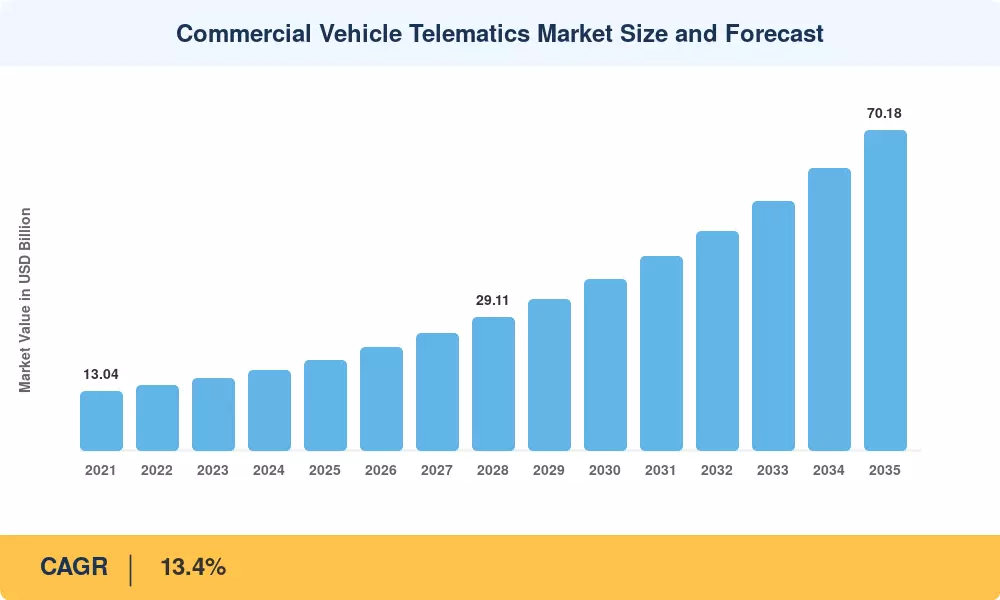
The Commercial Vehicle Telematics Market stood at USD 19.78 Billion in 2025 and is projected to reach USD 22.64 Billion in 2026 before climbing to USD 70.18 Billion by 2035, registering a CAGR of 13.4% across the 2026–2035 forecast window. Two catalysts anchor this trajectory: the U.S. Federal Motor Carrier Safety Administration's broadened electronic logging device mandate — now covering an estimated 4.2 million active commercial vehicles — and the European Union's revised General Safety Regulation requiring advanced driver-assistance telemetry on all new trucks from 2024 onward [2]. Together, these policy instruments have converted telematics from an optional efficiency tool into a compliance necessity, pulling forward adoption curves by an estimated two to three years.
The Commercial Vehicle Telematics Market is currently experiencing a generational technological transition. Cloud-native platforms that integrate cellular connectivity, periphery computing, and machine learning inference are replacing legacy black-box recorders and standalone GPS modules. Daimler Truck and Volvo Group, among other OEMs, have collectively allocated more than USD 1.2 billion to embedded connectivity stacks that are included as standard equipment [3]. The economic model of the sector is reshaped as a result of the transition, which compresses aftermarket hardware margins but unlocks recurring software and data-services revenue.
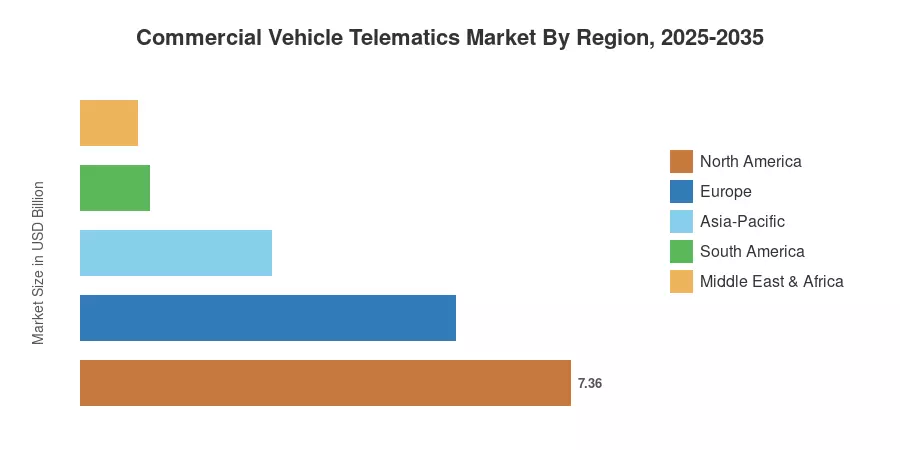
Supported by a high fleet-management software penetration and a mature ELD compliance infrastructure, North America controls approximately 37.2% of the Commercial Vehicle Telematics Market. The Bharat Stage VI emission-linked telematics requirements in India and China's 14th Five-Year Plan's emphasis on intelligent transportation systems are driving the quickest growth in the Asia-Pacific region, with a compound annual growth rate (CAGR) of 14.5% through 2035 [4][5]. Europe retains the second-largest share at approximately 28.5%, anchored by the EU's smart tachograph rollout. As global zero-emission mandates become more stringent, battery-health monitoring will impose additional data requirements on every connected vehicle, ensuring double-digit growth for the forthcoming decade.
Key Report Takeaways
• By Offering
- Solutions accounted for 66.6% of Commercial Vehicle Telematics Market revenue in 2025, reflecting fleet operators' preference for integrated software-hardware bundles over standalone services.
- Services are projected to expand at a 13.9% CAGR through 2035, driven by subscription analytics and managed connectivity packages.
• By Provider Type
- OEM-embedded platforms held 54.2% of the Commercial Vehicle Telematics Market in 2025, benefiting from factory-fit integration partnerships.
• By Vehicle Class
- Heavy and medium commercial vehicles are set to register the highest segment CAGR of 13.9% through 2035, as regulatory compliance and fuel-cost pressure intensify.
• By Region
- North America led the Commercial Vehicle Telematics Market with a 37.2% share in 2025, while Asia-Pacific is climbing at a 14.5% CAGR through 2035.
- Europe contributed 28.5% of global demand, underpinned by smart-tachograph mandates and cross-border interoperability standards.
Market Size and Forecast (2021–2035)
Market Research Future's estimates draw on primary interviews with fleet operators and OEM procurement teams, validated against public regulatory filings, customs shipment data, and published annual reports. Historical figures (2021–2024) reflect actual industry performance; the base year (2025) uses trailing twelve-month actuals; and the forecast period (2026–2035) applies a compound growth model calibrated to regulatory timelines, vehicle production forecasts, and subscription-revenue trends.




 Noah Malgeri
Co-Founder

 Peter Groot koerkamp
Account and Business Manager

 Younghwan Choi
Senior Retail Manager

 Mark Irwin
Management Consultant

 Akif Moroglu
Strategy & Business Development Director

 Guilherme Gomes Martins
Product Management Director

 Joseph Aguayo
Sales Operations & Pricing Manager

 La Terria Dodd
Program Support Specialist

 Rob Kooiker
Group Product Manager HVAC & Fire Protection GMA



