×
Request Free Sample ×

Kindly complete the form below to receive a free sample of this Report

Leading companies partner with us for data-driven Insights

clients tt-cursor
Hero Background

Cloud Telephony Services Market

ID: MRFR/ICT/5885-HCR
100 Pages
Aarti Dhapte
October 2025

Cloud Telephony Services Market Research Report Information By Deployment (Services, Cloud), By Network Type (Voice over Internet Protocol, Public switched telephones), By Application (Conferencing, Customer relationship management, Sales and marketing multilevel VR), By End Users (Retail, IT, Healthcare, Media and entertainment, Government, BFSI) And By Region (North America, Europe, Asia-Pacific, And Rest Of The World) –Market Forecast Till 2035

Share:
Download PDF ×

We do not share your information with anyone. However, we may send you emails based on your report interest from time to time. You may contact us at any time to opt-out.

Cloud Telephony Services Market Infographic
Purchase Options

Cloud Telephony Services Market Summary

As per MRFR analysis, the Cloud Telephony Services Market Size was estimated at 23.2 USD Billion in 2024. The Cloud Telephony Services industry is projected to grow from 25.04 USD Billion in 2025 to 53.67 USD Billion by 2035, exhibiting a compound annual growth rate (CAGR) of 7.92 during the forecast period 2025 - 2035.

Key Market Trends & Highlights

The Cloud Telephony Services Market is experiencing robust growth driven by technological advancements and evolving customer needs.

  • The market witnesses increased adoption of unified communications, particularly in North America, which remains the largest market.
  • There is a pronounced focus on enhancing customer experience, especially within the customer relationship management segment, which is the fastest-growing.
  • Integration of AI and automation is becoming prevalent, with significant implications for service delivery and operational efficiency.
  • Key market drivers include the growing demand for remote work solutions and advancements in technology and infrastructure, which are shaping the landscape.

Market Size & Forecast

2024 Market Size 23.2 (USD Billion)
2035 Market Size 53.67 (USD Billion)
CAGR (2025 - 2035) 7.92%

Major Players

Twilio (US), RingCentral (US), 8x8 (US), Vonage (US), Cisco (US), Nextiva (US), Dialpad (US), Aircall (FR), Freshcaller (IN)

Cloud Telephony Services Market Trends

The Cloud Telephony Services Market is currently experiencing a transformative phase, driven by advancements in technology and changing consumer preferences. Organizations are increasingly adopting cloud-based solutions to enhance communication efficiency and reduce operational costs. This shift appears to be fueled by the need for flexibility and scalability, allowing businesses to adapt to evolving market demands. Furthermore, the integration of artificial intelligence and machine learning into telephony services is likely to enhance customer interactions, providing personalized experiences that were previously unattainable. As companies seek to improve their customer engagement strategies, the Cloud Telephony Services Market is poised for substantial growth. In addition, the rise of remote work and digital collaboration tools has further accelerated the demand for cloud telephony solutions. Businesses are recognizing the importance of seamless communication channels that can operate across various platforms and devices. This trend suggests a potential for increased investment in cloud telephony services, as organizations strive to maintain connectivity and productivity in a rapidly changing environment. Overall, the Cloud Telephony Services Market appears to be on a trajectory of innovation and expansion, with numerous opportunities for service providers and end-users alike.

Increased Adoption of Unified Communications

Organizations are increasingly integrating cloud telephony with unified communications platforms. This trend indicates a desire for streamlined communication tools that enhance collaboration and efficiency. By consolidating various communication channels, businesses can improve workflow and reduce the complexity of managing multiple systems.

Focus on Enhanced Customer Experience

There is a growing emphasis on utilizing cloud telephony to improve customer interactions. Companies are leveraging advanced features such as call analytics and automated responses to provide a more personalized experience. This focus on customer satisfaction suggests that businesses are prioritizing service quality in their communication strategies.

Integration of AI and Automation

The incorporation of artificial intelligence and automation into cloud telephony services is becoming more prevalent. This trend indicates a shift towards smarter communication solutions that can analyze data and optimize interactions. By automating routine tasks, organizations can enhance efficiency and allow human agents to focus on more complex inquiries.

Cloud Telephony Services Market Drivers

Cost Efficiency and Scalability

Cost efficiency and scalability are pivotal drivers in the Cloud Telephony Services Market. Organizations are increasingly seeking solutions that reduce operational costs while providing the flexibility to scale as needed. Cloud telephony services eliminate the need for extensive hardware investments and maintenance, allowing businesses to allocate resources more effectively. Recent studies indicate that companies can save up to 40% on communication costs by transitioning to cloud-based systems. This financial advantage, coupled with the ability to easily scale services according to demand, makes cloud telephony an attractive option for businesses of all sizes. As more organizations recognize the potential for cost savings and operational efficiency, the demand for cloud telephony solutions is expected to rise, further propelling the growth of the market.

Rising Focus on Customer Engagement

In the Cloud Telephony Services Market, there is an increasing emphasis on customer engagement strategies. Businesses are recognizing the importance of effective communication in enhancing customer satisfaction and loyalty. The integration of cloud telephony solutions allows organizations to streamline their customer interactions through features like automated responses and personalized communication. According to recent data, companies utilizing cloud telephony services have reported a 30% increase in customer retention rates. This trend underscores the necessity for businesses to invest in advanced communication technologies that not only improve operational efficiency but also foster stronger relationships with customers. As competition intensifies across various sectors, the ability to engage customers effectively is becoming a critical differentiator, driving the demand for cloud telephony solutions.

Regulatory Compliance and Data Security

Regulatory compliance and data security are increasingly becoming focal points in the Cloud Telephony Services Market. As businesses navigate complex regulatory landscapes, the need for secure communication solutions is paramount. Cloud telephony providers are enhancing their offerings to ensure compliance with data protection regulations, such as GDPR and HIPAA. This focus on security is crucial, as organizations face growing concerns regarding data breaches and privacy issues. The market is witnessing a shift towards solutions that not only provide robust communication capabilities but also prioritize data security. Companies are likely to invest in cloud telephony services that offer advanced encryption and secure data storage options. This trend indicates a broader recognition of the importance of safeguarding sensitive information, which is essential for maintaining customer trust and meeting regulatory requirements.

Growing Demand for Remote Work Solutions

The Cloud Telephony Services Market is experiencing a notable surge in demand for remote work solutions. As organizations increasingly adopt flexible work arrangements, the need for reliable communication tools has intensified. This shift is reflected in the projected growth of the cloud telephony market, which is expected to reach USD 50 billion by 2026. Companies are seeking solutions that facilitate seamless communication among remote teams, thereby enhancing productivity and collaboration. Cloud telephony services provide features such as call forwarding, voicemail, and conferencing, which are essential for remote operations. This trend indicates a significant transformation in workplace dynamics, where traditional telephony systems are being replaced by cloud-based solutions that offer scalability and flexibility. Consequently, the Cloud Telephony Services Market is poised for continued expansion as businesses adapt to the evolving landscape of work.

Advancements in Technology and Infrastructure

The Cloud Telephony Services Market is significantly influenced by advancements in technology and infrastructure. The proliferation of high-speed internet and the increasing availability of cloud computing resources have created a conducive environment for the adoption of cloud telephony solutions. Enhanced network capabilities enable businesses to leverage sophisticated telephony features without the constraints of traditional systems. As a result, the market is projected to grow at a compound annual growth rate of 15% over the next five years. This technological evolution not only facilitates better communication but also allows for the integration of advanced analytics and reporting tools, which can provide valuable insights into customer interactions. Consequently, organizations are increasingly turning to cloud telephony services to optimize their communication strategies and improve overall performance.

Market Segment Insights

By Deployment: Services (Largest) vs. Cloud (Fastest-Growing)

In the Cloud Telephony Services Market, the distribution of market share among the deployment options highlights the dominance of Services. Services have established a substantial foothold, reflecting the established demand for reliable communication solutions in enterprises. Meanwhile, Cloud has rapidly gained traction, appealing particularly to small and medium-sized enterprises seeking scalable and cost-effective telephony solutions. This duality showcases the varying preferences and needs of businesses in a digital-first environment. The growth trends within this sector are currently being driven by the increasing demand for flexibility and remote capabilities in business communications. As more organizations transition to cloud-based solutions, the Cloud deployment segment stands out as the fastest-growing. This shift is further propelled by technological advancements and the rising need for integrated solutions that enhance operational efficiency and streamline communications across geographically dispersed teams.

Services: On-Premise (Dominant) vs. Cloud-Based (Emerging)

In the context of the Cloud Telephony Services Market, On-Premise services have emerged as the dominant segment, providing organizations with greater control over their communication infrastructures. They are particularly favored by larger enterprises with specific compliance and security requirements, allowing for a more tailored approach to telephony management. Conversely, Cloud-Based services are categorized as emerging due to their rapid adoption among organizations that prioritize flexibility and cost savings. With an increasingly competitive landscape, Cloud-Based services are characterized by their scalability, ease of implementation, and the ability to quickly adapt to changing business needs, making them a compelling choice for new-age businesses.

By Application: Conferencing (Largest) vs. Customer Relationship Management (Fastest-Growing)

In the Cloud Telephony Services Market, the application segment is primarily dominated by conferencing solutions, which hold the largest share due to the increasing adoption of remote collaboration tools among businesses. Customer Relationship Management (CRM) solutions closely follow, showing significant growth as companies prioritize customer engagement and support through telephony integrations. Sales & Marketing applications, while important, constitute a smaller portion of the market compared to conferencing and CRM, reflecting their more specialized use cases.

Conferencing (Dominant) vs. Customer Relationship Management (Emerging)

Conferencing solutions stand out as the dominant force in the application segment of cloud telephony services, providing robust platforms for virtual meetings and collaboration. These solutions enhance productivity by facilitating seamless communication, making them essential for remote teams. On the other hand, Customer Relationship Management applications are emerging rapidly, driven by the growing need for businesses to enhance customer interactions and streamline communication processes. The integration of telephony in CRM systems offers significant advantages, such as automated call logging and improved customer insights. As both segments evolve, they reflect the broader trends of digital transformation and the push towards enhancing customer experiences.

By End Users: Retail (Largest) vs. Healthcare (Fastest-Growing)

In the Cloud Telephony Services Market, the end-user segment is characterized by a diverse array of industries leveraging telephony solutions to enhance communication and operational efficiency. Retail holds the largest share due to the increasing adoption of cloud-based systems for managing customer interactions, sales processes, and backend operations. This is followed by sectors like IT, BFSI, and Media & Entertainment, each steadily integrating cloud telephony to improve service delivery and customer engagement.

Retail: Largest vs. Healthcare: Fastest-Growing

The Retail sector stands out as the dominant end user in the Cloud Telephony Services Market, primarily due to its continuous demand for efficient communication systems that connect customers with services and improve overall operational workflow. Retailers increasingly rely on integrated solutions to manage sales inquiries and customer service interactions seamlessly. Conversely, Healthcare represents the fastest-growing segment, propelled by the urgent need for efficient patient communication, appointment scheduling, and emergency services management. The surge in telehealth and remote patient monitoring further drives healthcare providers to adopt cloud telephony as a vital tool for enhancing patient engagement and operational efficiency.

By Network Type: Voice over Internet Protocol (Largest) vs. Public Switched Telephones (Fastest-Growing)

In the Cloud Telephony Services Market, the distribution of market share reveals a clear dominance of Voice over Internet Protocol (VoIP), which has established itself as the leading segment due to its cost-effectiveness and advanced features. This technology facilitates seamless communication over the internet, appealing to a wide range of business applications. On the other hand, Public Switched Telephones (PSTN) continue to hold a significant position, although they are increasingly being overshadowed by modern cloud-based solutions.

Network Type: VoIP (Dominant) vs. PSTN (Emerging)

Voice over Internet Protocol (VoIP) is the dominant segment in the Cloud Telephony Services Market, driven by its capability to offer versatile communication solutions, integration with various digital applications, and scalability that suits different business sizes. VoIP's flexibility allows it to cater to both large enterprises and small businesses, enhancing its appeal. In contrast, Public Switched Telephones (PSTN), while still relevant, are emerging as a transitional technology, gradually being replaced by VoIP due to its higher reliability and additional functionalities. PSTN remains critical in specific sectors, especially where legacy infrastructure is prevalent, but its growth is hampered by the rapid adoption of cloud-based telephony solutions.

Get more detailed insights about Cloud Telephony Services Market

Regional Insights

North America : Leading Innovation and Adoption

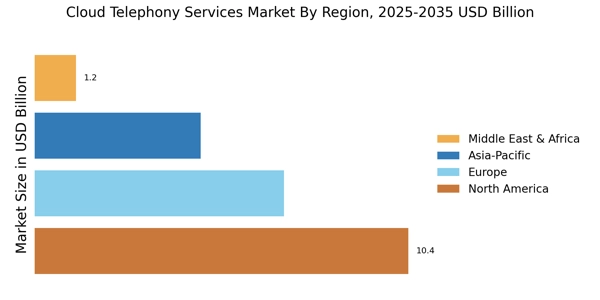
North America is the largest market for cloud telephony services, holding approximately 45% of the global market share. The region's growth is driven by the increasing adoption of cloud-based solutions, advancements in technology, and a strong regulatory framework that supports digital transformation. The demand for remote communication solutions has surged, particularly post-pandemic, leading to a robust market environment. The United States is the primary contributor, with key players like Twilio, RingCentral, and Cisco leading the charge. The competitive landscape is characterized by rapid innovation and a focus on customer-centric solutions. Canada also plays a significant role, contributing to the market with its growing tech ecosystem. The presence of major companies ensures a dynamic and competitive market.

Europe : Emerging Market with Growth Potential

Europe is witnessing significant growth in the cloud telephony services market, accounting for about 30% of the global share. The region's growth is fueled by increasing digitalization, regulatory support for cloud adoption, and a shift towards remote work solutions. Countries like Germany and the UK are leading this transformation, with favorable regulations promoting cloud technologies and enhancing market dynamics. Germany stands out as a key player, with a strong presence of local and international companies. The competitive landscape is vibrant, featuring players like Aircall and other emerging startups. The European market is characterized by a focus on data privacy and compliance, which drives innovation in service offerings. The region is poised for further growth as businesses increasingly recognize the value of cloud telephony solutions.

Asia-Pacific : Rapid Growth and Adoption

Asia-Pacific is rapidly emerging as a significant player in the cloud telephony services market, holding approximately 20% of the global market share. The region's growth is driven by increasing internet penetration, a surge in mobile device usage, and a growing demand for cost-effective communication solutions. Countries like India and Australia are at the forefront, with supportive government policies fostering digital transformation and cloud adoption. India, in particular, is witnessing a boom in cloud telephony, with local players like Freshcaller gaining traction. The competitive landscape is diverse, featuring both established companies and startups. The region's unique challenges, such as varying regulatory environments, are being addressed through innovative solutions, making it a dynamic market for cloud services.

Middle East and Africa : Emerging Market with Unique Challenges

The Middle East and Africa (MEA) region is gradually emerging in the cloud telephony services market, currently holding about 5% of the global share. The growth is driven by increasing mobile connectivity, a young population, and a rising demand for digital communication solutions. Countries like South Africa and the UAE are leading the charge, with government initiatives promoting cloud adoption and digital infrastructure development. South Africa is a key player, with a growing number of local providers entering the market. The competitive landscape is evolving, with both regional and international players vying for market share. However, challenges such as regulatory hurdles and varying levels of infrastructure development remain. Despite these challenges, the region shows promising potential for future growth in cloud telephony services.

Cloud Telephony Services Market Regional Image

Key Players and Competitive Insights

The Cloud Telephony Services Market is currently characterized by a dynamic competitive landscape, driven by rapid technological advancements and an increasing demand for flexible communication solutions. Major players such as Twilio (US), RingCentral (US), and Cisco (US) are strategically positioning themselves through innovation and partnerships. Twilio (US) focuses on enhancing its API offerings, enabling businesses to integrate communication capabilities seamlessly. RingCentral (US) emphasizes its all-in-one communication platform, which combines voice, video, and messaging, catering to the growing trend of remote work. Cisco (US), leveraging its extensive enterprise experience, is enhancing its cloud solutions to support hybrid work environments, thereby shaping a competitive environment that prioritizes integrated solutions and customer-centric approaches.

The market structure appears moderately fragmented, with numerous players vying for market share. Key business tactics include localizing services to meet regional demands and optimizing supply chains to enhance service delivery. The collective influence of these major players fosters a competitive atmosphere where innovation and customer experience are paramount, compelling smaller entrants to adapt or specialize in niche markets.

In August 2025, Twilio (US) announced a strategic partnership with a leading CRM provider to enhance its customer engagement capabilities. This collaboration is likely to bolster Twilio's position in the market by integrating advanced analytics and AI-driven insights into its communication solutions, thereby providing clients with more personalized customer interactions. Such moves indicate a trend towards deeper integration of communication tools within existing business frameworks.

In September 2025, RingCentral (US) launched a new AI-driven analytics feature within its platform, aimed at optimizing call center operations. This development not only enhances operational efficiency but also positions RingCentral as a leader in leveraging AI to improve customer service outcomes. The introduction of such features reflects a broader industry trend towards automation and data-driven decision-making, which could redefine customer engagement strategies.

In July 2025, Cisco (US) expanded its cloud telephony services into emerging markets, particularly in Southeast Asia. This expansion is significant as it allows Cisco to tap into new customer bases and diversify its revenue streams. By focusing on regions with growing digital infrastructure, Cisco is likely to enhance its competitive edge and establish a stronger foothold in the global market.

As of October 2025, the competitive trends in the Cloud Telephony Services Market are increasingly defined by digitalization, AI integration, and sustainability initiatives. Strategic alliances are becoming more prevalent, as companies recognize the value of collaborative innovation in enhancing service offerings. Looking ahead, competitive differentiation is expected to evolve from traditional price-based competition to a focus on technological innovation, customer experience, and supply chain reliability, suggesting a transformative shift in how companies approach market positioning.

Key Companies in the Cloud Telephony Services Market market include

Industry Developments

August 2023 saw Dialpad Inc. build on its global efforts by partnering with MIA Distribution, a leading Australian Unified Communications as a Service (UCaaS) provider. By so doing, the company hopes to extend the coverage of its TrueCaaS products across Australia. It is expected that this will further expand Dialpad’s presence in the market and address the growing need for integrated cloud communication solutions in this part of the world.

In the same vein, Cisco Systems Inc. signed a contract with AT&T in June 2023 aimed at enhancing connectivity options for businesses with mobile workforce first orientation. The collaboration supports companies’ increasing adaptation towards mobile and remote work settings ensuring quality connection across these different environments.

Gupshup, a leading conversational engagement firm, announced its partnership with Truecaller—an identity verification platform to develop advanced enterprise identity solutions in February 2022. With this strategic alliance, they aim to provide brands with secure voice ecosystems that foster better customer interaction and efficient calling experiences throughout India.

During March 2022, Dialpad partnered with MIA Distribution Ltd to make sure that they made their TrueCaaS solution all over Australia. In addition, it entered into an agreement with Google while planning to list its UC-CC offering on Google Cloud Marketplace.

Tata Tele Business Services launched a business-tailored cloud-based communication system emphasizing hybrid connectivity to support seamless interactions between employees and clients in December 2020. It integrates voice, video chat and conferencing into one user-friendly platform that can be scaled up or down depending on the size of the organization using it while making it highly secure.

Also, during June 2020, Microsoft Teams was advanced by adding an enterprise-class cloud telephony solution from 8x8 Inc. This adds direct routing for PSTN calls into Microsoft Teams, advanced telephony features like call transfer and call queues as well as global reach for multi-country deployments. Both entities target businesses desiring enhanced communication for remote working by offering an integrated, scalable and cost-effective platform that streamlines communication and increases efficiency.

Future Outlook

Cloud Telephony Services Market Future Outlook

The Cloud Telephony Services Market is projected to grow at a 7.92% CAGR from 2024 to 2035, driven by increasing demand for remote communication and enhanced customer engagement solutions.

New opportunities lie in:

  • Integration of AI-driven analytics for customer insights
  • Expansion of VoIP services in emerging markets
  • Development of tailored solutions for vertical-specific industries

By 2035, the market is expected to be robust, reflecting substantial growth and innovation.

Market Segmentation

Cloud Telephony Services Market End Users Outlook

  • Retail
  • IT
  • Healthcare
  • Media & Entertainment
  • Government
  • BFSI

Cloud Telephony Services Market Deployment Outlook

  • Services
  • Cloud

Cloud Telephony Services Market Application Outlook

  • Conferencing
  • Customer Relationship Management
  • Sales & Marketing

Cloud Telephony Services Market Network Type Outlook

  • Voice over Internet Protocol
  • Public Switched Telephones

Report Scope

MARKET SIZE 202423.2(USD Billion)
MARKET SIZE 202525.04(USD Billion)
MARKET SIZE 203553.67(USD Billion)
COMPOUND ANNUAL GROWTH RATE (CAGR)7.92% (2024 - 2035)
REPORT COVERAGERevenue Forecast, Competitive Landscape, Growth Factors, and Trends
BASE YEAR2024
Market Forecast Period2025 - 2035
Historical Data2019 - 2024
Market Forecast UnitsUSD Billion
Key Companies ProfiledMarket analysis in progress
Segments CoveredMarket segmentation analysis in progress
Key Market OpportunitiesIntegration of artificial intelligence enhances customer engagement in the Cloud Telephony Services Market.
Key Market DynamicsRising demand for remote communication solutions drives innovation and competition in the Cloud Telephony Services Market.
Countries CoveredNorth America, Europe, APAC, South America, MEA

Market Highlights

Author
Aarti Dhapte
Team Lead - Research

She holds an experience of about 6+ years in Market Research and Business Consulting, working under the spectrum of Information Communication Technology, Telecommunications and Semiconductor domains. Aarti conceptualizes and implements a scalable business strategy and provides strategic leadership to the clients. Her expertise lies in market estimation, competitive intelligence, pipeline analysis, customer assessment, etc.

Leave a Comment

FAQs

What is the current valuation of the Cloud Telephony Services Market?

The Cloud Telephony Services Market was valued at 23.2 USD Billion in 2024.

What is the projected market size for the Cloud Telephony Services Market by 2035?

The market is projected to reach 53.67 USD Billion by 2035.

What is the expected CAGR for the Cloud Telephony Services Market during the forecast period?

The expected CAGR for the Cloud Telephony Services Market from 2025 to 2035 is 7.92%.

Which companies are considered key players in the Cloud Telephony Services Market?

Key players include Twilio, RingCentral, 8x8, Vonage, Cisco, Nextiva, Dialpad, Aircall, and Freshcaller.

What are the main segments of the Cloud Telephony Services Market?

The main segments include Deployment, Application, End Users, and Network Type.

How much is the Deployment segment expected to grow by 2035?

The Deployment segment is projected to grow from 15.2 USD Billion in 2024 to 35.67 USD Billion by 2035.

What is the expected growth for the Customer Relationship Management application segment?

The Customer Relationship Management application segment is anticipated to increase from 8.0 USD Billion in 2024 to 20.0 USD Billion by 2035.

Which end-user segment is projected to see the highest growth?

The IT end-user segment is expected to grow from 5.0 USD Billion in 2024 to 12.0 USD Billion by 2035.

Download Free Sample

Kindly complete the form below to receive a free sample of this Report

Compare Licence

×
Features License Type
Single User Multiuser License Enterprise User
Price $4,950 $5,950 $7,250
Maximum User Access Limit 1 User Upto 10 Users Unrestricted Access Throughout the Organization
Free Customization
Direct Access to Analyst
Deliverable Format
Platform Access
Discount on Next Purchase 10% 15% 15%
Printable Versions