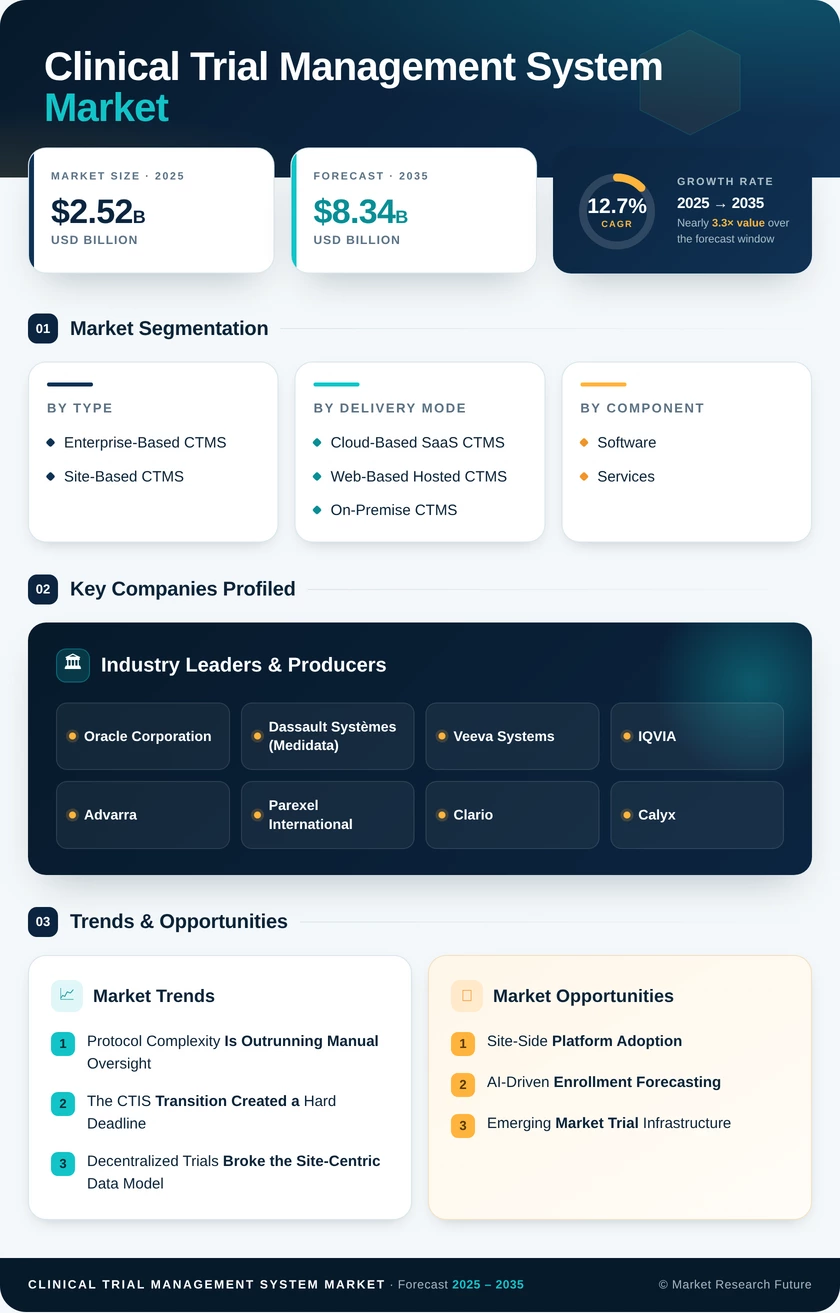
Segmentation Quick Reference
| Dimension | Sub-Segments | Dominant Segment | Fastest Growing Segment |
| By System Type | Enterprise-Based CTMS; Site-Based CTMS | Enterprise-Based CTMS | Site-Based CTMS |
| By Delivery Mode | Web-Based Hosted CTMS; Cloud-Based SaaS CTMS; On-Premise CTMS | Cloud-Based SaaS CTMS | Cloud-Based SaaS CTMS |
| By Component | Software; Services | Software | Services |
| By End User | Pharmaceutical & Biotechnology Companies; Contract Research Organizations; Medical Device Manufacturers; Academic & Research Institutes | Pharmaceutical & Biotechnology Companies | Contract Research Organizations |
| By Geography | North America; Europe; Asia-Pacific; South America; Middle East & Africa | North America | Asia-Pacific |
Market Segmentation Overview
By System Type
| Sub-Segment | Key Trend |
| Enterprise-Based CTMS | Consolidation of multi-study portfolios into a single governance layer with automated sponsor reporting |
| Site-Based CTMS | Independent site networks buying their own financial and enrollment tooling rather than relying on sponsor portals |
Enterprise platforms hold the revenue, but the interesting movement is at the site. As site networks consolidate into forty- and fifty-location operators, their purchasing behaviour starts to resemble a small CRO's — and their platform preference increasingly influences which sponsors they will work with.
By Delivery Mode
| Sub-Segment | Key Trend |
| Web-Based Hosted CTMS | Single-tenant hosted instances retained where sponsors want isolation without on-site infrastructure |
| Cloud-Based SaaS CTMS | Validated multi-tenant environments are now the default for new deployments across all sponsor sizes |
| On-Premise CTMS | Persisting in heavily customized estates and jurisdictions with strict data localization rules |
Deployment choice determines validation economics more than any other variable. Multi-tenant cloud shifts qualification effort onto the vendor and shortens implementation by roughly two-thirds, which is why it dominates greenfield selection even among sponsors historically committed to on-premise control.
By Component
| Sub-Segment | Key Trend |
| Software | Modular expansion — payments, monitoring, and forecasting sold as incremental licences on a core platform |
| Services | Recurring validation, migration, and managed hosting engagements that outlast initial implementation |
Services are frequently mispriced in buyer business cases. Requalification obligations recur with every significant vendor release, and configuration work never truly ends because protocols evolve — so the services line behaves like a subscription even when it is contracted as a project.
By End User
| Sub-Segment | Key Trend |
| Pharmaceutical & Biotechnology Companies | Portfolio-level oversight and inspection readiness driving suite standardization |
| Contract Research Organizations | Multi-tenant configurability required to serve dozens of sponsors under different SOPs |
| Medical Device Manufacturers | EU MDR post-market clinical follow-up creating sustained evidence-generation workload |
| Academic & Research Institutes | Grant administration and compliance reporting shaping feature priorities distinct from industry sponsors |
Buyer requirements diverge sharply across these four groups. A CRO needs tenant isolation and sponsor-specific workflow templates; an academic centre needs grant accounting and effort tracking. Vendors that treat all four as one segment consistently lose the two smaller ones.


 Noah Malgeri
Co-Founder
Noah Malgeri
Co-Founder

 Peter Groot koerkamp
Account and Business Manager
Peter Groot koerkamp
Account and Business Manager

 Younghwan Choi
Senior Retail Manager
Younghwan Choi
Senior Retail Manager

 Mark Irwin
Management Consultant
Mark Irwin
Management Consultant

 Akif Moroglu
Strategy & Business Development Director
Akif Moroglu
Strategy & Business Development Director

 Guilherme Gomes Martins
Product Management Director
Guilherme Gomes Martins
Product Management Director

 Joseph Aguayo
Sales Operations & Pricing Manager
Joseph Aguayo
Sales Operations & Pricing Manager

 La Terria Dodd
Program Support Specialist
La Terria Dodd
Program Support Specialist

 Rob Kooiker
Group Product Manager HVAC & Fire Protection GMA
Rob Kooiker
Group Product Manager HVAC & Fire Protection GMA