
Request Free Sample ×

Kindly complete the form below to receive a free sample of this Report

* Please use a valid business email

Leading companies partner with us for data-driven Insights

clients tt-cursor
Hero Background
English
Chinese
French
Japanese
Korean
German
Spanish

Casino Market Analysis

ID: MRFR/ICT/8628-CR
80 Pages
Ankit Gupta
July 2020

Casino Market Research Report Information By Type (Land-Based Casino Gaming and Online Casino Gaming), By End User (Gambling Enthusiasts, Dabblers, Lottery Loyalists, and Unengaged Audience), And By Region (North America, Europe, Asia-Pacific, And Rest Of The World) –Market Forecast Till 2035.

Share:
Download PDF ×

We do not share your information with anyone. However, we may send you emails based on your report interest from time to time. You may contact us at any time to opt-out.

Casino Market Infographic
Purchase Options

Market Analysis

In-depth Analysis of Casino Market Industry Landscape

The independent casino market is seeing a number of noteworthy developments that are reshaping this ever-changing sector. The rise in popularity of mobile and internet casinos that run separately from conventional brick-and-mortar businesses is one notable development. Players are drawn to internet platforms because of its accessibility and ease as technology develops. Independent online casinos have grown because of the popularity of mobile gaming, which has made it possible for players to enjoy their favorite casino games whether on the road or in the comfort of their homes. The expansion of gaming alternatives is another significant development in the independent casino industry. Although classic casino games like poker, blackjack, and slots continue to be well-liked, there is an increasing market for unique and specialized games. In order to appeal to a wide range of patrons, independent casinos are launching distinctive and niche gaming experiences. These comprise skill-based games, live dealer games, and themed slots that provide players with a more personalized and interesting gaming experience. In the independent casino business, the fusion of blockchain technology and cryptocurrencies is becoming a major trend. As a payment option, some operators are accepting digital currencies, giving players an option to conventional banking procedures. Blockchain technology is also being utilized to improve gaming operations' security, fairness, and transparency, solving issues with integrity and confidence in the sector. In the independent casino business, socializing within internet casinos is becoming more and more popular. Social elements are being added to platforms so that users may communicate with one another while playing. This social component replicates the spirit of community found in classic brick-and-mortar casinos, adding a dimension of fun and participation. Multiplayer games, live chat, and online communities are some of the features that make gaming more socially engaged and engaging.

In an attempt to tap into unexplored markets and satisfy the need for gaming experiences in places where access to well-known casino sites is limited, casinos have been expanding into new states and regions. The US casino sector is experiencing shifting demand due to changes in consumer behavior and technological improvements. People may now enjoy casino experiences from the comfort of their homes or while they're on the road thanks to the growth of online and mobile casinos. The ease of use provided by digital platforms appeals to a certain demographic looking for accessible and adaptable gaming alternatives, which has an impact on the demand landscape as a whole. The demand for casino services is influenced by demographic characteristics such as age, gender, and cultural background. It's possible for different demographic groups to have different tastes in gaming, entertainment, and overall casino experiences. Casinos realize how important it is to comprehend and satisfy the varied needs of their target audience, which is why they frequently customize their offers to appeal to particular groups. The level of competition in the US casino industry affects demand as well. Customers have options because there are several casinos, each with special features and services.

A few things that set casinos apart from one another include the games they provide, the incentives they offer for playing, the entertainment they provide, and the general atmosphere of the places they operate. As customers look for experiences that fit their interests, the diversity and caliber of offers add to the total demand. The demand for the US casino sector is influenced by legislative actions and regulatory frameworks. The accessibility and total demand of the sector can be influenced by the federal and state legalization or prohibition of gaming. Regulations changing can affect the demand environment by creating new opportunities, such as the legalization of internet gambling in some states. In summary, a variety of factors, including those related to culture, economy, geography, technology, demography, competition, and regulations, affect the demand for the US casino industry. Successful operators will be those that can utilize technology improvements, adjust to shifting customer tastes, and successfully negotiate the ever-changing regulatory framework as the sector continues to change. In this dynamic and always shifting industry, casinos must comprehend demand dynamics in order to stay competitive and satisfy the wide range of demands of their customers.


Author
Author Profile
Ankit Gupta
Team Lead - Research

Ankit Gupta is a seasoned market intelligence and strategic research professional with over six plus years of experience in the ICT and Semiconductor industries. With academic roots in Telecom, Marketing, and Electronics, he blends technical insight with business strategy. Ankit has led 200+ projects, including work for Fortune 500 clients like Microsoft and Rio Tinto, covering market sizing, tech forecasting, and go-to-market strategies. Known for bridging engineering and enterprise decision-making, his insights support growth, innovation, and investment planning across diverse technology markets.

Leave a Comment

FAQs

What is the current valuation of the Casino Market in 2025?

<p>The Casino Market valuation stands at 309.54 USD Billion in 2024, and it is projected to grow significantly.</p>

What is the expected CAGR for the Casino Market from 2025 to 2035?

<p>The expected CAGR for the Casino Market during the forecast period 2025 - 2035 is 6.48%.</p>

Which companies are the key players in the Casino Market?

<p>Key players in the Casino Market include Las Vegas Sands, MGM Resorts International, Caesars Entertainment, and Wynn Resorts.</p>

What are the projected valuations for the Casino Market by 2035?

<p>The Casino Market is projected to reach a valuation of 617.67 USD Billion by 2035.</p>

How does the performance of land-based casino gaming compare to online casino gaming?

<p>In 2024, land-based casino gaming was valued at 400.0 USD Billion, while online casino gaming was valued at 217.67 USD Billion.</p>

What are the different end-user segments in the Casino Market?

<p>The Casino Market includes end-user segments such as Gambling Enthusiasts, Dabblers, Lottery Loyalists, and Unengaged Audiences.</p>

What was the valuation of Gambling Enthusiasts in 2024?

In 2024, the valuation of Gambling Enthusiasts was 123.81 USD Billion.

What is the projected growth for Dabblers in the Casino Market by 2035?

Dabblers are expected to grow from 61.9 USD Billion in 2024 to 123.76 USD Billion by 2035.

How do the valuations of Lottery Loyalists and Unengaged Audiences compare?

Both Lottery Loyalists and Unengaged Audiences had a valuation of 61.9 USD Billion in 2024, indicating similar market interest.

What trends are anticipated in the Casino Market as it approaches 2035?

The Casino Market is likely to experience robust growth, driven by increasing engagement from various user segments and technological advancements.

Market Summary

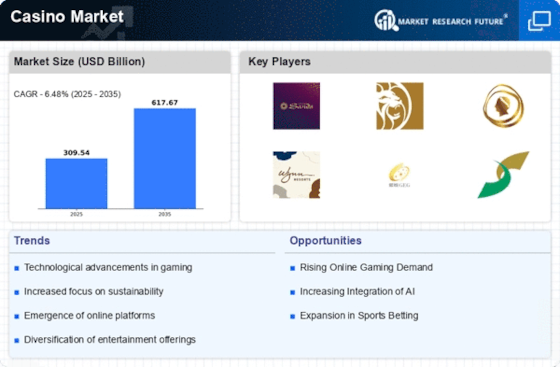
As per Market Research Future analysis, the Casino Market Size was estimated at 309.54 USD Billion in 2024. The Casino industry is projected to grow from 329.6 USD Billion in 2025 to 617.67 USD Billion by 2035, exhibiting a compound annual growth rate (CAGR) of 6.48% during the forecast period 2025 - 2035

Key Market Trends & Highlights

The Casino Market is currently experiencing a dynamic shift driven by technological advancements and evolving consumer preferences.

  • North America remains the largest market for casino gaming, showcasing robust revenue generation. Asia-Pacific is emerging as the fastest-growing region, fueled by increasing disposable incomes and urbanization. Land-based casino gaming continues to dominate the market, while online casino gaming is rapidly gaining traction among younger demographics. Technological advancements and changing consumer preferences are key drivers propelling the growth of both online and land-based segments.

Market Size & Forecast

2024 Market Size 309.54 (USD Billion)
2035 Market Size 617.67 (USD Billion)
CAGR (2025 - 2035) 6.48%
Largest Regional Market Share in 2024 Asia Pacific

Major Players

Las Vegas Sands (US), MGM Resorts International (US), Caesars Entertainment (US), Wynn Resorts (US), Galaxy Entertainment Group (HK), SJM Holdings (HK), Melco Resorts and Entertainment (HK), Boyd Gaming (US), Hard Rock International (US)

Market Trends

The Casino Market is currently experiencing a dynamic evolution, driven by various factors that shape consumer preferences and technological advancements. The integration of digital platforms has transformed traditional gaming experiences, allowing for greater accessibility and engagement. To ensure long-term stability, casino affiliate marketing software in 2026 prioritizes server-to-server tracking and first-party identity management to combat the phase-out of traditional third-party cookies. This shift appears to be fostering a more diverse audience, as younger generations increasingly seek entertainment options that blend gaming with social interaction.

Recent gambling statistics indicate rising participation across both land-based and online casino platforms, driven by increased digital adoption and regulatory support. 

Furthermore, the rise of mobile gaming applications seems to be redefining how individuals participate in casino activities, making it more convenient and appealing to a broader demographic. In addition to technological influences, regulatory changes across different regions are likely to impact the Casino Market significantly. As governments reassess their stances on gambling, new opportunities may arise for expansion and innovation. This evolving landscape suggests that operators must remain agile and responsive to both consumer demands and regulatory frameworks. Overall, the Casino Market appears poised for continued growth, with a focus on enhancing user experiences and adapting to emerging trends.

The growth of the casino sector continues to contribute significantly to overall gaming industry revenue, supported by tourism, digital platforms, and evolving consumer preferences. The rising adoption of blockchain-based platforms is gradually increasing the crypto casino market share, particularly among tech-savvy and younger demographics. The biggest gambling cities in the world, including Las Vegas, Macau, and Singapore, remain central to global casino revenue generation. Despite digital disruption, data suggests that the answer to is casino still popular remains affirmative, supported by steady revenue growth and rising online participation.

Digital Transformation

The Casino Market is witnessing a profound shift towards digital platforms, which are reshaping how consumers engage with gaming. Online casinos and mobile applications are becoming increasingly popular, offering convenience and a wider array of gaming options. This trend indicates a growing preference for accessible entertainment that can be enjoyed from anywhere. Digital customer acquisition strategies, including affiliate marketing casino programs, are increasingly adopted by online operators to expand player reach. Online operators are leveraging casino affiliate marketing software to track player acquisition, optimize campaigns, and improve marketing ROI.

Growth in the crypto casino market share is being further fueled by the integration of decentralized finance (DeFi) features like liquidity staking and native token rewards.

Regulatory Evolution

Changes in regulations across various jurisdictions are influencing the Casino Market landscape. As governments reconsider their policies on gambling, new opportunities for market expansion may emerge. This evolving regulatory environment suggests that operators must navigate complex legal frameworks while seeking innovative solutions. Digital customer acquisition strategies, including affiliate marketing casino programs, are increasingly adopted by online operators to expand player reach. Online operators are leveraging casino affiliate marketing software to track player acquisition, optimize campaigns, and improve marketing ROI.

Social Gaming Integration

The integration of social elements into gaming experiences is becoming more prevalent within the Casino Market. Platforms that facilitate social interaction among players are likely to attract a younger audience, as they seek not only gaming but also community engagement.

Additionally, travelers often define the best casino in the world by the quality of its non-gaming amenities, such as Michelin-starred dining and exclusive high-roller retreats. The affiliate marketing casino landscape also is shifting toward high-intent "live" traffic, with streamers and social commerce creators becoming the primary drivers for new player acquisitions.

This trend highlights the importance of creating immersive experiences that resonate with modern consumers.

Casino Market Market Drivers

Economic Factors

Economic factors play a crucial role in shaping the Casino Market, as disposable income levels directly influence consumer spending on gaming activities. In periods of economic growth, individuals are more likely to engage in leisure activities, including casino gaming. Recent economic indicators suggest a steady increase in consumer confidence, which may lead to higher expenditures in the Casino Market. Additionally, tourism plays a vital role, as many casinos are located in popular travel destinations. A rise in international tourism can significantly boost casino revenues, as visitors often seek entertainment options during their travels. Therefore, the Casino Market remains sensitive to broader economic trends and consumer behavior.

Emerging Markets

Emerging markets present a promising opportunity for the Casino Market, as several regions are beginning to embrace legalized gambling. Countries in Asia and Latin America are witnessing a surge in interest, with governments exploring the potential economic benefits of casino establishments. For example, recent developments in markets such as Japan and Brazil indicate a growing acceptance of casino gaming, which could lead to substantial investments in the sector. This trend suggests that the Casino Market may experience significant growth in these regions, attracting both domestic and international operators. As these markets mature, they are likely to contribute to the overall expansion and diversification of the Casino Market.

Regulatory Changes

The Casino Market is significantly influenced by regulatory changes that vary across different jurisdictions. Governments are increasingly recognizing the potential economic benefits of legalized gambling, leading to the expansion of regulated markets. For instance, recent legislative changes in several regions have resulted in the opening of new casinos and the expansion of online gaming options. This regulatory evolution is expected to generate substantial tax revenues, which can be reinvested into local economies. Moreover, as regulations become more favorable, the Casino Market may witness an influx of new operators, enhancing competition and potentially leading to improved services and offerings for consumers.

Technological Advancements

The Casino Market is experiencing a notable transformation due to rapid technological advancements. Innovations such as virtual reality and augmented reality are enhancing the gaming experience, making it more immersive and engaging. Furthermore, the integration of artificial intelligence is streamlining operations and personalizing customer interactions. According to recent data, the adoption of mobile gaming applications has surged, with mobile gaming accounting for approximately 50% of the total gaming revenue. This shift indicates a growing preference for convenience and accessibility among players. As technology continues to evolve, the Casino Market is likely to see further enhancements in game design and player engagement, potentially attracting a broader audience.

Changing Consumer Preferences

Consumer preferences are shifting significantly within the Casino Market, driven by a younger demographic that favors interactive and social gaming experiences. This demographic is increasingly drawn to online platforms that offer a blend of traditional casino games and innovative formats. Data suggests that online casinos have seen a substantial increase in participation, with a reported growth rate of around 15% annually. This trend indicates a potential decline in traditional brick-and-mortar establishments as players seek more engaging and flexible gaming options. The Casino Market must adapt to these changing preferences to remain competitive, potentially leading to the development of new gaming formats and experiences that cater to this evolving audience.

Market Segment Insights

By Type: Land-Based Casino Gaming (Largest) vs. Online Casino Gaming (Fastest-Growing)

<p>In the Casino Market, the distribution of market share between Land-Based Casino Gaming and Online Casino Gaming is marked by a clear distinction in consumer preference. Land-Based Casino Gaming holds a significant share of the market, benefiting from traditional gaming experiences and social interactions that physical casinos provide. This segment continues to attract a loyal customer base, particularly among those who value the immersive experience and social atmosphere prevalent in land-based venues. Conversely, Online Casino Gaming is emerging as the fastest-growing segment in the Casino Market. The increasing accessibility of internet services and advancing technologies have allowed online platforms to reach a broader audience. As consumer preferences shift towards the convenience of remote gaming, the growth of Online Casino Gaming is being driven by innovative gaming solutions, mobile applications, and an expansive portfolio of games, appealing particularly to millennials and younger demographics.</p>

<p>Gaming Experience: Land-Based Casino Gaming (Dominant) vs. Online Casino Gaming (Emerging)</p>

<p>Land-Based Casino Gaming continues to dominate the Casino Market by offering a unique and engaging gaming environment that is hard to replicate online. These establishments provide not only gaming options but also additional entertainment such as dining, live shows, and social gatherings, attracting a diverse group of players. The experience is enhanced by the ambiance and personal interactions that land-based casinos offer. However, Online Casino Gaming is rapidly emerging, leveraging technology to create a seamless and user-friendly experience that allows players to gamble from the comfort of their homes or on the go. Promotions, bonuses, and a wide range of games cater to consumer preferences, making online options increasingly appealing, particularly to tech-savvy and younger customers.</p>

By End User: Gambling Enthusiasts (Largest) vs. Dabblers (Fastest-Growing)

<p>The Casino Market is segmented into four key user groups: Gambling Enthusiasts, Dabblers, Lottery Loyalists, and Unengaged Audiences. Among these, Gambling Enthusiasts command the largest share of the market, reflecting their robust engagement with casino offerings and a propensity for high expenditure. Dabblers, while smaller in market share, represent a rapidly growing segment as they increasingly embrace casino-related activities. This growth trend is significant in driving the overall dynamics of the market as more individuals experiment with gambling experiences.</p>

<p>Gambling Enthusiasts: (Dominant) vs. Dabblers: (Emerging)</p>

<p>Gambling Enthusiasts are characterized by their frequent participation in casino activities, strong brand loyalty, and higher expenditure compared to other segments. They see gambling as a primary source of entertainment, often engaging with both online and offline platforms. On the other hand, Dabblers represent an emerging segment in the casino market; they engage periodically, motivated by the thrill of gaming and social interaction. This group is driven by promotions and new experiences, showcasing a potential for growth with targeted marketing strategies that transform them into more committed players.</p>

Get more detailed insights about Casino Market Research Report - Global Forecast till 2035

Regional Insights

North America : Market Leader in Casino Market Revenue

North America remains the largest market for the casino industry, accounting for approximately 45% of the global market share.The United States is the leading country in this region, with Las Vegas and Atlantic City as prominent hubs. Major players like MGM Resorts and Caesars Entertainment dominate the landscape, offering diverse gaming options and entertainment experiences. The best casino to gamble in Vegas for modern enthusiasts typically offers a mix of classic table games and the latest skill-based digital terminals. The competitive environment is characterized by continuous innovation and strategic partnerships, ensuring a robust market presence for these key operators.

Several of the highest grossing casinos in the US, primarily located in Las Vegas, continue to drive regional market dominance through integrated resort models and premium entertainment offerings. State-level performance indicators, such as Illinois gaming revenue, highlight the economic impact of regulated casino and sports betting markets in the US.

Key growth drivers include the increasing legalization of sports betting and online gambling, alongside a resurgence in tourism post-pandemic. Regulatory support from various states has further catalyzed market expansion, with significant investments in infrastructure and technology enhancing gaming experience

Europe : Emerging Trends in Gaming

Europe is witnessing a dynamic shift in the casino market, holding approximately 30% of the global share. The growth is driven by increasing disposable incomes, a rise in tourism, and the expansion of online gaming platforms. Regulatory frameworks are evolving, with several countries implementing reforms to enhance consumer protection and promote responsible gaming, which is crucial for sustaining market growth. Leading countries include the United Kingdom, Germany, and France, each contributing significantly to the market. The competitive landscape features established players like Bet365 and Flutter Entertainment, alongside traditional casinos. The presence of major operators ensures a diverse range of offerings, from land-based casinos to online platforms, catering to a broad audience.

Asia-Pacific : Rapid Growth in Gaming Sector

The Asia-Pacific region is rapidly emerging as a powerhouse in the casino market, accounting for about 20% of the global share. Key growth drivers include rising disposable incomes, a burgeoning middle class, and increasing tourism, particularly in countries like China and Australia. Regulatory changes are also facilitating market entry and expansion, with governments recognizing the economic benefits of the gaming industry. Emerging markets are competing to join the list of the biggest gambling cities in the world by establishing integrated resorts that cater to both regional tourism and international high-rollers.

Leading countries in this region include China, Australia, and Singapore, with major players like Galaxy Entertainment and Melco Resorts leading the charge. The competitive landscape is characterized by a mix of luxury resorts and integrated gaming facilities, attracting both local and international tourists. This diverse offering enhances the region's appeal as a premier gaming destination.

Middle East and Africa : Emerging Casino Markets

The Middle East and Africa region is gradually developing its casino market, currently holding about 5% of the global share. The growth is primarily driven by increasing tourism and investments in entertainment infrastructure. Countries like South Africa and the UAE are leading the way, with regulatory frameworks evolving to accommodate the growing interest in gaming and entertainment, which is crucial for attracting international visitors. South Africa is the largest market in this region, with a competitive landscape featuring established operators like Sun International and Tsogo Sun. The UAE is also emerging as a significant player, with investments in luxury resorts and casinos. The presence of these key players is vital for fostering a vibrant gaming environment, enhancing the region's attractiveness as a tourist destination.

Key Players and Competitive Insights

The Casino is characterized by a dynamic competitive landscape, driven by a confluence of factors including technological advancements, regulatory changes, and evolving consumer preferences. The presence of the world biggest casino complexes highlights the scale of investment and tourism-driven growth within the global casino market. Major players such as Las Vegas Sands (US), MGM Resorts International (US), and Galaxy Entertainment Group (HK) are strategically positioned to leverage these trends. 
Las Vegas Sands (US) focuses on expanding its footprint in Asia, particularly in Singapore and Macau, while MGM Resorts International (US) emphasizes a diversified portfolio that includes both gaming and non-gaming experiences. Galaxy Entertainment Group (HK) appears to be investing heavily in luxury accommodations and entertainment options, which may enhance its appeal to high-rollers and tourists alike. Collectively, these strategies contribute to a competitive environment that is increasingly defined by innovation and customer-centric offerings.
In terms of business tactics, companies are increasingly localizing their operations and optimizing supply chains to enhance efficiency and responsiveness to market demands. The Casino Market is moderately fragmented, with a mix of large, established players and smaller, regional operators. This structure allows for a variety of competitive strategies, as key players seek to differentiate themselves through unique offerings and localized experiences.
In September 2025, MGM Resorts International (US) announced a partnership with a leading technology firm to enhance its digital gaming platform. This strategic move is likely to bolster MGM's online presence, catering to the growing demand for digital gaming solutions. By integrating advanced technologies, MGM aims to create a more engaging and personalized experience for its customers, which could potentially increase customer loyalty and market share.
In August 2025, Galaxy Entertainment Group (HK) unveiled plans for a new luxury resort in Macau, which is expected to open in late 2026. This ambitious project underscores Galaxy's commitment to attracting high-end clientele and enhancing its competitive edge in the region. The investment in luxury accommodations aligns with the broader trend of experiential offerings in the casino sector, suggesting that Galaxy is keen on capitalizing on the premium market segment.
In July 2025, Caesars Entertainment (US) launched a sustainability initiative aimed at reducing its carbon footprint across all properties. This initiative reflects a growing trend within the industry towards environmental responsibility, which may resonate well with increasingly eco-conscious consumers. By prioritizing sustainability, Caesars positions itself as a forward-thinking operator, potentially attracting a new demographic of environmentally aware patrons.
As of October 2025, the Casino Market is witnessing significant trends such as digitalization, sustainability, and the integration of artificial intelligence. Strategic alliances are becoming increasingly important, as companies collaborate to enhance their technological capabilities and operational efficiencies. Looking ahead, competitive differentiation is likely to evolve from traditional price-based competition to a focus on innovation, technology integration, and supply chain reliability. This shift may redefine how companies engage with consumers, emphasizing the importance of unique experiences and sustainable practices in attracting and retaining customers.

Key Companies in the Casino Market include

Industry Developments

August 2022: A top supplier of player acquisition services, Gambling.Com Group Limited, for the regulated online gambling section, introduced its plans to provide marketing services to online sports betting operators that are licensed in Kansas.

January 2021: SYNKROS was launched by Cher-Ae Heights Casino Market and Konami Gaming Inc at a beachside gaming facility in California. The casino management system of Konami provides a powerful combination of marketing solutions to charm the guest at Cher Eh Heights Casino Market, consisting of various floor-wise bonus events, draws, personalized rewards, and more offers.

October 2021: Connecticut completely introduced its online casino and sports betting, just a day after New Jersey declared that it was the first state to take in more than 1 billion dollars in wagers on sports in one month, thousands of wagers were included in the first few hours.

Future Outlook

Casino Market Future Outlook

The Casino Market is projected to grow at a 6.48% CAGR from 2025 to 2035, driven by technological advancements, increased tourism, and evolving consumer preferences.

New opportunities lie in:

  • <p>Integration of AI-driven customer engagement platforms Expansion of mobile gaming applications Development of immersive virtual reality casino experiences</p>

By 2035, the Casino Market is expected to achieve robust growth, solidifying its global presence.

Market Segmentation

Casino Market Type Outlook

  • Land-Based Casino Gaming
  • Online Casino Gaming

Casino Market End User Outlook

  • Gambling Enthusiasts
  • Dabblers
  • Lottery Loyalists
  • Unengaged Audiences

Report Scope

MARKET SIZE 2024 309.54(USD Billion)
MARKET SIZE 2025 329.6(USD Billion)
MARKET SIZE 2035 617.67(USD Billion)
COMPOUND ANNUAL GROWTH RATE (CAGR) 6.48% (2025 - 2035)
REPORT COVERAGE Revenue Forecast, Competitive Landscape, Growth Factors, and Trends
BASE YEAR 2024
Market Forecast Period 2025 - 2035
Historical Data 2019 - 2024
Market Forecast Units USD Billion
Key Companies Profiled Las Vegas Sands (US), MGM Resorts International (US), Caesars Entertainment (US), Wynn Resorts (US), Galaxy Entertainment Group (HK), SJM Holdings (HK), Melco Resorts and Entertainment (HK), Boyd Gaming (US), Hard Rock International (US)
Segments Covered Type, End User, Region
Key Market Opportunities Integration of advanced technologies enhances customer engagement in the Casino Market.
Key Market Dynamics Technological advancements and regulatory changes are reshaping competitive dynamics within the Casino Market.
Countries Covered North America, Europe, APAC, South America, MEA

FAQs

What is the current valuation of the Casino Market in 2025?

<p>The Casino Market valuation stands at 309.54 USD Billion in 2024, and it is projected to grow significantly.</p>

What is the expected CAGR for the Casino Market from 2025 to 2035?

<p>The expected CAGR for the Casino Market during the forecast period 2025 - 2035 is 6.48%.</p>

Which companies are the key players in the Casino Market?

<p>Key players in the Casino Market include Las Vegas Sands, MGM Resorts International, Caesars Entertainment, and Wynn Resorts.</p>

What are the projected valuations for the Casino Market by 2035?

<p>The Casino Market is projected to reach a valuation of 617.67 USD Billion by 2035.</p>

How does the performance of land-based casino gaming compare to online casino gaming?

<p>In 2024, land-based casino gaming was valued at 400.0 USD Billion, while online casino gaming was valued at 217.67 USD Billion.</p>

What are the different end-user segments in the Casino Market?

<p>The Casino Market includes end-user segments such as Gambling Enthusiasts, Dabblers, Lottery Loyalists, and Unengaged Audiences.</p>

What was the valuation of Gambling Enthusiasts in 2024?

In 2024, the valuation of Gambling Enthusiasts was 123.81 USD Billion.

What is the projected growth for Dabblers in the Casino Market by 2035?

Dabblers are expected to grow from 61.9 USD Billion in 2024 to 123.76 USD Billion by 2035.

How do the valuations of Lottery Loyalists and Unengaged Audiences compare?

Both Lottery Loyalists and Unengaged Audiences had a valuation of 61.9 USD Billion in 2024, indicating similar market interest.

What trends are anticipated in the Casino Market as it approaches 2035?

The Casino Market is likely to experience robust growth, driven by increasing engagement from various user segments and technological advancements.

  1. SECTION I: EXECUTIVE SUMMARY AND KEY HIGHLIGHTS
    1. | 1.1 EXECUTIVE SUMMARY
    2. | | 1.1.1 Market Overview
    3. | | 1.1.2 Key Findings
    4. | | 1.1.3 Market Segmentation
    5. | | 1.1.4 Competitive Landscape
    6. | | 1.1.5 Challenges and Opportunities
    7. | | 1.1.6 Future Outlook
  2. SECTION II: SCOPING, METHODOLOGY AND MARKET STRUCTURE
    1. | 2.1 MARKET INTRODUCTION
    2. | | 2.1.1 Definition
    3. | | 2.1.2 Scope of the study
    4. | | | 2.1.2.1 Research Objective
    5. | | | 2.1.2.2 Assumption
    6. | | | 2.1.2.3 Limitations
    7. | 2.2 RESEARCH METHODOLOGY
    8. | | 2.2.1 Overview
    9. | | 2.2.2 Data Mining
    10. | | 2.2.3 Secondary Research
    11. | | 2.2.4 Primary Research
    12. | | | 2.2.4.1 Primary Interviews and Information Gathering Process
    13. | | | 2.2.4.2 Breakdown of Primary Respondents
    14. | | 2.2.5 Forecasting Model
    15. | | 2.2.6 Market Size Estimation
    16. | | | 2.2.6.1 Bottom-Up Approach
    17. | | | 2.2.6.2 Top-Down Approach
    18. | | 2.2.7 Data Triangulation
    19. | | 2.2.8 Validation
  3. SECTION III: QUALITATIVE ANALYSIS
    1. | 3.1 MARKET DYNAMICS
    2. | | 3.1.1 Overview
    3. | | 3.1.2 Drivers
    4. | | 3.1.3 Restraints
    5. | | 3.1.4 Opportunities
    6. | 3.2 MARKET FACTOR ANALYSIS
    7. | | 3.2.1 Value chain Analysis
    8. | | 3.2.2 Porter's Five Forces Analysis
    9. | | | 3.2.2.1 Bargaining Power of Suppliers
    10. | | | 3.2.2.2 Bargaining Power of Buyers
    11. | | | 3.2.2.3 Threat of New Entrants
    12. | | | 3.2.2.4 Threat of Substitutes
    13. | | | 3.2.2.5 Intensity of Rivalry
    14. | | 3.2.3 COVID-19 Impact Analysis
    15. | | | 3.2.3.1 Market Impact Analysis
    16. | | | 3.2.3.2 Regional Impact
    17. | | | 3.2.3.3 Opportunity and Threat Analysis
  4. SECTION IV: QUANTITATIVE ANALYSIS
    1. | 4.1 Information and Communications Technology, BY Type (USD Billion)
    2. | | 4.1.1 Land-Based Casino Gaming
    3. | | 4.1.2 Online Casino Gaming
    4. | 4.2 Information and Communications Technology, BY End User (USD Billion)
    5. | | 4.2.1 Gambling Enthusiasts
    6. | | 4.2.2 Dabblers
    7. | | 4.2.3 Lottery Loyalists
    8. | | 4.2.4 Unengaged Audiences
    9. | 4.3 Information and Communications Technology, BY Region (USD Billion)
    10. | | 4.3.1 North America
    11. | | | 4.3.1.1 US
    12. | | | 4.3.1.2 Canada
    13. | | 4.3.2 Europe
    14. | | | 4.3.2.1 Germany
    15. | | | 4.3.2.2 UK
    16. | | | 4.3.2.3 France
    17. | | | 4.3.2.4 Russia
    18. | | | 4.3.2.5 Italy
    19. | | | 4.3.2.6 Spain
    20. | | | 4.3.2.7 Rest of Europe
    21. | | 4.3.3 APAC
    22. | | | 4.3.3.1 China
    23. | | | 4.3.3.2 India
    24. | | | 4.3.3.3 Japan
    25. | | | 4.3.3.4 South Korea
    26. | | | 4.3.3.5 Malaysia
    27. | | | 4.3.3.6 Thailand
    28. | | | 4.3.3.7 Indonesia
    29. | | | 4.3.3.8 Rest of APAC
    30. | | 4.3.4 South America
    31. | | | 4.3.4.1 Brazil
    32. | | | 4.3.4.2 Mexico
    33. | | | 4.3.4.3 Argentina
    34. | | | 4.3.4.4 Rest of South America
    35. | | 4.3.5 MEA
    36. | | | 4.3.5.1 GCC Countries
    37. | | | 4.3.5.2 South Africa
    38. | | | 4.3.5.3 Rest of MEA
  5. SECTION V: COMPETITIVE ANALYSIS
    1. | 5.1 Competitive Landscape
    2. | | 5.1.1 Overview
    3. | | 5.1.2 Competitive Analysis
    4. | | 5.1.3 Market share Analysis
    5. | | 5.1.4 Major Growth Strategy in the Information and Communications Technology
    6. | | 5.1.5 Competitive Benchmarking
    7. | | 5.1.6 Leading Players in Terms of Number of Developments in the Information and Communications Technology
    8. | | 5.1.7 Key developments and growth strategies
    9. | | | 5.1.7.1 New Product Launch/Service Deployment
    10. | | | 5.1.7.2 Merger & Acquisitions
    11. | | | 5.1.7.3 Joint Ventures
    12. | | 5.1.8 Major Players Financial Matrix
    13. | | | 5.1.8.1 Sales and Operating Income
    14. | | | 5.1.8.2 Major Players R&D Expenditure. 2023
    15. | 5.2 Company Profiles
    16. | | 5.2.1 Las Vegas Sands (US)
    17. | | | 5.2.1.1 Financial Overview
    18. | | | 5.2.1.2 Products Offered
    19. | | | 5.2.1.3 Key Developments
    20. | | | 5.2.1.4 SWOT Analysis
    21. | | | 5.2.1.5 Key Strategies
    22. | | 5.2.2 MGM Resorts International (US)
    23. | | | 5.2.2.1 Financial Overview
    24. | | | 5.2.2.2 Products Offered
    25. | | | 5.2.2.3 Key Developments
    26. | | | 5.2.2.4 SWOT Analysis
    27. | | | 5.2.2.5 Key Strategies
    28. | | 5.2.3 Caesars Entertainment (US)
    29. | | | 5.2.3.1 Financial Overview
    30. | | | 5.2.3.2 Products Offered
    31. | | | 5.2.3.3 Key Developments
    32. | | | 5.2.3.4 SWOT Analysis
    33. | | | 5.2.3.5 Key Strategies
    34. | | 5.2.4 Wynn Resorts (US)
    35. | | | 5.2.4.1 Financial Overview
    36. | | | 5.2.4.2 Products Offered
    37. | | | 5.2.4.3 Key Developments
    38. | | | 5.2.4.4 SWOT Analysis
    39. | | | 5.2.4.5 Key Strategies
    40. | | 5.2.5 Galaxy Entertainment Group (HK)
    41. | | | 5.2.5.1 Financial Overview
    42. | | | 5.2.5.2 Products Offered
    43. | | | 5.2.5.3 Key Developments
    44. | | | 5.2.5.4 SWOT Analysis
    45. | | | 5.2.5.5 Key Strategies
    46. | | 5.2.6 SJM Holdings (HK)
    47. | | | 5.2.6.1 Financial Overview
    48. | | | 5.2.6.2 Products Offered
    49. | | | 5.2.6.3 Key Developments
    50. | | | 5.2.6.4 SWOT Analysis
    51. | | | 5.2.6.5 Key Strategies
    52. | | 5.2.7 Melco Resorts and Entertainment (HK)
    53. | | | 5.2.7.1 Financial Overview
    54. | | | 5.2.7.2 Products Offered
    55. | | | 5.2.7.3 Key Developments
    56. | | | 5.2.7.4 SWOT Analysis
    57. | | | 5.2.7.5 Key Strategies
    58. | | 5.2.8 Boyd Gaming (US)
    59. | | | 5.2.8.1 Financial Overview
    60. | | | 5.2.8.2 Products Offered
    61. | | | 5.2.8.3 Key Developments
    62. | | | 5.2.8.4 SWOT Analysis
    63. | | | 5.2.8.5 Key Strategies
    64. | | 5.2.9 Hard Rock International (US)
    65. | | | 5.2.9.1 Financial Overview
    66. | | | 5.2.9.2 Products Offered
    67. | | | 5.2.9.3 Key Developments
    68. | | | 5.2.9.4 SWOT Analysis
    69. | | | 5.2.9.5 Key Strategies
    70. | 5.3 Appendix
    71. | | 5.3.1 References
    72. | | 5.3.2 Related Reports
  6. LIST OF FIGURES
    1. | 6.1 MARKET SYNOPSIS
    2. | 6.2 NORTH AMERICA MARKET ANALYSIS
    3. | 6.3 US MARKET ANALYSIS BY TYPE
    4. | 6.4 US MARKET ANALYSIS BY END USER
    5. | 6.5 CANADA MARKET ANALYSIS BY TYPE
    6. | 6.6 CANADA MARKET ANALYSIS BY END USER
    7. | 6.7 EUROPE MARKET ANALYSIS
    8. | 6.8 GERMANY MARKET ANALYSIS BY TYPE
    9. | 6.9 GERMANY MARKET ANALYSIS BY END USER
    10. | 6.10 UK MARKET ANALYSIS BY TYPE
    11. | 6.11 UK MARKET ANALYSIS BY END USER
    12. | 6.12 FRANCE MARKET ANALYSIS BY TYPE
    13. | 6.13 FRANCE MARKET ANALYSIS BY END USER
    14. | 6.14 RUSSIA MARKET ANALYSIS BY TYPE
    15. | 6.15 RUSSIA MARKET ANALYSIS BY END USER
    16. | 6.16 ITALY MARKET ANALYSIS BY TYPE
    17. | 6.17 ITALY MARKET ANALYSIS BY END USER
    18. | 6.18 SPAIN MARKET ANALYSIS BY TYPE
    19. | 6.19 SPAIN MARKET ANALYSIS BY END USER
    20. | 6.20 REST OF EUROPE MARKET ANALYSIS BY TYPE
    21. | 6.21 REST OF EUROPE MARKET ANALYSIS BY END USER
    22. | 6.22 APAC MARKET ANALYSIS
    23. | 6.23 CHINA MARKET ANALYSIS BY TYPE
    24. | 6.24 CHINA MARKET ANALYSIS BY END USER
    25. | 6.25 INDIA MARKET ANALYSIS BY TYPE
    26. | 6.26 INDIA MARKET ANALYSIS BY END USER
    27. | 6.27 JAPAN MARKET ANALYSIS BY TYPE
    28. | 6.28 JAPAN MARKET ANALYSIS BY END USER
    29. | 6.29 SOUTH KOREA MARKET ANALYSIS BY TYPE
    30. | 6.30 SOUTH KOREA MARKET ANALYSIS BY END USER
    31. | 6.31 MALAYSIA MARKET ANALYSIS BY TYPE
    32. | 6.32 MALAYSIA MARKET ANALYSIS BY END USER
    33. | 6.33 THAILAND MARKET ANALYSIS BY TYPE
    34. | 6.34 THAILAND MARKET ANALYSIS BY END USER
    35. | 6.35 INDONESIA MARKET ANALYSIS BY TYPE
    36. | 6.36 INDONESIA MARKET ANALYSIS BY END USER
    37. | 6.37 REST OF APAC MARKET ANALYSIS BY TYPE
    38. | 6.38 REST OF APAC MARKET ANALYSIS BY END USER
    39. | 6.39 SOUTH AMERICA MARKET ANALYSIS
    40. | 6.40 BRAZIL MARKET ANALYSIS BY TYPE
    41. | 6.41 BRAZIL MARKET ANALYSIS BY END USER
    42. | 6.42 MEXICO MARKET ANALYSIS BY TYPE
    43. | 6.43 MEXICO MARKET ANALYSIS BY END USER
    44. | 6.44 ARGENTINA MARKET ANALYSIS BY TYPE
    45. | 6.45 ARGENTINA MARKET ANALYSIS BY END USER
    46. | 6.46 REST OF SOUTH AMERICA MARKET ANALYSIS BY TYPE
    47. | 6.47 REST OF SOUTH AMERICA MARKET ANALYSIS BY END USER
    48. | 6.48 MEA MARKET ANALYSIS
    49. | 6.49 GCC COUNTRIES MARKET ANALYSIS BY TYPE
    50. | 6.50 GCC COUNTRIES MARKET ANALYSIS BY END USER
    51. | 6.51 SOUTH AFRICA MARKET ANALYSIS BY TYPE
    52. | 6.52 SOUTH AFRICA MARKET ANALYSIS BY END USER
    53. | 6.53 REST OF MEA MARKET ANALYSIS BY TYPE
    54. | 6.54 REST OF MEA MARKET ANALYSIS BY END USER
    55. | 6.55 KEY BUYING CRITERIA OF INFORMATION AND COMMUNICATIONS TECHNOLOGY
    56. | 6.56 RESEARCH PROCESS OF MRFR
    57. | 6.57 DRO ANALYSIS OF INFORMATION AND COMMUNICATIONS TECHNOLOGY
    58. | 6.58 DRIVERS IMPACT ANALYSIS: INFORMATION AND COMMUNICATIONS TECHNOLOGY
    59. | 6.59 RESTRAINTS IMPACT ANALYSIS: INFORMATION AND COMMUNICATIONS TECHNOLOGY
    60. | 6.60 SUPPLY / VALUE CHAIN: INFORMATION AND COMMUNICATIONS TECHNOLOGY
    61. | 6.61 INFORMATION AND COMMUNICATIONS TECHNOLOGY, BY TYPE, 2024 (% SHARE)
    62. | 6.62 INFORMATION AND COMMUNICATIONS TECHNOLOGY, BY TYPE, 2024 TO 2035 (USD Billion)
    63. | 6.63 INFORMATION AND COMMUNICATIONS TECHNOLOGY, BY END USER, 2024 (% SHARE)
    64. | 6.64 INFORMATION AND COMMUNICATIONS TECHNOLOGY, BY END USER, 2024 TO 2035 (USD Billion)
    65. | 6.65 BENCHMARKING OF MAJOR COMPETITORS
  7. LIST OF TABLES
    1. | 7.1 LIST OF ASSUMPTIONS
    2. | | 7.1.1
    3. | 7.2 North America MARKET SIZE ESTIMATES; FORECAST
    4. | | 7.2.1 BY TYPE, 2025-2035 (USD Billion)
    5. | | 7.2.2 BY END USER, 2025-2035 (USD Billion)
    6. | 7.3 US MARKET SIZE ESTIMATES; FORECAST
    7. | | 7.3.1 BY TYPE, 2025-2035 (USD Billion)
    8. | | 7.3.2 BY END USER, 2025-2035 (USD Billion)
    9. | 7.4 Canada MARKET SIZE ESTIMATES; FORECAST
    10. | | 7.4.1 BY TYPE, 2025-2035 (USD Billion)
    11. | | 7.4.2 BY END USER, 2025-2035 (USD Billion)
    12. | 7.5 Europe MARKET SIZE ESTIMATES; FORECAST
    13. | | 7.5.1 BY TYPE, 2025-2035 (USD Billion)
    14. | | 7.5.2 BY END USER, 2025-2035 (USD Billion)
    15. | 7.6 Germany MARKET SIZE ESTIMATES; FORECAST
    16. | | 7.6.1 BY TYPE, 2025-2035 (USD Billion)
    17. | | 7.6.2 BY END USER, 2025-2035 (USD Billion)
    18. | 7.7 UK MARKET SIZE ESTIMATES; FORECAST
    19. | | 7.7.1 BY TYPE, 2025-2035 (USD Billion)
    20. | | 7.7.2 BY END USER, 2025-2035 (USD Billion)
    21. | 7.8 France MARKET SIZE ESTIMATES; FORECAST
    22. | | 7.8.1 BY TYPE, 2025-2035 (USD Billion)
    23. | | 7.8.2 BY END USER, 2025-2035 (USD Billion)
    24. | 7.9 Russia MARKET SIZE ESTIMATES; FORECAST
    25. | | 7.9.1 BY TYPE, 2025-2035 (USD Billion)
    26. | | 7.9.2 BY END USER, 2025-2035 (USD Billion)
    27. | 7.10 Italy MARKET SIZE ESTIMATES; FORECAST
    28. | | 7.10.1 BY TYPE, 2025-2035 (USD Billion)
    29. | | 7.10.2 BY END USER, 2025-2035 (USD Billion)
    30. | 7.11 Spain MARKET SIZE ESTIMATES; FORECAST
    31. | | 7.11.1 BY TYPE, 2025-2035 (USD Billion)
    32. | | 7.11.2 BY END USER, 2025-2035 (USD Billion)
    33. | 7.12 Rest of Europe MARKET SIZE ESTIMATES; FORECAST
    34. | | 7.12.1 BY TYPE, 2025-2035 (USD Billion)
    35. | | 7.12.2 BY END USER, 2025-2035 (USD Billion)
    36. | 7.13 APAC MARKET SIZE ESTIMATES; FORECAST
    37. | | 7.13.1 BY TYPE, 2025-2035 (USD Billion)
    38. | | 7.13.2 BY END USER, 2025-2035 (USD Billion)
    39. | 7.14 China MARKET SIZE ESTIMATES; FORECAST
    40. | | 7.14.1 BY TYPE, 2025-2035 (USD Billion)
    41. | | 7.14.2 BY END USER, 2025-2035 (USD Billion)
    42. | 7.15 India MARKET SIZE ESTIMATES; FORECAST
    43. | | 7.15.1 BY TYPE, 2025-2035 (USD Billion)
    44. | | 7.15.2 BY END USER, 2025-2035 (USD Billion)
    45. | 7.16 Japan MARKET SIZE ESTIMATES; FORECAST
    46. | | 7.16.1 BY TYPE, 2025-2035 (USD Billion)
    47. | | 7.16.2 BY END USER, 2025-2035 (USD Billion)
    48. | 7.17 South Korea MARKET SIZE ESTIMATES; FORECAST
    49. | | 7.17.1 BY TYPE, 2025-2035 (USD Billion)
    50. | | 7.17.2 BY END USER, 2025-2035 (USD Billion)
    51. | 7.18 Malaysia MARKET SIZE ESTIMATES; FORECAST
    52. | | 7.18.1 BY TYPE, 2025-2035 (USD Billion)
    53. | | 7.18.2 BY END USER, 2025-2035 (USD Billion)
    54. | 7.19 Thailand MARKET SIZE ESTIMATES; FORECAST
    55. | | 7.19.1 BY TYPE, 2025-2035 (USD Billion)
    56. | | 7.19.2 BY END USER, 2025-2035 (USD Billion)
    57. | 7.20 Indonesia MARKET SIZE ESTIMATES; FORECAST
    58. | | 7.20.1 BY TYPE, 2025-2035 (USD Billion)
    59. | | 7.20.2 BY END USER, 2025-2035 (USD Billion)
    60. | 7.21 Rest of APAC MARKET SIZE ESTIMATES; FORECAST
    61. | | 7.21.1 BY TYPE, 2025-2035 (USD Billion)
    62. | | 7.21.2 BY END USER, 2025-2035 (USD Billion)
    63. | 7.22 South America MARKET SIZE ESTIMATES; FORECAST
    64. | | 7.22.1 BY TYPE, 2025-2035 (USD Billion)
    65. | | 7.22.2 BY END USER, 2025-2035 (USD Billion)
    66. | 7.23 Brazil MARKET SIZE ESTIMATES; FORECAST
    67. | | 7.23.1 BY TYPE, 2025-2035 (USD Billion)
    68. | | 7.23.2 BY END USER, 2025-2035 (USD Billion)
    69. | 7.24 Mexico MARKET SIZE ESTIMATES; FORECAST
    70. | | 7.24.1 BY TYPE, 2025-2035 (USD Billion)
    71. | | 7.24.2 BY END USER, 2025-2035 (USD Billion)
    72. | 7.25 Argentina MARKET SIZE ESTIMATES; FORECAST
    73. | | 7.25.1 BY TYPE, 2025-2035 (USD Billion)
    74. | | 7.25.2 BY END USER, 2025-2035 (USD Billion)
    75. | 7.26 Rest of South America MARKET SIZE ESTIMATES; FORECAST
    76. | | 7.26.1 BY TYPE, 2025-2035 (USD Billion)
    77. | | 7.26.2 BY END USER, 2025-2035 (USD Billion)
    78. | 7.27 MEA MARKET SIZE ESTIMATES; FORECAST
    79. | | 7.27.1 BY TYPE, 2025-2035 (USD Billion)
    80. | | 7.27.2 BY END USER, 2025-2035 (USD Billion)
    81. | 7.28 GCC Countries MARKET SIZE ESTIMATES; FORECAST
    82. | | 7.28.1 BY TYPE, 2025-2035 (USD Billion)
    83. | | 7.28.2 BY END USER, 2025-2035 (USD Billion)
    84. | 7.29 South Africa MARKET SIZE ESTIMATES; FORECAST
    85. | | 7.29.1 BY TYPE, 2025-2035 (USD Billion)
    86. | | 7.29.2 BY END USER, 2025-2035 (USD Billion)
    87. | 7.30 Rest of MEA MARKET SIZE ESTIMATES; FORECAST
    88. | | 7.30.1 BY TYPE, 2025-2035 (USD Billion)
    89. | | 7.30.2 BY END USER, 2025-2035 (USD Billion)
    90. | 7.31 PRODUCT LAUNCH/PRODUCT DEVELOPMENT/APPROVAL
    91. | | 7.31.1
    92. | 7.32 ACQUISITION/PARTNERSHIP
    93. | | 7.32.1

Information and Communications Technology Market Segmentation

Information and Communications Technology By Type (USD Billion, 2025-2035)

  • Land-Based Casino Gaming
  • Online Casino Gaming

Information and Communications Technology By End User (USD Billion, 2025-2035)

  • Gambling Enthusiasts
  • Dabblers
  • Lottery Loyalists
  • Unengaged Audiences
Infographic

Free Sample Request

Kindly complete the form below to receive a free sample of this Report

Get Free Sample

Customer Strories

Compare Licence

×
Features License Type
Single User Multiuser License Enterprise User
Price $4,950 $5,950 $7,250
Maximum User Access Limit 1 User Upto 10 Users Unrestricted Access Throughout the Organization
Free Customization
Direct Access to Analyst
Deliverable Format
Platform Access
Discount on Next Purchase 10% 15% 15%
Printable Versions