Request Free Sample ×

Kindly complete the form below to receive a free sample of this Report

* Please use a valid business email

Leading companies partner with us for data-driven Insights

clients tt-cursor
Hero Background
English
Chinese
French
Japanese
Korean
German
Spanish

Batteries Market Trends

ID: MRFR/EnP/2154-HCR
110 Pages
Snehal Singh
Last Updated: April 23, 2026

Battery Market Share, Size and Trends Analysis Research Report By Battery Type (Lead-acid Battery, Flow Battery, Nickel-metal Hybrid Battery, Small Sealed Lead-acid Battery, Sodium-sulfur Battery, Zinc-manganese dioxide Battery, Lithium-ion Battery, Nickel-ion Battery, Others), By Application (SLI Batteries, Automotive Batteries, Portable Batteries, Industrial Batteries, Power Tool Batteries, Consumer Electronics) And By Region (North America, Europe, Asia-Pacific, And Rest Of The World) – Growth & Industry Outlook Forecast to 2035

Share:
Download PDF ×

We do not share your information with anyone. However, we may send you emails based on your report interest from time to time. You may contact us at any time to opt-out.

Battery Market Infographic
Purchase Options

Market Trends

Introduction

At the beginning of 2024, the Battery Market is undergoing a major transformation, driven by a combination of macro-factors, such as rapid technological development, changing regulatory frameworks and changing consumer preferences. Various innovations in the field of chemistry and energy density are improving the performance and the environment of batteries. Tightening regulations on CO2 emissions are driving the industry to adopt more sustainable production methods. Meanwhile, the growing demand for electric vehicles and storage solutions for renewable energy is changing the way people use electricity and driving and leading to a rise in investment in batteries. These trends are strategically important for all market participants, as they not only influence the positioning of the industry but also determine the future of energy storage and mobility solutions.

Top Trends

  1. Increased Demand for Electric Vehicles (EVs)
    A booming market for electric vehicles (EVs) is driving the demand for batteries, with a projected 30 million units to be sold by 2030. Governments are providing incentives for consumers to buy EVs, as in the United States with tax breaks and in Europe with stricter emissions standards. The trend is pushing manufacturers to improve battery technology, leading to greater energy density and faster charging. The operational impact is to increase production capacity and adjust the supply chain to meet the growing demand.
  2. Advancements in Solid-State Batteries
    The solid-state batteries are gaining ground because of their greater energy density and safety over the lithium-ion batteries. In 2025, they are expected to represent up to 20 per cent of the market. The shift to solid-state batteries would mean lower costs and better performance for the e-mobility sector. But it would also require new production methods and new materials.
  3. Recycling and Sustainability Initiatives
    With the growing production of batteries, the focus is increasingly on the environment and the re-use of batteries. By establishing closed systems, companies can recover the valuable materials in the batteries and by 2030 the percentage of batteries that are recycled is expected to be 90%. The government also wants to increase battery re-use and thereby influence business strategies. This is not only a question of the environment, but also of the raw material, which is used and thus of the circular economy.
  4. Integration of AI and IoT in Battery Management
    The intelligent battery is a battery that combines the Internet of Things and artificial intelligence. Its performance and service life are greatly improved by the Internet of Things and artificial intelligence. The intelligent battery has sensors that monitor its health and optimizes the charging cycle, resulting in an increase of up to 30 percent in energy efficiency. This is an advanced technology that can reduce operating costs and improve the experience of users. Predictive maintenance and remote monitoring are also possible in the future.
  5. Expansion of Battery Storage Solutions
    Large batteries are the most promising solution for energy storage. With the ever-increasing use of solar and wind energy, a stable grid is becoming increasingly important. Industry estimates predict that by 2025 the global market for batteries will reach 200 GWh. This trend is causing companies to invest in scalable solutions, which is affecting their production and distribution strategies.
  6. Emergence of Alternative Chemistries
    In consequence of the lithium shortage, research into other batteries, such as sodium-ion and lithium-sulfur, is gaining ground. These alternatives might offer cheap and sustainable solutions. Sodium-ion batteries are expected to enter commercial production by 2025. Lithium-ion markets may then be disrupted. This could force lithium-ion manufacturers to diversify their products and respond to changing consumer demands.
  7. Government Policies Supporting Battery Innovation
    Governments around the world are promoting the development of batteries and are supporting research and development. For example, the U.S. Department of Energy has allocated significant resources to the development of batteries. These policies will increase the performance of batteries and reduce their costs. The practical outcome is that the public and private sectors will work together more closely and this will help to develop the innovation system.
  8. Focus on Fast-Charging Technologies
    The demand for fast-charging solutions is rising, especially in the EV sector where consumers are looking for convenience. Companies are developing ultra-fast charging systems that can charge batteries in less than half an hour. This trend is expected to increase the uptake of EVs and also affect the development of charging stations and investment strategies. Future developments could result in a shift towards the development of a fast-charging network.
  9. Growth of Battery-as-a-Service (BaaS) Models
    For example, in the case of a company, a battery-as-a-service model is a flexible solution that allows the customer to pay for the use of the battery rather than the ownership of the battery. This is a trend that is gaining ground in the field of electric mobility and the storage of renewable energy. A company that has adopted this model reduces the cost of entry and increases customer retention. This has an operational impact on the company by requiring new business models and strategies.
  10. Increased Focus on Safety Standards
    The batteries have developed and become more complex, the standards for safety have to be kept up. Authorities are tightening the rules to prevent accidents caused by battery failures. Companies are investing in safety certification and in testing, which increases costs but strengthens consumer confidence. The next step will probably be to standardize the industry's safety regulations, which will have a direct influence on product design and manufacturing.

Conclusion: Navigating the Competitive Battery Landscape

The battery market in 2024 will be marked by intense competition and significant fragmentation, with both the established and the new players vying for market share. Regional trends are pointing to a trend towards more localized production and innovation, particularly in Asia and North America, where regulatory and sustainable development concerns are reshaping strategies. Suppliers are concentrating on the development of new capabilities such as data analysis, automation of manufacturing processes and sustainable development to gain a competitive advantage. As the market evolves, those who can show flexibility in their offerings and adapt to changing customer needs are likely to come out on top. Strategic alliances and research and development investments will be crucial to companies that want to secure their position in this fast-changing market.

Author
Author Profile
Snehal Singh
Manager - Research

High acumen in analyzing complex macro & micro markets with more than 6 years of work experience in the field of market research. By implementing her analytical skills in forecasting and estimation into market research reports, she has expertise in Packaging, Construction, and Equipment domains. She handles a team size of 20-25 resources and ensures smooth running of the projects, associated marketing activities, and client servicing.

Leave a Comment

FAQs

What is the current valuation of the battery market as of 2024?

<p>The battery market was valued at 150.0 USD Billion in 2024.</p>

What is the projected market valuation for the battery market in 2035?

<p>The battery market is projected to reach 300.0 USD Billion by 2035.</p>

What is the expected CAGR for the battery market during the forecast period 2025 - 2035?

<p>The expected CAGR for the battery market during the forecast period 2025 - 2035 is 6.5%.</p>

Which application segments are driving the battery market's growth?

<p>The application segments driving growth include Electric Vehicles, which are projected to grow from 50.0 to 120.0 USD Billion, and Energy Storage Systems, expected to rise from 40.0 to 80.0 USD Billion.</p>

What are the key players in the battery market?

<p>Key players in the battery market include CATL, LG Energy Solution, Panasonic, Samsung SDI, BYD, A123 Systems, SK Innovation, Toshiba, and Northvolt.</p>

How does the battery market perform in the transportation sector?

<p>In the transportation sector, the battery market is anticipated to grow from 50.0 to 100.0 USD Billion.</p>

What types of batteries dominate the market?

<p>Lithium-ion batteries dominate the market, with a valuation projected to increase from 75.0 to 150.0 USD Billion.</p>

What is the expected growth in the residential battery segment?

<p>The residential battery segment is expected to grow from 30.0 to 60.0 USD Billion by 2035.</p>

How does the market for lead-acid batteries compare to lithium-ion batteries?

<p>The lead-acid battery market is projected to grow from 40.0 to 80.0 USD Billion, which is significantly lower than the growth anticipated for lithium-ion batteries.</p>

What chemistry types are expected to see growth in the battery market?

<p>Chemistry types such as Lithium Iron Phosphate and Lithium Cobalt Oxide are expected to see growth, with valuations projected to rise from 40.0 to 80.0 USD Billion and 30.0 to 60.0 USD Billion, respectively.</p>

Market Summary

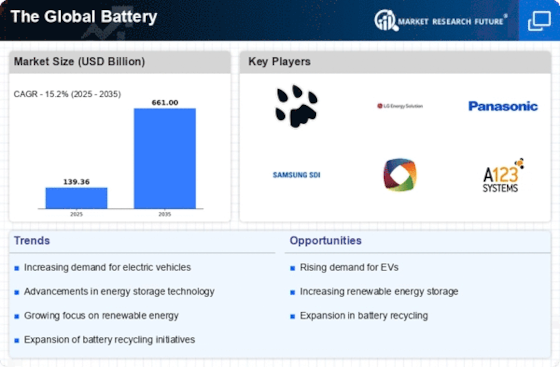
As per Market Research Future analysis, The Global Battery Market Size was estimated at 139.36 USD Billion in 2024. The battery industry is projected to grow from 160.55 USD Billion in 2025 to 661.0 USD Billion by 2035, exhibiting a compound annual growth rate (CAGR) of 15% during the forecast period 2025 - 2035

Key Market Trends & Highlights

The Global Battery Market is experiencing robust growth driven by technological advancements and increasing demand across various sectors.

  • The market is witnessing a notable shift towards sustainable technologies, particularly in North America. Advancements in battery chemistry are enhancing the performance and efficiency of Lithium-ion batteries, which remain the largest segment. Integration of smart technologies is becoming prevalent, especially in the automotive battery sector, which is currently the largest market segment. Rising demand for electric vehicles and growth in renewable energy storage solutions are key drivers propelling market expansion.

Market Size & Forecast

2024 Market Size 139.36 (USD Billion)
2035 Market Size 661.0 (USD Billion)
CAGR (2025 - 2035) 15.2%
Largest Regional Market Share in 2024 Asia Pacific

Major Players

Top Companies in the <a href="https://www.marketresearchfuture.com/reports/battery-market/companies">Battery Manufacturing Industt</a> are, CATL (CN), <a href="https://www.lgensol.com/en/business-ess-battery">LG Energy Solution</a> (KR), Panasonic (JP), Samsung SDI (KR), BYD (CN), A123 Systems (US), <a href="http://eng.sk-on.com/business/business_01.asp">SK Innovation</a> (KR), Toshiba (JP), Hitachi Energy (JP)

Market Trends

The Battery Market is currently experiencing a transformative phase, driven by the increasing demand for energy storage solutions across various sectors. This surge is largely attributed to the growing emphasis on renewable energy sources, which necessitate efficient storage systems to manage intermittent supply. Additionally, the automotive industry is witnessing a significant shift towards electric vehicles, further propelling the need for advanced battery technologies.

As manufacturers strive to enhance performance and sustainability, innovations in battery chemistry and design are becoming more prevalent. Moreover, the rise of portable electronic devices continues to fuel the market, as consumers seek longer-lasting and more efficient power sources. The integration of smart technologies into battery systems is also gaining traction, allowing for improved monitoring and management of energy usage.

This evolving landscape suggests that the Battery Market is poised for substantial growth, with a focus on sustainability and technological advancement shaping its future trajectory. Stakeholders are likely to invest in research and development to meet the diverse needs of consumers and industries alike, indicating a dynamic and competitive environment ahead.

Shift Towards Sustainable Technologies

The Battery Market is increasingly leaning towards sustainable technologies, as manufacturers prioritize eco-friendly materials and processes. This trend reflects a broader commitment to reducing environmental impact and enhancing the lifecycle of battery products.

Advancements in Battery Market Chemistry

Innovations in battery chemistry are emerging as a key trend, with research focusing on improving energy density and charging speeds. These advancements are essential for meeting the demands of electric vehicles and portable electronics, potentially revolutionizing performance standards.

Integration of Smart Technologies

The incorporation of smart technologies into battery systems is gaining momentum, enabling enhanced monitoring and management capabilities. This trend suggests a shift towards more intelligent energy solutions, which could optimize performance and efficiency in various applications.

Battery Market Market Drivers

Government Policies and Incentives

Government policies and incentives aimed at promoting clean energy and reducing carbon footprints are significantly shaping The Global Battery Industry. Various countries are implementing subsidies and tax breaks for battery production and electric vehicle purchases, which is likely to stimulate market growth. In 2025, it is expected that these policies will lead to an increase in battery production capacity, potentially exceeding 400 GWh. This regulatory support not only encourages investment in battery technologies but also fosters innovation, thereby enhancing the overall competitiveness of The Battery Industry.

Rising Demand for Electric Vehicles

The increasing adoption of electric vehicles (EVs) is a primary driver for The Battery Industry. As governments worldwide implement stricter emissions regulations and provide incentives for EV purchases, the demand for high-capacity batteries is surging. In 2025, the EV market is projected to grow significantly, with estimates suggesting that battery demand could reach over 300 GWh. This growth is likely to be fueled by advancements in battery technology, which enhance energy density and reduce costs. Consequently, manufacturers are investing heavily in battery production facilities to meet this burgeoning demand, indicating a robust future for The Battery Industry.

Increasing Consumer Electronics Demand

The surging demand for consumer electronics is a notable driver of The Battery Industry. With the proliferation of smartphones, laptops, and wearable devices, the need for compact and efficient batteries is escalating. In 2025, the consumer electronics sector is projected to account for a substantial share of battery consumption, with estimates indicating a demand of over 150 GWh. This trend underscores the importance of batteries in powering everyday devices, thereby reinforcing their critical role in The Battery Industry. Manufacturers are responding by developing batteries that offer longer life cycles and faster charging capabilities.

Growth in Renewable Energy Storage Solutions

The transition towards renewable energy sources, such as solar and wind, is driving the need for efficient energy storage solutions, thereby impacting The Battery Industry. As renewable energy generation becomes more prevalent, the demand for batteries that can store excess energy for later use is increasing. In 2025, the energy storage market is expected to expand, with battery storage capacity projected to exceed 200 GWh. This trend suggests that batteries will play a crucial role in stabilizing energy supply and demand, further solidifying their importance in The Battery Market Outlook.

Technological Innovations in Battery Manufacturing

Technological advancements in battery manufacturing processes are significantly influencing The Battery Industry. Innovations such as solid-state batteries and improved lithium-ion technologies are enhancing battery performance, safety, and longevity. In 2025, the market for advanced battery technologies is anticipated to grow, with investments in research and development reaching unprecedented levels. These innovations not only improve energy efficiency but also reduce production costs, making batteries more accessible to a wider range of applications. As a result, The Battery Industry is likely to experience a transformative shift driven by these technological breakthroughs.

Market Segment Insights

By Application: Consumer Electronics (Largest) vs. Electric Vehicles (Fastest-Growing)

In the battery market, 'Consumer Electronics' currently holds the largest share, driven by the increasing demand for smartphones, laptops, and other portable devices. This segment has established itself as a staple in everyday technology, leading to a robust market presence. In contrast, 'Electric Vehicles' has emerged as the fastest-growing segment, reflecting a significant shift towards sustainable transportation solutions. The rising adoption of electric vehicles is spurred by government incentives, environmental awareness, and advancements in battery technology.

Consumer Electronics (Dominant) vs. Electric Vehicles (Emerging)

The 'Consumer Electronics' segment is characterized by its vast array of applications, including smartphones, tablets, and wearables, making it the dominant force in the battery market. This segment's stability is attributed to continuous innovation, fierce competition, and ever-increasing consumer expectations. In contrast, 'Electric Vehicles' represent an emerging wave within the battery sector, driven by the global shift towards electrification and sustainability. This segment is poised for rapid expansion, supported by substantial investments in infrastructure, research, and development, positioning electric vehicles at the forefront of future growth.

By End Use: Residential (Largest) vs. Transportation (Fastest-Growing)

The battery market's end-use segment reveals a diverse landscape, with residential applications commanding the largest share. This reflects a growing trend of homeowners seeking energy independence and sustainable solutions through solar energy storage. On the other hand, transportation is rapidly gaining traction as electric vehicles become more mainstream, shifting consumer preferences and regulatory pressures spur innovative battery technologies. As we analyze growth trends, transportation is identified as the fastest-growing segment driven by advancements in battery technology, decreasing costs, and increasing investments in infrastructure. Incentives promoting electric vehicle adoption, along with a heightened focus on sustainability, enhance demand in this category. The commercial sector also shows robust growth due to an increase in renewable energy initiatives and an emphasis on energy efficiency across industries.

Residential (Dominant) vs. Telecommunications (Emerging)

The residential battery segment is marked by significant demand, as consumers increasingly invest in home energy storage solutions to manage peak energy costs and support renewable energy sources. This segment dominates due to its integration with solar power systems, allowing homeowners to store excess energy for later use. In contrast, the telecommunications segment, while emerging, is primarily focused on providing uninterrupted power supply to telecommunication networks. It revolves around critical infrastructure needs and increasingly sophisticated backup battery systems to enhance reliability, particularly in regions vulnerable to power interruptions. Both segments showcase distinct characteristics, where residential solutions prioritize consumer energy savings and resilience, while telecommunications emphasize operational continuity and efficiency.

By Battery Type: Lithium-ion (Largest) vs. Solid State (Fastest-Growing)

The battery market showcases a diverse range of technologies, with Lithium-ion batteries holding the largest market share due to their widespread adoption in electronic devices and electric vehicles. This segment has established itself as a dominant player, significantly outpacing traditional battery types like Lead-acid and Nickel-metal Hydride, which cater to more niche applications. As advancements in technology continue to proliferate, the sustained demand for Lithium-ion batteries remains a critical driver of market stability. In contrast, Solid State batteries are emerging as the fastest-growing segment, driven by innovations that promise higher energy density and enhanced safety. The shift towards renewable energy sources and the increasing demand for more efficient energy storage systems are propelling this growth. As manufacturers invest in research and development to improve Solid State battery performance, the market is likely to witness a significant transformation in the coming years, favoring sustainability and efficiency.

Lithium-ion (Dominant) vs. Solid State (Emerging)

Lithium-ion batteries have become the backbone of modern energy storage solutions, known for their impressive energy capacity and efficiency. They dominate the market due to their versatility, powering everything from smartphones to electric vehicles. As technology evolves, advanced lithium-ion chemistries are being developed, enhancing performance and lifespan while reducing costs. Meanwhile, Solid State batteries represent an innovative approach to energy storage, utilizing a solid electrolyte instead of a liquid one. This technology potentially offers greater energy density and safety, attracting attention from manufacturers and investors alike. As Solid State technology matures, its adoption in consumer electronics and electric vehicles is expected to rise, paving the way for a competitive new entrant in the energy storage landscape.

By Chemistry: Lithium Cobalt Oxide (Largest) vs. Lithium Iron Phosphate (Fastest-Growing)

In the battery market, the chemistry segment is primarily dominated by Lithium Cobalt Oxide, which is known for its high energy density and wide usage in consumer electronics. This segment accounts for a significant portion of the market, making it the largest chemistry type in terms of volume and application. Meanwhile, Lithium Iron Phosphate has been gaining rapid traction due to its safety features and long cycle life, appealing strongly to the electric vehicle (EV) and renewable energy sectors. Its growing adoption is indicative of a market shift towards more sustainable alternatives. Growth trends within the battery segment are heavily influenced by technological advancements and market demands for energy-efficient solutions. Lithium Iron Phosphate, in particular, is witnessing accelerated growth driven by the increasing need for safer batteries in transportation and energy storage solutions. Consumers and manufacturers are seeking alternatives that not only improve performance but also minimize environmental impacts. With stringent regulations favoring green technologies, the momentum for these chemistries will continue to rise, reshaping the future landscape of the battery market.

Lithium Cobalt Oxide (Dominant) vs. Lead Acid (Emerging)

Lithium Cobalt Oxide remains the dominant player in the battery chemistry landscape, widely utilized for its superior energy density, making it ideal for portable electronics and electric vehicles. Its established presence gives it a competitive edge, but it also faces challenges related to cost and ethical sourcing of cobalt. On the other hand, Lead Acid batteries are emerging as a resilient and cost-effective option despite being an older technology. They are increasingly favored in applications such as backup power systems and automotive starter batteries. Although Lead Acid batteries have limitations in terms of energy density and lifespan compared to lithium-ion chemistries, innovations such as enhanced lead-acid technologies and recycling efforts are enabling them to maintain relevance in the market.

Get more detailed insights about Battery Market Research Report - Forecast to 2035

Regional Insights

By region, the study provides market insights into North America, Europe, Asia-Pacific, and the Rest of the World. The highest revenue share was attributed to Asia Pacific. Due to rising vehicle production, fast industrial expansion, and increasing demand throughout the area, Asia Pacific is a significant consumer of batteries. Due to their low setup and production costs and accessibility to a competent labour pool, China and India are the main producers in the consumer electronics sector.

Figure 3 Battery Market Share By Region 2021 (%)

Source Secondary Research, Primary Research, MRFR Database, and Analyst Review

North America is anticipated to have tremendous growth. The regional market is primarily driven by reasons such as falling Li-ion battery prices, rising consumer electronics sales, quick adoption of electric cars, and a developing renewable sector. Additionally, North America continues to be a leader in battery research and development as well as one of the world's biggest users of batteries.

Europe is projected to experience notable growth. Europe has long been one of the world's top automakers, and it will hold this position well into the future. Key automakers including Audi, BMW, Volvo, Jaguar, Ferrari, Mercedes Benz, Porsche, and Lamborghini are present in the area, which will boost the expansion of the automotive sector and, as a result, increase demand for industrial batteries throughout the forecasted period.

Key Players and Competitive Insights

The Global Battery is currently characterized by intense competition and rapid innovation, driven by the increasing demand for electric vehicles (EVs), renewable energy storage, and portable electronics. Key players such as CATL (China), LG Energy Solution (South Korea), and BYD (China) are at the forefront, each adopting distinct strategies to enhance their market positioning. CATL (China) focuses on expanding its production capacity and technological advancements in battery chemistry, while LG Energy Solution (South Korea) emphasizes strategic partnerships with automotive manufacturers to secure long-term supply agreements. BYD (China) is diversifying its product offerings and investing in vertical integration to control its supply chain, thereby enhancing its competitive edge. Collectively, these strategies contribute to a dynamic competitive environment, where innovation and strategic collaborations are paramount. In terms of business tactics, companies are increasingly localizing manufacturing to mitigate supply chain disruptions and optimize logistics. This trend is particularly evident in the context of The Global Battery, which appears moderately fragmented, with several players vying for market share. The collective influence of these key players shapes the market structure, as they engage in strategic maneuvers to enhance their operational efficiencies and market reach. In August 2025, LG Energy Solution (South Korea) announced a significant partnership with a leading automotive manufacturer to develop next-generation battery technologies. This collaboration is poised to accelerate the development of high-capacity batteries, which are essential for the growing EV market. The strategic importance of this partnership lies in its potential to enhance LG's technological capabilities and solidify its position as a preferred supplier in the automotive sector. In September 2025, CATL (China) unveiled a new battery recycling initiative aimed at reducing environmental impact and promoting sustainability. This initiative not only aligns with global sustainability goals but also positions CATL as a leader in the circular economy within the battery industry. The strategic significance of this move is underscored by the increasing regulatory pressures on battery manufacturers to adopt sustainable practices, thereby enhancing CATL's reputation and market appeal. In October 2025, BYD (China) launched a new line of solid-state batteries, which are expected to offer higher energy density and improved safety compared to traditional lithium-ion batteries. This innovation is crucial as it addresses consumer concerns regarding battery safety and performance, potentially giving BYD a competitive advantage in the rapidly evolving battery landscape. The introduction of solid-state technology signifies a pivotal shift in battery development, reflecting the industry's focus on innovation and performance. As of October 2025, current competitive trends in The Global Battery are increasingly defined by digitalization, sustainability, and the integration of artificial intelligence in manufacturing processes. Strategic alliances are becoming more prevalent, as companies recognize the need to collaborate to enhance technological capabilities and market reach. Looking ahead, competitive differentiation is likely to evolve from traditional price-based competition to a focus on innovation, advanced technology, and supply chain reliability, underscoring the importance of adaptability in a rapidly changing market.

Key Companies in the Battery Market include

Industry Developments

Q2 2025: CATL to Open New $2 Billion Battery Market Plant in Hungary Contemporary Amperex Technology Co. Ltd. (CATL) announced the opening of a new $2 billion battery manufacturing facility in Debrecen, Hungary, aimed at supplying European automakers with lithium-ion batteries.

Q2 2025: Panasonic Energy and Mazda Announce EV Battery Market Partnership Panasonic Energy and Mazda entered into a strategic partnership to supply cylindrical lithium-ion batteries for Mazda’s next-generation electric vehicles, with production set to begin in 2026.

Q2 2025: Northvolt Raises $1.2 Billion to Expand Battery Market Production in Europe Swedish battery maker Northvolt secured $1.2 billion in new funding to accelerate the expansion of its European gigafactories, supporting growing demand from the automotive and energy storage sectors.

Q2 2025: General Motors and POSCO Future M Open Battery Market Materials Plant in Canada General Motors and POSCO Future M officially opened a new battery materials facility in Quebec, Canada, to produce cathode active materials for GM’s Ultium batteries.

Q1 2025: Redwood Materials Secures $500 Million in Series D Funding Battery Market recycling startup Redwood Materials raised $500 million in a Series D funding round to expand its recycling operations and build a new facility in the United States.

Q1 2025: BYD Launches New Sodium-Ion Battery Market for Electric Vehicles Chinese automaker BYD unveiled its first sodium-ion battery for electric vehicles, marking a significant step toward diversifying battery chemistries and reducing reliance on lithium.

Q1 2025: SK On Signs $3 Billion Battery Market Supply Deal with Ford South Korea’s SK On signed a $3 billion multi-year contract to supply batteries for Ford’s next generation of electric vehicles in North America.

Q4 2024: Tesla Appoints New Head of Battery Market Engineering Tesla announced the appointment of Dr. Maria Chen as Senior Vice President of Battery Market Engineering, overseeing the company’s global battery technology and manufacturing strategy.

Q4 2024: LG Energy Solution and Honda Open Joint Battery Market Plant in Ohio LG Energy Solution and Honda inaugurated their joint $4.4 billion battery manufacturing facility in Ohio, which will supply batteries for Honda and Acura electric vehicles in North America.

Q4 2024: QuantumScape Receives Regulatory Approval for Solid-State Battery Market Pilot Line QuantumScape received regulatory approval to begin operations at its solid-state battery pilot manufacturing line in California, a key milestone toward commercializing next-generation batteries.

Q3 2024: Samsung SDI and Stellantis Announce $2.5 Billion Battery Market Plant in Indiana Samsung SDI and Stellantis broke ground on a $2.5 billion battery manufacturing plant in Indiana, expected to supply batteries for Stellantis’ electric vehicles in the U.S. market.

Q3 2024: CATL Signs Long-Term Battery Market Supply Agreement with BMW CATL announced a long-term agreement to supply BMW with lithium-ion batteries for its upcoming electric vehicle models, strengthening their existing partnership.

Future Outlook

Battery Market Future Outlook

The Battery Market is projected to grow at a 15.2% CAGR from 2025 to 2035, driven by advancements in electric vehicles, renewable energy storage, and consumer electronics.

New opportunities lie in:

  • <p>Development of solid-state battery technologies for enhanced safety and performance. Expansion of battery recycling facilities to capture valuable materials. Integration of AI for predictive maintenance in battery management systems.</p>

By 2035, The Battery Market is expected to be robust, driven by innovation and sustainability.

Market Segmentation

Battery Market Type Outlook

  • Lead-acid Battery
  • Flow Battery
  • Nickel-metal Hybrid Battery
  • Small Sealed Lead-acid Battery
  • Sodium-sulfur Battery
  • Zinc-manganese dioxide Battery
  • Lithium-ion Battery
  • Nickel-ion Battery
  • Others

Battery Market Application Outlook

  • SLI Batteries
  • Automotive Batteries
  • Portable Batteries
  • Industrial Batteries
  • Power Tool Batteries
  • Consumer Electronics

Report Scope

MARKET SIZE 2024 139.36(USD Billion)
MARKET SIZE 2025 160.55(USD Billion)
MARKET SIZE 2035 661.0(USD Billion)
COMPOUND ANNUAL GROWTH RATE (CAGR) 15.2% (2025 - 2035)
REPORT COVERAGE Revenue Forecast, Competitive Landscape, Growth Factors, and Trends
BASE YEAR 2024
Market Forecast Period 2025 - 2035
Historical Data 2019 - 2024
Market Forecast Units USD Billion
Key Companies Profiled CATL (CN), LG Energy Solution (KR), Panasonic (JP), Samsung SDI (KR), BYD (CN), A123 Systems (US), SK Innovation (KR), Toshiba (JP), Hitachi Energy (JP)
Segments Covered Battery Type, Application, Region
Key Market Opportunities Advancements in solid-state battery technology enhance energy density and safety in The Global Battery Market.
Key Market Dynamics Rising demand for electric vehicles drives innovation and competition in battery technology and supply chain management.
Countries Covered North America, Europe, APAC, South America, MEA

FAQs

What is the current valuation of the battery market as of 2024?

<p>The battery market was valued at 150.0 USD Billion in 2024.</p>

What is the projected market valuation for the battery market in 2035?

<p>The battery market is projected to reach 300.0 USD Billion by 2035.</p>

What is the expected CAGR for the battery market during the forecast period 2025 - 2035?

<p>The expected CAGR for the battery market during the forecast period 2025 - 2035 is 6.5%.</p>

Which application segments are driving the battery market's growth?

<p>The application segments driving growth include Electric Vehicles, which are projected to grow from 50.0 to 120.0 USD Billion, and Energy Storage Systems, expected to rise from 40.0 to 80.0 USD Billion.</p>

What are the key players in the battery market?

<p>Key players in the battery market include CATL, LG Energy Solution, Panasonic, Samsung SDI, BYD, A123 Systems, SK Innovation, Toshiba, and Northvolt.</p>

How does the battery market perform in the transportation sector?

<p>In the transportation sector, the battery market is anticipated to grow from 50.0 to 100.0 USD Billion.</p>

What types of batteries dominate the market?

<p>Lithium-ion batteries dominate the market, with a valuation projected to increase from 75.0 to 150.0 USD Billion.</p>

What is the expected growth in the residential battery segment?

<p>The residential battery segment is expected to grow from 30.0 to 60.0 USD Billion by 2035.</p>

How does the market for lead-acid batteries compare to lithium-ion batteries?

<p>The lead-acid battery market is projected to grow from 40.0 to 80.0 USD Billion, which is significantly lower than the growth anticipated for lithium-ion batteries.</p>

What chemistry types are expected to see growth in the battery market?

<p>Chemistry types such as Lithium Iron Phosphate and Lithium Cobalt Oxide are expected to see growth, with valuations projected to rise from 40.0 to 80.0 USD Billion and 30.0 to 60.0 USD Billion, respectively.</p>

  1. SECTION I: EXECUTIVE SUMMARY AND KEY HIGHLIGHTS |
    1. EXECUTIVE SUMMARY | |
      1. Market Overview | |
      2. Key Findings | |
      3. Market Segmentation | |
      4. Competitive Landscape | |
      5. Challenges and Opportunities | |
      6. Future Outlook 2
  2. SECTION II: SCOPING, METHODOLOGY AND MARKET STRUCTURE |
    1. MARKET INTRODUCTION | |
      1. Definition | |
      2. Scope of the study | | |
    2. RESEARCH METHODOLOGY | |
      1. Overview | |
      2. Data Mining | |
      3. Secondary Research | |
      4. Primary Research | | |
      5. Forecasting Model | |
      6. Market Size Estimation | | |
      7. Data Triangulation | |
      8. Validation 3
  3. SECTION III: QUALITATIVE ANALYSIS |
    1. MARKET DYNAMICS | |
      1. Overview | |
      2. Drivers | |
      3. Restraints | |
      4. Opportunities |
    2. MARKET FACTOR ANALYSIS | |
      1. Value chain Analysis | |
      2. Porter's Five Forces Analysis | | |
      3. COVID-19 Impact Analysis | | |
  4. SECTION IV: QUANTITATIVE ANALYSIS |
    1. Energy & Power, BY Application (USD Billion) | |
      1. Consumer Electronics | |
      2. Electric Vehicles | |
      3. Energy Storage Systems | |
      4. Industrial Equipment | |
      5. Medical Devices |
    2. Energy & Power, BY End Use (USD Billion) | |
      1. Residential | |
      2. Commercial | |
      3. Transportation | |
      4. Telecommunications | |
      5. Healthcare |
    3. Energy & Power, BY Battery Type (USD Billion) | |
      1. Lithium-ion | |
      2. Lead-acid | |
      3. Nickel-metal Hydride | |
      4. Solid State | |
      5. Flow Battery |
    4. Energy & Power, BY Chemistry (USD Billion) | |
      1. Lithium Cobalt Oxide | |
      2. Lithium Iron Phosphate | |
      3. Nickel Cobalt Aluminum Oxide | |
      4. Lithium Manganese Oxide | |
      5. Lead Acid |
    5. Energy & Power, BY Region (USD Billion) | |
      1. North America | | |
      2. Europe | | |
      3. APAC | | |
      4. South America | | |
      5. MEA | | |
  5. SECTION V: COMPETITIVE ANALYSIS |
    1. Competitive Landscape | |
      1. Overview | |
      2. Competitive Analysis | |
      3. Market share Analysis | |
      4. Major Growth Strategy in the Energy & Power | |
      5. Competitive Benchmarking | |
      6. Leading Players in Terms of Number of Developments in the Energy & Power | |
      7. Key developments and growth strategies | | |
      8. Major Players Financial Matrix | | |
    2. Company Profiles | |
      1. CATL (CN) | | |
      2. LG Energy Solution (KR) | | |
      3. Panasonic (JP) | | |
      4. Samsung SDI (KR) | | |
      5. BYD (CN) | | |
      6. A123 Systems (US) | | |
      7. SK Innovation (KR) | | |
      8. Toshiba (JP) | | |
      9. Northvolt (SE) | | |
    3. Appendix | |
      1. References | |
      2. Related Reports 6 LIST OF FIGURES |
    4. MARKET SYNOPSIS |
    5. NORTH AMERICA MARKET ANALYSIS |
    6. US MARKET ANALYSIS BY APPLICATION |
    7. US MARKET ANALYSIS BY END USE |
    8. US MARKET ANALYSIS BY BATTERY TYPE |
    9. US MARKET ANALYSIS BY CHEMISTRY |
    10. CANADA MARKET ANALYSIS BY APPLICATION |
    11. CANADA MARKET ANALYSIS BY END USE |
    12. CANADA MARKET ANALYSIS BY BATTERY TYPE |
    13. CANADA MARKET ANALYSIS BY CHEMISTRY |
    14. EUROPE MARKET ANALYSIS |
    15. GERMANY MARKET ANALYSIS BY APPLICATION |
    16. GERMANY MARKET ANALYSIS BY END USE |
    17. GERMANY MARKET ANALYSIS BY BATTERY TYPE |
    18. GERMANY MARKET ANALYSIS BY CHEMISTRY |
    19. UK MARKET ANALYSIS BY APPLICATION |
    20. UK MARKET ANALYSIS BY END USE |
    21. UK MARKET ANALYSIS BY BATTERY TYPE |
    22. UK MARKET ANALYSIS BY CHEMISTRY |
    23. FRANCE MARKET ANALYSIS BY APPLICATION |
    24. FRANCE MARKET ANALYSIS BY END USE |
    25. FRANCE MARKET ANALYSIS BY BATTERY TYPE |
    26. FRANCE MARKET ANALYSIS BY CHEMISTRY |
    27. RUSSIA MARKET ANALYSIS BY APPLICATION |
    28. RUSSIA MARKET ANALYSIS BY END USE |
    29. RUSSIA MARKET ANALYSIS BY BATTERY TYPE |
    30. RUSSIA MARKET ANALYSIS BY CHEMISTRY |
    31. ITALY MARKET ANALYSIS BY APPLICATION |
    32. ITALY MARKET ANALYSIS BY END USE |
    33. ITALY MARKET ANALYSIS BY BATTERY TYPE |
    34. ITALY MARKET ANALYSIS BY CHEMISTRY |
    35. SPAIN MARKET ANALYSIS BY APPLICATION |
    36. SPAIN MARKET ANALYSIS BY END USE |
    37. SPAIN MARKET ANALYSIS BY BATTERY TYPE |
    38. SPAIN MARKET ANALYSIS BY CHEMISTRY |
    39. REST OF EUROPE MARKET ANALYSIS BY APPLICATION |
    40. REST OF EUROPE MARKET ANALYSIS BY END USE |
    41. REST OF EUROPE MARKET ANALYSIS BY BATTERY TYPE |
    42. REST OF EUROPE MARKET ANALYSIS BY CHEMISTRY |
    43. APAC MARKET ANALYSIS |
    44. CHINA MARKET ANALYSIS BY APPLICATION |
    45. CHINA MARKET ANALYSIS BY END USE |
    46. CHINA MARKET ANALYSIS BY BATTERY TYPE |
    47. CHINA MARKET ANALYSIS BY CHEMISTRY |
    48. INDIA MARKET ANALYSIS BY APPLICATION |
    49. INDIA MARKET ANALYSIS BY END USE |
    50. INDIA MARKET ANALYSIS BY BATTERY TYPE |
    51. INDIA MARKET ANALYSIS BY CHEMISTRY |
    52. JAPAN MARKET ANALYSIS BY APPLICATION |
    53. JAPAN MARKET ANALYSIS BY END USE |
    54. JAPAN MARKET ANALYSIS BY BATTERY TYPE |
    55. JAPAN MARKET ANALYSIS BY CHEMISTRY |
    56. SOUTH KOREA MARKET ANALYSIS BY APPLICATION |
    57. SOUTH KOREA MARKET ANALYSIS BY END USE |
    58. SOUTH KOREA MARKET ANALYSIS BY BATTERY TYPE |
    59. SOUTH KOREA MARKET ANALYSIS BY CHEMISTRY |
    60. MALAYSIA MARKET ANALYSIS BY APPLICATION |
    61. MALAYSIA MARKET ANALYSIS BY END USE |
    62. MALAYSIA MARKET ANALYSIS BY BATTERY TYPE |
    63. MALAYSIA MARKET ANALYSIS BY CHEMISTRY |
    64. THAILAND MARKET ANALYSIS BY APPLICATION |
    65. THAILAND MARKET ANALYSIS BY END USE |
    66. THAILAND MARKET ANALYSIS BY BATTERY TYPE |
    67. THAILAND MARKET ANALYSIS BY CHEMISTRY |
    68. INDONESIA MARKET ANALYSIS BY APPLICATION |
    69. INDONESIA MARKET ANALYSIS BY END USE |
    70. INDONESIA MARKET ANALYSIS BY BATTERY TYPE |
    71. INDONESIA MARKET ANALYSIS BY CHEMISTRY |
    72. REST OF APAC MARKET ANALYSIS BY APPLICATION |
    73. REST OF APAC MARKET ANALYSIS BY END USE |
    74. REST OF APAC MARKET ANALYSIS BY BATTERY TYPE |
    75. REST OF APAC MARKET ANALYSIS BY CHEMISTRY |
    76. SOUTH AMERICA MARKET ANALYSIS |
    77. BRAZIL MARKET ANALYSIS BY APPLICATION |
    78. BRAZIL MARKET ANALYSIS BY END USE |
    79. BRAZIL MARKET ANALYSIS BY BATTERY TYPE |
    80. BRAZIL MARKET ANALYSIS BY CHEMISTRY |
    81. MEXICO MARKET ANALYSIS BY APPLICATION |
    82. MEXICO MARKET ANALYSIS BY END USE |
    83. MEXICO MARKET ANALYSIS BY BATTERY TYPE |
    84. MEXICO MARKET ANALYSIS BY CHEMISTRY |
    85. ARGENTINA MARKET ANALYSIS BY APPLICATION |
    86. ARGENTINA MARKET ANALYSIS BY END USE |
    87. ARGENTINA MARKET ANALYSIS BY BATTERY TYPE |
    88. ARGENTINA MARKET ANALYSIS BY CHEMISTRY |
    89. REST OF SOUTH AMERICA MARKET ANALYSIS BY APPLICATION |
    90. REST OF SOUTH AMERICA MARKET ANALYSIS BY END USE |
    91. REST OF SOUTH AMERICA MARKET ANALYSIS BY BATTERY TYPE |
    92. REST OF SOUTH AMERICA MARKET ANALYSIS BY CHEMISTRY |
    93. MEA MARKET ANALYSIS |
    94. GCC COUNTRIES MARKET ANALYSIS BY APPLICATION |
    95. GCC COUNTRIES MARKET ANALYSIS BY END USE |
    96. GCC COUNTRIES MARKET ANALYSIS BY BATTERY TYPE |
    97. GCC COUNTRIES MARKET ANALYSIS BY CHEMISTRY |
    98. SOUTH AFRICA MARKET ANALYSIS BY APPLICATION |
    99. SOUTH AFRICA MARKET ANALYSIS BY END USE |
    100. SOUTH AFRICA MARKET ANALYSIS BY BATTERY TYPE |
    101. SOUTH AFRICA MARKET ANALYSIS BY CHEMISTRY |
    102. REST OF MEA MARKET ANALYSIS BY APPLICATION |
    103. REST OF MEA MARKET ANALYSIS BY END USE |
    104. REST OF MEA MARKET ANALYSIS BY BATTERY TYPE |
    105. REST OF MEA MARKET ANALYSIS BY CHEMISTRY |
    106. KEY BUYING CRITERIA OF ENERGY & POWER |
    107. RESEARCH PROCESS OF MRFR |
    108. DRO ANALYSIS OF ENERGY & POWER |
    109. DRIVERS IMPACT ANALYSIS: ENERGY & POWER |
    110. RESTRAINTS IMPACT ANALYSIS: ENERGY & POWER |
    111. SUPPLY / VALUE CHAIN: ENERGY & POWER |
    112. ENERGY & POWER, BY APPLICATION, 2024 (% SHARE) |
    113. ENERGY & POWER, BY APPLICATION, 2024 TO 2035 (USD Billion) |
    114. ENERGY & POWER, BY END USE, 2024 (% SHARE) |
    115. ENERGY & POWER, BY END USE, 2024 TO 2035 (USD Billion) |
    116. ENERGY & POWER, BY BATTERY TYPE, 2024 (% SHARE) |
    117. ENERGY & POWER, BY BATTERY TYPE, 2024 TO 2035 (USD Billion) |
    118. ENERGY & POWER, BY CHEMISTRY, 2024 (% SHARE) |
    119. ENERGY & POWER, BY CHEMISTRY, 2024 TO 2035 (USD Billion) |
    120. BENCHMARKING OF MAJOR COMPETITORS 7 LIST OF TABLES |
    121. LIST OF ASSUMPTIONS | |
      1. |
    122. North America MARKET SIZE ESTIMATES; FORECAST | |
      1. BY APPLICATION, 2025-2035 (USD Billion) | |
      2. BY END USE, 2025-2035 (USD Billion) | |
      3. BY BATTERY TYPE, 2025-2035 (USD Billion) | |
      4. BY CHEMISTRY, 2025-2035 (USD Billion) |
    123. US MARKET SIZE ESTIMATES; FORECAST | |
      1. BY APPLICATION, 2025-2035 (USD Billion) | |
      2. BY END USE, 2025-2035 (USD Billion) | |
      3. BY BATTERY TYPE, 2025-2035 (USD Billion) | |
      4. BY CHEMISTRY, 2025-2035 (USD Billion) |
    124. Canada MARKET SIZE ESTIMATES; FORECAST | |
      1. BY APPLICATION, 2025-2035 (USD Billion) | |
      2. BY END USE, 2025-2035 (USD Billion) | |
      3. BY BATTERY TYPE, 2025-2035 (USD Billion) | |
      4. BY CHEMISTRY, 2025-2035 (USD Billion) |
    125. Europe MARKET SIZE ESTIMATES; FORECAST | |
      1. BY APPLICATION, 2025-2035 (USD Billion) | |
      2. BY END USE, 2025-2035 (USD Billion) | |
      3. BY BATTERY TYPE, 2025-2035 (USD Billion) | |
      4. BY CHEMISTRY, 2025-2035 (USD Billion) |
    126. Germany MARKET SIZE ESTIMATES; FORECAST | |
      1. BY APPLICATION, 2025-2035 (USD Billion) | |
      2. BY END USE, 2025-2035 (USD Billion) | |
      3. BY BATTERY TYPE, 2025-2035 (USD Billion) | |
      4. BY CHEMISTRY, 2025-2035 (USD Billion) |
    127. UK MARKET SIZE ESTIMATES; FORECAST | |
      1. BY APPLICATION, 2025-2035 (USD Billion) | |
      2. BY END USE, 2025-2035 (USD Billion) | |
      3. BY BATTERY TYPE, 2025-2035 (USD Billion) | |
      4. BY CHEMISTRY, 2025-2035 (USD Billion) |
    128. France MARKET SIZE ESTIMATES; FORECAST | |
      1. BY APPLICATION, 2025-2035 (USD Billion) | |
      2. BY END USE, 2025-2035 (USD Billion) | |
      3. BY BATTERY TYPE, 2025-2035 (USD Billion) | |
      4. BY CHEMISTRY, 2025-2035 (USD Billion) |
    129. Russia MARKET SIZE ESTIMATES; FORECAST | |
      1. BY APPLICATION, 2025-2035 (USD Billion) | |
      2. BY END USE, 2025-2035 (USD Billion) | |
      3. BY BATTERY TYPE, 2025-2035 (USD Billion) | |
      4. BY CHEMISTRY, 2025-2035 (USD Billion) |
    130. Italy MARKET SIZE ESTIMATES; FORECAST | |
      1. BY APPLICATION, 2025-2035 (USD Billion) | |
      2. BY END USE, 2025-2035 (USD Billion) | |
      3. BY BATTERY TYPE, 2025-2035 (USD Billion) | |
      4. BY CHEMISTRY, 2025-2035 (USD Billion) |
    131. Spain MARKET SIZE ESTIMATES; FORECAST | |
      1. BY APPLICATION, 2025-2035 (USD Billion) | |
      2. BY END USE, 2025-2035 (USD Billion) | |
      3. BY BATTERY TYPE, 2025-2035 (USD Billion) | |
      4. BY CHEMISTRY, 2025-2035 (USD Billion) |
    132. Rest of Europe MARKET SIZE ESTIMATES; FORECAST | |
      1. BY APPLICATION, 2025-2035 (USD Billion) | |
      2. BY END USE, 2025-2035 (USD Billion) | |
      3. BY BATTERY TYPE, 2025-2035 (USD Billion) | |
      4. BY CHEMISTRY, 2025-2035 (USD Billion) |
    133. APAC MARKET SIZE ESTIMATES; FORECAST | |
      1. BY APPLICATION, 2025-2035 (USD Billion) | |
      2. BY END USE, 2025-2035 (USD Billion) | |
      3. BY BATTERY TYPE, 2025-2035 (USD Billion) | |
      4. BY CHEMISTRY, 2025-2035 (USD Billion) |
    134. China MARKET SIZE ESTIMATES; FORECAST | |
      1. BY APPLICATION, 2025-2035 (USD Billion) | |
      2. BY END USE, 2025-2035 (USD Billion) | |
      3. BY BATTERY TYPE, 2025-2035 (USD Billion) | |
      4. BY CHEMISTRY, 2025-2035 (USD Billion) |
    135. India MARKET SIZE ESTIMATES; FORECAST | |
      1. BY APPLICATION, 2025-2035 (USD Billion) | |
      2. BY END USE, 2025-2035 (USD Billion) | |
      3. BY BATTERY TYPE, 2025-2035 (USD Billion) | |
      4. BY CHEMISTRY, 2025-2035 (USD Billion) |
    136. Japan MARKET SIZE ESTIMATES; FORECAST | |
      1. BY APPLICATION, 2025-2035 (USD Billion) | |
      2. BY END USE, 2025-2035 (USD Billion) | |
      3. BY BATTERY TYPE, 2025-2035 (USD Billion) | |
      4. BY CHEMISTRY, 2025-2035 (USD Billion) |
    137. South Korea MARKET SIZE ESTIMATES; FORECAST | |
      1. BY APPLICATION, 2025-2035 (USD Billion) | |
      2. BY END USE, 2025-2035 (USD Billion) | |
      3. BY BATTERY TYPE, 2025-2035 (USD Billion) | |
      4. BY CHEMISTRY, 2025-2035 (USD Billion) |
    138. Malaysia MARKET SIZE ESTIMATES; FORECAST | |
      1. BY APPLICATION, 2025-2035 (USD Billion) | |
      2. BY END USE, 2025-2035 (USD Billion) | |
      3. BY BATTERY TYPE, 2025-2035 (USD Billion) | |
      4. BY CHEMISTRY, 2025-2035 (USD Billion) |
    139. Thailand MARKET SIZE ESTIMATES; FORECAST | |
      1. BY APPLICATION, 2025-2035 (USD Billion) | |
      2. BY END USE, 2025-2035 (USD Billion) | |
      3. BY BATTERY TYPE, 2025-2035 (USD Billion) | |
      4. BY CHEMISTRY, 2025-2035 (USD Billion) |
    140. Indonesia MARKET SIZE ESTIMATES; FORECAST | |
      1. BY APPLICATION, 2025-2035 (USD Billion) | |
      2. BY END USE, 2025-2035 (USD Billion) | |
      3. BY BATTERY TYPE, 2025-2035 (USD Billion) | |
      4. BY CHEMISTRY, 2025-2035 (USD Billion) |
    141. Rest of APAC MARKET SIZE ESTIMATES; FORECAST | |
      1. BY APPLICATION, 2025-2035 (USD Billion) | |
      2. BY END USE, 2025-2035 (USD Billion) | |
      3. BY BATTERY TYPE, 2025-2035 (USD Billion) | |
      4. BY CHEMISTRY, 2025-2035 (USD Billion) |
    142. South America MARKET SIZE ESTIMATES; FORECAST | |
      1. BY APPLICATION, 2025-2035 (USD Billion) | |
      2. BY END USE, 2025-2035 (USD Billion) | |
      3. BY BATTERY TYPE, 2025-2035 (USD Billion) | |
      4. BY CHEMISTRY, 2025-2035 (USD Billion) |
    143. Brazil MARKET SIZE ESTIMATES; FORECAST | |
      1. BY APPLICATION, 2025-2035 (USD Billion) | |
      2. BY END USE, 2025-2035 (USD Billion) | |
      3. BY BATTERY TYPE, 2025-2035 (USD Billion) | |
      4. BY CHEMISTRY, 2025-2035 (USD Billion) |
    144. Mexico MARKET SIZE ESTIMATES; FORECAST | |
      1. BY APPLICATION, 2025-2035 (USD Billion) | |
      2. BY END USE, 2025-2035 (USD Billion) | |
      3. BY BATTERY TYPE, 2025-2035 (USD Billion) | |
      4. BY CHEMISTRY, 2025-2035 (USD Billion) |
    145. Argentina MARKET SIZE ESTIMATES; FORECAST | |
      1. BY APPLICATION, 2025-2035 (USD Billion) | |
      2. BY END USE, 2025-2035 (USD Billion) | |
      3. BY BATTERY TYPE, 2025-2035 (USD Billion) | |
      4. BY CHEMISTRY, 2025-2035 (USD Billion) |
    146. Rest of South America MARKET SIZE ESTIMATES; FORECAST | |
      1. BY APPLICATION, 2025-2035 (USD Billion) | |
      2. BY END USE, 2025-2035 (USD Billion) | |
      3. BY BATTERY TYPE, 2025-2035 (USD Billion) | |
      4. BY CHEMISTRY, 2025-2035 (USD Billion) |
    147. MEA MARKET SIZE ESTIMATES; FORECAST | |
      1. BY APPLICATION, 2025-2035 (USD Billion) | |
      2. BY END USE, 2025-2035 (USD Billion) | |
      3. BY BATTERY TYPE, 2025-2035 (USD Billion) | |
      4. BY CHEMISTRY, 2025-2035 (USD Billion) |
    148. GCC Countries MARKET SIZE ESTIMATES; FORECAST | |
      1. BY APPLICATION, 2025-2035 (USD Billion) | |
      2. BY END USE, 2025-2035 (USD Billion) | |
      3. BY BATTERY TYPE, 2025-2035 (USD Billion) | |
      4. BY CHEMISTRY, 2025-2035 (USD Billion) |
    149. South Africa MARKET SIZE ESTIMATES; FORECAST | |
      1. BY APPLICATION, 2025-2035 (USD Billion) | |
      2. BY END USE, 2025-2035 (USD Billion) | |
      3. BY BATTERY TYPE, 2025-2035 (USD Billion) | |
      4. BY CHEMISTRY, 2025-2035 (USD Billion) |
    150. Rest of MEA MARKET SIZE ESTIMATES; FORECAST | |
      1. BY APPLICATION, 2025-2035 (USD Billion) | |
      2. BY END USE, 2025-2035 (USD Billion) | |
      3. BY BATTERY TYPE, 2025-2035 (USD Billion) | |
      4. BY CHEMISTRY, 2025-2035 (USD Billion) |
    151. PRODUCT LAUNCH/PRODUCT DEVELOPMENT/APPROVAL | |
      1. |
    152. ACQUISITION/PARTNERSHIP | |

Energy & Power Market Segmentation

Energy & Power By Application (USD Billion, 2025-2035)

  • Consumer Electronics
  • Electric Vehicles
  • Energy Storage Systems
  • Industrial Equipment
  • Medical Devices

Energy & Power By End Use (USD Billion, 2025-2035)

  • Residential
  • Commercial
  • Transportation
  • Telecommunications
  • Healthcare

Energy & Power By Battery Type (USD Billion, 2025-2035)

  • Lithium-ion
  • Lead-acid
  • Nickel-metal Hydride
  • Solid State
  • Flow Battery

Energy & Power By Chemistry (USD Billion, 2025-2035)

  • Lithium Cobalt Oxide
  • Lithium Iron Phosphate
  • Nickel Cobalt Aluminum Oxide
  • Lithium Manganese Oxide
  • Lead Acid
Infographic

Free Sample Request

Kindly complete the form below to receive a free sample of this Report

Get Free Sample

Customer Strories

Compare Licence

×
Features License Type
Single User Multiuser License Enterprise User
Price $4,950 $5,950 $7,250
Maximum User Access Limit 1 User Upto 10 Users Unrestricted Access Throughout the Organization
Free Customization
Direct Access to Analyst
Deliverable Format
Platform Access
Discount on Next Purchase 10% 15% 15%
Printable Versions