×
Hero Background
English
Chinese
French
Japanese
Korean
German
Spanish

Battery Market Analysis

ID: MRFR/EnP/2154-HCR
110 Pages
Snehal Singh
October 2025

Battery Market Research Report Information By Battery Type (Lead-acid Battery, Flow Battery, Nickel-metal Hybrid Battery, Small Sealed Lead-acid Battery, Sodium-sulfur Battery, Zinc-manganese dioxide Battery, Lithium-ion Battery, Nickel-ion Battery, Others), By Application (SLI Batteries, Automotive Batteries, Portable Batteries, Industrial Batteries, Power Tool Batteries, Consumer Electronics) And By Region (North America, Europe, Asia-Pacific, And Rest Of The World) – Market Forecast Till 2035

Share:
Download PDF ×

We do not share your information with anyone. However, we may send you emails based on your report interest from time to time. You may contact us at any time to opt-out.

Battery Market Infographic
Purchase Options

Market Analysis

Battery Market (Global, 2024)

Introduction

The market for batteries is undergoing a period of transformation. It is being driven by the increasing demand for storage devices in various sectors, such as the automobile, consumer products, and renewable energy. The batteries are also becoming more powerful, more efficient, and more sustainable, and manufacturers are developing new products to meet the changing needs of consumers and industries. These changes are being driven by the shift to electric vehicles and the integration of renewable energy into the grid. The growing importance of reducing CO2 emissions and promoting sustainable development is also influencing the competitive landscape. The companies are trying to differentiate themselves by their green practices and their advanced technology. The dynamic environment is presenting challenges and opportunities for the players. They are faced with the need to manage regulatory issues, supply chain complexities, and the need to produce batteries at the lowest possible cost.

PESTLE Analysis

Political
In 2024, government policy is promoting the use of batteries, particularly in the context of the drive for a switch to renewable energy. For example, the American government has set aside a budget of seven billion dollars to develop batteries and the recovery of materials for batteries as part of its plan for energy independence and reducing greenhouse gas emissions. The European Union has set itself the goal of having seventy per cent of its new cars be electric by 2030, thereby driving demand for batteries and increasing political support for related industries.
Economic
The market for batteries is in a good state of health. By 2024, investments in batteries will amount to about fifteen billion dollars. This includes both research and development, and the expansion of the production facilities. Lithium-ion batteries have fallen in price to about one hundred and twenty dollars per kilowatt hour. This makes electric vehicles more attractive to consumers and increases the economic growth of the industry.
Social
The demand for sustainable energy is on the increase. In recent studies it has been shown that in developed countries, consumers are willing to pay an additional price for an electric car with advanced battery technology. The trend towards the greening of the public opinion is reflected in the increasing willingness to pay for more sustainable products.
Technological
By the end of 2025, solid-state batteries will have an energy density of 500 Wh/Kg. In 2024, the number of patents related to batteries has risen to more than 10,000. This is an indication of the rapid development of the field and the fierce competition in the market.
Legal
The regulatory framework is evolving in support of the battery market. New regulations in the European Union stipulate that, by 2024, all manufacturers of batteries must comply with the strictest standards of recyclability and sustainability. The use of at least fifty per cent of recycled lithium in batteries is to be required, which is to have a major impact on the industry's supply chains and production processes.
Environmental
The question of the environment is at the forefront of the question of batteries. According to the International Energy Agency, the batteries are responsible for about 30 percent of the total life-cycle emissions of electric vehicles. The industry is investing heavily in cleaner production processes. By 2024, it is expected that the carbon footprint of batteries will be reduced by $ 3 billion. The goal is to reduce the emissions by 20 percent by 2025.

Porter's Five Forces

Threat of New Entrants
The battery market in 2024 faces a moderate threat of new entrants. The demand for batteries, especially for electric vehicles and the storage of renewable energy, is growing, but the high cost of building factories and developing new technology is a deterrent. Also, the economies of scale and brand loyalty of the leading companies are a barrier to entry.
Bargaining Power of Suppliers
Suppliers of raw materials in the market for batteries have great bargaining power, because of the limited availability of lithium, cobalt, and nickel. As the market for electric vehicles and storage systems grows, suppliers are able to dictate terms and prices. In addition, the geopolitical factors that affect mining and production could increase their power.
Bargaining Power of Buyers
The buyers in the market for batteries have a medium degree of bargaining power. In the interests of economies of scale, the large producers and car manufacturers are able to negotiate better terms, while the smaller companies and end users have less negotiating power. However, with the increasing availability of alternative battery technology and the increasing demand for a more sustainable approach, the buyers have an incentive to seek better solutions.
Threat of Substitutes
The threat of substitutes in the battery market is moderate. Competition from supercapacitors and fuel cells is growing, but their use is not yet widespread in all applications. However, further development of these new products could be a threat to the battery industry in the future, especially if they offer better performance or lower cost.
Competitive Rivalry
Competition is intense in the battery industry, with a large number of players vying for market share in a rapidly growing industry. The major companies are investing heavily in research and development, to keep the batteries at the forefront of technology. And the race to secure supply chains for key materials is further increasing competition.

SWOT Analysis

Strengths

  • Growing demand for electric vehicles (EVs) driving battery production.
  • Technological advancements leading to improved battery efficiency and lifespan.
  • Diverse applications across various industries including consumer electronics, renewable energy, and automotive.

Weaknesses

  • High production costs associated with raw materials and manufacturing processes.
  • Environmental concerns related to battery disposal and recycling.
  • Limited infrastructure for charging and battery swapping in certain regions.

Opportunities

  • Expansion of renewable energy storage solutions creating new market segments.
  • Government incentives and regulations promoting electric vehicle adoption.
  • Emerging markets showing increased interest in battery technology and applications.

Threats

  • Intense competition leading to price wars and reduced profit margins.
  • Supply chain disruptions affecting raw material availability.
  • Rapid technological changes requiring continuous innovation and adaptation.

Summary

The battery market in 2024 is characterized by strong growth driven by the electric vehicle industry and technological developments. Despite this, the high cost of production and the concerns about the environment persist. Opportunities are mainly in the storage of renewable energy and in the support of government policy. Competition and supply chain risks threaten profits. The industry must capitalize on its strengths and overcome its weaknesses to seize the opportunities and ward off the risks.

Author
Snehal Singh
Assistant Manager - Research

High acumen in analyzing complex macro & micro markets with more than 6 years of work experience in the field of market research. By implementing her analytical skills in forecasting and estimation into market research reports, she has expertise in Packaging, Construction, and Equipment domains. She handles a team size of 20-25 resources and ensures smooth running of the projects, associated marketing activities, and client servicing.

Leave a Comment

FAQs

What is the current valuation of The Global Battery as of 2024?

The Global Battery was valued at 139.36 USD Billion in 2024.

What is the projected market valuation for The Global Battery in 2035?

The market is projected to reach a valuation of 661.0 USD Billion by 2035.

What is the expected CAGR for The Global Battery during the forecast period 2025 - 2035?

The expected CAGR for The Global Battery during 2025 - 2035 is 15.2%.

Which battery type holds the largest market share in terms of valuation?

Lithium-ion Batteries dominate the market with a valuation range of 70.0 to 350.0 USD Billion.

What are the projected valuations for Lead-acid Batteries in The Global Battery?

Lead-acid Batteries are projected to have a valuation range of 20.0 to 90.0 USD Billion.

How do Automotive Batteries perform in The Global Battery?

Automotive Batteries are expected to range from 30.0 to 150.0 USD Billion in valuation.

Which companies are considered key players in The Global Battery?

Key players include CATL, LG Energy Solution, Panasonic, Samsung SDI, and BYD.

Market Summary

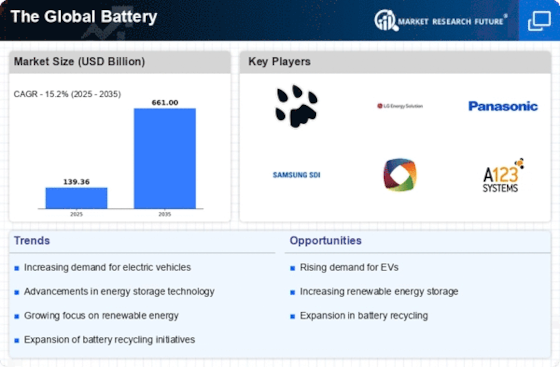
As per MRFR analysis, The Global Battery Market Size was estimated at 139.36 USD Billion in 2024. The battery industry is projected to grow from 160.55 USD Billion in 2025 to 661.0 USD Billion by 2035, exhibiting a compound annual growth rate (CAGR) of 15.2 during the forecast period 2025 - 2035.

Key Market Trends & Highlights

The Global Battery Market is experiencing robust growth driven by technological advancements and increasing demand across various sectors.

  • The market is witnessing a notable shift towards sustainable technologies, particularly in North America. Advancements in battery chemistry are enhancing the performance and efficiency of Lithium-ion batteries, which remain the largest segment. Integration of smart technologies is becoming prevalent, especially in the automotive battery sector, which is currently the largest market segment. Rising demand for electric vehicles and growth in renewable energy storage solutions are key drivers propelling market expansion.

Market Size & Forecast

2024 Market Size 139.36 (USD Billion)
2035 Market Size 661.0 (USD Billion)
CAGR (2025 - 2035) 15.2%
Largest Regional Market Share in 2024 Asia Pacific

Major Players

<p>CATL (CN), <a href="https://www.lgensol.com/en/business-ess-battery">LG Energy Solution</a> (KR), Panasonic (JP), Samsung SDI (KR), BYD (CN), A123 Systems (US), <a href="http://eng.sk-on.com/business/business_01.asp">SK Innovation</a> (KR), Toshiba (JP), Hitachi Energy (JP)</p>

Market Trends

The Battery Market is currently experiencing a transformative phase, driven by the increasing demand for energy storage solutions across various sectors. This surge is largely attributed to the growing emphasis on renewable energy sources, which necessitate efficient storage systems to manage intermittent supply. Additionally, the automotive industry is witnessing a significant shift towards electric vehicles, further propelling the need for advanced battery technologies. As manufacturers strive to enhance performance and sustainability, innovations in battery chemistry and design are becoming more prevalent. Moreover, the rise of portable electronic devices continues to fuel the market, as consumers seek longer-lasting and more efficient power sources. The integration of smart technologies into battery systems is also gaining traction, allowing for improved monitoring and management of energy usage. This evolving landscape suggests that The Battery Market is poised for substantial growth, with a focus on sustainability and technological advancement shaping its future trajectory. Stakeholders are likely to invest in research and development to meet the diverse needs of consumers and industries alike, indicating a dynamic and competitive environment ahead.

Shift Towards Sustainable Technologies

The Battery Market is increasingly leaning towards sustainable technologies, as manufacturers prioritize eco-friendly materials and processes. This trend reflects a broader commitment to reducing environmental impact and enhancing the lifecycle of battery products.

Advancements in Battery Market Chemistry

Innovations in battery chemistry are emerging as a key trend, with research focusing on improving energy density and charging speeds. These advancements are essential for meeting the demands of electric vehicles and portable electronics, potentially revolutionizing performance standards.

Integration of Smart Technologies

The incorporation of smart technologies into battery systems is gaining momentum, enabling enhanced monitoring and management capabilities. This trend suggests a shift towards more intelligent energy solutions, which could optimize performance and efficiency in various applications.

Battery Market Market Drivers

Government Policies and Incentives

Government policies and incentives aimed at promoting clean energy and reducing carbon footprints are significantly shaping The Global Battery Industry. Various countries are implementing subsidies and tax breaks for battery production and electric vehicle purchases, which is likely to stimulate market growth. In 2025, it is expected that these policies will lead to an increase in battery production capacity, potentially exceeding 400 GWh. This regulatory support not only encourages investment in battery technologies but also fosters innovation, thereby enhancing the overall competitiveness of The Battery Industry.

Rising Demand for Electric Vehicles

The increasing adoption of electric vehicles (EVs) is a primary driver for The Battery Industry. As governments worldwide implement stricter emissions regulations and provide incentives for EV purchases, the demand for high-capacity batteries is surging. In 2025, the EV market is projected to grow significantly, with estimates suggesting that battery demand could reach over 300 GWh. This growth is likely to be fueled by advancements in battery technology, which enhance energy density and reduce costs. Consequently, manufacturers are investing heavily in battery production facilities to meet this burgeoning demand, indicating a robust future for The Battery Industry.

Increasing Consumer Electronics Demand

The surging demand for consumer electronics is a notable driver of The Battery Industry. With the proliferation of smartphones, laptops, and wearable devices, the need for compact and efficient batteries is escalating. In 2025, the consumer electronics sector is projected to account for a substantial share of battery consumption, with estimates indicating a demand of over 150 GWh. This trend underscores the importance of batteries in powering everyday devices, thereby reinforcing their critical role in The Battery Industry. Manufacturers are responding by developing batteries that offer longer life cycles and faster charging capabilities.

Growth in Renewable Energy Storage Solutions

The transition towards renewable energy sources, such as solar and wind, is driving the need for efficient energy storage solutions, thereby impacting The Battery Industry. As renewable energy generation becomes more prevalent, the demand for batteries that can store excess energy for later use is increasing. In 2025, the energy storage market is expected to expand, with battery storage capacity projected to exceed 200 GWh. This trend suggests that batteries will play a crucial role in stabilizing energy supply and demand, further solidifying their importance in The Battery Market Outlook.

Technological Innovations in Battery Manufacturing

Technological advancements in battery manufacturing processes are significantly influencing The Battery Industry. Innovations such as solid-state batteries and improved lithium-ion technologies are enhancing battery performance, safety, and longevity. In 2025, the market for advanced battery technologies is anticipated to grow, with investments in research and development reaching unprecedented levels. These innovations not only improve energy efficiency but also reduce production costs, making batteries more accessible to a wider range of applications. As a result, The Battery Industry is likely to experience a transformative shift driven by these technological breakthroughs.

Market Segment Insights

By Type: Lithium-ion Battery Market (Largest) vs. Lead-acid Battery Market (Fastest-Growing)

<p>In The Battery Market, Lithium-ion Batteries dominate the landscape, accounting for a substantial share compared to other battery types. Their widespread adoption is primarily fueled by their high energy density, lightweight nature, and efficiency, leading to their prevalence in consumer electronics and electric vehicles. Following closely, <a href="https://www.marketresearchfuture.com/reports/lead-acid-battery-market-5055">Lead-acid Batteries</a>, traditionally used in automotive applications, have seen a resurgence as new technologies enhance their performance and recyclability, positioning them as a competitor in <a href="https://www.marketresearchfuture.com/reports/energy-storage-market-4476">energy storage</a> solutions. Growth trends indicate that while Lithium-ion Batteries remain the market leaders, Lead-acid Batteries are experiencing rapid growth spurred by the rising demand for renewable energy systems and backup power supplies. Furthermore, innovations in battery technology are expanding the applications for Lead-acid Batteries, enabling their integration into hybrid systems and alternative energy sources. This diversification is expected to solidify their role in the energy transition, with prospects for substantial growth in the coming years.</p>

<p>Lithium-ion Battery Market (Dominant) vs. Lead-acid Battery Market (Emerging)</p>

<p>Lithium-ion Batteries have emerged as the dominant force in The Battery Market due to their superior performance characteristics. Known for their high energy density and long cycle life, these batteries are extensively used in electric vehicles, mobile devices, and renewable energy systems. The increased emphasis on reducing carbon emissions has further boosted their adoption. In contrast, Lead-acid Batteries, although traditionally seen as the standard in automotive uses, are now categorized as an emerging technology due to innovations that improve their efficiency and sustainability. With enhanced recycling processes and new applications in energy storage and backup power solutions, Lead-acid Batteries are re-establishing themselves as a viable option, particularly in markets focused on affordable energy storage.</p>

By Application: Automotive Batteries (Largest) vs. Portable Batteries (Fastest-Growing)

<p>The Battery Market exhibits a diverse range of applications, with automotive batteries holding the largest share. This segment caters to various transportation needs, including electric vehicles, passenger cars, and motorcycles. Portable batteries, designed for consumer electronics and portable devices, are increasingly significant due to rising demand from mobile phone and laptop industries. Other segments like industrial and <a href="https://www.marketresearchfuture.com/reports/power-tools-market-3571">power tool</a> batteries are also growing but remain smaller in comparison.</p>

<p>Automotive Batteries (Dominant) vs. Portable Batteries (Emerging)</p>

<p><a href="https://www.marketresearchfuture.com/reports/automotive-battery-market-4763">Automotive batteries</a> are characterized by their robust design and durability, making them essential for a variety of vehicles. They are mainly lead-acid or lithium-based, with advancements prompting a shift toward lithium-ion technology for electric vehicles. On the other hand, portable batteries, which include lithium-ion and nickel-metal hydride cells, are emerging rapidly due to the heightened demand for mobility and convenience in personal electronics. Their compact size and high energy density are vital for powering devices on the go, reflecting broader trends in consumer behavior and technological advancements.</p>

Get more detailed insights about Battery Market Research Report - Forecast to 2035

Regional Insights

By region, the study provides market insights into North America, Europe, Asia-Pacific, and the Rest of the World. The highest revenue share was attributed to Asia Pacific. Due to rising vehicle production, fast industrial expansion, and increasing demand throughout the area, Asia Pacific is a significant consumer of batteries. Due to their low setup and production costs and accessibility to a competent labour pool, China and India are the main producers in the consumer electronics sector.

Figure 3 Battery Market Share By Region 2021 (%)

BATTERY MARKET SHARE BY REGION 2021

Source Secondary Research, Primary Research, MRFR Database, and Analyst Review

North America is anticipated to have tremendous growth. The regional market is primarily driven by reasons such as falling Li-ion battery prices, rising consumer electronics sales, quick adoption of electric cars, and a developing renewable sector. Additionally, North America continues to be a leader in battery research and development as well as one of the world's biggest users of batteries.

Europe is projected to experience notable growth. Europe has long been one of the world's top automakers, and it will hold this position well into the future. Key automakers including Audi, BMW, Volvo, Jaguar, Ferrari, Mercedes Benz, Porsche, and Lamborghini are present in the area, which will boost the expansion of the automotive sector and, as a result, increase demand for industrial batteries throughout the forecasted period.

Key Players and Competitive Insights

The Global Battery is currently characterized by intense competition and rapid innovation, driven by the increasing demand for electric vehicles (EVs), renewable energy storage, and portable electronics. Key players such as CATL (China), LG Energy Solution (South Korea), and BYD (China) are at the forefront, each adopting distinct strategies to enhance their market positioning. CATL (China) focuses on expanding its production capacity and technological advancements in battery chemistry, while LG Energy Solution (South Korea) emphasizes strategic partnerships with automotive manufacturers to secure long-term supply agreements. BYD (China) is diversifying its product offerings and investing in vertical integration to control its supply chain, thereby enhancing its competitive edge. Collectively, these strategies contribute to a dynamic competitive environment, where innovation and strategic collaborations are paramount.

In terms of business tactics, companies are increasingly localizing manufacturing to mitigate supply chain disruptions and optimize logistics. This trend is particularly evident in the context of The Global Battery, which appears moderately fragmented, with several players vying for market share. The collective influence of these key players shapes the market structure, as they engage in strategic maneuvers to enhance their operational efficiencies and market reach.

In August 2025, LG Energy Solution (South Korea) announced a significant partnership with a leading automotive manufacturer to develop next-generation battery technologies. This collaboration is poised to accelerate the development of high-capacity batteries, which are essential for the growing EV market. The strategic importance of this partnership lies in its potential to enhance LG's technological capabilities and solidify its position as a preferred supplier in the automotive sector.

In September 2025, CATL (China) unveiled a new battery recycling initiative aimed at reducing environmental impact and promoting sustainability. This initiative not only aligns with global sustainability goals but also positions CATL as a leader in the circular economy within the battery industry. The strategic significance of this move is underscored by the increasing regulatory pressures on battery manufacturers to adopt sustainable practices, thereby enhancing CATL's reputation and market appeal.

In October 2025, BYD (China) launched a new line of solid-state batteries, which are expected to offer higher energy density and improved safety compared to traditional lithium-ion batteries. This innovation is crucial as it addresses consumer concerns regarding battery safety and performance, potentially giving BYD a competitive advantage in the rapidly evolving battery landscape. The introduction of solid-state technology signifies a pivotal shift in battery development, reflecting the industry's focus on innovation and performance.

As of October 2025, current competitive trends in The Global Battery are increasingly defined by digitalization, sustainability, and the integration of artificial intelligence in manufacturing processes. Strategic alliances are becoming more prevalent, as companies recognize the need to collaborate to enhance technological capabilities and market reach. Looking ahead, competitive differentiation is likely to evolve from traditional price-based competition to a focus on innovation, advanced technology, and supply chain reliability, underscoring the importance of adaptability in a rapidly changing market.

Key Companies in the Battery Market market include

Industry Developments

Q2 2025: CATL to Open New $2 Billion Battery Market Plant in Hungary Contemporary Amperex Technology Co. Ltd. (CATL) announced the opening of a new $2 billion battery manufacturing facility in Debrecen, Hungary, aimed at supplying European automakers with lithium-ion batteries.

Q2 2025: Panasonic Energy and Mazda Announce EV Battery Market Partnership Panasonic Energy and Mazda entered into a strategic partnership to supply cylindrical lithium-ion batteries for Mazda’s next-generation electric vehicles, with production set to begin in 2026.

Q2 2025: Northvolt Raises $1.2 Billion to Expand Battery Market Production in Europe Swedish battery maker Northvolt secured $1.2 billion in new funding to accelerate the expansion of its European gigafactories, supporting growing demand from the automotive and energy storage sectors.

Q2 2025: General Motors and POSCO Future M Open Battery Market Materials Plant in Canada General Motors and POSCO Future M officially opened a new battery materials facility in Quebec, Canada, to produce cathode active materials for GM’s Ultium batteries.

Q1 2025: Redwood Materials Secures $500 Million in Series D Funding Battery Market recycling startup Redwood Materials raised $500 million in a Series D funding round to expand its recycling operations and build a new facility in the United States.

Q1 2025: BYD Launches New Sodium-Ion Battery Market for Electric Vehicles Chinese automaker BYD unveiled its first sodium-ion battery for electric vehicles, marking a significant step toward diversifying battery chemistries and reducing reliance on lithium.

Q1 2025: SK On Signs $3 Billion Battery Market Supply Deal with Ford South Korea’s SK On signed a $3 billion multi-year contract to supply batteries for Ford’s next generation of electric vehicles in North America.

Q4 2024: Tesla Appoints New Head of Battery Market Engineering Tesla announced the appointment of Dr. Maria Chen as Senior Vice President of Battery Market Engineering, overseeing the company’s global battery technology and manufacturing strategy.

Q4 2024: LG Energy Solution and Honda Open Joint Battery Market Plant in Ohio LG Energy Solution and Honda inaugurated their joint $4.4 billion battery manufacturing facility in Ohio, which will supply batteries for Honda and Acura electric vehicles in North America.

Q4 2024: QuantumScape Receives Regulatory Approval for Solid-State Battery Market Pilot Line QuantumScape received regulatory approval to begin operations at its solid-state battery pilot manufacturing line in California, a key milestone toward commercializing next-generation batteries.

Q3 2024: Samsung SDI and Stellantis Announce $2.5 Billion Battery Market Plant in Indiana Samsung SDI and Stellantis broke ground on a $2.5 billion battery manufacturing plant in Indiana, expected to supply batteries for Stellantis’ electric vehicles in the U.S. market.

Q3 2024: CATL Signs Long-Term Battery Market Supply Agreement with BMW CATL announced a long-term agreement to supply BMW with lithium-ion batteries for its upcoming electric vehicle models, strengthening their existing partnership.

Future Outlook

Battery Market Future Outlook

<p>The Battery Market is projected to grow at a 15.2% CAGR from 2024 to 2035, driven by advancements in electric vehicles, renewable energy storage, and consumer electronics.</p>

New opportunities lie in:

  • <p>Development of solid-state battery technologies for enhanced safety and performance.</p><p>Expansion of battery recycling facilities to capture valuable materials.</p><p>Integration of AI for predictive maintenance in battery management systems.</p>

<p>By 2035, The Battery Market is expected to be robust, driven by innovation and sustainability.</p>

Market Segmentation

Battery Market Type Outlook

  • Lead-acid Battery
  • Flow Battery
  • Nickel-metal Hybrid Battery
  • Small Sealed Lead-acid Battery
  • Sodium-sulfur Battery
  • Zinc-manganese dioxide Battery
  • Lithium-ion Battery
  • Nickel-ion Battery
  • Others

Battery Market Application Outlook

  • SLI Batteries
  • Automotive Batteries
  • Portable Batteries
  • Industrial Batteries
  • Power Tool Batteries
  • Consumer Electronics

Report Scope

MARKET SIZE 2024139.36(USD Billion)
MARKET SIZE 2025160.55(USD Billion)
MARKET SIZE 2035661.0(USD Billion)
COMPOUND ANNUAL GROWTH RATE (CAGR)15.2% (2024 - 2035)
REPORT COVERAGERevenue Forecast, Competitive Landscape, Growth Factors, and Trends
BASE YEAR2024
Market Forecast Period2025 - 2035
Historical Data2019 - 2024
Market Forecast UnitsUSD Billion
Key Companies ProfiledMarket analysis in progress
Segments CoveredMarket segmentation analysis in progress
Key Market OpportunitiesAdvancements in solid-state battery technology enhance energy density and safety in The Global Battery Market.
Key Market DynamicsRising demand for electric vehicles drives innovation and competition in battery technology and supply chain management.
Countries CoveredNorth America, Europe, APAC, South America, MEA

FAQs

What is the current valuation of The Global Battery as of 2024?

The Global Battery was valued at 139.36 USD Billion in 2024.

What is the projected market valuation for The Global Battery in 2035?

The market is projected to reach a valuation of 661.0 USD Billion by 2035.

What is the expected CAGR for The Global Battery during the forecast period 2025 - 2035?

The expected CAGR for The Global Battery during 2025 - 2035 is 15.2%.

Which battery type holds the largest market share in terms of valuation?

Lithium-ion Batteries dominate the market with a valuation range of 70.0 to 350.0 USD Billion.

What are the projected valuations for Lead-acid Batteries in The Global Battery?

Lead-acid Batteries are projected to have a valuation range of 20.0 to 90.0 USD Billion.

How do Automotive Batteries perform in The Global Battery?

Automotive Batteries are expected to range from 30.0 to 150.0 USD Billion in valuation.

Which companies are considered key players in The Global Battery?

Key players include CATL, LG Energy Solution, Panasonic, Samsung SDI, and BYD.

  1. Executive Summary
  2. Research Methodology
    1. Scope of the Study
      1. Definition
      2. Research Objective
      3. Assumptions
      4. Limitations
    2. Research Process
      1. Primary Research
      2. Secondary Research
    3. Market size Estimation
    4. Forecast Model
  3. Market Dynamics
    1. Market Drivers
    2. Market Inhibitors
    3. Supply/Value Chain Analysis
    4. Porter’s Five Forces Analysis
  4. Global Battery market, By Battery Type
    1. Introduction
    2. Lead acid
    3. Lithium ion
    4. Nickel metal hydride
    5. Nickel cadmium
  5. Global Battery market, By Application
    1. Introduction
    2. Portable
    3. Automotive
    4. Industrial
  6. Regional Market Analysis
    1. Introduction
    2. North America
      1. U.S.
      2. Canada
    3. Europe
      1. U.K
      2. France
      3. Germany
      4. Spain
      5. Rest of Europe
    4. Asia-Pacific
      1. China
      2. Japan
      3. India
      4. Rest of Asia-Pacific
    5. Rest of the World
  7. Competitive Analysis
    1. Introduction
    2. Competitive Scenario
      1. Market Share Analysis
      2. Market Development Analysis
      3. Battery Type/Service Benchmarking
    3. Exide Technologies
      1. Overview
      2. Battery Type/Service Offering
      3. Strategy
    4. Douglas Battery
      1. Overview
      2. Battery Type/Service Offering
      3. Strategy
    5. East Penn Manufacturing Co.
      1. Overview
      2. Battery Type/Service Offering
      3. Strategy
    6. Johnson Controls Inc
      1. Overview
      2. Battery Type/Service Offering
      3. Strategy
    7. The Furukawa Battery Co. ltd
      1. Overview
      2. Battery Type/Service Offering
      3. Strategy
    8. Zhejiang Haijiu Battery Co. Ltd
      1. Overview
      2. Battery Type/Service Offering
      3. Strategy
    9. Chaowei Power Holding ltd
      1. Overview
      2. Battery Type/Service Offering
      3. Strategy
    10. CamelGroup
      1. Overview
      2. Battery Type/Service Offering
      3. Strategy
    11. Fengfan Co. Ltd
      1. Overview
      2. Battery Type/Service Offering
      3. Strategy
  8. LIST OF TABLES
  9. GLOBAL BATTERY MARKET, BY BATTERY TYPE
  10. GLOBAL BATTERY MARKET, BY APPLICATION
  11. GLOBAL BATTERY MARKET, BY REGIONS
  12. NORTH AMERICA BATTERY MARKET, BY BATTERY TYPE
  13. NORTH AMERICA BATTERY MARKET, BY APPLICATION
  14. U.S. BATTERY MARKET, BY BATTERY TYPE
  15. U.S. BATTERY MARKET, BY APPLICATION
  16. CANADA BATTERY MARKET, BY BATTERY TYPE
  17. CANADA BATTERY MARKET, BY APPLICATION
  18. EUROPE BATTERY MARKET, BY BATTERY TYPE
  19. EUROPE BATTERY MARKET, BY APPLICATION
  20. GERMANY BATTERY MARKET, BY BATTERY TYPE
  21. GERMANY BATTERY MARKET, BY APPLICATION
  22. FRANCE BATTERY MARKET, BY BATTERY TYPE
  23. FRANCE BATTERY MARKET, BY APPLICATION
  24. U.K. BATTERY MARKET, BY BATTERY TYPE
  25. U.K. BATTERY MARKET, BY APPLICATION
  26. REST OF EUROPE BATTERY MARKET, BY BATTERY TYPE
  27. REST OF EUROPE BATTERY MARKET, BY APPLICATION
  28. ASIA-PACIFIC BATTERY MARKET, BY BATTERY TYPE
  29. ASIA-PACIFIC BATTERY MARKET, BY APPLICATION
  30. ROW BATTERY MARKET, BY BATTERY TYPE
  31. ROW BATTERY MARKET, BY APPLICATION
  32. LIST OF FIGURES
  33. RESEARCH METHODOLOGY
  34. GLOBAL BATTERY MARKET: BY BATTERY TYPE (%)
  35. GLOBAL BATTERY MARKET: BY APPLICATION (%)
  36. GLOBAL BATTERY MARKET: BY REGION
  37. NORTH AMERICA BATTERY MARKET, BY BATTERY TYPE (%)
  38. NORTH AMERICA BATTERY MARKET, BY APPLICATION (%)
  39. EUROPE BATTERY MARKET, BY BATTERY TYPE (%)
  40. EUROPE BATTERY MARKET, BY APPLICATION (%)
  41. ASIA-PACIFIC BATTERY MARKET, BY BATTERY TYPE (%)
  42. ASIA-PACIFIC BATTERY MARKET, BY APPLICATION (%)
  43. ROW BATTERY MARKET, BY BATTERY TYPE (%)
  44. ROW BATTERY MARKET, BY APPLICATION (%)

Battery Market Segmentation

Battery Type Outlook (USD Million, 2018-2030)

Lead-acid Battery

Flow Battery

Nickel-metal Hybrid Battery

Small Sealed Lead-acid Battery

Sodium-sulfur Battery

Zinc-manganese dioxide Battery

Lithium-ion Battery

Nickel-ion battery

Others

Battery Application Outlook (USD Million, 2018-2030)

SLI Batteries

Automotive Batteries

Portable Batteries

Industrial Batteries

Power Tool Batteries

Consumer Electronics

Battery Regional Outlook (USD Million, 2018-2030)

North America Outlook (USD Million, 2018-2030)

North America Battery by Battery Type

Lead-acid Battery

Flow Battery

Nickel-metal Hybrid Battery

Small Sealed Lead-acid Battery

Sodium-sulfur Battery

Zinc-manganese dioxide Battery

Lithium-ion Battery

Nickel-ion battery

Others

North America Battery by Application

SLI Batteries

Automotive Batteries

Portable Batteries

Industrial Batteries

Power Tool Batteries

Consumer Electronics

US Outlook (USD Million, 2018-2030)

US Battery by Battery Type

Lead-acid Battery

Flow Battery

Nickel-metal Hybrid Battery

Small Sealed Lead-acid Battery

Sodium-sulfur Battery

Zinc-manganese dioxide Battery

Lithium-ion Battery

Nickel-ion battery

Others

US Battery by Application

SLI Batteries

Automotive Batteries

Portable Batteries

Industrial Batteries

Power Tool Batteries

Consumer Electronics

CANADA Outlook (USD Million, 2018-2030)

CANADA Battery by Battery Type

Lead-acid Battery

Flow Battery

Nickel-metal Hybrid Battery

Small Sealed Lead-acid Battery

Sodium-sulfur Battery

Zinc-manganese dioxide Battery

Lithium-ion Battery

Nickel-ion battery

Others

CANADA Battery by Application

SLI Batteries

Automotive Batteries

Portable Batteries

Industrial Batteries

Power Tool Batteries

Consumer Electronics

Europe Outlook (USD Million, 2018-2030)

Europe Battery by Battery Type

Lead-acid Battery

Flow Battery

Nickel-metal Hybrid Battery

Small Sealed Lead-acid Battery

Sodium-sulfur Battery

Zinc-manganese dioxide Battery

Lithium-ion Battery

Nickel-ion battery

Others

Europe Battery by Application

SLI Batteries

Automotive Batteries

Portable Batteries

Industrial Batteries

Power Tool Batteries

Consumer Electronics

Germany Outlook (USD Million, 2018-2030)

Germany Battery by Battery Type

Lead-acid Battery

Flow Battery

Nickel-metal Hybrid Battery

Small Sealed Lead-acid Battery

Sodium-sulfur Battery

Zinc-manganese dioxide Battery

Lithium-ion Battery

Nickel-ion battery

Others

Germany Battery by Application

SLI Batteries

Automotive Batteries

Portable Batteries

Industrial Batteries

Power Tool Batteries

Consumer Electronics

France Outlook (USD Million, 2018-2030)

France Battery by Battery Type

Lead-acid Battery

Flow Battery

Nickel-metal Hybrid Battery

Small Sealed Lead-acid Battery

Sodium-sulfur Battery

Zinc-manganese dioxide Battery

Lithium-ion Battery

Nickel-ion battery

Others

France Battery by Application

SLI Batteries

Automotive Batteries

Portable Batteries

Industrial Batteries

Power Tool Batteries

Consumer Electronics

UK Outlook (USD Million, 2018-2030)

UK Battery by Battery Type

Lead-acid Battery

Flow Battery

Nickel-metal Hybrid Battery

Small Sealed Lead-acid Battery

Sodium-sulfur Battery

Zinc-manganese dioxide Battery

Lithium-ion Battery

Nickel-ion battery

Others

UK Battery by Application

SLI Batteries

Automotive Batteries

Portable Batteries

Industrial Batteries

Power Tool Batteries

Consumer Electronics

ITALY Outlook (USD Million, 2018-2030)

ITALY Battery by Battery Type

Lead-acid Battery

Flow Battery

Nickel-metal Hybrid Battery

Small Sealed Lead-acid Battery

Sodium-sulfur Battery

Zinc-manganese dioxide Battery

Lithium-ion Battery

Nickel-ion battery

Others

ITALY Battery by Application

SLI Batteries

Automotive Batteries

Portable Batteries

Industrial Batteries

Power Tool Batteries

Consumer Electronics

SPAIN Outlook (USD Million, 2018-2030)

Spain Battery by Battery Type

Lead-acid Battery

Flow Battery

Nickel-metal Hybrid Battery

Small Sealed Lead-acid Battery

Sodium-sulfur Battery

Zinc-manganese dioxide Battery

Lithium-ion Battery

Nickel-ion battery

Others

Spain Battery by Application

SLI Batteries

Automotive Batteries

Portable Batteries

Industrial Batteries

Power Tool Batteries

Consumer Electronics

Rest Of Europe Outlook (USD Million, 2018-2030)

REST OF EUROPE Battery by Battery Type

Lead-acid Battery

Flow Battery

Nickel-metal Hybrid Battery

Small Sealed Lead-acid Battery

Sodium-sulfur Battery

Zinc-manganese dioxide Battery

Lithium-ion Battery

Nickel-ion battery

Others

REST OF EUROPE Battery by Application

SLI Batteries

Automotive Batteries

Portable Batteries

Industrial Batteries

Power Tool Batteries

Consumer Electronics

Asia-Pacific Outlook (USD Million, 2018-2030)

Asia-Pacific Battery by Battery Type

Lead-acid Battery

Flow Battery

Nickel-metal Hybrid Battery

Small Sealed Lead-acid Battery

Sodium-sulfur Battery

Zinc-manganese dioxide Battery

Lithium-ion Battery

Nickel-ion battery

Others

Asia-Pacific Battery by Application

SLI Batteries

Automotive Batteries

Portable Batteries

Industrial Batteries

Power Tool Batteries

Consumer Electronics

China Outlook (USD Million, 2018-2030)

China Battery by Battery Type

Lead-acid Battery

Flow Battery

Nickel-metal Hybrid Battery

Small Sealed Lead-acid Battery

Sodium-sulfur Battery

Zinc-manganese dioxide Battery

Lithium-ion Battery

Nickel-ion battery

Others

China Battery by Application

SLI Batteries

Automotive Batteries

Portable Batteries

Industrial Batteries

Power Tool Batteries

Consumer Electronics

Japan Outlook (USD Million, 2018-2030)

Japan Battery by Battery Type

Lead-acid Battery

Flow Battery

Nickel-metal Hybrid Battery

Small Sealed Lead-acid Battery

Sodium-sulfur Battery

Zinc-manganese dioxide Battery

Lithium-ion Battery

Nickel-ion battery

Others

Japan Battery by Application

SLI Batteries

Automotive Batteries

Portable Batteries

Industrial Batteries

Power Tool Batteries

Consumer Electronics

India Outlook (USD Million, 2018-2030)

India Battery by Battery Type

Lead-acid Battery

Flow Battery

Nickel-metal Hybrid Battery

Small Sealed Lead-acid Battery

Sodium-sulfur Battery

Zinc-manganese dioxide Battery

Lithium-ion Battery

Nickel-ion battery

Others

India Battery by Application

SLI Batteries

Automotive Batteries

Portable Batteries

Industrial Batteries

Power Tool Batteries

Consumer Electronics

Australia Outlook (USD Million, 2018-2030)

Australia Battery by Battery Type

Lead-acid Battery

Flow Battery

Nickel-metal Hybrid Battery

Small Sealed Lead-acid Battery

Sodium-sulfur Battery

Zinc-manganese dioxide Battery

Lithium-ion Battery

Nickel-ion battery

Others

Australia Battery by Application

SLI Batteries

Automotive Batteries

Portable Batteries

Industrial Batteries

Power Tool Batteries

Consumer Electronics

Rest of Asia-Pacific Outlook (USD Million, 2018-2030)

Rest of Asia-Pacific Battery by Battery Type

Lead-acid Battery

Flow Battery

Nickel-metal Hybrid Battery

Small Sealed Lead-acid Battery

Sodium-sulfur Battery

Zinc-manganese dioxide Battery

Lithium-ion Battery

Nickel-ion battery

Others

Rest of Asia-Pacific Battery by Application

SLI Batteries

Automotive Batteries

Portable Batteries

Industrial Batteries

Power Tool Batteries

Consumer Electronics

Rest of the World Outlook (USD Million, 2018-2030)

Rest of the World Battery by Battery Type

Lead-acid Battery

Flow Battery

Nickel-metal Hybrid Battery

Small Sealed Lead-acid Battery

Sodium-sulfur Battery

Zinc-manganese dioxide Battery

Lithium-ion Battery

Nickel-ion battery

Others

Rest of the World Battery by Application

SLI Batteries

Automotive Batteries

Portable Batteries

Industrial Batteries

Power Tool Batteries

Consumer Electronics

Middle East Outlook (USD Million, 2018-2030)

Middle East Battery by Battery Type

Lead-acid Battery

Flow Battery

Nickel-metal Hybrid Battery

Small Sealed Lead-acid Battery

Sodium-sulfur Battery

Zinc-manganese dioxide Battery

Lithium-ion Battery

Nickel-ion battery

Others

Middle East Battery by Application

SLI Batteries

Automotive Batteries

Portable Batteries

Industrial Batteries

Power Tool Batteries

Consumer Electronics

Africa Outlook (USD Million, 2018-2030)

Africa Battery by Battery Type

Lead-acid Battery

Flow Battery

Nickel-metal Hybrid Battery

Small Sealed Lead-acid Battery

Sodium-sulfur Battery

Zinc-manganese dioxide Battery

Lithium-ion Battery

Nickel-ion battery

Others

Africa Battery by Application

SLI Batteries

Automotive Batteries

Portable Batteries

Industrial Batteries

Power Tool Batteries

Consumer Electronics

Latin America Outlook (USD Million, 2018-2030)

Latin America Battery by Battery Type

Lead-acid Battery

Flow Battery

Nickel-metal Hybrid Battery

Small Sealed Lead-acid Battery

Sodium-sulfur Battery

Zinc-manganese dioxide Battery

Lithium-ion Battery

Nickel-ion battery

Others

Latin America Battery by Application

SLI Batteries

Automotive Batteries

Portable Batteries

Industrial Batteries

Power Tool Batteries

Consumer Electronics

Infographic

Free Sample Request

Kindly complete the form below to receive a free sample of this Report

Get Free Sample

Customer Strories

Compare Licence

×
Features License Type
Single User Multiuser License Enterprise User
Price $4,950 $5,950 $7,250
Maximum User Access Limit 1 User Upto 10 Users Unrestricted Access Throughout the Organization
Free Customization
Direct Access to Analyst
Deliverable Format
Platform Access
Discount on Next Purchase 10% 15% 15%
Printable Versions