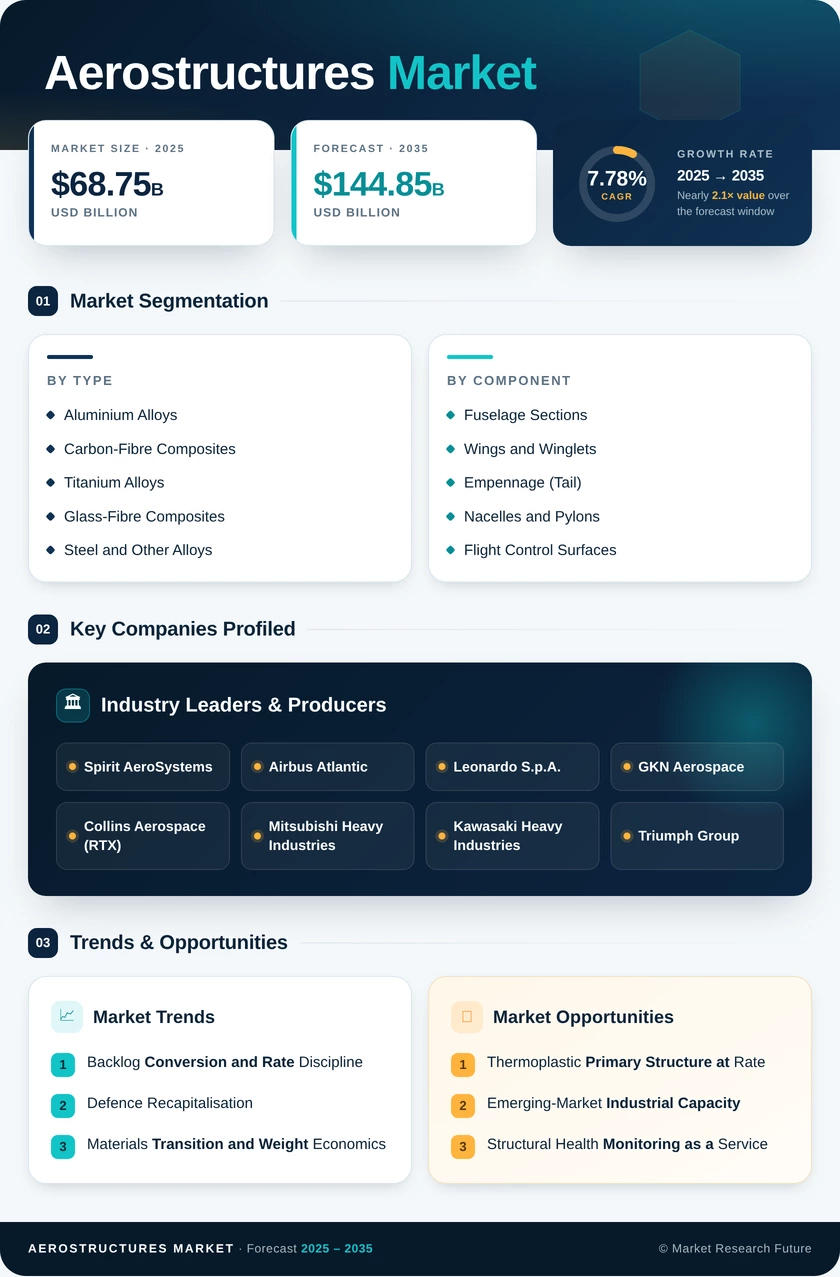
Segmentation Quick Reference
| Dimension | Sub-Segments | Dominant Segment | Fastest Growing Segment |
| By Aircraft Type | Narrow-Body (Single-Aisle); Wide-Body; Regional Jets; Military Aircraft and Rotorcraft; Unmanned Aerial Vehicles | Narrow-Body (Single-Aisle) | Unmanned Aerial Vehicles |
| By Component | Fuselage Sections; Wings and Winglets; Empennage (Tail); Nacelles and Pylons; Flight Control Surfaces; Doors and Other Structures | Fuselage Sections | Nacelles and Pylons |
| By Material Type | Aluminium Alloys; Titanium Alloys; Carbon-Fibre Composites; Glass-Fibre Composites; Steel and Other Alloys | Aluminium Alloys | Carbon-Fibre Composites |
| By End User | OEMs; Tier-1 Integrators; Aftermarket / MRO | Tier-1 Integrators | Aftermarket / MRO |
| By Geography | North America; Europe; Asia-Pacific; South America; Middle East & Africa | North America | Asia-Pacific |
Market Segmentation Overview
By Aircraft Type
| Sub-Segment | Key Trend |
| Narrow-Body (Single-Aisle) | Rate ramps toward 75 aircraft per month drive sustained shipset volume |
| Wide-Body | Long-haul recovery and freighter conversions restore high-content demand |
| Regional Jets | Ageing fleet replacement supports steady, low-volatility volume |
| Military Aircraft and Rotorcraft | Recapitalisation budgets lift margin mix for dual-track suppliers |
| Unmanned Aerial Vehicles | All-composite airframes and fleet-scale procurement drive fastest growth |
Platform mix determines supplier economics more than any other variable. Single-aisle work rewards throughput and automation, while wide-body and military packages reward engineering depth and certification experience — few suppliers excel at both simultaneously.
By Component
| Sub-Segment | Key Trend |
| Fuselage Sections | Barrel and panel production shifting toward automated fibre placement |
| Wings and Winglets | High-aspect-ratio and folding-tip architectures increase design complexity |
| Empennage (Tail) | Composite conversion of stabilisers reduces weight and part count |
| Nacelles and Pylons | New engine programmes expand thermal and acoustic content per aircraft |
| Flight Control Surfaces | Morphing and electrically actuated surfaces raise integration value |
| Doors and Other Structures | Freighter conversion and cabin reconfiguration sustain replacement demand |
Component selection defines where a supplier sits on the risk curve. Primary structure carries the highest barriers and the stickiest positions; secondary structure is more contestable and increasingly sourced from emerging-market capacity.
By Material Type
| Sub-Segment | Key Trend |
| Aluminium Alloys | Third-generation aluminium-lithium defends share on metallic platforms |
| Titanium Alloys | Demand rises with composite adoption due to galvanic compatibility |
| Carbon-Fibre Composites | Thermoplastic press-forming unlocks high-rate primary structure |
| Glass-Fibre Composites | Cost-effective choice for fairings and secondary panels |
| Steel and Other Alloys | Concentrated in landing gear interfaces and high-load fittings |
Material strategy is now a competitive moat. Suppliers that invested early in out-of-autoclave processing hold qualification advantages that competitors cannot replicate quickly, given multi-year substantiation timelines.
By End User
| Sub-Segment | Key Trend |
| OEMs | Reversing outsourcing to regain control of critical structures |
| Tier-1 Integrators | Absorbing large work packages while renegotiating risk-sharing terms |
| Aftermarket / MRO | Fleet ageing and life-extension programmes lift high-margin repair demand |
Buyer structure is in genuine flux. The outsourcing consensus that defined the 2000s has partially unwound, and suppliers are repositioning around whichever segments retain durable design authority.
You’ve used 75% of your weekly limit

 Noah Malgeri
Co-Founder
Noah Malgeri
Co-Founder

 Peter Groot koerkamp
Account and Business Manager
Peter Groot koerkamp
Account and Business Manager

 Younghwan Choi
Senior Retail Manager
Younghwan Choi
Senior Retail Manager

 Mark Irwin
Management Consultant
Mark Irwin
Management Consultant

 Akif Moroglu
Strategy & Business Development Director
Akif Moroglu
Strategy & Business Development Director

 Guilherme Gomes Martins
Product Management Director
Guilherme Gomes Martins
Product Management Director

 Joseph Aguayo
Sales Operations & Pricing Manager
Joseph Aguayo
Sales Operations & Pricing Manager

 La Terria Dodd
Program Support Specialist
La Terria Dodd
Program Support Specialist

 Rob Kooiker
Group Product Manager HVAC & Fire Protection GMA
Rob Kooiker
Group Product Manager HVAC & Fire Protection GMA