Request Free Sample ×

Kindly complete the form below to receive a free sample of this Report

* Please use a valid business email

Leading companies partner with us for data-driven Insights

clients tt-cursor
Hero Background
English
Chinese
French
Japanese
Korean
German
Spanish

Aerospace Coatings Market Trends

ID: MRFR/CnM/2011-HCR
111 Pages
Chitranshi Jaiswal
March 2026

Aerospace Coating Market Research Report Information By Resin Type (Epoxy, Polyurethane, Acrylic, and Others), By End-Use (Commercial, Military, and Others), By Industry (OEM and MRO), By Application (Exterior and Interior), And By Region (North America, Europe, Asia-Pacific, And Rest Of The World) –Market Forecast Till 2035.

Share:
Download PDF ×

We do not share your information with anyone. However, we may send you emails based on your report interest from time to time. You may contact us at any time to opt-out.

Aerospace Coatings Market Infographic
Purchase Options

Market Trends

Key Emerging Trends in the Aerospace Coatings Market

The aerospace coating market has been marked by significant trends, reflecting the intricate demands of the aerospace industry. Aerospace coatings are crucial for protecting aircraft surfaces from corrosion, erosion, and environmental factors while also enhancing their aesthetic appeal. Several key factors are shaping the market trends in the aerospace coating sector.

Raw materials costs are currently fluctuating widely. This can push the cost of the raw materials needed to make aerospace coatings up dramatically. The result is that airplane manufacturers have to use more expensive products which means that they have to produce fewer planes. The aerospace coatings industry has to find ways to keep its products in the affordable range even with wild fluctuations in the price of raw materials.

One notable trend in the aerospace coating market is the increasing demand for environmentally friendly and sustainable coating solutions. As the aerospace industry faces growing scrutiny over its environmental impact, there is a heightened focus on developing coatings with reduced volatile organic compound (VOC) emissions and environmentally responsible formulations. Manufacturers are investing in research and development to create water-based and eco-friendly aerospace coatings that meet stringent environmental regulations without compromising on performance. This trend aligns with the broader push towards sustainable practices across industries.

Technological advancements are playing a pivotal role in shaping the aerospace coating market. Continuous innovation in coating technologies, such as the development of smart coatings with self-healing properties, anti-icing capabilities, and enhanced durability, is gaining momentum. These advanced coatings contribute to the overall performance and longevity of aircraft surfaces, reducing maintenance costs and enhancing operational efficiency. The aerospace industry is increasingly adopting coatings with specialized functionalities to address specific challenges, such as extreme weather conditions and the need for increased fuel efficiency.

The growing importance of military aerospace applications is another key driver of market trends in the aerospace coating sector. Military aircraft operate in diverse and challenging environments, requiring coatings that provide superior protection and stealth capabilities. The development of coatings with radar-absorbing properties, low infrared signatures, and resistance to chemical and biological agents is gaining prominence in military aviation. The evolving geopolitical landscape and increased defense spending further contribute to the demand for advanced aerospace coatings tailored for military applications.

The shift towards lightweight materials in aircraft design is influencing market dynamics in the aerospace coating sector. As the aerospace industry emphasizes fuel efficiency and reduced emissions, there is a growing trend towards lightweight composite materials in aircraft construction. Coatings specifically formulated for these materials, offering corrosion resistance and compatibility with composite surfaces, are gaining importance. This trend is expected to continue as the aviation industry explores innovative materials to achieve weight reduction and enhance overall aircraft performance.

Global economic factors and regional dynamics also impact market trends in the aerospace coating industry. Economic growth, airline fleet expansions, and increasing air travel contribute to the demand for aerospace coatings. The Asia-Pacific region, in particular, has witnessed substantial growth in commercial aviation, with rising aircraft deliveries and maintenance activities. Moreover, regional regulations and standards, including those related to environmental protection and safety, influence the adoption of aerospace coatings in different markets.


Author
Author Profile
Chitranshi Jaiswal
Team Lead - Research

Chitranshi is a Team Leader in the Chemicals & Materials (CnM) and Energy & Power (EnP) domains, with 6+ years of experience in market research. She leads and mentors teams to deliver cross-domain projects that equip clients with actionable insights and growth strategies. She is skilled in market estimation, forecasting, competitive benchmarking, and both primary & secondary research, enabling her to turn complex data into decision-ready insights. An engineer and MBA professional, she combines technical expertise with strategic acumen to solve dynamic market challenges. Chitranshi has successfully managed projects that support market entry, investment planning, and competitive positioning, while building strong client relationships. Certified in Advanced Excel & Power BI she leverages data-driven approaches to ensure accuracy, clarity, and impactful outcomes.

Leave a Comment

FAQs

What is the projected market valuation of the Aerospace Coating Market by 2035?

<p>The Aerospace Coating Market is projected to reach a valuation of 39.31 USD Billion by 2035.</p>

What was the market valuation of the Aerospace Coating Market in 2024?

<p>In 2024, the Aerospace Coating Market was valued at 21.05 USD Billion.</p>

What is the expected CAGR for the Aerospace Coating Market during the forecast period 2025 - 2035?

<p>The expected CAGR for the Aerospace Coating Market during the forecast period 2025 - 2035 is 5.84%.</p>

Which resin type segment is projected to have the highest valuation by 2035?

<p>The Epoxy resin type segment is projected to reach a valuation of 12.0 USD Billion by 2035.</p>

What are the projected valuations for the Military end-use segment by 2035?

<p>The Military end-use segment is projected to reach a valuation of 11.73 USD Billion by 2035.</p>

Which company is a key player in the Aerospace Coating Market?

<p>AkzoNobel is one of the key players in the Aerospace Coating Market.</p>

What is the projected valuation for the MRO industry segment by 2035?

The MRO industry segment is projected to reach a valuation of 20.19 USD Billion by 2035.

What is the expected valuation for the Aerospace Coating Market's interior application segment by 2035?

The interior application segment is expected to reach a valuation of 20.19 USD Billion by 2035.

What was the valuation of the Commercial end-use segment in 2024?

The Commercial end-use segment was valued at 8.42 USD Billion in 2024.

Which company is likely to lead the Aerospace Coating Market in terms of innovation?

PPG Industries is likely to lead the Aerospace Coating Market in terms of innovation.

Market Summary

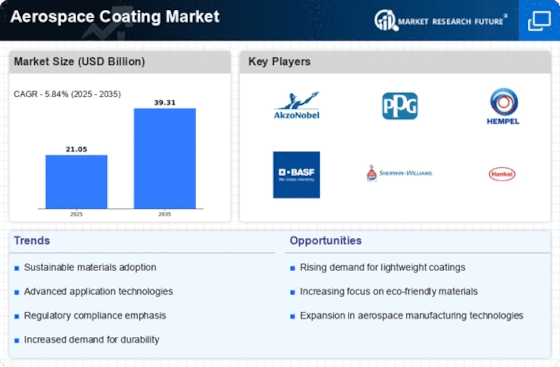
As per Market Research Future analysis, the Aerospace Coating Market Size was estimated at 21.05 USD Billion in 2024. The Aerospace Coating industry is projected to grow from 22.28 USD Billion in 2025 to 39.31 USD Billion by 2035, exhibiting a compound annual growth rate (CAGR) of 5.84% during the forecast period 2025 - 2035

Key Market Trends & Highlights

The Aerospace Coating Market is poised for growth driven by sustainability and technological advancements.

  • North America remains the largest market for aerospace coatings, driven by robust demand from the commercial aviation sector. The Asia-Pacific region is emerging as the fastest-growing market, fueled by increasing investments in aviation infrastructure. Epoxy coatings dominate the market due to their superior performance, while polyurethane coatings are experiencing rapid growth. Key market drivers include the rising demand for lightweight materials and regulatory compliance, which are shaping the industry's future.

Market Size & Forecast

2024 Market Size 21.05 (USD Billion)
2035 Market Size 39.31 (USD Billion)
CAGR (2025 - 2035) 5.84%
Largest Regional Market Share in 2024 North America

Major Players

AkzoNobel (NL), PPG Industries (US), Hempel (DK), BASF (DE), Sherwin-Williams (US), Henkel (DE), Mankiewicz (DE), Zircotec (GB), Kansai Paint (JP)

Market Trends

The Aerospace Coating Market is currently experiencing a transformative phase, driven by advancements in technology and increasing demand for lightweight materials. Manufacturers are focusing on developing innovative coatings that enhance durability, corrosion resistance, and thermal protection. This shift is largely influenced by the aerospace industry's need for improved performance and sustainability. As environmental regulations become more stringent, the emphasis on eco-friendly coatings is also growing, prompting companies to explore alternative materials and processes that minimize environmental impact. In addition, the Aerospace Coating Market is witnessing a rise in the adoption of advanced application techniques, such as electrostatic spray and thermal spray methods. These techniques not only improve the efficiency of coating application but also ensure a more uniform finish. Furthermore, the expansion of the aerospace sector in emerging economies is likely to create new opportunities for coating manufacturers. As the market evolves, collaboration between coating producers and aerospace manufacturers appears essential to meet the changing demands and expectations of the industry.

Sustainability Initiatives

The Aerospace Coating Market is increasingly prioritizing sustainability, with manufacturers exploring eco-friendly materials and processes. This trend reflects a broader commitment to reducing environmental impact and adhering to stringent regulations.

Technological Advancements

Innovations in coating technologies are reshaping the Aerospace Coating Market. New formulations and application methods enhance performance characteristics, such as durability and resistance to extreme conditions, thereby meeting the evolving needs of the aerospace sector.

Emerging Market Growth

The expansion of the aerospace industry in developing regions is driving demand for coatings. As new players enter the market, there is a growing need for specialized coatings that cater to diverse aircraft designs and operational requirements.

Aerospace Coatings Market Market Drivers

Rising Demand for Sustainable Coatings

The Aerospace Coating Market is witnessing a growing demand for sustainable and eco-friendly coatings. As environmental concerns become more pronounced, manufacturers are increasingly focusing on developing coatings that minimize environmental impact while maintaining high performance. This shift towards sustainability is driven by both regulatory pressures and consumer preferences for greener products. Companies are exploring bio-based materials and low-VOC (volatile organic compounds) formulations to meet these demands. The market for sustainable aerospace coatings is projected to expand significantly, with estimates indicating a potential growth rate of 5% annually as more manufacturers adopt eco-friendly practices.

Growing Military and Defense Expenditure

The Aerospace Coating Market is benefiting from increased military and defense expenditure across various nations. Governments are investing heavily in upgrading their military aircraft fleets, which necessitates the use of advanced coatings to enhance performance and longevity. This trend is particularly evident in regions where geopolitical tensions are rising, prompting nations to bolster their defense capabilities. As a result, the demand for high-performance aerospace coatings is expected to surge, with estimates suggesting a market growth rate of around 7% in the defense sector alone over the next few years. This growth is likely to have a ripple effect on the overall aerospace coatings market.

Increased Demand for Lightweight Materials

The Aerospace Coating Market is experiencing a notable shift towards lightweight materials, driven by the need for fuel efficiency and reduced emissions in aircraft. Manufacturers are increasingly adopting advanced coatings that not only enhance the durability of lightweight materials but also contribute to overall weight reduction. This trend is underscored by the fact that every kilogram saved in aircraft weight can lead to significant fuel savings over time. As a result, the demand for specialized aerospace coatings that cater to these lightweight materials is expected to rise, potentially leading to a market growth rate of around 5% annually over the next few years.

Regulatory Compliance and Safety Standards

The Aerospace Coating Market is heavily influenced by stringent regulatory compliance and safety standards imposed by aviation authorities. These regulations necessitate the use of high-performance coatings that can withstand extreme environmental conditions and ensure the safety of aircraft. As regulations evolve, manufacturers are compelled to innovate and develop coatings that meet these enhanced safety requirements. This has led to an increase in R&D investments within the industry, as companies strive to create coatings that not only comply with regulations but also offer superior performance. The market is projected to grow as companies adapt to these changing standards.

Technological Innovations in Coating Applications

Technological advancements are playing a pivotal role in shaping the Aerospace Coating Market. Innovations such as nanotechnology and advanced application techniques are enhancing the performance and efficiency of aerospace coatings. These technologies allow for better adhesion, improved resistance to corrosion, and enhanced thermal stability. As a result, manufacturers are increasingly investing in research and development to create cutting-edge coatings that meet the evolving demands of the aerospace sector. The integration of these technologies is expected to drive market growth, with projections indicating a potential increase in market size by approximately 6% over the next five years.

Market Segment Insights

By Resin Type: Epoxy (Largest) vs. Polyurethane (Fastest-Growing)

In the Aerospace Coating Market, the distribution of market share among resin types reveals a clear hierarchy. Epoxy resins are currently the largest segment, due to their superior adhesion, chemical resistance, and durability, making them a preferred choice for a variety of aerospace applications. In contrast, <a href="https://www.marketresearchfuture.com/reports/polyurethane-catalyst-market-4025">polyurethane</a> resins are emerging as the fastest-growing segment, appealing to manufacturers seeking flexibility and toughness in their coatings, especially in areas subject to the harsh environmental conditions typical in aerospace operations.

Epoxy (Dominant) vs. Polyurethane (Emerging)

Epoxy resins hold the dominant position in the aerospace coating sector, owing to their exceptional performance characteristics, including heat resistance and minimal shrinkage during curing. They are widely utilized for protective coatings, ensuring the longevity and integrity of aerospace components and structures. On the other hand, polyurethane resins are emerging as a vital competitor in the market, prized for their versatility, enhancing durability and aesthetics of coatings. The ongoing innovation in polyurethane formulations is enabling their adoption in critical aerospace components, thereby rapidly increasing their market presence and appeal to manufacturers focused on advanced coating technologies.

By End-Use: Commercial (Largest) vs. Military (Fastest-Growing)

In the Aerospace Coating Market, the end-use segment is significantly distributed, with the commercial aerospace segment holding the largest market share. This segment accounts for a substantial portion of the demand, driven primarily by the increasing number of commercial aircraft in operation and the need for maintenance and refurbishing. The military segment, although smaller in comparison, is quickly gaining traction, contributing to a competitive landscape where innovation and advanced technologies are prioritized.

Commercial (Dominant) vs. Military (Emerging)

The commercial aerospace segment of the aerospace coating market is characterized by high demand for coatings that enhance durability, aesthetics, and fuel efficiency. These coatings are essential for protecting the aircraft against harsh environmental conditions and ensuring passenger safety. On the other hand, the military aerospace segment represents an emerging opportunity focusing on specialized coatings that offer stealth capabilities, corrosion resistance, and durability under extreme conditions. As military budgets increase globally, this segment is expected to witness rapid advancements, ensuring coatings meet the evolving standards of defense and protection.

By Industry: MRO (Largest) vs. OEM (Fastest-Growing)

The Aerospace Coating Market is divided primarily into two segments: Original Equipment Manufacturer (OEM) and Maintenance, Repair, and Overhaul (MRO). The MRO segment holds a significant share of the market due to the continuous need for aircraft maintenance and the increasing age of fleet operations. In contrast, the OEM segment is gaining traction rapidly, driven by rising production rates of new aircraft and technological advancements in coating solutions that enhance performance and durability. As the aerospace industry continues to recover, growth in the MRO segment remains driven by the demand for efficient maintenance practices and longer aircraft lifespans. Conversely, the OEM segment sees accelerated growth due to innovations in aerospace materials, improvements in fuel efficiency, and the introduction of advanced coatings that meet stringent regulatory standards, making them essential for new aircraft production.

MRO (Dominant) vs. OEM (Emerging)

The MRO segment of the Aerospace Coating Market is characterized by its established position and critical importance in the lifecycle of aircraft. This segment benefits from ongoing demand for maintenance services and the replacement of coatings on aging fleets. On the other hand, the OEM segment is marked as emerging, showing promise in its growth trajectory fueled by technological advancements and the introduction of innovative coating solutions. OEM coatings are designed to meet the rigorous requirements of new aircraft manufacturing, focusing on performance, efficiency, and compliance with environmental regulations. The drive toward more sustainable aviation solutions and enhanced material properties positions the OEM segment as a dynamic and rapidly evolving part of the market.

By Application: Exterior (Largest) vs. Interior (Fastest-Growing)

In the Aerospace Coating Market, the application segment is divided into Exterior and Interior, with Exterior coatings holding the largest market share. The demand for exterior coatings is driven largely by the need for durability, UV resistance, and aesthetics, crucial for the performance and longevity of aircraft. Exterior coatings are essential for protecting the exterior surfaces from harsh environmental conditions and improving fuel efficiency through weight reduction. In contrast, the Interior segment is the fastest-growing area. This can be attributed to the increasing focus on passenger comfort and safety, along with the growing trend towards lightweight and multifunctional materials in aircraft interiors. As airlines prioritize enhancing the passenger experience, the demand for innovative interior coatings continues to rise.

Aerospace Coatings Market: Exterior (Dominant) vs. Interior (Emerging)

Exterior coatings in the Aerospace Coating Market are characterized by their ability to withstand extreme weather conditions while providing an appealing finish to aircraft. They are formulated to offer protection against corrosion, UV degradation, and other detrimental effects of the environment, making them indispensable for aircraft longevity. Emerging rapidly, Interior coatings are gaining traction due to their specialized properties, catering to the increasing demands for passenger comfort and safety. These coatings often incorporate features such as antimicrobial properties, enhanced durability, and lighter weights, aligning with the industry's sustainability goals. The emerging focus on <a href="https://www.marketresearchfuture.com/reports/advanced-magnetic-materials-market-21883">advanced materials</a> and innovative applications is setting the stage for substantial growth in the Interior coatings segment, making it a vital area of development for manufacturers.

Get more detailed insights about Aerospace Coating Market Research Report - Global Forecast till 2035

Regional Insights

By Region, the research provides market insights into North America, Europe, Asia-Pacific, and Rest of the World. The North American Aerospace Coating market region will dominate this market because the USA is a hub for aircraft manufacturing and exports.

Further, the major countries studied in the market report are The U.S., Canada, German, France, the UK, Italy, Spain, China, Japan, India, Australia, South Korea, and Brazil.

Figure 2:  Aerospace Coating Market Share by Region 2022 (%)

Europe region's Aerospace Coating market accounts for the second-highest market share due to the rise in innovative utilization for aerospace coating and government-supportive policy to promote innovative aerospace coating. Further, the German Aerospace Coating market holds the largest market share, and the UK Aerospace Coating market is anticipated to grow significantly in the European Region.

The Asia-Pacific Aerospace Coating Market is expected to grow steadily during the projected timeframe. This is due to rapid industrialization and urbanization that have fueled air passenger traffic and, subsequently, demand for aerospace coatings. Moreover, China’s Aerospace Coating market and the Indian Aerospace Coating market are expected to grow significantly in the Asia-Pacific region.

For instance, according to the FAA, until 2038, aviation traffic in America is anticipated to grow by 1.9% per year. This has led to an increase in domestic and international flights, necessitating the use of more aircraft. As a result, the market for aircraft coatings has boomed.

Key Players and Competitive Insights

Leading market players are investing heavily in research and development to expand their product lines, which will help the Aerospace Coating market to grow further. Market participants are also undertaking strategic approaches to expand and strengthen their footprint, with important market developments including new product establishments, partnerships, mergers and acquisitions, higher investments, and strategic alliances with other organizations. The Aerospace Coating industry must offer cost-effective and sustainable products to survive and capture major market share in a highly fragmented market.Manufacturing locally to minimize expenses is one of the key business tactics organizations use in the Aerospace Coating industry to benefit clients and capture major market revenue. In recent years, the Aerospace Coating industry has offered some of the most significant advantages to the aviation field.Major players in the aerospace coatings market include AkzoNobel N.V. (The Netherlands), PPG Industries Inc (US), Sherwin Williams (US), and Mankiewicz Gebr. & Co. (Germany), Axalta Coating Systems Ltd (US), Saint-Gobain S.A. (France), Henkel Corporation (Germany), IHI Ionbond AG (India), Zircotec Ltd (UK), LORD Corporation (US), and Asahi Kinzoku Kogyo Inc. (Japan), are attempting to cater untapped market share by investing in research and development to offer affordable and sustainable products.To offer consumers cutting-edge products and services, Textron, a multi-industry firm, uses its extensive network of enterprises in the aerospace, defense, industrial, and financial sectors. Textron is the largest aircraft manufacturer, established in 2014. Textron's strong brands include Bell, Cessna, Arctic Cat, Pipistrel, Beechcraft, Lycoming, E-Z-GO, and Textron Systems, which are well-known internationally.

In October Skyscapes Next Generation (NG) by Sherwin-Williams Aerospace Coating received Textron Aviation's approval for using an external basecoat and clearcoat system for Beechcraft, Cessna, and Hawker aircraft.The business claims that its proprietary method, an of-component polyurethane topcoat created for MRO and OEM aircraft refinishing, offers quicker processing times, simpler repair, and richer color than rival systems.The Sherwin-Williams Company works with experts to develop, produce, distribute, and sell paint and protective coatings. The organization's four main segments are Paint Stores Group, Consumer Group, Finishes Group, and Latin America Coatings Group. The section known as "Paint Stores Group" is made up of company-owned specialty paint shops that engage in the business of selling paint and coatings to end users all over the world. Sherwin-Williams-branded architecture paint and coatings, commercial and marine goods, and related goods are marketed and sold in this division.

In September A JetPen for adjustments of aviation coatings was introduced by Sherwin Williams, a major manufacturer of coatings and painted worldwide. The JetPen is a 2K completely reactive paint that offers aircraft paint remarkable strength and corrosion resistance.

Key Companies in the Aerospace Coatings Market include

Industry Developments

In December of 2024, Honeywell International Inc. stated that they were weighing up plans for the divestiture of its aerospace segment from its suite of conglomerates. This strategic exam was prompted by activist investor Elliott Investment Management, which owned a considerable portion of Honeywell. If the separation takes place, the aerospace unit would most likely become more focused and competitive, which is similar to the trend seen in other conglomerates within the United States.

In April of 2021, Leading Edge Aviation Services, Combined Painting and Eirtech Aviation merged to create a singular company for aircraft painting named International Aerospace Coatings Market, or IAC. The company operates globally and primarily aims to assist in the painting or coating of aircraft. The mission of combining all three companies together was to be able to expand the goal of assisting clients with superior offerings, as well as expanding the company’s scope of operations on a global level.

Satys, an aircraft painter and sealer company from France, joined forces with PPG on June 2023. The PPG AEROCRON™ e-coat primer system was installed in Omni’s facility, which was located in Dugny, France. This new system allows for a more uniform coat to be applied whilst diminishing the traditional amount of paint that would have been used, therefore allowing for green and weight-saving measures to be incorporated into the process of assembling aircraft.

In July 2024, Airbus and Thales met to form discussions about pooling parts of their satellite units together; these discussions also held the intention to combine both of their business activities. No official contracts have been signed as of yet; however, the direction in which the talks are headed indicates the relocation of army satellites to the New Space area; these discussions have revealed aspects of the growing appeal that is currently trending in the aerospace industry.

Sherwin William Aerospace Coatings Market has revealed plans for Jet Prep Pretreatment, which aids in protecting aluminum substrates and improves adhesion, Sherwin-Williams has claimed. The product’s new Sol gel helps in providing better coatings without any chromes.

As of December 2024, Honeywell revealed operational adjustments that would separate the Aerospace division from the conglomerate. The goal of these changes is to improve the operations in the industry and increase the value for stakeholders.

Substantial financial support has aided in the betterment of many areas, including but not limited to infrastructure, education, poverty alleviation and healthcare of regions. These contributions have improved the access of citizens to these services. To measure the positive impact the assistance has provided, some scholars have adopted an approach whereby it determines the development of these regions through quantifiable factors in regions that have received aid and compares them with those that have not. The gross domestic product per capita of countries is used as the indicator for comparison.

Future Outlook

Aerospace Coatings Market Future Outlook

The Aerospace Coating Market is projected to grow at a 5.84% CAGR from 2025 to 2035, driven by advancements in technology, increasing demand for fuel efficiency, and stringent regulatory standards.

New opportunities lie in:

  • Development of eco-friendly aerospace coatings</p><p>Integration of smart coatings with self-healing properties</p><p>Expansion of digital color matching technologies for customization

By 2035, the Aerospace Coating Market is expected to achieve robust growth, driven by innovation and sustainability.

Market Segmentation

Aerospace Coatings Market End-Use Outlook

  • Commercial
  • Military
  • Others

Aerospace Coatings Market Industry Outlook

  • OEM
  • MRO

Aerospace Coatings Market Resin Type Outlook

  • Epoxy
  • Polyurethane
  • Acrylic
  • Others

Aerospace Coatings Market Application Outlook

  • Exterior
  • Interior

Report Scope

MARKET SIZE 2024 21.05(USD Billion)
MARKET SIZE 2025 22.28(USD Billion)
MARKET SIZE 2035 39.31(USD Billion)
COMPOUND ANNUAL GROWTH RATE (CAGR) 5.84% (2025 - 2035)
REPORT COVERAGE Revenue Forecast, Competitive Landscape, Growth Factors, and Trends
BASE YEAR 2024
Market Forecast Period 2025 - 2035
Historical Data 2019 - 2024
Market Forecast Units USD Billion
Key Companies Profiled AkzoNobel (NL), PPG Industries (US), Hempel (DK), BASF (DE), Sherwin-Williams (US), Henkel (DE), Mankiewicz (DE), Zircotec (GB), Kansai Paint (JP)
Segments Covered Resin Type, End-Use, Industry, Application, Region
Key Market Opportunities Advancements in eco-friendly coatings drive growth in the Aerospace Coating Market.
Key Market Dynamics Technological advancements and stringent regulations drive innovation and competition in the Aerospace Coating Market.
Countries Covered North America, Europe, APAC, South America, MEA

FAQs

What is the projected market valuation of the Aerospace Coating Market by 2035?

<p>The Aerospace Coating Market is projected to reach a valuation of 39.31 USD Billion by 2035.</p>

What was the market valuation of the Aerospace Coating Market in 2024?

<p>In 2024, the Aerospace Coating Market was valued at 21.05 USD Billion.</p>

What is the expected CAGR for the Aerospace Coating Market during the forecast period 2025 - 2035?

<p>The expected CAGR for the Aerospace Coating Market during the forecast period 2025 - 2035 is 5.84%.</p>

Which resin type segment is projected to have the highest valuation by 2035?

<p>The Epoxy resin type segment is projected to reach a valuation of 12.0 USD Billion by 2035.</p>

What are the projected valuations for the Military end-use segment by 2035?

<p>The Military end-use segment is projected to reach a valuation of 11.73 USD Billion by 2035.</p>

Which company is a key player in the Aerospace Coating Market?

<p>AkzoNobel is one of the key players in the Aerospace Coating Market.</p>

What is the projected valuation for the MRO industry segment by 2035?

The MRO industry segment is projected to reach a valuation of 20.19 USD Billion by 2035.

What is the expected valuation for the Aerospace Coating Market's interior application segment by 2035?

The interior application segment is expected to reach a valuation of 20.19 USD Billion by 2035.

What was the valuation of the Commercial end-use segment in 2024?

The Commercial end-use segment was valued at 8.42 USD Billion in 2024.

Which company is likely to lead the Aerospace Coating Market in terms of innovation?

PPG Industries is likely to lead the Aerospace Coating Market in terms of innovation.

  1. SECTION I: EXECUTIVE SUMMARY AND KEY HIGHLIGHTS
    1. | 1.1 EXECUTIVE SUMMARY
    2. | | 1.1.1 Market Overview
    3. | | 1.1.2 Key Findings
    4. | | 1.1.3 Market Segmentation
    5. | | 1.1.4 Competitive Landscape
    6. | | 1.1.5 Challenges and Opportunities
    7. | | 1.1.6 Future Outlook
  2. SECTION II: SCOPING, METHODOLOGY AND MARKET STRUCTURE
    1. | 2.1 MARKET INTRODUCTION
    2. | | 2.1.1 Definition
    3. | | 2.1.2 Scope of the study
    4. | | | 2.1.2.1 Research Objective
    5. | | | 2.1.2.2 Assumption
    6. | | | 2.1.2.3 Limitations
    7. | 2.2 RESEARCH METHODOLOGY
    8. | | 2.2.1 Overview
    9. | | 2.2.2 Data Mining
    10. | | 2.2.3 Secondary Research
    11. | | 2.2.4 Primary Research
    12. | | | 2.2.4.1 Primary Interviews and Information Gathering Process
    13. | | | 2.2.4.2 Breakdown of Primary Respondents
    14. | | 2.2.5 Forecasting Model
    15. | | 2.2.6 Market Size Estimation
    16. | | | 2.2.6.1 Bottom-Up Approach
    17. | | | 2.2.6.2 Top-Down Approach
    18. | | 2.2.7 Data Triangulation
    19. | | 2.2.8 Validation
  3. SECTION III: QUALITATIVE ANALYSIS
    1. | 3.1 MARKET DYNAMICS
    2. | | 3.1.1 Overview
    3. | | 3.1.2 Drivers
    4. | | 3.1.3 Restraints
    5. | | 3.1.4 Opportunities
    6. | 3.2 MARKET FACTOR ANALYSIS
    7. | | 3.2.1 Value chain Analysis
    8. | | 3.2.2 Porter's Five Forces Analysis
    9. | | | 3.2.2.1 Bargaining Power of Suppliers
    10. | | | 3.2.2.2 Bargaining Power of Buyers
    11. | | | 3.2.2.3 Threat of New Entrants
    12. | | | 3.2.2.4 Threat of Substitutes
    13. | | | 3.2.2.5 Intensity of Rivalry
    14. | | 3.2.3 COVID-19 Impact Analysis
    15. | | | 3.2.3.1 Market Impact Analysis
    16. | | | 3.2.3.2 Regional Impact
    17. | | | 3.2.3.3 Opportunity and Threat Analysis
  4. SECTION IV: QUANTITATIVE ANALYSIS
    1. | 4.1 Chemicals and Materials, BY Resin Type (USD Billion)
    2. | | 4.1.1 Epoxy
    3. | | 4.1.2 Polyurethane
    4. | | 4.1.3 Acrylic
    5. | | 4.1.4 Others
    6. | 4.2 Chemicals and Materials, BY End-Use (USD Billion)
    7. | | 4.2.1 Commercial
    8. | | 4.2.2 Military
    9. | | 4.2.3 Others
    10. | 4.3 Chemicals and Materials, BY Industry (USD Billion)
    11. | | 4.3.1 OEM
    12. | | 4.3.2 MRO
    13. | 4.4 Chemicals and Materials, BY Application (USD Billion)
    14. | | 4.4.1 Exterior
    15. | | 4.4.2 Interior
    16. | 4.5 Chemicals and Materials, BY Region (USD Billion)
    17. | | 4.5.1 North America
    18. | | | 4.5.1.1 US
    19. | | | 4.5.1.2 Canada
    20. | | 4.5.2 Europe
    21. | | | 4.5.2.1 Germany
    22. | | | 4.5.2.2 UK
    23. | | | 4.5.2.3 France
    24. | | | 4.5.2.4 Russia
    25. | | | 4.5.2.5 Italy
    26. | | | 4.5.2.6 Spain
    27. | | | 4.5.2.7 Rest of Europe
    28. | | 4.5.3 APAC
    29. | | | 4.5.3.1 China
    30. | | | 4.5.3.2 India
    31. | | | 4.5.3.3 Japan
    32. | | | 4.5.3.4 South Korea
    33. | | | 4.5.3.5 Malaysia
    34. | | | 4.5.3.6 Thailand
    35. | | | 4.5.3.7 Indonesia
    36. | | | 4.5.3.8 Rest of APAC
    37. | | 4.5.4 South America
    38. | | | 4.5.4.1 Brazil
    39. | | | 4.5.4.2 Mexico
    40. | | | 4.5.4.3 Argentina
    41. | | | 4.5.4.4 Rest of South America
    42. | | 4.5.5 MEA
    43. | | | 4.5.5.1 GCC Countries
    44. | | | 4.5.5.2 South Africa
    45. | | | 4.5.5.3 Rest of MEA
  5. SECTION V: COMPETITIVE ANALYSIS
    1. | 5.1 Competitive Landscape
    2. | | 5.1.1 Overview
    3. | | 5.1.2 Competitive Analysis
    4. | | 5.1.3 Market share Analysis
    5. | | 5.1.4 Major Growth Strategy in the Chemicals and Materials
    6. | | 5.1.5 Competitive Benchmarking
    7. | | 5.1.6 Leading Players in Terms of Number of Developments in the Chemicals and Materials
    8. | | 5.1.7 Key developments and growth strategies
    9. | | | 5.1.7.1 New Product Launch/Service Deployment
    10. | | | 5.1.7.2 Merger & Acquisitions
    11. | | | 5.1.7.3 Joint Ventures
    12. | | 5.1.8 Major Players Financial Matrix
    13. | | | 5.1.8.1 Sales and Operating Income
    14. | | | 5.1.8.2 Major Players R&D Expenditure. 2023
    15. | 5.2 Company Profiles
    16. | | 5.2.1 AkzoNobel (NL)
    17. | | | 5.2.1.1 Financial Overview
    18. | | | 5.2.1.2 Products Offered
    19. | | | 5.2.1.3 Key Developments
    20. | | | 5.2.1.4 SWOT Analysis
    21. | | | 5.2.1.5 Key Strategies
    22. | | 5.2.2 PPG Industries (US)
    23. | | | 5.2.2.1 Financial Overview
    24. | | | 5.2.2.2 Products Offered
    25. | | | 5.2.2.3 Key Developments
    26. | | | 5.2.2.4 SWOT Analysis
    27. | | | 5.2.2.5 Key Strategies
    28. | | 5.2.3 Hempel (DK)
    29. | | | 5.2.3.1 Financial Overview
    30. | | | 5.2.3.2 Products Offered
    31. | | | 5.2.3.3 Key Developments
    32. | | | 5.2.3.4 SWOT Analysis
    33. | | | 5.2.3.5 Key Strategies
    34. | | 5.2.4 BASF (DE)
    35. | | | 5.2.4.1 Financial Overview
    36. | | | 5.2.4.2 Products Offered
    37. | | | 5.2.4.3 Key Developments
    38. | | | 5.2.4.4 SWOT Analysis
    39. | | | 5.2.4.5 Key Strategies
    40. | | 5.2.5 Sherwin-Williams (US)
    41. | | | 5.2.5.1 Financial Overview
    42. | | | 5.2.5.2 Products Offered
    43. | | | 5.2.5.3 Key Developments
    44. | | | 5.2.5.4 SWOT Analysis
    45. | | | 5.2.5.5 Key Strategies
    46. | | 5.2.6 Henkel (DE)
    47. | | | 5.2.6.1 Financial Overview
    48. | | | 5.2.6.2 Products Offered
    49. | | | 5.2.6.3 Key Developments
    50. | | | 5.2.6.4 SWOT Analysis
    51. | | | 5.2.6.5 Key Strategies
    52. | | 5.2.7 Mankiewicz (DE)
    53. | | | 5.2.7.1 Financial Overview
    54. | | | 5.2.7.2 Products Offered
    55. | | | 5.2.7.3 Key Developments
    56. | | | 5.2.7.4 SWOT Analysis
    57. | | | 5.2.7.5 Key Strategies
    58. | | 5.2.8 Zircotec (GB)
    59. | | | 5.2.8.1 Financial Overview
    60. | | | 5.2.8.2 Products Offered
    61. | | | 5.2.8.3 Key Developments
    62. | | | 5.2.8.4 SWOT Analysis
    63. | | | 5.2.8.5 Key Strategies
    64. | | 5.2.9 Kansai Paint (JP)
    65. | | | 5.2.9.1 Financial Overview
    66. | | | 5.2.9.2 Products Offered
    67. | | | 5.2.9.3 Key Developments
    68. | | | 5.2.9.4 SWOT Analysis
    69. | | | 5.2.9.5 Key Strategies
    70. | 5.3 Appendix
    71. | | 5.3.1 References
    72. | | 5.3.2 Related Reports
  6. LIST OF FIGURES
    1. | 6.1 MARKET SYNOPSIS
    2. | 6.2 NORTH AMERICA MARKET ANALYSIS
    3. | 6.3 US MARKET ANALYSIS BY RESIN TYPE
    4. | 6.4 US MARKET ANALYSIS BY END-USE
    5. | 6.5 US MARKET ANALYSIS BY INDUSTRY
    6. | 6.6 US MARKET ANALYSIS BY APPLICATION
    7. | 6.7 CANADA MARKET ANALYSIS BY RESIN TYPE
    8. | 6.8 CANADA MARKET ANALYSIS BY END-USE
    9. | 6.9 CANADA MARKET ANALYSIS BY INDUSTRY
    10. | 6.10 CANADA MARKET ANALYSIS BY APPLICATION
    11. | 6.11 EUROPE MARKET ANALYSIS
    12. | 6.12 GERMANY MARKET ANALYSIS BY RESIN TYPE
    13. | 6.13 GERMANY MARKET ANALYSIS BY END-USE
    14. | 6.14 GERMANY MARKET ANALYSIS BY INDUSTRY
    15. | 6.15 GERMANY MARKET ANALYSIS BY APPLICATION
    16. | 6.16 UK MARKET ANALYSIS BY RESIN TYPE
    17. | 6.17 UK MARKET ANALYSIS BY END-USE
    18. | 6.18 UK MARKET ANALYSIS BY INDUSTRY
    19. | 6.19 UK MARKET ANALYSIS BY APPLICATION
    20. | 6.20 FRANCE MARKET ANALYSIS BY RESIN TYPE
    21. | 6.21 FRANCE MARKET ANALYSIS BY END-USE
    22. | 6.22 FRANCE MARKET ANALYSIS BY INDUSTRY
    23. | 6.23 FRANCE MARKET ANALYSIS BY APPLICATION
    24. | 6.24 RUSSIA MARKET ANALYSIS BY RESIN TYPE
    25. | 6.25 RUSSIA MARKET ANALYSIS BY END-USE
    26. | 6.26 RUSSIA MARKET ANALYSIS BY INDUSTRY
    27. | 6.27 RUSSIA MARKET ANALYSIS BY APPLICATION
    28. | 6.28 ITALY MARKET ANALYSIS BY RESIN TYPE
    29. | 6.29 ITALY MARKET ANALYSIS BY END-USE
    30. | 6.30 ITALY MARKET ANALYSIS BY INDUSTRY
    31. | 6.31 ITALY MARKET ANALYSIS BY APPLICATION
    32. | 6.32 SPAIN MARKET ANALYSIS BY RESIN TYPE
    33. | 6.33 SPAIN MARKET ANALYSIS BY END-USE
    34. | 6.34 SPAIN MARKET ANALYSIS BY INDUSTRY
    35. | 6.35 SPAIN MARKET ANALYSIS BY APPLICATION
    36. | 6.36 REST OF EUROPE MARKET ANALYSIS BY RESIN TYPE
    37. | 6.37 REST OF EUROPE MARKET ANALYSIS BY END-USE
    38. | 6.38 REST OF EUROPE MARKET ANALYSIS BY INDUSTRY
    39. | 6.39 REST OF EUROPE MARKET ANALYSIS BY APPLICATION
    40. | 6.40 APAC MARKET ANALYSIS
    41. | 6.41 CHINA MARKET ANALYSIS BY RESIN TYPE
    42. | 6.42 CHINA MARKET ANALYSIS BY END-USE
    43. | 6.43 CHINA MARKET ANALYSIS BY INDUSTRY
    44. | 6.44 CHINA MARKET ANALYSIS BY APPLICATION
    45. | 6.45 INDIA MARKET ANALYSIS BY RESIN TYPE
    46. | 6.46 INDIA MARKET ANALYSIS BY END-USE
    47. | 6.47 INDIA MARKET ANALYSIS BY INDUSTRY
    48. | 6.48 INDIA MARKET ANALYSIS BY APPLICATION
    49. | 6.49 JAPAN MARKET ANALYSIS BY RESIN TYPE
    50. | 6.50 JAPAN MARKET ANALYSIS BY END-USE
    51. | 6.51 JAPAN MARKET ANALYSIS BY INDUSTRY
    52. | 6.52 JAPAN MARKET ANALYSIS BY APPLICATION
    53. | 6.53 SOUTH KOREA MARKET ANALYSIS BY RESIN TYPE
    54. | 6.54 SOUTH KOREA MARKET ANALYSIS BY END-USE
    55. | 6.55 SOUTH KOREA MARKET ANALYSIS BY INDUSTRY
    56. | 6.56 SOUTH KOREA MARKET ANALYSIS BY APPLICATION
    57. | 6.57 MALAYSIA MARKET ANALYSIS BY RESIN TYPE
    58. | 6.58 MALAYSIA MARKET ANALYSIS BY END-USE
    59. | 6.59 MALAYSIA MARKET ANALYSIS BY INDUSTRY
    60. | 6.60 MALAYSIA MARKET ANALYSIS BY APPLICATION
    61. | 6.61 THAILAND MARKET ANALYSIS BY RESIN TYPE
    62. | 6.62 THAILAND MARKET ANALYSIS BY END-USE
    63. | 6.63 THAILAND MARKET ANALYSIS BY INDUSTRY
    64. | 6.64 THAILAND MARKET ANALYSIS BY APPLICATION
    65. | 6.65 INDONESIA MARKET ANALYSIS BY RESIN TYPE
    66. | 6.66 INDONESIA MARKET ANALYSIS BY END-USE
    67. | 6.67 INDONESIA MARKET ANALYSIS BY INDUSTRY
    68. | 6.68 INDONESIA MARKET ANALYSIS BY APPLICATION
    69. | 6.69 REST OF APAC MARKET ANALYSIS BY RESIN TYPE
    70. | 6.70 REST OF APAC MARKET ANALYSIS BY END-USE
    71. | 6.71 REST OF APAC MARKET ANALYSIS BY INDUSTRY
    72. | 6.72 REST OF APAC MARKET ANALYSIS BY APPLICATION
    73. | 6.73 SOUTH AMERICA MARKET ANALYSIS
    74. | 6.74 BRAZIL MARKET ANALYSIS BY RESIN TYPE
    75. | 6.75 BRAZIL MARKET ANALYSIS BY END-USE
    76. | 6.76 BRAZIL MARKET ANALYSIS BY INDUSTRY
    77. | 6.77 BRAZIL MARKET ANALYSIS BY APPLICATION
    78. | 6.78 MEXICO MARKET ANALYSIS BY RESIN TYPE
    79. | 6.79 MEXICO MARKET ANALYSIS BY END-USE
    80. | 6.80 MEXICO MARKET ANALYSIS BY INDUSTRY
    81. | 6.81 MEXICO MARKET ANALYSIS BY APPLICATION
    82. | 6.82 ARGENTINA MARKET ANALYSIS BY RESIN TYPE
    83. | 6.83 ARGENTINA MARKET ANALYSIS BY END-USE
    84. | 6.84 ARGENTINA MARKET ANALYSIS BY INDUSTRY
    85. | 6.85 ARGENTINA MARKET ANALYSIS BY APPLICATION
    86. | 6.86 REST OF SOUTH AMERICA MARKET ANALYSIS BY RESIN TYPE
    87. | 6.87 REST OF SOUTH AMERICA MARKET ANALYSIS BY END-USE
    88. | 6.88 REST OF SOUTH AMERICA MARKET ANALYSIS BY INDUSTRY
    89. | 6.89 REST OF SOUTH AMERICA MARKET ANALYSIS BY APPLICATION
    90. | 6.90 MEA MARKET ANALYSIS
    91. | 6.91 GCC COUNTRIES MARKET ANALYSIS BY RESIN TYPE
    92. | 6.92 GCC COUNTRIES MARKET ANALYSIS BY END-USE
    93. | 6.93 GCC COUNTRIES MARKET ANALYSIS BY INDUSTRY
    94. | 6.94 GCC COUNTRIES MARKET ANALYSIS BY APPLICATION
    95. | 6.95 SOUTH AFRICA MARKET ANALYSIS BY RESIN TYPE
    96. | 6.96 SOUTH AFRICA MARKET ANALYSIS BY END-USE
    97. | 6.97 SOUTH AFRICA MARKET ANALYSIS BY INDUSTRY
    98. | 6.98 SOUTH AFRICA MARKET ANALYSIS BY APPLICATION
    99. | 6.99 REST OF MEA MARKET ANALYSIS BY RESIN TYPE
    100. | 6.100 REST OF MEA MARKET ANALYSIS BY END-USE
    101. | 6.101 REST OF MEA MARKET ANALYSIS BY INDUSTRY
    102. | 6.102 REST OF MEA MARKET ANALYSIS BY APPLICATION
    103. | 6.103 KEY BUYING CRITERIA OF CHEMICALS AND MATERIALS
    104. | 6.104 RESEARCH PROCESS OF MRFR
    105. | 6.105 DRO ANALYSIS OF CHEMICALS AND MATERIALS
    106. | 6.106 DRIVERS IMPACT ANALYSIS: CHEMICALS AND MATERIALS
    107. | 6.107 RESTRAINTS IMPACT ANALYSIS: CHEMICALS AND MATERIALS
    108. | 6.108 SUPPLY / VALUE CHAIN: CHEMICALS AND MATERIALS
    109. | 6.109 CHEMICALS AND MATERIALS, BY RESIN TYPE, 2024 (% SHARE)
    110. | 6.110 CHEMICALS AND MATERIALS, BY RESIN TYPE, 2024 TO 2035 (USD Billion)
    111. | 6.111 CHEMICALS AND MATERIALS, BY END-USE, 2024 (% SHARE)
    112. | 6.112 CHEMICALS AND MATERIALS, BY END-USE, 2024 TO 2035 (USD Billion)
    113. | 6.113 CHEMICALS AND MATERIALS, BY INDUSTRY, 2024 (% SHARE)
    114. | 6.114 CHEMICALS AND MATERIALS, BY INDUSTRY, 2024 TO 2035 (USD Billion)
    115. | 6.115 CHEMICALS AND MATERIALS, BY APPLICATION, 2024 (% SHARE)
    116. | 6.116 CHEMICALS AND MATERIALS, BY APPLICATION, 2024 TO 2035 (USD Billion)
    117. | 6.117 BENCHMARKING OF MAJOR COMPETITORS
  7. LIST OF TABLES
    1. | 7.1 LIST OF ASSUMPTIONS
    2. | | 7.1.1
    3. | 7.2 North America MARKET SIZE ESTIMATES; FORECAST
    4. | | 7.2.1 BY RESIN TYPE, 2025-2035 (USD Billion)
    5. | | 7.2.2 BY END-USE, 2025-2035 (USD Billion)
    6. | | 7.2.3 BY INDUSTRY, 2025-2035 (USD Billion)
    7. | | 7.2.4 BY APPLICATION, 2025-2035 (USD Billion)
    8. | 7.3 US MARKET SIZE ESTIMATES; FORECAST
    9. | | 7.3.1 BY RESIN TYPE, 2025-2035 (USD Billion)
    10. | | 7.3.2 BY END-USE, 2025-2035 (USD Billion)
    11. | | 7.3.3 BY INDUSTRY, 2025-2035 (USD Billion)
    12. | | 7.3.4 BY APPLICATION, 2025-2035 (USD Billion)
    13. | 7.4 Canada MARKET SIZE ESTIMATES; FORECAST
    14. | | 7.4.1 BY RESIN TYPE, 2025-2035 (USD Billion)
    15. | | 7.4.2 BY END-USE, 2025-2035 (USD Billion)
    16. | | 7.4.3 BY INDUSTRY, 2025-2035 (USD Billion)
    17. | | 7.4.4 BY APPLICATION, 2025-2035 (USD Billion)
    18. | 7.5 Europe MARKET SIZE ESTIMATES; FORECAST
    19. | | 7.5.1 BY RESIN TYPE, 2025-2035 (USD Billion)
    20. | | 7.5.2 BY END-USE, 2025-2035 (USD Billion)
    21. | | 7.5.3 BY INDUSTRY, 2025-2035 (USD Billion)
    22. | | 7.5.4 BY APPLICATION, 2025-2035 (USD Billion)
    23. | 7.6 Germany MARKET SIZE ESTIMATES; FORECAST
    24. | | 7.6.1 BY RESIN TYPE, 2025-2035 (USD Billion)
    25. | | 7.6.2 BY END-USE, 2025-2035 (USD Billion)
    26. | | 7.6.3 BY INDUSTRY, 2025-2035 (USD Billion)
    27. | | 7.6.4 BY APPLICATION, 2025-2035 (USD Billion)
    28. | 7.7 UK MARKET SIZE ESTIMATES; FORECAST
    29. | | 7.7.1 BY RESIN TYPE, 2025-2035 (USD Billion)
    30. | | 7.7.2 BY END-USE, 2025-2035 (USD Billion)
    31. | | 7.7.3 BY INDUSTRY, 2025-2035 (USD Billion)
    32. | | 7.7.4 BY APPLICATION, 2025-2035 (USD Billion)
    33. | 7.8 France MARKET SIZE ESTIMATES; FORECAST
    34. | | 7.8.1 BY RESIN TYPE, 2025-2035 (USD Billion)
    35. | | 7.8.2 BY END-USE, 2025-2035 (USD Billion)
    36. | | 7.8.3 BY INDUSTRY, 2025-2035 (USD Billion)
    37. | | 7.8.4 BY APPLICATION, 2025-2035 (USD Billion)
    38. | 7.9 Russia MARKET SIZE ESTIMATES; FORECAST
    39. | | 7.9.1 BY RESIN TYPE, 2025-2035 (USD Billion)
    40. | | 7.9.2 BY END-USE, 2025-2035 (USD Billion)
    41. | | 7.9.3 BY INDUSTRY, 2025-2035 (USD Billion)
    42. | | 7.9.4 BY APPLICATION, 2025-2035 (USD Billion)
    43. | 7.10 Italy MARKET SIZE ESTIMATES; FORECAST
    44. | | 7.10.1 BY RESIN TYPE, 2025-2035 (USD Billion)
    45. | | 7.10.2 BY END-USE, 2025-2035 (USD Billion)
    46. | | 7.10.3 BY INDUSTRY, 2025-2035 (USD Billion)
    47. | | 7.10.4 BY APPLICATION, 2025-2035 (USD Billion)
    48. | 7.11 Spain MARKET SIZE ESTIMATES; FORECAST
    49. | | 7.11.1 BY RESIN TYPE, 2025-2035 (USD Billion)
    50. | | 7.11.2 BY END-USE, 2025-2035 (USD Billion)
    51. | | 7.11.3 BY INDUSTRY, 2025-2035 (USD Billion)
    52. | | 7.11.4 BY APPLICATION, 2025-2035 (USD Billion)
    53. | 7.12 Rest of Europe MARKET SIZE ESTIMATES; FORECAST
    54. | | 7.12.1 BY RESIN TYPE, 2025-2035 (USD Billion)
    55. | | 7.12.2 BY END-USE, 2025-2035 (USD Billion)
    56. | | 7.12.3 BY INDUSTRY, 2025-2035 (USD Billion)
    57. | | 7.12.4 BY APPLICATION, 2025-2035 (USD Billion)
    58. | 7.13 APAC MARKET SIZE ESTIMATES; FORECAST
    59. | | 7.13.1 BY RESIN TYPE, 2025-2035 (USD Billion)
    60. | | 7.13.2 BY END-USE, 2025-2035 (USD Billion)
    61. | | 7.13.3 BY INDUSTRY, 2025-2035 (USD Billion)
    62. | | 7.13.4 BY APPLICATION, 2025-2035 (USD Billion)
    63. | 7.14 China MARKET SIZE ESTIMATES; FORECAST
    64. | | 7.14.1 BY RESIN TYPE, 2025-2035 (USD Billion)
    65. | | 7.14.2 BY END-USE, 2025-2035 (USD Billion)
    66. | | 7.14.3 BY INDUSTRY, 2025-2035 (USD Billion)
    67. | | 7.14.4 BY APPLICATION, 2025-2035 (USD Billion)
    68. | 7.15 India MARKET SIZE ESTIMATES; FORECAST
    69. | | 7.15.1 BY RESIN TYPE, 2025-2035 (USD Billion)
    70. | | 7.15.2 BY END-USE, 2025-2035 (USD Billion)
    71. | | 7.15.3 BY INDUSTRY, 2025-2035 (USD Billion)
    72. | | 7.15.4 BY APPLICATION, 2025-2035 (USD Billion)
    73. | 7.16 Japan MARKET SIZE ESTIMATES; FORECAST
    74. | | 7.16.1 BY RESIN TYPE, 2025-2035 (USD Billion)
    75. | | 7.16.2 BY END-USE, 2025-2035 (USD Billion)
    76. | | 7.16.3 BY INDUSTRY, 2025-2035 (USD Billion)
    77. | | 7.16.4 BY APPLICATION, 2025-2035 (USD Billion)
    78. | 7.17 South Korea MARKET SIZE ESTIMATES; FORECAST
    79. | | 7.17.1 BY RESIN TYPE, 2025-2035 (USD Billion)
    80. | | 7.17.2 BY END-USE, 2025-2035 (USD Billion)
    81. | | 7.17.3 BY INDUSTRY, 2025-2035 (USD Billion)
    82. | | 7.17.4 BY APPLICATION, 2025-2035 (USD Billion)
    83. | 7.18 Malaysia MARKET SIZE ESTIMATES; FORECAST
    84. | | 7.18.1 BY RESIN TYPE, 2025-2035 (USD Billion)
    85. | | 7.18.2 BY END-USE, 2025-2035 (USD Billion)
    86. | | 7.18.3 BY INDUSTRY, 2025-2035 (USD Billion)
    87. | | 7.18.4 BY APPLICATION, 2025-2035 (USD Billion)
    88. | 7.19 Thailand MARKET SIZE ESTIMATES; FORECAST
    89. | | 7.19.1 BY RESIN TYPE, 2025-2035 (USD Billion)
    90. | | 7.19.2 BY END-USE, 2025-2035 (USD Billion)
    91. | | 7.19.3 BY INDUSTRY, 2025-2035 (USD Billion)
    92. | | 7.19.4 BY APPLICATION, 2025-2035 (USD Billion)
    93. | 7.20 Indonesia MARKET SIZE ESTIMATES; FORECAST
    94. | | 7.20.1 BY RESIN TYPE, 2025-2035 (USD Billion)
    95. | | 7.20.2 BY END-USE, 2025-2035 (USD Billion)
    96. | | 7.20.3 BY INDUSTRY, 2025-2035 (USD Billion)
    97. | | 7.20.4 BY APPLICATION, 2025-2035 (USD Billion)
    98. | 7.21 Rest of APAC MARKET SIZE ESTIMATES; FORECAST
    99. | | 7.21.1 BY RESIN TYPE, 2025-2035 (USD Billion)
    100. | | 7.21.2 BY END-USE, 2025-2035 (USD Billion)
    101. | | 7.21.3 BY INDUSTRY, 2025-2035 (USD Billion)
    102. | | 7.21.4 BY APPLICATION, 2025-2035 (USD Billion)
    103. | 7.22 South America MARKET SIZE ESTIMATES; FORECAST
    104. | | 7.22.1 BY RESIN TYPE, 2025-2035 (USD Billion)
    105. | | 7.22.2 BY END-USE, 2025-2035 (USD Billion)
    106. | | 7.22.3 BY INDUSTRY, 2025-2035 (USD Billion)
    107. | | 7.22.4 BY APPLICATION, 2025-2035 (USD Billion)
    108. | 7.23 Brazil MARKET SIZE ESTIMATES; FORECAST
    109. | | 7.23.1 BY RESIN TYPE, 2025-2035 (USD Billion)
    110. | | 7.23.2 BY END-USE, 2025-2035 (USD Billion)
    111. | | 7.23.3 BY INDUSTRY, 2025-2035 (USD Billion)
    112. | | 7.23.4 BY APPLICATION, 2025-2035 (USD Billion)
    113. | 7.24 Mexico MARKET SIZE ESTIMATES; FORECAST
    114. | | 7.24.1 BY RESIN TYPE, 2025-2035 (USD Billion)
    115. | | 7.24.2 BY END-USE, 2025-2035 (USD Billion)
    116. | | 7.24.3 BY INDUSTRY, 2025-2035 (USD Billion)
    117. | | 7.24.4 BY APPLICATION, 2025-2035 (USD Billion)
    118. | 7.25 Argentina MARKET SIZE ESTIMATES; FORECAST
    119. | | 7.25.1 BY RESIN TYPE, 2025-2035 (USD Billion)
    120. | | 7.25.2 BY END-USE, 2025-2035 (USD Billion)
    121. | | 7.25.3 BY INDUSTRY, 2025-2035 (USD Billion)
    122. | | 7.25.4 BY APPLICATION, 2025-2035 (USD Billion)
    123. | 7.26 Rest of South America MARKET SIZE ESTIMATES; FORECAST
    124. | | 7.26.1 BY RESIN TYPE, 2025-2035 (USD Billion)
    125. | | 7.26.2 BY END-USE, 2025-2035 (USD Billion)
    126. | | 7.26.3 BY INDUSTRY, 2025-2035 (USD Billion)
    127. | | 7.26.4 BY APPLICATION, 2025-2035 (USD Billion)
    128. | 7.27 MEA MARKET SIZE ESTIMATES; FORECAST
    129. | | 7.27.1 BY RESIN TYPE, 2025-2035 (USD Billion)
    130. | | 7.27.2 BY END-USE, 2025-2035 (USD Billion)
    131. | | 7.27.3 BY INDUSTRY, 2025-2035 (USD Billion)
    132. | | 7.27.4 BY APPLICATION, 2025-2035 (USD Billion)
    133. | 7.28 GCC Countries MARKET SIZE ESTIMATES; FORECAST
    134. | | 7.28.1 BY RESIN TYPE, 2025-2035 (USD Billion)
    135. | | 7.28.2 BY END-USE, 2025-2035 (USD Billion)
    136. | | 7.28.3 BY INDUSTRY, 2025-2035 (USD Billion)
    137. | | 7.28.4 BY APPLICATION, 2025-2035 (USD Billion)
    138. | 7.29 South Africa MARKET SIZE ESTIMATES; FORECAST
    139. | | 7.29.1 BY RESIN TYPE, 2025-2035 (USD Billion)
    140. | | 7.29.2 BY END-USE, 2025-2035 (USD Billion)
    141. | | 7.29.3 BY INDUSTRY, 2025-2035 (USD Billion)
    142. | | 7.29.4 BY APPLICATION, 2025-2035 (USD Billion)
    143. | 7.30 Rest of MEA MARKET SIZE ESTIMATES; FORECAST
    144. | | 7.30.1 BY RESIN TYPE, 2025-2035 (USD Billion)
    145. | | 7.30.2 BY END-USE, 2025-2035 (USD Billion)
    146. | | 7.30.3 BY INDUSTRY, 2025-2035 (USD Billion)
    147. | | 7.30.4 BY APPLICATION, 2025-2035 (USD Billion)
    148. | 7.31 PRODUCT LAUNCH/PRODUCT DEVELOPMENT/APPROVAL
    149. | | 7.31.1
    150. | 7.32 ACQUISITION/PARTNERSHIP
    151. | | 7.32.1

Chemicals and Materials Market Segmentation

Chemicals and Materials By Resin Type (USD Billion, 2025-2035)

  • Epoxy
  • Polyurethane
  • Acrylic
  • Others

Chemicals and Materials By End-Use (USD Billion, 2025-2035)

  • Commercial
  • Military
  • Others

Chemicals and Materials By Industry (USD Billion, 2025-2035)

  • OEM
  • MRO

Chemicals and Materials By Application (USD Billion, 2025-2035)

  • Exterior
  • Interior
Infographic

Free Sample Request

Kindly complete the form below to receive a free sample of this Report

Get Free Sample

Customer Strories

Compare Licence

×
Features License Type
Single User Multiuser License Enterprise User
Price $4,950 $5,950 $7,250
Maximum User Access Limit 1 User Upto 10 Users Unrestricted Access Throughout the Organization
Free Customization
Direct Access to Analyst
Deliverable Format
Platform Access
Discount on Next Purchase 10% 15% 15%
Printable Versions