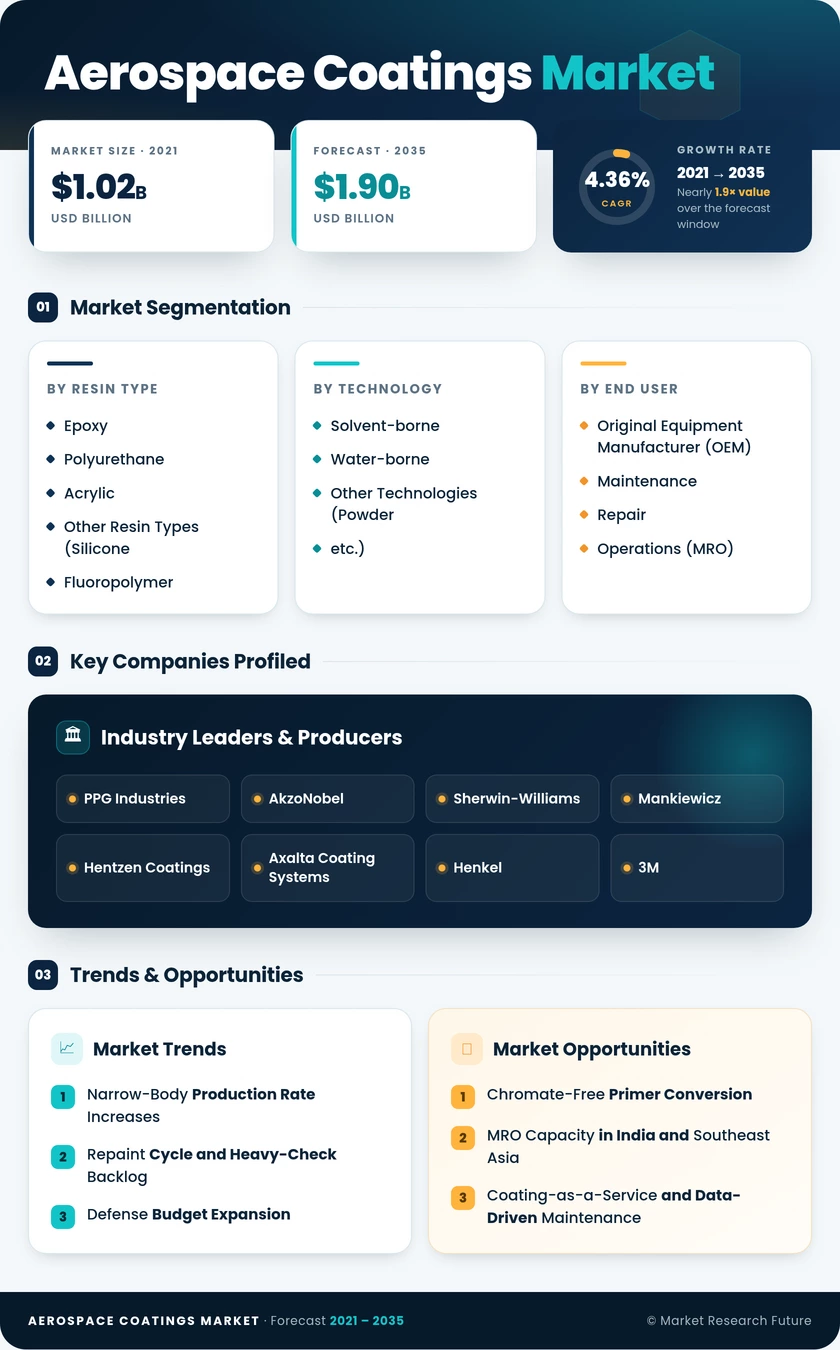
Aerospace Coatings Market (2026 - 2035)

ID: MRFR/CnM/2011-HCR 111 Pages Chitranshi Jaiswal Last Updated: November 04, 2026
Aerospace Coatings Market Research Report Information By Resin Type (Epoxy, Polyurethane, Acrylic, and Other Resin Types (Silicone, Fluoropolymer, etc.)), By Technology (Solvent-Borne, Water-Borne, and Other Technologies (Powder, etc.)), By End User (Original Equipment Manufacturer (OEM) and Maintenance, Repair and Operations (MRO)), By Aviation Type (Commercial Aviation, Military Aviation, and General Aviation), And By Region (North America, Europe, Asia-Pacific, and Rest of the World) – Market Forecast Till 2035.
Aerospace Coatings Market
Market Size
Forecast Period2026-2035
CAGR (2026-2035)4.36%
2025 Market SizeUSD 1.24 Billion
2035 Market SizeUSD 1.90 Billion
Key Players
PPG Industries
AkzoNobel
Sherwin-Williams
Mankiewicz
Hentzen Coatings
Axalta Coating Systems
Opportunities
  • Chromate-Free Primer Conversion
  • MRO Capacity in India and Southeast Asia
  • Coating-as-a-Service and Data-Driven Maintenance
  1. 1 Market Summary | |
  2. 2 Key Report Takeaways | |
    1. 2.1 By Resin Type | |
    2. 2.2 By Technology | |
    3. 2.3 By End User | |
    4. 2.4 By Aviation Type | |
    5. 2.5 By Region | |
  3. 3 Market Size and Forecast (2021–2035) | |
    1. 3.1 Historical Market Size (2021–2025) | |
    2. 3.2 Forecast Market Size (2026–2035) | |
    3. 3.3 Year-over-Year Growth Analysis | |
  4. 4 Driver Impact Analysis | |
    1. 4.1 Narrow-Body Production Rate Increases | |
    2. 4.2 Repaint Cycle and Heavy-Check Backlog | |
    3. 4.3 Defense Budget Expansion | |
    4. 4.4 Asia-Pacific Fleet Expansion | |
    5. 4.5 Chromate-Free and Low-VOC Regulatory Transition | |
    6. 4.6 Composite-Intensive Airframes | |
    7. 4.7 Fuel-Saving Functional Surfaces | |
  5. 5 Restraints Impact Analysis | |
    1. 5.1 Lengthy Qualification and Certification Cycles | |
    2. 5.2 OEM Production and Supply-Chain Constraints | |
    3. 5.3 Raw Material Price Volatility | |
    4. 5.4 PFAS Compliance Costs | |
    5. 5.5 Skilled Painter and Hangar-Slot Shortages | |
  6. 6 Opportunities | |
    1. 6.1 Chromate-Free Primer Conversion | |
    2. 6.2 MRO Capacity in India and Southeast Asia | |
    3. 6.3 Coating-as-a-Service and Data-Driven Maintenance | |
    4. 6.4 Digital Livery Printing | |
    5. 6.5 Advanced Air Mobility Platforms | |
  7. 7 Regional Market Share and Country-Level Analysis | |
    1. 7.1 North America | | |
      1. 7.1.1 United States | | |
      2. 7.1.2 Canada | | |
      3. 7.1.3 Mexico | |
    2. 7.2 Europe | | |
      1. 7.2.1 Germany | | |
      2. 7.2.2 France | | |
      3. 7.2.3 United Kingdom | | |
      4. 7.2.4 Italy | | |
      5. 7.2.5 Spain | | |
      6. 7.2.6 Rest of Europe | |
    3. 7.3 Asia-Pacific | | |
      1. 7.3.1 China | | |
      2. 7.3.2 India | | |
      3. 7.3.3 Japan | | |
      4. 7.3.4 South Korea | | |
      5. 7.3.5 Rest of Asia-Pacific | |
    4. 7.4 South America | | |
      1. 7.4.1 Brazil | | |
      2. 7.4.2 Argentina | | |
      3. 7.4.3 Rest of South America | |
    5. 7.5 Middle East and Africa | | |
      1. 7.5.1 Saudi Arabia | | |
      2. 7.5.2 South Africa | | |
      3. 7.5.3 Rest of Middle East and Africa | |
  8. 8 Future Outlook (2026–2035) | |
    1. 8.1 Decarbonization and Weight Reduction | |
    2. 8.2 Automation and Digital Application | |
    3. 8.3 Defense Recapitalization | |
    4. 8.4 Fleet Growth Shifts East | |
  9. 9 Segmentation Analysis | |
    1. 9.1 By Resin Type | | |
      1. 9.1.1 Epoxy | | |
      2. 9.1.2 Polyurethane | | |
      3. 9.1.3 Acrylic | | |
      4. 9.1.4 Other Resin Types (Silicone, Fluoropolymer, etc.) | |
    2. 9.2 By Technology | | |
      1. 9.2.1 Solvent-borne | | |
      2. 9.2.2 Water-borne | | |
      3. 9.2.3 Other Technologies (Powder, etc.) | |
    3. 9.3 By End User | | |
      1. 9.3.1 Original Equipment Manufacturer (OEM) | | |
      2. 9.3.2 Maintenance, Repair and Operations (MRO) | |
    4. 9.4 By Aviation Type | | |
      1. 9.4.1 Commercial Aviation | | |
      2. 9.4.2 Military Aviation | | |
      3. 9.4.3 General Aviation | |
  10. 10 Competitive Landscape | |
    1. 10.1 Market Concentration Analysis | |
    2. 10.2 Competitive Benchmarking Table | |
    3. 10.3 Company Profiles | | |
      1. 10.3.1 PPG Industries | | |
      2. 10.3.2 AkzoNobel | | |
      3. 10.3.3 Sherwin-Williams | | |
      4. 10.3.4 Mankiewicz | | |
      5. 10.3.5 Hentzen Coatings | | |
      6. 10.3.6 Axalta Coating Systems | | |
      7. 10.3.7 Henkel | | |
      8. 10.3.8 3M | | |
      9. 10.3.9 Chemetall (BASF) | | |
      10. 10.3.10 Indestructible Paint | | |
      11. 10.3.11 IHI Ionbond | |
  11. 11 Recent News & Developments | |
  12. 12 Report Scope and Methodology | |
  13. 13 Detailed Sources and Citations | |
  14. 14 Frequently Asked Questions (FAQs) | | LIST OF TABLES | |
  15. TABLE 1 Global Aerospace Coating Market Snapshot, 2025–2035 | |
  16. TABLE 2 Global Market Size & Forecast, by Revenue (USD Billion), 2021–2035 | |
  17. TABLE 3 Driver Impact Analysis | |
  18. TABLE 4 Restraints Impact Analysis | |
  19. TABLE 5 Regional Summary, by Region, 2025 | |
  20. TABLE 6 North America Market, by Country, 2025 | |
  21. TABLE 7 Europe Market, by Country, 2025 | |
  22. TABLE 8 Asia-Pacific Market, by Country, 2025 | |
  23. TABLE 9 South America Market, by Country, 2025 | |
  24. TABLE 10 Middle East and Africa Market, by Country, 2025 | |
  25. TABLE 11 Global Market, by Resin Type, 2025 | |
  26. TABLE 12 Global Market, by Technology, 2025 | |
  27. TABLE 13 Global Market, by End User, 2025 | |
  28. TABLE 14 Global Market, by Aviation Type, 2025 | |
  29. TABLE 15 Competitive Benchmarking Table | |
  30. TABLE 16 Report Scope and Methodology | |
  31. TABLE 17 Detailed Sources and Citations | | LIST OF FIGURES | |
  32. FIGURE 1 Market Dynamics Overview — Drivers, Restraints and Opportunities | |
  33. FIGURE 2 Industry Value Chain Analysis | |
  34. FIGURE 3 Porter's Five Forces Analysis | |
  35. FIGURE 4 Global Market Size Trend (USD Billion), 2021–2035 | |
  36. FIGURE 5 Market Share, by Resin Type, 2025 | |
  37. FIGURE 6 Market Share, by Technology, 2025 | |
  38. FIGURE 7 Market Share, by End User, 2025 | |
  39. FIGURE 8 Market Share, by Aviation Type, 2025 | |
  40. FIGURE 9 Regional Market Share, 2025 | |
  41. FIGURE 10 Country-Level Share Within Each Region, 2025 | |
  42. FIGURE 11 Competitive Landscape — Estimated Revenue Share Ranges | |
  43. FIGURE 12 Recent Strategic Developments Timeline, 2023–2025

Segmentation Quick Reference

DimensionSub-SegmentsDominant SegmentFastest Growing Segment
By Resin TypeEpoxy; Polyurethane; Acrylic; Other Resin Types (Silicone, Fluoropolymer, etc.)Epoxy (54.2% share)Epoxy (54.2% share)
By TechnologySolvent-borne; Water-borne; Other Technologies (Powder,etc.)Solvent-borne (50.4% share)Water-borne (4.5% CAGR)
By End UserOriginal Equipment Manufacturer (OEM); Maintenance, Repair and Operations (MRO)Original Equipment Manufacturer (OEM) (55.4% share)Maintenance, Repair and Operations (MRO) (4.7% CAGR)
By Aviation TypeCommercial Aviation; Military Aviation; General AviationCommercial Aviation (4.6% CAGR)Commercial Aviation (4.6% CAGR)
By RegionNorth America; Europe; Asia-Pacific; South America; Middle East and AfricaNorth America (38.5% share)Asia-Pacific (5.6% CAGR)

Market Segmentation Overview

By Resin Type

Sub-SegmentKey Trend
EpoxyChromate-free epoxy primers matched to composite fuselages
PolyurethaneUV-stable topcoats with longer gloss retention
AcrylicDielectric coatings for radomes and antennas
Other Resin Types (Silicone, Fluoropolymer, etc.)Reformulation under PFAS scrutiny

Epoxy leads the resin mix and is also the fastest-growing resin, because composite-rich airframes need epoxy primers and surfacers for adhesion and corrosion control. Polyurethane follows as the standard exterior topcoat chemistry. Silicone and fluoropolymer resins lag as PFAS rules lengthen requalification.

By Technology

Sub-SegmentKey Trend
Solvent-borneRetained under legacy military specifications
Water-borneExpanding as VOC limits tighten
Other Technologies (Powder,etc.)Confined to metallic components and cabin parts

Solvent-borne coatings still lead because military and OEM specifications written decades ago anchor them on existing fleets. Water-borne systems grow fastest since they meet emission limits without incineration equipment. Powder coatings stay limited to heat-tolerant metal parts.

By End User

Sub-SegmentKey Trend
Original Equipment Manufacturer (OEM)Volume tied to airframe production rates
Maintenance, Repair and Operations (MRO)Growth from repaint cycles and deferred heavy checks

Original Equipment Manufacturer (OEM) lines lead because each new aircraft receives a full multilayer stack. Maintenance, Repair and Operations (MRO) grows faster as 2010–2015 deliveries reach repaint age and airlines clear pandemic-era maintenance backlogs.

By Aviation Type

Sub-SegmentKey Trend
Commercial AviationSingle-aisle rate increases and wide-body replacements
Military AviationLow-observable and chemical-agent-resistant finishes
General AviationFragmented production limits scale

Commercial Aviation both leads and grows fastest, driven by single-aisle production ramps and the large paint areas of wide-body fuselages. Military Aviation adds high-value specialty finishes but follows uneven budget cycles. General Aviation trails because many small manufacturers split output.


Download PDF ×

We do not share your information with anyone. However, we may send you emails based on your report interest from time to time. You may contact us at any time to opt-out.