KUKA Develops Collaborative Robotics in 2025
In 2025, KUKA substantially broadened its portfolio of collaborative robotics, establishing 2025 as a pivotal year for the Industrial Robotics and Collaborative Automation Market. As manufacturers globally increasingly implement automation to mitigate labor shortages, boost productivity, and improve safety, collaborative robots (cobots) are emerging as a significant growth sector, facilitating human-robot interaction within adaptable production settings. KUKA's advancements in 2025 demonstrate this evolution toward intelligent, collaborative robotic systems.
KUKA's 2025 portfolio expansion includes its latest iteration of lightweight, safety-oriented cobots, featuring advanced force-sensing capabilities, increased reach, and enhanced payload versatility. These innovative models are designed for seamless deployment across diverse skill-level environments — encompassing assembly, material handling, packaging, inspection, and precision machining — without requiring extensive cell safeguarding. By incorporating integrated safety features, user-friendly programming interfaces, and compatibility with leading industrial vision and sensing systems, KUKA's 2025 cobots facilitate swift on-site deployment and flexible automation.
A primary factor underpinning KUKA's 2025 strategic initiative is the ongoing increase in the adoption of collaborative robotics by small and medium enterprises (SMEs) as an initial step towards automation. KUKA's portfolio enhancements facilitate modular peripheral integration, AI-assisted programming, and edge-enabled analytics — enabling organizations to lower integration costs and expedite return on investment. Furthermore, KUKA expanded its ecosystem partnerships in 2025 by incorporating additional third-party software, vision systems, and digital twin tools that enhance simulation, deployment, and remote monitoring processes.
Another significant development in 2025 is KUKA's emphasis on vertical-specific collaborative robot solutions. The company launched industry-specific bundles for electronics, automotive sub-assembly, consumer products, and life sciences manufacturing, each equipped with domain-specific tool sets, safety protocols, and workflows. These offerings are intended to address the diverse requirements of contemporary production lines while minimizing customization obstacles and engineering lead times.
KUKA's 2025 expansion of its collaborative robotics portfolio is poised to accelerate cobot adoption across diverse industries by mitigating implementation challenges, particularly for small- and medium-sized manufacturers undergoing digital transformation. Enhanced safety features and sophisticated sensor integration introduced in 2025 facilitate closer human–robot collaboration without the need for extensive infrastructure modifications, enabling manufacturers to implement automation in more dynamic and space-limited production settings.
Meanwhile, AI-enabled programming and modular integration tools in 2025 are reducing deployment and commissioning durations, enabling manufacturers to adapt more swiftly to evolving production demands. Expanded integration across the software and hardware ecosystems further enables simulation, predictive maintenance, and digital twin processes, establishing cobots as essential elements of Industry 4.0 initiatives. Overall, KUKA's 2025 initiatives signify a pivotal turning point for the industrial robotics and collaborative automation industry, fostering enhanced flexibility, increased productivity, and improved workforce collaboration across manufacturing sectors.
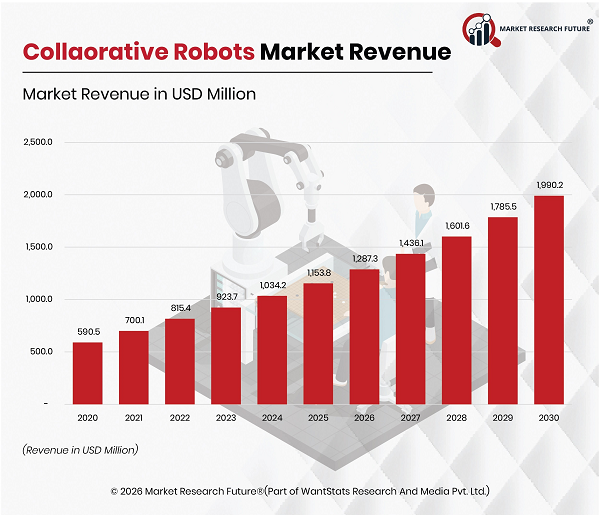
The figure shows the collaborative Robots market revenue from 2020 to 2030: