×
Hero Background
English
Chinese
French
Japanese
Korean
German
Spanish

Automotive Camshaft Market Trends

ID: MRFR/AT/10056-HCR
100 Pages
Garvit Vyas
October 2025

Automotive Camshaft Market Research Report Information By Product Type (Cast Camshaft, Forged Camshaft, and Assembled Camshaft), By Vehicle Type (Passenger Car, Light Commercial Vehicles, and Heavy Commercial Vehicle), By Sales Channel (Original Equipment Manufacturer (OEM), and Aftermarket), And By Region (North America, Europe, Asia-Pacific, And Rest of The World) –Market Forecast Till 2035

Share:
Download PDF ×

We do not share your information with anyone. However, we may send you emails based on your report interest from time to time. You may contact us at any time to opt-out.

Automotive Camshaft Market Infographic
Purchase Options

Market Trends

Key Emerging Trends in the Automotive Camshaft Market

In the dynamic landscape of the Automotive Camshaft Market, companies employ various market share positioning strategies to gain a competitive edge and carve out their niche in the industry. One prevalent approach is differentiation, where companies focus on unique features, technology, or design to set their camshafts apart from competitors. This strategy enables them to target specific customer segments and build a loyal customer base.

Another strategic avenue is cost leadership, where companies aim to become the low-cost provider in the market. By optimizing production processes, sourcing materials efficiently, and achieving economies of scale, companies can offer competitive prices while maintaining acceptable profit margins. This strategy is particularly effective in price-sensitive markets, attracting a broad customer base and potentially driving higher sales volumes.

Innovation plays a crucial role in the Automotive Camshaft Market, and companies often adopt a strategy of continuous product development. This involves staying at the forefront of technological advancements, introducing cutting-edge materials, and enhancing performance to meet the evolving demands of the automotive industry. By consistently innovating, companies can not only capture market share but also establish themselves as industry leaders.

Market segmentation is another key aspect of market share positioning. Companies analyze the diverse needs of customers and create tailored products for specific market segments. For instance, they may develop high-performance camshafts for sports cars or focus on fuel efficiency for economy models. This targeted approach allows companies to address the unique requirements of different customer groups, enhancing their market presence and competitiveness.

Strategic partnerships and collaborations are becoming increasingly prevalent in the Automotive Camshaft Market. Companies form alliances with suppliers, distributors, or other industry players to leverage each other's strengths and create synergies. This collaborative approach can result in shared resources, reduced costs, and expanded market reach. By aligning with strategic partners, companies position themselves to navigate industry challenges more effectively and capitalize on emerging opportunities.

Global expansion is a strategy adopted by many companies seeking to increase their market share in the Automotive Camshaft industry. By entering new markets or strengthening their presence in existing ones, companies can tap into additional customer bases and diversify their revenue streams. This expansion strategy requires a deep understanding of regional preferences, regulatory environments, and competition dynamics.

Customer-centric approaches are gaining prominence as companies recognize the importance of building strong relationships with their clients. Providing excellent customer service, offering customization options, and actively seeking feedback contribute to enhanced customer satisfaction and loyalty. Satisfied customers are more likely to become repeat buyers and brand advocates, positively impacting a company's market share.

In conclusion, the Automotive Camshaft Market is shaped by a variety of market share positioning strategies that companies employ to gain a competitive advantage. Whether through differentiation, cost leadership, innovation, segmentation, partnerships, global expansion, or customer-centric approaches, these strategies play a pivotal role in shaping the market dynamics. As the industry continues to evolve, companies will need to adapt and refine their strategies to stay ahead in the highly competitive Automotive Camshaft Market.


Author
Garvit Vyas
Analyst

Explore the profile of Garvit Vyas, one of our esteemed authors at Market Research Future, and access their expert research contributions in the field of market research and industry analysis

Leave a Comment

FAQs

What is the projected market valuation of the Automotive Camshaft Market by 2035?

The Automotive Camshaft Market is projected to reach a valuation of 7.167 USD Billion by 2035.

What was the market valuation of the Automotive Camshaft Market in 2024?

In 2024, the Automotive Camshaft Market was valued at 4.103 USD Billion.

What is the expected CAGR for the Automotive Camshaft Market during the forecast period 2025 - 2035?

The expected CAGR for the Automotive Camshaft Market during the forecast period 2025 - 2035 is 5.2%.

Which product type segment is anticipated to have the highest valuation in the Automotive Camshaft Market?

The Forged Camshaft segment is anticipated to have the highest valuation, projected to grow from 1.8 to 3.0 USD Billion.

What are the projected valuations for the Passenger Cars segment in the Automotive Camshaft Market?

The Passenger Cars segment is projected to grow from 2.051 to 3.646 USD Billion.

Which sales channel is expected to dominate the Automotive Camshaft Market?

The Original Equipment Manufacturer (OEM) sales channel is expected to dominate, with projections from 2.0515 to 3.8835 USD Billion.

Market Summary

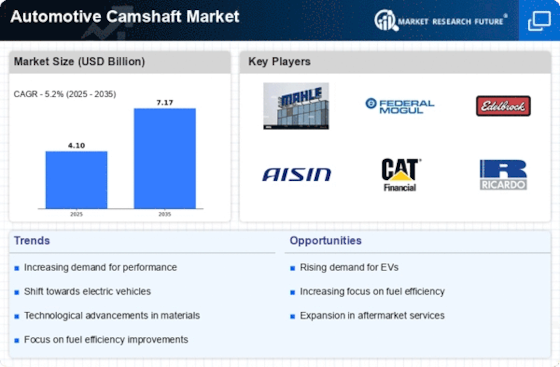
As per MRFR analysis, the Automotive Camshaft Market Size was estimated at 4.103 USD Billion in 2024. The Automotive Camshaft industry is projected to grow from 4.316 USD Billion in 2025 to 7.167 USD Billion by 2035, exhibiting a compound annual growth rate (CAGR) of 5.2 during the forecast period 2025 - 2035.

Key Market Trends & Highlights

The Automotive Camshaft Market is poised for growth driven by technological advancements and shifting consumer preferences.

  • Technological advancements in camshaft design are enhancing performance and efficiency across various vehicle types. North America remains the largest market, while Asia-Pacific is emerging as the fastest-growing region in the automotive sector. Cast camshafts dominate the market, yet forged camshafts are witnessing rapid growth due to their lightweight properties. Rising demand for fuel efficiency and stringent regulatory compliance are key drivers propelling market expansion.

Market Size & Forecast

2024 Market Size 4.103 (USD Billion)
2035 Market Size 7.167 (USD Billion)
CAGR (2025 - 2035) 5.2%
Largest Regional Market Share in 2024 Asia Pacific

Major Players

<p>Mahle GmbH (DE), Federal-Mogul Corporation (US), <a href="https://www.edelbrock.com/shop/camshafts.html">Edelbrock LLC</a> (US), Aisin Seiki Co., Ltd. (JP), Caterpillar Inc. (US), Ricardo plc (GB), Schaeffler AG (DE), Hitachi Automotive Systems, Ltd. (JP), <a href="https://www.borgwarner.com/newsroom/press-releases/2023/06/23/borgwarner-to-deliver-electric-variable-cam-timing-technology-to-global-oem">BorgWarner Inc</a>. (US)</p>

Market Trends

The Automotive Camshaft Market is currently experiencing a transformative phase, driven by advancements in engine technology and increasing demand for fuel-efficient vehicles. Manufacturers are focusing on developing innovative camshaft designs that enhance performance while reducing emissions. This shift is largely influenced by stringent environmental regulations and consumer preferences for greener alternatives. As a result, the market is witnessing a surge in the adoption of variable valve timing systems, which optimize engine efficiency and power output. Furthermore, the integration of smart technologies into automotive components is reshaping the landscape, allowing for more precise control over engine functions. In addition to technological advancements, the Automotive Camshaft Market is also influenced by the growing trend of electrification in the automotive sector. As electric vehicles gain traction, traditional camshaft applications are evolving to accommodate new powertrain architectures. This transition presents both challenges and opportunities for manufacturers, as they must adapt to changing market dynamics. The increasing focus on lightweight materials and manufacturing processes is another critical factor, as it aligns with the broader industry goal of enhancing overall vehicle efficiency. Overall, the Automotive Camshaft Market appears poised for growth, driven by innovation and a shift towards sustainable practices.

Technological Advancements in Camshaft Design

The Automotive Camshaft Market is witnessing a notable trend towards the development of advanced camshaft designs. Innovations such as variable valve timing and multi-stage camshaft systems are becoming increasingly prevalent. These technologies enhance engine performance and efficiency, catering to the growing demand for high-performance vehicles.

Shift Towards Electrification

As the automotive industry embraces electrification, the Automotive Camshaft Market is adapting to new powertrain configurations. This shift presents unique challenges, as traditional camshaft functions must evolve to meet the requirements of electric and hybrid vehicles. Manufacturers are exploring new designs to accommodate these changes.

Focus on Lightweight Materials

The trend towards lightweight materials is gaining momentum within the Automotive Camshaft Market. Manufacturers are increasingly utilizing materials such as aluminum and composites to reduce weight and improve fuel efficiency. This focus aligns with the broader industry goal of enhancing vehicle performance while minimizing environmental impact.

Automotive Camshaft Market Market Drivers

Growth of the Automotive Industry

The Automotive Camshaft Market is poised for growth, driven by the overall expansion of the automotive sector. As vehicle production increases, the demand for high-performance camshafts is expected to rise correspondingly. Recent statistics reveal that the automotive industry is projected to grow at a rate of 4% annually, leading to an increased need for advanced engine components. This growth is further fueled by the rising popularity of performance vehicles, which require specialized camshaft designs to enhance power output and efficiency. Consequently, manufacturers within the Automotive Camshaft Market are likely to ramp up production to meet this burgeoning demand, thereby fostering innovation and competition.

Rising Demand for Fuel Efficiency

The Automotive Camshaft Market is experiencing a notable increase in demand for fuel-efficient vehicles. As consumers become more environmentally conscious, manufacturers are compelled to innovate and enhance engine performance while reducing fuel consumption. This trend is reflected in the growing adoption of advanced camshaft technologies, which optimize engine timing and improve combustion efficiency. According to recent data, vehicles equipped with advanced camshaft systems can achieve fuel savings of up to 15% compared to traditional designs. Consequently, this heightened focus on fuel efficiency is driving investments in research and development within the Automotive Camshaft Market, as companies strive to meet regulatory standards and consumer expectations.

Technological Innovations in Engine Design

The Automotive Camshaft Market is witnessing a wave of technological innovations that are reshaping engine design. Advancements such as 3D printing and computer-aided design are enabling manufacturers to create more complex and efficient camshaft profiles. These innovations not only enhance performance but also reduce production costs and time. Furthermore, the integration of smart technologies, such as sensors and electronic control units, allows for real-time adjustments to camshaft timing, optimizing engine performance under varying conditions. As these technologies become more prevalent, they are likely to drive the demand for advanced camshaft solutions within the Automotive Camshaft Market, fostering a competitive landscape.

Regulatory Compliance and Emission Standards

The Automotive Camshaft Market is significantly influenced by stringent emission regulations imposed by various governments. These regulations necessitate the development of engines that produce lower emissions, prompting manufacturers to invest in advanced camshaft technologies. The implementation of stricter emission standards has led to a surge in demand for variable valve timing systems, which enhance engine performance while minimizing harmful emissions. Data indicates that the market for such technologies is projected to grow at a compound annual growth rate of approximately 8% over the next five years. As a result, compliance with these regulations is not only a legal requirement but also a key driver of innovation within the Automotive Camshaft Market.

Increasing Popularity of Performance Vehicles

The Automotive Camshaft Market is significantly impacted by the rising popularity of performance vehicles among consumers. As automotive enthusiasts seek enhanced driving experiences, manufacturers are compelled to develop high-performance camshafts that cater to this demand. The market for performance vehicles is expected to grow at a rate of 6% annually, driven by consumer preferences for speed, power, and efficiency. This trend is prompting manufacturers to invest in research and development to create specialized camshaft designs that optimize engine output and responsiveness. Consequently, the increasing interest in performance vehicles is likely to serve as a catalyst for innovation and growth within the Automotive Camshaft Market.

Market Segment Insights

By Product Type: Cast Camshaft (Largest) vs. Forged Camshaft (Fastest-Growing)

<p>The Automotive Camshaft Market exhibits a diverse distribution among its product types, with cast camshafts holding the majority share. These are preferred for their cost-effectiveness and adequate performance in various engine applications, making them a staple in mass-market vehicles. In contrast, forged camshafts are gaining traction due to their superior strength and durability, appealing to the high-performance automotive sector. As performance demands increase, the adoption of forged camshafts is on the rise, indicating a shift in customer preferences within the market. Growth trends in the Automotive Camshaft Market reveal an increasing inclination towards forged camshafts as manufacturers strive for enhanced performance and efficiency in modern vehicles. Technological advancements and evolving engine designs contribute to this trend, as forged camshafts can withstand higher stress and temperatures, making them ideal for sports cars and performance vehicles. Additionally, sustainability concerns are encouraging manufacturers to optimize their products, thereby fueling the demand for innovative camshaft designs that incorporate lighter and stronger materials, particularly in the forged segment.</p>

<p>Cast Camshaft (Dominant) vs. Forged Camshaft (Emerging)</p>

<p>Cast camshafts dominate the Automotive Camshaft Market due to their lower production costs and ease of manufacturing. These camshafts are widely used in a variety of standard vehicle applications, particularly in economy and mid-range segments, due to their reliability and sufficient performance metrics. Conversely, forged camshafts represent an emerging segment, becoming increasingly popular in performance-driven markets. Their enhanced mechanical properties provide a distinct advantage, allowing for better performance under extreme conditions, which is ideal for high-end sports vehicles and turbocharged engines. As automotive technology evolves, the demand for forged camshafts is expected to grow, driven by the need for products that offer both reliability and high performance.</p>

By Vehicle Type: Passenger Cars (Largest) vs. Heavy Commercial Vehicles (Fastest-Growing)

<p>The Automotive Camshaft Market exhibits a clear distribution of shares among its primary vehicle segments. Passenger Cars constitute the largest segment, reflecting a robust demand driven by consumer preferences and technological advancements in fuel efficiency. Meanwhile, Light Commercial Vehicles and Heavy Commercial Vehicles also hold significant portions of the market, responding to varying transportation needs across different terrains and industries.</p>

<p>Passenger Cars (Dominant) vs. Heavy Commercial Vehicles (Emerging)</p>

<p>Passenger Cars dominate the market due to their widespread adoption and continuous innovation in engine design, which enhances performance and efficiency. They benefit from constant advancements in automotive technology and are key in meeting regulatory standards. Conversely, Heavy Commercial Vehicles are the emerging segment, experiencing rapid growth driven by the expansion of e-commerce and logistics sectors. This segment is attracting investments for improved engine performance and emissions control technologies, making them vital to the future of the Automotive Camshaft Market.</p>

By Sales Channel: OEM (Largest) vs. Aftermarket (Fastest-Growing)

<p>The sales channel distribution in the automotive camshaft market reveals a pronounced dominance of the Original Equipment Manufacturer (OEM) segment. This segment accounts for a significant portion of total sales, driven by new vehicle manufacturing and increasing production rates. On the other hand, the aftermarket segment, while smaller in market share, is emerging vigorously as consumers seek replacements and upgrades for older vehicles, creating a balanced dynamic in the sales landscape.</p>

<p>Sales Channel: OEM (Dominant) vs. Aftermarket (Emerging)</p>

<p>The OEM segment represents the backbone of the automotive camshaft market, catering primarily to vehicle manufacturers through long-term supply contracts. This segment thrives on technological advancements and synergies with automakers, ensuring high performance and reliability in engine components. Conversely, the aftermarket segment is gaining traction as vehicle owners increasingly look for repair and enhancement options post-purchase. Factors such as aging vehicle fleets and rising consumer interest in performance upgrades position the aftermarket as a rapidly evolving segment, appealing particularly to DIY enthusiasts and independent workshops.</p>

Get more detailed insights about Automotive Camshaft Market Research Report - Forecast to 2035

Regional Insights

North America : Automotive Innovation Leader

North America is witnessing robust growth in the automotive camshaft market, driven by increasing vehicle production and technological advancements. The region holds approximately 40% of the global market share, making it the largest market. Regulatory support for fuel efficiency and emissions reduction is further propelling demand for advanced camshaft technologies. The shift towards electric vehicles is also influencing market dynamics, creating opportunities for innovation. The United States and Canada are the leading countries in this region, with major automotive manufacturers and suppliers establishing a strong presence. Key players such as Federal-Mogul Corporation and BorgWarner Inc. are at the forefront, contributing to competitive dynamics. The market is characterized by a focus on R&D and partnerships, ensuring that North America remains a hub for automotive innovation and technology development.

Europe : Sustainable Mobility Focus

Europe is emerging as a significant player in the automotive camshaft market, driven by stringent regulations aimed at reducing emissions and promoting sustainable mobility. The region accounts for approximately 30% of the global market share, making it the second-largest market. The European Union's commitment to carbon neutrality by 2050 is a key driver, pushing manufacturers to innovate and adopt advanced camshaft technologies that enhance fuel efficiency and performance. Germany, France, and the UK are the leading countries in this market, with a strong presence of key players like Mahle GmbH and Schaeffler AG. The competitive landscape is marked by collaborations between automotive manufacturers and suppliers to develop cutting-edge solutions. The focus on electric and hybrid vehicles is reshaping the market, with companies investing heavily in R&D to meet evolving consumer demands and regulatory requirements.

Asia-Pacific : Emerging Market Potential

Asia-Pacific is rapidly becoming a powerhouse in the automotive camshaft market, driven by increasing vehicle production and rising consumer demand. The region holds approximately 25% of the global market share, with countries like China and India leading the charge. Government initiatives to promote electric vehicles and improve fuel efficiency are significant growth drivers, creating a favorable environment for camshaft manufacturers to thrive. China is the largest market in the region, with a strong presence of key players such as Aisin Seiki Co., Ltd. and Hitachi Automotive Systems, Ltd. The competitive landscape is characterized by a mix of local and international companies, all vying for market share. The focus on innovation and technology adoption is evident, as manufacturers invest in advanced camshaft designs to meet the demands of a growing automotive sector.

Middle East and Africa : Resource-Rich Opportunities

The Middle East and Africa region is witnessing a gradual increase in demand for automotive camshafts, driven by rising vehicle ownership and infrastructure development. The region holds approximately 5% of the global market share, with potential for growth as economies diversify and invest in automotive manufacturing. Regulatory frameworks are evolving to support local production and reduce dependency on imports, which is a positive catalyst for market expansion. Countries like South Africa and the UAE are leading the market, with a growing number of automotive manufacturers establishing operations. The competitive landscape is still developing, with opportunities for both local and international players. As the region continues to invest in automotive technology and infrastructure, the demand for high-quality camshafts is expected to rise, creating a favorable environment for growth.

Key Players and Competitive Insights

Leading market players are investing heavily in research and development to expand their product lines, which will help the Auto Camshaft market, grow even more. Market participants are also undertaking a variety of strategic activities to expand their global footprint, with important market developments including new product launches, contractual agreements, mergers and acquisitions, higher investments, and collaboration with other organizations. To expand and survive in a more competitive and rising market climate, the Automotive Camshaft industry must offer cost-effective items.

Manufacturing locally to minimize operational costs is one of the key business tactics used by manufacturers in the global Automotive Camshaft industry to benefit clients and increase the market sector. In recent years, the Automotive Camshaft industry has offered some of the most significant advantages to the transportation sector and overall automotive performance. Major players in the Automotive Camshaft Market Market, including Mahle GmbH, JD Norman Industries, Inc., Thyssenkrupp AG, Linamar Corporation, ESTAS CAMSHAFT & CHILLED CAST, Crance Cams Inc., Aichi Forge USA Inc., Engine Power Components Inc., Hirschvogel Holding GmbH, KAUTEX TEXTRON GmbH & Co.

KG, Shadbolt Cams, Comp Performance Group, Precision Camshafts Ltd., Varroc Group, Camshaft Machine Company are attempting to increase market demand by investing in research and development operations.

Mahle GmbH, a prominent player in engine systems and components manufacturing, is a key supplier of piston systems, cylinder components, and other critical parts for automotive applications. The company's diverse product portfolio encompasses connecting piston rings, rods, cylinder liners, bearings, piston pins, and bushings, catering to combustion engines. Mahle's offerings extend to engine systems, filtration, thermal management, and electrics/mechatronics, providing comprehensive solutions for passenger cars, commercial vehicles, motorsport, high-performance engines, and industrial applications.

In a strategic move to enhance its market position, Mahle acquired Behr Hella Service GmbH in 2020, a German company specializing in thermal management solutions for the automotive industry. This acquisition aimed to broaden Mahle's product range, reinforcing its presence in the global automotive camshaft market. The company also delivers various services, including engineering, module testing, engine testing, and cooling wind tunnel services. Mahle is headquartered in Stuttgart, Germany.

ThyssenKrupp AG, an industrial conglomerate, operates across diverse sectors, including automotive, steel, processing, trading, construction, engineering, energy, utilities, public sector, packaging, and more. The company provides a range of offerings, such as steel products, component technology solutions, marine systems, and automation solutions tailored for automotive original equipment manufacturers (OEMs). ThyssenKrupp serves as a partner in engineering, construction, and industrial plant services, catering to sectors like automobiles, chemicals, power generation, oil and gas, shipbuilding, and aerospace. With a global presence, including operations in Germany, China, and the US, ThyssenKrupp owns manufacturing, research and development, and various facilities worldwide.

In 2021, the company introduced a new line of camshafts known as Rothe Erde camshafts, specifically designed for electric and hybrid vehicles. These camshafts utilize lightweight materials to enhance efficiency, aligning with the evolving trends in the automotive industry. ThyssenKrupp is headquartered in Essen, Nordrhein-Westfalen, Germany.

Key Companies in the Automotive Camshaft Market market include

Industry Developments

November 2021: In 2021, Thyssenkrupp AG collaborated with Daimler AG to employ additive manufacturing technology for the production of 3D-printed camshafts. This strategic partnership focuses on enhancing the efficiency of camshafts to reduce weight and contribute to the development of fuel-efficient vehicles.

March 2020: Schaeffler AG, 2020, introduced the INA Timing Chain Systems, an innovative line of camshaft phasing systems. Utilizing a compact design and hydraulic actuators, these systems aim to optimize engine efficiency and minimize emissions, showcasing Schaeffler AG's commitment to technological advancements in the automotive industry.

Future Outlook

Automotive Camshaft Market Future Outlook

<p>The Automotive Camshaft Market is projected to grow at a 5.2% CAGR from 2024 to 2035, driven by advancements in engine technology and increasing demand for fuel efficiency.</p>

New opportunities lie in:

  • <p>Development of lightweight camshaft materials for enhanced performance</p>
  • <p>Integration of smart camshaft systems for real-time engine monitoring</p>
  • <p>Expansion into electric vehicle camshaft solutions to capture emerging markets</p>

<p>By 2035, the market is expected to solidify its position as a key component in automotive innovation.</p>

Market Segmentation

Automotive Camshaft Market Product Type Outlook

  • Cast Camshaft
  • Forged Camshaft
  • Assembled Camshaft

Automotive Camshaft Market Vehicle Type Outlook

  • Passenger Cars
  • Light Commercial Vehicles
  • Heavy Commercial Vehicles

Automotive Camshaft Market Sales Channel Outlook

  • Original Equipment Manufacturer (OEM)
  • Aftermarket

Report Scope

MARKET SIZE 2024 4.103(USD Billion)
MARKET SIZE 2025 4.316(USD Billion)
MARKET SIZE 2035 7.167(USD Billion)
COMPOUND ANNUAL GROWTH RATE (CAGR) 5.2% (2024 - 2035)
REPORT COVERAGE Revenue Forecast, Competitive Landscape, Growth Factors, and Trends
BASE YEAR 2024
Market Forecast Period 2025 - 2035
Historical Data 2019 - 2024
Market Forecast Units USD Billion
Key Companies Profiled Market analysis in progress
Segments Covered Market segmentation analysis in progress
Key Market Opportunities Integration of advanced materials and technologies enhances performance in the Automotive Camshaft Market.

Key Market Dynamics Technological advancements in automotive engines drive demand for high-performance camshafts, influencing competitive dynamics and innovation.
Countries Covered North America, Europe, APAC, South America, MEA

FAQs

What is the projected market valuation of the Automotive Camshaft Market by 2035?

The Automotive Camshaft Market is projected to reach a valuation of 7.167 USD Billion by 2035.

What was the market valuation of the Automotive Camshaft Market in 2024?

In 2024, the Automotive Camshaft Market was valued at 4.103 USD Billion.

What is the expected CAGR for the Automotive Camshaft Market during the forecast period 2025 - 2035?

The expected CAGR for the Automotive Camshaft Market during the forecast period 2025 - 2035 is 5.2%.

Which product type segment is anticipated to have the highest valuation in the Automotive Camshaft Market?

The Forged Camshaft segment is anticipated to have the highest valuation, projected to grow from 1.8 to 3.0 USD Billion.

What are the projected valuations for the Passenger Cars segment in the Automotive Camshaft Market?

The Passenger Cars segment is projected to grow from 2.051 to 3.646 USD Billion.

Which sales channel is expected to dominate the Automotive Camshaft Market?

The Original Equipment Manufacturer (OEM) sales channel is expected to dominate, with projections from 2.0515 to 3.8835 USD Billion.

  1. SECTION I: EXECUTIVE SUMMARY AND KEY HIGHLIGHTS
    1. EXECUTIVE SUMMARY
      1. Market Overview
      2. Key Findings
      3. Market Segmentation
      4. Competitive Landscape
      5. Challenges and Opportunities
      6. Future Outlook 2
  2. SECTION II: SCOPING, METHODOLOGY AND MARKET STRUCTURE
    1. MARKET INTRODUCTION
      1. Definition
      2. Scope of the study
    2. RESEARCH METHODOLOGY
      1. Overview
      2. Data Mining
      3. Secondary Research
      4. Primary Research
      5. Forecasting Model
      6. Market Size Estimation
      7. Data Triangulation
      8. Validation 3
  3. SECTION III: QUALITATIVE ANALYSIS
    1. MARKET DYNAMICS
      1. Overview
      2. Drivers
      3. Restraints
      4. Opportunities
    2. MARKET FACTOR ANALYSIS
      1. Value chain Analysis
      2. Porter's Five Forces Analysis
      3. COVID-19 Impact Analysis
  4. SECTION IV: QUANTITATIVE ANALYSIS
    1. Automobile, BY Product Type (USD Billion)
      1. Cast Camshaft
      2. Forged Camshaft
      3. Assembled Camshaft
    2. Automobile, BY Vehicle Type (USD Billion)
      1. Passenger Cars
      2. Light Commercial Vehicles
      3. Heavy Commercial Vehicles
    3. Automobile, BY Sales Channel (USD Billion)
      1. Original Equipment Manufacturer (OEM)
      2. Aftermarket
    4. Automobile, BY Region (USD Billion)
      1. North America
      2. Europe
      3. APAC
      4. South America
      5. MEA
  5. SECTION V: COMPETITIVE ANALYSIS
    1. Competitive Landscape
      1. Overview
      2. Competitive Analysis
      3. Market share Analysis
      4. Major Growth Strategy in the Automobile
      5. Competitive Benchmarking
      6. Leading Players in Terms of Number of Developments in the Automobile
      7. Key developments and growth strategies
      8. Major Players Financial Matrix
    2. Company Profiles
      1. Mahle GmbH (DE)
      2. Federal-Mogul Corporation (US)
      3. Edelbrock LLC (US)
      4. Aisin Seiki Co., Ltd. (JP)
      5. Caterpillar Inc. (US)
      6. Ricardo plc (GB)
      7. Schaeffler AG (DE)
      8. Hitachi Automotive Systems, Ltd. (JP)
      9. BorgWarner Inc. (US)
    3. Appendix
      1. References
      2. Related Reports 6 LIST OF FIGURES
    4. MARKET SYNOPSIS
    5. NORTH AMERICA MARKET ANALYSIS
    6. US MARKET ANALYSIS BY PRODUCT TYPE
    7. US MARKET ANALYSIS BY VEHICLE TYPE
    8. US MARKET ANALYSIS BY SALES CHANNEL
    9. CANADA MARKET ANALYSIS BY PRODUCT TYPE
    10. CANADA MARKET ANALYSIS BY VEHICLE TYPE
    11. CANADA MARKET ANALYSIS BY SALES CHANNEL
    12. EUROPE MARKET ANALYSIS
    13. GERMANY MARKET ANALYSIS BY PRODUCT TYPE
    14. GERMANY MARKET ANALYSIS BY VEHICLE TYPE
    15. GERMANY MARKET ANALYSIS BY SALES CHANNEL
    16. UK MARKET ANALYSIS BY PRODUCT TYPE
    17. UK MARKET ANALYSIS BY VEHICLE TYPE
    18. UK MARKET ANALYSIS BY SALES CHANNEL
    19. FRANCE MARKET ANALYSIS BY PRODUCT TYPE
    20. FRANCE MARKET ANALYSIS BY VEHICLE TYPE
    21. FRANCE MARKET ANALYSIS BY SALES CHANNEL
    22. RUSSIA MARKET ANALYSIS BY PRODUCT TYPE
    23. RUSSIA MARKET ANALYSIS BY VEHICLE TYPE
    24. RUSSIA MARKET ANALYSIS BY SALES CHANNEL
    25. ITALY MARKET ANALYSIS BY PRODUCT TYPE
    26. ITALY MARKET ANALYSIS BY VEHICLE TYPE
    27. ITALY MARKET ANALYSIS BY SALES CHANNEL
    28. SPAIN MARKET ANALYSIS BY PRODUCT TYPE
    29. SPAIN MARKET ANALYSIS BY VEHICLE TYPE
    30. SPAIN MARKET ANALYSIS BY SALES CHANNEL
    31. REST OF EUROPE MARKET ANALYSIS BY PRODUCT TYPE
    32. REST OF EUROPE MARKET ANALYSIS BY VEHICLE TYPE
    33. REST OF EUROPE MARKET ANALYSIS BY SALES CHANNEL
    34. APAC MARKET ANALYSIS
    35. CHINA MARKET ANALYSIS BY PRODUCT TYPE
    36. CHINA MARKET ANALYSIS BY VEHICLE TYPE
    37. CHINA MARKET ANALYSIS BY SALES CHANNEL
    38. INDIA MARKET ANALYSIS BY PRODUCT TYPE
    39. INDIA MARKET ANALYSIS BY VEHICLE TYPE
    40. INDIA MARKET ANALYSIS BY SALES CHANNEL
    41. JAPAN MARKET ANALYSIS BY PRODUCT TYPE
    42. JAPAN MARKET ANALYSIS BY VEHICLE TYPE
    43. JAPAN MARKET ANALYSIS BY SALES CHANNEL
    44. SOUTH KOREA MARKET ANALYSIS BY PRODUCT TYPE
    45. SOUTH KOREA MARKET ANALYSIS BY VEHICLE TYPE
    46. SOUTH KOREA MARKET ANALYSIS BY SALES CHANNEL
    47. MALAYSIA MARKET ANALYSIS BY PRODUCT TYPE
    48. MALAYSIA MARKET ANALYSIS BY VEHICLE TYPE
    49. MALAYSIA MARKET ANALYSIS BY SALES CHANNEL
    50. THAILAND MARKET ANALYSIS BY PRODUCT TYPE
    51. THAILAND MARKET ANALYSIS BY VEHICLE TYPE
    52. THAILAND MARKET ANALYSIS BY SALES CHANNEL
    53. INDONESIA MARKET ANALYSIS BY PRODUCT TYPE
    54. INDONESIA MARKET ANALYSIS BY VEHICLE TYPE
    55. INDONESIA MARKET ANALYSIS BY SALES CHANNEL
    56. REST OF APAC MARKET ANALYSIS BY PRODUCT TYPE
    57. REST OF APAC MARKET ANALYSIS BY VEHICLE TYPE
    58. REST OF APAC MARKET ANALYSIS BY SALES CHANNEL
    59. SOUTH AMERICA MARKET ANALYSIS
    60. BRAZIL MARKET ANALYSIS BY PRODUCT TYPE
    61. BRAZIL MARKET ANALYSIS BY VEHICLE TYPE
    62. BRAZIL MARKET ANALYSIS BY SALES CHANNEL
    63. MEXICO MARKET ANALYSIS BY PRODUCT TYPE
    64. MEXICO MARKET ANALYSIS BY VEHICLE TYPE
    65. MEXICO MARKET ANALYSIS BY SALES CHANNEL
    66. ARGENTINA MARKET ANALYSIS BY PRODUCT TYPE
    67. ARGENTINA MARKET ANALYSIS BY VEHICLE TYPE
    68. ARGENTINA MARKET ANALYSIS BY SALES CHANNEL
    69. REST OF SOUTH AMERICA MARKET ANALYSIS BY PRODUCT TYPE
    70. REST OF SOUTH AMERICA MARKET ANALYSIS BY VEHICLE TYPE
    71. REST OF SOUTH AMERICA MARKET ANALYSIS BY SALES CHANNEL
    72. MEA MARKET ANALYSIS
    73. GCC COUNTRIES MARKET ANALYSIS BY PRODUCT TYPE
    74. GCC COUNTRIES MARKET ANALYSIS BY VEHICLE TYPE
    75. GCC COUNTRIES MARKET ANALYSIS BY SALES CHANNEL
    76. SOUTH AFRICA MARKET ANALYSIS BY PRODUCT TYPE
    77. SOUTH AFRICA MARKET ANALYSIS BY VEHICLE TYPE
    78. SOUTH AFRICA MARKET ANALYSIS BY SALES CHANNEL
    79. REST OF MEA MARKET ANALYSIS BY PRODUCT TYPE
    80. REST OF MEA MARKET ANALYSIS BY VEHICLE TYPE
    81. REST OF MEA MARKET ANALYSIS BY SALES CHANNEL
    82. KEY BUYING CRITERIA OF AUTOMOBILE
    83. RESEARCH PROCESS OF MRFR
    84. DRO ANALYSIS OF AUTOMOBILE
    85. DRIVERS IMPACT ANALYSIS: AUTOMOBILE
    86. RESTRAINTS IMPACT ANALYSIS: AUTOMOBILE
    87. SUPPLY / VALUE CHAIN: AUTOMOBILE
    88. AUTOMOBILE, BY PRODUCT TYPE, 2024 (% SHARE)
    89. AUTOMOBILE, BY PRODUCT TYPE, 2024 TO 2035 (USD Billion)
    90. AUTOMOBILE, BY VEHICLE TYPE, 2024 (% SHARE)
    91. AUTOMOBILE, BY VEHICLE TYPE, 2024 TO 2035 (USD Billion)
    92. AUTOMOBILE, BY SALES CHANNEL, 2024 (% SHARE)
    93. AUTOMOBILE, BY SALES CHANNEL, 2024 TO 2035 (USD Billion)
    94. BENCHMARKING OF MAJOR COMPETITORS 7 LIST OF TABLES
    95. LIST OF ASSUMPTIONS
    96. North America MARKET SIZE ESTIMATES; FORECAST
      1. BY PRODUCT TYPE, 2025-2035 (USD Billion)
      2. BY VEHICLE TYPE, 2025-2035 (USD Billion)
      3. BY SALES CHANNEL, 2025-2035 (USD Billion)
    97. US MARKET SIZE ESTIMATES; FORECAST
      1. BY PRODUCT TYPE, 2025-2035 (USD Billion)
      2. BY VEHICLE TYPE, 2025-2035 (USD Billion)
      3. BY SALES CHANNEL, 2025-2035 (USD Billion)
    98. Canada MARKET SIZE ESTIMATES; FORECAST
      1. BY PRODUCT TYPE, 2025-2035 (USD Billion)
      2. BY VEHICLE TYPE, 2025-2035 (USD Billion)
      3. BY SALES CHANNEL, 2025-2035 (USD Billion)
    99. Europe MARKET SIZE ESTIMATES; FORECAST
      1. BY PRODUCT TYPE, 2025-2035 (USD Billion)
      2. BY VEHICLE TYPE, 2025-2035 (USD Billion)
      3. BY SALES CHANNEL, 2025-2035 (USD Billion)
    100. Germany MARKET SIZE ESTIMATES; FORECAST
      1. BY PRODUCT TYPE, 2025-2035 (USD Billion)
      2. BY VEHICLE TYPE, 2025-2035 (USD Billion)
      3. BY SALES CHANNEL, 2025-2035 (USD Billion)
    101. UK MARKET SIZE ESTIMATES; FORECAST
      1. BY PRODUCT TYPE, 2025-2035 (USD Billion)
      2. BY VEHICLE TYPE, 2025-2035 (USD Billion)
      3. BY SALES CHANNEL, 2025-2035 (USD Billion)
    102. France MARKET SIZE ESTIMATES; FORECAST
      1. BY PRODUCT TYPE, 2025-2035 (USD Billion)
      2. BY VEHICLE TYPE, 2025-2035 (USD Billion)
      3. BY SALES CHANNEL, 2025-2035 (USD Billion)
    103. Russia MARKET SIZE ESTIMATES; FORECAST
      1. BY PRODUCT TYPE, 2025-2035 (USD Billion)
      2. BY VEHICLE TYPE, 2025-2035 (USD Billion)
      3. BY SALES CHANNEL, 2025-2035 (USD Billion)
    104. Italy MARKET SIZE ESTIMATES; FORECAST
      1. BY PRODUCT TYPE, 2025-2035 (USD Billion)
      2. BY VEHICLE TYPE, 2025-2035 (USD Billion)
      3. BY SALES CHANNEL, 2025-2035 (USD Billion)
    105. Spain MARKET SIZE ESTIMATES; FORECAST
      1. BY PRODUCT TYPE, 2025-2035 (USD Billion)
      2. BY VEHICLE TYPE, 2025-2035 (USD Billion)
      3. BY SALES CHANNEL, 2025-2035 (USD Billion)
    106. Rest of Europe MARKET SIZE ESTIMATES; FORECAST
      1. BY PRODUCT TYPE, 2025-2035 (USD Billion)
      2. BY VEHICLE TYPE, 2025-2035 (USD Billion)
      3. BY SALES CHANNEL, 2025-2035 (USD Billion)
    107. APAC MARKET SIZE ESTIMATES; FORECAST
      1. BY PRODUCT TYPE, 2025-2035 (USD Billion)
      2. BY VEHICLE TYPE, 2025-2035 (USD Billion)
      3. BY SALES CHANNEL, 2025-2035 (USD Billion)
    108. China MARKET SIZE ESTIMATES; FORECAST
      1. BY PRODUCT TYPE, 2025-2035 (USD Billion)
      2. BY VEHICLE TYPE, 2025-2035 (USD Billion)
      3. BY SALES CHANNEL, 2025-2035 (USD Billion)
    109. India MARKET SIZE ESTIMATES; FORECAST
      1. BY PRODUCT TYPE, 2025-2035 (USD Billion)
      2. BY VEHICLE TYPE, 2025-2035 (USD Billion)
      3. BY SALES CHANNEL, 2025-2035 (USD Billion)
    110. Japan MARKET SIZE ESTIMATES; FORECAST
      1. BY PRODUCT TYPE, 2025-2035 (USD Billion)
      2. BY VEHICLE TYPE, 2025-2035 (USD Billion)
      3. BY SALES CHANNEL, 2025-2035 (USD Billion)
    111. South Korea MARKET SIZE ESTIMATES; FORECAST
      1. BY PRODUCT TYPE, 2025-2035 (USD Billion)
      2. BY VEHICLE TYPE, 2025-2035 (USD Billion)
      3. BY SALES CHANNEL, 2025-2035 (USD Billion)
    112. Malaysia MARKET SIZE ESTIMATES; FORECAST
      1. BY PRODUCT TYPE, 2025-2035 (USD Billion)
      2. BY VEHICLE TYPE, 2025-2035 (USD Billion)
      3. BY SALES CHANNEL, 2025-2035 (USD Billion)
    113. Thailand MARKET SIZE ESTIMATES; FORECAST
      1. BY PRODUCT TYPE, 2025-2035 (USD Billion)
      2. BY VEHICLE TYPE, 2025-2035 (USD Billion)
      3. BY SALES CHANNEL, 2025-2035 (USD Billion)
    114. Indonesia MARKET SIZE ESTIMATES; FORECAST
      1. BY PRODUCT TYPE, 2025-2035 (USD Billion)
      2. BY VEHICLE TYPE, 2025-2035 (USD Billion)
      3. BY SALES CHANNEL, 2025-2035 (USD Billion)
    115. Rest of APAC MARKET SIZE ESTIMATES; FORECAST
      1. BY PRODUCT TYPE, 2025-2035 (USD Billion)
      2. BY VEHICLE TYPE, 2025-2035 (USD Billion)
      3. BY SALES CHANNEL, 2025-2035 (USD Billion)
    116. South America MARKET SIZE ESTIMATES; FORECAST
      1. BY PRODUCT TYPE, 2025-2035 (USD Billion)
      2. BY VEHICLE TYPE, 2025-2035 (USD Billion)
      3. BY SALES CHANNEL, 2025-2035 (USD Billion)
    117. Brazil MARKET SIZE ESTIMATES; FORECAST
      1. BY PRODUCT TYPE, 2025-2035 (USD Billion)
      2. BY VEHICLE TYPE, 2025-2035 (USD Billion)
      3. BY SALES CHANNEL, 2025-2035 (USD Billion)
    118. Mexico MARKET SIZE ESTIMATES; FORECAST
      1. BY PRODUCT TYPE, 2025-2035 (USD Billion)
      2. BY VEHICLE TYPE, 2025-2035 (USD Billion)
      3. BY SALES CHANNEL, 2025-2035 (USD Billion)
    119. Argentina MARKET SIZE ESTIMATES; FORECAST
      1. BY PRODUCT TYPE, 2025-2035 (USD Billion)
      2. BY VEHICLE TYPE, 2025-2035 (USD Billion)
      3. BY SALES CHANNEL, 2025-2035 (USD Billion)
    120. Rest of South America MARKET SIZE ESTIMATES; FORECAST
      1. BY PRODUCT TYPE, 2025-2035 (USD Billion)
      2. BY VEHICLE TYPE, 2025-2035 (USD Billion)
      3. BY SALES CHANNEL, 2025-2035 (USD Billion)
    121. MEA MARKET SIZE ESTIMATES; FORECAST
      1. BY PRODUCT TYPE, 2025-2035 (USD Billion)
      2. BY VEHICLE TYPE, 2025-2035 (USD Billion)
      3. BY SALES CHANNEL, 2025-2035 (USD Billion)
    122. GCC Countries MARKET SIZE ESTIMATES; FORECAST
      1. BY PRODUCT TYPE, 2025-2035 (USD Billion)
      2. BY VEHICLE TYPE, 2025-2035 (USD Billion)
      3. BY SALES CHANNEL, 2025-2035 (USD Billion)
    123. South Africa MARKET SIZE ESTIMATES; FORECAST
      1. BY PRODUCT TYPE, 2025-2035 (USD Billion)
      2. BY VEHICLE TYPE, 2025-2035 (USD Billion)
      3. BY SALES CHANNEL, 2025-2035 (USD Billion)
    124. Rest of MEA MARKET SIZE ESTIMATES; FORECAST
      1. BY PRODUCT TYPE, 2025-2035 (USD Billion)
      2. BY VEHICLE TYPE, 2025-2035 (USD Billion)
      3. BY SALES CHANNEL, 2025-2035 (USD Billion)
    125. PRODUCT LAUNCH/PRODUCT DEVELOPMENT/APPROVAL
    126. ACQUISITION/PARTNERSHIP

Automotive Camshaft Market Segmentation

Automotive Camshaft Market Product Type Outlook (USD Billion, 2018-2032)

Cast Camshaft

Forged Camshaft

Assembled Camshaft

Automotive Camshaft Market Vehicle Type Outlook

Passenger Car

Light Commercial Vehicles

Heavy Commercial Vehicle

Automotive Camshaft Market Sales Channel Outlook (USD Billion, 2018-2032)

Original Equipment Manufacturer (OEM)

Aftermarket

Automotive Camshaft Market Regional Outlook (USD Billion, 2018-2032)

North America Outlook (USD Billion, 2018-2032)

North America Automotive Camshaft Market by Product Type

Cast Camshaft

Forged Camshaft

Assembled Camshaft

North America Automotive Camshaft Market by Vehicle Type

Passenger Car

Light Commercial Vehicles

Heavy Commercial Vehicle

North America Automotive Camshaft Market by Sales Channel

Original Equipment Manufacturer (OEM)

Aftermarket

US Outlook (USD Billion, 2018-2032)

US Automotive Camshaft Market by Product Type

Cast Camshaft

Forged Camshaft

Assembled Camshaft

US Automotive Camshaft Market by Vehicle Type

Passenger Car

Light Commercial Vehicles

Heavy Commercial Vehicle

US Automotive Camshaft Market by Sales Channel

Original Equipment Manufacturer (OEM)

Aftermarket

CANADA Outlook (USD Billion, 2018-2032)

CANADA Automotive Camshaft Market by Product Type

Cast Camshaft

Forged Camshaft

Assembled Camshaft

CANADA Automotive Camshaft Market by Vehicle Type

Passenger Car

Light Commercial Vehicles

Heavy Commercial Vehicle

CANADA Automotive Camshaft Market by Sales Channel

Original Equipment Manufacturer (OEM)

Aftermarket

Europe Outlook (USD Billion, 2018-2032)

Europe Automotive Camshaft Market by Product Type

Cast Camshaft

Forged Camshaft

Assembled Camshaft

Europe Automotive Camshaft Market by Vehicle Type

Passenger Car

Light Commercial Vehicles

Heavy Commercial Vehicle

Europe Automotive Camshaft Market by Sales Channel

Original Equipment Manufacturer (OEM)

Aftermarket

Germany Outlook (USD Billion, 2018-2032)

Germany Automotive Camshaft Market by Product Type

Cast Camshaft

Forged Camshaft

Assembled Camshaft

Germany Automotive Camshaft Market by Vehicle Type

Passenger Car

Light Commercial Vehicles

Heavy Commercial Vehicle

Germany Automotive Camshaft Market by Sales Channel

Original Equipment Manufacturer (OEM)

Aftermarket

France Outlook (USD Billion, 2018-2032)

France Automotive Camshaft Market by Product Type

Cast Camshaft

Forged Camshaft

Assembled Camshaft

France Automotive Camshaft Market by Vehicle Type

Passenger Car

Light Commercial Vehicles

Heavy Commercial Vehicle

France Automotive Camshaft Market by Sales Channel

Original Equipment Manufacturer (OEM)

Aftermarket

UK Outlook (USD Billion, 2018-2032)

UK Automotive Camshaft Market by Product Type

Cast Camshaft

Forged Camshaft

Assembled Camshaft

UK Automotive Camshaft Market by Vehicle Type

Passenger Car

Light Commercial Vehicles

Heavy Commercial Vehicle

UK Automotive Camshaft Market by Sales Channel

Original Equipment Manufacturer (OEM)

Aftermarket

ITALY Outlook (USD Billion, 2018-2032)

ITALY Automotive Camshaft Market by Product Type

Cast Camshaft

Forged Camshaft

Assembled Camshaft

ITALY Automotive Camshaft Market by Vehicle Type

Passenger Car

Light Commercial Vehicles

Heavy Commercial Vehicle

ITALY Automotive Camshaft Market by Sales Channel

Original Equipment Manufacturer (OEM)

Aftermarket

SPAIN Outlook (USD Billion, 2018-2032)

Spain Automotive Camshaft Market by Product Type

Cast Camshaft

Forged Camshaft

Assembled Camshaft

Spain Automotive Camshaft Market by Vehicle Type

Passenger Car

Light Commercial Vehicles

Heavy Commercial Vehicle

Spain Automotive Camshaft Market by Sales Channel

Original Equipment Manufacturer (OEM)

Aftermarket

Rest Of Europe Outlook (USD Billion, 2018-2032)

Rest Of Europe Automotive Camshaft Market by Product Type

Cast Camshaft

Forged Camshaft

Assembled Camshaft

Rest Of Europe Automotive Camshaft Market by Vehicle Type

Passenger Car

Light Commercial Vehicles

Heavy Commercial Vehicle

Rest Of Europe Automotive Camshaft Market by Sales Channel

Original Equipment Manufacturer (OEM)

Aftermarket

Asia-Pacific Outlook (USD Billion, 2018-2032)

Asia-Pacific Automotive Camshaft Market by Product Type

Cast Camshaft

Forged Camshaft

Assembled Camshaft

Asia-Pacific Automotive Camshaft Market by Vehicle Type

Passenger Car

Light Commercial Vehicles

Heavy Commercial Vehicle

Asia-Pacific Automotive Camshaft Market by Sales Channel

Original Equipment Manufacturer (OEM)

Aftermarket

China Outlook (USD Billion, 2018-2032)

China Automotive Camshaft Market by Product Type

Cast Camshaft

Forged Camshaft

Assembled Camshaft

China Automotive Camshaft Market by Vehicle Type

Passenger Car

Light Commercial Vehicles

Heavy Commercial Vehicle

China Automotive Camshaft Market by Sales Channel

Original Equipment Manufacturer (OEM)

Aftermarket

Japan Outlook (USD Billion, 2018-2032)

Japan Automotive Camshaft Market by Product Type

Cast Camshaft

Forged Camshaft

Assembled Camshaft

Japan Automotive Camshaft Market by Vehicle Type

Passenger Car

Light Commercial Vehicles

Heavy Commercial Vehicle

Japan Automotive Camshaft Market by Sales Channel

Original Equipment Manufacturer (OEM)

Aftermarket

India Outlook (USD Billion, 2018-2032)

India Automotive Camshaft Market by Product Type

Cast Camshaft

Forged Camshaft

Assembled Camshaft

India Automotive Camshaft Market by Vehicle Type

Passenger Car

Light Commercial Vehicles

Heavy Commercial Vehicle

India Automotive Camshaft Market by Sales Channel

Original Equipment Manufacturer (OEM)

Aftermarket

Australia Outlook (USD Billion, 2018-2032)

Australia Automotive Camshaft Market by Product Type

Cast Camshaft

Forged Camshaft

Assembled Camshaft

Australia Automotive Camshaft Market by Vehicle Type

Passenger Car

Light Commercial Vehicles

Heavy Commercial Vehicle

Australia Automotive Camshaft Market by Sales Channel

Original Equipment Manufacturer (OEM)

Aftermarket

Rest of Asia-Pacific Outlook (USD Billion, 2018-2032)

Rest of Asia-Pacific Automotive Camshaft Market by Product Type

Cast Camshaft

Forged Camshaft

Assembled Camshaft

Rest of Asia-Pacific Automotive Camshaft Market by Vehicle Type

Passenger Car

Light Commercial Vehicles

Heavy Commercial Vehicle

Rest of Asia-Pacific Automotive Camshaft Market by Sales Channel

Original Equipment Manufacturer (OEM)

Aftermarket

Rest of the World Outlook (USD Billion, 2018-2032)

Rest of the World Automotive Camshaft Market by Product Type

Cast Camshaft

Forged Camshaft

Assembled Camshaft

Rest of the World Automotive Camshaft Market by Vehicle Type

Passenger Car

Light Commercial Vehicles

Heavy Commercial Vehicle

Rest of the World Automotive Camshaft Market by Sales Channel

Original Equipment Manufacturer (OEM)

Aftermarket

Middle East Outlook (USD Billion, 2018-2032)

Middle East Automotive Camshaft Market by Product Type

Cast Camshaft

Forged Camshaft

Assembled Camshaft

Middle East Automotive Camshaft Market by Vehicle Type

Passenger Car

Light Commercial Vehicles

Heavy Commercial Vehicle

Middle East Automotive Camshaft Market by Sales Channel

Original Equipment Manufacturer (OEM)

Aftermarket

Africa Outlook (USD Billion, 2018-2032)

Africa Automotive Camshaft Market by Product Type

Cast Camshaft

Forged Camshaft

Assembled Camshaft

Africa Automotive Camshaft Market by Vehicle Type

Passenger Car

Light Commercial Vehicles

Heavy Commercial Vehicle

Africa Automotive Camshaft Market by Sales Channel

Original Equipment Manufacturer (OEM)

Aftermarket

Latin America Outlook (USD Billion, 2018-2032)

Latin America Automotive Camshaft Market by Product Type

Cast Camshaft

Forged Camshaft

Assembled Camshaft

Latin America Automotive Camshaft Market by Vehicle Type

Passenger Car

Light Commercial Vehicles

Heavy Commercial Vehicle

Latin America Automotive Camshaft Market by Sales Channel

Original Equipment Manufacturer (OEM)

Aftermarket

Infographic

Free Sample Request

Kindly complete the form below to receive a free sample of this Report

Get Free Sample

Customer Strories

Compare Licence

×
Features License Type
Single User Multiuser License Enterprise User
Price $4,950 $5,950 $7,250
Maximum User Access Limit 1 User Upto 10 Users Unrestricted Access Throughout the Organization
Free Customization
Direct Access to Analyst
Deliverable Format
Platform Access
Discount on Next Purchase 10% 15% 15%
Printable Versions