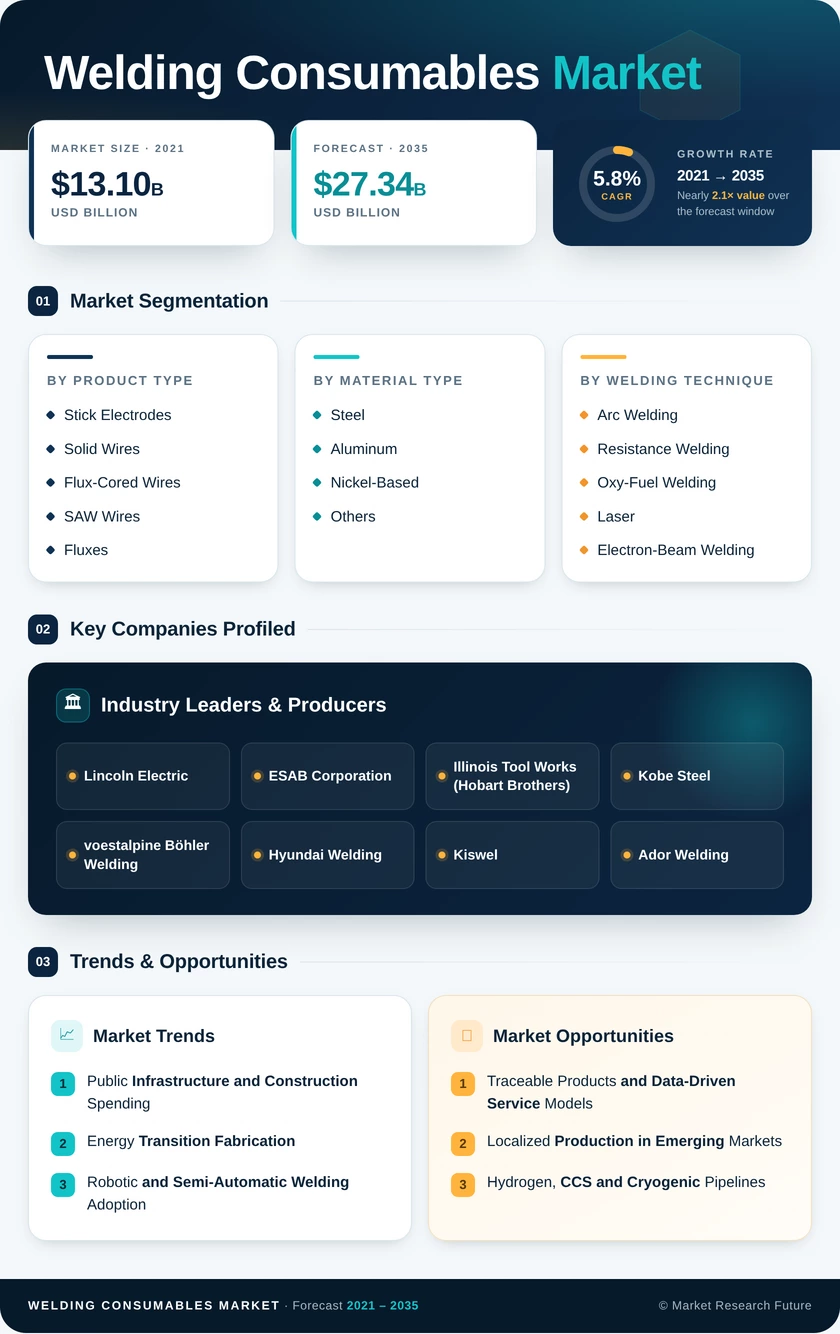
Welding Consumables Market (2026 - 2035)

ID: MRFR/CnM/21320-HCR 111 Pages Pradeep Nandi Last Updated: October 22, 2026
Welding Consumables Market Research Report Information By Product Type (Stick Electrodes, Solid Wires, Flux-Cored Wires, SAW Wires and Fluxes, and Welding Rods), By Material Type (Steel, Aluminum, Nickel-Based, and Others), By Welding Technique (Arc Welding, Resistance Welding, Oxy-Fuel Welding, Laser and Electron-Beam Welding, and Others), By End-Use Industry (Building & Construction, Oil & Gas, Automotive & Transportation, Marine & Shipbuilding, Power Generation, and Others), And By Region (North America, Europe, Asia-Pacific, and Rest of the World) – Market Forecast Till 2035.
Welding Consumables Market
Market Size
Forecast Period2026-2035
CAGR (2026-2035)5.8%
2025 Market SizeUSD 15.56 Billion
2035 Market SizeUSD 27.34 Billion
Key Players
Lincoln Electric
ESAB Corporation
Illinois Tool Works
Kobe Steel
voestalpine Böhler Welding
Hyundai Welding
Opportunities
  • Traceable Products and Data-Driven Service Models
  • Localized Production in Emerging Markets
  • Hydrogen, CCS and Cryogenic Pipelines
  1. 1 Market Summary | |
  2. 2 Key Report Takeaways | |
    1. 2.1 By Product Type | |
    2. 2.2 By Material Type | |
    3. 2.3 By Welding Technique | |
    4. 2.4 By End-Use Industry | |
    5. 2.5 By Region | |
  3. 3 Market Size and Forecast (2021–2035) | |
  4. 4 Driver Impact Analysis | |
    1. 4.1 Public Infrastructure and Construction Spending | |
    2. 4.2 Energy Transition Fabrication | |
    3. 4.3 Robotic and Semi-Automatic Welding Adoption | |
    4. 4.4 Shipbuilding and Hydrocarbon Capex | |
    5. 4.5 EV and Lightweight Vehicle Production | |
    6. 4.6 Steel Output and EAF Transition | |
  5. 5 Restraints Impact Analysis | |
    1. 5.1 Raw Material Price Volatility | |
    2. 5.2 Skilled Welder Shortage | |
    3. 5.3 Low-Filler Joining Technologies | |
    4. 5.4 Tariffs and Trade Remedies | |
    5. 5.5 Fume Exposure Compliance Costs | |
  6. 6 Opportunities | |
    1. 6.1 Traceable Products and Data-Driven Service Models | |
    2. 6.2 Localized Production in Emerging Markets | |
    3. 6.3 Hydrogen, CCS and Cryogenic Pipelines | |
    4. 6.4 Thick-Section Offshore Wind Foundations | |
    5. 6.5 Low-Carbon Product Declarations | |
  7. 7 Regional Market Share and Country-Level Analysis | |
    1. 7.1 North America | | |
      1. 7.1.1 US | | |
      2. 7.1.2 Canada | | |
      3. 7.1.3 Mexico | |
    2. 7.2 Europe | | |
      1. 7.2.1 Germany | | |
      2. 7.2.2 UK | | |
      3. 7.2.3 France | | |
      4. 7.2.4 Italy | | |
      5. 7.2.5 Spain | | |
      6. 7.2.6 Nordic Countries | | |
      7. 7.2.7 Russia | | |
      8. 7.2.8 Rest of Europe | |
    3. 7.3 Asia-Pacific | | |
      1. 7.3.1 China | | |
      2. 7.3.2 India | | |
      3. 7.3.3 Japan | | |
      4. 7.3.4 South Korea | | |
      5. 7.3.5 ASEAN | | |
      6. 7.3.6 Rest of Asia-Pacific | |
    4. 7.4 South America | | |
      1. 7.4.1 Brazil | | |
      2. 7.4.2 Argentina | | |
      3. 7.4.3 Rest of South America | |
    5. 7.5 Middle East & Africa | | |
      1. 7.5.1 Saudi Arabia | | |
      2. 7.5.2 UAE | | |
      3. 7.5.3 South Africa | | |
      4. 7.5.4 Egypt | | |
      5. 7.5.5 Rest of MEA | |
  8. 8 Future Outlook (2026–2035) | |
    1. 8.1 AI-Guided and Collaborative Welding | |
    2. 8.2 Electrification and Grid Build-Out | |
    3. 8.3 Embedded-Carbon Reporting | |
    4. 8.4 Regionalized Supply Chains | |
  9. 9 Segmentation Analysis | |
    1. 9.1 By Product Type | | |
      1. 9.1.1 Stick Electrodes | | |
      2. 9.1.2 Solid Wires | | |
      3. 9.1.3 Flux-Cored Wires | | |
      4. 9.1.4 SAW Wires and Fluxes | | |
      5. 9.1.5 Welding Rods | |
    2. 9.2 By Material Type | | |
      1. 9.2.1 Steel | | |
      2. 9.2.2 Aluminum | | |
      3. 9.2.3 Nickel-Based | | |
      4. 9.2.4 Others | |
    3. 9.3 By Welding Technique | | |
      1. 9.3.1 Arc Welding | | |
      2. 9.3.2 Resistance Welding | | |
      3. 9.3.3 Oxy-Fuel Welding | | |
      4. 9.3.4 Laser and Electron-Beam Welding | | |
      5. 9.3.5 Others | |
    4. 9.4 By End-Use Industry | | |
      1. 9.4.1 Building & Construction | | |
      2. 9.4.2 Oil & Gas | | |
      3. 9.4.3 Automotive & Transportation | | |
      4. 9.4.4 Marine & Shipbuilding | | |
      5. 9.4.5 Power Generation | | |
      6. 9.4.6 Others | |
  10. 10 Competitive Landscape | |
  11. 11 Recent News & Developments | |
  12. 12 Report Scope and Methodology | |
  13. 13 Detailed Sources and Citations | |
  14. 14 Frequently Asked Questions (FAQs) | | LIST OF TABLES | |
  15. TABLE 1 Market Snapshot, 2025–2035 | |
  16. TABLE 2 Global Market Size and Forecast, 2021–2035 (USD Billion) | |
  17. TABLE 3 Driver Impact Analysis | |
  18. TABLE 4 Restraints Impact Analysis | |
  19. TABLE 5 Regional Summary, 2025 | |
  20. TABLE 6 North America Market, by Country, 2025 | |
  21. TABLE 7 Europe Market, by Country, 2025 | |
  22. TABLE 8 Asia-Pacific Market, by Country, 2025 | |
  23. TABLE 9 South America Market, by Country, 2025 | |
  24. TABLE 10 Middle East & Africa Market, by Country, 2025 | |
  25. TABLE 11 Global Market, by Product Type, 2025 | |
  26. TABLE 12 Global Market, by Material Type, 2025 | |
  27. TABLE 13 Global Market, by Welding Technique, 2025 | |
  28. TABLE 14 Global Market, by End-Use Industry, 2025 | |
  29. TABLE 15 Competitive Benchmarking Matrix | |
  30. TABLE 16 Report Scope and Methodology | |
  31. TABLE 17 Detailed Sources and Citations | |
  32. TABLE 18 Segmentation Quick Reference | | LIST OF FIGURES | |
  33. FIGURE 1 Market Dynamics Overview — Drivers, Restraints and Opportunities | |
  34. FIGURE 2 Industry Value Chain Analysis | |
  35. FIGURE 3 Porter's Five Forces Analysis | |
  36. FIGURE 4 Global Market Size Trend, 2021–2035 (USD Billion) | |
  37. FIGURE 5 Market Share by Product Type, 2025 | |
  38. FIGURE 6 Market Share by Material Type, 2025 | |
  39. FIGURE 7 Market Share by Welding Technique, 2025 | |
  40. FIGURE 8 Market Share by End-Use Industry, 2025 | |
  41. FIGURE 9 Regional Market Share, 2025 | |
  42. FIGURE 10 Regional Growth Comparison, 2026–2035 | |
  43. FIGURE 11 Competitive Positioning Matrix | |
  44. FIGURE 12 Estimated Revenue Share Ranges of Key Players

Segmentation Quick Reference

DimensionSub-SegmentsDominant SegmentFastest Growing Segment
By Product TypeStick Electrodes, Solid Wires, Flux-Cored Wires, SAW Wires and Fluxes, Welding RodsStick Electrodes (36.5% share)Flux-Cored Wires (7.6% CAGR)
By Material TypeSteel, Aluminum, Nickel-Based, OthersSteel (48.7% share)Aluminum (8.8% CAGR)
By Welding TechniqueArc Welding, Resistance Welding, Oxy-Fuel Welding, Laser and Electron-Beam Welding, OthersArc Welding (65.6% share)Laser and Electron-Beam Welding (10.8% CAGR)
By End-Use IndustryBuilding & Construction, Oil & Gas, Automotive & Transportation, Marine & Shipbuilding, Power Generation, OthersBuilding & Construction (28.4% share)Automotive & Transportation (6.9% CAGR)
By RegionNorth America, Europe, Asia-Pacific, South America, Middle East & AfricaAsia-Pacific (46.8% share)Middle East & Africa (7.4% CAGR)

Market Segmentation Overview

By Product Type

Sub-SegmentKey Trend
Stick ElectrodesSteady field demand in remote construction and pipeline repair
Solid WiresStable volume on automotive and light structural lines
Flux-Cored WiresRapid uptake in robotic and semi-automatic cells
SAW Wires and FluxesPremium pricing on thick offshore and vessel joints
Welding RodsGradual decline outside maintenance and TIG repair

Stick Electrodes keep the lead at 36.5% because field crews value their portability and code approvals where gas and power are unreliable. Flux-Cored Wires grow fastest at 7.6% CAGR as gas-shielded grades deliver the deposition rates and feed stability that robots require. SAW Wires and Fluxes stay smaller in tonnage but earn the most revenue per kilogram on certified heavy-section work.

By Material Type

Sub-SegmentKey Trend
SteelLow-hydrogen grades gain as EAF-route plate spreads
AluminumEV battery trays and lightweight bodies lift demand
Nickel-BasedHigh-value use in nuclear, aerospace and hydrogen service
OthersCopper, titanium and cobalt serve specialty niches

Steel holds 48.7% of demand because carbon, HSLA and stainless fabrication underpin structures, vessels and pipelines. Aluminum grows fastest at 8.8% CAGR as automakers qualify fillers for battery enclosures and laser-welded assemblies. Nickel-Based grades remain low-volume but command the highest unit prices, supported by hydrogen and cryogenic pipeline specifications.

By Welding Technique

Sub-SegmentKey Trend
Arc WeldingBroadest process base across thicknesses and positions
Resistance WeldingFiller-light body-in-white joining
Oxy-Fuel WeldingShrinking share as fabrication electrifies
Laser and Electron-Beam WeldingFast adoption in battery and aerospace joints
OthersFriction stir and hybrid processes in niche structures

Arc Welding dominates with a 65.6% share because SMAW, GMAW, GTAW and SAW cover nearly every joint type, from field pipe to offshore monopiles. Laser and Electron-Beam Welding expands fastest at 10.8% CAGR on precision battery and aerospace work. Lower filler use per laser joint means its volume contribution trails its adoption rate.

By End-Use Industry

Sub-SegmentKey Trend
Building & ConstructionPublic infrastructure programs sustain tonnage
Oil & GasPipeline and LNG terminal projects in the Gulf and Americas
Automotive & TransportationEV platforms reshape filler mix toward aluminum
Marine & ShipbuildingEast Asian LNG carrier and container ship orders
Power GenerationNuclear refurbishment and offshore wind fabrication
OthersMining, heavy machinery and agricultural equipment

Building & Construction leads at 28.4% as bridges, rail and steel-frame buildings funded by IIJA and Indian capex absorb large electrode and wire volumes. Automotive & Transportation grows fastest at 6.9% CAGR because EV platforms introduce new aluminum and high-strength steel joints. Marine & Shipbuilding stays concentrated in Chinese, Korean and Japanese yards, where backlogs secure near-term flux-cored demand.


Download PDF ×

We do not share your information with anyone. However, we may send you emails based on your report interest from time to time. You may contact us at any time to opt-out.