
×
Request Free Sample ×

Kindly complete the form below to receive a free sample of this Report

* Please use a valid business email

Leading companies partner with us for data-driven Insights

clients tt-cursor
Hero Background
English
Chinese
French
Japanese
Korean
German
Spanish

Virtualized Evolved Packet Core Market Analysis

ID: MRFR/ICT/4167-CR
121 Pages
Shubham Munde
August 2018

Virtualized Evolved Packet Core (vEPC) Market Research Report Information By component (Solution And Services), By Deployment (On-Premise And On-Cloud), By Applications (LTE, VOLTE, VOWiFi, IoT and M2M, And MPN & MVNO), By End-User (Telecom Operators And Enterprises) And By Region (North America, Europe, Asia-Pacific, And Rest Of The World) –Market Forecast Till 2035

Share:
Download PDF ×

We do not share your information with anyone. However, we may send you emails based on your report interest from time to time. You may contact us at any time to opt-out.

Virtualized Evolved Packet Core Market Infographic
Purchase Options

Market Analysis

In-depth Analysis of Virtualized Evolved Packet Core Market Industry Landscape

Virtualized Evolved Packet Core (vEPC) market aspects are undergoing a pioneering movement due to the growing need for productive and adaptable portable organization foundation. With media transmission administrators trying to accommodate customers' changing needs, vEPC is a crucial breakthrough. Cell phones and information-related applications are driving this market's growth.

The vEPC industry is flooded by mechanical advances, notably in virtualization and SDN. The need for network agility drives the migration to vEPC. Virtualized partners provide more adaptability and asset usage than equipment-based EPC frameworks. This improvement allows administrators to modernize their organization architecture, reduce functional costs, and respond quickly to market demands.

Due to 5G companies' widespread deployment, the vEPC industry is booming. 5G innovation demands a strong, agile core organization, and vEPC fits the bill. The vEPC industry is growing as media transmission companies invest in 5G. The potential of vEPC to efficiently manage and distribute assets on-demand adapts to 5G enterprises' needs.

Other factors affecting vEPC market features include cost-adequacy. Virtualization reduces administrators' capital consumption by eliminating expensive and space-consuming equipment. This cost proficiency is appealing to established and emerging telecom businesses looking to increase profits while maintaining network performance.

The serious vEPC market is distinguished by central member coordination and organizations. Merchants are joining unions to expand their product lines and market reach as vEPC interest grows. This design helps merchants and end-clients by integrating and expanding the biological system. In addition, creative new companies are offering customized arrangements and improving the vEPC scene.

The rapid growth of the vEPC industry brings challenges. Virtualized network security issues remain core for administrators. As virtualization creates new attack surfaces, these flaws must be addressed. Sellers are investing in safety measures and conventions to allay these concerns and boost vEPC acceptance.


Author
Shubham Munde
Team Lead - Research

Shubham brings over 7 years of expertise in Market Intelligence and Strategic Consulting, with a strong focus on the Automotive, Aerospace, and Defense sectors. Backed by a solid foundation in semiconductors, electronics, and software, he has successfully delivered high-impact syndicated and custom research on a global scale. His core strengths include market sizing, forecasting, competitive intelligence, consumer insights, and supply chain mapping. Widely recognized for developing scalable growth strategies, Shubham empowers clients to navigate complex markets and achieve a lasting competitive edge. Trusted by start-ups and Fortune 500 companies alike, he consistently converts challenges into strategic opportunities that drive sustainable growth.

Leave a Comment

FAQs

What is the projected market valuation of the Virtualized Evolved Packet Core (vEPC) Market by 2035?

<p>The projected market valuation for the vEPC Market is expected to reach 38.49 USD Billion by 2035.</p>

What was the market valuation of the vEPC Market in 2024?

<p>The overall market valuation of the vEPC Market was 4.23 USD Billion in 2024.</p>

What is the expected CAGR for the vEPC Market during the forecast period 2025 - 2035?

<p>The expected CAGR for the vEPC Market during the forecast period 2025 - 2035 is 22.23%.</p>

Which companies are considered key players in the vEPC Market?

<p>Key players in the vEPC Market include Nokia, Ericsson, Huawei, ZTE, Cisco, Mavenir, Samsung, Intel, and Juniper Networks.</p>

What are the main components of the vEPC Market and their valuations?

<p>The main components of the vEPC Market include Solutions valued at 23.1 USD Billion and Services valued at 15.39 USD Billion.</p>

How is the vEPC Market segmented by deployment type?

<p>The vEPC Market is segmented into On-Premise, valued at 19.25 USD Billion, and On-Cloud, valued at 19.24 USD Billion.</p>

What applications are driving growth in the vEPC Market?

Applications driving growth in the vEPC Market include LTE, VoLTE, VoWiFi, IoT and M2M, and MPN &amp; MVNO, with valuations ranging from 4.0 to 13.0 USD Billion.

Who are the primary end-users of vEPC solutions?

The primary end-users of vEPC solutions are Telecom Operators, valued at 23.08 USD Billion, and Enterprises, valued at 15.41 USD Billion.

What trends are influencing the growth of the vEPC Market?

Trends influencing the growth of the vEPC Market include the increasing demand for efficient network management and the rise of IoT applications.

How does the vEPC Market compare to traditional packet core solutions?

The vEPC Market offers enhanced flexibility and scalability compared to traditional packet core solutions, which is likely to drive its adoption.

Market Summary

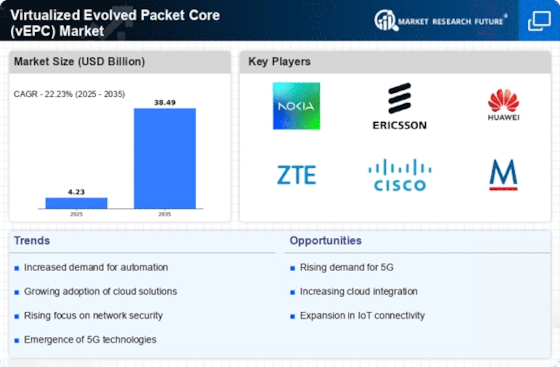
As per Market Research Future analysis, the Virtualized Evolved Packet Core Market (vEPC) Market Size was estimated at 4.23 USD Billion in 2024. The vEPC industry is projected to grow from USD 5.17 Billion in 2025 to USD 38.49 Billion by 2035, exhibiting a compound annual growth rate (CAGR) of 22.23% during the forecast period 2025 - 2035

Key Market Trends & Highlights

The Virtualized Evolved Packet Core Market (vEPC) market is experiencing robust growth driven by technological advancements and evolving consumer demands.

  • The market is witnessing increased adoption of cloud-native solutions, particularly in North America, which remains the largest market. There is a pronounced focus on network automation, especially in the Asia-Pacific region, recognized as the fastest-growing area. Security and compliance are becoming paramount as organizations seek to enhance their network integrity and protect sensitive data. The growing demand for high-speed connectivity and the rise of IoT applications are key drivers propelling the market forward.

Market Size & Forecast

2024 Market Size 4.23 (USD Billion)
2035 Market Size 38.49 (USD Billion)
CAGR (2025 - 2035) 22.23%
Largest Regional Market Share in 2024 North America

Major Players

Nokia (FI), Ericsson (SE), Huawei (CN), ZTE (CN), Cisco (US), Mavenir (US), Samsung (KR), Intel (US), Juniper Networks (US)

Market Trends

The Virtualized Evolved Packet Core Market (vEPC) Market is currently experiencing a transformative phase, driven by the increasing demand for efficient and scalable network solutions. As mobile data traffic continues to surge, telecommunications providers are seeking innovative ways to enhance their infrastructure. The adoption of virtualization technologies allows for greater flexibility and cost-effectiveness, enabling operators to manage resources more efficiently. This shift towards virtualization is not merely a trend but appears to be a fundamental change in how networks are designed and operated. Furthermore, the rise of Internet of Things (IoT) applications and the need for seamless connectivity are propelling the growth of the vEPC Market, as these technologies require robust and adaptable network architectures. In addition, the ongoing evolution of 5G networks is likely to further influence the Virtualized Evolved Packet Core Market (vEPC) Market. As operators prepare for the deployment of next-generation services, the integration of vEPC solutions is becoming increasingly critical. This integration may facilitate improved service delivery and enhanced user experiences. Moreover, the emphasis on network slicing and edge computing suggests that the vEPC Market will continue to evolve, adapting to the diverse needs of various industries. Overall, the current landscape indicates a promising future for the Virtualized Evolved Packet Core Market (vEPC) Market, characterized by innovation and strategic advancements in network technology.

Increased Adoption of Cloud-Native Solutions

The trend towards cloud-native architectures is gaining momentum within the Virtualized Evolved Packet Core Market (vEPC) Market. Operators are increasingly recognizing the benefits of deploying vEPC solutions in cloud environments, which offer enhanced scalability and flexibility. This shift allows for more efficient resource allocation and improved service delivery, aligning with the growing demand for high-performance networks.

Focus on Network Automation

Automation is becoming a pivotal focus in the Virtualized Evolved Packet Core Market (vEPC) Market. As networks grow in complexity, the need for automated management and orchestration tools is evident. This trend suggests that operators are seeking to streamline operations, reduce human error, and enhance overall network efficiency through advanced automation technologies.

Emphasis on Security and Compliance

With the increasing reliance on virtualized networks, security and compliance are emerging as critical concerns in the Virtualized Evolved Packet Core Market (vEPC) Market. Operators are prioritizing the implementation of robust security measures to protect sensitive data and ensure regulatory compliance. This emphasis on security indicates a proactive approach to safeguarding network integrity in a rapidly evolving digital landscape.

Virtualized Evolved Packet Core Market Market Drivers

Support for Network Slicing

Network slicing is emerging as a crucial feature in the Virtualized Evolved Packet Core Market (vEPC) Market, particularly with the advent of 5G technology. This capability allows operators to create multiple virtual networks on a single physical infrastructure, tailored to specific service requirements. As industries such as automotive, healthcare, and entertainment demand customized network solutions, the ability to implement network slicing becomes increasingly vital. The market for network slicing is expected to grow significantly, with estimates suggesting it could reach several billion dollars by 2026. This trend indicates that vEPC solutions, which facilitate network slicing, are likely to see heightened adoption as operators seek to meet diverse customer needs.

Growing Demand for High-Speed Connectivity

The increasing demand for high-speed connectivity is a primary driver for the Virtualized Evolved Packet Core Market (vEPC) Market. As consumers and businesses alike seek faster internet services, telecommunications providers are compelled to upgrade their infrastructure. The vEPC technology facilitates the deployment of 4G and 5G networks, which are essential for meeting these connectivity demands. According to recent data, the number of 5G subscriptions is projected to reach over 1 billion by the end of 2025, indicating a robust growth trajectory. This surge in demand for high-speed services necessitates the adoption of vEPC solutions, which offer scalability and flexibility, thereby enhancing network performance and user experience.

Cost Efficiency and Operational Flexibility

Cost efficiency remains a significant driver for the Virtualized Evolved Packet Core Market (vEPC) Market. By transitioning to a virtualized architecture, telecom operators can reduce capital expenditures associated with traditional hardware. The operational flexibility provided by vEPC allows for dynamic resource allocation, which can lead to substantial savings in operational costs. Reports suggest that companies adopting vEPC solutions have experienced up to a 30% reduction in operational expenses. This financial incentive is particularly appealing in a competitive market where profit margins are often tight. As operators strive to optimize their expenditures while enhancing service delivery, the cost benefits of vEPC are likely to drive its adoption further.

Rise of Internet of Things (IoT) Applications

The proliferation of Internet of Things (IoT) applications is significantly influencing the Virtualized Evolved Packet Core Market (vEPC) Market. With billions of devices expected to be connected in the coming years, the demand for a robust and scalable network infrastructure is paramount. vEPC solutions are well-suited to handle the diverse and dynamic traffic generated by IoT devices, ensuring seamless connectivity and data management. Industry forecasts indicate that the number of connected IoT devices could exceed 30 billion by 2025, necessitating advanced network solutions. This trend underscores the importance of vEPC in supporting the growing IoT ecosystem, thereby driving its market growth.

Regulatory Compliance and Security Enhancements

Regulatory compliance and security enhancements are becoming increasingly important drivers for the Virtualized Evolved Packet Core Market (vEPC) Market. As data privacy regulations tighten globally, telecom operators must ensure that their networks comply with these standards. vEPC solutions offer advanced security features that help operators safeguard sensitive data and maintain compliance with regulations such as GDPR and CCPA. The market for telecom security solutions is projected to grow, reflecting the heightened focus on security in network operations. This emphasis on compliance and security not only protects operators from potential fines but also builds consumer trust, thereby driving the adoption of vEPC technologies.

Market Segment Insights

By Component: Solutions (Largest) vs. Services (Fastest-Growing)

<p>In the Virtualized Evolved Packet Core (vEPC) Market, the component segment is distinctly characterized by solutions holding a significant portion of the market share. Solutions are widely adopted among telecommunications providers due to their reliability and effectiveness in managing networks, which enhance operational efficiency. On the other hand, the services segment is rapidly gaining traction, reflecting the increasing demand for professional guidance and support as organizations transition to more sophisticated vEPC implementations.</p>

<p>Solutions (Dominant) vs. Services (Emerging)</p>

<p>Within the vEPC Market, Solutions serve as a dominant force, facilitating scalable, resilient infrastructure essential for enhancing network performance. Their configurability and integration with various technologies make them invaluable for telecom operators aiming for a competitive edge. Conversely, services have emerged as a crucial component in the market, particularly as businesses seek partnerships for cloud deployment and operational support. These services enable organizations to rapidly adapt to changing technological demands, ensuring seamless transitions and optimal performance through expert implementations. As a result, the services sector is projected to experience sustained growth as it complements the solutions with necessary expertise.</p>

By Deployment: On-Cloud (Largest) vs. On-Premise (Fastest-Growing)

<p>In the Virtualized Evolved Packet Core (vEPC) Market, the deployment landscape is prominently divided between On-Cloud and On-Premise models. On-Cloud solutions are currently the largest segment, capturing a substantive share of the market due to their flexibility and scalability, which meets the demands of modern network operators. On-Premise deployments, however, are gaining significant traction, especially among enterprises seeking enhanced security and control over their network environments.</p>

<p>Deployment: On-Cloud (Dominant) vs. On-Premise (Emerging)</p>

<p>On-Cloud deployments are characterized by their ability to provide virtualized infrastructure through third-party service providers, enabling telecom operators to manage their services dynamically and at scale. This model offers advantages including reduced capital expenditures and faster service delivery, appealing to a wide range of enterprises. Conversely, On-Premise deployments cater to industries that prioritize security and regulatory compliance. These solutions allow organizations to maintain physical control over their infrastructure, leading to increased customization and reliability, making them increasingly relevant in securing critical network operations.</p>

By Applications: LTE (Largest) vs. VoLTE (Fastest-Growing)

<p>The 'Applications' segment in the Virtualized Evolved Packet Core (vEPC) Market showcases a competitive landscape with LTE commanding the largest share. LTE continues to be the predominant application due to its widespread adoption and the foundational role it plays in modern mobile networks. VoLTE is emerging rapidly as a key player, capitalizing on the need for high-quality voice services over LTE networks, thereby capturing a significant portion of market interest. Together, these applications illustrate the dynamic nature of vEPC market segmentation.</p>

<p>VoLTE (Dominant) vs. IoT and M2M (Emerging)</p>

<p>VoLTE is positioned as a dominant force within the vEPC landscape, offering superior voice quality and enabling HD voice calling, which is becoming an essential offering for mobile operators. Its ability to enhance user experience is driving its rapid adoption across various networks. On the other hand, IoT and M2M are emerging applications that present significant growth potential as the world shifts towards interconnected devices and smart solutions. This segment is being fueled by the increasing demand for data connectivity among IoT devices, emphasizing the need for innovative solutions that vEPC can offer. The interplay between these two applications highlights a shift from traditional voice-centric to data-driven mobile communications.</p>

By End-User: Telecom Operators (Largest) vs. Enterprises (Fastest-Growing)

<p>In the Virtualized Evolved Packet Core (vEPC) Market, the distribution of market share among end-users reveals a significant prominence of telecom operators. These operators typically account for a substantial portion of vEPC deployments, driven by their need to enhance network efficiency and support growing data traffic. Contrastingly, enterprises are quickly gaining ground, reflecting a rising interest in adopting virtualized network solutions to streamline operations and enable better service delivery. Growth trends in this segment indicate a robust expansion, especially among enterprises who are increasingly recognizing the advantages of vEPC deployments. The shift towards cloud-based services and the growing demand for flexible and scalable network solutions are propelling enterprises to adopt vEPC technologies at an accelerated pace, making them one of the fastest-growing segments in the market.</p>

<p>End-User Sector: Telecom Operators (Dominant) vs. Enterprises (Emerging)</p>

<p>Telecom operators represent the dominant force in the Virtualized Evolved Packet Core (vEPC) Market, leveraging their scale and infrastructure to implement advanced network solutions that cater to their extensive user bases. These operators focus on enhancing quality of service and network efficiency while accommodating the increasing demand for mobile data. On the other hand, enterprises are emerging as a pivotal segment, driven by the necessity for agile and cost-effective networking solutions. Their increasing participation signifies a paradigm shift where businesses seek to optimize operations through virtualization, indicating a rapidly evolving landscape as they aggressively pursue digital transformation initiatives.</p>

Get more detailed insights about Virtualized Evolved Packet Core (vEPC) Market Research Report- Forecast to 2035

Regional Insights

North America : Innovation and Leadership Hub

North America is the largest market for Virtualized Evolved Packet Core Market (vEPC), holding approximately 40% of the global market share. The region's growth is driven by the increasing demand for high-speed mobile networks and the transition to 5G technology. Regulatory support from the Federal Communications Commission (FCC) and investments in infrastructure are key catalysts for this growth. The region's focus on innovation and technology adoption further enhances its market position. The competitive landscape in North America is characterized by the presence of major players such as Cisco, Ericsson, and Nokia. The United States leads the market, followed by Canada, which is also witnessing significant investments in telecommunications infrastructure. The collaboration between telecom operators and technology providers is fostering a robust ecosystem for vEPC solutions, ensuring that North America remains at the forefront of the market.

Europe : Emerging Market with Regulations

Europe is the second-largest market for Virtualized Evolved Packet Core Market (vEPC), accounting for approximately 30% of the global market share. The region's growth is propelled by stringent regulatory frameworks aimed at enhancing network efficiency and security. The European Union's Digital Single Market strategy encourages the adoption of advanced telecommunications technologies, including vEPC, to support 5G deployment and improve connectivity across member states. Leading countries in Europe include Germany, the UK, and France, which are investing heavily in digital infrastructure. The competitive landscape features key players like Ericsson and Nokia, who are actively collaborating with local telecom operators to deliver innovative vEPC solutions. The presence of a strong regulatory environment and a focus on sustainability further enhance Europe's position in The Virtualized Evolved Packet Core Market (vEPC).

Asia-Pacific : Rapid Growth and Adoption

Asia-Pacific is witnessing rapid growth in the Virtualized Evolved Packet Core Market (vEPC) market, holding approximately 25% of the global market share. The region's expansion is driven by the increasing adoption of mobile broadband services and the rollout of 5G networks. Government initiatives in countries like China and India to enhance digital connectivity are significant growth catalysts, alongside the rising demand for cloud-based solutions in telecommunications. China is the largest market in the region, followed by India and Japan, with major players like Huawei and ZTE leading the charge. The competitive landscape is marked by aggressive investments in technology and infrastructure, as telecom operators seek to modernize their networks. The presence of both local and international players fosters a dynamic environment, positioning Asia-Pacific as a key player in The Virtualized Evolved Packet Core Market (vEPC).

Middle East and Africa : Resource-Rich Frontier

The Middle East and Africa region is emerging as a significant player in the Virtualized Evolved Packet Core Market (vEPC) market, accounting for approximately 5% of the global market share. The growth is driven by increasing mobile penetration and the demand for enhanced connectivity solutions. Government initiatives aimed at improving digital infrastructure and attracting foreign investments are crucial for the region's development in telecommunications, particularly in countries like South Africa and the UAE. Leading countries in this region include South Africa, the UAE, and Nigeria, where telecom operators are investing in modernizing their networks. The competitive landscape features both local and international players, with companies like Ericsson and Huawei actively participating in the market. The region's focus on digital transformation and smart city initiatives is expected to further boost the demand for vEPC solutions.

Key Players and Competitive Insights

Leading market players are investing heavily in research and development to expand their product lines, which will help the Virtualized Evolved Packet Core Market (vEPC) market grow even more. Market participants are also undertaking various strategic activities to expand their global footprint, with important market developments including new product launches, contractual agreements, mergers and acquisitions, higher investments, and collaboration with other organizations. To expand and survive in a more competitive and rising market climate, Virtualized Evolved Packet Core Market (vEPC) industry must offer cost-effective items.
Manufacturing locally to minimize operational costs is one of the key business tactics manufacturers use in the global Virtualized Evolved Packet Core Market (vEPC) industry to benefit clients and increase the market sector. In recent years, the Virtualized Evolved Packet Core Market (vEPC) industry has offered some of the most significant advantages to technology. Major players in the Virtualized Evolved Packet Core Market (vEPC) market, including Nokia Corporation (Finland), Cisco System Inc. (US), Huawei Technologies Co.
Ltd. (China), NEC Corporation (Japan), Ericsson AB (Sweden), SAMSUNG (South Korea), ZTE Corporation (China), Mitel Networks Corporation (US), Affirmed Networks (US), Athonet S.R.L.(Italy), and others, are attempting to increase market demand by investing in research and development operations.
Nokia Corporation is a multinational company that specializes in consumer electronics, information technology, and telecommunications. Nokia Corporation is also known as Nokia in Finnish and Swedish. The headquater of Nokia are situated in Espoo, Finland. The company was established in 1865. For instance: In September 2022, Nokia launched its newest Software-as-a-Service (SaaS) solution, Visualization, Automation, and Analytics (AVA) charging, intended to assist Communication Service Providers (CSPs) and enterprises in efficiency releasing new offerings for 5G and IoT usage cases.
With its ‘Intelligence Everywhere’ method, Machine Learning (ML), AVA Charging leverages Artificial Intelligence (AI), Open APIs, no code configuration, multi-cloud orchestration and digital ecosystems to bring comprehensive capabilities.
Telefonaktiebolaget LM Ericcson, also known as Ericcson, is a global Swedish networking and telecommunications corporation headquartered in Stockholm. For telecom service providers and businesses, the company supplies software, infrastructure, and services in information and communications technology, and optical transport systems. Over 1, 00,000 individuals work for the corporation, which operates in over 180 nations. Over 57,000 awarded patents belong to Erricson. One of the pioneers in 5G, Ericsson has made important contributions to the growth of the telecom sector. For Instance: In February 2023, Ericsson and Econet will roll out 5G in Zimbave.
Due to the cooperation, Econet will have access to Ericsson’s most recent Radio Access Network (RAN) and 5G Evolved Packet Core (EPC) solutions, which are much faster than 4G and will improve user experience and capacity.

Key Companies in the Virtualized Evolved Packet Core Market include

Industry Developments

In February 2023, Intel Corporation and SK Telecom have announced the release of Intel Infrastructure Power Manager for 5G Core, which saves an average of 30% CPU power at runtime with built-in acceleration to meet critical performance, scaling and power requirements.

In June 2021, Nokia Corporation, in partnership with DISH, deployed the first standalone 5G core network on the public cloud using AWS. Network operations become streamlined when you deploy network on AWS; it is possible to quickly install new software and services and support integration for a legion of innovative use cases for customers.

In October 2022, to support the development of 5G ecosystems and advance 6G research in Europe, Smart Networks and Services Joint Undertaking (SNS JU) has chosen its initial portfolio of thirty-five research, innovation and trial projects. The objective is to create a world-class European supply chain for state-of-the-art 5G systems and expand Europe's technology capabilities in the area of 6G technologies under Horizon Europe through total funding for this new set of about €250 million.

In September 2022, Nokia released AVA Charging - Software as a Service (SaaS); this product will enable CSPs as well as enterprises to quickly commercialize new offerings for lot & 5 G use cases.

In June 2019, Mavenir began offering an alternative Virtual RAN aimed at ending the global mobile network supply oligopoly and is currently contesting several tenders/RFIs for mobile networks across the APAC region.

In May 2019, Vodafone Idea Limited will deploy the Ericsson cloud packet core to enhance network performance.VIL will benefit from Ericsson’s leading applications in the core network and Network Functions such as Ericsson virtual Evolved Packet Gateway (vEPG), Service-Aware Policy Controller (vSAPC) and Virtualization Infrastructure (NFVI) solution enabling the fast introduction of new services and providing full-service continuity.

In November 2017, Ericsson worked with Telefónica Chile to deploy its NFV solution, including vEPC, virtual Authentication Authorization and Accounting (AAA), Virtual IP Multimedia Subsystem (IMS) and NFVi infrastructure to virtualize their network function.


Future Outlook

Virtualized Evolved Packet Core Market Future Outlook

The Virtualized Evolved Packet Core Market (vEPC) Market is projected to grow at a 22.23% CAGR from 2025 to 2035, driven by increasing demand for mobile data and IoT applications.

New opportunities lie in:

  • Development of AI-driven network optimization tools
  • Expansion into emerging markets with tailored vEPC solutions
  • Partnerships with cloud service providers for integrated offerings

By 2035, the vEPC market is expected to be a cornerstone of global telecommunications infrastructure.

Market Segmentation

Virtualized Evolved Packet Core Market End-User Outlook

  • Telecom Operators
  • Enterprises

Virtualized Evolved Packet Core Market Component Outlook

  • Solutions
  • Services

Virtualized Evolved Packet Core Market Deployment Outlook

  • On-Premise
  • On-Cloud

Virtualized Evolved Packet Core Market Applications Outlook

  • LTE
  • VoLTE
  • VoWiFi
  • IoT and M2M
  • MPN & MVNO

Report Scope

MARKET SIZE 2024 4.23(USD Billion)
MARKET SIZE 2025 5.17(USD Billion)
MARKET SIZE 2035 38.49(USD Billion)
COMPOUND ANNUAL GROWTH RATE (CAGR) 22.23% (2025 - 2035)
REPORT COVERAGE Revenue Forecast, Competitive Landscape, Growth Factors, and Trends
BASE YEAR 2024
Market Forecast Period 2025 - 2035
Historical Data 2019 - 2024
Market Forecast Units USD Billion
Key Companies Profiled Nokia (FI), Ericsson (SE), Huawei (CN), ZTE (CN), Cisco (US), Mavenir (US), Samsung (KR), Intel (US), Juniper Networks (US)
Segments Covered component, Deployment, Applications, End-User, Region
Key Market Opportunities Integration of edge computing enhances scalability and efficiency in the Virtualized Evolved Packet Core (vEPC) Market.
Key Market Dynamics Rising demand for network flexibility drives innovation in Virtualized Evolved Packet Core solutions among telecommunications providers.
Countries Covered North America, Europe, APAC, South America, MEA

FAQs

What is the projected market valuation of the Virtualized Evolved Packet Core (vEPC) Market by 2035?

<p>The projected market valuation for the vEPC Market is expected to reach 38.49 USD Billion by 2035.</p>

What was the market valuation of the vEPC Market in 2024?

<p>The overall market valuation of the vEPC Market was 4.23 USD Billion in 2024.</p>

What is the expected CAGR for the vEPC Market during the forecast period 2025 - 2035?

<p>The expected CAGR for the vEPC Market during the forecast period 2025 - 2035 is 22.23%.</p>

Which companies are considered key players in the vEPC Market?

<p>Key players in the vEPC Market include Nokia, Ericsson, Huawei, ZTE, Cisco, Mavenir, Samsung, Intel, and Juniper Networks.</p>

What are the main components of the vEPC Market and their valuations?

<p>The main components of the vEPC Market include Solutions valued at 23.1 USD Billion and Services valued at 15.39 USD Billion.</p>

How is the vEPC Market segmented by deployment type?

<p>The vEPC Market is segmented into On-Premise, valued at 19.25 USD Billion, and On-Cloud, valued at 19.24 USD Billion.</p>

What applications are driving growth in the vEPC Market?

Applications driving growth in the vEPC Market include LTE, VoLTE, VoWiFi, IoT and M2M, and MPN &amp; MVNO, with valuations ranging from 4.0 to 13.0 USD Billion.

Who are the primary end-users of vEPC solutions?

The primary end-users of vEPC solutions are Telecom Operators, valued at 23.08 USD Billion, and Enterprises, valued at 15.41 USD Billion.

What trends are influencing the growth of the vEPC Market?

Trends influencing the growth of the vEPC Market include the increasing demand for efficient network management and the rise of IoT applications.

How does the vEPC Market compare to traditional packet core solutions?

The vEPC Market offers enhanced flexibility and scalability compared to traditional packet core solutions, which is likely to drive its adoption.

  1. SECTION I: EXECUTIVE SUMMARY AND KEY HIGHLIGHTS
    1. | 1.1 EXECUTIVE SUMMARY
    2. | | 1.1.1 Market Overview
    3. | | 1.1.2 Key Findings
    4. | | 1.1.3 Market Segmentation
    5. | | 1.1.4 Competitive Landscape
    6. | | 1.1.5 Challenges and Opportunities
    7. | | 1.1.6 Future Outlook
  2. SECTION II: SCOPING, METHODOLOGY AND MARKET STRUCTURE
    1. | 2.1 MARKET INTRODUCTION
    2. | | 2.1.1 Definition
    3. | | 2.1.2 Scope of the study
    4. | | | 2.1.2.1 Research Objective
    5. | | | 2.1.2.2 Assumption
    6. | | | 2.1.2.3 Limitations
    7. | 2.2 RESEARCH METHODOLOGY
    8. | | 2.2.1 Overview
    9. | | 2.2.2 Data Mining
    10. | | 2.2.3 Secondary Research
    11. | | 2.2.4 Primary Research
    12. | | | 2.2.4.1 Primary Interviews and Information Gathering Process
    13. | | | 2.2.4.2 Breakdown of Primary Respondents
    14. | | 2.2.5 Forecasting Model
    15. | | 2.2.6 Market Size Estimation
    16. | | | 2.2.6.1 Bottom-Up Approach
    17. | | | 2.2.6.2 Top-Down Approach
    18. | | 2.2.7 Data Triangulation
    19. | | 2.2.8 Validation
  3. SECTION III: QUALITATIVE ANALYSIS
    1. | 3.1 MARKET DYNAMICS
    2. | | 3.1.1 Overview
    3. | | 3.1.2 Drivers
    4. | | 3.1.3 Restraints
    5. | | 3.1.4 Opportunities
    6. | 3.2 MARKET FACTOR ANALYSIS
    7. | | 3.2.1 Value chain Analysis
    8. | | 3.2.2 Porter's Five Forces Analysis
    9. | | | 3.2.2.1 Bargaining Power of Suppliers
    10. | | | 3.2.2.2 Bargaining Power of Buyers
    11. | | | 3.2.2.3 Threat of New Entrants
    12. | | | 3.2.2.4 Threat of Substitutes
    13. | | | 3.2.2.5 Intensity of Rivalry
    14. | | 3.2.3 COVID-19 Impact Analysis
    15. | | | 3.2.3.1 Market Impact Analysis
    16. | | | 3.2.3.2 Regional Impact
    17. | | | 3.2.3.3 Opportunity and Threat Analysis
  4. SECTION IV: QUANTITATIVE ANALYSIS
    1. | 4.1 Information and Communications Technology, BY Component (USD Billion)
    2. | | 4.1.1 Solutions
    3. | | 4.1.2 Services
    4. | 4.2 Information and Communications Technology, BY Deployment (USD Billion)
    5. | | 4.2.1 On-Premise
    6. | | 4.2.2 On-Cloud
    7. | 4.3 Information and Communications Technology, BY Applications (USD Billion)
    8. | | 4.3.1 LTE
    9. | | 4.3.2 VoLTE
    10. | | 4.3.3 VoWiFi
    11. | | 4.3.4 IoT and M2M
    12. | | 4.3.5 MPN & MVNO
    13. | 4.4 Information and Communications Technology, BY End-User (USD Billion)
    14. | | 4.4.1 Telecom Operators
    15. | | 4.4.2 Enterprises
    16. | 4.5 Information and Communications Technology, BY Region (USD Billion)
    17. | | 4.5.1 North America
    18. | | | 4.5.1.1 US
    19. | | | 4.5.1.2 Canada
    20. | | 4.5.2 Europe
    21. | | | 4.5.2.1 Germany
    22. | | | 4.5.2.2 UK
    23. | | | 4.5.2.3 France
    24. | | | 4.5.2.4 Russia
    25. | | | 4.5.2.5 Italy
    26. | | | 4.5.2.6 Spain
    27. | | | 4.5.2.7 Rest of Europe
    28. | | 4.5.3 APAC
    29. | | | 4.5.3.1 China
    30. | | | 4.5.3.2 India
    31. | | | 4.5.3.3 Japan
    32. | | | 4.5.3.4 South Korea
    33. | | | 4.5.3.5 Malaysia
    34. | | | 4.5.3.6 Thailand
    35. | | | 4.5.3.7 Indonesia
    36. | | | 4.5.3.8 Rest of APAC
    37. | | 4.5.4 South America
    38. | | | 4.5.4.1 Brazil
    39. | | | 4.5.4.2 Mexico
    40. | | | 4.5.4.3 Argentina
    41. | | | 4.5.4.4 Rest of South America
    42. | | 4.5.5 MEA
    43. | | | 4.5.5.1 GCC Countries
    44. | | | 4.5.5.2 South Africa
    45. | | | 4.5.5.3 Rest of MEA
  5. SECTION V: COMPETITIVE ANALYSIS
    1. | 5.1 Competitive Landscape
    2. | | 5.1.1 Overview
    3. | | 5.1.2 Competitive Analysis
    4. | | 5.1.3 Market share Analysis
    5. | | 5.1.4 Major Growth Strategy in the Information and Communications Technology
    6. | | 5.1.5 Competitive Benchmarking
    7. | | 5.1.6 Leading Players in Terms of Number of Developments in the Information and Communications Technology
    8. | | 5.1.7 Key developments and growth strategies
    9. | | | 5.1.7.1 New Product Launch/Service Deployment
    10. | | | 5.1.7.2 Merger & Acquisitions
    11. | | | 5.1.7.3 Joint Ventures
    12. | | 5.1.8 Major Players Financial Matrix
    13. | | | 5.1.8.1 Sales and Operating Income
    14. | | | 5.1.8.2 Major Players R&D Expenditure. 2023
    15. | 5.2 Company Profiles
    16. | | 5.2.1 Nokia (FI)
    17. | | | 5.2.1.1 Financial Overview
    18. | | | 5.2.1.2 Products Offered
    19. | | | 5.2.1.3 Key Developments
    20. | | | 5.2.1.4 SWOT Analysis
    21. | | | 5.2.1.5 Key Strategies
    22. | | 5.2.2 Ericsson (SE)
    23. | | | 5.2.2.1 Financial Overview
    24. | | | 5.2.2.2 Products Offered
    25. | | | 5.2.2.3 Key Developments
    26. | | | 5.2.2.4 SWOT Analysis
    27. | | | 5.2.2.5 Key Strategies
    28. | | 5.2.3 Huawei (CN)
    29. | | | 5.2.3.1 Financial Overview
    30. | | | 5.2.3.2 Products Offered
    31. | | | 5.2.3.3 Key Developments
    32. | | | 5.2.3.4 SWOT Analysis
    33. | | | 5.2.3.5 Key Strategies
    34. | | 5.2.4 ZTE (CN)
    35. | | | 5.2.4.1 Financial Overview
    36. | | | 5.2.4.2 Products Offered
    37. | | | 5.2.4.3 Key Developments
    38. | | | 5.2.4.4 SWOT Analysis
    39. | | | 5.2.4.5 Key Strategies
    40. | | 5.2.5 Cisco (US)
    41. | | | 5.2.5.1 Financial Overview
    42. | | | 5.2.5.2 Products Offered
    43. | | | 5.2.5.3 Key Developments
    44. | | | 5.2.5.4 SWOT Analysis
    45. | | | 5.2.5.5 Key Strategies
    46. | | 5.2.6 Mavenir (US)
    47. | | | 5.2.6.1 Financial Overview
    48. | | | 5.2.6.2 Products Offered
    49. | | | 5.2.6.3 Key Developments
    50. | | | 5.2.6.4 SWOT Analysis
    51. | | | 5.2.6.5 Key Strategies
    52. | | 5.2.7 Samsung (KR)
    53. | | | 5.2.7.1 Financial Overview
    54. | | | 5.2.7.2 Products Offered
    55. | | | 5.2.7.3 Key Developments
    56. | | | 5.2.7.4 SWOT Analysis
    57. | | | 5.2.7.5 Key Strategies
    58. | | 5.2.8 Intel (US)
    59. | | | 5.2.8.1 Financial Overview
    60. | | | 5.2.8.2 Products Offered
    61. | | | 5.2.8.3 Key Developments
    62. | | | 5.2.8.4 SWOT Analysis
    63. | | | 5.2.8.5 Key Strategies
    64. | | 5.2.9 Juniper Networks (US)
    65. | | | 5.2.9.1 Financial Overview
    66. | | | 5.2.9.2 Products Offered
    67. | | | 5.2.9.3 Key Developments
    68. | | | 5.2.9.4 SWOT Analysis
    69. | | | 5.2.9.5 Key Strategies
    70. | 5.3 Appendix
    71. | | 5.3.1 References
    72. | | 5.3.2 Related Reports
  6. LIST OF FIGURES
    1. | 6.1 MARKET SYNOPSIS
    2. | 6.2 NORTH AMERICA MARKET ANALYSIS
    3. | 6.3 US MARKET ANALYSIS BY COMPONENT
    4. | 6.4 US MARKET ANALYSIS BY DEPLOYMENT
    5. | 6.5 US MARKET ANALYSIS BY APPLICATIONS
    6. | 6.6 US MARKET ANALYSIS BY END-USER
    7. | 6.7 CANADA MARKET ANALYSIS BY COMPONENT
    8. | 6.8 CANADA MARKET ANALYSIS BY DEPLOYMENT
    9. | 6.9 CANADA MARKET ANALYSIS BY APPLICATIONS
    10. | 6.10 CANADA MARKET ANALYSIS BY END-USER
    11. | 6.11 EUROPE MARKET ANALYSIS
    12. | 6.12 GERMANY MARKET ANALYSIS BY COMPONENT
    13. | 6.13 GERMANY MARKET ANALYSIS BY DEPLOYMENT
    14. | 6.14 GERMANY MARKET ANALYSIS BY APPLICATIONS
    15. | 6.15 GERMANY MARKET ANALYSIS BY END-USER
    16. | 6.16 UK MARKET ANALYSIS BY COMPONENT
    17. | 6.17 UK MARKET ANALYSIS BY DEPLOYMENT
    18. | 6.18 UK MARKET ANALYSIS BY APPLICATIONS
    19. | 6.19 UK MARKET ANALYSIS BY END-USER
    20. | 6.20 FRANCE MARKET ANALYSIS BY COMPONENT
    21. | 6.21 FRANCE MARKET ANALYSIS BY DEPLOYMENT
    22. | 6.22 FRANCE MARKET ANALYSIS BY APPLICATIONS
    23. | 6.23 FRANCE MARKET ANALYSIS BY END-USER
    24. | 6.24 RUSSIA MARKET ANALYSIS BY COMPONENT
    25. | 6.25 RUSSIA MARKET ANALYSIS BY DEPLOYMENT
    26. | 6.26 RUSSIA MARKET ANALYSIS BY APPLICATIONS
    27. | 6.27 RUSSIA MARKET ANALYSIS BY END-USER
    28. | 6.28 ITALY MARKET ANALYSIS BY COMPONENT
    29. | 6.29 ITALY MARKET ANALYSIS BY DEPLOYMENT
    30. | 6.30 ITALY MARKET ANALYSIS BY APPLICATIONS
    31. | 6.31 ITALY MARKET ANALYSIS BY END-USER
    32. | 6.32 SPAIN MARKET ANALYSIS BY COMPONENT
    33. | 6.33 SPAIN MARKET ANALYSIS BY DEPLOYMENT
    34. | 6.34 SPAIN MARKET ANALYSIS BY APPLICATIONS
    35. | 6.35 SPAIN MARKET ANALYSIS BY END-USER
    36. | 6.36 REST OF EUROPE MARKET ANALYSIS BY COMPONENT
    37. | 6.37 REST OF EUROPE MARKET ANALYSIS BY DEPLOYMENT
    38. | 6.38 REST OF EUROPE MARKET ANALYSIS BY APPLICATIONS
    39. | 6.39 REST OF EUROPE MARKET ANALYSIS BY END-USER
    40. | 6.40 APAC MARKET ANALYSIS
    41. | 6.41 CHINA MARKET ANALYSIS BY COMPONENT
    42. | 6.42 CHINA MARKET ANALYSIS BY DEPLOYMENT
    43. | 6.43 CHINA MARKET ANALYSIS BY APPLICATIONS
    44. | 6.44 CHINA MARKET ANALYSIS BY END-USER
    45. | 6.45 INDIA MARKET ANALYSIS BY COMPONENT
    46. | 6.46 INDIA MARKET ANALYSIS BY DEPLOYMENT
    47. | 6.47 INDIA MARKET ANALYSIS BY APPLICATIONS
    48. | 6.48 INDIA MARKET ANALYSIS BY END-USER
    49. | 6.49 JAPAN MARKET ANALYSIS BY COMPONENT
    50. | 6.50 JAPAN MARKET ANALYSIS BY DEPLOYMENT
    51. | 6.51 JAPAN MARKET ANALYSIS BY APPLICATIONS
    52. | 6.52 JAPAN MARKET ANALYSIS BY END-USER
    53. | 6.53 SOUTH KOREA MARKET ANALYSIS BY COMPONENT
    54. | 6.54 SOUTH KOREA MARKET ANALYSIS BY DEPLOYMENT
    55. | 6.55 SOUTH KOREA MARKET ANALYSIS BY APPLICATIONS
    56. | 6.56 SOUTH KOREA MARKET ANALYSIS BY END-USER
    57. | 6.57 MALAYSIA MARKET ANALYSIS BY COMPONENT
    58. | 6.58 MALAYSIA MARKET ANALYSIS BY DEPLOYMENT
    59. | 6.59 MALAYSIA MARKET ANALYSIS BY APPLICATIONS
    60. | 6.60 MALAYSIA MARKET ANALYSIS BY END-USER
    61. | 6.61 THAILAND MARKET ANALYSIS BY COMPONENT
    62. | 6.62 THAILAND MARKET ANALYSIS BY DEPLOYMENT
    63. | 6.63 THAILAND MARKET ANALYSIS BY APPLICATIONS
    64. | 6.64 THAILAND MARKET ANALYSIS BY END-USER
    65. | 6.65 INDONESIA MARKET ANALYSIS BY COMPONENT
    66. | 6.66 INDONESIA MARKET ANALYSIS BY DEPLOYMENT
    67. | 6.67 INDONESIA MARKET ANALYSIS BY APPLICATIONS
    68. | 6.68 INDONESIA MARKET ANALYSIS BY END-USER
    69. | 6.69 REST OF APAC MARKET ANALYSIS BY COMPONENT
    70. | 6.70 REST OF APAC MARKET ANALYSIS BY DEPLOYMENT
    71. | 6.71 REST OF APAC MARKET ANALYSIS BY APPLICATIONS
    72. | 6.72 REST OF APAC MARKET ANALYSIS BY END-USER
    73. | 6.73 SOUTH AMERICA MARKET ANALYSIS
    74. | 6.74 BRAZIL MARKET ANALYSIS BY COMPONENT
    75. | 6.75 BRAZIL MARKET ANALYSIS BY DEPLOYMENT
    76. | 6.76 BRAZIL MARKET ANALYSIS BY APPLICATIONS
    77. | 6.77 BRAZIL MARKET ANALYSIS BY END-USER
    78. | 6.78 MEXICO MARKET ANALYSIS BY COMPONENT
    79. | 6.79 MEXICO MARKET ANALYSIS BY DEPLOYMENT
    80. | 6.80 MEXICO MARKET ANALYSIS BY APPLICATIONS
    81. | 6.81 MEXICO MARKET ANALYSIS BY END-USER
    82. | 6.82 ARGENTINA MARKET ANALYSIS BY COMPONENT
    83. | 6.83 ARGENTINA MARKET ANALYSIS BY DEPLOYMENT
    84. | 6.84 ARGENTINA MARKET ANALYSIS BY APPLICATIONS
    85. | 6.85 ARGENTINA MARKET ANALYSIS BY END-USER
    86. | 6.86 REST OF SOUTH AMERICA MARKET ANALYSIS BY COMPONENT
    87. | 6.87 REST OF SOUTH AMERICA MARKET ANALYSIS BY DEPLOYMENT
    88. | 6.88 REST OF SOUTH AMERICA MARKET ANALYSIS BY APPLICATIONS
    89. | 6.89 REST OF SOUTH AMERICA MARKET ANALYSIS BY END-USER
    90. | 6.90 MEA MARKET ANALYSIS
    91. | 6.91 GCC COUNTRIES MARKET ANALYSIS BY COMPONENT
    92. | 6.92 GCC COUNTRIES MARKET ANALYSIS BY DEPLOYMENT
    93. | 6.93 GCC COUNTRIES MARKET ANALYSIS BY APPLICATIONS
    94. | 6.94 GCC COUNTRIES MARKET ANALYSIS BY END-USER
    95. | 6.95 SOUTH AFRICA MARKET ANALYSIS BY COMPONENT
    96. | 6.96 SOUTH AFRICA MARKET ANALYSIS BY DEPLOYMENT
    97. | 6.97 SOUTH AFRICA MARKET ANALYSIS BY APPLICATIONS
    98. | 6.98 SOUTH AFRICA MARKET ANALYSIS BY END-USER
    99. | 6.99 REST OF MEA MARKET ANALYSIS BY COMPONENT
    100. | 6.100 REST OF MEA MARKET ANALYSIS BY DEPLOYMENT
    101. | 6.101 REST OF MEA MARKET ANALYSIS BY APPLICATIONS
    102. | 6.102 REST OF MEA MARKET ANALYSIS BY END-USER
    103. | 6.103 KEY BUYING CRITERIA OF INFORMATION AND COMMUNICATIONS TECHNOLOGY
    104. | 6.104 RESEARCH PROCESS OF MRFR
    105. | 6.105 DRO ANALYSIS OF INFORMATION AND COMMUNICATIONS TECHNOLOGY
    106. | 6.106 DRIVERS IMPACT ANALYSIS: INFORMATION AND COMMUNICATIONS TECHNOLOGY
    107. | 6.107 RESTRAINTS IMPACT ANALYSIS: INFORMATION AND COMMUNICATIONS TECHNOLOGY
    108. | 6.108 SUPPLY / VALUE CHAIN: INFORMATION AND COMMUNICATIONS TECHNOLOGY
    109. | 6.109 INFORMATION AND COMMUNICATIONS TECHNOLOGY, BY COMPONENT, 2024 (% SHARE)
    110. | 6.110 INFORMATION AND COMMUNICATIONS TECHNOLOGY, BY COMPONENT, 2024 TO 2035 (USD Billion)
    111. | 6.111 INFORMATION AND COMMUNICATIONS TECHNOLOGY, BY DEPLOYMENT, 2024 (% SHARE)
    112. | 6.112 INFORMATION AND COMMUNICATIONS TECHNOLOGY, BY DEPLOYMENT, 2024 TO 2035 (USD Billion)
    113. | 6.113 INFORMATION AND COMMUNICATIONS TECHNOLOGY, BY APPLICATIONS, 2024 (% SHARE)
    114. | 6.114 INFORMATION AND COMMUNICATIONS TECHNOLOGY, BY APPLICATIONS, 2024 TO 2035 (USD Billion)
    115. | 6.115 INFORMATION AND COMMUNICATIONS TECHNOLOGY, BY END-USER, 2024 (% SHARE)
    116. | 6.116 INFORMATION AND COMMUNICATIONS TECHNOLOGY, BY END-USER, 2024 TO 2035 (USD Billion)
    117. | 6.117 BENCHMARKING OF MAJOR COMPETITORS
  7. LIST OF TABLES
    1. | 7.1 LIST OF ASSUMPTIONS
    2. | | 7.1.1
    3. | 7.2 North America MARKET SIZE ESTIMATES; FORECAST
    4. | | 7.2.1 BY COMPONENT, 2025-2035 (USD Billion)
    5. | | 7.2.2 BY DEPLOYMENT, 2025-2035 (USD Billion)
    6. | | 7.2.3 BY APPLICATIONS, 2025-2035 (USD Billion)
    7. | | 7.2.4 BY END-USER, 2025-2035 (USD Billion)
    8. | 7.3 US MARKET SIZE ESTIMATES; FORECAST
    9. | | 7.3.1 BY COMPONENT, 2025-2035 (USD Billion)
    10. | | 7.3.2 BY DEPLOYMENT, 2025-2035 (USD Billion)
    11. | | 7.3.3 BY APPLICATIONS, 2025-2035 (USD Billion)
    12. | | 7.3.4 BY END-USER, 2025-2035 (USD Billion)
    13. | 7.4 Canada MARKET SIZE ESTIMATES; FORECAST
    14. | | 7.4.1 BY COMPONENT, 2025-2035 (USD Billion)
    15. | | 7.4.2 BY DEPLOYMENT, 2025-2035 (USD Billion)
    16. | | 7.4.3 BY APPLICATIONS, 2025-2035 (USD Billion)
    17. | | 7.4.4 BY END-USER, 2025-2035 (USD Billion)
    18. | 7.5 Europe MARKET SIZE ESTIMATES; FORECAST
    19. | | 7.5.1 BY COMPONENT, 2025-2035 (USD Billion)
    20. | | 7.5.2 BY DEPLOYMENT, 2025-2035 (USD Billion)
    21. | | 7.5.3 BY APPLICATIONS, 2025-2035 (USD Billion)
    22. | | 7.5.4 BY END-USER, 2025-2035 (USD Billion)
    23. | 7.6 Germany MARKET SIZE ESTIMATES; FORECAST
    24. | | 7.6.1 BY COMPONENT, 2025-2035 (USD Billion)
    25. | | 7.6.2 BY DEPLOYMENT, 2025-2035 (USD Billion)
    26. | | 7.6.3 BY APPLICATIONS, 2025-2035 (USD Billion)
    27. | | 7.6.4 BY END-USER, 2025-2035 (USD Billion)
    28. | 7.7 UK MARKET SIZE ESTIMATES; FORECAST
    29. | | 7.7.1 BY COMPONENT, 2025-2035 (USD Billion)
    30. | | 7.7.2 BY DEPLOYMENT, 2025-2035 (USD Billion)
    31. | | 7.7.3 BY APPLICATIONS, 2025-2035 (USD Billion)
    32. | | 7.7.4 BY END-USER, 2025-2035 (USD Billion)
    33. | 7.8 France MARKET SIZE ESTIMATES; FORECAST
    34. | | 7.8.1 BY COMPONENT, 2025-2035 (USD Billion)
    35. | | 7.8.2 BY DEPLOYMENT, 2025-2035 (USD Billion)
    36. | | 7.8.3 BY APPLICATIONS, 2025-2035 (USD Billion)
    37. | | 7.8.4 BY END-USER, 2025-2035 (USD Billion)
    38. | 7.9 Russia MARKET SIZE ESTIMATES; FORECAST
    39. | | 7.9.1 BY COMPONENT, 2025-2035 (USD Billion)
    40. | | 7.9.2 BY DEPLOYMENT, 2025-2035 (USD Billion)
    41. | | 7.9.3 BY APPLICATIONS, 2025-2035 (USD Billion)
    42. | | 7.9.4 BY END-USER, 2025-2035 (USD Billion)
    43. | 7.10 Italy MARKET SIZE ESTIMATES; FORECAST
    44. | | 7.10.1 BY COMPONENT, 2025-2035 (USD Billion)
    45. | | 7.10.2 BY DEPLOYMENT, 2025-2035 (USD Billion)
    46. | | 7.10.3 BY APPLICATIONS, 2025-2035 (USD Billion)
    47. | | 7.10.4 BY END-USER, 2025-2035 (USD Billion)
    48. | 7.11 Spain MARKET SIZE ESTIMATES; FORECAST
    49. | | 7.11.1 BY COMPONENT, 2025-2035 (USD Billion)
    50. | | 7.11.2 BY DEPLOYMENT, 2025-2035 (USD Billion)
    51. | | 7.11.3 BY APPLICATIONS, 2025-2035 (USD Billion)
    52. | | 7.11.4 BY END-USER, 2025-2035 (USD Billion)
    53. | 7.12 Rest of Europe MARKET SIZE ESTIMATES; FORECAST
    54. | | 7.12.1 BY COMPONENT, 2025-2035 (USD Billion)
    55. | | 7.12.2 BY DEPLOYMENT, 2025-2035 (USD Billion)
    56. | | 7.12.3 BY APPLICATIONS, 2025-2035 (USD Billion)
    57. | | 7.12.4 BY END-USER, 2025-2035 (USD Billion)
    58. | 7.13 APAC MARKET SIZE ESTIMATES; FORECAST
    59. | | 7.13.1 BY COMPONENT, 2025-2035 (USD Billion)
    60. | | 7.13.2 BY DEPLOYMENT, 2025-2035 (USD Billion)
    61. | | 7.13.3 BY APPLICATIONS, 2025-2035 (USD Billion)
    62. | | 7.13.4 BY END-USER, 2025-2035 (USD Billion)
    63. | 7.14 China MARKET SIZE ESTIMATES; FORECAST
    64. | | 7.14.1 BY COMPONENT, 2025-2035 (USD Billion)
    65. | | 7.14.2 BY DEPLOYMENT, 2025-2035 (USD Billion)
    66. | | 7.14.3 BY APPLICATIONS, 2025-2035 (USD Billion)
    67. | | 7.14.4 BY END-USER, 2025-2035 (USD Billion)
    68. | 7.15 India MARKET SIZE ESTIMATES; FORECAST
    69. | | 7.15.1 BY COMPONENT, 2025-2035 (USD Billion)
    70. | | 7.15.2 BY DEPLOYMENT, 2025-2035 (USD Billion)
    71. | | 7.15.3 BY APPLICATIONS, 2025-2035 (USD Billion)
    72. | | 7.15.4 BY END-USER, 2025-2035 (USD Billion)
    73. | 7.16 Japan MARKET SIZE ESTIMATES; FORECAST
    74. | | 7.16.1 BY COMPONENT, 2025-2035 (USD Billion)
    75. | | 7.16.2 BY DEPLOYMENT, 2025-2035 (USD Billion)
    76. | | 7.16.3 BY APPLICATIONS, 2025-2035 (USD Billion)
    77. | | 7.16.4 BY END-USER, 2025-2035 (USD Billion)
    78. | 7.17 South Korea MARKET SIZE ESTIMATES; FORECAST
    79. | | 7.17.1 BY COMPONENT, 2025-2035 (USD Billion)
    80. | | 7.17.2 BY DEPLOYMENT, 2025-2035 (USD Billion)
    81. | | 7.17.3 BY APPLICATIONS, 2025-2035 (USD Billion)
    82. | | 7.17.4 BY END-USER, 2025-2035 (USD Billion)
    83. | 7.18 Malaysia MARKET SIZE ESTIMATES; FORECAST
    84. | | 7.18.1 BY COMPONENT, 2025-2035 (USD Billion)
    85. | | 7.18.2 BY DEPLOYMENT, 2025-2035 (USD Billion)
    86. | | 7.18.3 BY APPLICATIONS, 2025-2035 (USD Billion)
    87. | | 7.18.4 BY END-USER, 2025-2035 (USD Billion)
    88. | 7.19 Thailand MARKET SIZE ESTIMATES; FORECAST
    89. | | 7.19.1 BY COMPONENT, 2025-2035 (USD Billion)
    90. | | 7.19.2 BY DEPLOYMENT, 2025-2035 (USD Billion)
    91. | | 7.19.3 BY APPLICATIONS, 2025-2035 (USD Billion)
    92. | | 7.19.4 BY END-USER, 2025-2035 (USD Billion)
    93. | 7.20 Indonesia MARKET SIZE ESTIMATES; FORECAST
    94. | | 7.20.1 BY COMPONENT, 2025-2035 (USD Billion)
    95. | | 7.20.2 BY DEPLOYMENT, 2025-2035 (USD Billion)
    96. | | 7.20.3 BY APPLICATIONS, 2025-2035 (USD Billion)
    97. | | 7.20.4 BY END-USER, 2025-2035 (USD Billion)
    98. | 7.21 Rest of APAC MARKET SIZE ESTIMATES; FORECAST
    99. | | 7.21.1 BY COMPONENT, 2025-2035 (USD Billion)
    100. | | 7.21.2 BY DEPLOYMENT, 2025-2035 (USD Billion)
    101. | | 7.21.3 BY APPLICATIONS, 2025-2035 (USD Billion)
    102. | | 7.21.4 BY END-USER, 2025-2035 (USD Billion)
    103. | 7.22 South America MARKET SIZE ESTIMATES; FORECAST
    104. | | 7.22.1 BY COMPONENT, 2025-2035 (USD Billion)
    105. | | 7.22.2 BY DEPLOYMENT, 2025-2035 (USD Billion)
    106. | | 7.22.3 BY APPLICATIONS, 2025-2035 (USD Billion)
    107. | | 7.22.4 BY END-USER, 2025-2035 (USD Billion)
    108. | 7.23 Brazil MARKET SIZE ESTIMATES; FORECAST
    109. | | 7.23.1 BY COMPONENT, 2025-2035 (USD Billion)
    110. | | 7.23.2 BY DEPLOYMENT, 2025-2035 (USD Billion)
    111. | | 7.23.3 BY APPLICATIONS, 2025-2035 (USD Billion)
    112. | | 7.23.4 BY END-USER, 2025-2035 (USD Billion)
    113. | 7.24 Mexico MARKET SIZE ESTIMATES; FORECAST
    114. | | 7.24.1 BY COMPONENT, 2025-2035 (USD Billion)
    115. | | 7.24.2 BY DEPLOYMENT, 2025-2035 (USD Billion)
    116. | | 7.24.3 BY APPLICATIONS, 2025-2035 (USD Billion)
    117. | | 7.24.4 BY END-USER, 2025-2035 (USD Billion)
    118. | 7.25 Argentina MARKET SIZE ESTIMATES; FORECAST
    119. | | 7.25.1 BY COMPONENT, 2025-2035 (USD Billion)
    120. | | 7.25.2 BY DEPLOYMENT, 2025-2035 (USD Billion)
    121. | | 7.25.3 BY APPLICATIONS, 2025-2035 (USD Billion)
    122. | | 7.25.4 BY END-USER, 2025-2035 (USD Billion)
    123. | 7.26 Rest of South America MARKET SIZE ESTIMATES; FORECAST
    124. | | 7.26.1 BY COMPONENT, 2025-2035 (USD Billion)
    125. | | 7.26.2 BY DEPLOYMENT, 2025-2035 (USD Billion)
    126. | | 7.26.3 BY APPLICATIONS, 2025-2035 (USD Billion)
    127. | | 7.26.4 BY END-USER, 2025-2035 (USD Billion)
    128. | 7.27 MEA MARKET SIZE ESTIMATES; FORECAST
    129. | | 7.27.1 BY COMPONENT, 2025-2035 (USD Billion)
    130. | | 7.27.2 BY DEPLOYMENT, 2025-2035 (USD Billion)
    131. | | 7.27.3 BY APPLICATIONS, 2025-2035 (USD Billion)
    132. | | 7.27.4 BY END-USER, 2025-2035 (USD Billion)
    133. | 7.28 GCC Countries MARKET SIZE ESTIMATES; FORECAST
    134. | | 7.28.1 BY COMPONENT, 2025-2035 (USD Billion)
    135. | | 7.28.2 BY DEPLOYMENT, 2025-2035 (USD Billion)
    136. | | 7.28.3 BY APPLICATIONS, 2025-2035 (USD Billion)
    137. | | 7.28.4 BY END-USER, 2025-2035 (USD Billion)
    138. | 7.29 South Africa MARKET SIZE ESTIMATES; FORECAST
    139. | | 7.29.1 BY COMPONENT, 2025-2035 (USD Billion)
    140. | | 7.29.2 BY DEPLOYMENT, 2025-2035 (USD Billion)
    141. | | 7.29.3 BY APPLICATIONS, 2025-2035 (USD Billion)
    142. | | 7.29.4 BY END-USER, 2025-2035 (USD Billion)
    143. | 7.30 Rest of MEA MARKET SIZE ESTIMATES; FORECAST
    144. | | 7.30.1 BY COMPONENT, 2025-2035 (USD Billion)
    145. | | 7.30.2 BY DEPLOYMENT, 2025-2035 (USD Billion)
    146. | | 7.30.3 BY APPLICATIONS, 2025-2035 (USD Billion)
    147. | | 7.30.4 BY END-USER, 2025-2035 (USD Billion)
    148. | 7.31 PRODUCT LAUNCH/PRODUCT DEVELOPMENT/APPROVAL
    149. | | 7.31.1
    150. | 7.32 ACQUISITION/PARTNERSHIP
    151. | | 7.32.1

Information and Communications Technology Market Segmentation

Information and Communications Technology By Component (USD Billion, 2025-2035)

  • Solutions
  • Services

Information and Communications Technology By Deployment (USD Billion, 2025-2035)

  • On-Premise
  • On-Cloud

Information and Communications Technology By Applications (USD Billion, 2025-2035)

  • LTE
  • VoLTE
  • VoWiFi
  • IoT and M2M
  • MPN & MVNO

Information and Communications Technology By End-User (USD Billion, 2025-2035)

  • Telecom Operators
  • Enterprises
Infographic

Free Sample Request

Kindly complete the form below to receive a free sample of this Report

Get Free Sample

Customer Strories

Compare Licence

×
Features License Type
Single User Multiuser License Enterprise User
Price $4,950 $5,950 $7,250
Maximum User Access Limit 1 User Upto 10 Users Unrestricted Access Throughout the Organization
Free Customization
Direct Access to Analyst
Deliverable Format
Platform Access
Discount on Next Purchase 10% 15% 15%
Printable Versions