Mobile Data Protection Market (2026 - 2035)

Mobile Data Protection Market Size, Share and Research Report By Type (Software, Services), By Deployment (On-Premises, Cloud), By Enterprise Size (Large Enterprises, Small and Medium Enterprises), By End-User Industry (BFSI, Healthcare, Retail, Hospitality, Transport) and By Regional (North America, Europe, Asia-Pacific, South America, Middle East & Africa) - Industry Forecast to 2035.
ID: MRFR/ICT/30681-HCR 100 Pages Aarti Dhapte Last Updated: October 12, 2026
Mobile Data Protection Market
Market Size
Forecast Period2026-2035
CAGR (2026-2035)15.7%
2025 Market SizeUSD 11.95 Billion
2035 Market SizeUSD 51.81 Billion
Key Players
Microsoft
Broadcom
IBM
Check Point Software Technologies
Trellix
Sophos
Opportunities
  • Gulf and Indian Demand Expansion
  • Managed and Consumption-Based Service Models
  • Post-Quantum Readiness for Mobile Fleets

Mobile Data Protection Market Summary

The Mobile Data Protection Market was valued at USD 11.95 Billion in 2025. It is projected to reach USD 13.95 Billion in 2026 and USD 51.81 Billion by 2035, a CAGR of 15.7% over 2026–2035. Two policy catalysts anchor the outlook. The future-dated requirements of PCI DSS v4.0 became mandatory on March 31, 2025, forcing payment-handling firms to extend controls to staff and customer devices [2]. The EU's NIS2 Directive raised maximum penalties for essential entities to EUR 10 million or 2% of global turnover [7].

Identity-aware, cloud-delivered platforms are replacing legacy device-centric mobile device management and perimeter VPNs. Mobile Threat Defense, data-loss controls, and zero-trust network access are now integrated into unified endpoint management consoles, ensuring that a single policy is enforced across personal and corporate handsets. Device posture is one of five core pillars in the CISA Zero Trust Maturity Model 2.0 [1]. The spending capacity is also increasing, with a global forecast of USD 212 billion in information security spending in 2025 .

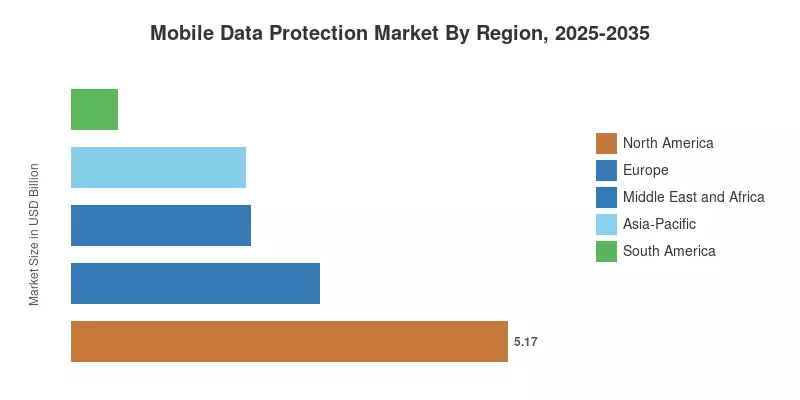
North America is the global leader in revenue, accounting for 43.3% of the total. This growth is attributed to the dense financial and healthcare buyer bases and disclosure regulations. With a compound annual growth rate (CAGR) of 17.7%, the Middle East and Africa is the fastest-growing region, bolstered by national cybersecurity authorities and data-localization mandates. The NIS2 and DORA compliance cycles have significantly influenced Europe's second-place ranking at USD 2.94 billion. Vendors that integrate detection, compliance automation, and managed response into a single subscription will be advantageous in the Mobile Data Protection Market until 2035.


Key Report Takeaways

• By Type

  • Software held 63.1% of the Mobile Data Protection Market in 2025, supported by entrenched on-premises estates in regulated industries.
  • Services is the fastest-growing type at a 17.1% CAGR through 2035, as enterprises outsource incident response and forensics.

• By Deployment

  • On-Premises accounted for 54.6% of 2025 revenue, anchored by air-gap rules and local-hosting mandates.
  • Cloud deployments are expanding at a 17.6% CAGR as subscription pricing and instant patching win budget approval.

• By Enterprise

  • Large Enterprise buyers represented 66.6% of Mobile Data Protection Market spending in 2025
  • Small and Medium Enterprise demand is rising at a 17.0% CAGR, pushed by cyber-insurance prerequisites.

• By End-User Industry

  • BFSI led with a 36.1% revenue share in 2025 on the back of payment-security and resilience rules
  • Healthcare is the fastest-growing industry at a 17.6% CAGR as clinical mobility meets stricter breach penalties
  • Retail captured 17.3% of 2025 revenue as mobile point-of-sale adoption widened the attack surface

• By Region

  • North America held 43.3% of global revenue in 2025
  • Middle East and Africa is forecast to grow at a 17.7% CAGR, the fastest of any region
  • Europe generated USD 2.94 billion in 2025, making it the second-largest region

Market Size and Forecast (2021–2035)

Market Research Future built this series from vendor revenue disclosures, channel checks with integrators and managed security providers, and buyer surveys across five regions, then validated totals against breach-cost and security-spending benchmarks [4]. Historical values for 2021–2024 reflect reported and reconstructed revenue, while 2026–2035 figures rest on scenario-based modelling of regulation, threat activity, and pricing shifts in the Mobile Data Protection Market.
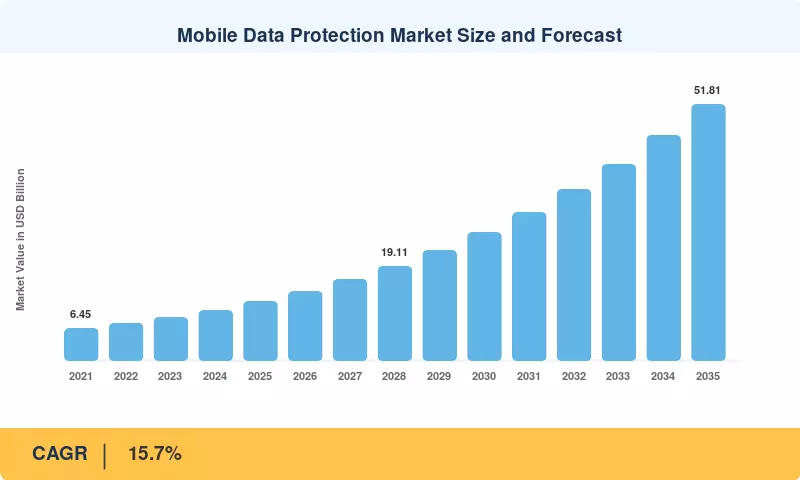
Mobile Data Protection Market Size and Forecast
Our Impact

Enabled $4.3B Revenue Impact for Fortune 500 and Leading Multinationals

Partnering with 2000+ Global Organizations Each Year

30K+ Citations by Top-Tier Firms in the Industry

Driver Impact Analysis

Driver ~% Impact on CAGR Geographic Relevance Impact Timeline
Escalating ransomware and mobile-borne phishing ~+3.0% Global Short-term (≤2 yr)
PCI DSS v4.0 payment-security requirements ~+2.3% North America, Europe, Asia-Pacific Short-term (≤2 yr)
Converging privacy and resilience mandates ~+2.5% Europe, Asia-Pacific Medium-term (2–4 yr)
Zero-trust architecture adoption ~+2.1% North America, Europe Medium-term (2–4 yr)
Cyber-insurance underwriting requirements ~+1.6% North America, Europe Short-term (≤2 yr)
Healthcare mobility and HIPAA tightening ~+1.4% North America Medium-term (2–4 yr)
Platform consolidation and SaaS delivery ~+1.8% Global Long-term (≥4 yr)


Escalating Ransomware and Mobile-Borne Phishing

Attackers increasingly start with the phone. Verizon's 2024 Data Breach Investigations Report attributed 68% of breaches to a non-malicious human element such as phishing or error [3], and SMS-based lures exploit small screens that hide malicious links. Costs keep climbing: IBM put the 2024 global average breach at USD 4.88 million, about 10% above 2023 [4]. The FBI recorded USD 16.6 billion in reported cybercrime losses for 2024 [19]. Boards now fund device-level detection as a direct loss-prevention measure.

PCI DSS v4.0 Payment-Security Requirements

PCI DSS v4.0 introduced 64 new requirements, and the 51 future-dated items became mandatory on March 31 2025 [2]. Rules on stronger authentication, targeted risk analysis, and anti-phishing controls reach into the mobile wallets, tap-to-pay terminals, and banking apps that now carry a large share of card traffic. Merchants and processors that once kept phones outside their cardholder environment must document controls, which converts audit deadlines directly into licensed seats and assessment services.

Converging Privacy and Resilience Mandates

Regulators across major economies now ask similar questions about device-held data. NIS2 transposition was due in October 2024 [7], DORA has applied to EU financial entities since January 17, 2025 [8], and India's Digital Personal Data Protection Act allows penalties of up to INR 250 crore per breach [9]. In the U.S., listed companies must disclose material incidents within four business days [21]. Multinationals increasingly design to the strictest regime, standardizing encryption and remote-wipe policies globally.

Zero-Trust Architecture Adoption

Federal policy turned zero trust from concept into a procurement line item. OMB Memorandum M-22-09 required U.S. agencies to meet specific zero-trust goals by the end of fiscal 2024 [25], and CISA's maturity model ranks continuous device-posture checks as an advanced capability [1]. Private-sector buyers copy the framework because auditors and insurers recognize it. Every conditional-access decision needs a trustworthy device signal, which pulls mobile agents into identity projects that previously ignored handsets.

Cyber-Insurance Underwriting Requirements

Insurers have become de facto security regulators for smaller firms. Business email compromise alone caused USD 2.77 billion in reported U.S. losses in 2024 [19], and carriers responded by requiring multi-factor authentication and endpoint detection before binding policies. Mobile devices increasingly fall inside those questionnaires because they hold authenticator apps and email. Small companies that never budgeted for device security now buy it to secure coverage or avoid premium surcharges.

Healthcare Mobility and HIPAA Tightening

Clinical work has moved onto tablets and phones, and regulators are tightening controls in response. More than 700 large breaches were reported to the HHS Office for Civil Rights in 2023 [6], and the February 2024 Change Healthcare attack disrupted claims processing nationwide [11]. HHS's proposed HIPAA Security Rule update would mandate encryption of electronic health data and multi-factor authentication, with first-year compliance costs estimated at USD 9 billion [15].

Platform Consolidation and SaaS Delivery

Buyers want fewer consoles. Microsoft's Intune Suite, launched in March 2023, bundled advanced endpoint controls into existing licensing [12], while Omnissa's July 2024 launch created a standalone digital-workspace vendor [14]. Projected 15.1% growth in 2025 security spending, with cloud-delivered tools gaining share . SaaS delivery shortens patch cycles and removes capital expense, making suites the default choice for new deployments over the long term.

Restraints Impact Analysis

Restraint impacts are directional estimates of downward pressure on growth. They are not additive and partly offset driver effects within the Mobile Data Protection Market forecast.

Restraint ~% Impact on CAGR Geographic Relevance Impact Timeline
Cybersecurity talent shortage ~−1.7% Global Long-term (≥4 yr)
On-device performance and cryptographic overhead ~−0.8% Global Short-term (≤2 yr)
Data sovereignty fragmentation ~−1.0% Middle East and Africa, Asia-Pacific, Europe Medium-term (2–4 yr)
Employee privacy resistance on personal devices ~−0.7% Europe, North America Medium-term (2–4 yr)
Budget constraints and tool sprawl ~−0.9% South America, Asia-Pacific, Middle East and Africa Short-term (≤2 yr)


Cybersecurity Talent Shortage

ISC2 estimated a global cybersecurity workforce gap of 4.8 million in 2024, up 19% year on year, while the active workforce stalled near 5.5 million [5]. Deployments slip when no one can tune policies or triage alerts. IBM found that organizations with severe staffing shortages paid USD 1.76 million more per breach [4]. The shortage pushes some buyers toward services but delays projects for firms that insist on in-house operation.

On-Device Performance and Cryptographic Overhead

Always-on VPN tunnels, content scanning, and full-disk encryption consume battery and processing headroom, especially on older handsets. Upcoming post-quantum algorithms add weight: an ML-KEM-768 public key is 1,184 bytes, compared with 32 bytes for X25519 [16]. Frontline workers on budget devices notice lag quickly, and complaints often lead IT teams to relax or remove controls, shrinking effective seat counts.

Data Sovereignty Fragmentation

Divergent hosting rules complicate global rollouts. Saudi Arabia's National Cybersecurity Authority expects government and critical-infrastructure data to stay in-kingdom [10], and India's DPDP Act allows the government to restrict transfers to specific countries [9]. Vendors must build regional instances, separate key management, and local support teams. Those costs slow market entry and raise prices in smaller jurisdictions where volumes cannot justify dedicated infrastructure.

Employee Privacy Resistance on Personal Devices

BYOD data protection programs stall when employees believe the employer can read personal messages or track location. GDPR fines can reach 4% of global annual turnover, so European works councils scrutinize monitoring scope closely [24]. Some firms respond by limiting controls to app-level containers, which reduces license value per user. Others abandon personal-device programs and issue corporate handsets, delaying purchases.

Budget Constraints and Tool Sprawl

Smaller organizations in emerging economies often run overlapping antivirus, MDM, and VPN tools without integration. ENISA's 2024 threat landscape highlighted how resource-constrained entities remain prime ransomware targets yet lag on basic controls [20]. Currency volatility in Argentina and Egypt inflates dollar-denominated subscriptions. Buyers postpone upgrades, and vendors face long sales cycles with low average contract values.

Mobile Data Protection Market Opportunities

Gulf and Indian Demand Expansion

Emerging markets show strong growth driven by tight government regulations. Saudi Arabia’s National Cybersecurity Authority enforces Essential Cybersecurity Controls across public entities, while the Reserve Bank of India’s Master Direction took effect on April 1, 2024, mandating mobile device binding. Localized hosting and multilingual support allow security vendors to capture high-value public-sector opportunities before competitors expand regionally.


Managed and Consumption-Based Service Models

High operational costs drive rapid adoption of outsourced security models. Managed security providers bundle mobile protection into monthly per-user fees to assist resource-constrained firms. The United Nations Conference on Trade and Development noted global e-commerce sales reached $27 trillion across 43 countries, enabling vendors to anonymize and monetize massive device telemetry streams sold to banks and insurers for risk scoring.


Post-Quantum Readiness for Mobile Fleets

The U.S. National Institute of Standards and Technology finalized FIPS 203, 204, and 205 on August 13, 2024, establishing official post-quantum encryption standards. Enterprises must inventory cryptographic algorithms across all mobile applications and endpoints. Vendors offering automated crypto-discovery, agile key management, and quantum-resistant tunnels are positioned to capture a multi-year software upgrade cycle across enterprise mobile fleets.


AI-Driven Phishing and Smishing Defense

Generative AI lets attackers write convincing lures in any language at near-zero cost, and phishing remained among the most reported crime types in 2024 [19]. On-device machine-learning models that inspect links, QR codes, and messaging-app content offer a defensible product edge. Carriers and handset makers are natural distribution partners for consumer and SME editions.

Connected Transport and Mobile Point-of-Sale

Handheld payment terminals and connected fleet devices are expanding rapidly across global logistics and retail. As payment card operations shift to mobile terminals, PCI DSS v4.0 mandates strict device controls, with 51 future-dated requirements becoming mandatory on March 31, 2025. Lightweight endpoint agents featuring offline security enforcement and centralized dashboards directly address this specialized, high-volume segment.


Mobile Data Protection Market Future Outlook

AI-Native Detection and Autonomous Response

Detection in the Mobile Data Protection Market will move from signature matching to on-device models that score behavior continuously. With roughly 5.8 billion unique mobile subscribers worldwide [18], cloud-only analysis cannot scale economically. Expect autonomous responses such as session revocation and selective wipe to execute within seconds, with human analysts reviewing outcomes rather than approving each action.

Platform Economics and Suite Consolidation

Suites will absorb point products, and pricing will shift toward per-user bundles inside productivity and identity licenses. According to a recently published report, it is projected that USD 212 billion in 2025 security spending masks intense price competition at the platform layer. Independent specialists will survive by owning niches such as app shielding, rugged devices, or regulated-sector certifications.

Post-Quantum Transition and Cryptographic Agility

The U.S. National Institute of Standards and Technology finalized FIPS 203, 204, and 205 on August 13, 2024, initiating a mandatory migration across enterprise endpoints. Adopting ML-KEM-768 expands key encapsulation payloads from 32 bytes under classical X25519 to 1,184 bytes. Vendors offering automated crypto-discovery and policy-driven agility will secure long-term procurement budgets across banking and public sector fleets.


Regulatory Convergence and Sovereign Delivery

Regulatory frameworks increasingly enforce operational resilience and strict hosting boundaries across international jurisdictions. European Union Agency for Cybersecurity reports reveal that state-linked threat activity targeted over 40% of public and financial organizations across member states. With non-compliance penalties reaching 4% of global annual turnover under GDPR, vendors capable of deploying unified policy engines across sovereign, public, and on-premises clouds will capture dominant market share.


Regional Market Share Analysis

Region Key Metric Primary Investment Themes
North America 43.3% share (2025) Disclosure rules, healthcare security, zero-trust programs
Europe USD 2.94 Billion (2025) NIS2 and DORA compliance, sovereign cloud
Asia-Pacific 17.2% CAGR (2026–2035) Banking digitization, new privacy laws
South America 4.6% share (2025) LGPD enforcement, digital payments
Middle East and Africa 17.7% CAGR (2026–2035) National cybersecurity frameworks, data localization
Total USD 11.95 Billion (2025) —

Regional demand in the Mobile Data Protection Market tracks regulatory intensity, financial-sector depth, and cloud maturity. North America sets the revenue base, Europe follows with compliance-driven spending, and the Middle East and Africa and Asia-Pacific supply the highest growth rates.


North America

Country Key Metric Key Driver
US 83.5% share of region (2025) SEC disclosure rule, HIPAA update, federal zero trust
Canada USD 0.53 Billion (2025) OSFI technology-risk guidance for financial institutions
Mexico 16.4% CAGR (2026–2035) Nearshored manufacturing and fintech growth


The U.S. dominates regional demand because three regulatory forces converge there: the SEC's four-day incident disclosure requirement [21], the proposed HIPAA Security Rule overhaul [15], and federal zero-trust mandates under OMB M-22-09 [25]. These rules push the Mobile Data Protection Market toward audited, cloud-managed controls. Canada's federally regulated financial institutions follow OSFI Guideline B-13 on technology and cyber risk, while Mexico's demand grows with nearshored factories and digital banks adopting enterprise device policies.

Europe

Country Key Metric Key Driver
Germany 22.4% share of region (2025) NIS2 transposition, BSI security standards
UK USD 0.62 Billion (2025) Financial-sector operational resilience rules
France 15.1% CAGR (2026–2035) ANSSI certification and public-sector programs
Italy 9.6% share of region (2025) Banking and public administration modernization
Spain USD 0.21 Billion (2025) National Security Scheme compliance
Nordic Countries 16.3% CAGR (2026–2035) High mobile-first workforce adoption
Russia 4.1% share of region (2025) Domestic vendor substitution
Rest of Europe USD 0.36 Billion (2025) Central European banking digitization


Europe's spending is compliance-led. DORA requires EU financial entities to test and document ICT risk controls, including on staff devices [8], and NIS2 expands obligations to sectors such as logistics and food production [7]. Germany leads on scale, and the UK follows with resilience requirements for banks and insurers. Nordic buyers adopt cloud-first suites quickly, while Russia's market is shifting toward domestic suppliers following foreign vendor exits.

Asia-Pacific

Country Key Metric Key Driver
China 31.8% share of region (2025) PIPL compliance and domestic vendor ecosystem
India 19.4% CAGR (2026–2035) DPDP Act and RBI IT governance directions
Japan USD 0.49 Billion (2025) APPI amendments and corporate governance
South Korea 9.7% share of region (2025) PIPA enforcement and 5G enterprise devices
ASEAN 18.6% CAGR (2026–2035) Digital banking licenses and data laws
Rest of Asia-Pacific USD 0.21 Billion (2025) Australian critical-infrastructure rules


India posts the region's fastest growth as the DPDP Act [9] and the RBI's Master Direction on IT governance, effective April 2024 [22], require banks and their suppliers to document device controls. China's demand is great but served mainly by domestic vendors under the Personal Information Protection Law. Japan and South Korea favor integrated suites from established partners, while ASEAN digital banks build security into cloud-native operating models from launch.

South America

Country Key Metric Key Driver
Brazil 52.7% share of region (2025) LGPD enforcement and Pix instant payments
Argentina USD 0.11 Billion (2025) Fintech growth despite currency pressure
Rest of South America 15.2% CAGR (2026–2035) Banking digitization in Chile, Colombia, Peru


Brazil accounts for the majority of regional spending as the national data protection authority enforces the LGPD and the central bank's Pix instant-payment system moves high-value transactions onto phones. Banks there run some of the region's most mature mobile-app protection programs. Argentina's buyers face currency constraints that favor local billing, while Chile, Colombia, and Peru expand through bank and retail digitization.

Middle East and Africa

Country Key Metric Key Driver
Saudi Arabia 19.8% CAGR (2026–2035) NCA Essential Cybersecurity Controls, Vision 2030
UAE 21.5% share of region (2025) Federal Personal Data Protection Law
South Africa USD 0.13 Billion (2025) POPIA compliance in banking and telecoms
Egypt 18.1% CAGR (2026–2035) Personal Data Protection Law No. 151 of 2020
Rest of MEA 23.4% share of region (2025) Qatar, Kuwait, and Nigeria digitization programs


Saudi Arabia drives the fastest growth in the Mobile Data Protection Market as the National Cybersecurity Authority's controls [10] and data-localization expectations push government agencies and suppliers toward in-kingdom deployments. The UAE's Federal Decree-Law No. 45 of 2021 underpins demand from banks and free-zone enterprises. South Africa's POPIA keeps financial and telecom buyers active, while Egypt's new data law opens a nascent compliance market.

Mobile Data Protection Market By Region, 2025-2035

Mobile Data Protection Market Segmentation

By Type

Segment Key Metric Primary Demand Driver
Software 63.1% share (2025) Installed on-premises estates and regulated-sector preferences
Services 17.1% CAGR (2026–2035) Outsourced incident response, integration, and training


Software remains the backbone of the Mobile Data Protection Market, covering encryption, data-loss controls, threat detection, and policy management licensed per device or user. Services are growing faster because few enterprises can hire forensic investigators or compliance specialists. Integration work rises as clients merge point tools into unified suites, and training and certification services expand alongside, as vendors require partners to complete coursework before selling advanced offerings.

By Deployment

Segment Key Metric Primary Demand Driver
On-Premises 54.6% share (2025) Air-gap rules and local-hosting mandates
Cloud 17.6% CAGR (2026–2035) Subscription pricing and instant patching


On-premises installations still hold the majority of Mobile Data Protection Market revenue, protecting defense, government, and banking environments bound by air-gap or in-country hosting rules. Cloud deployments grow faster as zero-trust frameworks favor cloud-native policy engines [1]. Hybrid patterns bridge the gap, keeping sensitive keys and logs on-premises while using public cloud for analytics and threat intelligence.

By Enterprise

Segment Key Metric Primary Demand Driver
Large Enterprise 66.6% share (2025) Contractor and supply-chain device coverage
Small and Medium Enterprise 17.0% CAGR (2026–2035) Cyber-insurance prerequisites and consumption pricing


Large Enterprise buyers dominate the Mobile Data Protection Market, extending controls to contractors and suppliers after supply-chain breaches showed how third-party devices expose core systems. License bundles in office productivity suites help them rationalize tooling. Small and Medium Enterprise demand grows faster as insurers require endpoint detection before issuing policies and per-user monthly pricing removes upfront costs.

By End-User Industry

Segment Key Metric Primary Demand Driver
BFSI 36.1% share (2025) PCI DSS v4.0, DORA, real-time payments
Healthcare 17.6% CAGR (2026–2035) Telehealth, record mobility, HIPAA tightening
Retail 17.3% share (2025) Mobile point-of-sale and associate devices
Hospitality USD 1.34 Billion (2025) Guest-facing tablets and payment terminals
Transport 14.6% CAGR (2026–2035) Driver tablets and connected-vehicle programs


BFSI leads the Mobile Data Protection Market because payment-security and operational-resilience rules apply directly to banking apps and staff devices [2][8]. Healthcare grows fastest as clinicians rely on mobile access to records and the proposed HIPAA update raises encryption requirements [15]. Retail, Hospitality, and Transport trail on scale but add device-management needs as mobile checkout, guest tablets, and connected fleets mature.

Competitive Benchmarking

The Mobile Data Protection Market is moderately concentrated. The top five vendors hold an estimated 36% of revenue, and the Herfindahl-Hirschman Index sits near 450, indicating a fragmented field with a few platform leaders. Competition centers on suite breadth, analytics depth, and compliance automation, while specialists compete on detection quality and vertical certifications.

Company Est. Revenue Share Range Key Offerings for Mobile Data Protection Market Strategic Positioning
Microsoft ~9–12% Intune Suite, Defender for Endpoint, Purview data-loss controls Bundles device controls into Microsoft 365 licensing for the widest installed base
Broadcom (Symantec Enterprise) ~5–8% Symantec Endpoint Security, Symantec DLP Focuses on large regulated enterprises with deep policy controls
IBM ~4–7% MaaS360, Guardium, X-Force incident response Pairs device management with services-led response
Check Point Software Technologies ~4–6% Harmony Mobile, Harmony SASE Integrates device protection with SASE after acquiring Perimeter 81
Trellix ~3–6% Trellix DLP, Trellix Endpoint Security Targets government and critical-infrastructure accounts
Sophos ~3–5% Intercept X for Mobile, Sophos Mobile, Sophos MDR Mid-market leader with managed detection and response
Trend Micro ~3–5% Trend Vision One, Mobile Security for Enterprise Unified platform strength in Asia-Pacific
Ivanti ~2–4% Ivanti Neurons for MDM, Ivanti EPMM Established in frontline and government device fleets
Lookout ~2–4% Lookout Cloud Security Platform, mobile phishing protection Specialist in mobile threat detection and carrier partnerships
Zscaler ~2–4% Zero Trust Exchange, Client Connector Cloud-native zero-trust access with consumption pricing


Recent News & Developments

  • Microsoft (March 2023): Launched the Intune Suite, bundling advanced endpoint analytics, remote help, and privilege management into one license, accelerating suite consolidation [12]
  • Government of India (August 2023): Enacted the Digital Personal Data Protection Act, creating penalties of up to INR 250 crore and new device-data obligations for Indian enterprises [9]
  • Check Point Software Technologies (September 2023): Completed the acquisition of Perimeter 81, adding cloud network security to its mobile and endpoint portfolio [13]
  • UnitedHealth Group (February 2024): Disclosed the Change Healthcare ransomware attack, which disrupted U.S. claims processing and raised board-level urgency for device and identity controls [11]
  • Omnissa (July 2024): Launched as an independent digital-workspace company after Broadcom's sale of VMware's end-user computing unit, reshaping the device-management field [14]
  • NIST (August 2024): Published FIPS 203, 204, and 205, the first post-quantum cryptography standards, setting the stage for mobile crypto migration [16]
  • European Union (October 2024): Reached the NIS2 transposition deadline, extending security obligations to thousands of additional entities across member states [7]
  • PCI Security Standards Council (March 2025): Future-dated PCI DSS v4.0 requirements became mandatory, tightening controls across mobile payment environments [2]

Mobile Data Protection Market Report Scope

Parameter Details
Market Scope The Mobile Data Protection Market covers software and services that encrypt, monitor, and control enterprise data on mobile devices, deployed on-premises or in the cloud for large enterprises and SMEs across BFSI, healthcare, retail, hospitality, and transport.
Study Period 2021–2035
Base Year 2025
Historical Data 2021–2024
Forecast Period 2026–2035
Market Size in 2025 USD 11.95 Billion
Market Size in 2035 USD 51.81 Billion
CAGR (2026–2035) 15.7%
Fastest Growing Segments Cloud (17.6% CAGR); Healthcare (17.6% CAGR); Services (17.1% CAGR); Small and Medium Enterprise (17.0% CAGR)
Regions Covered North America, Europe, South America, Asia Pacific, Middle East and Africa and ROW
Companies Profiled Microsoft, Broadcom, IBM, Check Point Software Technologies, Trellix, Sophos, Trend Micro, Ivanti, Lookout, Zscaler
Valuation Currency USD Billion
Methodology 350+ primary expert interviews; bottom-up market sizing; top-down validation; data triangulation; scenario-based forecasting; real-time project tracking

FAQs

How should buyers compare suites and best-of-breed tools in the Mobile Data Protection Market?
Suites cut licensing and console overhead, but specialist tools often detect app tampering and jailbreaks faster. Many enterprises run a suite for policy and add a specialist agent for high-risk users such as executives and traders [12].
Does on-device AI reduce privacy risk on personal handsets?
Yes, when models classify content locally and send only verdicts, not raw messages, to the cloud. That design narrows employer visibility, a selling point gaining weight across the Mobile Data Protection Market [24].
What should Mobile Data Protection Market buyers ask vendors about post-quantum cryptography?
Ask for a dated roadmap to ML-KEM and ML-DSA support and whether ciphers can be swapped by policy without reinstalling apps. Vendors lacking cryptographic agility will force costly migrations once regulators set deadlines [16].
How do managed service providers typically price mobile protection?
Across the Mobile Data Protection Market, most providers charge per user per month, bundling detection, policy management, and a fixed block of incident-response hours. Per-device pricing persists for shared frontline and kiosk handsets.
Can work-profile containerization satisfy data protection law on employee-owned phones?
Often, because Android Work Profile and Apple User Enrollment separate corporate data and block employer access to personal content. Legal teams should still document data minimization and retention limits for each jurisdiction [24].
What integration hurdles most often delay rollouts in the Mobile Data Protection Market?
Identity is the usual bottleneck, because device-posture signals must feed conditional-access rules before policies can block risky sessions. Legacy VPN concentrators and custom apps without SDK support add further months [1].
Which emerging use cases could expand the Mobile Data Protection Market beyond corporate phones?
Warehouse handhelds, clinician devices on hospital wards, and in-vehicle systems are joining managed fleets. Each needs lightweight agents with offline enforcement, creating room for specialist vendors.
Author
Author Author Profile Aarti Dhapte LinkedIn AVP - Research
A consulting professional focused on helping businesses navigate complex markets through structured research and strategic insights. I partner with clients to solve high-impact business problems across market entry strategy, competitive intelligence, and opportunity assessment. Over the course of my experience, I have led and contributed to 100+ market research and consulting engagements, delivering insights across multiple industries and geographies, and supporting strategic decisions linked to $500M+ market opportunities. My core expertise lies in building robust market sizing, forecasting, and commercial models (top-down and bottom-up), alongside deep-dive competitive and industry analysis. I have played a key role in shaping go-to-market strategies, investment cases, and growth roadmaps, enabling clients to make confident, data-backed decisions in dynamic markets.
Download Free Sample

Kindly complete the form below to receive a free sample of this Report

Global Diameter Signaling Market
Case Study
Information and Communications Technology
Download PDF ×

We do not share your information with anyone. However, we may send you emails based on your report interest from time to time. You may contact us at any time to opt-out.