
Request Free Sample ×

Kindly complete the form below to receive a free sample of this Report

* Please use a valid business email

Leading companies partner with us for data-driven Insights

clients tt-cursor
Hero Background
English
Chinese
French
Japanese
Korean
German
Spanish

US Warehouse Robotics Market Share

ID: MRFR/SEM/11010-HCR
128 Pages
Nirmit Biswas
April 2026

US Warehouse Robotics Market Size, Share and Research Report By by Type (Automated Guided Vehicles, Autonomous Mobile Robots, Robotic Arms, Automated Storage and Retrieval Systems), and by Region- Industry Forecast Till 2035

Share:
Download PDF ×

We do not share your information with anyone. However, we may send you emails based on your report interest from time to time. You may contact us at any time to opt-out.

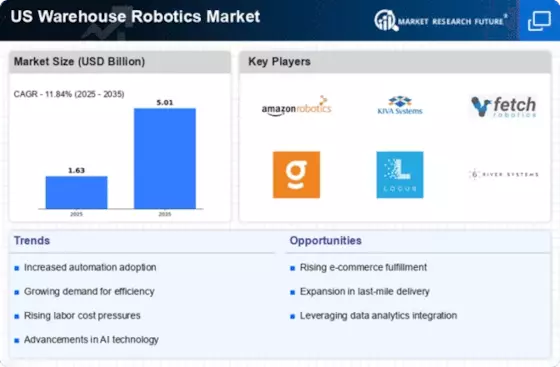
US Warehouse Robotics Market Infographic
Purchase Options

Market Share

US Warehouse Robotics Market Share Analysis

In the dynamic landscape of the US Warehouse Robotics Market, companies employ various market share positioning strategies to gain a competitive edge and solidify their presence. One prominent strategy involves differentiation, where companies focus on offering unique features or capabilities that set their robotics solutions apart from competitors. This could involve advanced technologies, such as artificial intelligence (AI) integration, enhanced efficiency, or specialized applications tailored to specific industries. By emphasizing these distinctive aspects, companies aim to carve out a niche for themselves and attract customers seeking specialized solutions tailored to their warehouse needs.

Another key market share positioning strategy is cost leadership. Some companies prioritize cost-effectiveness, aiming to provide high-quality warehouse robotics solutions at a lower price point than competitors. This approach can be particularly attractive to cost-conscious customers looking to optimize their operations without breaking the bank. By strategically managing production costs, companies can offer competitive pricing without compromising on the quality and reliability of their robotic systems, ultimately appealing to a broader customer base.

Collaboration and strategic partnerships represent yet another avenue for market share positioning in the US Warehouse Robotics Market. Companies often join forces with other players in the industry, forming alliances that leverage complementary strengths. Whether through partnerships with software developers, integrators, or logistics experts, collaborative efforts enable companies to offer comprehensive solutions that address a broader spectrum of customer needs. This approach not only expands market reach but also allows companies to capitalize on the expertise of their partners, fostering innovation and enhancing the overall value proposition.

Adaptability is crucial in the rapidly evolving warehouse robotics sector, and companies pursuing a market share positioning strategy frequently prioritize flexibility. This involves designing robotic systems that can be easily customized or scaled to accommodate varying warehouse sizes, layouts, and operational requirements. The ability to adapt to different environments and evolving customer needs positions companies as reliable and future-ready partners, capable of providing solutions that grow alongside their clients' businesses.

Customer-centric strategies also play a pivotal role in market share positioning. Successful companies prioritize understanding their customers' pain points and tailoring their solutions accordingly. This customer-centric approach involves not only providing effective robotics solutions but also offering comprehensive support, training, and maintenance services. By building strong relationships with clients and addressing their specific challenges, companies can cultivate loyalty and secure a larger share of the market, as satisfied customers are more likely to become repeat buyers and advocates for the brand.


 

Author
Author Profile
Nirmit Biswas
Senior Research Analyst

With 5+ years of expertise in Market Intelligence and Strategic Research, Nirmit Biswas specializes in ICT, Semiconductors, and BFSI. Backed by an MBA in Financial Services and a Computer Science foundation, Nirmit blends technical depth with business acumen. He has successfully led 100+ projects for global enterprises and startups, including Amazon, Cisco, L&T and Huawei, delivering market estimations, competitive benchmarking, and GTM strategies. His focus lies in transforming complex data into clear, actionable insights that drive growth, innovation, and investment decisions. Recognized for bridging engineering innovation with executive strategy, Nirmit helps businesses navigate dynamic markets with confidence.

Leave a Comment

FAQs

What is the current valuation of the US Warehouse Robotics Market?

<p>The US Warehouse Robotics Market was valued at 2.726 USD Million in 2024.</p>

What is the projected market valuation for the US Warehouse Robotics Market in 2035?

<p>The market is projected to reach a valuation of 17.64 USD Million by 2035.</p>

What is the expected CAGR for the US Warehouse Robotics Market from 2025 to 2035?

<p>The expected CAGR for the market during the forecast period 2025 - 2035 is 18.5%.</p>

Who are the key players in the US Warehouse Robotics Market?

<p>Key players include Amazon Robotics, Kiva Systems, Fetch Robotics, GreyOrange, Locus Robotics, 6 River Systems, Vecna Robotics, Omron Robotics, and Seegrid.</p>

What types of robotics are included in the US Warehouse Robotics Market?

<p>The market includes Automated Guided Vehicles, Autonomous Mobile Robots, Robotic Arms, and Automated Storage and Retrieval Systems.</p>

What was the market performance of Automated Guided Vehicles in 2024?

<p>Automated Guided Vehicles had a valuation of 0.8185 USD Million in 2024.</p>

How did the valuation of Autonomous Mobile Robots compare to other segments in 2024?

<p>Autonomous Mobile Robots also had a valuation of 0.8185 USD Million in 2024, indicating parity with Automated Guided Vehicles.</p>

What was the valuation of Robotic Arms in 2024?

<p>Robotic Arms were valued at 0.8185 USD Million in 2024.</p>

What is the projected growth trend for Automated Storage and Retrieval Systems?

<p>Automated Storage and Retrieval Systems had a valuation of 0.2705 USD Million in 2024, suggesting potential for growth.</p>

How does the US Warehouse Robotics Market compare to other sectors in terms of growth?

<p>The US Warehouse Robotics Market appears to be on a robust growth trajectory, with a projected valuation increase to 17.64 USD Million by 2035.</p>

Market Summary

As per analysis, the US Warehouse Robotics Market is projected to grow from USD 1.66 Billion in 2025 to USD 5.01 Billion by 2035, exhibiting a compound annual growth rate (CAGR) of 11.84% during the forecast period (2025 - 2035).

Key Market Trends & Highlights

The US Warehouse Robotics Market is poised for substantial growth driven by technological advancements and evolving consumer demands.

  • The adoption of Autonomous Mobile Robots is increasing, particularly in the Order Fulfillment segment, which remains the largest in the market.
  • Integration of Artificial Intelligence is enhancing operational efficiency, especially in Inventory Management, which is the fastest-growing segment.
  • There is a heightened focus on safety and ergonomics as companies seek to improve working conditions and reduce injury risks.
  • Key market drivers include growing e-commerce demand and labor shortages, which are compelling businesses to invest in advanced robotics solutions.

Market Size & Forecast

2024 Market Size 1.46 (USD Billion)
2035 Market Size 5.01 (USD Billion)
CAGR (2025 - 2035) 11.84%

Major Players

<p>Amazon Robotics (US), Kiva Systems (US), Fetch Robotics (US), GreyOrange (US), Locus Robotics (US), 6 River Systems (US), Vecna Robotics (US), Omron Robotics (US), Seegrid (US)</p>

Market Trends

The US Warehouse Robotics Market is currently experiencing a transformative phase, driven by advancements in automation technology and the increasing demand for efficiency in logistics operations. As e-commerce continues to expand, warehouses are under pressure to optimize their processes, leading to a greater reliance on robotic solutions. These systems not only enhance productivity but also reduce operational costs, which appears to be a primary concern for many businesses in the sector. Furthermore, the integration of artificial intelligence and machine learning into robotic systems is likely to improve their capabilities, enabling them to perform complex tasks with greater precision and adaptability. In addition to technological advancements, the US Warehouse Robotics Market is influenced by labor shortages and the need for safer working environments. Companies are increasingly turning to robotics to mitigate risks associated with manual labor, thereby enhancing workplace safety. This trend suggests a shift in how warehouses operate, with a focus on creating a more automated and efficient environment. As the market evolves, it seems that the collaboration between human workers and robotic systems will become more prevalent, fostering a new era of productivity and innovation in the logistics industry.

Increased Adoption of Autonomous Mobile Robots

The US Warehouse Robotics Market is witnessing a surge in the adoption of autonomous mobile robots (AMRs). These robots are designed to navigate through warehouse environments independently, transporting goods and materials with minimal human intervention. This trend indicates a shift towards more flexible and efficient operations, as AMRs can adapt to changing layouts and workflows, thereby enhancing overall productivity.

Integration of Artificial Intelligence

The integration of artificial intelligence (AI) into warehouse robotics is becoming increasingly prominent. AI technologies enable robots to learn from their environments, optimize their routes, and make real-time decisions. This trend suggests that the US Warehouse Robotics Market is moving towards smarter systems that can handle complex tasks, ultimately improving operational efficiency and reducing errors.

Focus on Safety and Ergonomics

There is a growing emphasis on safety and ergonomics within the US Warehouse Robotics Market. Companies are investing in robotic solutions that not only enhance productivity but also prioritize the well-being of human workers. This trend indicates a recognition of the importance of creating a safe working environment, where robots assist in heavy lifting and repetitive tasks, thereby reducing the risk of injury.

US Warehouse Robotics Market Market Drivers

Growing E-commerce Demand

The US Warehouse Robotics Market is experiencing a surge in demand driven by the rapid growth of e-commerce. As online shopping continues to gain traction, warehouses are under pressure to enhance their operational efficiency. In 2025, e-commerce sales in the US reached approximately 1 trillion USD, prompting companies to invest in automation solutions. Robotics technology, including automated guided vehicles and robotic picking systems, is being adopted to streamline order fulfillment processes. This trend is likely to persist, as businesses seek to meet consumer expectations for faster delivery times and improved service levels. Consequently, the integration of robotics in warehouses is becoming a strategic imperative for companies aiming to remain competitive in the evolving retail landscape.

Government Initiatives and Support

The US Warehouse Robotics Market is benefiting from various government initiatives aimed at promoting automation and technological innovation. Federal and state programs are increasingly providing funding and resources to support the adoption of robotics in warehouses. These initiatives are designed to enhance productivity, improve safety standards, and foster economic growth. For instance, the US Department of Commerce has launched programs to assist small and medium-sized enterprises in integrating advanced technologies. Such support is likely to encourage more businesses to invest in warehouse robotics, thereby accelerating the market's growth. As these initiatives gain traction, the landscape of the US Warehouse Robotics Market is expected to evolve significantly.

Technological Advancements in Robotics

The US Warehouse Robotics Market is witnessing rapid technological advancements that are reshaping the landscape of warehouse operations. Innovations in robotics, such as improved sensors, machine learning algorithms, and enhanced navigation systems, are enabling more sophisticated automation solutions. These advancements allow for greater flexibility and adaptability in warehouse environments, facilitating the integration of robotics into existing workflows. As companies increasingly recognize the potential of these technologies, investments in robotic systems are expected to rise. In 2025, the market for warehouse robotics in the US was valued at approximately 5 billion USD, indicating a robust growth trajectory driven by technological innovation.

Rising Focus on Supply Chain Resilience

The US Warehouse Robotics Market is increasingly shaped by the growing emphasis on supply chain resilience. Companies are recognizing the need to enhance their operational capabilities to withstand disruptions and ensure continuity. Robotics technology plays a crucial role in achieving this goal by enabling more agile and responsive warehouse operations. The integration of automated systems allows for better inventory management, faster order processing, and improved overall efficiency. As businesses strive to build more resilient supply chains, investments in warehouse robotics are anticipated to rise. This trend is likely to drive the market forward, as organizations seek to leverage technology to navigate uncertainties and enhance their competitive edge.

Labor Shortages and Workforce Challenges

The US Warehouse Robotics Market is significantly influenced by ongoing labor shortages across various sectors. The logistics and warehousing industries are particularly affected, with many companies struggling to find skilled labor. In response, organizations are increasingly turning to robotics to mitigate the impact of these workforce challenges. The introduction of automated systems not only addresses labor shortages but also enhances productivity and operational efficiency. According to recent data, the US logistics sector is projected to face a shortfall of over 1 million workers by 2027. This alarming trend underscores the necessity for automation, as businesses seek to maintain their output levels and meet growing consumer demands.

Market Segment Insights

By Type: Automated Guided Vehicles (Largest) vs. Autonomous Mobile Robots (Fastest-Growing)

<p>In the US Warehouse Robotics Market, the distribution of market share among different robotic types reveals a clear hierarchy. Automated Guided Vehicles (AGVs) hold the largest share, driven by their established applications and reliability in handling goods within warehouses. In contrast, Autonomous Mobile Robots (AMRs) are emerging rapidly due to advancements in <a href="https://www.marketresearchfuture.com/reports/artificial-intelligence-market-1139" target="_blank" title="artificial intelligence">artificial intelligence</a> and their ability to navigate dynamic environments, indicating their growing adoption across various sectors.</p>

<p>AGVs (Dominant) vs. AMRs (Emerging)</p>

<p>Automated Guided Vehicles (AGVs) are the dominant players in the US Warehouse Robotics Market, characterized by their effectiveness in transporting goods along predefined paths. They are often equipped with sensors and guidance systems that ensure precision and safety in operations, making them a preferred choice for traditional warehouse setups. Conversely, Autonomous Mobile Robots (AMRs) are increasingly recognized as emerging solutions, offering flexibility and adaptability in complex environments. Unlike AGVs, AMRs utilize advanced navigation algorithms to move freely and interact with their surroundings, positioning them as key innovations that meet the evolving demands of modern logistics.</p>

By End Use: E-commerce (Largest) vs. Logistics (Fastest-Growing)

<p>In the US Warehouse Robotics Market, the 'End Use' segment demonstrates a diverse distribution of market share among its various applications. E-commerce stands out as the largest segment, driven by the rising demand for automated solutions to enhance efficiency in storage and retrieval processes. Following closely are retail and manufacturing, which also exhibit significant participation, while logistics is rapidly gaining traction due to the shift towards automated fulfillment solutions designed for optimizing supply chain operations. The growth trends within the End Use segment highlight E-commerce as a primary driver, bolstered by the growing reliance on online shopping and the need for quick order fulfillment. Meanwhile, logistics has emerged as the fastest-growing segment, attributable to advancements in technology and a surge in investments aimed at streamlining shipping and handling processes in warehouses. As businesses adapt to consumer expectations for speed and efficiency, warehouse robotics are becoming indispensable across these segments.</p>

<p>E-commerce: Dominant vs. Logistics: Emerging</p>

<p>E-commerce is currently the dominant force in the US Warehouse Robotics Market, providing automated solutions that address the complexities of order processing and inventory management. Companies within this segment prioritize efficiency and accuracy to meet consumer demand for rapid fulfillment, leading to significant investments in robotic technologies. On the other hand, logistics represents an emerging segment, noted for its rapid growth driven by the increasing complexity of supply chains and the necessity for enhanced operational efficiency. Innovations such as autonomous mobile robots (AMRs) and automated guided vehicles (AGVs) are reshaping logistics operations, positioning this segment as a vital area of focus for future technological advancements and competitive advantage in the warehouse sector.</p>

By Type: Autonomous Mobile Robot (Largest) vs. Automated Guided Vehicle (Fastest-Growing)

<p>In the US Warehouse Robotics Market, the 'Autonomous Mobile Robot' (AMR) segment holds a significant share, dominating the landscape due to its versatility and efficiency in navigating complex warehouse environments. Automated Guided Vehicles (AGVs), while currently smaller in terms of market share, are rapidly gaining traction as a vital component of modern logistics systems.</p>

<p>Warehouse Robotics: AMR (Dominant) vs. AGV (Emerging)</p>

<p>Autonomous Mobile Robots (AMRs) are the dominant force in the US Warehouse Robotics Market, valued for their advanced sensors and sophisticated navigation abilities that allow them to operate autonomously, enhancing warehouse efficiency. In contrast, Automated Guided Vehicles (AGVs) are emerging as a critical solution for structured environments, primarily following predefined paths. The rising preference for agility and flexibility in warehouse operations is steering investment towards AMRs, while the growing need for automation and improved productivity fuels the demand for AGVs in specific applications.</p>

By Technology: Artificial Intelligence (Largest) vs. Machine Learning (Fastest-Growing)

<p>The U.S. Warehouse Robotics Market showcases a diverse array of technologies, with Artificial Intelligence commanding the largest market share. AI's integration into warehouse operations optimizes processes like inventory management and order fulfillment, significantly enhancing efficiency. Following closely, Machine Learning is rapidly gaining ground, applying advanced algorithms to improve automation and operational decision-making, making it one of the fastest-growing segments in this market landscape. As organizations seek to elevate their logistics performance, the reliance on these technologies is projected to deepen, reshaping warehouse functionalities altogether.</p>

<p>Technology: Artificial Intelligence (Dominant) vs. Machine Learning (Emerging)</p>

<p>Artificial Intelligence remains the dominant force in the U.S. Warehouse Robotics Market, characterized by its ability to automate complex tasks and make real-time decisions that enhance operational efficiency. It enables robots to learn from data and improve their performance over time, thus reducing human error. On the other hand, Machine Learning emerges as a groundbreaking technology that enhances AI capabilities by allowing robots to analyze vast amounts of data, adapt to new scenarios, and improve efficiency through predictive analytics. As businesses increasingly rely on these advanced technologies, the demand for Machine Learning solutions is rapidly proliferating, establishing it as a critical player in the future landscape of warehousing.</p>

By Functionality: Pick and Place (Largest) vs. Transport (Fastest-Growing)

<p>In the US Warehouse Robotics Market, the functionality segment showcases a diverse array of applications, with 'Pick and Place' leading in market share due to its essential role in automating order fulfillment processes. This segment capitalizes on the growing demand for efficiency and accuracy, providing a significant edge in productivity. In contrast, 'Transport' is emerging rapidly, reflecting a shift toward automatic handling and movement of goods within warehouses, boosting overall operational efficiency.</p>

<p>Pick and Place: Dominant vs. Transport: Emerging</p>

<p>The 'Pick and Place' functionality dominates the US Warehouse Robotics Market, characterized by its critical role in streamlining operations, reducing labor costs, and enhancing inventory management. This automation technology is pivotal for a wide range of industries including e-commerce and retail distribution. Meanwhile, the 'Transport' segment is recognized as the fastest-growing segment, driven by advancements in autonomous vehicle technology and the increasing need for flexible and efficient logistics solutions. The integration of robotics into transportation processes not only optimizes space and time but also supports the growing demand for real-time inventory management and faster order processing.</p>

Get more detailed insights about US Warehouse Robotics Market Research Report – Forecast till 2035

Regional Insights

North America : Innovation and Leadership Hub

The North American warehouse robotics market is driven by rapid technological advancements, increasing demand for automation, and a strong focus on efficiency. The region holds approximately 60% of the global market share, with the United States being the largest contributor, followed by Canada at around 15%. Regulatory support for automation and logistics optimization further fuels growth, as companies seek to enhance productivity and reduce operational costs. Leading the charge in this market are key players such as Amazon Robotics, Kiva Systems, and Fetch Robotics, which are innovating to meet the growing demand. The competitive landscape is characterized by significant investments in R&D and strategic partnerships. The presence of major logistics hubs and e-commerce giants in the U.S. creates a fertile ground for robotics adoption, ensuring that North America remains at the forefront of warehouse automation.

Europe : Emerging Robotics Powerhouse

Europe is witnessing a significant shift towards warehouse automation, driven by the need for efficiency and cost reduction. The region accounts for approximately 25% of The US Warehouse Robotics Market, with Germany and the UK being the largest markets, holding around 10% and 7% respectively. Regulatory frameworks promoting innovation and sustainability are key catalysts for this growth, as companies adapt to changing consumer demands and labor shortages. Countries like Germany, France, and the UK are leading the charge, with a strong presence of robotics manufacturers and integrators. The competitive landscape is marked by collaborations between technology providers and logistics companies, enhancing the deployment of robotic solutions. Key players such as GreyOrange and Locus Robotics are making significant strides, ensuring that Europe remains a vital player in The US Warehouse Robotics Market.

Asia-Pacific : Rapidly Growing Market

The Asia-Pacific region is rapidly emerging as a significant player in the warehouse robotics market, driven by increasing investments in automation and a booming e-commerce sector. This region holds approximately 10% of the global market share, with China and Japan leading the way, accounting for about 5% and 3% respectively. Government initiatives aimed at promoting smart manufacturing and logistics are key drivers of this growth, as businesses seek to enhance operational efficiency and meet rising consumer expectations. China is at the forefront of this transformation, with a strong focus on robotics innovation and deployment across various industries. The competitive landscape features a mix of local and international players, including Omron Robotics and Seegrid, which are actively expanding their presence. As the demand for automated solutions continues to rise, the Asia-Pacific region is poised for substantial growth in the warehouse robotics sector.

Middle East and Africa : Emerging Market Potential

The Middle East and Africa region is gradually recognizing the potential of warehouse robotics, driven by increasing investments in logistics and supply chain optimization. This region currently holds about 5% of the global market share, with the UAE and South Africa being the most prominent markets. Government initiatives aimed at diversifying economies and enhancing technological capabilities are fostering growth in this sector, as businesses look to improve efficiency and reduce operational costs. Countries like the UAE are investing heavily in smart logistics and automation technologies, creating opportunities for robotics adoption. The competitive landscape is still developing, with a mix of local startups and international players entering the market. As awareness of the benefits of automation grows, the Middle East and Africa are expected to see significant advancements in warehouse robotics in the coming years.

Key Players and Competitive Insights

The Warehouse Robotics Market is currently characterized by a dynamic competitive landscape, driven by technological advancements and increasing demand for automation in logistics. Key players such as Amazon Robotics (US), GreyOrange (US), and Locus Robotics (US) are at the forefront, each adopting distinct strategies to enhance their market positioning. Amazon Robotics (US) continues to innovate with its advanced robotic systems, focusing on integrating AI and machine learning to optimize warehouse operations. Meanwhile, GreyOrange (US) emphasizes its modular robotics solutions, which allow for greater flexibility and scalability in warehouse environments. Locus Robotics (US) is also making strides by enhancing its collaborative robots, which work alongside human workers to improve efficiency and productivity in fulfillment centers.

In terms of business tactics, companies are increasingly localizing manufacturing and optimizing supply chains to reduce costs and improve responsiveness. The market appears moderately fragmented, with several players vying for market share, yet the collective influence of major companies is shaping a competitive structure that favors innovation and technological advancement. This competitive environment is further intensified by the need for companies to adapt to rapidly changing consumer demands and supply chain challenges.

In December 2025, Amazon Robotics (US) announced a partnership with a leading AI firm to enhance its robotic systems' decision-making capabilities. This strategic move is likely to bolster Amazon's operational efficiency, allowing for more adaptive and intelligent warehouse management. The integration of AI into their robotics could significantly reduce operational costs and improve service delivery times, thereby reinforcing Amazon's competitive edge in the market.

In November 2025, GreyOrange (US) launched a new line of autonomous mobile robots designed specifically for e-commerce fulfillment. This product introduction is strategically important as it addresses the growing demand for rapid order processing and delivery in the e-commerce sector. By expanding its product offerings, GreyOrange is positioning itself to capture a larger share of the market, particularly as online shopping continues to rise.

In October 2025, Locus Robotics (US) secured a major contract with a national retail chain to deploy its collaborative robots across multiple distribution centers. This contract not only signifies Locus's growing reputation in the industry but also highlights the increasing acceptance of collaborative robotics in traditional warehouse settings. The deployment of these robots is expected to enhance operational efficiency and reduce labor costs, further solidifying Locus's market presence.

As of January 2026, the Warehouse Robotics Market is witnessing trends such as digitalization, sustainability, and AI integration, which are redefining competitive dynamics. Strategic alliances among key players are becoming increasingly common, fostering innovation and enhancing technological capabilities. Looking ahead, competitive differentiation is likely to evolve from price-based competition to a focus on innovation, technology, and supply chain reliability. Companies that can effectively leverage these trends will likely emerge as leaders in the market.

Key Companies in the US Warehouse Robotics Market include

Industry Developments

Future Outlook

US Warehouse Robotics Market Future Outlook

The US Warehouse Robotics Market is projected to grow at 11.84% CAGR from 2025 to 2035, driven by automation demand, labor shortages, and technological advancements.

New opportunities lie in:

  • Integration of AI-driven inventory management systems
  • Development of autonomous <a href="https://www.marketresearchfuture.com/reports/mobile-robots-market-21851" target="_blank" title="mobile robots">mobile robots</a> for last-mile delivery
  • Expansion of robotic process automation in supply chain operations

By 2035, the market is expected to be robust, driven by innovation and increased adoption of robotics.

Market Segmentation

US Warehouse Robotics Market Type Outlook

  • Autonomous Mobile Robot
  • Automated Guided Vehicle
  • Robotic Arm
  • Automated Storage and Retrieval System
  • Sorting Robot

US Warehouse Robotics Market End Use Outlook

  • E-commerce
  • Retail
  • Manufacturing
  • Logistics
  • Pharmaceutical

US Warehouse Robotics Market Technology Outlook

  • Artificial Intelligence
  • Machine Learning
  • Computer Vision
  • Sensor Technology
  • Cloud Computing

US Warehouse Robotics Market Application Outlook

  • Order Fulfillment
  • Inventory Management
  • Material Handling
  • Packaging
  • Sorting

US Warehouse Robotics Market Functionality Outlook

  • Pick and Place
  • Transport
  • Sorting
  • Palletizing
  • Inspection

Report Scope

MARKET SIZE 2024 1.46(USD Billion)
MARKET SIZE 2025 1.66(USD Billion)
MARKET SIZE 2035 5.01(USD Billion)
COMPOUND ANNUAL GROWTH RATE (CAGR) 11.84% (2024 - 2035)
REPORT COVERAGE Revenue Forecast, Competitive Landscape, Growth Factors, and Trends
BASE YEAR 2024
Market Forecast Period 2025 - 2035
Historical Data 2019 - 2024
Market Forecast Units USD Billion
Key Companies Profiled Amazon Robotics (US), Kiva Systems (US), Fetch Robotics (US), GreyOrange (US), Locus Robotics (US), 6 River Systems (US), Vecna Robotics (US), Omron Robotics (US), Seegrid (US)
Segments Covered Application, End Use, Type, Technology, Functionality
Key Market Opportunities Integration of artificial intelligence in warehouse robotics enhances operational efficiency and accuracy in the US Warehouse Robotics Market.
Key Market Dynamics Rising automation in logistics drives demand for advanced warehouse robotics, enhancing operational efficiency across the US.
Countries Covered US

FAQs

What is the current valuation of the US Warehouse Robotics Market?

<p>The US Warehouse Robotics Market was valued at 2.726 USD Million in 2024.</p>

What is the projected market valuation for the US Warehouse Robotics Market in 2035?

<p>The market is projected to reach a valuation of 17.64 USD Million by 2035.</p>

What is the expected CAGR for the US Warehouse Robotics Market from 2025 to 2035?

<p>The expected CAGR for the market during the forecast period 2025 - 2035 is 18.5%.</p>

Who are the key players in the US Warehouse Robotics Market?

<p>Key players include Amazon Robotics, Kiva Systems, Fetch Robotics, GreyOrange, Locus Robotics, 6 River Systems, Vecna Robotics, Omron Robotics, and Seegrid.</p>

What types of robotics are included in the US Warehouse Robotics Market?

<p>The market includes Automated Guided Vehicles, Autonomous Mobile Robots, Robotic Arms, and Automated Storage and Retrieval Systems.</p>

What was the market performance of Automated Guided Vehicles in 2024?

<p>Automated Guided Vehicles had a valuation of 0.8185 USD Million in 2024.</p>

How did the valuation of Autonomous Mobile Robots compare to other segments in 2024?

<p>Autonomous Mobile Robots also had a valuation of 0.8185 USD Million in 2024, indicating parity with Automated Guided Vehicles.</p>

What was the valuation of Robotic Arms in 2024?

<p>Robotic Arms were valued at 0.8185 USD Million in 2024.</p>

What is the projected growth trend for Automated Storage and Retrieval Systems?

<p>Automated Storage and Retrieval Systems had a valuation of 0.2705 USD Million in 2024, suggesting potential for growth.</p>

How does the US Warehouse Robotics Market compare to other sectors in terms of growth?

<p>The US Warehouse Robotics Market appears to be on a robust growth trajectory, with a projected valuation increase to 17.64 USD Million by 2035.</p>

  1. SECTION I: EXECUTIVE SUMMARY AND KEY HIGHLIGHTS
    1. | 1.1 EXECUTIVE SUMMARY
    2. | | 1.1.1 Market Overview
    3. | | 1.1.2 Key Findings
    4. | | 1.1.3 Market Segmentation
    5. | | 1.1.4 Competitive Landscape
    6. | | 1.1.5 Challenges and Opportunities
    7. | | 1.1.6 Future Outlook
  2. SECTION II: SCOPING, METHODOLOGY AND MARKET STRUCTURE
    1. | 2.1 MARKET INTRODUCTION
    2. | | 2.1.1 Definition
    3. | | 2.1.2 Scope of the study
    4. | | | 2.1.2.1 Research Objective
    5. | | | 2.1.2.2 Assumption
    6. | | | 2.1.2.3 Limitations
    7. | 2.2 RESEARCH METHODOLOGY
    8. | | 2.2.1 Overview
    9. | | 2.2.2 Data Mining
    10. | | 2.2.3 Secondary Research
    11. | | 2.2.4 Primary Research
    12. | | | 2.2.4.1 Primary Interviews and Information Gathering Process
    13. | | | 2.2.4.2 Breakdown of Primary Respondents
    14. | | 2.2.5 Forecasting Model
    15. | | 2.2.6 Market Size Estimation
    16. | | | 2.2.6.1 Bottom-Up Approach
    17. | | | 2.2.6.2 Top-Down Approach
    18. | | 2.2.7 Data Triangulation
    19. | | 2.2.8 Validation
  3. SECTION III: QUALITATIVE ANALYSIS
    1. | 3.1 MARKET DYNAMICS
    2. | | 3.1.1 Overview
    3. | | 3.1.2 Drivers
    4. | | 3.1.3 Restraints
    5. | | 3.1.4 Opportunities
    6. | 3.2 MARKET FACTOR ANALYSIS
    7. | | 3.2.1 Value chain Analysis
    8. | | 3.2.2 Porter's Five Forces Analysis
    9. | | | 3.2.2.1 Bargaining Power of Suppliers
    10. | | | 3.2.2.2 Bargaining Power of Buyers
    11. | | | 3.2.2.3 Threat of New Entrants
    12. | | | 3.2.2.4 Threat of Substitutes
    13. | | | 3.2.2.5 Intensity of Rivalry
    14. | | 3.2.3 COVID-19 Impact Analysis
    15. | | | 3.2.3.1 Market Impact Analysis
    16. | | | 3.2.3.2 Regional Impact
    17. | | | 3.2.3.3 Opportunity and Threat Analysis
  4. SECTION IV: QUANTITATIVE ANALYSIS
    1. | 4.1 Semiconductor & Electronics, BY Type (USD Million)
    2. | | 4.1.1 Automated Guided Vehicles
    3. | | 4.1.2 Autonomous Mobile Robots
    4. | | 4.1.3 Robotic Arms
    5. | | 4.1.4 Automated Storage and Retrieval Systems
    6. | 4.2 Semiconductor & Electronics, BY Region (USD Million)
    7. | | 4.2.1 North America
    8. | | | 4.2.1.1 US
    9. | | | 4.2.1.2 Canada
    10. | | 4.2.2 Europe
    11. | | | 4.2.2.1 Germany
    12. | | | 4.2.2.2 UK
    13. | | | 4.2.2.3 France
    14. | | | 4.2.2.4 Russia
    15. | | | 4.2.2.5 Italy
    16. | | | 4.2.2.6 Spain
    17. | | | 4.2.2.7 Rest of Europe
    18. | | 4.2.3 APAC
    19. | | | 4.2.3.1 China
    20. | | | 4.2.3.2 India
    21. | | | 4.2.3.3 Japan
    22. | | | 4.2.3.4 South Korea
    23. | | | 4.2.3.5 Malaysia
    24. | | | 4.2.3.6 Thailand
    25. | | | 4.2.3.7 Indonesia
    26. | | | 4.2.3.8 Rest of APAC
    27. | | 4.2.4 South America
    28. | | | 4.2.4.1 Brazil
    29. | | | 4.2.4.2 Mexico
    30. | | | 4.2.4.3 Argentina
    31. | | | 4.2.4.4 Rest of South America
    32. | | 4.2.5 MEA
    33. | | | 4.2.5.1 GCC Countries
    34. | | | 4.2.5.2 South Africa
    35. | | | 4.2.5.3 Rest of MEA
  5. SECTION V: COMPETITIVE ANALYSIS
    1. | 5.1 Competitive Landscape
    2. | | 5.1.1 Overview
    3. | | 5.1.2 Competitive Analysis
    4. | | 5.1.3 Market share Analysis
    5. | | 5.1.4 Major Growth Strategy in the Semiconductor & Electronics
    6. | | 5.1.5 Competitive Benchmarking
    7. | | 5.1.6 Leading Players in Terms of Number of Developments in the Semiconductor & Electronics
    8. | | 5.1.7 Key developments and growth strategies
    9. | | | 5.1.7.1 New Product Launch/Service Deployment
    10. | | | 5.1.7.2 Merger & Acquisitions
    11. | | | 5.1.7.3 Joint Ventures
    12. | | 5.1.8 Major Players Financial Matrix
    13. | | | 5.1.8.1 Sales and Operating Income
    14. | | | 5.1.8.2 Major Players R&D Expenditure. 2023
    15. | 5.2 Company Profiles
    16. | | 5.2.1 Amazon Robotics (US)
    17. | | | 5.2.1.1 Financial Overview
    18. | | | 5.2.1.2 Products Offered
    19. | | | 5.2.1.3 Key Developments
    20. | | | 5.2.1.4 SWOT Analysis
    21. | | | 5.2.1.5 Key Strategies
    22. | | 5.2.2 Kiva Systems (US)
    23. | | | 5.2.2.1 Financial Overview
    24. | | | 5.2.2.2 Products Offered
    25. | | | 5.2.2.3 Key Developments
    26. | | | 5.2.2.4 SWOT Analysis
    27. | | | 5.2.2.5 Key Strategies
    28. | | 5.2.3 Fetch Robotics (US)
    29. | | | 5.2.3.1 Financial Overview
    30. | | | 5.2.3.2 Products Offered
    31. | | | 5.2.3.3 Key Developments
    32. | | | 5.2.3.4 SWOT Analysis
    33. | | | 5.2.3.5 Key Strategies
    34. | | 5.2.4 GreyOrange (US)
    35. | | | 5.2.4.1 Financial Overview
    36. | | | 5.2.4.2 Products Offered
    37. | | | 5.2.4.3 Key Developments
    38. | | | 5.2.4.4 SWOT Analysis
    39. | | | 5.2.4.5 Key Strategies
    40. | | 5.2.5 Locus Robotics (US)
    41. | | | 5.2.5.1 Financial Overview
    42. | | | 5.2.5.2 Products Offered
    43. | | | 5.2.5.3 Key Developments
    44. | | | 5.2.5.4 SWOT Analysis
    45. | | | 5.2.5.5 Key Strategies
    46. | | 5.2.6 6 River Systems (US)
    47. | | | 5.2.6.1 Financial Overview
    48. | | | 5.2.6.2 Products Offered
    49. | | | 5.2.6.3 Key Developments
    50. | | | 5.2.6.4 SWOT Analysis
    51. | | | 5.2.6.5 Key Strategies
    52. | | 5.2.7 Vecna Robotics (US)
    53. | | | 5.2.7.1 Financial Overview
    54. | | | 5.2.7.2 Products Offered
    55. | | | 5.2.7.3 Key Developments
    56. | | | 5.2.7.4 SWOT Analysis
    57. | | | 5.2.7.5 Key Strategies
    58. | | 5.2.8 Omron Robotics (US)
    59. | | | 5.2.8.1 Financial Overview
    60. | | | 5.2.8.2 Products Offered
    61. | | | 5.2.8.3 Key Developments
    62. | | | 5.2.8.4 SWOT Analysis
    63. | | | 5.2.8.5 Key Strategies
    64. | | 5.2.9 Seegrid (US)
    65. | | | 5.2.9.1 Financial Overview
    66. | | | 5.2.9.2 Products Offered
    67. | | | 5.2.9.3 Key Developments
    68. | | | 5.2.9.4 SWOT Analysis
    69. | | | 5.2.9.5 Key Strategies
    70. | 5.3 Appendix
    71. | | 5.3.1 References
    72. | | 5.3.2 Related Reports
  6. LIST OF FIGURES
    1. | 6.1 MARKET SYNOPSIS
    2. | 6.2 NORTH AMERICA MARKET ANALYSIS
    3. | 6.3 US MARKET ANALYSIS BY TYPE
    4. | 6.4 CANADA MARKET ANALYSIS BY TYPE
    5. | 6.5 EUROPE MARKET ANALYSIS
    6. | 6.6 GERMANY MARKET ANALYSIS BY TYPE
    7. | 6.7 UK MARKET ANALYSIS BY TYPE
    8. | 6.8 FRANCE MARKET ANALYSIS BY TYPE
    9. | 6.9 RUSSIA MARKET ANALYSIS BY TYPE
    10. | 6.10 ITALY MARKET ANALYSIS BY TYPE
    11. | 6.11 SPAIN MARKET ANALYSIS BY TYPE
    12. | 6.12 REST OF EUROPE MARKET ANALYSIS BY TYPE
    13. | 6.13 APAC MARKET ANALYSIS
    14. | 6.14 CHINA MARKET ANALYSIS BY TYPE
    15. | 6.15 INDIA MARKET ANALYSIS BY TYPE
    16. | 6.16 JAPAN MARKET ANALYSIS BY TYPE
    17. | 6.17 SOUTH KOREA MARKET ANALYSIS BY TYPE
    18. | 6.18 MALAYSIA MARKET ANALYSIS BY TYPE
    19. | 6.19 THAILAND MARKET ANALYSIS BY TYPE
    20. | 6.20 INDONESIA MARKET ANALYSIS BY TYPE
    21. | 6.21 REST OF APAC MARKET ANALYSIS BY TYPE
    22. | 6.22 SOUTH AMERICA MARKET ANALYSIS
    23. | 6.23 BRAZIL MARKET ANALYSIS BY TYPE
    24. | 6.24 MEXICO MARKET ANALYSIS BY TYPE
    25. | 6.25 ARGENTINA MARKET ANALYSIS BY TYPE
    26. | 6.26 REST OF SOUTH AMERICA MARKET ANALYSIS BY TYPE
    27. | 6.27 MEA MARKET ANALYSIS
    28. | 6.28 GCC COUNTRIES MARKET ANALYSIS BY TYPE
    29. | 6.29 SOUTH AFRICA MARKET ANALYSIS BY TYPE
    30. | 6.30 REST OF MEA MARKET ANALYSIS BY TYPE
    31. | 6.31 KEY BUYING CRITERIA OF SEMICONDUCTOR & ELECTRONICS
    32. | 6.32 RESEARCH PROCESS OF MRFR
    33. | 6.33 DRO ANALYSIS OF SEMICONDUCTOR & ELECTRONICS
    34. | 6.34 DRIVERS IMPACT ANALYSIS: SEMICONDUCTOR & ELECTRONICS
    35. | 6.35 RESTRAINTS IMPACT ANALYSIS: SEMICONDUCTOR & ELECTRONICS
    36. | 6.36 SUPPLY / VALUE CHAIN: SEMICONDUCTOR & ELECTRONICS
    37. | 6.37 SEMICONDUCTOR & ELECTRONICS, BY TYPE, 2024 (% SHARE)
    38. | 6.38 SEMICONDUCTOR & ELECTRONICS, BY TYPE, 2024 TO 2035 (USD Million)
    39. | 6.39 BENCHMARKING OF MAJOR COMPETITORS
  7. LIST OF TABLES
    1. | 7.1 LIST OF ASSUMPTIONS
    2. | | 7.1.1
    3. | 7.2 North America MARKET SIZE ESTIMATES; FORECAST
    4. | | 7.2.1 BY TYPE, 2025-2035 (USD Million)
    5. | 7.3 US MARKET SIZE ESTIMATES; FORECAST
    6. | | 7.3.1 BY TYPE, 2025-2035 (USD Million)
    7. | 7.4 Canada MARKET SIZE ESTIMATES; FORECAST
    8. | | 7.4.1 BY TYPE, 2025-2035 (USD Million)
    9. | 7.5 Europe MARKET SIZE ESTIMATES; FORECAST
    10. | | 7.5.1 BY TYPE, 2025-2035 (USD Million)
    11. | 7.6 Germany MARKET SIZE ESTIMATES; FORECAST
    12. | | 7.6.1 BY TYPE, 2025-2035 (USD Million)
    13. | 7.7 UK MARKET SIZE ESTIMATES; FORECAST
    14. | | 7.7.1 BY TYPE, 2025-2035 (USD Million)
    15. | 7.8 France MARKET SIZE ESTIMATES; FORECAST
    16. | | 7.8.1 BY TYPE, 2025-2035 (USD Million)
    17. | 7.9 Russia MARKET SIZE ESTIMATES; FORECAST
    18. | | 7.9.1 BY TYPE, 2025-2035 (USD Million)
    19. | 7.10 Italy MARKET SIZE ESTIMATES; FORECAST
    20. | | 7.10.1 BY TYPE, 2025-2035 (USD Million)
    21. | 7.11 Spain MARKET SIZE ESTIMATES; FORECAST
    22. | | 7.11.1 BY TYPE, 2025-2035 (USD Million)
    23. | 7.12 Rest of Europe MARKET SIZE ESTIMATES; FORECAST
    24. | | 7.12.1 BY TYPE, 2025-2035 (USD Million)
    25. | 7.13 APAC MARKET SIZE ESTIMATES; FORECAST
    26. | | 7.13.1 BY TYPE, 2025-2035 (USD Million)
    27. | 7.14 China MARKET SIZE ESTIMATES; FORECAST
    28. | | 7.14.1 BY TYPE, 2025-2035 (USD Million)
    29. | 7.15 India MARKET SIZE ESTIMATES; FORECAST
    30. | | 7.15.1 BY TYPE, 2025-2035 (USD Million)
    31. | 7.16 Japan MARKET SIZE ESTIMATES; FORECAST
    32. | | 7.16.1 BY TYPE, 2025-2035 (USD Million)
    33. | 7.17 South Korea MARKET SIZE ESTIMATES; FORECAST
    34. | | 7.17.1 BY TYPE, 2025-2035 (USD Million)
    35. | 7.18 Malaysia MARKET SIZE ESTIMATES; FORECAST
    36. | | 7.18.1 BY TYPE, 2025-2035 (USD Million)
    37. | 7.19 Thailand MARKET SIZE ESTIMATES; FORECAST
    38. | | 7.19.1 BY TYPE, 2025-2035 (USD Million)
    39. | 7.20 Indonesia MARKET SIZE ESTIMATES; FORECAST
    40. | | 7.20.1 BY TYPE, 2025-2035 (USD Million)
    41. | 7.21 Rest of APAC MARKET SIZE ESTIMATES; FORECAST
    42. | | 7.21.1 BY TYPE, 2025-2035 (USD Million)
    43. | 7.22 South America MARKET SIZE ESTIMATES; FORECAST
    44. | | 7.22.1 BY TYPE, 2025-2035 (USD Million)
    45. | 7.23 Brazil MARKET SIZE ESTIMATES; FORECAST
    46. | | 7.23.1 BY TYPE, 2025-2035 (USD Million)
    47. | 7.24 Mexico MARKET SIZE ESTIMATES; FORECAST
    48. | | 7.24.1 BY TYPE, 2025-2035 (USD Million)
    49. | 7.25 Argentina MARKET SIZE ESTIMATES; FORECAST
    50. | | 7.25.1 BY TYPE, 2025-2035 (USD Million)
    51. | 7.26 Rest of South America MARKET SIZE ESTIMATES; FORECAST
    52. | | 7.26.1 BY TYPE, 2025-2035 (USD Million)
    53. | 7.27 MEA MARKET SIZE ESTIMATES; FORECAST
    54. | | 7.27.1 BY TYPE, 2025-2035 (USD Million)
    55. | 7.28 GCC Countries MARKET SIZE ESTIMATES; FORECAST
    56. | | 7.28.1 BY TYPE, 2025-2035 (USD Million)
    57. | 7.29 South Africa MARKET SIZE ESTIMATES; FORECAST
    58. | | 7.29.1 BY TYPE, 2025-2035 (USD Million)
    59. | 7.30 Rest of MEA MARKET SIZE ESTIMATES; FORECAST
    60. | | 7.30.1 BY TYPE, 2025-2035 (USD Million)
    61. | 7.31 PRODUCT LAUNCH/PRODUCT DEVELOPMENT/APPROVAL
    62. | | 7.31.1
    63. | 7.32 ACQUISITION/PARTNERSHIP
    64. | | 7.32.1

Semiconductor & Electronics Market Segmentation

Semiconductor & Electronics By Type (USD Million, 2025-2035)

  • Automated Guided Vehicles
  • Autonomous Mobile Robots
  • Robotic Arms
  • Automated Storage and Retrieval Systems
Infographic

Free Sample Request

Kindly complete the form below to receive a free sample of this Report

Get Free Sample

Customer Strories

Compare Licence

×
Features License Type
Single User Multiuser License Enterprise User
Price $4,950 $5,950 $7,250
Maximum User Access Limit 1 User Upto 10 Users Unrestricted Access Throughout the Organization
Free Customization
Direct Access to Analyst
Deliverable Format
Platform Access
Discount on Next Purchase 10% 15% 15%
Printable Versions