×
Request Free Sample ×

Kindly complete the form below to receive a free sample of this Report

* Please use a valid business email

Leading companies partner with us for data-driven Insights

clients tt-cursor
Hero Background
English
Chinese
French
Japanese
Korean
German
Spanish

US Warehouse Robotics Market Size

ID: MRFR/SEM/11010-HCR
128 Pages
Aarti Dhapte
October 2025

US Warehouse Robotics Market Size, Share and Research Report By by Type (Automated Guided Vehicles, Autonomous Mobile Robots, Robotic Arms, Automated Storage and Retrieval Systems), and by Region- Industry Forecast Till 2035

Share:
Download PDF ×

We do not share your information with anyone. However, we may send you emails based on your report interest from time to time. You may contact us at any time to opt-out.

US Warehouse Robotics Market Infographic
Purchase Options

Us Warehouse Robotics Size

US Warehouse Robotics Market Growth Projections and Opportunities

The US warehouse robotics market is undergoing a transformative phase, driven by a confluence of market factors that collectively shape its trajectory. One of the primary catalysts for this evolution is the escalating demand for efficiency and speed in logistics and supply chain operations. As e-commerce continues to burgeon, fueled by changing consumer habits and a surge in online shopping, companies are increasingly turning to warehouse robotics to streamline their processes. The need for swift order fulfillment, coupled with the desire to reduce operational costs, has become a driving force behind the adoption of robotic solutions in warehouses across the United States.

Technological advancements represent another pivotal factor influencing the warehouse robotics market. The integration of cutting-edge technologies such as artificial intelligence, machine learning, and computer vision has significantly enhanced the capabilities of warehouse robots. These innovations enable robots to navigate complex warehouse environments, optimize inventory management, and execute intricate tasks with precision. As the technology matures, the cost-effectiveness of implementing robotic solutions increases, making them more accessible to a broader spectrum of businesses.

Furthermore, the ongoing labor challenges within the logistics industry contribute to the increasing reliance on warehouse robotics. With a growing demand for skilled labor and a simultaneous shortage of qualified workers, companies are turning to automation to address these workforce constraints. Warehouse robots not only fill the gaps in labor but also contribute to a safer working environment by handling repetitive and physically demanding tasks, allowing human workers to focus on more complex and value-added responsibilities.

The competitive landscape is another critical market factor shaping the trajectory of warehouse robotics in the US. As more companies recognize the benefits of automation, there is a heightened emphasis on innovation and product development among manufacturers and solution providers. This competition fosters the creation of more sophisticated and specialized robotic solutions tailored to meet the diverse needs of different industries. As a result, the market experiences a continual influx of new and improved robotic technologies.

Government initiatives and regulations also play a role in steering the warehouse robotics market. Policies that promote the adoption of automation, such as tax incentives or subsidies, can incentivize businesses to invest in robotic solutions. Conversely, regulations regarding safety standards and ethical considerations in the use of robotics can influence the pace and direction of market growth. Striking a balance between innovation and ethical practices becomes paramount as the industry navigates through regulatory landscapes.

In addition to these factors, the COVID-19 pandemic has accelerated the adoption of warehouse robotics. The disruptions caused by the global health crisis highlighted the vulnerability of traditional supply chain models. To mitigate future risks and enhance resilience, businesses are increasingly incorporating robotics into their supply chain strategies. The pandemic has acted as a catalyst, propelling the warehouse robotics market into the spotlight as a strategic investment for future-proofing supply chain operations.
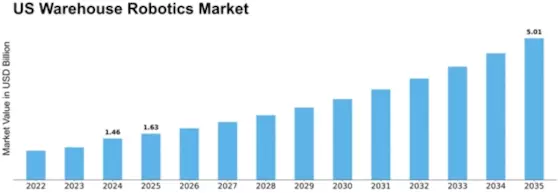

 

US Warehouse Robotics Market Size Graph
Author
Aarti Dhapte
Team Lead - Research

She holds an experience of about 6+ years in Market Research and Business Consulting, working under the spectrum of Information Communication Technology, Telecommunications and Semiconductor domains. Aarti conceptualizes and implements a scalable business strategy and provides strategic leadership to the clients. Her expertise lies in market estimation, competitive intelligence, pipeline analysis, customer assessment, etc.

Leave a Comment

FAQs

What is the current valuation of the US Warehouse Robotics Market?

As of 2024, the US Warehouse Robotics Market was valued at 1.46 USD Billion.

What is the projected market size for the US Warehouse Robotics Market by 2035?

The market is projected to reach a valuation of 5.01 USD Billion by 2035.

What is the expected CAGR for the US Warehouse Robotics Market during the forecast period?

The expected CAGR for the US Warehouse Robotics Market from 2025 to 2035 is 11.84%.

Which applications are driving growth in the US Warehouse Robotics Market?

Key applications include Order Fulfillment, Inventory Management, and Material Handling, with Order Fulfillment projected to grow from 0.58 to 1.95 USD Billion.

What are the primary end-use sectors for warehouse robotics in the US?

The primary end-use sectors include E-commerce, Retail, and Manufacturing, with E-commerce expected to grow from 0.58 to 1.99 USD Billion.

What types of robots are prevalent in the US Warehouse Robotics Market?

Prominent types include Autonomous Mobile Robots and Automated Guided Vehicles, with the latter projected to grow from 0.3 to 1.0 USD Billion.

How does technology influence the US Warehouse Robotics Market?

Technologies such as Artificial Intelligence and Cloud Computing are crucial, with Cloud Computing expected to grow from 0.36 to 1.0 USD Billion.

What functionalities are most sought after in warehouse robotics?

Key functionalities include Pick and Place and Transport, with Pick and Place projected to grow from 0.4 to 1.4 USD Billion.

Who are the key players in the US Warehouse Robotics Market?

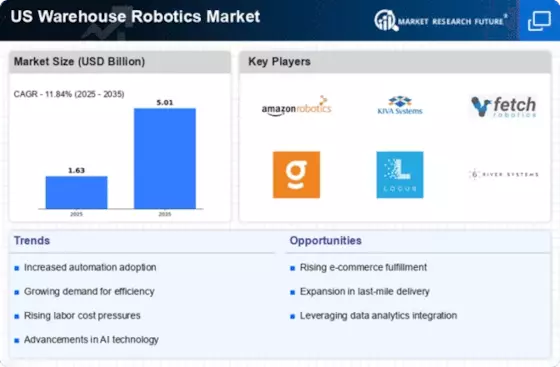
Key players include Amazon Robotics, Kiva Systems, and Fetch Robotics, among others.

What trends are shaping the future of warehouse robotics in the US?

Trends include increased automation in logistics and advancements in AI, which are likely to drive market growth significantly.

Market Summary

As per analysis, the US Warehouse Robotics Market is projected to grow from USD 1.66 Billion in 2025 to USD 5.01 Billion by 2035, exhibiting a compound annual growth rate (CAGR) of 11.84% during the forecast period (2025 - 2035).

Key Market Trends & Highlights

The US Warehouse Robotics Market is poised for substantial growth driven by technological advancements and evolving consumer demands.

  • The adoption of Autonomous Mobile Robots is increasing, particularly in the Order Fulfillment segment, which remains the largest in the market.
  • Integration of Artificial Intelligence is enhancing operational efficiency, especially in Inventory Management, which is the fastest-growing segment.
  • There is a heightened focus on safety and ergonomics as companies seek to improve working conditions and reduce injury risks.
  • Key market drivers include growing e-commerce demand and labor shortages, which are compelling businesses to invest in advanced robotics solutions.

Market Size & Forecast

2024 Market Size 1.46 (USD Billion)
2035 Market Size 5.01 (USD Billion)
CAGR (2025 - 2035) 11.84%

Major Players

<p>Amazon Robotics (US), Kiva Systems (US), Fetch Robotics (US), GreyOrange (US), Locus Robotics (US), 6 River Systems (US), Vecna Robotics (US), Omron Robotics (US), Seegrid (US)</p>

Market Trends

The US Warehouse Robotics Market is currently experiencing a transformative phase, driven by advancements in automation technology and the increasing demand for efficiency in logistics operations. As e-commerce continues to expand, warehouses are under pressure to optimize their processes, leading to a greater reliance on robotic solutions. These systems not only enhance productivity but also reduce operational costs, which appears to be a primary concern for many businesses in the sector. Furthermore, the integration of artificial intelligence and machine learning into robotic systems is likely to improve their capabilities, enabling them to perform complex tasks with greater precision and adaptability. In addition to technological advancements, the US Warehouse Robotics Market is influenced by labor shortages and the need for safer working environments. Companies are increasingly turning to robotics to mitigate risks associated with manual labor, thereby enhancing workplace safety. This trend suggests a shift in how warehouses operate, with a focus on creating a more automated and efficient environment. As the market evolves, it seems that the collaboration between human workers and robotic systems will become more prevalent, fostering a new era of productivity and innovation in the logistics industry.

Increased Adoption of Autonomous Mobile Robots

The US Warehouse Robotics Market is witnessing a surge in the adoption of autonomous mobile robots (AMRs). These robots are designed to navigate through warehouse environments independently, transporting goods and materials with minimal human intervention. This trend indicates a shift towards more flexible and efficient operations, as AMRs can adapt to changing layouts and workflows, thereby enhancing overall productivity.

Integration of Artificial Intelligence

The integration of artificial intelligence (AI) into warehouse robotics is becoming increasingly prominent. AI technologies enable robots to learn from their environments, optimize their routes, and make real-time decisions. This trend suggests that the US Warehouse Robotics Market is moving towards smarter systems that can handle complex tasks, ultimately improving operational efficiency and reducing errors.

Focus on Safety and Ergonomics

There is a growing emphasis on safety and ergonomics within the US Warehouse Robotics Market. Companies are investing in robotic solutions that not only enhance productivity but also prioritize the well-being of human workers. This trend indicates a recognition of the importance of creating a safe working environment, where robots assist in heavy lifting and repetitive tasks, thereby reducing the risk of injury.

US Warehouse Robotics Market Market Drivers

Growing E-commerce Demand

The US Warehouse Robotics Market is experiencing a surge in demand driven by the rapid growth of e-commerce. As online shopping continues to gain traction, warehouses are under pressure to enhance their operational efficiency. In 2025, e-commerce sales in the US reached approximately 1 trillion USD, prompting companies to invest in automation solutions. Robotics technology, including automated guided vehicles and robotic picking systems, is being adopted to streamline order fulfillment processes. This trend is likely to persist, as businesses seek to meet consumer expectations for faster delivery times and improved service levels. Consequently, the integration of robotics in warehouses is becoming a strategic imperative for companies aiming to remain competitive in the evolving retail landscape.

Government Initiatives and Support

The US Warehouse Robotics Market is benefiting from various government initiatives aimed at promoting automation and technological innovation. Federal and state programs are increasingly providing funding and resources to support the adoption of robotics in warehouses. These initiatives are designed to enhance productivity, improve safety standards, and foster economic growth. For instance, the US Department of Commerce has launched programs to assist small and medium-sized enterprises in integrating advanced technologies. Such support is likely to encourage more businesses to invest in warehouse robotics, thereby accelerating the market's growth. As these initiatives gain traction, the landscape of the US Warehouse Robotics Market is expected to evolve significantly.

Technological Advancements in Robotics

The US Warehouse Robotics Market is witnessing rapid technological advancements that are reshaping the landscape of warehouse operations. Innovations in robotics, such as improved sensors, machine learning algorithms, and enhanced navigation systems, are enabling more sophisticated automation solutions. These advancements allow for greater flexibility and adaptability in warehouse environments, facilitating the integration of robotics into existing workflows. As companies increasingly recognize the potential of these technologies, investments in robotic systems are expected to rise. In 2025, the market for warehouse robotics in the US was valued at approximately 5 billion USD, indicating a robust growth trajectory driven by technological innovation.

Rising Focus on Supply Chain Resilience

The US Warehouse Robotics Market is increasingly shaped by the growing emphasis on supply chain resilience. Companies are recognizing the need to enhance their operational capabilities to withstand disruptions and ensure continuity. Robotics technology plays a crucial role in achieving this goal by enabling more agile and responsive warehouse operations. The integration of automated systems allows for better inventory management, faster order processing, and improved overall efficiency. As businesses strive to build more resilient supply chains, investments in warehouse robotics are anticipated to rise. This trend is likely to drive the market forward, as organizations seek to leverage technology to navigate uncertainties and enhance their competitive edge.

Labor Shortages and Workforce Challenges

The US Warehouse Robotics Market is significantly influenced by ongoing labor shortages across various sectors. The logistics and warehousing industries are particularly affected, with many companies struggling to find skilled labor. In response, organizations are increasingly turning to robotics to mitigate the impact of these workforce challenges. The introduction of automated systems not only addresses labor shortages but also enhances productivity and operational efficiency. According to recent data, the US logistics sector is projected to face a shortfall of over 1 million workers by 2027. This alarming trend underscores the necessity for automation, as businesses seek to maintain their output levels and meet growing consumer demands.

Market Segment Insights

By Application: Order Fulfillment (Largest) vs. Inventory Management (Fastest-Growing)

<p>In the US Warehouse Robotics Market, the application segment is predominantly driven by Order Fulfillment, which commands the largest share among all applications. Other significant contributors include Inventory Management, Material Handling, Packaging, and Sorting. Each segment plays a crucial role in automating warehouse operations, thereby enhancing efficiency and accuracy. The market shares of these applications reflect their necessity in modern warehouse environments, with Order Fulfillment leading, owing to the increasing demand for rapid processing and shipping of online orders. Growth trends are notably optimistic within the Inventory Management segment, which has emerged as the fastest-growing category, spurred by advancements in AI and data analytics. The rise of e-commerce has further accelerated this growth, with companies investing in robotic solutions to effectively track and manage inventory. Moreover, as warehouses evolve to become more automated and intelligent, other applications like Material Handling and Sorting are also expected to witness significant activity, driven by the need for streamlined operations and reduced labor costs.</p>

<p>Order Fulfillment (Dominant) vs. Inventory Management (Emerging)</p>

<p>The Order Fulfillment segment stands out as the dominant application in the US Warehouse Robotics Market, representing the cornerstone of logistics operations. This application focuses on automating the picking, packing, and shipping processes, enabling warehouses to meet the demands of a rapidly changing consumer landscape. Its widespread use is backed by the continuous push for faster delivery times and improved accuracy in order processing. On the other hand, the Inventory Management segment is considered an emerging force, gaining traction due to its critical role in inventory tracking and stock management. Enhanced technologies such as RFID and real-time data analytics are positioning it for significant growth. As companies seek to optimize their supply chains, the importance of effective inventory management is driving robotic solutions further into warehouses, fostering more efficient overall operations.</p>

By End Use: E-commerce (Largest) vs. Logistics (Fastest-Growing)

<p>In the US Warehouse Robotics Market, the 'End Use' segment demonstrates a diverse distribution of market share among its various applications. E-commerce stands out as the largest segment, driven by the rising demand for automated solutions to enhance efficiency in storage and retrieval processes. Following closely are retail and manufacturing, which also exhibit significant participation, while logistics is rapidly gaining traction due to the shift towards automated fulfillment solutions designed for optimizing supply chain operations. The growth trends within the End Use segment highlight E-commerce as a primary driver, bolstered by the growing reliance on online shopping and the need for quick order fulfillment. Meanwhile, logistics has emerged as the fastest-growing segment, attributable to advancements in technology and a surge in investments aimed at streamlining shipping and handling processes in warehouses. As businesses adapt to consumer expectations for speed and efficiency, warehouse robotics are becoming indispensable across these segments.</p>

<p>E-commerce: Dominant vs. Logistics: Emerging</p>

<p>E-commerce is currently the dominant force in the US Warehouse Robotics Market, providing automated solutions that address the complexities of order processing and inventory management. Companies within this segment prioritize efficiency and accuracy to meet consumer demand for rapid fulfillment, leading to significant investments in robotic technologies. On the other hand, logistics represents an emerging segment, noted for its rapid growth driven by the increasing complexity of supply chains and the necessity for enhanced operational efficiency. Innovations such as autonomous mobile robots (AMRs) and automated guided vehicles (AGVs) are reshaping logistics operations, positioning this segment as a vital area of focus for future technological advancements and competitive advantage in the warehouse sector.</p>

By Type: Autonomous Mobile Robot (Largest) vs. Automated Guided Vehicle (Fastest-Growing)

<p>In the US Warehouse Robotics Market, the 'Autonomous Mobile Robot' (AMR) segment holds a significant share, dominating the landscape due to its versatility and efficiency in navigating complex warehouse environments. Automated Guided Vehicles (AGVs), while currently smaller in terms of market share, are rapidly gaining traction as a vital component of modern logistics systems.</p>

<p>Warehouse Robotics: AMR (Dominant) vs. AGV (Emerging)</p>

<p>Autonomous Mobile Robots (AMRs) are the dominant force in the US Warehouse Robotics Market, valued for their advanced sensors and sophisticated navigation abilities that allow them to operate autonomously, enhancing warehouse efficiency. In contrast, Automated Guided Vehicles (AGVs) are emerging as a critical solution for structured environments, primarily following predefined paths. The rising preference for agility and flexibility in warehouse operations is steering investment towards AMRs, while the growing need for automation and improved productivity fuels the demand for AGVs in specific applications.</p>

By Technology: Artificial Intelligence (Largest) vs. Machine Learning (Fastest-Growing)

<p>The U.S. Warehouse Robotics Market showcases a diverse array of technologies, with Artificial Intelligence commanding the largest market share. AI's integration into warehouse operations optimizes processes like inventory management and order fulfillment, significantly enhancing efficiency. Following closely, Machine Learning is rapidly gaining ground, applying advanced algorithms to improve automation and operational decision-making, making it one of the fastest-growing segments in this market landscape. As organizations seek to elevate their logistics performance, the reliance on these technologies is projected to deepen, reshaping warehouse functionalities altogether.</p>

<p>Technology: Artificial Intelligence (Dominant) vs. Machine Learning (Emerging)</p>

<p>Artificial Intelligence remains the dominant force in the U.S. Warehouse Robotics Market, characterized by its ability to automate complex tasks and make real-time decisions that enhance operational efficiency. It enables robots to learn from data and improve their performance over time, thus reducing human error. On the other hand, Machine Learning emerges as a groundbreaking technology that enhances AI capabilities by allowing robots to analyze vast amounts of data, adapt to new scenarios, and improve efficiency through predictive analytics. As businesses increasingly rely on these advanced technologies, the demand for Machine Learning solutions is rapidly proliferating, establishing it as a critical player in the future landscape of warehousing.</p>

By Functionality: Pick and Place (Largest) vs. Transport (Fastest-Growing)

<p>In the US Warehouse Robotics Market, the functionality segment showcases a diverse array of applications, with 'Pick and Place' leading in market share due to its essential role in automating order fulfillment processes. This segment capitalizes on the growing demand for efficiency and accuracy, providing a significant edge in productivity. In contrast, 'Transport' is emerging rapidly, reflecting a shift toward automatic handling and movement of goods within warehouses, boosting overall operational efficiency.</p>

<p>Pick and Place: Dominant vs. Transport: Emerging</p>

<p>The 'Pick and Place' functionality dominates the US Warehouse Robotics Market, characterized by its critical role in streamlining operations, reducing labor costs, and enhancing inventory management. This automation technology is pivotal for a wide range of industries including e-commerce and retail distribution. Meanwhile, the 'Transport' segment is recognized as the fastest-growing segment, driven by advancements in autonomous vehicle technology and the increasing need for flexible and efficient logistics solutions. The integration of robotics into transportation processes not only optimizes space and time but also supports the growing demand for real-time inventory management and faster order processing.</p>

Get more detailed insights about US Warehouse Robotics Market Research Report – Forecast till 2035

Regional Insights

North America : Innovation and Leadership Hub

The North American warehouse robotics market is driven by rapid technological advancements, increasing demand for automation, and a strong focus on efficiency. The region holds approximately 60% of the global market share, with the United States being the largest contributor, followed by Canada at around 15%. Regulatory support for automation and logistics optimization further fuels growth, as companies seek to enhance productivity and reduce operational costs. Leading the charge in this market are key players such as Amazon Robotics, Kiva Systems, and Fetch Robotics, which are innovating to meet the growing demand. The competitive landscape is characterized by significant investments in R&D and strategic partnerships. The presence of major logistics hubs and e-commerce giants in the U.S. creates a fertile ground for robotics adoption, ensuring that North America remains at the forefront of warehouse automation.

Europe : Emerging Robotics Powerhouse

Europe is witnessing a significant shift towards warehouse automation, driven by the need for efficiency and cost reduction. The region accounts for approximately 25% of The US Warehouse Robotics Market, with Germany and the UK being the largest markets, holding around 10% and 7% respectively. Regulatory frameworks promoting innovation and sustainability are key catalysts for this growth, as companies adapt to changing consumer demands and labor shortages. Countries like Germany, France, and the UK are leading the charge, with a strong presence of robotics manufacturers and integrators. The competitive landscape is marked by collaborations between technology providers and logistics companies, enhancing the deployment of robotic solutions. Key players such as GreyOrange and Locus Robotics are making significant strides, ensuring that Europe remains a vital player in The US Warehouse Robotics Market.

Asia-Pacific : Rapidly Growing Market

The Asia-Pacific region is rapidly emerging as a significant player in the warehouse robotics market, driven by increasing investments in automation and a booming e-commerce sector. This region holds approximately 10% of the global market share, with China and Japan leading the way, accounting for about 5% and 3% respectively. Government initiatives aimed at promoting smart manufacturing and logistics are key drivers of this growth, as businesses seek to enhance operational efficiency and meet rising consumer expectations. China is at the forefront of this transformation, with a strong focus on robotics innovation and deployment across various industries. The competitive landscape features a mix of local and international players, including Omron Robotics and Seegrid, which are actively expanding their presence. As the demand for automated solutions continues to rise, the Asia-Pacific region is poised for substantial growth in the warehouse robotics sector.

Middle East and Africa : Emerging Market Potential

The Middle East and Africa region is gradually recognizing the potential of warehouse robotics, driven by increasing investments in logistics and supply chain optimization. This region currently holds about 5% of the global market share, with the UAE and South Africa being the most prominent markets. Government initiatives aimed at diversifying economies and enhancing technological capabilities are fostering growth in this sector, as businesses look to improve efficiency and reduce operational costs. Countries like the UAE are investing heavily in smart logistics and automation technologies, creating opportunities for robotics adoption. The competitive landscape is still developing, with a mix of local startups and international players entering the market. As awareness of the benefits of automation grows, the Middle East and Africa are expected to see significant advancements in warehouse robotics in the coming years.

Key Players and Competitive Insights

The Warehouse Robotics Market is currently characterized by a dynamic competitive landscape, driven by technological advancements and increasing demand for automation in logistics. Key players such as Amazon Robotics (US), GreyOrange (US), and Locus Robotics (US) are at the forefront, each adopting distinct strategies to enhance their market positioning. Amazon Robotics (US) continues to innovate with its advanced robotic systems, focusing on integrating AI and machine learning to optimize warehouse operations. Meanwhile, GreyOrange (US) emphasizes its modular robotics solutions, which allow for greater flexibility and scalability in warehouse environments. Locus Robotics (US) is also making strides by enhancing its collaborative robots, which work alongside human workers to improve efficiency and productivity in fulfillment centers.

In terms of business tactics, companies are increasingly localizing manufacturing and optimizing supply chains to reduce costs and improve responsiveness. The market appears moderately fragmented, with several players vying for market share, yet the collective influence of major companies is shaping a competitive structure that favors innovation and technological advancement. This competitive environment is further intensified by the need for companies to adapt to rapidly changing consumer demands and supply chain challenges.

In December 2025, Amazon Robotics (US) announced a partnership with a leading AI firm to enhance its robotic systems' decision-making capabilities. This strategic move is likely to bolster Amazon's operational efficiency, allowing for more adaptive and intelligent warehouse management. The integration of AI into their robotics could significantly reduce operational costs and improve service delivery times, thereby reinforcing Amazon's competitive edge in the market.

In November 2025, GreyOrange (US) launched a new line of autonomous mobile robots designed specifically for e-commerce fulfillment. This product introduction is strategically important as it addresses the growing demand for rapid order processing and delivery in the e-commerce sector. By expanding its product offerings, GreyOrange is positioning itself to capture a larger share of the market, particularly as online shopping continues to rise.

In October 2025, Locus Robotics (US) secured a major contract with a national retail chain to deploy its collaborative robots across multiple distribution centers. This contract not only signifies Locus's growing reputation in the industry but also highlights the increasing acceptance of collaborative robotics in traditional warehouse settings. The deployment of these robots is expected to enhance operational efficiency and reduce labor costs, further solidifying Locus's market presence.

As of January 2026, the Warehouse Robotics Market is witnessing trends such as digitalization, sustainability, and AI integration, which are redefining competitive dynamics. Strategic alliances among key players are becoming increasingly common, fostering innovation and enhancing technological capabilities. Looking ahead, competitive differentiation is likely to evolve from price-based competition to a focus on innovation, technology, and supply chain reliability. Companies that can effectively leverage these trends will likely emerge as leaders in the market.

Key Companies in the US Warehouse Robotics Market include

Industry Developments

Future Outlook

US Warehouse Robotics Market Future Outlook

The US Warehouse Robotics Market is projected to grow at 11.84% CAGR from 2025 to 2035, driven by automation demand, labor shortages, and technological advancements.

New opportunities lie in:

  • Integration of AI-driven inventory management systems
  • Development of autonomous mobile robots for last-mile delivery
  • Expansion of robotic process automation in supply chain operations

By 2035, the market is expected to be robust, driven by innovation and increased adoption of robotics.

Market Segmentation

US Warehouse Robotics Market Type Outlook

  • Autonomous Mobile Robot
  • Automated Guided Vehicle
  • Robotic Arm
  • Automated Storage and Retrieval System
  • Sorting Robot

US Warehouse Robotics Market End Use Outlook

  • E-commerce
  • Retail
  • Manufacturing
  • Logistics
  • Pharmaceutical

US Warehouse Robotics Market Technology Outlook

  • Artificial Intelligence
  • Machine Learning
  • Computer Vision
  • Sensor Technology
  • Cloud Computing

US Warehouse Robotics Market Application Outlook

  • Order Fulfillment
  • Inventory Management
  • Material Handling
  • Packaging
  • Sorting

US Warehouse Robotics Market Functionality Outlook

  • Pick and Place
  • Transport
  • Sorting
  • Palletizing
  • Inspection

Report Scope

MARKET SIZE 20241.46(USD Billion)
MARKET SIZE 20251.66(USD Billion)
MARKET SIZE 20355.01(USD Billion)
COMPOUND ANNUAL GROWTH RATE (CAGR)11.84% (2024 - 2035)
REPORT COVERAGERevenue Forecast, Competitive Landscape, Growth Factors, and Trends
BASE YEAR2024
Market Forecast Period2025 - 2035
Historical Data2019 - 2024
Market Forecast UnitsUSD Billion
Key Companies ProfiledAmazon Robotics (US), Kiva Systems (US), Fetch Robotics (US), GreyOrange (US), Locus Robotics (US), 6 River Systems (US), Vecna Robotics (US), Omron Robotics (US), Seegrid (US)
Segments CoveredApplication, End Use, Type, Technology, Functionality
Key Market OpportunitiesIntegration of artificial intelligence in warehouse robotics enhances operational efficiency and accuracy in the US Warehouse Robotics Market.
Key Market DynamicsRising automation in logistics drives demand for advanced warehouse robotics, enhancing operational efficiency across the US.
Countries CoveredUS

FAQs

What is the current valuation of the US Warehouse Robotics Market?

As of 2024, the US Warehouse Robotics Market was valued at 1.46 USD Billion.

What is the projected market size for the US Warehouse Robotics Market by 2035?

The market is projected to reach a valuation of 5.01 USD Billion by 2035.

What is the expected CAGR for the US Warehouse Robotics Market during the forecast period?

The expected CAGR for the US Warehouse Robotics Market from 2025 to 2035 is 11.84%.

Which applications are driving growth in the US Warehouse Robotics Market?

Key applications include Order Fulfillment, Inventory Management, and Material Handling, with Order Fulfillment projected to grow from 0.58 to 1.95 USD Billion.

What are the primary end-use sectors for warehouse robotics in the US?

The primary end-use sectors include E-commerce, Retail, and Manufacturing, with E-commerce expected to grow from 0.58 to 1.99 USD Billion.

What types of robots are prevalent in the US Warehouse Robotics Market?

Prominent types include Autonomous Mobile Robots and Automated Guided Vehicles, with the latter projected to grow from 0.3 to 1.0 USD Billion.

How does technology influence the US Warehouse Robotics Market?

Technologies such as Artificial Intelligence and Cloud Computing are crucial, with Cloud Computing expected to grow from 0.36 to 1.0 USD Billion.

What functionalities are most sought after in warehouse robotics?

Key functionalities include Pick and Place and Transport, with Pick and Place projected to grow from 0.4 to 1.4 USD Billion.

Who are the key players in the US Warehouse Robotics Market?

Key players include Amazon Robotics, Kiva Systems, and Fetch Robotics, among others.

What trends are shaping the future of warehouse robotics in the US?

Trends include increased automation in logistics and advancements in AI, which are likely to drive market growth significantly.

  1. SECTION I: EXECUTIVE SUMMARY AND KEY HIGHLIGHTS
    1. | 1.1 EXECUTIVE SUMMARY
  2. SECTION II: SCOPING, METHODOLOGY AND MARKET STRUCTURE
    1. | 2.1 MARKET INTRODUCTION
    2. | 2.2 RESEARCH METHODOLOGY
  3. SECTION III: QUALITATIVE ANALYSIS
    1. | 3.1 MARKET DYNAMICS
    2. | 3.2 MARKET FACTOR ANALYSIS
  4. SECTION IV: QUANTITATIVE ANALYSIS
    1. | 4.1 Semiconductor & Electronics, BY Application (USD Billion)
    2. | 4.2 Semiconductor & Electronics, BY End Use (USD Billion)
    3. | 4.3 Semiconductor & Electronics, BY Type (USD Billion)
    4. | 4.4 Semiconductor & Electronics, BY Technology (USD Billion)
    5. | 4.5 Semiconductor & Electronics, BY Functionality (USD Billion)
  5. SECTION V: COMPETITIVE ANALYSIS
    1. | 5.1 Competitive Landscape
    2. | 5.2 Company Profiles
    3. | 5.3 Appendix

US Warehouse Robotics Market Segmentation

Market Segmentation Overview

  • Detailed segmentation data will be available in the full report
  • Comprehensive analysis by multiple parameters
  • Regional and country-level breakdowns
  • Market size forecasts by segment
Infographic

Free Sample Request

Kindly complete the form below to receive a free sample of this Report

Get Free Sample

Customer Strories

Compare Licence

×
Features License Type
Single User Multiuser License Enterprise User
Price $4,950 $5,950 $7,250
Maximum User Access Limit 1 User Upto 10 Users Unrestricted Access Throughout the Organization
Free Customization
Direct Access to Analyst
Deliverable Format
Platform Access
Discount on Next Purchase 10% 15% 15%
Printable Versions