×
Request Free Sample ×

Kindly complete the form below to receive a free sample of this Report

* Please use a valid business email

Leading companies partner with us for data-driven Insights

clients tt-cursor
Hero Background
English
Chinese
French
Japanese
Korean
German
Spanish

US Canned Cocktails (RTD Cocktails) Market Size

ID: MRFR/FnB/12425-HCR
128 Pages
Snehal Singh
February 2026

US Canned Cocktails (RTD Cocktails) Market Size, Share, Industry Trend & Analysis Research Report Information By Alcohol Base (Malt-based, Spirit-based, and Wine-based), By Packaging (Bottles and Cans), By Distribution Channel (Hypermarkets/Supermarkets, Online, and Liquor Stores), Forecast Till 2035

Share:
Download PDF ×

We do not share your information with anyone. However, we may send you emails based on your report interest from time to time. You may contact us at any time to opt-out.

US Canned Cocktails (RTD Cocktails) Market Infographic
Purchase Options

Us Canned Cocktails Rtd Cocktails Size

US Canned Cocktails (RTD Cocktails) Market Growth Projections and Opportunities

The US canned cocktails, or ready-to-drink (RTD) cocktails, market is influenced by several key factors that shape its growth, trends, and consumer demand. One significant factor is the changing consumer lifestyle and preferences. As more people seek convenient and portable beverage options for social gatherings, outdoor activities, and on-the-go consumption, canned cocktails offer a convenient solution. These pre-mixed cocktails in a can provide consumers with the convenience of enjoying their favorite cocktails without the need for specialized ingredients, equipment, or bartending skills, catering to the fast-paced lifestyle of modern consumers.

Changing drinking habits and the desire for premium experiences also drive the US canned cocktails market. With an increasing number of consumers looking for high-quality cocktails outside of traditional bar settings, there's a growing demand for premium RTD cocktails made with premium spirits and natural ingredients. Canned cocktails crafted by experienced mixologists or renowned brands offer consumers the assurance of consistent quality and flavor, appealing to those seeking a premium drinking experience without the hassle of mixing drinks from scratch.

The influence of convenience and portability is another significant market factor in the US canned cocktails industry. Canned cocktails provide a convenient and portable alternative to traditional bottled cocktails or homemade mixes, allowing consumers to enjoy their favorite drinks anytime, anywhere. Whether at a picnic, beach outing, or outdoor concert, canned cocktails are easy to transport, store, and consume, making them ideal for outdoor and social occasions where glassware and bar accessories may be impractical or prohibited.

Marketing and branding strategies play a crucial role in shaping consumer perceptions and driving demand in the US canned cocktails market. Companies invest in creative packaging, branding, and marketing campaigns to differentiate their products and stand out on store shelves. Eye-catching labels, vibrant designs, and compelling brand stories help attract consumers' attention and communicate the unique flavor profiles and premium ingredients of canned cocktails. Moreover, engaging consumers through social media, influencer partnerships, and experiential marketing events helps build brand awareness and foster consumer loyalty.

Distribution channels also impact the US canned cocktails market, influencing accessibility and consumer reach. While canned cocktails were once primarily sold through liquor stores or specialty retailers, they have now become more mainstream, with supermarkets, convenience stores, and online retailers expanding their selection of RTD cocktail options. This wider distribution network ensures that canned cocktails are readily available to a broader audience of consumers, driving market growth and increasing consumer awareness and adoption of canned cocktail products.

Government regulations and labeling requirements also influence the US canned cocktails market. Regulatory bodies such as the Alcohol and Tobacco Tax and Trade Bureau (TTB) set guidelines for labeling, packaging, and advertising of alcoholic beverages to ensure consumer protection and transparency. Compliance with these regulations is essential for canned cocktail manufacturers to maintain product quality, safety, and consumer trust. Additionally, adherence to certifications such as Kosher or Organic may help differentiate canned cocktail products and appeal to specific consumer segments.

Competitive dynamics and market trends drive innovation and product differentiation in the US canned cocktails market. With an increasing number of players entering the market, competition is intensifying, leading to a greater variety of flavor options, cocktail recipes, and packaging formats. Companies differentiate themselves by offering unique flavor combinations, premium spirits, and innovative packaging designs that stand out on store shelves and appeal to discerning consumers. Moreover, innovation in low-calorie or low-sugar options, as well as functional enhancements such as added vitamins or botanical extracts, further contributes to product diversification and market competitiveness.

Consumer behavior and preferences continue to evolve, shaping the dynamics of the US canned cocktails market. While some consumers prioritize convenience and portability, others prioritize taste, quality, and brand reputation in their canned cocktail purchases. Understanding these preferences and market trends is essential for canned cocktail manufacturers and retailers to develop targeted marketing strategies, product offerings, and distribution channels that resonate with their target audience. Consumer education initiatives highlighting the convenience, versatility, and premium quality of canned cocktails help increase awareness and drive demand in the US market.
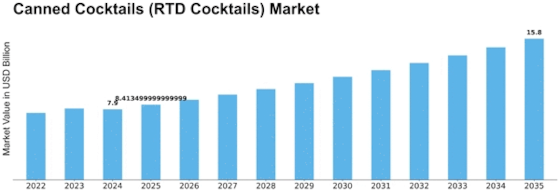

US Canned Cocktails (RTD Cocktails) Market Size Graph
Author
Snehal Singh
Assistant Manager - Research

High acumen in analyzing complex macro & micro markets with more than 6 years of work experience in the field of market research. By implementing her analytical skills in forecasting and estimation into market research reports, she has expertise in Packaging, Construction, and Equipment domains. She handles a team size of 20-25 resources and ensures smooth running of the projects, associated marketing activities, and client servicing.

Leave a Comment

FAQs

What is the current valuation of the US canned cocktails RTD cocktails market?

<p>The market valuation was 525.0 USD Million in 2024.</p>

What is the projected market size for the US canned cocktails RTD cocktails market by 2035?

<p>The projected valuation for 2035 is 1680.0 USD Million.</p>

What is the expected CAGR for the US canned cocktails RTD cocktails market during the forecast period?

<p>The expected CAGR for the market from 2025 to 2035 is 11.15%.</p>

Which product type segment holds the highest valuation in the US canned cocktails RTD cocktails market?

<p>The Classic Cocktails segment had a valuation of 100.0 to 350.0 USD Million.</p>

How do supermarkets compare to other distribution channels in the US canned cocktails RTD cocktails market?

<p>Supermarkets accounted for 210.0 to 680.0 USD Million, making them a leading distribution channel.</p>

What demographic segment shows the highest potential in the US canned cocktails RTD cocktails market?

<p>Health-Conscious Consumers represent a significant segment with a valuation of 150.0 to 480.0 USD Million.</p>

Which key players are leading the US canned cocktails RTD cocktails market?

<p>Key players include Anheuser-Busch InBev, Diageo, and Constellation Brands, among others.</p>

What is the valuation range for the Ready-to-Drink Spirits segment?

<p>The Ready-to-Drink Spirits segment had a valuation range of 150.0 to 500.0 USD Million.</p>

How does the online retail channel perform in the US canned cocktails RTD cocktails market?

<p>Online retail had a valuation range of 52.5 to 170.0 USD Million.</p>

What is the valuation range for the High Alcohol content segment in the market?

<p>The High Alcohol segment had a valuation range of 105.0 to 336.0 USD Million.</p>

Market Summary

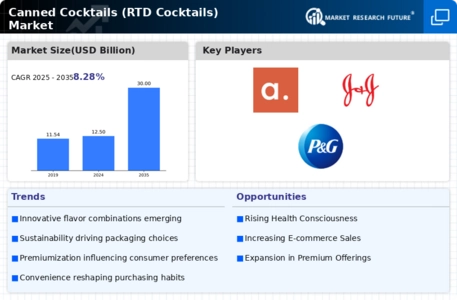
As per Market Research Future analysis, the Canned Cocktails (RTD Cocktails) Market Size was estimated at 7.9 USD Billion in 2024. The Canned Cocktails industry is projected to grow from 8.414 USD Billion in 2025 to 15.8 USD Billion by 2035, exhibiting a compound annual growth rate (CAGR) of 6.5% during the forecast period 2025 - 2035

Key Market Trends & Highlights

The Canned Cocktails (RTD Cocktails) Market is experiencing dynamic growth driven by health trends and innovative flavors.

  • Health-conscious formulations are increasingly influencing product development in the North American market.
  • Flavor innovation is a key trend, with brands exploring unique combinations to attract diverse consumer preferences in Asia-Pacific.
  • The spirit-based segment remains the largest, while the malt-based segment is rapidly gaining traction due to evolving consumer tastes.
  • Convenience and portability, along with sustainability initiatives, are major drivers propelling the market forward.

Market Size & Forecast

2024 Market Size 7.9 (USD Billion)
2035 Market Size 15.8 (USD Billion)
CAGR (2025 - 2035) 6.5%
Largest Regional Market Share in 2024 North America

Major Players

Diageo (GB), Constellation Brands (US), Anheuser-Busch InBev (BE), Brown-Forman (US), Pernod Ricard (FR), Bacardi Limited (BM), Mark Anthony Brands (CA), Cutwater Spirits (US), High Noon (US)

Market Trends

The Canned Cocktails (RTD Cocktails) Market is currently experiencing a notable transformation, driven by evolving consumer preferences and lifestyle changes. As individuals increasingly seek convenience and quality, the demand for ready-to-drink cocktails has surged. This market segment appears to be appealing to a diverse demographic, including younger consumers who favor innovative flavors and premium ingredients. Furthermore, the rise of social occasions and outdoor activities has contributed to the popularity of portable beverage options, making canned cocktails a favored choice for gatherings and events. In addition to convenience, the Canned Cocktails (RTD Cocktails) Market is witnessing a growing emphasis on health-conscious options. Many brands are now formulating beverages with lower alcohol content and natural ingredients, catering to consumers who prioritize wellness. This trend suggests a shift towards more mindful drinking habits, where flavor and quality are not compromised. As the market continues to evolve, it is likely that brands will further innovate to meet the changing demands of consumers, ensuring a dynamic and competitive landscape.

Health-Conscious Formulations

The Canned Cocktails (RTD Cocktails) Market is increasingly focusing on health-oriented products. Brands are introducing beverages with lower alcohol levels and natural ingredients, appealing to consumers who are more health-conscious. This trend indicates a shift towards mindful consumption, where quality and wellness are prioritized.

Flavor Innovation

Innovation in flavor profiles is a prominent trend within the Canned Cocktails (RTD Cocktails) Market. Manufacturers are experimenting with unique combinations and exotic ingredients to attract adventurous consumers. This approach not only enhances the drinking experience but also differentiates brands in a competitive market.

Sustainability Initiatives

Sustainability is becoming a key consideration in the Canned Cocktails (RTD Cocktails) Market. Many companies are adopting eco-friendly packaging and sourcing practices, responding to consumer demand for environmentally responsible products. This trend reflects a broader commitment to sustainability within the beverage industry.

US Canned Cocktails (RTD Cocktails) Market Market Drivers

Social Media Influence

The Canned Cocktails (RTD Cocktails) Market is significantly influenced by social media trends, which play a pivotal role in shaping consumer preferences and purchasing behaviors. Platforms such as Instagram and TikTok have become vital marketing channels for brands, allowing them to showcase visually appealing products and engage with consumers directly. The rise of influencer marketing has further amplified this effect, as influencers promote various canned cocktail brands, creating buzz and driving sales. Data indicates that products featured by influencers often experience a spike in demand, highlighting the importance of social media presence in the Canned Cocktails market. This trend suggests that brands must strategically leverage social media to enhance visibility and attract a broader audience.

Diverse Flavor Profiles

The Canned Cocktails (RTD Cocktails) Market is characterized by an expanding array of flavor profiles that appeal to a wide range of consumer preferences. Manufacturers are increasingly experimenting with unique and innovative flavors, moving beyond traditional options to include exotic ingredients and artisanal blends. This diversification is crucial in attracting adventurous consumers who seek novel taste experiences. Market data suggests that flavor innovation is a key driver of growth, with a significant portion of consumers indicating a willingness to try new flavors. As a result, brands that successfully introduce distinctive flavor combinations are likely to capture a larger market share, enhancing their competitive edge in the Canned Cocktails market.

Health and Wellness Trends

The Canned Cocktails (RTD Cocktails) Market is increasingly aligning with health and wellness trends, as consumers become more health-conscious in their beverage choices. There is a growing demand for lower-calorie, low-sugar, and organic options within the RTD cocktail segment. Brands that incorporate health-oriented ingredients, such as natural sweeteners and functional additives, are likely to resonate with consumers seeking guilt-free indulgence. Market data reveals that the health-conscious segment of the RTD market is expanding, with a notable increase in sales of healthier canned cocktail options. This shift indicates that brands must adapt their product offerings to meet the evolving preferences of health-focused consumers, thereby enhancing their competitiveness in the Canned Cocktails market.

Convenience and Portability

The Canned Cocktails (RTD Cocktails) Market is experiencing a surge in demand due to the increasing preference for convenience and portability among consumers. As lifestyles become busier, individuals seek ready-to-drink options that require minimal preparation. Canned cocktails offer a practical solution, allowing consumers to enjoy their favorite beverages on-the-go, whether at picnics, parties, or outdoor events. This trend is reflected in market data, which indicates that the RTD cocktail segment has seen a notable increase in sales, with a projected growth rate of approximately 15% annually. The ease of use and accessibility of canned cocktails cater to a diverse demographic, including millennials and young professionals, who prioritize convenience in their purchasing decisions.

Sustainability and Eco-Friendly Packaging

The Canned Cocktails (RTD Cocktails) Market is witnessing a growing emphasis on sustainability and eco-friendly packaging solutions. As environmental concerns become more pronounced, consumers are increasingly favoring brands that prioritize sustainable practices. This includes the use of recyclable materials and environmentally friendly production processes. Market data suggests that products marketed as sustainable are experiencing higher sales, as consumers are willing to pay a premium for eco-conscious options. Brands that adopt sustainable practices not only enhance their brand image but also align with the values of a significant portion of the consumer base. This trend indicates that sustainability will continue to be a critical driver in the Canned Cocktails market.

Market Segment Insights

By Product Type: Spiked Seltzers (Largest) vs. Cocktail Mixers (Fastest-Growing)

<p>The US canned cocktails RTD market has experienced a surge in various product types, with spiked seltzers leading the pack as the largest segment. Spiked seltzers have captured significant consumer attention due to their refreshing taste and low-calorie profiles, appealing to health-conscious drinkers. Following closely behind are cocktail mixers, which have emerged as a point of interest due to their versatility and convenience, making them a favorite among consumers looking for at-home mixology experiences. In terms of growth trends, the demand for classic cocktails remains steady, bolstered by the nostalgia factor and the rise of premium cocktail offerings. Meanwhile, flavored spirits and ready-to-drink spirits are witnessing increased popularity; the flavored variants are appealing to younger audiences, eager for unique and exciting tastes. Overall, innovation within these product types and changing consumer preferences are key drivers of market dynamics.</p>

<p>Spiked Seltzers (Dominant) vs. Cocktail Mixers (Emerging)</p>

<p>Spiked seltzers dominate the US canned cocktails RTD market, characterized by their light, refreshing taste and a reputation for being lower in calories compared to traditional cocktails. As a result, they have captured a substantial share of the market, resonating well with health-conscious consumers and those seeking convenient alcoholic options. On the other hand, cocktail mixers are emerging rapidly, offering consumers the freedom to create customized cocktails at home, making them attractive for social gatherings and events. This segment is innovating with new flavors and high-quality ingredients, positioning itself as an exciting choice for consumers aiming to enhance their drinking experiences. Both segments reflect evolving consumer trends towards convenience and unique flavor profiles.</p>

By Distribution Channel: Supermarkets (Largest) vs. Online Retail (Fastest-Growing)

<p>In the US canned cocktails RTD market, the distribution channels are diverse, with Supermarkets leading as the largest segment. This dominance is attributed to their extensive reach and consumer accessibility, enabling customers to conveniently find their favorite ready-to-drink cocktails in familiar settings. In contrast, Online Retail is emerging rapidly, capitalizing on evolving consumer shopping behaviors that favor digital convenience and a wider variety of options available at the click of a button. The growth trends in this segment are significantly influenced by changing lifestyles and preferences. The increasing popularity of canned cocktails during social events and gatherings has encouraged more consumers to explore diverse purchasing channels. Online Retail is particularly benefiting from the trend towards home delivery services and subscription models, making it an attractive option for younger consumers and busy professionals seeking convenience alongside variety.</p>

<p>Supermarkets: Dominant vs. Online Retail: Emerging</p>

<p>Supermarkets serve as the dominant distribution channel in the US canned cocktails RTD market, providing significant shelf space and visibility for brands. They attract a broad consumer base due to their established presence and ability to bundle products with other grocery items. The convenience of one-stop shopping allows consumers to easily access a wide array of canned cocktail options. Conversely, Online Retail is the emerging channel, driven by the rapid adoption of e-commerce. It caters to tech-savvy consumers looking for convenience and variety, featuring extensive product assortments and often exclusive online offerings. This channel has proven particularly appealing for younger demographics and those seeking personalized shopping experiences, enabling brands to engage with a broader audience directly.</p>

By Consumer Demographics: Millennials (Largest) vs. Health-Conscious Consumers (Fastest-Growing)

<p>In the US canned cocktails market, Millennials currently represent the largest demographic segment, significantly influencing consumption patterns. Their preference for convenience and quality has led to a growing market share, while they are drawn to innovative flavors and branding. Meanwhile, Health-Conscious Consumers are emerging as a significant segment, catering to the increasing demand for healthier and low-calorie options. This demographic seeks beverages that align with their lifestyle choices, thereby driving demand for options that offer lower sugar, organic ingredients, and functional benefits. The growth trends within this segment highlight a shift in consumer preferences, with younger generations rapidly adopting canned cocktails as a stylish and convenient option. As Millennials continue to lead in consumption, their behavior influences flavor trends and brand choices, equating quality with experience. Concurrently, Health-Conscious Consumers are growing due to an increased focus on wellness, prompting brands to innovate with healthier formulations and ingredient transparency. These trends reflect the evolving landscape of the US canned cocktails market, where consumer preferences are increasingly shaping product offerings.</p>

<p>Millennials (Dominant) vs. Health-Conscious Consumers (Emerging)</p>

<p>Millennials are the dominant force in the US canned cocktails market, characterized by their preference for unique, artisanal products that pair quality with convenience. This demographic enjoys sharing their drinking experiences on social media, driving the demand for visually appealing and trendy products. They are also more likely to experiment with new flavors and brands, pushing manufacturers toward innovation. In contrast, Health-Conscious Consumers, while emerging, present a growing opportunity for brands that can adapt to their health-driven lifestyle. They prioritize options that boast low calories, organic certification, and transparency regarding ingredients. The intersection of these two segments illustrates a competitive yet complementary relationship, where brands must balance innovation with health-conscious choices to capture a wider audience.</p>

By Alcohol Content: Moderate Alcohol (Largest) vs. Non-Alcoholic Options (Fastest-Growing)

<p>In the US canned cocktails RTD market, the alcohol content segments display a varied distribution of market share. Moderate Alcohol options dominate the landscape, appealing to consumers looking for a balanced drinking experience. Low Alcohol segments, while niche, also capture specific audiences focused on lighter consumption. Meanwhile, High Alcohol options cater to seasoned drinkers, though they hold a smaller percentage of the market. Non-Alcoholic Options have rapidly gained popularity, reflecting a societal shift towards mindful drinking and wellness, creating a vibrant segment for health-conscious consumers.</p>

<p>Moderate Alcohol (Dominant) vs. Non-Alcoholic Options (Emerging)</p>

<p>Moderate Alcohol canned cocktails represent a significant portion of the market, appealing to a wide consumer base seeking flavorful and enjoyable drinking experiences without excessive alcoholic content. These cocktails often feature innovative flavor profiles and are marketed as perfect for social occasions while smoothing the drinking experience. In contrast, Non-Alcoholic Options are emerging rapidly, driven by a growing trend towards health and wellness. These options cater to a diverse audience, including sober-curious consumers and designated drivers, emphasizing quality ingredients and unique flavors, often with the same complexity as traditional cocktails.</p>

Get more detailed insights about US Canned Cocktails (RTD Cocktails) Market Research Report— Forecast till 2035

Regional Insights

North America : Market Leader in RTD Cocktails

North America is the largest market for canned cocktails, holding approximately 60% of the global share. The growth is driven by increasing consumer demand for convenience and ready-to-drink options, alongside a rise in social gatherings. Regulatory support for alcohol sales in retail environments has further catalyzed market expansion. The U.S. is the primary contributor, followed by Canada, which is experiencing a surge in popularity for innovative flavors and premium offerings. The competitive landscape is robust, featuring key players such as Diageo, Constellation Brands, and Anheuser-Busch InBev. These companies are investing heavily in marketing and product development to capture the evolving tastes of consumers. The presence of craft brands like Cutwater Spirits and High Noon is also notable, as they cater to a growing segment seeking unique and high-quality canned cocktails. This dynamic environment is expected to foster further innovation and growth in the sector.

Europe : Emerging Market for RTD Cocktails

Europe is emerging as a significant player in the canned cocktails market, currently holding around 25% of the global share. The growth is fueled by changing consumer preferences towards convenience and premiumization in alcoholic beverages. Countries like the UK and Germany are leading this trend, supported by favorable regulations that promote the sale of ready-to-drink products in various retail channels. The increasing popularity of social drinking occasions is also a key driver. Leading countries in this region include the UK, Germany, and France, where major players like Pernod Ricard and Bacardi Limited are actively expanding their product lines. The competitive landscape is characterized by a mix of established brands and emerging craft producers, which are innovating with unique flavors and packaging. This vibrant market is expected to continue its upward trajectory as consumer interest in canned cocktails grows.

Asia-Pacific : Rapidly Growing Market Potential

Asia-Pacific is rapidly becoming a key market for canned cocktails, currently accounting for about 10% of the global share. The growth is driven by increasing urbanization, rising disposable incomes, and a growing trend towards convenience in beverage consumption. Countries like Australia and Japan are at the forefront, with regulatory frameworks becoming more supportive of alcohol sales in retail settings, thus facilitating market expansion. The competitive landscape is evolving, with both international brands and local players vying for market share. Key players such as Diageo and Brown-Forman are investing in the region, while local brands are innovating to cater to regional tastes. The increasing popularity of social events and gatherings is further propelling demand for ready-to-drink cocktails, making this region a focal point for future growth in the sector.

Middle East and Africa : Emerging Market with Challenges

The Middle East and Africa region is an emerging market for canned cocktails, currently holding about 5% of the global share. The growth potential is significant, driven by a young population and increasing urbanization. However, regulatory challenges regarding alcohol sales in certain countries can hinder market expansion. Countries like South Africa are leading the way, with a growing acceptance of ready-to-drink products in social settings. The competitive landscape is still developing, with a mix of international brands and local producers. Key players are beginning to explore this market, but the presence of strict regulations in some areas poses challenges. As consumer preferences shift towards convenience and quality, the potential for growth in the canned cocktails segment remains promising, particularly in more liberal markets within the region.

Key Players and Competitive Insights

Leading market players are investing heavily in research and development in order to expand their product lines, which will help the canned cocktails (RTD cocktails) market, grow even more. Market participants are also undertaking a variety of strategic activities to expand their  footprint, with important market developments including new product launches, contractual agreements, mergers and acquisitions, higher investments, and collaboration with other organizations. To expand and survive in a more competitive and rising market climate, canned cocktails (RTD cocktails) industry must offer cost-effective items.
Major players in the canned cocktails (RTD cocktails) market are attempting to increase market demand by investing in research and development operations includes The Absolut Company, House of Delola, LLC, Diageo plc, Brown-Forman, Bacardi Limited, Asahi Group Holdings, Ltd., Pernod Ricard, Halewood Wines & Spirits, Shanghai Bacchus Liquor Co., Ltd., Suntory Holdings Limited, Manchester Drinks Company Ltd., and Anheuser-Busch InBev.

Key Companies in the US Canned Cocktails (RTD Cocktails) Market include

Industry Developments

April 2023: A premium line of spirit-based and organic RTD cocktails called "The House of Delola" was introduced by American singer and actress Jennifer Lopez. The three flavors that were introduced were Bella Berry Spritz (10.5% ABV), L'Orange Spritz (10.5% ABV), and Paloma Rosa Spritz (11.5% ABV). These fruit-infused cocktails are lower in calories and more flavorful.

January 2022: Constellation Brands Inc. and The Coca-Cola Company inked a brand authorization agreement for the introduction of FRESCA Mixed, a range of richly flavored, spirit-based RTD drinks, in the United States. In order to provide a transition between crisp hard seltzers and richly flavored bar drinks, the FRESCA brands hope to attract customers looking for more flavorful experiences and premium RTD beverages.

Future Outlook

US Canned Cocktails (RTD Cocktails) Market Future Outlook

The Canned Cocktails market is projected to grow at a 6.5% CAGR from 2025 to 2035, driven by convenience, innovation, and evolving consumer preferences.

New opportunities lie in:

  • Expansion into health-conscious formulations with low-calorie options.
  • Development of premium, craft-style canned cocktails targeting upscale markets.
  • Strategic partnerships with e-commerce platforms for direct-to-consumer sales.

By 2035, the Canned Cocktails market is expected to achieve robust growth and diversification.

Market Segmentation

US Canned Cocktails (RTD Cocktails) Market Packaging Outlook

  • Bottles
  • Cans

US Canned Cocktails (RTD Cocktails) Market Alcohol Base Outlook

  • Malt-based
  • Spirit-based
  • Wine-based

US Canned Cocktails (RTD Cocktails) Market Distribution Channel Outlook

  • Hypermarkets/Supermarkets
  • Online
  • Liquor Stores

Report Scope

MARKET SIZE 2024 7.9(USD Billion)
MARKET SIZE 2025 8.414(USD Billion)
MARKET SIZE 2035 15.8(USD Billion)
COMPOUND ANNUAL GROWTH RATE (CAGR) 6.5% (2025 - 2035)
REPORT COVERAGE Revenue Forecast, Competitive Landscape, Growth Factors, and Trends
BASE YEAR 2024
Market Forecast Period 2025 - 2035
Historical Data 2019 - 2024
Market Forecast Units USD Billion
Key Companies Profiled Diageo (GB), Constellation Brands (US), Anheuser-Busch InBev (BE), Brown-Forman (US), Pernod Ricard (FR), Bacardi Limited (BM), Mark Anthony Brands (CA), Cutwater Spirits (US), High Noon (US)
Segments Covered Alcohol Base, Packaging, Distribution Channel
Key Market Opportunities Growing consumer preference for convenience and premium flavors in the Canned Cocktails (RTD Cocktails) Market.
Key Market Dynamics Rising consumer preference for convenience drives innovation and competition in the canned cocktails market.
Countries Covered North America, Europe, APAC, South America, MEA

FAQs

What is the current valuation of the US canned cocktails RTD cocktails market?

<p>The market valuation was 525.0 USD Million in 2024.</p>

What is the projected market size for the US canned cocktails RTD cocktails market by 2035?

<p>The projected valuation for 2035 is 1680.0 USD Million.</p>

What is the expected CAGR for the US canned cocktails RTD cocktails market during the forecast period?

<p>The expected CAGR for the market from 2025 to 2035 is 11.15%.</p>

Which product type segment holds the highest valuation in the US canned cocktails RTD cocktails market?

<p>The Classic Cocktails segment had a valuation of 100.0 to 350.0 USD Million.</p>

How do supermarkets compare to other distribution channels in the US canned cocktails RTD cocktails market?

<p>Supermarkets accounted for 210.0 to 680.0 USD Million, making them a leading distribution channel.</p>

What demographic segment shows the highest potential in the US canned cocktails RTD cocktails market?

<p>Health-Conscious Consumers represent a significant segment with a valuation of 150.0 to 480.0 USD Million.</p>

Which key players are leading the US canned cocktails RTD cocktails market?

<p>Key players include Anheuser-Busch InBev, Diageo, and Constellation Brands, among others.</p>

What is the valuation range for the Ready-to-Drink Spirits segment?

<p>The Ready-to-Drink Spirits segment had a valuation range of 150.0 to 500.0 USD Million.</p>

How does the online retail channel perform in the US canned cocktails RTD cocktails market?

<p>Online retail had a valuation range of 52.5 to 170.0 USD Million.</p>

What is the valuation range for the High Alcohol content segment in the market?

<p>The High Alcohol segment had a valuation range of 105.0 to 336.0 USD Million.</p>

  1. SECTION I: EXECUTIVE SUMMARY AND KEY HIGHLIGHTS
    1. | 1.1 EXECUTIVE SUMMARY
    2. | | 1.1.1 Market Overview
    3. | | 1.1.2 Key Findings
    4. | | 1.1.3 Market Segmentation
    5. | | 1.1.4 Competitive Landscape
    6. | | 1.1.5 Challenges and Opportunities
    7. | | 1.1.6 Future Outlook
  2. SECTION II: SCOPING, METHODOLOGY AND MARKET STRUCTURE
    1. | 2.1 MARKET INTRODUCTION
    2. | | 2.1.1 Definition
    3. | | 2.1.2 Scope of the study
    4. | | | 2.1.2.1 Research Objective
    5. | | | 2.1.2.2 Assumption
    6. | | | 2.1.2.3 Limitations
    7. | 2.2 RESEARCH METHODOLOGY
    8. | | 2.2.1 Overview
    9. | | 2.2.2 Data Mining
    10. | | 2.2.3 Secondary Research
    11. | | 2.2.4 Primary Research
    12. | | | 2.2.4.1 Primary Interviews and Information Gathering Process
    13. | | | 2.2.4.2 Breakdown of Primary Respondents
    14. | | 2.2.5 Forecasting Model
    15. | | 2.2.6 Market Size Estimation
    16. | | | 2.2.6.1 Bottom-Up Approach
    17. | | | 2.2.6.2 Top-Down Approach
    18. | | 2.2.7 Data Triangulation
    19. | | 2.2.8 Validation
  3. SECTION III: QUALITATIVE ANALYSIS
    1. | 3.1 MARKET DYNAMICS
    2. | | 3.1.1 Overview
    3. | | 3.1.2 Drivers
    4. | | 3.1.3 Restraints
    5. | | 3.1.4 Opportunities
    6. | 3.2 MARKET FACTOR ANALYSIS
    7. | | 3.2.1 Value chain Analysis
    8. | | 3.2.2 Porter's Five Forces Analysis
    9. | | | 3.2.2.1 Bargaining Power of Suppliers
    10. | | | 3.2.2.2 Bargaining Power of Buyers
    11. | | | 3.2.2.3 Threat of New Entrants
    12. | | | 3.2.2.4 Threat of Substitutes
    13. | | | 3.2.2.5 Intensity of Rivalry
    14. | | 3.2.3 COVID-19 Impact Analysis
    15. | | | 3.2.3.1 Market Impact Analysis
    16. | | | 3.2.3.2 Regional Impact
    17. | | | 3.2.3.3 Opportunity and Threat Analysis
  4. SECTION IV: QUANTITATIVE ANALYSIS
    1. | 4.1 Food, Beverages & Nutrition, BY Product Type (USD Million)
    2. | | 4.1.1 Spiked Seltzers
    3. | | 4.1.2 Cocktail Mixers
    4. | | 4.1.3 Classic Cocktails
    5. | | 4.1.4 Ready-to-Drink Spirits
    6. | | 4.1.5 Flavored Spirits
    7. | 4.2 Food, Beverages & Nutrition, BY Distribution Channel (USD Million)
    8. | | 4.2.1 Supermarkets
    9. | | 4.2.2 Convenience Stores
    10. | | 4.2.3 Online Retail
    11. | | 4.2.4 Specialty Stores
    12. | | 4.2.5 Bars and Restaurants
    13. | 4.3 Food, Beverages & Nutrition, BY Consumer Demographics (USD Million)
    14. | | 4.3.1 Millennials
    15. | | 4.3.2 Generation X
    16. | | 4.3.3 Baby Boomers
    17. | | 4.3.4 Young Adults
    18. | | 4.3.5 Health-Conscious Consumers
    19. | 4.4 Food, Beverages & Nutrition, BY Alcohol Content (USD Million)
    20. | | 4.4.1 Low Alcohol
    21. | | 4.4.2 Moderate Alcohol
    22. | | 4.4.3 High Alcohol
    23. | | 4.4.4 Non-Alcoholic Options
    24. | | 4.4.5 Flavored Alcohol
  5. SECTION V: COMPETITIVE ANALYSIS
    1. | 5.1 Competitive Landscape
    2. | | 5.1.1 Overview
    3. | | 5.1.2 Competitive Analysis
    4. | | 5.1.3 Market share Analysis
    5. | | 5.1.4 Major Growth Strategy in the Food, Beverages & Nutrition
    6. | | 5.1.5 Competitive Benchmarking
    7. | | 5.1.6 Leading Players in Terms of Number of Developments in the Food, Beverages & Nutrition
    8. | | 5.1.7 Key developments and growth strategies
    9. | | | 5.1.7.1 New Product Launch/Service Deployment
    10. | | | 5.1.7.2 Merger & Acquisitions
    11. | | | 5.1.7.3 Joint Ventures
    12. | | 5.1.8 Major Players Financial Matrix
    13. | | | 5.1.8.1 Sales and Operating Income
    14. | | | 5.1.8.2 Major Players R&D Expenditure. 2023
    15. | 5.2 Company Profiles
    16. | | 5.2.1 Anheuser-Busch InBev (US)
    17. | | | 5.2.1.1 Financial Overview
    18. | | | 5.2.1.2 Products Offered
    19. | | | 5.2.1.3 Key Developments
    20. | | | 5.2.1.4 SWOT Analysis
    21. | | | 5.2.1.5 Key Strategies
    22. | | 5.2.2 Diageo (US)
    23. | | | 5.2.2.1 Financial Overview
    24. | | | 5.2.2.2 Products Offered
    25. | | | 5.2.2.3 Key Developments
    26. | | | 5.2.2.4 SWOT Analysis
    27. | | | 5.2.2.5 Key Strategies
    28. | | 5.2.3 Constellation Brands (US)
    29. | | | 5.2.3.1 Financial Overview
    30. | | | 5.2.3.2 Products Offered
    31. | | | 5.2.3.3 Key Developments
    32. | | | 5.2.3.4 SWOT Analysis
    33. | | | 5.2.3.5 Key Strategies
    34. | | 5.2.4 Molson Coors Beverage Company (US)
    35. | | | 5.2.4.1 Financial Overview
    36. | | | 5.2.4.2 Products Offered
    37. | | | 5.2.4.3 Key Developments
    38. | | | 5.2.4.4 SWOT Analysis
    39. | | | 5.2.4.5 Key Strategies
    40. | | 5.2.5 Pernod Ricard (US)
    41. | | | 5.2.5.1 Financial Overview
    42. | | | 5.2.5.2 Products Offered
    43. | | | 5.2.5.3 Key Developments
    44. | | | 5.2.5.4 SWOT Analysis
    45. | | | 5.2.5.5 Key Strategies
    46. | | 5.2.6 Boston Beer Company (US)
    47. | | | 5.2.6.1 Financial Overview
    48. | | | 5.2.6.2 Products Offered
    49. | | | 5.2.6.3 Key Developments
    50. | | | 5.2.6.4 SWOT Analysis
    51. | | | 5.2.6.5 Key Strategies
    52. | | 5.2.7 Mark Anthony Brands (US)
    53. | | | 5.2.7.1 Financial Overview
    54. | | | 5.2.7.2 Products Offered
    55. | | | 5.2.7.3 Key Developments
    56. | | | 5.2.7.4 SWOT Analysis
    57. | | | 5.2.7.5 Key Strategies
    58. | | 5.2.8 Cutwater Spirits (US)
    59. | | | 5.2.8.1 Financial Overview
    60. | | | 5.2.8.2 Products Offered
    61. | | | 5.2.8.3 Key Developments
    62. | | | 5.2.8.4 SWOT Analysis
    63. | | | 5.2.8.5 Key Strategies
    64. | | 5.2.9 High Noon Spirits (US)
    65. | | | 5.2.9.1 Financial Overview
    66. | | | 5.2.9.2 Products Offered
    67. | | | 5.2.9.3 Key Developments
    68. | | | 5.2.9.4 SWOT Analysis
    69. | | | 5.2.9.5 Key Strategies
    70. | 5.3 Appendix
    71. | | 5.3.1 References
    72. | | 5.3.2 Related Reports
  6. LIST OF FIGURES
    1. | 6.1 MARKET SYNOPSIS
    2. | 6.2 US MARKET ANALYSIS BY PRODUCT TYPE
    3. | 6.3 US MARKET ANALYSIS BY DISTRIBUTION CHANNEL
    4. | 6.4 US MARKET ANALYSIS BY CONSUMER DEMOGRAPHICS
    5. | 6.5 US MARKET ANALYSIS BY ALCOHOL CONTENT
    6. | 6.6 KEY BUYING CRITERIA OF FOOD, BEVERAGES & NUTRITION
    7. | 6.7 RESEARCH PROCESS OF MRFR
    8. | 6.8 DRO ANALYSIS OF FOOD, BEVERAGES & NUTRITION
    9. | 6.9 DRIVERS IMPACT ANALYSIS: FOOD, BEVERAGES & NUTRITION
    10. | 6.10 RESTRAINTS IMPACT ANALYSIS: FOOD, BEVERAGES & NUTRITION
    11. | 6.11 SUPPLY / VALUE CHAIN: FOOD, BEVERAGES & NUTRITION
    12. | 6.12 FOOD, BEVERAGES & NUTRITION, BY PRODUCT TYPE, 2024 (% SHARE)
    13. | 6.13 FOOD, BEVERAGES & NUTRITION, BY PRODUCT TYPE, 2024 TO 2035 (USD Million)
    14. | 6.14 FOOD, BEVERAGES & NUTRITION, BY DISTRIBUTION CHANNEL, 2024 (% SHARE)
    15. | 6.15 FOOD, BEVERAGES & NUTRITION, BY DISTRIBUTION CHANNEL, 2024 TO 2035 (USD Million)
    16. | 6.16 FOOD, BEVERAGES & NUTRITION, BY CONSUMER DEMOGRAPHICS, 2024 (% SHARE)
    17. | 6.17 FOOD, BEVERAGES & NUTRITION, BY CONSUMER DEMOGRAPHICS, 2024 TO 2035 (USD Million)
    18. | 6.18 FOOD, BEVERAGES & NUTRITION, BY ALCOHOL CONTENT, 2024 (% SHARE)
    19. | 6.19 FOOD, BEVERAGES & NUTRITION, BY ALCOHOL CONTENT, 2024 TO 2035 (USD Million)
    20. | 6.20 BENCHMARKING OF MAJOR COMPETITORS
  7. LIST OF TABLES
    1. | 7.1 LIST OF ASSUMPTIONS
    2. | | 7.1.1
    3. | 7.2 US MARKET SIZE ESTIMATES; FORECAST
    4. | | 7.2.1 BY PRODUCT TYPE, 2026-2035 (USD Million)
    5. | | 7.2.2 BY DISTRIBUTION CHANNEL, 2026-2035 (USD Million)
    6. | | 7.2.3 BY CONSUMER DEMOGRAPHICS, 2026-2035 (USD Million)
    7. | | 7.2.4 BY ALCOHOL CONTENT, 2026-2035 (USD Million)
    8. | 7.3 PRODUCT LAUNCH/PRODUCT DEVELOPMENT/APPROVAL
    9. | | 7.3.1
    10. | 7.4 ACQUISITION/PARTNERSHIP
    11. | | 7.4.1

US Food, Beverages & Nutrition Market Segmentation

Food, Beverages & Nutrition By Product Type (USD Million, 2022-2035)

  • Spiked Seltzers
  • Cocktail Mixers
  • Classic Cocktails
  • Ready-to-Drink Spirits
  • Flavored Spirits

Food, Beverages & Nutrition By Distribution Channel (USD Million, 2022-2035)

  • Supermarkets
  • Convenience Stores
  • Online Retail
  • Specialty Stores
  • Bars and Restaurants

Food, Beverages & Nutrition By Consumer Demographics (USD Million, 2022-2035)

  • Millennials
  • Generation X
  • Baby Boomers
  • Young Adults
  • Health-Conscious Consumers

Food, Beverages & Nutrition By Alcohol Content (USD Million, 2022-2035)

  • Low Alcohol
  • Moderate Alcohol
  • High Alcohol
  • Non-Alcoholic Options
  • Flavored Alcohol
Infographic

Free Sample Request

Kindly complete the form below to receive a free sample of this Report

Get Free Sample

Customer Strories

Compare Licence

×
Features License Type
Single User Multiuser License Enterprise User
Price $4,950 $5,950 $7,250
Maximum User Access Limit 1 User Upto 10 Users Unrestricted Access Throughout the Organization
Free Customization
Direct Access to Analyst
Deliverable Format
Platform Access
Discount on Next Purchase 10% 15% 15%
Printable Versions