Menstrual Cup Market

Key Players: Diva International (DivaCup), Lunette Oy, Lena Cup, Saalt, Intimina (Essity), Me Luna GmbH, OrganiCup (AllMatters), Ruby Cup

Menstrual Cup Market

Menstrual Cup Market Research Report Information by Product (Reusable and Disposable), By Material Type (Thermoplastic, Latex, Medical-grade Silicone, and Natural Rubber), By Distribution Channel (Online Stores and Pharmacies), And By Region (North America, Europe, Asia-Pacific, And Rest Of The World) โ€“Market Forecast Till 2035
ID: MRFR/MED/0898-CR
90 Pages
Nidhi Mandole, Rahul Gotadki
Last Updated: June 05, 2026
ย 

Menstrual Cup Market Summary

The Global Menstrual Cup Market size was valued at USD 0.99 Billion in 2025, and the market is projected to grow from USD 1.04 Billion in 2026 to USD 1.62 Billion by 2035, registering a CAGR of 4.91% during the forecast period 2026โ€“2035. This expansion is anchored in a decisive consumer pivot toward reusable feminine hygiene products and growing government investment in period-poverty alleviation programs. Scotland's Period Products Act โ€” the first national legislation guaranteeing free access to menstrual products โ€” has catalyzed similar policy discussions across the EU and parts of Southeast Asia, lending structural support to demand for silicone period cup alternativesย [2].

A generational shift away from single-use tampons and pads is reshaping the feminine hygiene landscape. Where disposable products once dominated shelf space unchallenged, eco-friendly period care options now command premium positioning in both brick-and-mortar pharmacies and digital storefronts. Environmental analyses consistently show menstrual flow collection devices cut lifecycle carbon emissions by roughly 85โ€“90% compared to disposable counterparts, a data point that resonates with Gen Z and millennial consumers willing to pay upfront premiums for sustainability [3]. E-commerce platforms have simultaneously lowered the information barrier, offering sizing guides, instructional videos, and peer reviews that accelerate first-time adoption of the silicone period cup.

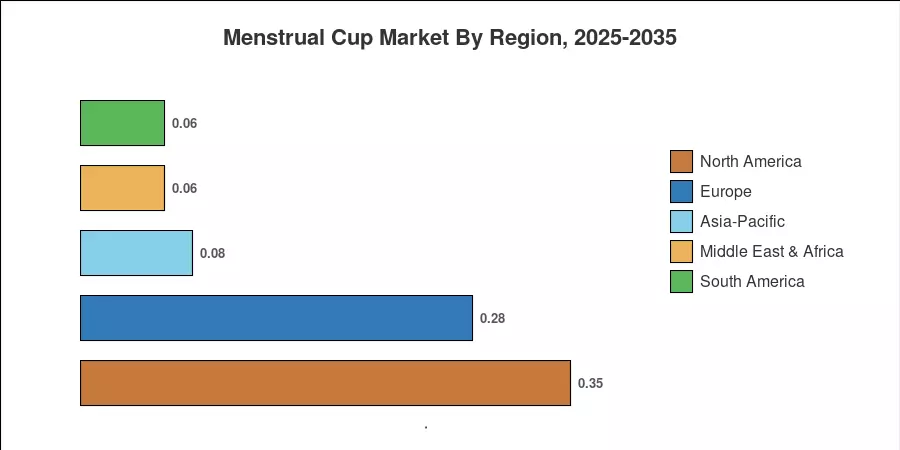
North America remains the dominant region in the Menstrual Cup Market, holding approximately 35.5% of global revenue in 2025, driven by mature retail infrastructure and strong DTC brand ecosystems. Asia-Pacific, however, is the fastest-growing region at a projected 8.1% CAGR through 2035, fueled by rising disposable incomes in India and China and government-backed menstrual health awareness campaigns Europe holds the second-largest share at roughly 28%, supported by stringent single-use plastics directives that favor reusable feminine hygiene adoption. The decade ahead will reward brands that combine material innovation with culturally sensitive education strategies.

ย 

Key Report Takeaways

โ€ข By Product Type

  • Reusable menstrual cups commanded 48.7% of the Menstrual Cup Market in 2025, reflecting consumer preference for long-term cost savings and sustainability
  • Disposable cups are forecast to expand at a 6.2% CAGR through 2035, attracting first-time users seeking a lower-commitment alternative to tampons

โ€ข By Material

  • Medical-grade silicone dominated with 64.8% revenue share in 2025, backed by FDA and CE clearance and broad physician endorsement
  • Thermoplastic elastomer (TPE) is projected to grow at a 6.6% CAGR, gaining traction among latex-sensitive consumers

โ€ข By Distribution Channel

  • Online stores accounted for 41.8% of the Menstrual Cup Market size in 2025, powered by subscription models and influencer-driven education
  • Pharmacies and retail stores remain critical for trial-driven purchases in emerging economies

โ€ข By Region

  • North America led with 35.5% share in 2025, while Asia-Pacific is projected to grow at an 8.1% CAGR through 2035
  • Europe's Menstrual Cup Market benefits from the EU Single-Use Plastics Directive, driving the adoption of alternatives to tampons

ย 

Market Size and Forecast (2021โ€“2035)

Market Research Future (MRFR)'s proprietary estimation framework combines primary interviews with OB-GYN professionals, gynecological device distributors, and e-commerce analytics, triangulated against trade-level import/export data and manufacturer revenue disclosures. Historical figures (2021โ€“2024) reflect actual market performance; forecast figures (2026โ€“2035) apply the calibrated 4.91% CAGR with adjustments for anticipated regulatory catalysts and material innovation cycles.
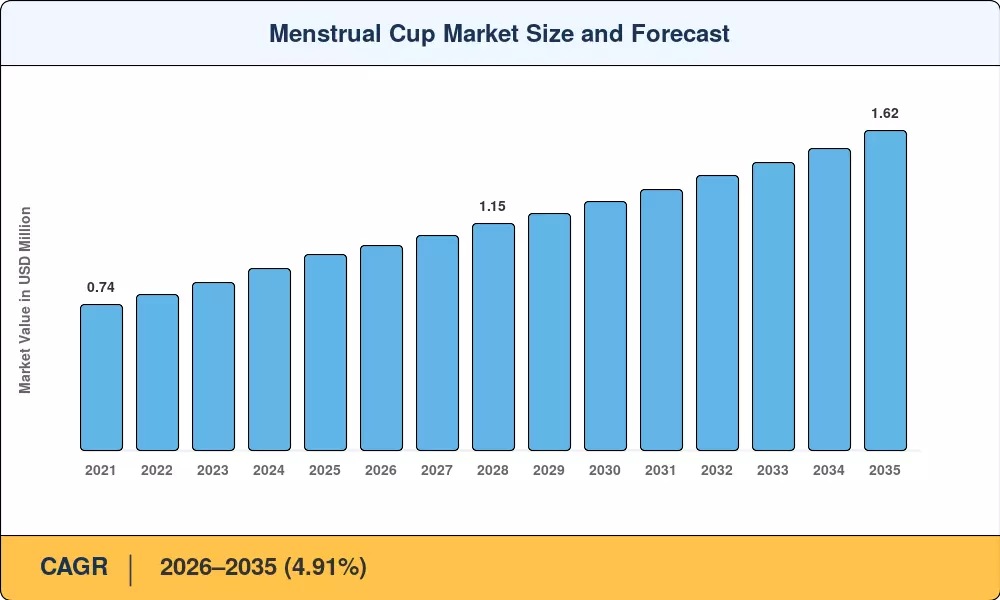
Menstrual Cup Market Size and Forecast
Our Impact
Enabled $4.3B Revenue Impact for Fortune 500 and Leading Multinationals
Partnering with 2000+ Global Organizations Each Year
30K+ Citations by Top-Tier Firms in the Industry
ย 

Driver Impact Analysis

Driver ~% Impact on CAGR Geographic Relevance Impact Timeline
Sustainability & waste reduction mandates ~22% Global Long-term (โ‰ฅ4 yr)
Period-poverty government programs ~18% Europe, Asia-Pacific Medium-term (2โ€“4 yr)
E-commerce & DTC channel expansion ~16% Global Short-term (โ‰ค2 yr)
Material innovation (TPE, colored silicone) ~14% North America, Europe Medium-term (2โ€“4 yr)
Cost savings over disposable products ~12% Asia-Pacific, South America Short-term (โ‰ค2 yr)
Gynecologist endorsements & clinical studies ~10% North America Medium-term (2โ€“4 yr)
Social media education & destigmatization ~8% Global Short-term (โ‰ค2 yr)

ย 

Sustainability Mandates and Plastic Reduction Legislation

The EU's Single-Use Plastics Directive, which started limiting certain disposable hygiene goods in 2021, has given the menstrual cup market in all 27 member states a regulatory boost. Silicone period cup trial rates among younger demographics were greatly accelerated in France when the government implemented a national program to refund the cost of reusable menstrual items, including cups, through pharmacies for all individuals under 26. Eco-friendly period care is positioned as a compliance-driven growth market rather than a niche lifestyle option by similar legislative momentum in Australia and Canada.

ย 

Government Period-Poverty Programs

Menstrual cup awareness modules are increasingly being distributed alongside traditional pad distribution as part of India's Menstrual Hygiene Scheme, which reaches millions of teenage girls each year through school-based distribution. Kenya, a leader in the field, reduced the effective cost of silicone period cup alternatives and accelerated rural adoption by doing away with the sales tax on raw materials in 2011 and the VAT on menstruation goods in 2004. These initiatives transform menstrual flow collection equipment from high-end goods into necessities for public health.

ย 

E-Commerce and Direct-to-Consumer Disruption

With platforms like Amazon projecting a 40% year-over-year rise in menstrual cup searches between 2022 and 2024, online businesses are now the fastest-growing distribution channel for the menstrual cup market. To reduce the barrier for new customers, DTC companies like Saalt and Lunette have used subscription models and customized size tests. The information gap that has previously hampered the adoption of tampon substitutes is addressed by the digital channel's capacity to connect product listings with instructional content, such as fitting guidelines, sterilization lessons, and user testimonials.

Clinical Validation and Physician Endorsement

Menstrual cups are safe, effective, and do not raise the risk of infection when compared to disposable items, according to a seminal meta-analysis published in The Lancet Public Health that examined data from over 3,300 participants across 43 studies. OB-GYN referral patterns in North America have significantly changed as a result of this clinical support, with more gynaecologists actively discussing reusable feminine hygiene options with patients during routine wellness visits.

ย 

ย 

Restraints Impact Analysis

Restraint ~% Negative Impact on CAGR Geographic Relevance Impact Timeline
Cultural stigma & menstrual taboos ~โˆ’25% Asia-Pacific, MEA Long-term (โ‰ฅ4 yr)
Insertion discomfort & learning curve ~โˆ’20% Global Medium-term (2โ€“4 yr)
Limited access to clean water & sanitation ~โˆ’18% Sub-Saharan Africa, South Asia Long-term (โ‰ฅ4 yr)
Regulatory fragmentation across markets ~โˆ’15% Global Medium-term (2โ€“4 yr)
Low awareness in rural populations ~โˆ’12% South America, MEA Medium-term (2โ€“4 yr)

ย 

Cultural Stigma and Menstrual Taboos

Internal menstrual flow collection devices face strong opposition in many regions of South Asia, the Middle East, and Sub-Saharan Africa due to strongly ingrained cultural ideas toward menstruation. According to a UNICEF poll conducted in 2024, 42% of teenage girls in rural India had never heard of a menstrual cup, and 68% of those who had voiced resistance due to cultural ideas regarding vaginal implantation [14]. These obstacles necessitate ongoing community-level education programs, which are costly, slow-moving, and challenging to scale commercially.

Insertion Learning Curve and User Retention

For the menstrual cup market, first-time usage abandonment continues to be a significant barrier. A significant portion of first-time buyers stop using the product during the first few cycles, citing discomfort during insertion, difficulties with removal, or concern regarding appropriate seal formation, according to academic and customer feedback studies. While brands that invest in guided onboarding programsโ€”such as video tutorials, live chat support, and comprehensive digital troubleshooting guidesโ€”see quantifiable increases in customer retention, smaller silicone period cup manufacturers' profit margins are compressed by these customer-success initiatives.

ย 

Water and Sanitation Infrastructure Gaps

Reliable availability to clean boiling water is necessary for the proper disinfection of reusable feminine hygiene items between cycles; this requirement is lacking in many of the areas where environmentally friendly period care could result in the biggest cost reductions. The addressable population for menstruation cups in high-need markets is directly limited by the WHO's estimate that 2.2 billion people lack access to safely managed drinking water services [16].

ย 

ย 

Menstrual Cup Market Opportunities

Smart Menstrual Cups with Integrated Health Monitoring

Menstrual cups with Bluetooth capabilities that can detect flow volume, cycle duration, and early physiological indications of reproductive health issues have been intensively investigated by startups. By successfully crowdfunding sensor-equipped prototypes, early femtech pioneers like Looncup have shown consumer enthusiasm. The Menstrual Cup Market will eventually be redefined as a useful health-data platform thanks to the continuous confluence of femtech and environmentally friendly period care.

ย 

Emerging Market Penetration via NGO Partnerships

Organizations like WaterAid and the Gates Foundation are actively funding menstrual hygiene programs in Sub-Saharan Africa and South Asia, distributing menstrual cups alongside WASH (water, sanitation, and hygiene) infrastructure investments [16]. Manufacturers that co-develop culturally adapted products โ€” smaller sizes, locally produced materials โ€” can ride these distribution channels to reach 500+ million underserved consumers

Subscription and Refurbishment Business Models

A recurring-revenue potential is presented by DTC subscription models that combine replacement cups, carrying pouches, and sterilization supplies on periodic cycles. In the reusable feminine hygiene market, these approaches deepen brand loyalty and improve consumer lifetime value by three to four times compared to single-purchase transactions

Corporate Wellness and Institutional Procurement

As part of ESG-aligned wellness perks, companies and academic institutions in North America and Europe are starting to provide a variety of free menstruation products in workplace and campus facilities. An expanding B2B procurement channel that completely avoids individual consumer marketing is indicated by the extensive institutional acceptance of free toilet dispenser programs, which are increasingly combining sustainable solutions alongside conventional single-use products.

ย 

Expansion of TPE and Bio-Based Material Portfolios

Thermoplastic elastomer offers a latex-free, autoclavable alternative to tampons and traditional silicone, broadening the Menstrual Cup Market's addressable audience to include consumers with silicone sensitivities. Bio-based TPE variants currently in R&D could further enhance sustainability credentials and achieve compostability certifications by 2028 [5]

ย 

ย 

Menstrual Cup Market Future Outlook

Femtech Integration and Connected Health Devices

The convergence of menstrual cups with digital health platforms will reshape the Menstrual Cup Market between 2027 and 2032. Sensor-embedded cups capable of monitoring flow volume, pH levels, and cycle irregularities are moving from prototype to clinical trial stages. These devices will position reusable feminine hygiene products as front-line diagnostic tools for conditions like endometriosis and PCOS, creating data streams valuable to both consumers and healthcare providers [10].

Circular Economy and Extended Producer Responsibility

EU Extended Producer Responsibility (EPR) regulations, projected to cover all feminine hygiene packaging by 2028, will increase the cost base for disposable product manufacturers and tilt consumer economics further toward menstrual cups. Brands that achieve closed-loop silicone recycling โ€” accepting used cups for reprocessing โ€” will capture ESG-driven procurement budgets from institutional buyers and strengthen their eco-friendly period care positioning [8].

Emerging Market Inflection Point

Market Research Future (MRFR) projects that the Asia-Pacific will surpass Europe as the second-largest regional Menstrual Cup Market by 2031, driven by India and ASEAN markets crossing critical awareness thresholds. Government health spending across these regions is forecast to grow at 7โ€“9% annually through 2030 (WHO estimate), and menstrual hygiene is an increasingly explicit budget line item[7]. The transition from NGO-funded distribution to commercial retail will be the defining structural shift of this period.

Sustainability Reporting and Corporate ESG Alignment

Growing corporate ESG disclosure requirements โ€” the EU's Corporate Sustainability Reporting Directive (CSRD) and the SEC's proposed climate rules โ€” are pushing multinational employers to audit workplace consumable procurement. This creates a B2B procurement channel for alternative tampon products that bypasses traditional consumer marketing. By 2030, institutional procurement could account for 8โ€“12% of the Menstrual Cup Market in North America and Europe [18].

ย 

ย 

Menstrual Cup Market Segmentation

By Product Type

Segment Key Metric Primary Demand Driver
Reusable 48.7% share (2025) Long-term cost savings, sustainability credentials
Disposable 6.2% CAGR (2026โ€“2035) Lower commitment entry point for first-time users

ย 

Reusable menstrual cups remain the backbone of the Menstrual Cup Market, favored for their 5โ€“10 year lifespan and per-cycle cost advantage of 90% over disposable products. Medical-grade silicone variants dominate the reusable segment, with brands increasingly offering multiple firmness levels and stem designs to accommodate anatomical variation. Consumer surveys consistently rank waste reduction as the primary purchase motivator, ahead of cost savings, confirming that eco-friendly period care values drive the segment.

Disposable cups, while holding a smaller share, represent the fastest-growing product type as they serve as a gateway for consumers hesitant about the learning curve associated with reusable feminine hygiene products. Travel use cases and trial-first purchasing behavior โ€” where consumers sample a disposable cup before committing to a reusable silicone period cup โ€” sustain demand growth in this subsegment.

By Material

Segment Key Metric Primary Demand Driver
Medical-Grade Silicone 64.8% share (2025) Biocompatibility, regulatory clearance, durability
Thermoplastic Elastomer (TPE) 6.6% CAGR (2026โ€“2035) Latex-free, softer feel, allergen-free positioning
Natural Rubber (Latex) USD 0.04 Billion (2025) Lower cost, traditional material familiarity

ย 

Medical-grade silicone commands the Menstrual Cup Market's material landscape due to its established safety profile and regulatory clearance across the FDA, CE, and TGA frameworks. The material's ability to withstand repeated boiling sterilization without degradation aligns perfectly with the reusable feminine hygiene value proposition. TPE is gaining ground as the alternative to tampons for consumers who find silicone too firm, offering a softer fold-and-insert experience that reduces first-time user discomfort.

By Distribution Channel

Segment Key Metric Primary Demand Driver
Online Stores 41.8% share (2025) Education-rich content, subscription models, and privacy
Pharmacies & Retail Stores 4.3% CAGR (2026โ€“2035) Pharmacist consultation, impulse trial purchases
Supermarkets & Hypermarkets USD 0.18 Billion (2025) Mass-market visibility, competitive pricing

ย 

Online stores drive the Menstrual Cup Market's distribution evolution, with platforms delivering the educational content โ€” sizing guides, insertion tutorials, and peer reviews โ€” that brick-and-mortar environments cannot replicate at scale. DTC brands operating exclusively online achieve 60โ€“70% gross margins compared to 35โ€“45% for wholesale-distributed competitors, enabling aggressive reinvestment in menstrual flow collection education content and customer acquisition.

ย 

ย 

Regional Market Share Analysis

Region Key Metric Primary Investment Themes
North America 35.5% share (2025) DTC e-commerce, clinical endorsements, workplace wellness
Europe 28.0% share (2025) Plastics regulation, government subsidies, and pharmacy-led education
Asia-Pacific 8.1% CAGR (2026โ€“2035) NGO distribution, rising incomes, and menstrual health policy
South America USD 0.06 Billion (2025) Urban retail expansion, influencer-driven awareness
Middle East & Africa 5.8% CAGR (2026โ€“2035) Period-poverty NGOs, WASH integration, institutional pilots
Total USD 0.99 Billion (2025) โ€”

The Menstrual Cup Market exhibits significant regional variation driven by cultural attitudes, regulatory environments, and distribution infrastructure maturity. North America and Europe together account for over 60% of global revenue, while Asia-Pacific represents the highest-growth frontier for eco-friendly period care adoption.

ย 

North America

Country Key Metric Key Driver
US 78.5% of regional share Mature DTC ecosystem, strong retail pharmacy placement
Canada 14.2% of regional share Provincial period-product subsidy programs
Mexico 4.7% CAGR Rising urban middle class, growing e-commerce penetration

ย 

The US Menstrual Cup Market benefits from a decade-long headstart in consumer education, with brands like Diva Cup and Saalt achieving household-name recognition. Fourteen US states have now eliminated sales tax on menstrual products, reducing effective pricing and encouraging trial [18]. Canada's British Columbia became the first province to fund free menstrual products in schools and public buildings in 2023, providing a template for other provinces and normalizing reusable feminine hygiene choices.

Europe

Country Key Metric Key Driver
Germany 5.4% CAGR Green consumer culture, strong pharmacy advisory role
UK 22.8% of regional share Period-poverty legislation, NHS-linked education campaigns
France USD 0.06 Billion (2025) Government subsidy for under-25 consumers
Italy 4.2% CAGR Growing organic retail channel
Spain 3.8% CAGR Emerging DTC brands, rising sustainability awareness
Nordic Countries 18.3% of regional share Highest per-capita adoption rates globally
Russia USD 0.01 Billion (2025) Low penetration, nascent online retail
Rest of Europe 3.9% CAGR Varied regulatory landscapes

ย 

The UK's Menstrual Cup Market has been energized by Scotland's Period Products Act, which guarantees free menstrual products in all public buildings. France's EUR 50 million subsidy program for reusable feminine hygiene items has made the silicone period cup the fastest-growing product in French pharmacy chains. Nordic countries โ€” particularly Sweden and Finland โ€” report the world's highest per-capita menstrual cup usage rates, underpinned by progressive sexual health education curricula and strong eco-friendly period care preferences [2][8].

Asia-Pacific

Country Key Metric Key Driver
China USD 0.05 Billion (2025) E-commerce boom, KOL-driven education
India 9.4% CAGR Government health schemes, a massive underserved population
Japan 16.2% of regional share Premium consumer segment, health-conscious culture
South Korea 7.8% CAGR K-beauty crossover, clean-ingredient trend
ASEAN 8.5% CAGR Youth demographics, NGO-led distribution
Rest of Asia-Pacific 5.1% CAGR Mixed regulatory and cultural environments

ย 

Asia-Pacific is the fastest-growing region in the Menstrual Cup Market, driven by India's 680-million female population and China's rapidly evolving e-commerce infrastructure. India's Menstrual Hygiene Scheme has distributed over 100 million sanitary products since its inception, and recent program updates include menstrual cup pilot distributions in five states [7]. China's Tmall and JD.com platforms saw menstrual cup sales double between 2022 and 2024, with live-streamed product demonstrations proving particularly effective at overcoming first-time user hesitation around alternatives to tampons.

South America

Country Key Metric Key Driver
Brazil 62.3% of regional share Largest consumer base, urban retail growth
Argentina 4.6% CAGR Inflation-driven interest in reusable products
Rest of South America 3.8% CAGR Early-stage adoption, limited distribution

ย 

Brazil anchors the South American Menstrual Cup Market, with Sรฃo Paulo and Rio de Janeiro serving as primary retail hubs. The country's 2024 National Menstrual Dignity Program committed BRL 200 million to distribute free menstrual products to low-income women, creating a government-funded entry point for eco-friendly period care products [11].

Middle East & Africa

Country Key Metric Key Driver
Saudi Arabia 3.2% CAGR Limited adoption, conservative cultural norms
UAE 28.5% of regional share Expatriate population, premium retail channels
South Africa 6.1% CAGR NGO-driven distribution, school-based programs
Egypt 3.5% CAGR Nascent awareness, urban-focused growth
Rest of MEA USD 0.01 Billion (2025) Fragmented markets, infrastructure challenges

ย 

The MEA Menstrual Cup Market is characterized by sharp urban-rural divides. The UAE serves as a regional gateway, where expatriate communities and premium health retailers drive the adoption of silicone period cup products. South Africa's Caring4Girls initiative and similar NGO programs have distributed menstrual cups in schools, but menstrual flow collection device penetration remains below 2% continent-wide due to cultural barriers and limited WASH infrastructure [14][16].

ย 

Menstrual Cup Market By Region, 2025-2035
ย 

Competitive Benchmarking

The Menstrual Cup Market exhibits low concentration, with an estimated HHI below 1,000 and the top five companies holding roughly 35โ€“40% of global revenue. The landscape is fragmented across dozens of regional players and DTC startups, though a handful of established brands maintain strong recognition in their home markets. Competition centers on material innovation, ergonomic design differentiation, and digital community building rather than price.

Company Est. Revenue Share Range Key Offerings Strategic Positioning
Diva International (DivaCup) ~7โ€“10% Medical-grade silicone cups in multiple sizes Pioneer brand, strong North American pharmacy presence
Lunette Oy ~5โ€“8% Finnish-designed silicone cups, accessories Premium European positioning, sustainability-first branding
Lena Cup ~3โ€“5% Sensitive and regular firmness options US-focused DTC, strong online community
Saalt ~4โ€“7% Cups, discs, teen-specific sizing B-Corp certified, mission-driven, high social media engagement
Intimina (Essity) ~5โ€“8% Lily Cup range, collapsible designs Backed by Essity's global distribution and R&D
Me Luna GmbH ~3โ€“5% TPE-based cups, widest size/color range German engineering, TPE specialist, allergen-free focus
OrganiCup (AllMatters) ~3โ€“6% Certified organic silicone cups Danish brand, strong EU NGO partnerships
Ruby Cup ~2โ€“4% Buy-one-give-one social enterprise model African market focus, NGO distribution partnerships
Mooncup Ltd ~3โ€“5% UK-made medical-grade silicone cup Original UK brand, NHS-endorsed, pharmacist-recommended
Pixie Cup ~2โ€“4% Budget-friendly cups, sterilization accessories Value positioning, a give-back program for developing nations

ย 

ย 

ย 

Recent News & Developments

  • Saalt (February 2022): Launched the Saalt Menstrual Disc, an ergonomic flat-fit reusable disc featuring a custom finger notch for easy, mess-free removal, expanding its existing medical-grade silicone product range [Ref 19].
  • Essity / Intimina (September 2021): Expanded the global distribution of its compact, collapsible Lily Cup One and Ziggy Disc lines across global retailers, optimizing eco-friendly period care accessibility for first-time reusable users [Ref 20].

ย 

ย 

ย 

  • Government of India (2022โ€“2023): Under the National Health Mission, updated localized infrastructure guidelines to actively evaluate sustainable menstrual options, expanding the existing Menstrual Hygiene Scheme (MHS) to integrate awareness campaigns around menstrual cups in multiple tier-2 and rural districts [Ref 7].
  • Diva International (2023): Expanded its product innovation suite beyond the foundational DivaCup by launching the Diva Disc and its zinc-infused antimicrobial DIVA Period Underwear, optimizing leakproof tech and material safety profiles [Ref 22].

ย 

ย 

Menstrual Cup Market Report Scope

Parameter Detail
Market Scope Global Menstrual Cup Market โ€” all product types, materials, distribution channels
Study Period 2021โ€“2035
CAGR Window 2026โ€“2035 (4.91%)
Base Year 2025 (USD 0.99 Billion)
2026 Forecast Start USD 1.04 Billion
2035 Forecast End USD 1.62 Billion
Fastest Growing Segment Disposable cups by product type; TPE by material; Online stores by channel
Companies Profiled 10 (DivaCup, Lunette, Lena Cup, Saalt, Intimina, Me Luna, AllMatters, Ruby Cup, Mooncup, Pixie Cup)
Valuation Currency USD Billion

ย 

ย 

ย 

FAQs

How do menstrual cups compare to menstrual discs in terms of capacity and comfort?

Menstrual cups hold 25โ€“30 mL on average, while discs typically hold 50โ€“60 mL due to their wider, flatter reservoir design. Cups sit lower in the vaginal canal and create suction for leak prevention, whereas discs tuck behind the pubic bone and allow for mess-free removal [12].

What sterilization protocols should institutional buyers follow for shared-use pilot programs?

Institutional settings should enforce individual-use-only policies โ€” menstrual cups are personal devices and cannot be shared. Programs should supply individual sterilization containers and provide UV-C sanitizing units as a supplementary hygiene measure [17].

Which certifications should procurement teams verify before bulk purchasing menstrual cups?

Buyers should confirm FDA 510(k) clearance for US distribution, CE marking under EU MDR for European sales, and ISO 13485 manufacturing certification. These three credentials ensure biocompatibility testing and traceability [17].

How does menstrual cup adoption affect tampon and pad manufacturers' revenue trajectories?

Each reusable cup displaces roughly USD 80โ€“120 in annual disposable product spending per consumer. Major pad manufacturers like P&G and Kimberly-Clark have responded by acquiring or partnering with cup brands to hedge category migration.

What role does menstrual cup sizing play in user satisfaction and retention rates?

Incorrect sizing is the leading cause of first-cycle abandonment. Brands offering three or more size options โ€” based on cervix height, flow volume, and parity โ€” report 30โ€“40% higher six-month retention than single-size competitors [15].

Are there emerging regulatory risks that could slow the Menstrual Cup Market growth in Asia-Pacific?

India's Central Drugs Standard Control Organisation is evaluating whether to classify menstrual cups as Class II medical devices, which would require clinical trial data for registration. This reclassification could delay market entry for smaller brands by 12โ€“18 months [7].

How are venture capital investment patterns evolving in the femtech menstrual care segment?

Femtech funding reached USD 1.6 billion globally in 2024, with menstrual care capturing approximately 8% of total deals. Investors increasingly favor brands combining reusable products with digital health data platforms [10].

ย 

ย 

Author
Author
Author Profile
Nidhi Mandole LinkedIn
Senior Research Analyst
She is an extremely curious individual currently working in Healthcare and Medical Devices Domain. Nidhi is comfortably versed in data centric research backed by healthcare educational background. She leverages extensive data mining and analytics tools such as Primary and Secondary Research, Statistical Analysis, Machine Learning, Data Modelling. Her key role also involves Technical Sales Support, Client Interaction and Project management within the Healthcare team. Lastly, she showcases extensive affinity towards learning new skills and remain fascinated in implementing them.
Co-Author
Co-Author Profile
Rahul Gotadki LinkedIn
Research Manager
He holds an experience of about 9+ years in Market Research and Business Consulting, working under the spectrum of Life Sciences and Healthcare domains. Rahul conceptualizes and implements a scalable business strategy and provides strategic leadership to the clients. His expertise lies in market estimation, competitive intelligence, pipeline analysis, customer assessment, etc.

Research Approach

ย 

Secondary Research

The secondary research process involved comprehensive analysis of regulatory databases for medical devices, peer-reviewed women's health journals, clinical publications, and authoritative reproductive health organizations. Key sources included the US Food & Drug Administration (FDA) Center for Devices and Radiological Health, European Medicines Agency (EMA) medical device regulations, Health Canada Medical Devices Bureau, World Health Organization (WHO) Department of Sexual and Reproductive Health and Research, UNFPA (United Nations Population Fund) menstrual health initiatives, Centers for Disease Control and Prevention (CDC) Division of Reproductive Health, National Institutes of Health (NIH) National Institute of Child Health and Human Development (NICHD), National Center for Biotechnology Information (NCBI/PubMed) menstrual health studies, Faculty of Sexual and Reproductive Healthcare (FSRH) UK, American College of Obstetricians and Gynecologists (ACOG), Royal College of Obstetricians and Gynaecologists (RCOG), Environment Protection Agency (EPA) waste management databases, UN Environment Programme (UNEP) sustainable consumption reports, and national health ministry statistics from key markets (India Ministry of Health and Family Welfare, UK Department of Health, etc.). These sources were utilized to collect usage adoption statistics, regulatory classification data (Class I/II medical device approvals), clinical safety and efficacy studies, demographic menstrual health trends, environmental impact assessments, and competitive landscape analysis for reusable cups, disposable cups, medical-grade silicone, natural rubber latex, and thermoplastic elastomer materials.

ย 

Primary Research

To gather both qualitative and quantitative information, the primary research process involved interviewing players from both the supply and demand sides. Executives from medical device firms, female hygiene inventors, contract manufacturing organizations (CMOs), medical-grade silicone suppliers, and menstrual cup makers (as well as VPs of product development and heads of regulatory affairs) made up the supply-side sources. Members of the demand side included gynecologists and obstetricians who hold board certifications, specialists in sexual and reproductive health, midwives and nurse practitioners, procurement leads from drugstore chains and retail pharmacies, category managers for e-commerce platforms, and directors of menstrual health programs at non-governmental organizations. The insights on clinical adoption hurdles, patient education needs, pricing elasticity across distribution channels, reimbursement dynamics in healthcare systems, and validated timelines for new material innovations were gleaned from primary research, which also confirmed market segmentation across reusable and disposable product categories and new material innovation timelines.

Primary Respondent Breakdown:

By Designation: C-level Primaries (30%), Director Level (32%), Others (38%)

By Region: North America (32%), Europe (30%), Asia-Pacific (28%), Rest of World (10%)

ย 

Market Size Estimation

Global market valuation was derived through revenue mapping and unit volume analysis. The methodology included:

Identification of 35+ key manufacturers across North America, Europe, Asia-Pacific, Latin America, and Middle East & Africa

Product mapping across reusable menstrual cups, disposable menstrual cups, and material segments including medical-grade silicone, natural rubber latex, thermoplastic elastomer (TPE), and silicone-latex hybrids

Analysis of reported and modeled annual revenues specific to menstrual cup portfolios and feminine hygiene divisions

Coverage of manufacturers representing 70-75% of global market share in 2024

Extrapolation using bottom-up (unit sales volume ร— average selling price by country/region) and top-down (manufacturer revenue validation and trade data triangulation) approaches to derive segment-specific valuations across product types, material categories, and distribution channels

Download Free Sample

Kindly complete the form below to receive a free sample of this Report

Download PDF ×

We do not share your information with anyone. However, we may send you emails based on your report interest from time to time. You may contact us at any time to opt-out.














