Request Free Sample ×

Kindly complete the form below to receive a free sample of this Report

* Please use a valid business email

Leading companies partner with us for data-driven Insights

clients tt-cursor
Hero Background
English
Chinese
French
Japanese
Korean
German
Spanish

Tissue Transglutaminase Test Market Size

ID: MRFR/LS/0328-HCR
81 Pages
Nidhi Mandole
March 2026

Tissue Transglutaminase Test Market: By Type (Serological, Biopsy, and others), and By End Users (Hospitals & Clinics, Homecare, Research Organisations, others) - Forecast Till 2035

Share:
Download PDF ×

We do not share your information with anyone. However, we may send you emails based on your report interest from time to time. You may contact us at any time to opt-out.

Tissue Transglutaminase Test Market Infographic
Purchase Options

Tissue Transglutaminase Test Size

Tissue Transglutaminase Test Market Growth Projections and Opportunities

The Tissue Transglutaminase (TTG) Test Market is significantly driven by the prevalence of celiac disease, an autoimmune disorder triggered by gluten consumption. As the awareness and diagnosis of celiac disease increase globally, the demand for TTG tests, particularly the serological TTG-IgA test, rises for accurate and timely detection of this condition. Celiac disease testing is associated with symptomatic significance in tissue transglutaminase. TTG is an antigen which attacked by the immune system in celiac disease. The test assists in the verification of a diagnosis; it also provides information on severity, and can be used to assess efficacy of gluten-free diet which makes this testing commercially popular. Technological advancements in serologic evaluation technologies determine the tissue transglutaminase test market. Advancements in assay sensitivity and specificity such as the point-of -care tests optimize TTG testing accuracy to meet healthcare providers’ dynamic needs. Increased sensitivity is indicative of increased awareness to celiac disease and gluten-related disorders which also act as a stimulus for the growth of the TTG Test Market. Public health campaigns, education initiatives and the general knowledge have led to their consequential need for TTG testing as early diagnosis of celiac disease eventually leads into its management. The TTG Test Market coincides with the global movement to gluten-free diets, from both a medical point of view and lifestyle. If the patient is opting for gluten-free lifestyles, being either celiac disease or nonceliac gluten sensitivity and requires subsequent confirmation testing of TTG; this test may be performed on serum samples to corroborate a prior diagnosis. The recommendations of clinicians, the compliance with diagnostic guidelines have an impact on TTG Test Market. The physician awareness of the celiac disease guidelines and their incorporation into routine clinical practice, thus promoting TTG testing for accurate diagnosis and sound patient management determines. The genetic predisposition toward celiac disease, mainly linked to HLA-DQ2 and the HLA DQ8 genes leads individuals with a family history into TTG testing. Genetic screening, coupled with serological testing helps identify individuals who may be at risk therefore boosting the market. All the above factors i.e., increasing healthcare awareness, improving diagnostic infrastructure and a growing number of reported celiac disease cases make the TTG testing in emerging markets to meet its demand rise gradually due to poor facilities for clinical analysis additionally lacking money sources. These areas are the markets that increase TTG Test Market Growth in general. The non-invasive nature of serological TTG testing appeals to patients and healthcare providers alike. As patients often prefer less invasive diagnostic methods, the blood-based TTG test offers a convenient and widely accepted approach for celiac disease diagnosis and monitoring. The ongoing impact of the COVID-19 pandemic has led to disruptions in healthcare services, affecting diagnostic testing patterns. However, the awareness of celiac disease and the need for TTG testing persist, and the market is expected to rebound as healthcare services normalize.

Tissue Transglutaminase Test Market Size Graph
Author
Author Profile
Nidhi Mandole
Senior Research Analyst

She is an extremely curious individual currently working in Healthcare and Medical Devices Domain. Nidhi is comfortably versed in data centric research backed by healthcare educational background. She leverages extensive data mining and analytics tools such as Primary and Secondary Research, Statistical Analysis, Machine Learning, Data Modelling. Her key role also involves Technical Sales Support, Client Interaction and Project management within the Healthcare team. Lastly, she showcases extensive affinity towards learning new skills and remain fascinated in implementing them.

Leave a Comment

FAQs

What is the projected market valuation for the Tissue Transglutaminase Test Market by 2035?

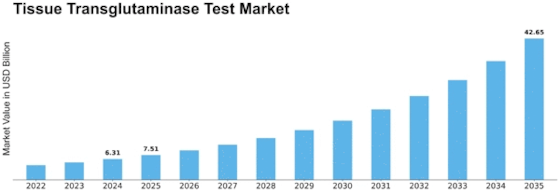
<p>The projected market valuation for the Tissue Transglutaminase Test Market is expected to reach 42.65 USD Billion by 2035.</p>

What was the market valuation for the Tissue Transglutaminase Test Market in 2024?

<p>The market valuation for the Tissue Transglutaminase Test Market was 6.306 USD Billion in 2024.</p>

What is the expected CAGR for the Tissue Transglutaminase Test Market during the forecast period 2025 - 2035?

<p>The expected CAGR for the Tissue Transglutaminase Test Market during the forecast period 2025 - 2035 is 18.98%.</p>

Which companies are considered key players in the Tissue Transglutaminase Test Market?

<p>Key players in the Tissue Transglutaminase Test Market include Thermo Fisher Scientific, Abbott Laboratories, Roche Diagnostics, and Siemens Healthineers.</p>

What are the main segments of the Tissue Transglutaminase Test Market?

<p>The main segments of the Tissue Transglutaminase Test Market include Serological Testing, Biopsy, and Others.</p>

How did the Serological Testing segment perform in 2024?

In 2024, the Serological Testing segment was valued at 2.5 USD Billion.

What is the projected value of the Home Care segment by 2035?

The Home Care segment is projected to reach a value of 8.5 USD Billion by 2035.

What was the valuation of the Biopsy segment in 2024?

The Biopsy segment was valued at 2.0 USD Billion in 2024.

How does the market for Clinics and Hospitals compare to other end users?

The market for Clinics and Hospitals was valued at 2.52 USD Billion in 2024, indicating a strong position compared to other end users.

What is the expected growth trend for the Tissue Transglutaminase Test Market?

The Tissue Transglutaminase Test Market is expected to experience robust growth, driven by an anticipated CAGR of 18.98% from 2025 to 2035.

Market Summary

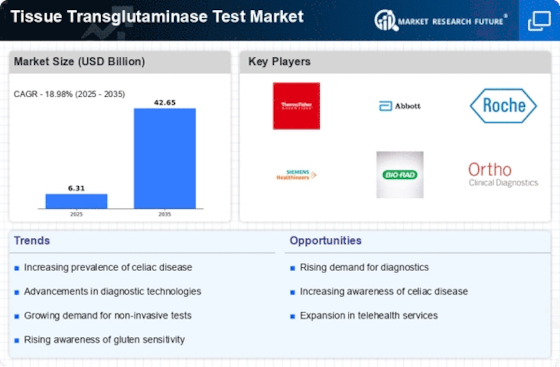
As per Market Research Future analysis, the Tissue Transglutaminase Test Market Size was estimated at 6.306 USD Billion in 2024. The Tissue Transglutaminase Test industry is projected to grow from 7.503 USD Billion in 2025 to 42.65 USD Billion by 2035, exhibiting a compound annual growth rate (CAGR) of 18.98% during the forecast period 2025 - 2035

Key Market Trends & Highlights

The Tissue Transglutaminase Test Market is experiencing robust growth driven by technological advancements and increased awareness of celiac disease.

  • North America remains the largest market for tissue transglutaminase tests, reflecting a strong healthcare infrastructure. The Asia-Pacific region is emerging as the fastest-growing market, driven by rising healthcare investments and awareness. Serological testing continues to dominate the market, while the biopsy segment is witnessing rapid growth due to its diagnostic accuracy. Key market drivers include technological advancements in testing methods and the rising incidence of autoimmune disorders.

Market Size & Forecast

2024 Market Size 6.306 (USD Billion)
2035 Market Size 42.65 (USD Billion)
CAGR (2025 - 2035) 18.98%
Largest Regional Market Share in 2024 Americas

Major Players

Thermo Fisher Scientific (US), Abbott Laboratories (US), Roche Diagnostics (CH), Siemens Healthineers (DE), Bio-Rad Laboratories (US), Ortho Clinical Diagnostics (US), QuidelOrtho Corporation (US), Hoffmann-La Roche (CH), Genova Diagnostics (US)

Market Trends

The Tissue Transglutaminase Test Market is currently experiencing a notable evolution, driven by increasing awareness regarding celiac disease and gluten sensitivity. This heightened awareness is prompting healthcare professionals to seek more accurate diagnostic tools, thereby enhancing the demand for tissue transglutaminase tests. Furthermore, advancements in technology are facilitating the development of more efficient testing methods, which could potentially improve patient outcomes. As a result, laboratories and healthcare facilities are increasingly adopting these tests to provide timely and precise diagnoses, reflecting a shift towards more personalized medicine. In addition, the Tissue Transglutaminase Test Market appears to be influenced by the growing trend of preventive healthcare. Patients are becoming more proactive about their health, leading to a rise in routine screenings for various conditions, including celiac disease. This trend may encourage manufacturers to innovate and expand their product offerings, ensuring that they meet the evolving needs of healthcare providers and patients alike. Overall, the market seems poised for growth, with a focus on enhancing diagnostic accuracy and accessibility for a broader patient population.

Technological Advancements

Recent innovations in testing methodologies are enhancing the accuracy and efficiency of tissue transglutaminase tests. These advancements may lead to quicker results and improved patient experiences, thereby driving market growth.

Increased Awareness of Celiac Disease

The rising awareness surrounding celiac disease and gluten-related disorders is prompting more individuals to seek testing. This trend suggests a growing demand for reliable diagnostic tools within the Tissue Transglutaminase Test Market.

Shift Towards Preventive Healthcare

A notable shift towards preventive healthcare is influencing the Tissue Transglutaminase Test Market. Patients are increasingly opting for routine screenings, which may drive the demand for these tests as part of comprehensive health assessments.

Tissue Transglutaminase Test Market Market Drivers

Regulatory Support and Guidelines

Regulatory support and the establishment of guidelines for the diagnosis of celiac disease are crucial factors driving the Tissue Transglutaminase Test Market. Health authorities are increasingly recognizing the importance of standardized testing protocols, which enhances the credibility and acceptance of tissue transglutaminase tests. These guidelines not only facilitate accurate diagnosis but also promote the integration of these tests into clinical practice. As regulatory bodies continue to endorse the use of tissue transglutaminase tests, healthcare providers are more likely to adopt them, leading to a projected increase in market growth. The Tissue Transglutaminase Test Market is anticipated to expand as a result of these supportive measures.

Shift Towards Preventive Healthcare

The ongoing shift towards preventive healthcare is influencing the Tissue Transglutaminase Test Market in notable ways. As healthcare systems worldwide emphasize early detection and prevention of diseases, the demand for diagnostic tests, including tissue transglutaminase tests, is on the rise. This trend is supported by a growing body of evidence linking early diagnosis of celiac disease to improved patient outcomes. Consequently, healthcare providers are increasingly recommending these tests as part of routine screenings, particularly for individuals with risk factors. The Tissue Transglutaminase Test Market is projected to benefit from this preventive approach, with an expected increase in test utilization by approximately 15% over the next few years.

Increased Awareness of Celiac Disease

The rising awareness of celiac disease among the general population is a pivotal driver for the Tissue Transglutaminase Test Market. Educational campaigns and advocacy from health organizations have significantly contributed to the understanding of this autoimmune disorder. As more individuals recognize the symptoms and seek diagnosis, the demand for tissue transglutaminase tests is likely to increase. Recent surveys indicate that nearly 1 in 100 individuals are affected by celiac disease, yet many remain undiagnosed. This gap presents a substantial opportunity for growth within the Tissue Transglutaminase Test Market, as healthcare providers strive to meet the needs of an informed patient population.

Rising Incidence of Autoimmune Disorders

The increasing incidence of autoimmune disorders, including celiac disease, is a significant driver for the Tissue Transglutaminase Test Market. Research indicates that autoimmune diseases are on the rise, with celiac disease being one of the most prevalent. This trend is likely attributed to various factors, including environmental influences and genetic predispositions. As more individuals are diagnosed with autoimmune conditions, the demand for specific diagnostic tests, such as tissue transglutaminase tests, is expected to grow. The Tissue Transglutaminase Test Market may see a compound annual growth rate of around 7% as healthcare systems adapt to the rising need for accurate and timely diagnostics.

Technological Advancements in Testing Methods

The Tissue Transglutaminase Test Market is experiencing a surge in technological advancements that enhance the accuracy and efficiency of testing methods. Innovations such as automated testing systems and high-throughput screening techniques are streamlining the diagnostic process. These advancements not only reduce the time required for test results but also improve the reliability of the tests. As a result, healthcare providers are increasingly adopting these modern technologies, leading to a projected growth rate of approximately 8% in the Tissue Transglutaminase Test Market over the next five years. Furthermore, the integration of artificial intelligence in data analysis is expected to refine diagnostic capabilities, making it easier for clinicians to identify celiac disease and related disorders.

Market Segment Insights

By Type: Serological Testing (Largest) vs. Biopsy (Fastest-Growing)

The Tissue Transglutaminase Test Market is primarily segmented into three types: Serological Testing, Biopsy, and Others. Among these, Serological Testing holds the largest share, attributed to its widespread adoption due to ease of use and accuracy in diagnosing <a href="https://www.marketresearchfuture.com/reports/celiac-disease-treatment-market-8474">celiac disease</a> and gluten sensitivity. Biopsy, although smaller in market share, is rapidly gaining traction as it provides definitive diagnosis, showing significant growth in its implementation across various healthcare settings. The 'Others' category encompasses alternative testing methods that remain niche but are witnessing a gradual increase in popularity based on innovative methodologies.

Serological Testing (Dominant) vs. Biopsy (Emerging)

Serological Testing is regarded as the dominant modality in the Tissue Transglutaminase Test Market due to its non-invasive nature and high sensitivity for detecting tissue transglutaminase antibodies, making it a preferred choice among clinicians. In contrast, the Biopsy segment is emerging as a critical diagnostic tool, particularly in complex cases where serology results might be inconclusive. Biopsy provides histological evidence, reinforcing its necessity in precise diagnoses. Both segments are essential, but while Serological Testing is driving volume and convenience, Biopsy’s growth highlights a shift towards comprehensive diagnostic approaches in the field of autoimmune disorders.

By End User: Clinics and Hospitals (Largest) vs. Home Care (Fastest-Growing)

The Tissue Transglutaminase Test Market demonstrates a significant distribution across various end-user segments, with Clinics and Hospitals leading the way. This segment captures a substantial portion of the market share due to the high number of diagnostic procedures performed in these settings. On the other hand, the Home Care segment is gaining momentum, driven by the growing preference for at-home diagnostic solutions that enhance patient convenience and comfort. Research Organizations and Others also contribute to the market but at a relatively smaller scale.

End User: Clinics and Hospitals (Dominant) vs. Home Care (Emerging)

Clinics and Hospitals play a dominant role in the Tissue Transglutaminase Test Market, providing essential diagnostic services and facilitating timely patient care for gluten-related disorders. Their established infrastructure and accessibility ensure a steady demand for these tests. Meanwhile, the Home Care segment emerges as a significant player, catering to the increasing inclination of patients to manage their health conditions from the comfort of their homes. This trend is bolstered by advancements in home-testing kits that deliver reliable results, fostering greater autonomy for patients and reducing the burden on healthcare facilities. The balance between these segments reflects evolving patient preferences and the broader shifts in healthcare delivery.

Get more detailed insights about Tissue Transglutaminase Test Market Research Report- Forecast till 2035

Regional Insights

North America : Leading Market for Diagnostics

North America is the largest market for Tissue Transglutaminase tests, accounting for approximately 45% of the global market share. The region's growth is driven by increasing prevalence of celiac disease, advancements in diagnostic technologies, and supportive healthcare policies. Regulatory bodies like the FDA have streamlined approval processes for diagnostic tests, further boosting market demand. The United States is the primary contributor, with significant investments in healthcare infrastructure and research. Key players such as Thermo Fisher Scientific and Abbott Laboratories are leading the market, focusing on innovative solutions and expanding their product portfolios. The competitive landscape is characterized by collaborations and partnerships aimed at enhancing diagnostic accuracy and accessibility.

Europe : Emerging Market with Growth Potential

Europe is the second-largest market for Tissue Transglutaminase tests, holding around 30% of the global market share. The region's growth is fueled by rising awareness of autoimmune diseases, increasing healthcare expenditure, and favorable regulatory frameworks. The European Medicines Agency (EMA) has been proactive in promoting innovative diagnostic solutions, which is expected to enhance market growth. Leading countries include Germany, France, and the UK, where healthcare systems are increasingly adopting advanced diagnostic technologies. Major players like Roche Diagnostics and Siemens Healthineers are investing in research and development to meet the growing demand. The competitive landscape is marked by a focus on quality and regulatory compliance, ensuring that products meet stringent European standards.

Asia-Pacific : Rapidly Growing Healthcare Sector

Asia-Pacific is witnessing rapid growth in the Tissue Transglutaminase test market, contributing approximately 20% to the global market share. The region's expansion is driven by increasing healthcare investments, a growing population, and rising incidences of celiac disease. Governments are implementing policies to improve healthcare access, which is further propelling market growth. Countries like China, India, and Japan are leading the market, with significant investments in healthcare infrastructure and technology. The competitive landscape features both local and international players, including Bio-Rad Laboratories and Ortho Clinical Diagnostics, who are focusing on expanding their market presence through strategic partnerships and product innovations. The region is becoming a hub for diagnostic advancements, catering to the increasing demand for accurate testing solutions.

Middle East and Africa : Emerging Market with Challenges

The Middle East and Africa region is gradually emerging in the Tissue Transglutaminase test market, holding about 5% of the global market share. Growth is driven by increasing awareness of celiac disease and improvements in healthcare infrastructure. However, challenges such as limited access to advanced diagnostic technologies and varying regulatory environments hinder faster growth. Governments are working to enhance healthcare systems, which is expected to positively impact market dynamics. Leading countries include South Africa and the UAE, where there is a growing focus on improving healthcare services. The competitive landscape is characterized by a mix of local and international players, with companies like QuidelOrtho Corporation making strides in expanding their reach. The market is poised for growth as investments in healthcare continue to rise, addressing the needs of the population.

Key Players and Competitive Insights

The Tissue Transglutaminase Test Market is currently characterized by a dynamic competitive landscape, driven by increasing awareness of celiac disease and the growing demand for accurate diagnostic tools. Major players such as Thermo Fisher Scientific (US), Abbott Laboratories (US), and Roche Diagnostics (CH) are strategically positioned to leverage their extensive research capabilities and innovative product offerings. These companies are focusing on enhancing their diagnostic accuracy and expanding their market reach through strategic partnerships and technological advancements. The collective efforts of these key players are shaping a competitive environment that emphasizes innovation and responsiveness to market needs.

In terms of business tactics, companies are increasingly localizing manufacturing to reduce costs and improve supply chain efficiency. The market appears moderately fragmented, with several players vying for market share. However, the influence of major companies is significant, as they set industry standards and drive technological advancements. This competitive structure suggests that while there is room for smaller players, the dominance of established firms is likely to continue shaping market dynamics.

In August 2025, Abbott Laboratories (US) announced the launch of a new, highly sensitive tissue transglutaminase test that significantly reduces the time required for diagnosis. This innovation is expected to enhance patient outcomes by facilitating earlier detection of celiac disease. The strategic importance of this launch lies in Abbott's commitment to maintaining its leadership position in the diagnostics market, particularly in the realm of autoimmune diseases, where timely intervention is crucial.

In September 2025, Roche Diagnostics (CH) expanded its product portfolio by acquiring a small biotech firm specializing in advanced diagnostic technologies. This acquisition is likely to bolster Roche's capabilities in the tissue transglutaminase testing space, allowing for the integration of cutting-edge technologies into their existing offerings. Such strategic moves indicate Roche's focus on innovation and its intent to remain competitive in a rapidly evolving market.

In July 2025, Thermo Fisher Scientific (US) entered into a strategic partnership with a leading healthcare provider to enhance the accessibility of its tissue transglutaminase tests in underserved regions. This collaboration aims to improve diagnostic services and expand market penetration, particularly in areas with limited access to advanced healthcare solutions. The partnership underscores Thermo Fisher's commitment to addressing healthcare disparities while simultaneously driving growth in its diagnostic segment.

As of October 2025, current competitive trends in the Tissue Transglutaminase Test Market are increasingly influenced by digitalization, sustainability, and the integration of artificial intelligence in diagnostic processes. Strategic alliances among key players are shaping the landscape, fostering innovation and enhancing product offerings. Looking ahead, competitive differentiation is likely to evolve from traditional price-based competition to a focus on technological innovation, supply chain reliability, and the ability to deliver rapid, accurate diagnostic solutions.

Key Companies in the Tissue Transglutaminase Test Market include

Industry Developments

    • In June 2021, Germany-based NanoRepro AG reported the development of its pilot task toward the Western Cape, South Africa, for assembling and dispersion of quick clinical trials for home and clinical use.

    • In June 2021, myLAB Box, a main at-home testing specialist co-op, reported the dispatch of its new Food Sensitivity Test unit. The test offers important experiences into how the client's body will respond to 96 sorts of normal food varieties. 

Report

To gain a deeper insight into the market, and industry performance, Market Research Future's report on Tissue Transglutaminase Test Market provides extensive primary research along with a detailed analysis of both the qualitative and quantitative aspects by various industry experts. An in-depth analysis of the market is provided in this report which covers historical and projected Tissue transglutaminase test market sizes in terms of volume and value, technological advancements, macroeconomics, and governing factors. In the report, the top key players in the industry are detailed and their strategies are outlined. 

There is also a comprehensive analysis of market segments and regions included in the report. It also gives a detailed analysis for investors to make informed decisions and also analyzes which part of the market will be the most fruitful for an investment decision to be made. The report also skims down the growth and restraints that let us the information on the Tissue transglutaminase Test Market growth.

This report is a great opportunity for the Tissue transglutaminase (TTG) Test Market key trends and also a global analysis for Tissue transglutaminase Test Market Value to understand the nitty-gritty of the market.

Future Outlook

Tissue Transglutaminase Test Market Future Outlook

The Tissue Transglutaminase Test Market is projected to grow at an 18.98% CAGR from 2025 to 2035, driven by increasing celiac disease diagnoses and advancements in diagnostic technologies.

New opportunities lie in:

  • <p>Development of point-of-care testing devices for rapid diagnosis. Expansion into emerging markets with tailored marketing strategies. Partnerships with healthcare providers for integrated testing solutions.</p>

By 2035, the market is expected to solidify its position as a leader in diagnostic testing.

Market Segmentation

Tissue Transglutaminase Test Market Type Outlook

  • Serological Testing
  • Biopsy
  • Others

Tissue Transglutaminase Test Market End User Outlook

  • Clinics and Hospitals
  • Home Care
  • Research Organizations
  • Others

Report Scope

MARKET SIZE 2024 6.306(USD Billion)
MARKET SIZE 2025 7.503(USD Billion)
MARKET SIZE 2035 42.65(USD Billion)
COMPOUND ANNUAL GROWTH RATE (CAGR) 18.98% (2025 - 2035)
REPORT COVERAGE Revenue Forecast, Competitive Landscape, Growth Factors, and Trends
BASE YEAR 2024
Market Forecast Period 2025 - 2035
Historical Data 2019 - 2024
Market Forecast Units USD Billion
Key Companies Profiled Thermo Fisher Scientific (US), Abbott Laboratories (US), Roche Diagnostics (CH), Siemens Healthineers (DE), Bio-Rad Laboratories (US), Ortho Clinical Diagnostics (US), QuidelOrtho Corporation (US), Hoffmann-La Roche (CH), Genova Diagnostics (US)
Segments Covered Type, End Users
Key Market Opportunities Advancements in diagnostic technologies enhance accuracy and accessibility in the Tissue Transglutaminase Test Market.
Key Market Dynamics Rising demand for accurate celiac disease diagnosis drives innovation and competition in the Tissue Transglutaminase Test market.
Countries Covered North America, Europe, APAC, South America, MEA

FAQs

What is the projected market valuation for the Tissue Transglutaminase Test Market by 2035?

<p>The projected market valuation for the Tissue Transglutaminase Test Market is expected to reach 42.65 USD Billion by 2035.</p>

What was the market valuation for the Tissue Transglutaminase Test Market in 2024?

<p>The market valuation for the Tissue Transglutaminase Test Market was 6.306 USD Billion in 2024.</p>

What is the expected CAGR for the Tissue Transglutaminase Test Market during the forecast period 2025 - 2035?

<p>The expected CAGR for the Tissue Transglutaminase Test Market during the forecast period 2025 - 2035 is 18.98%.</p>

Which companies are considered key players in the Tissue Transglutaminase Test Market?

<p>Key players in the Tissue Transglutaminase Test Market include Thermo Fisher Scientific, Abbott Laboratories, Roche Diagnostics, and Siemens Healthineers.</p>

What are the main segments of the Tissue Transglutaminase Test Market?

<p>The main segments of the Tissue Transglutaminase Test Market include Serological Testing, Biopsy, and Others.</p>

How did the Serological Testing segment perform in 2024?

In 2024, the Serological Testing segment was valued at 2.5 USD Billion.

What is the projected value of the Home Care segment by 2035?

The Home Care segment is projected to reach a value of 8.5 USD Billion by 2035.

What was the valuation of the Biopsy segment in 2024?

The Biopsy segment was valued at 2.0 USD Billion in 2024.

How does the market for Clinics and Hospitals compare to other end users?

The market for Clinics and Hospitals was valued at 2.52 USD Billion in 2024, indicating a strong position compared to other end users.

What is the expected growth trend for the Tissue Transglutaminase Test Market?

The Tissue Transglutaminase Test Market is expected to experience robust growth, driven by an anticipated CAGR of 18.98% from 2025 to 2035.

  1. SECTION I: EXECUTIVE SUMMARY AND KEY HIGHLIGHTS
    1. | 1.1 EXECUTIVE SUMMARY
    2. | | 1.1.1 Market Overview
    3. | | 1.1.2 Key Findings
    4. | | 1.1.3 Market Segmentation
    5. | | 1.1.4 Competitive Landscape
    6. | | 1.1.5 Challenges and Opportunities
    7. | | 1.1.6 Future Outlook
  2. SECTION II: SCOPING, METHODOLOGY AND MARKET STRUCTURE
    1. | 2.1 MARKET INTRODUCTION
    2. | | 2.1.1 Definition
    3. | | 2.1.2 Scope of the study
    4. | | | 2.1.2.1 Research Objective
    5. | | | 2.1.2.2 Assumption
    6. | | | 2.1.2.3 Limitations
    7. | 2.2 RESEARCH METHODOLOGY
    8. | | 2.2.1 Overview
    9. | | 2.2.2 Data Mining
    10. | | 2.2.3 Secondary Research
    11. | | 2.2.4 Primary Research
    12. | | | 2.2.4.1 Primary Interviews and Information Gathering Process
    13. | | | 2.2.4.2 Breakdown of Primary Respondents
    14. | | 2.2.5 Forecasting Model
    15. | | 2.2.6 Market Size Estimation
    16. | | | 2.2.6.1 Bottom-Up Approach
    17. | | | 2.2.6.2 Top-Down Approach
    18. | | 2.2.7 Data Triangulation
    19. | | 2.2.8 Validation
  3. SECTION III: QUALITATIVE ANALYSIS
    1. | 3.1 MARKET DYNAMICS
    2. | | 3.1.1 Overview
    3. | | 3.1.2 Drivers
    4. | | 3.1.3 Restraints
    5. | | 3.1.4 Opportunities
    6. | 3.2 MARKET FACTOR ANALYSIS
    7. | | 3.2.1 Value chain Analysis
    8. | | 3.2.2 Porter's Five Forces Analysis
    9. | | | 3.2.2.1 Bargaining Power of Suppliers
    10. | | | 3.2.2.2 Bargaining Power of Buyers
    11. | | | 3.2.2.3 Threat of New Entrants
    12. | | | 3.2.2.4 Threat of Substitutes
    13. | | | 3.2.2.5 Intensity of Rivalry
    14. | | 3.2.3 COVID-19 Impact Analysis
    15. | | | 3.2.3.1 Market Impact Analysis
    16. | | | 3.2.3.2 Regional Impact
    17. | | | 3.2.3.3 Opportunity and Threat Analysis
  4. SECTION IV: QUANTITATIVE ANALYSIS
    1. | 4.1 Healthcare, BY Type (USD Billion)
    2. | | 4.1.1 Serological Testing
    3. | | 4.1.2 Biopsy
    4. | | 4.1.3 Others
    5. | 4.2 Healthcare, BY End User (USD Billion)
    6. | | 4.2.1 Clinics and Hospitals
    7. | | 4.2.2 Home Care
    8. | | 4.2.3 Research Organizations
    9. | | 4.2.4 Others
    10. | 4.3 Healthcare, BY Region (USD Billion)
    11. | | 4.3.1 North America
    12. | | | 4.3.1.1 US
    13. | | | 4.3.1.2 Canada
    14. | | 4.3.2 Europe
    15. | | | 4.3.2.1 Germany
    16. | | | 4.3.2.2 UK
    17. | | | 4.3.2.3 France
    18. | | | 4.3.2.4 Russia
    19. | | | 4.3.2.5 Italy
    20. | | | 4.3.2.6 Spain
    21. | | | 4.3.2.7 Rest of Europe
    22. | | 4.3.3 APAC
    23. | | | 4.3.3.1 China
    24. | | | 4.3.3.2 India
    25. | | | 4.3.3.3 Japan
    26. | | | 4.3.3.4 South Korea
    27. | | | 4.3.3.5 Malaysia
    28. | | | 4.3.3.6 Thailand
    29. | | | 4.3.3.7 Indonesia
    30. | | | 4.3.3.8 Rest of APAC
    31. | | 4.3.4 South America
    32. | | | 4.3.4.1 Brazil
    33. | | | 4.3.4.2 Mexico
    34. | | | 4.3.4.3 Argentina
    35. | | | 4.3.4.4 Rest of South America
    36. | | 4.3.5 MEA
    37. | | | 4.3.5.1 GCC Countries
    38. | | | 4.3.5.2 South Africa
    39. | | | 4.3.5.3 Rest of MEA
  5. SECTION V: COMPETITIVE ANALYSIS
    1. | 5.1 Competitive Landscape
    2. | | 5.1.1 Overview
    3. | | 5.1.2 Competitive Analysis
    4. | | 5.1.3 Market share Analysis
    5. | | 5.1.4 Major Growth Strategy in the Healthcare
    6. | | 5.1.5 Competitive Benchmarking
    7. | | 5.1.6 Leading Players in Terms of Number of Developments in the Healthcare
    8. | | 5.1.7 Key developments and growth strategies
    9. | | | 5.1.7.1 New Product Launch/Service Deployment
    10. | | | 5.1.7.2 Merger & Acquisitions
    11. | | | 5.1.7.3 Joint Ventures
    12. | | 5.1.8 Major Players Financial Matrix
    13. | | | 5.1.8.1 Sales and Operating Income
    14. | | | 5.1.8.2 Major Players R&D Expenditure. 2023
    15. | 5.2 Company Profiles
    16. | | 5.2.1 Thermo Fisher Scientific (US)
    17. | | | 5.2.1.1 Financial Overview
    18. | | | 5.2.1.2 Products Offered
    19. | | | 5.2.1.3 Key Developments
    20. | | | 5.2.1.4 SWOT Analysis
    21. | | | 5.2.1.5 Key Strategies
    22. | | 5.2.2 Abbott Laboratories (US)
    23. | | | 5.2.2.1 Financial Overview
    24. | | | 5.2.2.2 Products Offered
    25. | | | 5.2.2.3 Key Developments
    26. | | | 5.2.2.4 SWOT Analysis
    27. | | | 5.2.2.5 Key Strategies
    28. | | 5.2.3 Roche Diagnostics (CH)
    29. | | | 5.2.3.1 Financial Overview
    30. | | | 5.2.3.2 Products Offered
    31. | | | 5.2.3.3 Key Developments
    32. | | | 5.2.3.4 SWOT Analysis
    33. | | | 5.2.3.5 Key Strategies
    34. | | 5.2.4 Siemens Healthineers (DE)
    35. | | | 5.2.4.1 Financial Overview
    36. | | | 5.2.4.2 Products Offered
    37. | | | 5.2.4.3 Key Developments
    38. | | | 5.2.4.4 SWOT Analysis
    39. | | | 5.2.4.5 Key Strategies
    40. | | 5.2.5 Bio-Rad Laboratories (US)
    41. | | | 5.2.5.1 Financial Overview
    42. | | | 5.2.5.2 Products Offered
    43. | | | 5.2.5.3 Key Developments
    44. | | | 5.2.5.4 SWOT Analysis
    45. | | | 5.2.5.5 Key Strategies
    46. | | 5.2.6 Ortho Clinical Diagnostics (US)
    47. | | | 5.2.6.1 Financial Overview
    48. | | | 5.2.6.2 Products Offered
    49. | | | 5.2.6.3 Key Developments
    50. | | | 5.2.6.4 SWOT Analysis
    51. | | | 5.2.6.5 Key Strategies
    52. | | 5.2.7 QuidelOrtho Corporation (US)
    53. | | | 5.2.7.1 Financial Overview
    54. | | | 5.2.7.2 Products Offered
    55. | | | 5.2.7.3 Key Developments
    56. | | | 5.2.7.4 SWOT Analysis
    57. | | | 5.2.7.5 Key Strategies
    58. | | 5.2.8 Hoffmann-La Roche (CH)
    59. | | | 5.2.8.1 Financial Overview
    60. | | | 5.2.8.2 Products Offered
    61. | | | 5.2.8.3 Key Developments
    62. | | | 5.2.8.4 SWOT Analysis
    63. | | | 5.2.8.5 Key Strategies
    64. | | 5.2.9 Genova Diagnostics (US)
    65. | | | 5.2.9.1 Financial Overview
    66. | | | 5.2.9.2 Products Offered
    67. | | | 5.2.9.3 Key Developments
    68. | | | 5.2.9.4 SWOT Analysis
    69. | | | 5.2.9.5 Key Strategies
    70. | 5.3 Appendix
    71. | | 5.3.1 References
    72. | | 5.3.2 Related Reports
  6. LIST OF FIGURES
    1. | 6.1 MARKET SYNOPSIS
    2. | 6.2 NORTH AMERICA MARKET ANALYSIS
    3. | 6.3 US MARKET ANALYSIS BY TYPE
    4. | 6.4 US MARKET ANALYSIS BY END USER
    5. | 6.5 CANADA MARKET ANALYSIS BY TYPE
    6. | 6.6 CANADA MARKET ANALYSIS BY END USER
    7. | 6.7 EUROPE MARKET ANALYSIS
    8. | 6.8 GERMANY MARKET ANALYSIS BY TYPE
    9. | 6.9 GERMANY MARKET ANALYSIS BY END USER
    10. | 6.10 UK MARKET ANALYSIS BY TYPE
    11. | 6.11 UK MARKET ANALYSIS BY END USER
    12. | 6.12 FRANCE MARKET ANALYSIS BY TYPE
    13. | 6.13 FRANCE MARKET ANALYSIS BY END USER
    14. | 6.14 RUSSIA MARKET ANALYSIS BY TYPE
    15. | 6.15 RUSSIA MARKET ANALYSIS BY END USER
    16. | 6.16 ITALY MARKET ANALYSIS BY TYPE
    17. | 6.17 ITALY MARKET ANALYSIS BY END USER
    18. | 6.18 SPAIN MARKET ANALYSIS BY TYPE
    19. | 6.19 SPAIN MARKET ANALYSIS BY END USER
    20. | 6.20 REST OF EUROPE MARKET ANALYSIS BY TYPE
    21. | 6.21 REST OF EUROPE MARKET ANALYSIS BY END USER
    22. | 6.22 APAC MARKET ANALYSIS
    23. | 6.23 CHINA MARKET ANALYSIS BY TYPE
    24. | 6.24 CHINA MARKET ANALYSIS BY END USER
    25. | 6.25 INDIA MARKET ANALYSIS BY TYPE
    26. | 6.26 INDIA MARKET ANALYSIS BY END USER
    27. | 6.27 JAPAN MARKET ANALYSIS BY TYPE
    28. | 6.28 JAPAN MARKET ANALYSIS BY END USER
    29. | 6.29 SOUTH KOREA MARKET ANALYSIS BY TYPE
    30. | 6.30 SOUTH KOREA MARKET ANALYSIS BY END USER
    31. | 6.31 MALAYSIA MARKET ANALYSIS BY TYPE
    32. | 6.32 MALAYSIA MARKET ANALYSIS BY END USER
    33. | 6.33 THAILAND MARKET ANALYSIS BY TYPE
    34. | 6.34 THAILAND MARKET ANALYSIS BY END USER
    35. | 6.35 INDONESIA MARKET ANALYSIS BY TYPE
    36. | 6.36 INDONESIA MARKET ANALYSIS BY END USER
    37. | 6.37 REST OF APAC MARKET ANALYSIS BY TYPE
    38. | 6.38 REST OF APAC MARKET ANALYSIS BY END USER
    39. | 6.39 SOUTH AMERICA MARKET ANALYSIS
    40. | 6.40 BRAZIL MARKET ANALYSIS BY TYPE
    41. | 6.41 BRAZIL MARKET ANALYSIS BY END USER
    42. | 6.42 MEXICO MARKET ANALYSIS BY TYPE
    43. | 6.43 MEXICO MARKET ANALYSIS BY END USER
    44. | 6.44 ARGENTINA MARKET ANALYSIS BY TYPE
    45. | 6.45 ARGENTINA MARKET ANALYSIS BY END USER
    46. | 6.46 REST OF SOUTH AMERICA MARKET ANALYSIS BY TYPE
    47. | 6.47 REST OF SOUTH AMERICA MARKET ANALYSIS BY END USER
    48. | 6.48 MEA MARKET ANALYSIS
    49. | 6.49 GCC COUNTRIES MARKET ANALYSIS BY TYPE
    50. | 6.50 GCC COUNTRIES MARKET ANALYSIS BY END USER
    51. | 6.51 SOUTH AFRICA MARKET ANALYSIS BY TYPE
    52. | 6.52 SOUTH AFRICA MARKET ANALYSIS BY END USER
    53. | 6.53 REST OF MEA MARKET ANALYSIS BY TYPE
    54. | 6.54 REST OF MEA MARKET ANALYSIS BY END USER
    55. | 6.55 KEY BUYING CRITERIA OF HEALTHCARE
    56. | 6.56 RESEARCH PROCESS OF MRFR
    57. | 6.57 DRO ANALYSIS OF HEALTHCARE
    58. | 6.58 DRIVERS IMPACT ANALYSIS: HEALTHCARE
    59. | 6.59 RESTRAINTS IMPACT ANALYSIS: HEALTHCARE
    60. | 6.60 SUPPLY / VALUE CHAIN: HEALTHCARE
    61. | 6.61 HEALTHCARE, BY TYPE, 2024 (% SHARE)
    62. | 6.62 HEALTHCARE, BY TYPE, 2024 TO 2035 (USD Billion)
    63. | 6.63 HEALTHCARE, BY END USER, 2024 (% SHARE)
    64. | 6.64 HEALTHCARE, BY END USER, 2024 TO 2035 (USD Billion)
    65. | 6.65 BENCHMARKING OF MAJOR COMPETITORS
  7. LIST OF TABLES
    1. | 7.1 LIST OF ASSUMPTIONS
    2. | | 7.1.1
    3. | 7.2 North America MARKET SIZE ESTIMATES; FORECAST
    4. | | 7.2.1 BY TYPE, 2025-2035 (USD Billion)
    5. | | 7.2.2 BY END USER, 2025-2035 (USD Billion)
    6. | 7.3 US MARKET SIZE ESTIMATES; FORECAST
    7. | | 7.3.1 BY TYPE, 2025-2035 (USD Billion)
    8. | | 7.3.2 BY END USER, 2025-2035 (USD Billion)
    9. | 7.4 Canada MARKET SIZE ESTIMATES; FORECAST
    10. | | 7.4.1 BY TYPE, 2025-2035 (USD Billion)
    11. | | 7.4.2 BY END USER, 2025-2035 (USD Billion)
    12. | 7.5 Europe MARKET SIZE ESTIMATES; FORECAST
    13. | | 7.5.1 BY TYPE, 2025-2035 (USD Billion)
    14. | | 7.5.2 BY END USER, 2025-2035 (USD Billion)
    15. | 7.6 Germany MARKET SIZE ESTIMATES; FORECAST
    16. | | 7.6.1 BY TYPE, 2025-2035 (USD Billion)
    17. | | 7.6.2 BY END USER, 2025-2035 (USD Billion)
    18. | 7.7 UK MARKET SIZE ESTIMATES; FORECAST
    19. | | 7.7.1 BY TYPE, 2025-2035 (USD Billion)
    20. | | 7.7.2 BY END USER, 2025-2035 (USD Billion)
    21. | 7.8 France MARKET SIZE ESTIMATES; FORECAST
    22. | | 7.8.1 BY TYPE, 2025-2035 (USD Billion)
    23. | | 7.8.2 BY END USER, 2025-2035 (USD Billion)
    24. | 7.9 Russia MARKET SIZE ESTIMATES; FORECAST
    25. | | 7.9.1 BY TYPE, 2025-2035 (USD Billion)
    26. | | 7.9.2 BY END USER, 2025-2035 (USD Billion)
    27. | 7.10 Italy MARKET SIZE ESTIMATES; FORECAST
    28. | | 7.10.1 BY TYPE, 2025-2035 (USD Billion)
    29. | | 7.10.2 BY END USER, 2025-2035 (USD Billion)
    30. | 7.11 Spain MARKET SIZE ESTIMATES; FORECAST
    31. | | 7.11.1 BY TYPE, 2025-2035 (USD Billion)
    32. | | 7.11.2 BY END USER, 2025-2035 (USD Billion)
    33. | 7.12 Rest of Europe MARKET SIZE ESTIMATES; FORECAST
    34. | | 7.12.1 BY TYPE, 2025-2035 (USD Billion)
    35. | | 7.12.2 BY END USER, 2025-2035 (USD Billion)
    36. | 7.13 APAC MARKET SIZE ESTIMATES; FORECAST
    37. | | 7.13.1 BY TYPE, 2025-2035 (USD Billion)
    38. | | 7.13.2 BY END USER, 2025-2035 (USD Billion)
    39. | 7.14 China MARKET SIZE ESTIMATES; FORECAST
    40. | | 7.14.1 BY TYPE, 2025-2035 (USD Billion)
    41. | | 7.14.2 BY END USER, 2025-2035 (USD Billion)
    42. | 7.15 India MARKET SIZE ESTIMATES; FORECAST
    43. | | 7.15.1 BY TYPE, 2025-2035 (USD Billion)
    44. | | 7.15.2 BY END USER, 2025-2035 (USD Billion)
    45. | 7.16 Japan MARKET SIZE ESTIMATES; FORECAST
    46. | | 7.16.1 BY TYPE, 2025-2035 (USD Billion)
    47. | | 7.16.2 BY END USER, 2025-2035 (USD Billion)
    48. | 7.17 South Korea MARKET SIZE ESTIMATES; FORECAST
    49. | | 7.17.1 BY TYPE, 2025-2035 (USD Billion)
    50. | | 7.17.2 BY END USER, 2025-2035 (USD Billion)
    51. | 7.18 Malaysia MARKET SIZE ESTIMATES; FORECAST
    52. | | 7.18.1 BY TYPE, 2025-2035 (USD Billion)
    53. | | 7.18.2 BY END USER, 2025-2035 (USD Billion)
    54. | 7.19 Thailand MARKET SIZE ESTIMATES; FORECAST
    55. | | 7.19.1 BY TYPE, 2025-2035 (USD Billion)
    56. | | 7.19.2 BY END USER, 2025-2035 (USD Billion)
    57. | 7.20 Indonesia MARKET SIZE ESTIMATES; FORECAST
    58. | | 7.20.1 BY TYPE, 2025-2035 (USD Billion)
    59. | | 7.20.2 BY END USER, 2025-2035 (USD Billion)
    60. | 7.21 Rest of APAC MARKET SIZE ESTIMATES; FORECAST
    61. | | 7.21.1 BY TYPE, 2025-2035 (USD Billion)
    62. | | 7.21.2 BY END USER, 2025-2035 (USD Billion)
    63. | 7.22 South America MARKET SIZE ESTIMATES; FORECAST
    64. | | 7.22.1 BY TYPE, 2025-2035 (USD Billion)
    65. | | 7.22.2 BY END USER, 2025-2035 (USD Billion)
    66. | 7.23 Brazil MARKET SIZE ESTIMATES; FORECAST
    67. | | 7.23.1 BY TYPE, 2025-2035 (USD Billion)
    68. | | 7.23.2 BY END USER, 2025-2035 (USD Billion)
    69. | 7.24 Mexico MARKET SIZE ESTIMATES; FORECAST
    70. | | 7.24.1 BY TYPE, 2025-2035 (USD Billion)
    71. | | 7.24.2 BY END USER, 2025-2035 (USD Billion)
    72. | 7.25 Argentina MARKET SIZE ESTIMATES; FORECAST
    73. | | 7.25.1 BY TYPE, 2025-2035 (USD Billion)
    74. | | 7.25.2 BY END USER, 2025-2035 (USD Billion)
    75. | 7.26 Rest of South America MARKET SIZE ESTIMATES; FORECAST
    76. | | 7.26.1 BY TYPE, 2025-2035 (USD Billion)
    77. | | 7.26.2 BY END USER, 2025-2035 (USD Billion)
    78. | 7.27 MEA MARKET SIZE ESTIMATES; FORECAST
    79. | | 7.27.1 BY TYPE, 2025-2035 (USD Billion)
    80. | | 7.27.2 BY END USER, 2025-2035 (USD Billion)
    81. | 7.28 GCC Countries MARKET SIZE ESTIMATES; FORECAST
    82. | | 7.28.1 BY TYPE, 2025-2035 (USD Billion)
    83. | | 7.28.2 BY END USER, 2025-2035 (USD Billion)
    84. | 7.29 South Africa MARKET SIZE ESTIMATES; FORECAST
    85. | | 7.29.1 BY TYPE, 2025-2035 (USD Billion)
    86. | | 7.29.2 BY END USER, 2025-2035 (USD Billion)
    87. | 7.30 Rest of MEA MARKET SIZE ESTIMATES; FORECAST
    88. | | 7.30.1 BY TYPE, 2025-2035 (USD Billion)
    89. | | 7.30.2 BY END USER, 2025-2035 (USD Billion)
    90. | 7.31 PRODUCT LAUNCH/PRODUCT DEVELOPMENT/APPROVAL
    91. | | 7.31.1
    92. | 7.32 ACQUISITION/PARTNERSHIP
    93. | | 7.32.1

Healthcare Market Segmentation

Healthcare By Type (USD Billion, 2025-2035)

  • Serological Testing
  • Biopsy
  • Others

Healthcare By End User (USD Billion, 2025-2035)

  • Clinics and Hospitals
  • Home Care
  • Research Organizations
  • Others
Infographic

Free Sample Request

Kindly complete the form below to receive a free sample of this Report

Get Free Sample

Customer Strories

Compare Licence

×
Features License Type
Single User Multiuser License Enterprise User
Price $4,950 $5,950 $7,250
Maximum User Access Limit 1 User Upto 10 Users Unrestricted Access Throughout the Organization
Free Customization
Direct Access to Analyst
Deliverable Format
Platform Access
Discount on Next Purchase 10% 15% 15%
Printable Versions